The study aimed to investigate the relationship between teamwork, staffing, satisfaction and self-efficacy among nurses at Main Assiut University Hospital. Design: A descriptive correlation research design was used. Subjects: The study included (161) nurses, they were convenient sample. Tools: This study utilized two tools: Tool I: The nursing team work questionnaire. Tool II: The Self-Efficacy Scale. Results: Most of nurses at Main Assiut University Hospital perceived their staff as inadequate at all working times but most of them were satisfied with their job position and team work. Conclusion: The highest mean scores of nursing team work dimensions was related to team awareness while the lowest was the team leadership comparing to all nursing team work dimensions. It was found that the higher score of nursing team work was related to ICUs comparing to other departments. Recommendations: Strategies to improve teamwork must be developed by the nurse managers through working on the all dimension of team work. Nurse manager must work to enhance the nurses' satisfaction and self-efficacy though engage the nurses in various activities.
The team-based work structures are the main element to achieve the health care organizations' goals because team as a unit is more competent to resolve multifaceted problems more efficiently than one member working separately 1. Each individual in the health care team is very significant in assuring quality and safety of patient care 2. Teamwork is a topic of interest in healthcare. There is an expectation that the various healthcare disciplines will work together to ensure that all patients and families are receiving optimal care in any health care setting 3, 4. The nursing profession tends to focus on teamwork that associated with greater staff retention and less job stress and burnout, ensure safety and satisfaction for both the patient and staff populations 5.
Teamwork is a combined action of more than two person, in which each individual share his own skills and expresses his ideas to the harmony and competence of the group which lead to goals achievement” 6.
Teamwork includes five concepts; trust, team orientation, backup behavior, shared mental model and team leadership; team orientation. It is significant for each member of the team be watchful of the purposes and load of the whole team, as opposed to just their goals or need; mutual trust: means “the common awareness that person’s in the team will do specific activities significant to its members and will identify and guard the rights and interests of all the team members engaged in joint endeavor”; backup behavior: it is “the optional delivery of capitals and mission related effort to another when there is respect by possible backup; shared mental models: defined as common mental pictures of the teams mission, vision, characteristics, goal’s and purpose; and team leadership: it is the process by which the leaders can influence the follower's action and performance to achieve the organizational goals 7, 8.
For teamwork to be effective, all members must work toward a common goal and contribute their particular skills and abilities to its accomplishment, fostering open communication, mutual respect, self-efficacy and shared decision-making to achieve quality. Teamwork was proposed as a mean of overcoming some of the challenges faced by patient care teams 5. It promotes a work environment that has a positive impact on both staff and patients 9, 10.
Adequate staffing is one of the many variables in the nursing work environment that have a direct result on the patient care quality 11. Staffing levels have been mentioned in the nursing literature as a factor associated with teamwork. The concept of nurse-to-patient staffing ratio is one approach used in the staffing research. Staffing skill mix can also be addressed by looking at the education or experience level of each staff member when considering staffing levels and appropriate patient assignments. Determining what constitutes adequacy in terms of staffing may vary significantly between units depending on multiple factors. For this reason, adequate staffing may be subjective and based on individual perceptions, in addition to what each individual is comfortable within terms of workload and nurse-to-patient ratio 12, 13.
Recently self-efficacy has been recognized as an important factor in nurse's motivation and learning and as a predictor of professional success 14, 15. In the context of nursing education, self-efficacy was defined as the “expectations of learning the knowledge base and performing the various skills necessary to become a registered nurse”. More importantly, increased self-efficacy has been linked to improved professional practice behaviors Cox & Simpson, 16. Self-efficacy is described as “people’s finding of their competences to form and implement courses of action needed to attain selected kinds of performances” 17.
1.1. Significance of the StudyImportant of nursing teamwork have been clearly mentioned in the nursing literature, Team work has little concern and effective teamwork is not always attained at main Assiut University Hospital. Also, no researches were done to investigate the relation between the teamwork and other variables, so this was the motive to the researchers to conduct this study.
1.2. Aim of the StudyThe study aimed to investigate the relationship between teamwork, staffing, satisfaction and self-efficacy among nurses at Main Assiut University Hospital.
1.3. Research Questions1. What nurse's perception about the adequacy of their staff at the main Assuit University Hospital?
2. Is there satisfaction among studied nurses about team work and job at Main Assiut University Hospital?
3. What nurse's perception about the team work and their self-efficacy at main Assuit University Hospital?
4. Is there correlation between the team work and self-efficacy among studied nurses at Main Assiut University Hospital?
5. Are there any relationship between the team work and, staffing and self-efficacy among studied nurses at main Assiut University Hospital?
6. Are there any significant relationship between the team work, staffing, self-efficacy and personal characteristics of studied nurses (age, sex, education, work experience………..etc.)?
A descriptive correlation research design was used.
It will includes the following
a. Study setting:
This study was conducted at the main Assuit University Hospital in intensive care units ICUs, inpatient medical units, emergency, inpatient surgical units, and Special medical units.
b. Study subjects:
The study included (161) nurses, they were convenient sample, they were classified as follow: (53) working in ICUs, (31) working in medical department, (17) working in emergency department, (18) working in surgical units department and (42) working in Special medical units.
c. Study tools:
Two tools were utilized for this study:
Tool I: The nursing team work questionnaire; included two parts:
Part 1:Personal characteristic of the participant which comprised of age, sex, department, marital status, job position, qualification, number of hours usually worked per week, experience in nursing profession, work hours, which shift do you most often work? In addition one question to measure nurses perception about staff adequacy and three questions to measure nurse's satisfaction about profession, job position and level of teamwork on their unit
Part 2: The nursing team work questionnaire was developed based on the teamwork framework by Kalisch, Lee and Salas, 13. It comprised of 33 items under five subscales; contained: trust (7 items), team orientation (9 items), backup behavior (6 items), shared mental model (7 items), and team leadership (4 items).
Tool II:
The Self-Efficacy Scale: It was developed by Schwarzer, & Jerusalem, 18. The scale was design to evaluate a sense of perceived self-efficacy.
Scoring system
-For staffing adequacy question five response 100% of the time scored (5), 75% of the time scored (4), 50% of the time scored (3). 25% of the time scored (2) and 0% of the time scored (1).
-For satisfaction questions the score response for questions include five Likert Scale ranged from very dissatisfied (1) to very satisfied (5) restricted to three responses
-For nursing team work questionnaire: the score response for questions include: Always (5), 75% of the time (4), 50% of the time (3), 25% of the time (2) and rarely (1). The total scores of the nursing team work analyzed for each participant subscale. Higher scores on the nursing team work indicate perceived higher levels of teamwork on the patient care unit, while lower scores indicates a perception of lower levels of teamwork occurring on the unit.
- For self- efficacy scale: the score response for questions include four point Likert scale: not at all true, hardly true, moderately true, and exactly true. The scoring was accordingly from 1 to 4 respectively. The score for all questions were summed and ranged from 1 and 40, a higher score indicating more self-efficacy.
Validity and reliability of the study:
The content validity of the questionnaire was evaluated by five experts from nursing administration departments- faculty of nursing at Assiut and Quena Universities. The reliability of the study tools were evaluated in a pilot study by measuring their internal consistency using Cronbchs alpha method. This turned to be (α =0.928) for total nursing team work questionnaire and the reliability for each subscale as following; (0.674 for Mutual trust, 0.811 for team awareness, 0.703 for backup behavior, 0.811 for shared mental model, and 0.749 for team leadership), and (α =0.755) for satisfaction questions and (α =0.775) for self- efficacy scale.
It included the following:
a-Preparatory phase:
The researchers spent two months from February to March 2018 to review the related literature, and they checked the validity of the study tools by experts. Additionally, Arabic translation and back translation of the tools was done.
b-Pilot study:
It conducted on (10%) of study subjects to test the feasibility of data collection tools as well as to estimate the time needed to answer it. And helped to assess the suitability of the study settings. The pilot study subjects were included into study subjects. After analyzed the data no modifications were done.
c-Data collection phase:
- Self-administered questionnaires were filled by the studied participant in the study setting. One from the researchers was presented to answer any question to the participant. The questionnaires took about 20 minutes to be filled. The data collection was 2 months started from April to the end of May 2018.
To conduct the study an official permeation was took from Main Assiut University Hospital director, and also from the director of nursing through an official letter from the Faculty of Nursing at Assiut and Quena Universities.
Ethical considerations:
The approval from the Nursing Administration Department and ethical committee in the Faculty of Nursing at Assiut University was obtained to research protocol. Oral agreement was taken from participant. Confidentiality of the data and privacy of the study subjects were assured. Participants have the right to withdrawal from the study without express any reason at any time.
Date entry and analysis were done using SPSS version 19. Data were presented using descriptive statistics in the form of frequencies and percentages also mean and standard deviations were calculated. Mann-Whitney test was used to compare quantitative variables between two groups and Kruskal Wallis Test for more than two groups in case of non-parametric data. Spearman correlation was done to measure correlation between quantitative variables. Statistically significant was considered at P-value P < 0.05.
Table 1: The data in this table declared that studied nurses were 161, about (32.9%) of them from ICUs units, (26.1%) from special medical units, about (19.3%) from medical units, (11.2%) from surgical units, and (10.6 %) of them were from emergency . It was observed that the majority (85.1%) of them were female, (57.8%) of them were married, slightly more than one third (37.9%) of them had their age less than 25 years, about 39.8% of them had less than 5 years of experience in nursing, about (36.0%) of them graduated from technical institute of nursing, while only (14.9%) of them had Bachelor degree in nursing, more than two thirds of them (68.9 %) working 30 hours or more per week, about (72.0 %) of studied nurses rotated their work hours shift between days, nights or evenings, about (65.8 %) of them work 6 hours shift most often.
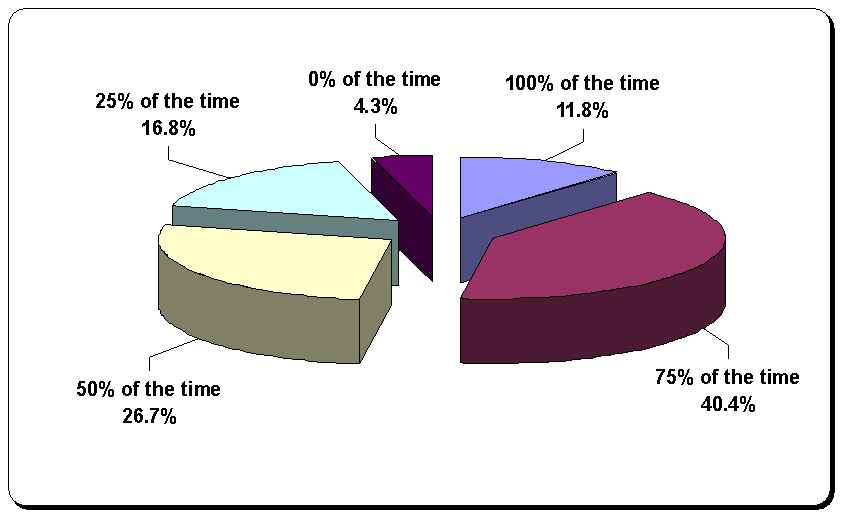
Figure 1: Shows that the perception of the participant nurses about the adequacy of their staff. The figure illustrated that about 40.4% of them perceived their team is adequate at 75% of the time.
Table 2: This table displays that more than two thirds of studied nurses were satisfied with their team work and job on the following two items; the satisfaction about their current position and the level of teamwork in their units (65.2% and 67.7%) respectively.
Table 3: Indicates mean scores of team work among studied nurses. It was found that the high mean score was related to team awareness (26.80 ± 6.93), while low mean score (12.46 ± 3.80) was related to team leadership.
Table 4: Reveals that slightly less or more than half of the studied nurses' perceived their self- efficacy as exactly true in the following items, If I am in trouble, I can usually think of a solution (52.8%) followed by I can usually handle whatever comes my way (49.7%), about (28.6%) studied nurses perceived their self–efficacy as moderately true in the following items, thanks to my resourcefulness (28.6%) followed by when I am confronted with a problem, I can usually find several solutions (26.1%) The data in this table pointed also that about (27.3%) of the studied nurse's perceived their self- efficacy as hardly true in two items, I can remain calm when facing difficulties because I can rely on my coping abilities followed by if someone opposes me, I can find the means and ways to get what I want (26.7%). It was notice that about (20.5%) only of studied nurses perceived their self–efficacy as not at all true in the following item, I can always manage to solve difficult problems if I try hard enough.


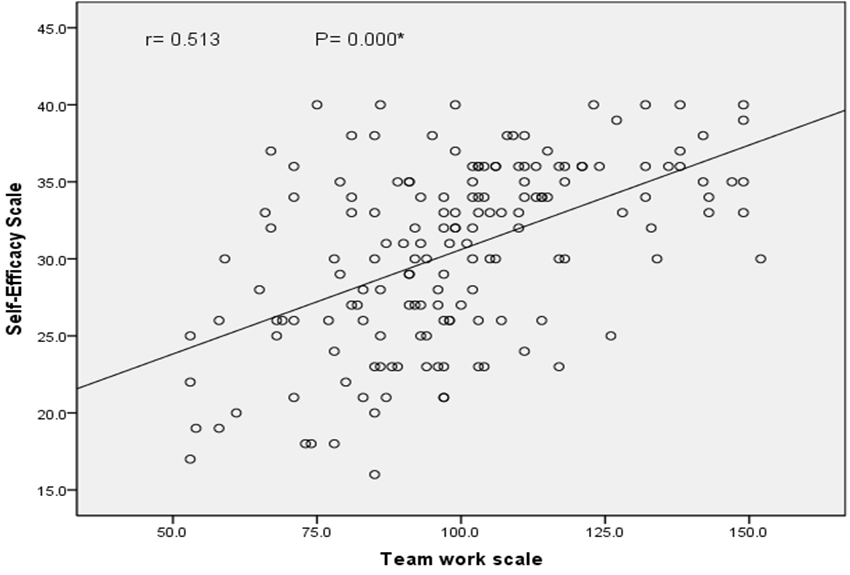
The data in this figure shows that the team work had highly positive statistically significant correlation with self-efficacy (r=0.513 and p=0.000). It was calculated with Spearman correlation.
Table 5: Demonstrates the relationship between staffing adequacy as perceived by studied nurses, team work, self-Efficacy and satisfaction. There were highly statistically significant differences between staffing adequacy as perceived by studied nurses, satisfaction, team work and self-efficacy with (P-value =0.000*, 0.000* and 0.021*) respectively.
Table 6: Shows correlation between team work, self-efficacy and satisfaction among nurses at main Assiut University Hospital. There were positive statistically significant correlation between team work, self-efficacy and satisfaction with (P-value =0.000*, r-value = 0.513, P-value =0.024*, and r-value=0.178) respectively.
Table 7: Shows that there were statistically significant differences between self –efficacy, department, marital status, job position, qualification and number of hours usually worked per week with (P-value =0.026*, 0.011*. 0.014*, 0.000* and 0.000*) respectively.
Table 8: Shows that there were statistically significant differences between nursing team work, job position, qualification, number of hours usually worked per week and which shift do you most often work with (P-value =0.000*, 0.000*, 0.001*, and 0.005*) respectively.
Teams are increasingly being utilized as the basic unit of work accomplishment. In health care setting both academics and practitioners have become particularly interested in the cognitive architecture that enables effective coordination and collaboration in work teams 19.
This study was conducted with the aim of investigating relationship between team work, staffing, satisfaction and self-efficacy among nurses at Main Assiut University Hospital. The study results showed that slightly more than ten percent of studied nurses' perceived staff at their units' adequate at all working time (Figure 1) this might be due to shortage in nursing staff at Main Assiut University Hospital. These finding in congruence with the results by Kane 20 who concluded that shortfalls in staff make it difficult to achieve excellence in standards of care.
The present study pointed that, more than two thirds of studied nurses were satisfied with their job position and team work (Table 2). This is might be explained by the fact that nurses in selected departments binds with good human relation. Also, the advantage of working in the University is associating with high salary and fringes benefits. In agreement with these study findings, Rochon, 21 found that the majority of studied nurses were very satisfied with team work in their units.
As revealed by the study results the highest mean scores of nursing team work dimensions was related to team awareness (Table 3). In congruence De Church & Magnus, 22, Cannon, Bowers, and Salas 19, and Cooke, et al., 23 mentioned that teams require a pattern of cognitive similarity that enables them to anticipate one another’s needs and actions and to synchronize their work in a way that is synergistic toward meeting the team’s final objectives.
The study results illuminated that the lowest mean scores of nursing team work dimensions was related to team leadership (Table 3). This might be due to improper management and supervision, and ineffective leadership style. Nelsey & Brownie, 5 who emphasized that team leadership as having a dedicated person who possesses the skill and knowledge to facilitate effective functioning of the team by encouraging team members to engage in teamwork, ensuring each member of the team understand and perform their role, and providing a work environment that is conducive to working on a team.
This study stated that, slightly less or more than half of the studied nurses perceived their self- efficacy as exactly true (Table 4). These might due to that nurses at Main Assiut University Hospital confident in their abilities, have experiences, and good physiological and emotional states. In the same line with these finding, Djigic, Stojiljkovic, and Doskovic 24 finished that perceived self-efficacy is cared with people's principles in their abilities to exercise control over their own working.
There were highly statistically significant differences between staffing adequacy as perceived by studied nurses, nurse's satisfaction about their job position and team work, nursing team work and self-efficacy (Table 5). In the similar line Kalisch, Lee. and Rochman 25 told that the participants who perceived adequate staffing on their work unit tended to rate their satisfaction in their role higher. Also, Chang et al.., 26 surveyed 10,022 nurses in England and found that nurses with higher interdisciplinary teamwork scores were satisfied with their jobs. Moreover, Kalisch & Lee, 10 and Rochon, 21 suggested that adequate staffing were an essential factor for teamwork to occur on patient care units and that effective teamwork can enhance job satisfaction for patients and staff.
Also, there were positive statistically significant correlation between nursing team work, self-efficacy and nurses; satisfaction about their job position and team work (Figure 2 and Table 6). The result is in agreement with Kalisch, Lee and Salas, 13 who mentioned that teamwork is one mechanism that may enhance the productivity of a nursing team as well as enhance the level of job satisfaction. In contrast with this finding Guillé & Feltz, 27 stated that the self-efficacy improved when people perceive they are performing competently or becoming more proficient and making development and self-efficacy related positively to persistence and achievement.
The present study attempted to find relation between self-efficacy and personal characteristics of studied nurses (Table 7). It was found that there were a statistically significantly differences between self-Efficacy, department, marital status, nursing qualification, job position, and number of hours usually worked per week. This might be explained by the fact that when the nurses work in ICU they are assigned to complicated patients this make them more competent and using the related information to provide a comprehensive patient care. This led to positively improve their self-efficacy and motivated them for continued learning and performance. This result is consistent with the study of Dijk, 28 who stated that individual who perform with high performance level, their self-efficacy increases. Also, Wyatt, 29 emphasized that self-efficacy interaction between personal (cognitive) factors, individual behavior and environmental conditions.
When marital status was considered, married nurses were found to have significantly lower mean scores of self-efficacy. This might due to that married nurses deducted part of their time for their families, In agreement with study findings. Akta. et al., 30 found that the influence of marital status on self-efficacy was significantly different between the married and unmarried participants. Also, Amstad et al,. 31 and Tyagi 32 indicated that there was a significant influence of marital status on participants self-efficacy. In contrast to findings by Odanga, Aloka and Raburu, 33 study who found that the marital status influenced self-efficacy with the married having higher self- efficacy.
As regard to studied nurses' qualifications, the study findings indicated that high mean score in self-efficacy was related to Bachelor nurses (Table 7). This might be due to that Bachelor degree nurse's participate in in-service training programs to renew, update their knowledge and skills, and they engage them-self in varied tasks and activities which reflecting on their own experiences and performance and which lead to improved their self-efficacy. In the same respect Moulding, Stewart, and Dunmeyer, 34 who stated that individuals vary in their self-efficacy for learning, level of education or performing actions as a function of their previous experience at the same actions and such personal abilities and attitudes.
The present study results indicated that the higher score of nursing team work was related to ICUs comparing to other departments (Table 8). This finding in line with Choi, Cheung and Pang 8 who found that the critical care unit had the highest overall score on the nursing team work indicating the staff perceived higher levels of teamwork. The inpatient surgical unit had the lowest overall score indicating the staff perceived lower levels of teamwork.
Lastly, the study results stated that there were statistically significant differences between nursing team work, nursing qualification, job position, number of hours usually worked per week, and which shift do you most often work (Table 8). On the same respect Unruh, 12 stressed that staffing skill mix can be addressed by looking at the education or experience level of each staff member when considering staffing levels and appropriate patient assignments. In the same line Malete, Chow, and Feltz, 35 mentioned that qualified staff work well as portion of the team, help to conserve a level of team functioning and demonstrate strong leadership qualities and ability.
1. The majority of nurses at Main Assiut University Hospital perceived that their staff was inadequate at all working times but most of them were satisfied with their job position and team work.
2. The highest mean scores of nursing team work dimensions was related to team awareness while the lowest was team leadership comparing to all nursing team work dimensions. It was found that the higher score of nursing team work was related to ICUs comparing to other departments.
3. Slightly less or more than half of the studied nurses' perceived their self-efficacy as exactly true. There were statistically significant differences between self-efficacy, and personal characteristics of studied nurses (as regard to department, marital status, nursing qualification, job position, and number of hours usually worked per week). Also, high mean score in self-efficacy was related to Bachelor, and single nurses.
4. There were highly statistically significant differences between staffing adequacy as perceived by studied nurses, nurse's satisfaction about their job position and team work, and self-efficacy, nursing team work.
5. There were positive statistically significant correlation between team work, self-efficacy and nurse's satisfaction about their job position and team work.
1. Strategies to improve teamwork must be developed by the nurse managers through working on the all dimensions of team work especially on
a. Team leadership skills through alignment of team member's value, unified the team goals, and increase the trust.
b. Backup behavior through promotion of staff feedback, enhanced communication and conflict management; provide effective supervision and guidance, and continuous coaching.
2. Nurses Manager must be developing policy to redistribution of nursing staff for compare the inadequate staff to overstaff in different department.
3. Nurses Manager must work to enhance the nurses' satisfaction and self- efficacy though engage the nurses in various activities, training, in-service education courses, seminars, conferences and should introduce them as a part member in nursing research and governing committee.
4. Policy maker must develop courses about teamwork and the teamwork theory must be applied in practical training that may assist students in developing the skills required for effective teamwork.
5. Teamwork training program should be introduced to all employees, especially to the new one.
6. Future study is recommended for team work to administer the teamwork measures to control the degree to which culture affects responses to the team work items.
| [1] | Salas E., Rosen M. and King H. (2015). Managing Teams Managing Crises: Principles of Teamwork to Improve Patient Safety in the Emergency Room and Beyond. Theoretical Issues in Ergonomics Science, Vol. 8, No, (5), Pp. 381-394. | ||
| In article | |||
| [2] | Salas E., Cooke N., and Gorman J. (2010). The Science of Team Performance: Progress and the Need for more. Human Factors, 52, 344-346. | ||
| In article | View Article PubMed | ||
| [3] | Estryn-Behar M., Van der Heijden B., Oginska H., Camerino D., Le Nezet O., Conway P., Fry C., Hasselhorn, H-, and the NEXT Study Group. (2007). The Impact of Social Work Environment, Team Work Characteristics, Burnout, and Personal Factors upon Intent to Leave among Nurses. Medical Care, Pp. 45, 939-950. | ||
| In article | View Article PubMed | ||
| [4] | Smith C. &Worsfold K. (2015). Unpacking the Learning-Work Nexus: ‘Priming’ as Lever for High Quality Learning Outcomes in Work-Integrated Learning Curricula. Studies in Higher Education, No, 40 v.(1), Pp. 22-42. | ||
| In article | |||
| [5] | Nesley L. & Brownie S. (2012). Effective Leadership, Teamwork and Mentoring – Essential Elements in Promoting Generational Cohesion in the Nursing Workforce and Retaining Nurses. Collegian, Pp. 19, 197-202. | ||
| In article | View Article | ||
| [6] | Capella J., Smith S. and ReMine S. (2010). Teamwork Training Improves the Clinical Care of Trauma Patients. J. Surg. Educ. 2010; Vol. 67, No. (6): Pp. 439-43. | ||
| In article | |||
| [7] | Duel J. (2010). Teamwork in Action: Military Teams Preparing for, and Conducting Peace Support Operations. | ||
| In article | |||
| [8] | Choi S., Cheung K. and Pang S. (2013). Attributes of Nursing Work Environment as Predictors of Registered Nurses’ Job Satisfaction and Intention to Leave. Journal of Nursing Management, Pp.21, 429-439. | ||
| In article | View Article PubMed | ||
| [9] | Rathert C. & Fleming D. (2008). Hospital Ethical Climate and Teamwork in Acute Care: The Moderating Role of Leaders. Health Care Management Review, Vol. 33, No. (4), Pp. 323-331. | ||
| In article | View Article PubMed | ||
| [10] | Kalisch B. & Lee K. (2011). Nurse Staffing Levels and Teamwork: A cross-Sectional Study of Patient Care Units in Acute Care Hospitals. Journal of Nursing Scholarship, Vol.43, No. (1), Pp. 82- 88. | ||
| In article | View Article PubMed | ||
| [11] | Hinno S., Partanen P., and Vehvilainen- K. (2011). Hospital Nurses’ Work Environment, Quality of Care Provided and Career Plans. International Nursing Review, Pp. 58, 255-262. | ||
| In article | View Article PubMed | ||
| [12] | Unruh L. (2008). Nursing Staffing and Patient, Nurse, and Financial Outcomes. American Journal of Nursing, Vol. 108, No. (1), Pp.62-72. | ||
| In article | View Article PubMed | ||
| [13] | Kalisch, B., Lee H. and Salas E. (2010). The Development and Testing of the Nursing, Teamwork Survey. Nursing Research, Vol. 59, Vo. (1), Pp. 42-50. | ||
| In article | View Article | ||
| [14] | Salas E., Frush K. and Baker D. (2013). Improving Patient Safety through TeamWork and Team Training. London: Oxford University Press; 2013. | ||
| In article | |||
| [15] | Bartimote- K., Bridgeman A., Walker R., Sharma M. and Smith L. (2015). The Study, Evaluation and Improvement of University Student Self-Efficacy. Studies in Higher Education, 40, 1-25. | ||
| In article | |||
| [16] | Cox J. & Simpson D. (2016). Exploring the Link between Self-Efficacy, Workplace Learning and Clinical Practice. Asia-Pacific Journal of Cooperative Education, 2016, Vol.17, No. (3), Pp.215-225. | ||
| In article | |||
| [17] | Bandura A. (2012). On the Functional Properties of Perceived Self-Efficacy Revisited. Journal of Management, Vol. 38, No. (1), Pp. 9-44. | ||
| In article | View Article | ||
| [18] | Schwarzer R. & Jerusalem M. (1995). Generalized Self-Efficacy scale. In J. Weinman, S. Wright, & M. Johnston, Measures in Health Psychology: A User’s Portfolio. Causal and Control beliefs (Pp. 35-37). Windsor, UK: NFER-NELSON. | ||
| In article | |||
| [19] | Cannon-Bowers, J. & Salas, E. (2012). Reflections on Team Cognition. Journal of Organizational Behavior, Pp. 22, 195-202. | ||
| In article | View Article | ||
| [20] | Kane R. (2015). Nursing Staffing and Quality of Patient Care. Evidence Report/ Technology Assessment. No.151. Rockville, MD: Agency for Healthcare Research and Quality. 24 Nursing Times 18.01.11 / Vol 107 No 2 / www.nursingtimes.net. | ||
| In article | |||
| [21] | Rochon A. (2014). Teamwork and Staffing in an Acute Care Hospital, A thesis submitted in partial fulfillment of the requirements for the degree of Master of Science in Nursing, The School of Graduate Studies Laurentian Univ. Model of Referee Efficacy. Frontiers in Psychology, Pp. 2, 1-5. | ||
| In article | |||
| [22] | DeChurch L. & Magnus J. (2010). Measuring Shared Team Mental Models: A Meta-Analysis, Group Dynamics: Theory, Research, and Practicem 2010, Vol. 14, No. 1, Pp.1-14. 2010. | ||
| In article | |||
| [23] | Cooke N., Gorman J., Duran J., and Taylor R. (2016). Team Cognition in Experienced Command-and-Control Teams. Journal of Experimental Psychology: Applied, Pp.13, 146-157. | ||
| In article | |||
| [24] | Djigic G., Stojiljkovic S., and Doskovic M. (2013). Basic Personality Dimensions and Teachers’ Self-efficacy. Procedia Social and Behavioral Sciences, Pp. 112, 593-602. | ||
| In article | View Article | ||
| [25] | Kalisch B., Lee H. and Rochman M. (2010). Nursing Staff Teamwork and Job Satisfaction Journal of Nursing Management, Pp.18, 938-947. | ||
| In article | |||
| [26] | Chang W, Ma J, Chiu H, Lin K, Lee P. (2009). Job Satisfaction and Perceptions of Quality of Patient Care, Collaboration and Teamwork in Acute Care Hospitals. Journal of Advanced Nursing. 2009; Vo.65, No (9): Pp. 1946:1955. | ||
| In article | |||
| [27] | Guillén, F. &Feltz, D. (2011). A conceptual Model of referee efficacy. Frontiers in Psychology, Pp. 2, 1-5. | ||
| In article | View Article | ||
| [28] | Dijk M, (2009). Employee Self Efficacy and Job Stress during Organizational Change: The Mediating Effect of Risk Perception Master Educational Science and Technology, Track Human Resource Develoment. Faculty of Behavioral sciences, University of Twente Utrecht, September 2009. | ||
| In article | |||
| [29] | Wyatt M. (2010). An English Teacher’s Developing Self-Efficacy Beliefs in Using Group Work. System, 38, 603-613. | ||
| In article | View Article | ||
| [30] | Akta M., Kurt H., Aksu o. and Ekic G. (2013). Gender and experience as predictor of biology teachers’ education process self-efficacy perception and perception of responsibility from student success. International Journal on New Trends in Education and Their Implications, Volume 4, Issue 3: Pp. 37-47. | ||
| In article | |||
| [31] | Amstad F., Meier L., Fasel U., Elfering A. and Semmer N. (2011). A meta-Analysis of Work–Family Conflict and Various Outcomes. Journal of Occupational Health Psychology, Vol. 16, No. 2: Pp.151-156. | ||
| In article | View Article PubMed | ||
| [32] | Tyagi S. (2013). A Study of Teaching Effectiveness of Secondary School Teachers in Relation to their Demographic Characteristics. International Journal of Engineering and Innovative Technology (IJEIT) Volume 3, Issue 1: Pp.288-295. | ||
| In article | |||
| [33] | Odanga S., Aloka P. and Raburu P. (2015). Influence of Marital Status on Teachers’ Self-Efficacy in Secondary Schools of Kisumu County, Kenya, E-ISSN 2281-4612, ISSN 2281-3993, Academic Journal of Interdisciplinary Studies, MCSER Publishing, Rome-Italy, Vol 4 No 3, November 2015. | ||
| In article | |||
| [34] | Moulding, L. R., Stewart, P. W., &Dunmeyer, M. L. (2014). Pre-service teachers’ sense of Efficacy: Relationship to Academic Ability, Student Teaching Placement characteristics, and Mentor Support. Teaching and Teacher Education, 41, 60-66. | ||
| In article | View Article | ||
| [35] | Malete L., Chow G. and Feltz D. (2011). The influence of Coaching Efficacy and Coaching Competency on Variables in Botswana Youth Soccer. Manuscript Submitted for Publication. Merbitz, C., Morriz, J. | ||
| In article | |||
Published with license by Science and Education Publishing, Copyright © 2018 Hanaa Esmail Sabra and Nahed Shawkat Abo-Elmagd
 This work is licensed under a Creative Commons Attribution 4.0 International License. To view a copy of this license, visit
http://creativecommons.org/licenses/by/4.0/
This work is licensed under a Creative Commons Attribution 4.0 International License. To view a copy of this license, visit
http://creativecommons.org/licenses/by/4.0/
| [1] | Salas E., Rosen M. and King H. (2015). Managing Teams Managing Crises: Principles of Teamwork to Improve Patient Safety in the Emergency Room and Beyond. Theoretical Issues in Ergonomics Science, Vol. 8, No, (5), Pp. 381-394. | ||
| In article | |||
| [2] | Salas E., Cooke N., and Gorman J. (2010). The Science of Team Performance: Progress and the Need for more. Human Factors, 52, 344-346. | ||
| In article | View Article PubMed | ||
| [3] | Estryn-Behar M., Van der Heijden B., Oginska H., Camerino D., Le Nezet O., Conway P., Fry C., Hasselhorn, H-, and the NEXT Study Group. (2007). The Impact of Social Work Environment, Team Work Characteristics, Burnout, and Personal Factors upon Intent to Leave among Nurses. Medical Care, Pp. 45, 939-950. | ||
| In article | View Article PubMed | ||
| [4] | Smith C. &Worsfold K. (2015). Unpacking the Learning-Work Nexus: ‘Priming’ as Lever for High Quality Learning Outcomes in Work-Integrated Learning Curricula. Studies in Higher Education, No, 40 v.(1), Pp. 22-42. | ||
| In article | |||
| [5] | Nesley L. & Brownie S. (2012). Effective Leadership, Teamwork and Mentoring – Essential Elements in Promoting Generational Cohesion in the Nursing Workforce and Retaining Nurses. Collegian, Pp. 19, 197-202. | ||
| In article | View Article | ||
| [6] | Capella J., Smith S. and ReMine S. (2010). Teamwork Training Improves the Clinical Care of Trauma Patients. J. Surg. Educ. 2010; Vol. 67, No. (6): Pp. 439-43. | ||
| In article | |||
| [7] | Duel J. (2010). Teamwork in Action: Military Teams Preparing for, and Conducting Peace Support Operations. | ||
| In article | |||
| [8] | Choi S., Cheung K. and Pang S. (2013). Attributes of Nursing Work Environment as Predictors of Registered Nurses’ Job Satisfaction and Intention to Leave. Journal of Nursing Management, Pp.21, 429-439. | ||
| In article | View Article PubMed | ||
| [9] | Rathert C. & Fleming D. (2008). Hospital Ethical Climate and Teamwork in Acute Care: The Moderating Role of Leaders. Health Care Management Review, Vol. 33, No. (4), Pp. 323-331. | ||
| In article | View Article PubMed | ||
| [10] | Kalisch B. & Lee K. (2011). Nurse Staffing Levels and Teamwork: A cross-Sectional Study of Patient Care Units in Acute Care Hospitals. Journal of Nursing Scholarship, Vol.43, No. (1), Pp. 82- 88. | ||
| In article | View Article PubMed | ||
| [11] | Hinno S., Partanen P., and Vehvilainen- K. (2011). Hospital Nurses’ Work Environment, Quality of Care Provided and Career Plans. International Nursing Review, Pp. 58, 255-262. | ||
| In article | View Article PubMed | ||
| [12] | Unruh L. (2008). Nursing Staffing and Patient, Nurse, and Financial Outcomes. American Journal of Nursing, Vol. 108, No. (1), Pp.62-72. | ||
| In article | View Article PubMed | ||
| [13] | Kalisch, B., Lee H. and Salas E. (2010). The Development and Testing of the Nursing, Teamwork Survey. Nursing Research, Vol. 59, Vo. (1), Pp. 42-50. | ||
| In article | View Article | ||
| [14] | Salas E., Frush K. and Baker D. (2013). Improving Patient Safety through TeamWork and Team Training. London: Oxford University Press; 2013. | ||
| In article | |||
| [15] | Bartimote- K., Bridgeman A., Walker R., Sharma M. and Smith L. (2015). The Study, Evaluation and Improvement of University Student Self-Efficacy. Studies in Higher Education, 40, 1-25. | ||
| In article | |||
| [16] | Cox J. & Simpson D. (2016). Exploring the Link between Self-Efficacy, Workplace Learning and Clinical Practice. Asia-Pacific Journal of Cooperative Education, 2016, Vol.17, No. (3), Pp.215-225. | ||
| In article | |||
| [17] | Bandura A. (2012). On the Functional Properties of Perceived Self-Efficacy Revisited. Journal of Management, Vol. 38, No. (1), Pp. 9-44. | ||
| In article | View Article | ||
| [18] | Schwarzer R. & Jerusalem M. (1995). Generalized Self-Efficacy scale. In J. Weinman, S. Wright, & M. Johnston, Measures in Health Psychology: A User’s Portfolio. Causal and Control beliefs (Pp. 35-37). Windsor, UK: NFER-NELSON. | ||
| In article | |||
| [19] | Cannon-Bowers, J. & Salas, E. (2012). Reflections on Team Cognition. Journal of Organizational Behavior, Pp. 22, 195-202. | ||
| In article | View Article | ||
| [20] | Kane R. (2015). Nursing Staffing and Quality of Patient Care. Evidence Report/ Technology Assessment. No.151. Rockville, MD: Agency for Healthcare Research and Quality. 24 Nursing Times 18.01.11 / Vol 107 No 2 / www.nursingtimes.net. | ||
| In article | |||
| [21] | Rochon A. (2014). Teamwork and Staffing in an Acute Care Hospital, A thesis submitted in partial fulfillment of the requirements for the degree of Master of Science in Nursing, The School of Graduate Studies Laurentian Univ. Model of Referee Efficacy. Frontiers in Psychology, Pp. 2, 1-5. | ||
| In article | |||
| [22] | DeChurch L. & Magnus J. (2010). Measuring Shared Team Mental Models: A Meta-Analysis, Group Dynamics: Theory, Research, and Practicem 2010, Vol. 14, No. 1, Pp.1-14. 2010. | ||
| In article | |||
| [23] | Cooke N., Gorman J., Duran J., and Taylor R. (2016). Team Cognition in Experienced Command-and-Control Teams. Journal of Experimental Psychology: Applied, Pp.13, 146-157. | ||
| In article | |||
| [24] | Djigic G., Stojiljkovic S., and Doskovic M. (2013). Basic Personality Dimensions and Teachers’ Self-efficacy. Procedia Social and Behavioral Sciences, Pp. 112, 593-602. | ||
| In article | View Article | ||
| [25] | Kalisch B., Lee H. and Rochman M. (2010). Nursing Staff Teamwork and Job Satisfaction Journal of Nursing Management, Pp.18, 938-947. | ||
| In article | |||
| [26] | Chang W, Ma J, Chiu H, Lin K, Lee P. (2009). Job Satisfaction and Perceptions of Quality of Patient Care, Collaboration and Teamwork in Acute Care Hospitals. Journal of Advanced Nursing. 2009; Vo.65, No (9): Pp. 1946:1955. | ||
| In article | |||
| [27] | Guillén, F. &Feltz, D. (2011). A conceptual Model of referee efficacy. Frontiers in Psychology, Pp. 2, 1-5. | ||
| In article | View Article | ||
| [28] | Dijk M, (2009). Employee Self Efficacy and Job Stress during Organizational Change: The Mediating Effect of Risk Perception Master Educational Science and Technology, Track Human Resource Develoment. Faculty of Behavioral sciences, University of Twente Utrecht, September 2009. | ||
| In article | |||
| [29] | Wyatt M. (2010). An English Teacher’s Developing Self-Efficacy Beliefs in Using Group Work. System, 38, 603-613. | ||
| In article | View Article | ||
| [30] | Akta M., Kurt H., Aksu o. and Ekic G. (2013). Gender and experience as predictor of biology teachers’ education process self-efficacy perception and perception of responsibility from student success. International Journal on New Trends in Education and Their Implications, Volume 4, Issue 3: Pp. 37-47. | ||
| In article | |||
| [31] | Amstad F., Meier L., Fasel U., Elfering A. and Semmer N. (2011). A meta-Analysis of Work–Family Conflict and Various Outcomes. Journal of Occupational Health Psychology, Vol. 16, No. 2: Pp.151-156. | ||
| In article | View Article PubMed | ||
| [32] | Tyagi S. (2013). A Study of Teaching Effectiveness of Secondary School Teachers in Relation to their Demographic Characteristics. International Journal of Engineering and Innovative Technology (IJEIT) Volume 3, Issue 1: Pp.288-295. | ||
| In article | |||
| [33] | Odanga S., Aloka P. and Raburu P. (2015). Influence of Marital Status on Teachers’ Self-Efficacy in Secondary Schools of Kisumu County, Kenya, E-ISSN 2281-4612, ISSN 2281-3993, Academic Journal of Interdisciplinary Studies, MCSER Publishing, Rome-Italy, Vol 4 No 3, November 2015. | ||
| In article | |||
| [34] | Moulding, L. R., Stewart, P. W., &Dunmeyer, M. L. (2014). Pre-service teachers’ sense of Efficacy: Relationship to Academic Ability, Student Teaching Placement characteristics, and Mentor Support. Teaching and Teacher Education, 41, 60-66. | ||
| In article | View Article | ||
| [35] | Malete L., Chow G. and Feltz D. (2011). The influence of Coaching Efficacy and Coaching Competency on Variables in Botswana Youth Soccer. Manuscript Submitted for Publication. Merbitz, C., Morriz, J. | ||
| In article | |||


)
)
)
)
)

)
)
)
)