Background: Nurses play a unique and crucial role in medication administration. In hospital units, the medication administration process is frequently viewed as a series of sequential steps, beginning with prescribing, then dispensing, and finally administering to the patient. Local problem: Data from 2020 indicated improper nursing medication administration practices in the hospital's inpatient units, despite adherence to medication safety standards and policies, so the current project was created to improve nursing medication administration compliance. Methods: A quality improvement project was conducted using the Standards for Quality Improvement Reporting Excellence Revised Publication Guidelines (SQUIRE 2.0). Common quality improvement tools were used, including the fishbone diagram, Focus PDCA, and the General Medication Administration (GMA) instrument. Interventions: Staff audit interviews and observations, as well as engaging and educating processes, were conducted weekly. A final medication administration compliance assessment was performed on the staff. Results: The present project found high medication administration compliance and an excessive enhancement of awareness among nurses related to medication administration. Conclusion: This quality improvement project summarizes the steps of using quality improvement tools to find and treat improper medication administration practices. As is obvious, there has been improvement in nursing compliance.
Nurses play a unique role in medication administration. In hospital units, the medication administration process is frequently viewed as a series of sequential steps, beginning with prescribing, then dispensing, and eventually administering to the patient. 1 The core processes for administering medications have become exceedingly complicated, increasing the risk of errors and process failures, which may lead to an adverse drug event. 2 According to Pham 3, the medication error rate was 78 reports per 100,000 visits, with nurses accountable for 54%. The most common type of error was improper dose/quantity, and the leading causes were not following procedure/protocol and poor communication while contributing factors included distractions, emergency situations, and workload increase. In hospitals worldwide, medication administration errors occur in 8.0% to 19.6% of doses. 4 In fact, the administration of medication and the occurrence of medication errors are not solely the responsibility of nurses, but rather a collaborative effort in which all members work together to ensure safe practice. 5 According to the World Health Organization 6, it is not due to a single cause, but to a system; a mature health system considers the increasing complexity in healthcare settings that makes humans more prone to errors. Edwards 5 returned the causes of medication errors to three factors human errors, faulty system errors, and environmental errors. Hayes 7 stated that distraction and Interruptions during medication administration are the most common causes of medication errors. However, medication administration and nursing practices are inseparable in any context. Nurses have been key in healthcare and are in charge of medication preparation, administration, and disposal. 8 Globally, medication errors are the leading cause of different injuries. In hospitals, avoidable mediational errors account for about 10% of all preventable harms. 8 Several nursing practices have been shown to improve overall medication administration safety and prevent patient harm. Nurses can make errors when ordering, prescribing, dispensing, preparing, and administering medication. 9 Nurses should intercept medication errors before they reach the patient by following the ten rights of the right patient, right drug, right dosage, right time, right route, right to refuse, right knowledge, right questions, the right advice, and right response or outcome. 5 In this project, the team focuses on the nine rights of medication administration according to hospital policy, which are the right patient, right drug, right dose, right time, right route, right form, right documentation, right action, and right response, and involves them in the education and awareness sessions and during the staff audited interview and observation. As part of efforts towards improving nursing medication administration practice in the King Abdullah Medical Complex inpatient units, the quality improvement nursing medication administration practice project was launched in 2021.
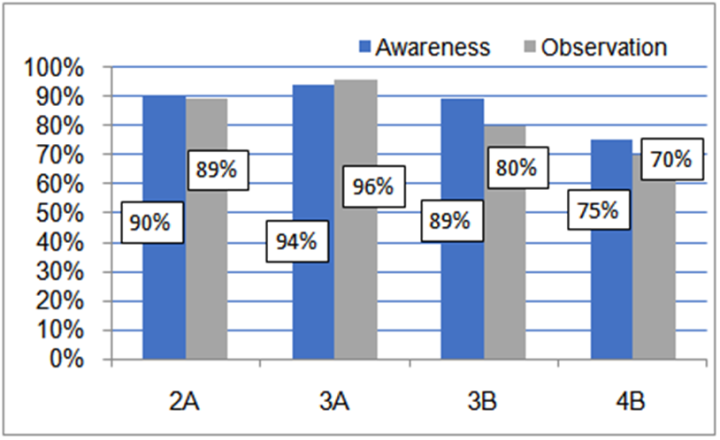
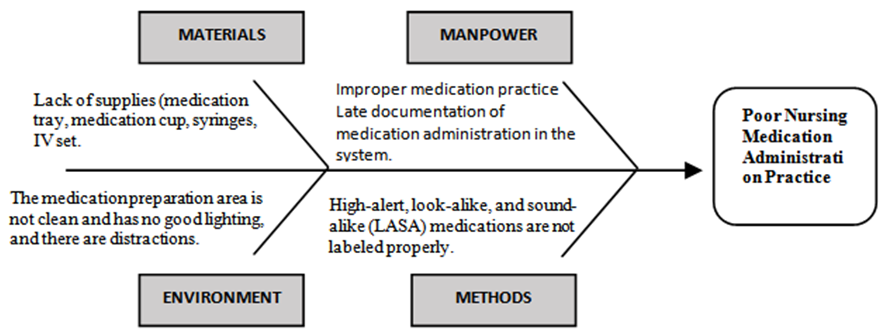
1.1. Problem DescriptionNurses are primarily involved in the administration of medications across settings. Nurses engaged in dispensing, preparing, and administering medications, including reporting and managing medication errors, quality, and risk management in nursing administration, identified the nursing medication administration practice project as a priority project for quality improvement. Because the data in 2020 indicated poor nursing medication administration practices Figure 1, despite the adherence to medication safety standards and policies as required by regulatory agencies, The team used a cause-and-effect diagram, Figure 3, to identify the main causes of poor nursing medication administration practice, which were a lack of medication supplies, poor or improper medication practice, late or improper medication documentation in the track-care system, and environment-related factors that may lead to a specific problem with medication administration, particularly the risk of medication errors. Because the risk remains high and the problem may persist if no action is taken to mitigate it, the implementation of this project was the appropriate response.
1.2. Available Knowledge. RationaleIn 2020, the data revealed improper nursing medication administration practices. This project was provided by the quality department in nursing administration as an attempt to improve medication administration at inpatient units. The current project was under assessment for priority implementation through applying the performance improvement (PI) project application form to determine the project's needs, which the quality department in nursing administration developed. The performance improvement (PI) project application form acceptance scores were distributed as follows: 0–5, no chance of approval for this project, and 6–10, possible approval; however, you might consider selecting a different issue, 11-15 these projects are more likely to gain approval. The current project score was 13, indicating a highly recommended application. This project highlights the magnitude of improper nursing medication administration, particularly nurses' medication compliance, and the need to conduct a quality improvement project (QI) to decrease or eliminate this problem. Additionally, this project will support nurses' ability to handle medication administration practices in a high-quality manner. Therefore, the present project aims to improve nursing medication administration practice in inpatient units.
1.3. Objectives are to- Increase nursing medication practice compliance.
-Reduce medication errors.
-Enhance medication practices through manpower and environment-related factors.
The King Abdullah Medical Complex in Jeddah (KAMCJ) is a 424-bed hospital complex under the Ministry of Health that provides elective medical and surgical services combined with a state-of-the-art laboratory, trauma center, and outpatient clinics serving north Jeddah. KAMCJ is organized by multi-disciplinary teamwork and flexibility principles to ensure the highest patient care and safety standards. The present project was conducted in inpatient units (2A-isolation unit, 3A-neurocardio unit, 3B-female medical unit, and 4B male medical unit) in 2021.
2.2. Quality Improvement ToolsTo identify the sources of the problem and define improvement opportunities, FOCUS was used, which included the following steps:
In 2020, the improvement team assessed the situation where data indicated improper nursing medication compliance.

In 2020, it was noticed from the above figure that the overall nursing medication administration compliance was low in units 2A, 3B, and 4B, while appearing high in unit 3A.
Organizing the improvement team for the project's implementation and the implementation of the educational program was an important step in the project.

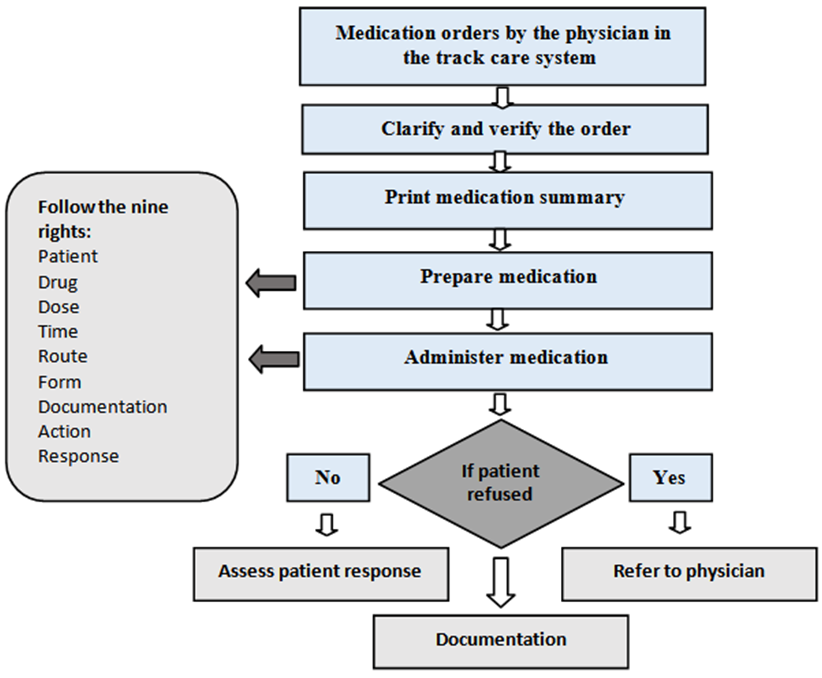
Established a clear workflow for nursing medication administration to help staff and the improvement team identify the tasks and processes related to medication administration, Figure 2. Workflow is defined as “a set of tasks grouped chronologically into processes and the set of people or resources needed for those tasks, that are necessary to accomplish the goal.” 10

The improvement team used the fishbone diagram, as mentioned in Figure 3, to obtain complete information on all potential causes and recognize the root cause of the problem. The main advantage achieved from this technique is a clear understanding of the problem, its causes, and how much the problem affects the final output. It also gives possible remedies to eliminate those root causes, up to a certain extent. The team classified and prioritized the risks according to their nature.
The main causes detected from the analyzed fishbone diagram Figure3, were:
- Lack of medication supplies
- Improper medication practice
- Late or improper documentation of medication
- Environment-related factors
To achieve systematic quality improvement, the PDCA (Plan – Do - Check – Act) model was used. The PDCA also called the Deming cycle, is defined as a “cycle that enables an organization to ensure that its processes are adequately resourced and managed and that opportunities for improvement are determined”. 11
This project began in early 2021, under the supervision of the quality department in nursing administration. This QI project was conducted using SQUIRE 2.0 (Standards for Quality Improvement Reporting Excellence Revised Publication Guidelines) from a Detailed Consensus Process. SQUIRE 2.0 is designed to apply across the many approaches used for systematically improving the quality, safety, and value of healthcare methods ranging from iterative changes using Plan-Do-Check-Act (PDCA) cycles. 12 The improvement team comprised the nursing manager, head nurses, nursing quality coordinators, and nursing educators. 30% of the staff must be checked weekly by the team according to their assigned focus based on nursing and hospital policies and procedures related to the project implementation requirement. Nursing education sent the list of staff names for each week. The units selected are 2A (Isolation), 3A (Cardio-Neuro), 3B (Female Medical), and 4B (Male Medical). The staff audit used interviews and observational design. In the current project, the team used “engage” and “educate” processes; two weeks of education sessions were offered to every nurse on all shifts to improve medication administration practice. Random interviews and observations of nurses during the preparation and administration of medications were done in both day and evening shifts using the general medication administration audit tool (GMA) in the selected four units. Action plans are prepared to improve medication administration practice based on root causes and contributing factors related to poor nursing medication administration practice in two categories, including manpower and environment-related factors. The following targets have been set to be achieved during the project implementation process: 95% in the first quarter and 100% in the second quarter of 2021. The implemented interventions focus on three root causes and contributing factor statements. The first is improper medication practices, and the second intervention includes late or improper documentation of medication administration in the system. The action to assess it is continuous monitoring of the current medication administration. The third intervention involved medication and environmental improvements to address the root causes and contributing factors. At the end of the first quarter and the second quarter, according to nursing and hospital policy and procedure, 30% of the staff should be audited per unit for medication administration compliance. The staff was interviewed for their medication administration awareness and observed for their practices. Each unit had the following numbers: 2A isolation: 33 nurses, 3A cardio-neuro: 54 nurses, 4B male medical: 54 nurses, and 3B female medical: 41 nurses.
The tools used to monitor and control the process and improve or redesign the process or product are known as quality management tools and techniques. 13 The improvement team in this project used two quality improvement tools to collect data: a cause-and-effect diagram, also known as an Ishikawa or “fishbone” diagram, which is “a graphic tool that helps people explore the possible causes of a certain effect.” Through the fishbone diagram, the improvement team asks teams to list and group causes under the categories of materials, methods, equipment, environment, and people. Use a process-type cause-and-effect diagram to show the causes of problems at each step in the process. 14 The second quality improvement tool was FOCUS-PDCA; FOCUS is an acronym for finding, organizing, clarifying, understanding, and selecting, while PDCA is an acronym for plan, do, act, and check results. 15 The third tool is called General Medication Administration (GMA). This tool was invented and approved by the quality department at King Abdullah Medical Complex. The instrument measures the awareness and compliance of the nurses with the standards of general medication administration to ensure safe practice and prevent medication errors. This tool contains two categories: awareness and observation items. The instrument includes 22 items, divided into eight awareness items and fourteen observation items. Table 2 and Table 3 anticipate responses on a two-point Likert scale: met or not met.
2.3. Ethical ConsiderationThis project was designed as a quality improvement project. Therefore, the approval obtained from the quality improvement department in the hospital did not require approval from the Research Review Board, which is consistent with a previous quality improvement project in the literature.

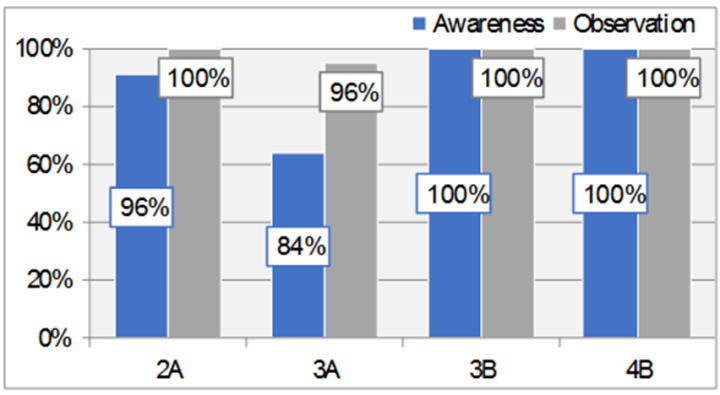
Overall, in the first quarter, as displayed in Figure 4 in the awareness category, the percentages ranged between 84% and 100%. This indicates a variation among the units, as 3B and 4B had a remarkable positive percentage in medication administration awareness. On the contrary, there is a lack of awareness regarding medication administration in some units. For the observation part, it was concluded that all the included units have favorable medication administration practices, as the percentages ranged between 96% and 100%, as detailed in Table 2.
In the 2A isolation unit, 73% of the staff showed a high level of medication administration awareness. While 27% of the staff demonstrated a lack of awareness regarding the LASA policy, On the other hand, in the 3A cardio-neuro unit, it was noticed that there is a huge lack of staff medication administration awareness, as it was reported that 36% of the staff had an issue related to medication administration compliance (awareness). Only 64% of the staff represented high-profile medication administration awareness; the issues were limited to five categories, which are LASA policy awareness (36%), verbal order policy awareness (36%), telephone order policy (36%), medication error and adverse reaction policy (7%), and handling multi-dose vials (7%). Table 2 shows that, with the exception of the 3A unit, all units obtained 100% distinct results for observation items. The issues were limited to using an updated list of patient medication administration, preparing one patient at a time, staff nurses comparing (drug name, dosage, frequency, and route), and following the proper technique for preparing intravenous therapy (IV), subcutaneous injection (SC), and intramuscular injection (IM) and patient teaching.

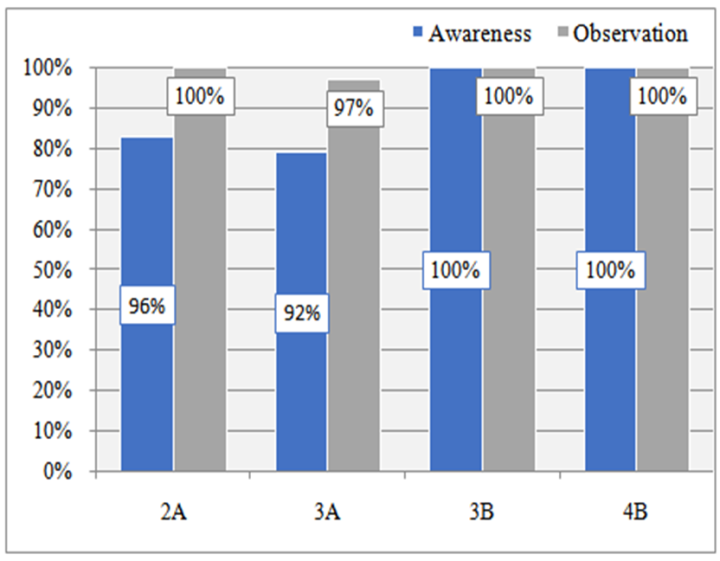
In the second quarter of 2021 Figure 5, units 3B and 4B maintained the same result for medication administration compliance: 100% in both categories of awareness and observation. On the other hand, there is a slight improvement in staff’s medication administration awareness compared to the first quarter in the 3A unit (from 84% to 92%).
Table 3 shows that medication administration awareness improved successfully in the 3A unit compared to the first quarter of 2021. There was an improvement in all categories: Table 2 and Table 3, LASA policy awareness increased from 64% to 79%, verbal order policy awareness increased from 64% to 83%, telephone order policy awareness increased from 64% to 83%, and handling multi-vial doses increased from 93% to 97%, with the exception of medication error and adverse reaction policy awareness, which remained at 93% in both quarters. For the observation part, all units maintained high percentages of 100%, with only 3A scoring a lower percentage than the other units.
Applying the staff audit and engaging in education and awareness strategies regularly is a feasible approach to enhancing nursing medication administration compliance in inpatient units.
4.2. Recommendations1. Medication administration policy awareness ensures that the policies, procedures, and guidelines have been read and understood by all nursing staff and have been made available to other professionals engaged in any aspect of medication management.
2. Developing nurses' medication administration practices through training and awareness programs.
3. Perform regular staff-audited interviews and observations (weekly, monthly, or quarterly, depending on needs) as a part of the monitoring process related to medication administration practices, with immediate learning, corrective action, and disciplinary actions for noncompliance staff.
4. The nurses should comply with the safe administration of medication and be knowledgeable of the “ten rights” of medication administration practices according to hospital policy, which are the right patient, right drug, right dose, right time, right route, right form, right documentation, right action, and right response, and consider them in all aspects of the administration of medicines.
5. Support simulation-based learning by providing a medication administration simulation laboratory.
6. Follow up on nursing performance regarding medication administration practices and set clear and practical quality monitoring indicators of achievement.
7. Providing all the necessary supplies and requirements for medication administration practices.
8. As a result of our findings, we recommend further projects and studies related to the main causes detected from the analyzed fishbone diagram, which were lack of medication supplies, improper medication practice, improper documentation, and environmental factors, to increase our understanding of the complexities surrounding these important nursing interventions.
4.3. Limitations• The project was only implemented in specific units and did not include all the units in the hospital.
• The unavailability of staff during the staff audit affected the project in terms of collecting the data.
• The heavy workload hindered the staff from cooperating with the auditor.
• The unavailability of some supplies (medication trays, medication cups, etc.) affected the project as well.
• The number of staff who were audited in the 2A isolation unit in the second quarter was below average due to the unit's maintenance over several months.
• Training and engagement practice were limited due to a lack of a medication administration simulation laboratory.
In 2020, it was found that overall nursing medication administration compliance among nurses in some inpatient units was low. Consequently, the quality department in nursing administration implemented improvement projects in 2021 at the target inpatient units to support nurses' abilities to handle medication administration practices and improve their compliance in a high-quality manner. Using quality improvement tools that result in significant improvements in nursing compliance, the staff was audited through interviews and observational approaches that used “engage” and “educate” processes. The project successfully increased nursing medication administration compliance and indicates that a training program and interactive monitoring could improve nursing practices.
We deeply appreciate the efforts of the nursing director, Mrs. Rowida Naholi, CEO assistant for nursing services, for supporting the team during the implementation of this project. We are extremely grateful for all the support from nursing supervisors, head nurses, and our nurse colleagues in units: 2A isolation, 3A cardio-neuro, 4B, and 3B medical.
| [1] | Smith, Jim, and Gillian Cavell. “Building a safer NHS for patients: improving medication safety.” (2004). | ||
| In article | |||
| [2] | Institute for Healthcare Improvement. All rights reserved. available at https://www.ihi.org/resources/Pages/Changes/Improve Core Processes for Administering Medications.aspx (2022). | ||
| In article | |||
| [3] | Pham, Julius Cuong, et al. “National study on the frequency, types, causes, and consequences of voluntarily reported emergency department medication errors.” The Journal of emergency medicine 40.5 (2011): 485-492 | ||
| In article | View Article PubMed | ||
| [4] | Keers, Richard N., et al. “Prevalence and nature of medication administration errors in health care settings: a systematic review of direct observational evidence.” Annals of Pharmacotherapy 47.2 (2013): 237-256. | ||
| In article | View Article PubMed | ||
| [5] | Edwards, S., & Axe, S. (2015). The 10 ‘R's of safe multidisciplinary drug administration. Nurse Prescribing, 13(8), 398-406. | ||
| In article | View Article | ||
| [6] | World Health Organization. “Global patient safety action plan 2021-2030: towards eliminating avoidable harm in health care.” (2021). | ||
| In article | |||
| [7] | Hayes, Carolyn, et al. “Medication errors in hospitals: a literature review of disruptions to nursing practice during medication administration.” Journal of clinical nursing 24.21-22 (2015): 3063-3076. | ||
| In article | View Article PubMed | ||
| [8] | Nasr Abd El Aziz, A. M., Ahmed, S. M., & Abolwafa, N. F. Nurses, Knowledge and Practice Regarding Medication Preparation and Administration Errors Occurrence at Neonatal Intensive Care Units. Minia Scientific Nursing Journal, (2021). 10(1), 141-147. | ||
| In article | View Article | ||
| [9] | Tsegaye, Dejene, et al. “Medication administration errors and associated factors among nurses.” International Journal of General Medicine. 13 (2020): 1621. | ||
| In article | View Article PubMed | ||
| [10] | Cain, Carol, and Saira Haque. “Organizational workflow and its impact on work quality.” (2011). | ||
| In article | |||
| [11] | Habibie, M. H., and R. H. Kresiani. “Implementation of PDCA Cycle in Calibration and Testing Laboratory Based on ISO/IEC 17025: 2017.” IOP Conference Series: Materials Science and Engineering. Vol. 598. No. 1. IOP Publishing, 2019. | ||
| In article | View Article | ||
| [12] | Ogrinc, Greg, et al. “SQUIRE 2.0 (Standards for Quality Improvement Reporting Excellence): revised publication guidelines from a detailed consensus process.” American Journal of Critical Care 24.6 (2015): 466-473. | ||
| In article | View Article PubMed | ||
| [13] | Awaj, Yonatan Mengesha, Ajit Pal Singh, And Wassihun Yimer Amedie. “Quality Improvement Using Statistical Process Control Tools in Glass Bottles Manufacturing Company.” International Journal For Quality Research 7.1 (2013). | ||
| In article | |||
| [14] | Institute for Healthcare Improvement, Process Analysis Tools - Cause and Effect Diagram, available at https://ldh.la. gov/assets/medicaid/ hss/docs/ NH/ IHICause Effect Diagram Fishbone Directions.pdf. | ||
| In article | |||
| [15] | Bader, Mary Kay, et al. “Using a FOCUS-PDCA quality improvement model for applying the severe traumatic brain injury guidelines to practice: process and outcomes.” Worldviews on Evidence-based Nursing presents the archives of Online Journal of Knowledge Synthesis for Nursing 9.1 (2002): 97-100. | ||
| In article | View Article | ||
Published with license by Science and Education Publishing, Copyright © 2023 Inass Khayyat, Bashayer mohammed, Marivel Mampusti Papasin, Ahmed Alhawari, Rana Aljadani, Mary Christle Yu, Abdullah Alosaimi, Shorouq Alsulami, Afnan Ashkan, Marwa Basha, Hams Ibrahim and Shafeah Aljedaani
 This work is licensed under a Creative Commons Attribution 4.0 International License. To view a copy of this license, visit
http://creativecommons.org/licenses/by/4.0/
This work is licensed under a Creative Commons Attribution 4.0 International License. To view a copy of this license, visit
http://creativecommons.org/licenses/by/4.0/
| [1] | Smith, Jim, and Gillian Cavell. “Building a safer NHS for patients: improving medication safety.” (2004). | ||
| In article | |||
| [2] | Institute for Healthcare Improvement. All rights reserved. available at https://www.ihi.org/resources/Pages/Changes/Improve Core Processes for Administering Medications.aspx (2022). | ||
| In article | |||
| [3] | Pham, Julius Cuong, et al. “National study on the frequency, types, causes, and consequences of voluntarily reported emergency department medication errors.” The Journal of emergency medicine 40.5 (2011): 485-492 | ||
| In article | View Article PubMed | ||
| [4] | Keers, Richard N., et al. “Prevalence and nature of medication administration errors in health care settings: a systematic review of direct observational evidence.” Annals of Pharmacotherapy 47.2 (2013): 237-256. | ||
| In article | View Article PubMed | ||
| [5] | Edwards, S., & Axe, S. (2015). The 10 ‘R's of safe multidisciplinary drug administration. Nurse Prescribing, 13(8), 398-406. | ||
| In article | View Article | ||
| [6] | World Health Organization. “Global patient safety action plan 2021-2030: towards eliminating avoidable harm in health care.” (2021). | ||
| In article | |||
| [7] | Hayes, Carolyn, et al. “Medication errors in hospitals: a literature review of disruptions to nursing practice during medication administration.” Journal of clinical nursing 24.21-22 (2015): 3063-3076. | ||
| In article | View Article PubMed | ||
| [8] | Nasr Abd El Aziz, A. M., Ahmed, S. M., & Abolwafa, N. F. Nurses, Knowledge and Practice Regarding Medication Preparation and Administration Errors Occurrence at Neonatal Intensive Care Units. Minia Scientific Nursing Journal, (2021). 10(1), 141-147. | ||
| In article | View Article | ||
| [9] | Tsegaye, Dejene, et al. “Medication administration errors and associated factors among nurses.” International Journal of General Medicine. 13 (2020): 1621. | ||
| In article | View Article PubMed | ||
| [10] | Cain, Carol, and Saira Haque. “Organizational workflow and its impact on work quality.” (2011). | ||
| In article | |||
| [11] | Habibie, M. H., and R. H. Kresiani. “Implementation of PDCA Cycle in Calibration and Testing Laboratory Based on ISO/IEC 17025: 2017.” IOP Conference Series: Materials Science and Engineering. Vol. 598. No. 1. IOP Publishing, 2019. | ||
| In article | View Article | ||
| [12] | Ogrinc, Greg, et al. “SQUIRE 2.0 (Standards for Quality Improvement Reporting Excellence): revised publication guidelines from a detailed consensus process.” American Journal of Critical Care 24.6 (2015): 466-473. | ||
| In article | View Article PubMed | ||
| [13] | Awaj, Yonatan Mengesha, Ajit Pal Singh, And Wassihun Yimer Amedie. “Quality Improvement Using Statistical Process Control Tools in Glass Bottles Manufacturing Company.” International Journal For Quality Research 7.1 (2013). | ||
| In article | |||
| [14] | Institute for Healthcare Improvement, Process Analysis Tools - Cause and Effect Diagram, available at https://ldh.la. gov/assets/medicaid/ hss/docs/ NH/ IHICause Effect Diagram Fishbone Directions.pdf. | ||
| In article | |||
| [15] | Bader, Mary Kay, et al. “Using a FOCUS-PDCA quality improvement model for applying the severe traumatic brain injury guidelines to practice: process and outcomes.” Worldviews on Evidence-based Nursing presents the archives of Online Journal of Knowledge Synthesis for Nursing 9.1 (2002): 97-100. | ||
| In article | View Article | ||