The main purpose of this paper is to develop the graph theoretic polynomial to solve numerical problems. We present a new method for the solution of Fredholm integral equations using Hosoya polynomials obtained from one of the standard class of graphs called as path. Proposed algorithm expands the desired solution in terms of a set of continuous polynomials over a closed interval [0,1]. However, accuracy and efficiency are dependent on the size of the set of Hosoya polynomials and compared with the existing method.
In graph theory, as in discrete mathematics in general, not only the existence, but also the counting of objects with some given properties, is of main interest. Each area introduces its own special terms for shared concepts in discrete mathematics. The only way to keep from reinventing the wheel from area to area is to know the precise mathematical ideas behind the concept being applied by these various fields. Graph theory is rapidly moving into the mainstream of mathematics mainly because of its applications in diverse fields which include biochemistry, electrical engineering (Communications networks and coding theory), computer science (algorithms and computations) and operations research (scheduling) 1, 2.
Integral equations have motivated a large amount of research work in recent years. Integral equations find its applications in various fields of mathematics, science and technology has been studied extensively both at the theoretical and practical level. In particular, integral equations arise in fluid mechanics, biological models, solid state physics, kinetics in chemistry etc. In most of the cases, it is difficult to solve them, especially analytically 3. Analytical solutions of integral equations, however, either does not exist or are difficult to find. It is precisely due to this fact that several numerical methods have been developed for finding solutions of integral equations.
Consider the Fredholm integral equation:
 | (1) |
where  and the kernels
  are assumed to be in L2(R) on the interval
  . We assume that Eq.(1) has a unique solution y to be determined. There are several numerical methods for approximating the solution of Fredholm integral equations are known and many different basic functions have been used. Such as, Lepik et al. 4 applied the Haar Wavelets. Maleknejad et al. 5 applied a combination of Hybrid taylor and block-pulse functions, Rationalized Haar wavelet 6, Hermite Cubic splines 7. Muthuvalu et al. 8 applied Half-sweep arithmetic mean method with composite trapezoidal scheme for the solution of Fredholm integral equations. In this paper, we proposed a numerical method for the solution of Fredholm integral equations using Hosoya polynomial of paths as basis.
A graph G consists of a finite nonempty set V of n points (vertices) together with a prescribed set X of m unordered pairs of distinct points of V. Each pair  of points in X is an edge of G. If the points u and v are joined by an edge, then we say that u and v are adjacent points. Let v1, v2, … ,vn be the vertices of G. The path Pn is a graph with n vertices
  where
where  is adjacent to vi + 1, i = 1, 2, …, n – 1. The length of a path is the number of edges in it. A graph G is said to be connected if every pair of points of G is joined by some path. The distance between the vertices
  and
and  in G is equal to the length of the shortest path joining them and is denoted by
  For more details about the graph theory one can refer the book 9.
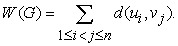
The Wiener index W(G) of a connected graph G is defined as the sum of the distances between all unordered pairs of vertices of G, that is,
 |
This index was put forward by Harold Wiener 10 in 1947 for approximation of the boiling points of alkanes. The effect of approximation was surprisingly good. From that point forward, the Wiener index has attracted the attention of chemists.
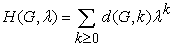
The Hosoya polynomial of a graph is a generating function about distance distributing, introduced by Hosoya 11 in 1988. For a connected graph G, the Hosoya polynomial denoted by  is defined as
 | (2) |
where  is the number of pairs of vertices of G that are at distance k and
  is the parameter.
The connection between the Hosoya polynomial and the Wiener index is elementary 11, 12:
 |
where  is the first derivative of
  .
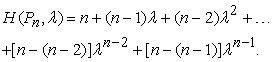
.
Hosoya polynomial of tress 13, 14, composite graphs 15, benzenoid graphs 16, 17, tori 18, zig-zag open-ended nanotubes 19, armchair open-ended nanotubes 20, zigzag polyhexnanotorus 21, Fibonacci and Lucas cubes 22 are reported in the literature.
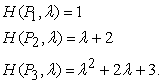
The paths P1, P2 and P3 are depicted in Figure 1.
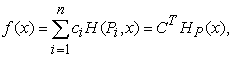
A function 
 is expanded as:
 | (3) |
where C and  are
are  matrices given by:
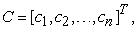 | (4) |
and
 | (5) |
Consider the Fredholm integral equation,
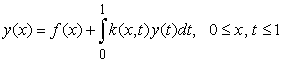 | (6) |
To solve Eq. (6), the procedure is as follows:
Step 1: We first approximate y(x) as truncated series defined in Eq. (3). That is,
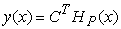 | (7) |
where C and  are defined as in Eqs. (4) and (5).
Step 2: Substituting Eq. (7) in Eq. (6), we get,
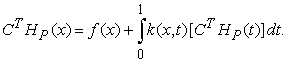 | (8) |
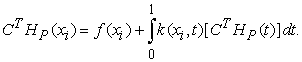
Step 3: Substituting the collocation point 
 in Eq. (8), we obtain,
 | (9) |
That is,
 |
Step 4: Now, we get the system of algebraic equations with unknown coefficients.
 |
Solving the above system of equations, we get the Hosoya coefficients ‘C’ and then substituting these coefficients in Eq. (7), we get the required approximate solution of Eq. (6).
In this section, we consider the some illustrative examples from the literature to demonstrate the capability of the method and error function is presented to verify the accuracy and efficiency of the numerical results:
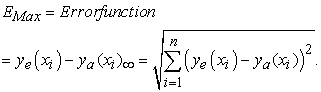 |
where,  and
and  are the exact and approximate solution respectively.
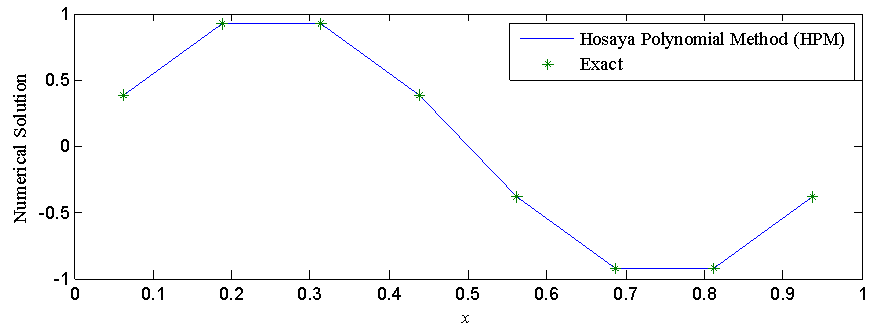
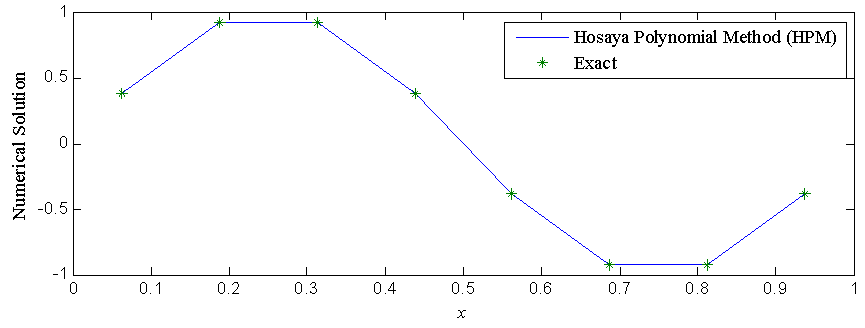
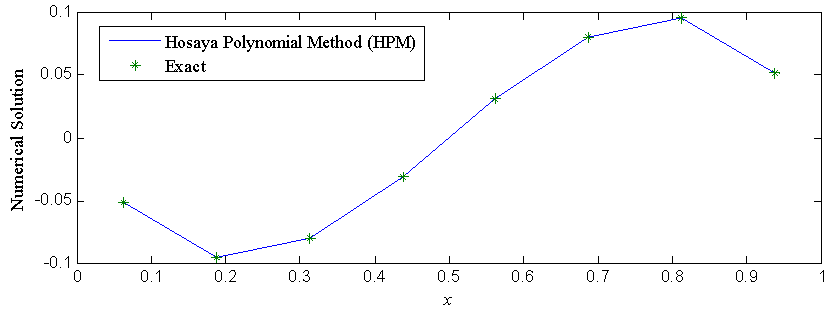
We considered the examples given in 7. Using the present technique, the numerical solutions with exact solutions presented in Table 1 and the maximum error analysis compared with existing method 7 given in Table 2.
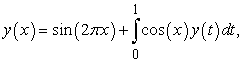
Example 1. Consider Fredholm integral equations,
 | (10) |
which has the exact solution 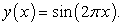
Solution: First we substitute 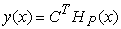 in Eq. (10) we get
 |
Therefore for n = 3
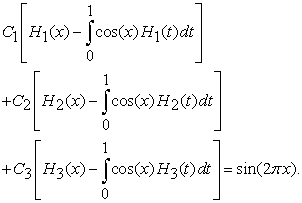 |
Next, we substitute the Hosoya polynomials as
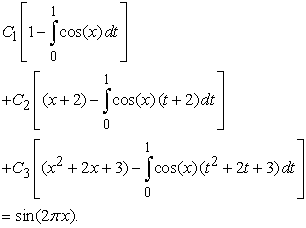 |
Next,
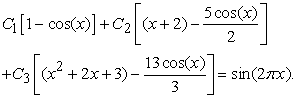 |
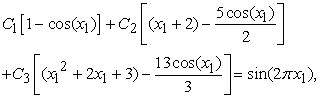
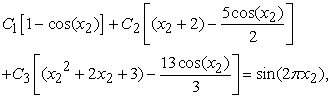
Substituting the collocation points, we get the system of three equations with three unknowns as,
 |
 |
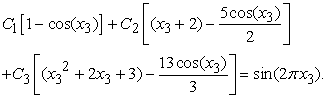 |
Solving these systems we obtain the three unknown Hosoya coefficients
 |
Substituting these coefficients in the approximation,
 |
we get the approximate values
 |
Maximum Error analyzed for n = 3 is 1.55e-15 and for n = 4, 6 & 8 are shown in the Table 2.
Example 2. Consider Fredholm integral equations,
 | (11) |
has the exact solution 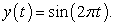
Example 3. Consider Fredholm integral equations,
 | (12) |
which has the exact solution  .
.


The Hosoya polynomial method is applied for the numerical solution of Fredholm integral equations. The present method reduces an integral equation into a set of algebraic equations. For instance in Example 1, our results are higher accuracy with exact ones and existing method 7. Subsequently other examples are also same in the nature. The numerical result shows that the accuracy improves with increasing of n, the order of a path Pn , for better accuracy. Error analysis justifies the accuracy, efficiency and validity of the present technique.
| [1] | L. Caccetta, K. Vijayan, Applications of graph theory, Ars. Combin., 23 (1987), 21-77. | ||
| In article | View Article | ||
| [2] | F. S. Roberts, Graph Theory and Its Applications to the Problems of Society, SIAM Publications, Philadelphia, 1978. | ||
| In article | View Article | ||
| [3] | A.M. Wazwaz. A First Course in Integral Equations. WSPC. New Jersey. 1997. | ||
| In article | View Article | ||
| [4] | U. Lepik, E. Tamme, Application of the Haar wavelets for solution of linearintegral equations, in: Dynamical Systems and Applications, Antala. Proce. (2004). 494-507. | ||
| In article | View Article | ||
| [5] | K. Maleknejad, Y. Mahmoudi, Numerical solution of linear Fredholm integral equation by using hybrid Taylor and Block-Pulse functions, App.Math. Comp. 149 (2004). 799-806. | ||
| In article | View Article | ||
| [6] | K. Maleknejad, F. Mirzaee, Using rationalized Haar wavelet for solvinglinear integral equations, App. Math. Comp. 160 (2005). 579-587. | ||
| In article | View Article | ||
| [7] | K. Maleknejad, M. Yousefi, Numerical solution of the integral equation ofthe second kind by using wavelet bases of hermite cubic splines, App. Math.Comp. 183 (2006). 134-141. | ||
| In article | View Article | ||
| [8] | M. S. Muthuvalu, J. Sulaiman, Half-Sweep Arithmetic Mean method withcomposite trapezoidal scheme for solving linear fredholm integral equations, App. Math. Comp. 217 (2011). 5442-5448. | ||
| In article | View Article | ||
| [9] | F. Harary, Graph Theory, Addison Wesley, Reading, 1968. | ||
| In article | |||
| [10] | H. Wiener, Structural determination of paraffin boiling points, J. Amer. Chem. Soc., 69 (1947), 17-20. | ||
| In article | View Article | ||
| [11] | H. Hosoya, On some counting polynomials in chemistry, Discrete Appl.Math., 19 (1988), 239-257. | ||
| In article | View Article | ||
| [12] | E. V. Konstantinova, M. V. Diudea, The Wiener polynomial derivativesand other topological indices in chemical research, Croat. Chem. Acta, 73 (2000), 383-403. | ||
| In article | View Article | ||
| [13] | D. Stevanovic, I. Gutman, I. Hosoya polynomials of trees with up to 11vertices, Zb. Rad. (Kragujevac), 21 (1999), 111-119. | ||
| In article | |||
| [14] | H. B. Walikar, H. S. Ramane, L. Sindagi, S. S. Shirkol, I. Gutman, Hosoya polynomial of thorn trees, rods, rings and stars, Kragujevac J. Sci., 28(2006), 47-56. | ||
| In article | View Article | ||
| [15] | D. Stevanovic, Hosoya polynomial of composite graphs, Discrete Math., 235 (2001), 237-244. | ||
| In article | View Article | ||
| [16] | I. Gutman, S. Klavzar, M. Petkovšek, P. Žigert, On Hosoya polynomials of benzenoid graphs, MATCH Commun. Math. Comput. Chem., 43 (2001), 49-66. | ||
| In article | View Article | ||
| [17] | S. Xu, H. Zhang, The Hosoya polynomial decomposition for cata condensed benzenoid graphs, Discrete Appl. Math., 156 (2008), 2930-2938. | ||
| In article | View Article | ||
| [18] | M. V. Diudea, Hosoya polynomial in tori, MATCH Commun. Math. Comput. Chem., 45 (2002), 109-122. | ||
| In article | |||
| [19] | S. Xu, H. Zhang, M. V. Diudea, Hosoya polynomials of zig-zag open-ended nanotubes, MATCH Commun. Math. Comput. Chem., 57 (2007), 443-456. | ||
| In article | View Article | ||
| [20] | S. Xu, H. Zhang, Hosoya polynomials of armchair open-ended nanotubes, Int. J. Quantum Chem., 107 (2007), 586-596. | ||
| In article | View Article | ||
| [21] | M. Eliasi, B. Taeri, Hosoya polynomial of zigzag polyhexnanotorus, J.Serb. Chem. Soc., 73 (2008), 311-319. | ||
| In article | View Article | ||
| [22] | S. Klavzar, M. Mollard, Wiener index and Hosoya polynomial of Fibonacci and Lucas cubes, MATCH Commun. Math. Comput. Chem., 68 (2012), 311-324. | ||
| In article | View Article | ||
Published with license by Science and Education Publishing, Copyright © 2017 H. S. Ramane, S.C. Shiralashetti, R. A. Mundewadi and R. B. Jummannaver
 This work is licensed under a Creative Commons Attribution 4.0 International License. To view a copy of this license, visit
http://creativecommons.org/licenses/by/4.0/
This work is licensed under a Creative Commons Attribution 4.0 International License. To view a copy of this license, visit
http://creativecommons.org/licenses/by/4.0/
| [1] | L. Caccetta, K. Vijayan, Applications of graph theory, Ars. Combin., 23 (1987), 21-77. | ||
| In article | View Article | ||
| [2] | F. S. Roberts, Graph Theory and Its Applications to the Problems of Society, SIAM Publications, Philadelphia, 1978. | ||
| In article | View Article | ||
| [3] | A.M. Wazwaz. A First Course in Integral Equations. WSPC. New Jersey. 1997. | ||
| In article | View Article | ||
| [4] | U. Lepik, E. Tamme, Application of the Haar wavelets for solution of linearintegral equations, in: Dynamical Systems and Applications, Antala. Proce. (2004). 494-507. | ||
| In article | View Article | ||
| [5] | K. Maleknejad, Y. Mahmoudi, Numerical solution of linear Fredholm integral equation by using hybrid Taylor and Block-Pulse functions, App.Math. Comp. 149 (2004). 799-806. | ||
| In article | View Article | ||
| [6] | K. Maleknejad, F. Mirzaee, Using rationalized Haar wavelet for solvinglinear integral equations, App. Math. Comp. 160 (2005). 579-587. | ||
| In article | View Article | ||
| [7] | K. Maleknejad, M. Yousefi, Numerical solution of the integral equation ofthe second kind by using wavelet bases of hermite cubic splines, App. Math.Comp. 183 (2006). 134-141. | ||
| In article | View Article | ||
| [8] | M. S. Muthuvalu, J. Sulaiman, Half-Sweep Arithmetic Mean method withcomposite trapezoidal scheme for solving linear fredholm integral equations, App. Math. Comp. 217 (2011). 5442-5448. | ||
| In article | View Article | ||
| [9] | F. Harary, Graph Theory, Addison Wesley, Reading, 1968. | ||
| In article | |||
| [10] | H. Wiener, Structural determination of paraffin boiling points, J. Amer. Chem. Soc., 69 (1947), 17-20. | ||
| In article | View Article | ||
| [11] | H. Hosoya, On some counting polynomials in chemistry, Discrete Appl.Math., 19 (1988), 239-257. | ||
| In article | View Article | ||
| [12] | E. V. Konstantinova, M. V. Diudea, The Wiener polynomial derivativesand other topological indices in chemical research, Croat. Chem. Acta, 73 (2000), 383-403. | ||
| In article | View Article | ||
| [13] | D. Stevanovic, I. Gutman, I. Hosoya polynomials of trees with up to 11vertices, Zb. Rad. (Kragujevac), 21 (1999), 111-119. | ||
| In article | |||
| [14] | H. B. Walikar, H. S. Ramane, L. Sindagi, S. S. Shirkol, I. Gutman, Hosoya polynomial of thorn trees, rods, rings and stars, Kragujevac J. Sci., 28(2006), 47-56. | ||
| In article | View Article | ||
| [15] | D. Stevanovic, Hosoya polynomial of composite graphs, Discrete Math., 235 (2001), 237-244. | ||
| In article | View Article | ||
| [16] | I. Gutman, S. Klavzar, M. Petkovšek, P. Žigert, On Hosoya polynomials of benzenoid graphs, MATCH Commun. Math. Comput. Chem., 43 (2001), 49-66. | ||
| In article | View Article | ||
| [17] | S. Xu, H. Zhang, The Hosoya polynomial decomposition for cata condensed benzenoid graphs, Discrete Appl. Math., 156 (2008), 2930-2938. | ||
| In article | View Article | ||
| [18] | M. V. Diudea, Hosoya polynomial in tori, MATCH Commun. Math. Comput. Chem., 45 (2002), 109-122. | ||
| In article | |||
| [19] | S. Xu, H. Zhang, M. V. Diudea, Hosoya polynomials of zig-zag open-ended nanotubes, MATCH Commun. Math. Comput. Chem., 57 (2007), 443-456. | ||
| In article | View Article | ||
| [20] | S. Xu, H. Zhang, Hosoya polynomials of armchair open-ended nanotubes, Int. J. Quantum Chem., 107 (2007), 586-596. | ||
| In article | View Article | ||
| [21] | M. Eliasi, B. Taeri, Hosoya polynomial of zigzag polyhexnanotorus, J.Serb. Chem. Soc., 73 (2008), 311-319. | ||
| In article | View Article | ||
| [22] | S. Klavzar, M. Mollard, Wiener index and Hosoya polynomial of Fibonacci and Lucas cubes, MATCH Commun. Math. Comput. Chem., 68 (2012), 311-324. | ||
| In article | View Article | ||