Background: External fixation is an important modality in fracture management. It is a method that utilises a combination of pins, wires, clamps and bars or rings. Clamps link a pin or wire to a rod or ring. Sometimes all the components of an external fixator may not be available and there will be need to improvise. Aim: To document the use of a synthetic cast as an improvised external fixator clamp in open fracture management. Methods: A prospective study of consecutive patients with open extremity fractures at the University of Port Harcourt Teaching Hospital, Port Harcourt from October 2012 to October 2017. A synthetic cast was utilised either partially or wholly as clamps for external fixation. The patients’ sociodemographics and information relevant to the injury were obtained. Data was analysed using SPSS version 23. Results: Twenty-eight patients were managed with improvised clamp. Ages ranged from 16 to 47 years, consisting of 18 males and 10 females. Majority resulted from road traffic crashes. There were three humeral and 25 tibial fractures with majority being in the middle third. Majority were Gustilo type IIIB. Twenty-five fractures united although two of these were malunited. One had non-union. Other complications were delayed union and pin tract infection. Two patients had below knee amputation for gangrene. Duration of hospital stay ranged from 26 to 151 days. Follow up period ranged from four to 24 months. Conclusion: Improvisation of synthetic cast for external fixator clamp is effective in acute management of open extremity fractures as well as during subsequent care.
External fixation is an important modality in fracture management. It is a method of aligning or realigning bones using a combination of pins, wires, clamps, and bars or rings. 1 Clamps link a pin or wire to a rod(bar) or ring. 2, 3, 4 Although external fixation fell into disrepute as a result of complications noted during World War II, 1, 3 there has been a resurgence of its use in modern trauma care. 4 It has been used for temporary or emergency stabilization of patients with limb- or life-threatening injuries, definitive modality of fracture treatment as well as limb reconstruction surgery. 4, 5
In developed countries, external fixation devices are readily available. However, in developing countries this is not always the case. A contributory factor to this is poor funding of the health system. 6, 7 With the poor funding, basic surgical devices including external fixator devices may not be acquired by the hospital. The components of the external fixators which are available in these hospitals may be difficult to replace when they go bad especially when these are reused.
In situations where standard external fixation devices are unavailable, locally made external fixators 8 or improvised external fixators 9, 10 have been used by surgeons. The aim of this study was to document the use of synthetic cast as improvised external fixator clamps in open extremity fracture management.
This was a prospective study of consecutive patients with open extremity fractures presenting at the University of Port Harcourt Teaching Hospital, Port Harcourt between October 2012 and October 2017 and in whom synthetic cast such as scotchcast was utilized either partially or wholly as clamps for external fixation.
At the time of initial wound debridement, the external fixators with the improvised clamps were applied. The fractures were reduced and maintained in the reduced state until the cast sets. Subsequent soft tissue wound cover was carried out depending on the grade of the injury. The patients received broad spectrum antibiotics, anti-tetanus prophylaxis, haematenics and other relevant medications. After soft tissue healing, the external fixators were replaced with appropriate casts if the fractures had not united then.
The inclusion criteria was patients with open extremity fractures in which synthetic cast was utilized partially or wholly as clamps for the fixators. Excluded were those patients in whom standard external fixator devices with all the components complete were used.
Data obtained included the patients’ age, sex, mechanism of injury, affected extremity and location of the injury, open fracture type (Gustilo et al classification 11), associated injuries, fracture union, complications, additional procedures undertaken, duration of hospital stay and follow up.
Data was analysed using Statistical Package for Social Sciences (SPSS) version 23 (IBM Inc., Armonk, NY, USA). Mean, standard deviation and median where applicable were used for descriptive statistics while categorical variables were expressed in absolute frequencies.
Ethical approval was obtained from the Research and Ethics Committee of the University of Port Harcourt Teaching Hospital.
During the period, 28 patients were managed for open extremity fractures in which synthetic cast was utilized as improvised external fixator clamp. The ages of the patients ranged from 16 to 47 years with a mean of 30.43±7.21 years. There were 18 males and 10 females. Twenty-three (82.1%) of the patients were involved in road traffic crashes while five (17.9%) sustained gunshot injuries. There were three humeral (10.7%) and 25 tibia/fibular (89.3%) fractures. The tibia fractures were mainly in the middle third (Table 1). The majority of the fractures were Gustilo type IIIB (85.7%). The associated injuries were left femoral fractures in two patients, partial left foot amputation (in one of the patients with femoral fracture) and 5th metacarpal fracture of the left hand in one patient.
Of the 28 patients who had their fractures managed with improvised external fixator clamps, 25 (89.3%) had united fractures although two of these were mal-unions while one (3.6%) had a non-united fracture and two (7.1%) developed gangrene of the foot. The complications encountered in the patients are shown in Table 1. The non-union occurred in the proximal fracture site of a segmental fracture; the distal fracture site united. Radial nerve palsy was noticed at presentation in one patient with gunshot to the humerus; this recovered subsequently. The foot gangrene occurred in the two patients who had Gustilo type IIIC fractures.
Ten (35.7%) patients had split skin grafting, four (14.3%) had secondary wound closure, two (7.1%) delayed primary closure and in 10 (35.7%) the wounds healed by secondary intention. Two (7.1%) patients had below knee amputation for foot gangrene. The two patients with femoral fractures had open reduction and internal fixation. Eighteen (64.3%) patients had subsequent cast immobilization after the soft tissue wounds had healed and their fractures had not united.
The duration of hospital stay ranged from 26 to 151 days with a mean of 56.29±26.29 days. Most of the patients spent between 29 and 56 days in hospital (Table 1). The follow up duration ranged from four to 24 months with a mean of 10.14±4.15 months. Most of the patients (42.9%) were followed up for between 5 and 8 months (Table 1). There was no mortality.
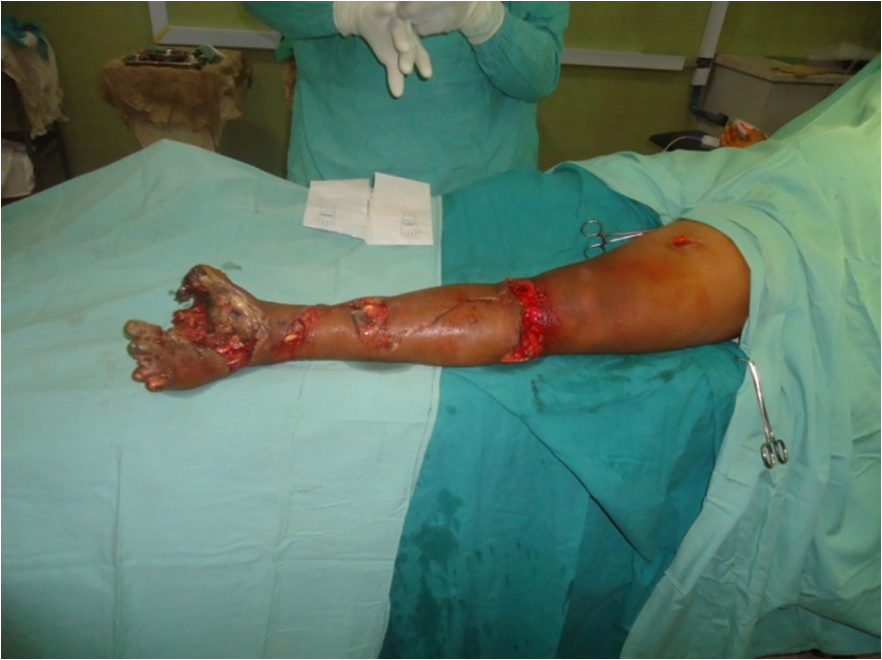
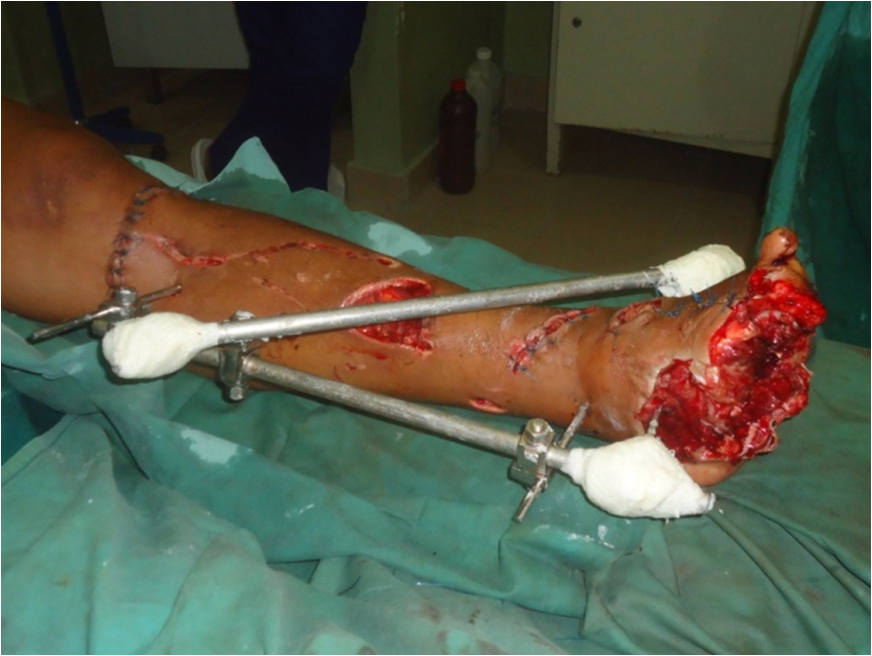
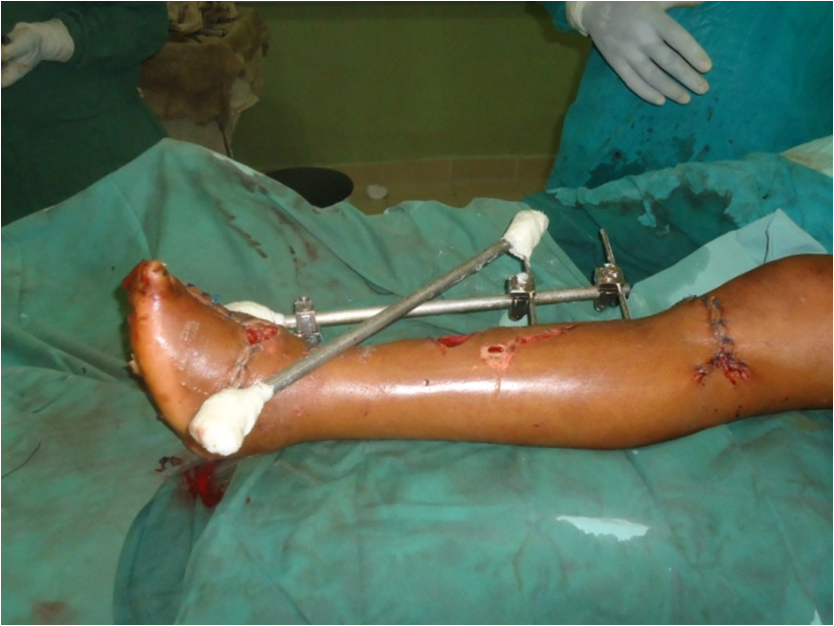
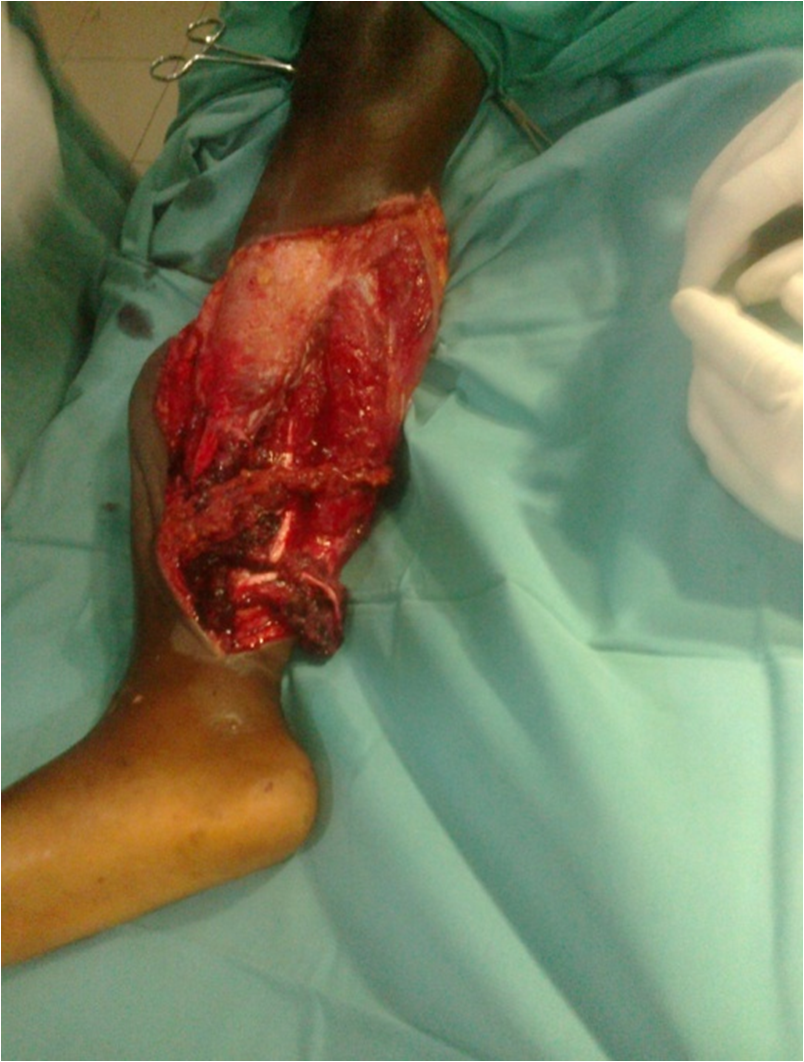
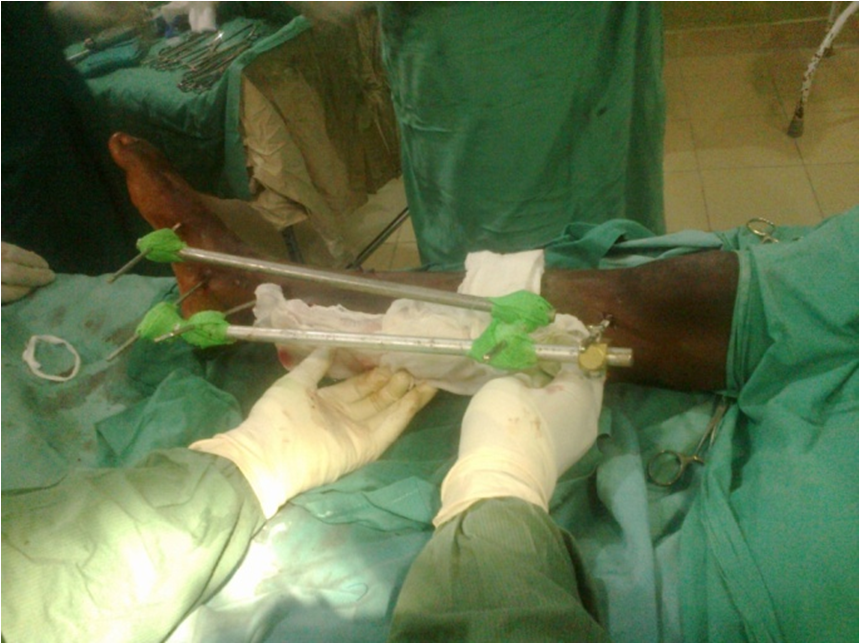
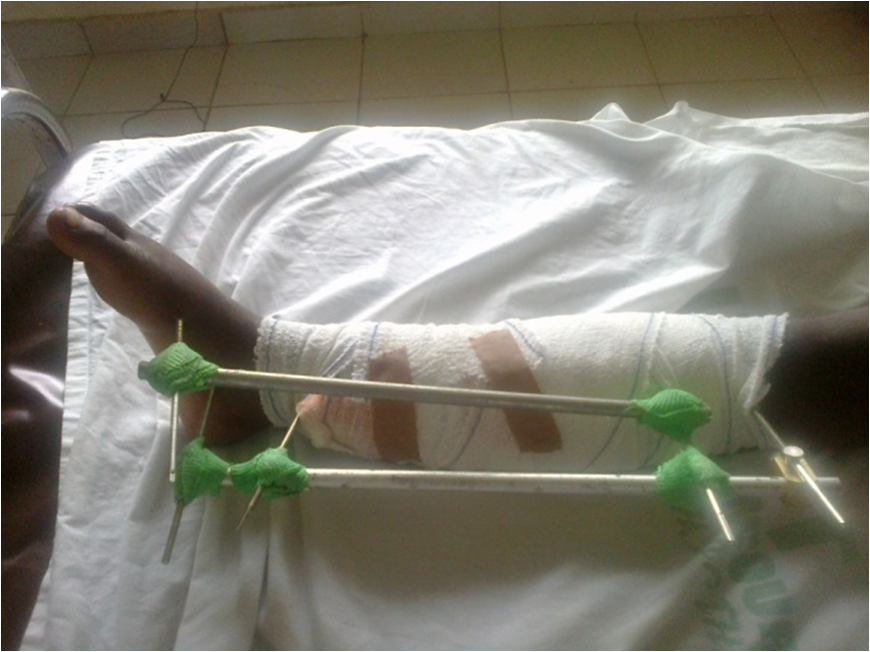
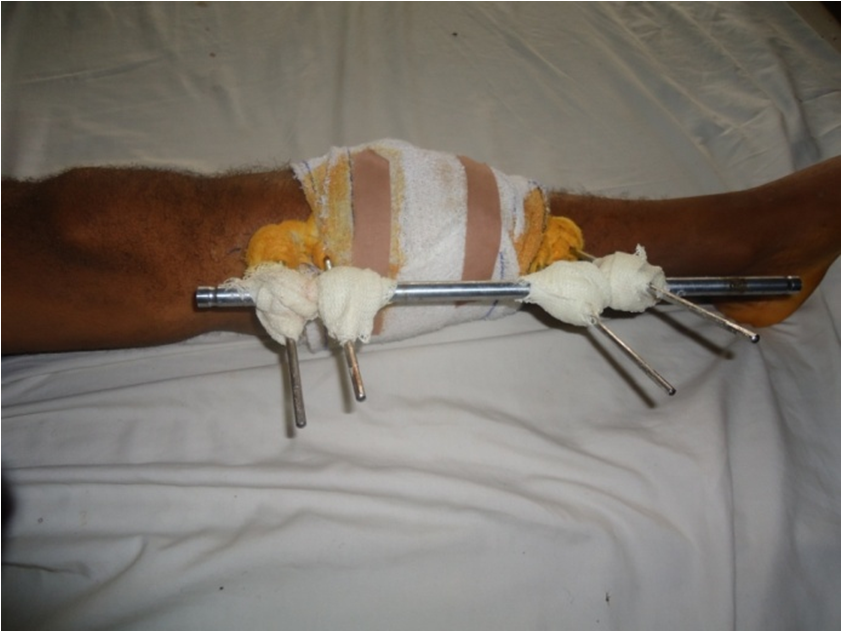
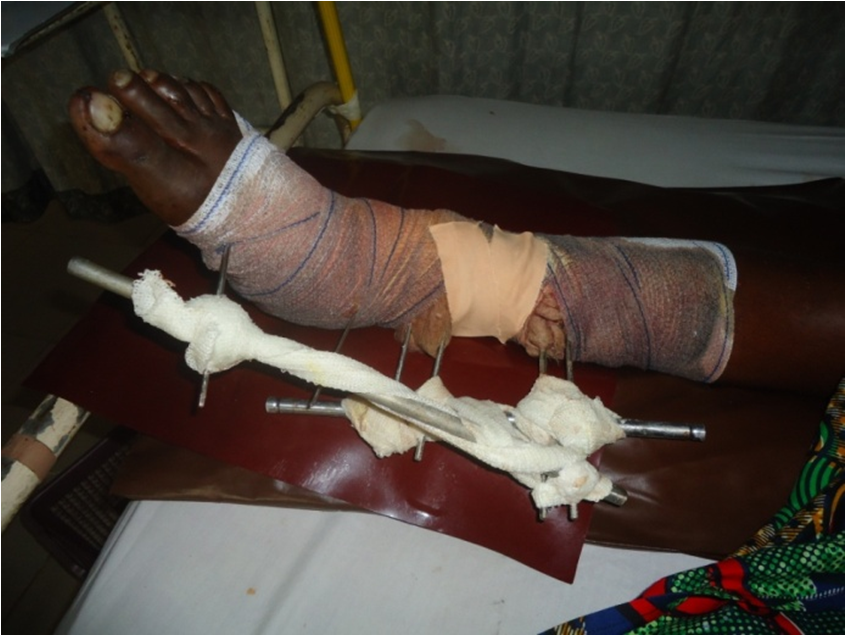
Figure 1 to Figure 4 show open extremity fractures stabilized with external fixators and synthetic cast utilized partially or wholly as external fixator clamps.


Figure 1. Clinical photograph of a patient with left tibia/fibula fracture (segmental) and partial left foot amputation. Synthetic cast was utilized partially as external fixator clamp in addition to the conventional clamps. The patient also had left femoral fracture.
Figure 2. Clinical photograph of a patient with open right tibia/fibula fracture and external fixator in place. Synthetic cast was utilized as external fixator clamp in all but one point where a conventional external fixator clamp was utilized.


This study has shown that synthetic cast can be utilized as external fixator clamp where conventional clamps are unavailable for management of open extremity fractures. The union rate for the fractures was high and complication rates were low.
External fixation of long bone fractures has been shown to have some advantages and capabilities over other modalities of fracture stabilization. These include not destroying the medullary circulation; not damaging the endosteal elements; simplicity of application; rigid fixation of the bone and skeletal stabilization at a distance from the site of the injury, disease or deformity; compression, neutralization or fixed distraction of fracture fragments; free access to an injury site for primary or secondary procedures; great versatility in accommodating a wide variety of bone and soft tissue lesions including the ability to stabilize injuries extending across two or more adjacent limb segments; adjustability of alignment, length and mechanical properties after the device has been applied; ability to use simultaneous and/or sequential internal fixation and other methods of skeletal stabilization; minimal interference with adjacent joints; and early mobilization of limb and patient. 1, 12, 13, 14
These advantages make external fixators useful in open extremity fractures and in fracture stabilization in austere environments including conflict/war zones, 8, 15, 16, 17, 18 where there are limited orthopaedic resources available. In these austere environments, when conventional external fixators are available, the fractures are easily stabilized. However, due to poor funding of the health system in most developing countries, 6, 7 basic orthopaedic devices/equipment may not be procured by hospitals. As a result, conventional external fixators with the complete components may not be available for use when open extremity fractures are encountered. In a number of developing countries, external fixators are re-used 8 and this includes the pins, clamps and rods (bars). The clamps could go bad and can no longer be used to connect the rods (bars) and the pins. In this situation, there will be a need to improvise clamps.
Improvisation of clamps in the present study was carried out with synthetic casts such as scotchcast. This is composed of fibreglass impregnated with polyurethane resin. 19 In the unhardened state, the resin contains a very low volatility form of di-isocyanate, methylene diphenyl diisocyanate (MDI). Exposure of the product to moisture or water initiates a chemical reaction which causes the material to become rigid. The cast material exhibits high rigidity and stiffness 19, 20 which lends credence to its use in the immobilization of fractures. When the synthetic cast connects the pins and the rod (bar), the rigidity is maintained during the period of its use. Hence, it is able to maintain the stabilized fracture fragments while the soft tissue wounds heal.
Several other materials have been improvised as clamps in external fixation of long bone fractures. Plaster-of-Paris has been used to connect pins and rods (bars) with good results in management of open extremity fractures. 9, 21, 22 Methyl methacrylate (bone cement) has been utilized by several workers to connect pins and rods (bars) and also as columns connecting the pins used for external fixation of long bones. 23, 24, 25, 26, 27, 28, 29 When methyl methacrylate sets, it hardens into a solid hardened material which has high rigidity and stiffness. This can maintain the stability of the external fixation. Good results in terms of high fracture union rates have been achieved with this method. 25, 26, 27, 28, 29 However, while the complication rates were lower in some 28, 29 they were higher in others. 26, 27 The present study which utilized synthetic cast as clamps also obtained good results with high fracture union and low complication rates. The hardened synthetic cast is stronger than plaster-of-Paris and more resistant to fluid coming in contact with it; this makes it preferable for use as improvised external fixator clamp. Cost and moderate hardening time makes synthetic cast a better alternative than bone cement in our environment.
Although the union rates are high with this rigid method of connecting the rods (bars) to pins, one potential disadvantage is that the fracture site cannot be altered once the material sets whether they are synthetic cast, plaster-of-Paris or methyl methacrylate. Hence there is a need to maintain good reduction at the fracture site while the materials set.
As long as the poor funding of the health system persists in developing countries 6, 7 and open fractures are common in these countries 8, 30, 31 there will always be a need to improvise during external fixation for the management of these long bone injuries. Governments in developing countries are encouraged to appropriately fund their hospitals as this will go a long way to make basic surgical devices/equipment available for patient care.
This study has a number of limitations. The small number of patients in this study was a limitation. The synthetic cast was not utilized completely for all the connections between the pins and the rods (bars). Hence, there were those which were partial and others which were complete. This was also a limitation.
Improvisation of synthetic cast as external fixator clamp is effective in the acute management of open extremity fractures as well as in the subsequent care of the patients. The union rate is high and the complication rate is low.
The authors have no competing interest
The study was self-funded
| [1] | Moss DP, Tejwani NC. Biomechanics of external fixation: a review of the literature. Bull NYU Hosp Jt Dis 2007;65(4):294-299. | ||
| In article | |||
| [2] | Behrens F. A primer of fixator devices and configurations. Clin Orthop Relat Res 1989;(241):5-14. | ||
| In article | View Article | ||
| [3] | Pontarelli WR. External fixation of tibial fractures. Iowa Orthop J 1982; 2: 80-88. | ||
| In article | |||
| [4] | Giotakis N, Narayan B. Stability with unilateral external fixation in the tibia. Strategies Trauma Limb Reconstr 2007; 2(1): 13-20. | ||
| In article | View Article PubMed | ||
| [5] | Beltsios M, Savvidou O, Kovanis J, Alexandropoulos P, Papagelopoulos P. External fixation as a primary and definitive treatment for tibial diaphyseal fractures. Strategies Trauma Limb Reconstr 2009; 4(2): 81-87. | ||
| In article | View Article PubMed | ||
| [6] | Smith MK. Hospitals in developing countries: a weak link in a weak chain. Lancet 1999;351 Suppl:SIV 26. | ||
| In article | View Article | ||
| [7] | Grimes CE, Henry JA, Maraka J, Mkandawire NC, Cotton M. Cost-effectiveness of surgery in low- and middle-income countries: a systematic review. World J Surg 2014; 38(1): 252-263. | ||
| In article | View Article PubMed | ||
| [8] | Padhi NR, Padhi P. Use of external fixators for open tibial injuries in the rural third world: panacea of the poor? Injury 2007; 38(2): 150-159. | ||
| In article | View Article PubMed | ||
| [9] | Agaja SB, Ogunye WK. Improvised external fixators for the treatment of open fractures at a private hospital in Ilorin, Kwara State. Niger J Orthop Trauma 2005; 4(1-2): 70-78. | ||
| In article | View Article | ||
| [10] | Musa A. How I improvised an external fixator to manage open fractures. South Sudan Med J 2013; 6(2): 31-32. | ||
| In article | |||
| [11] | Gustilo RB, Merkow RL, Templeman D. The management of open fractures. J Bone Joint Surg Am 1990; 72(2): 299-304. | ||
| In article | View Article PubMed | ||
| [12] | Rezaian SM. A new external fixation device for treatment of complicated fractures of the leg. Injury 1977; 9(1): 17-22. | ||
| In article | View Article | ||
| [13] | Behrens F. General theory and principles of external fixation. Clin Orthop Relat Res 1989; (241): 15-23. | ||
| In article | View Article | ||
| [14] | Sisk TD. External fixation. Historic review, advantages, disadvantages, complications, and indications. Clin Orthop Relat Res 1983; (180): 15-22. | ||
| In article | View Article | ||
| [15] | Checketts RG, Young CF. External fixation of diaphyseal fractures of the tibia. Curr Orthop 2003; 17(3): 176-189. | ||
| In article | View Article | ||
| [16] | Pathak G, Atkinson R. Military external fixation of fractures. Aust Def Forces Health 2001; 2: 24-28. | ||
| In article | |||
| [17] | Gordon WT, Grijalva S, Potter BK. Damage control and austere environment external fixation: Techniques for the civilian provider. J Surg Orthop Adv 2012; 21(1): 22-31. | ||
| In article | |||
| [18] | Carroll EA, Koman LA. External fixation and temporary stabilization of femoral and tibial trauma. J Surg Orthop Adv 2011; 20(1): 74-81. | ||
| In article | |||
| [19] | 3M Health Care. 3M Scotchcast casting products: Instructions for use. Document ID number: 34-7036-3759-4. St. Paul, MN: 3M Health Care, 1994. | ||
| In article | |||
| [20] | Pirhonen E, Parssinen A, Pelto M. Comparative study on stiffness properties of woodcast and conventional casting materials. Prosthet Orthot Int 2012; 37(4): 336-339. | ||
| In article | View Article PubMed | ||
| [21] | Bassey LO. The use of P.O.P integrated transfixation pins as an improvisation on the Hoffmann’s apparatus: contribution to open fracture management in the tropics. J Trauma 1989; 29(1): 59-64. | ||
| In article | View Article | ||
| [22] | Oni OO, Orhewere FA. Per-cutaneous pins and external fixation of compound fractures of the tibia: the Benin experience. Niger Med J 1982; 12: 255-257. | ||
| In article | |||
| [23] | Aron JD. Using methylmethacrylate to make external fixation splints. J Bone Joint Surg Am 1976; 58(1): 151. | ||
| In article | View Article PubMed | ||
| [24] | Inoue S, Ichida M, Imai R, Suzu F, Ohashi T, Sakakida K. External skeletal fixation using methylmethacrylate- technique and indication with clinical report. Int Orthop 1977; 1(1): 64-69. | ||
| In article | View Article | ||
| [25] | Edge AJ, Denham RA. The Portsmouth method of external fixation of complicated tibial fractures. Injury 1979; 11(1): 13-18. | ||
| In article | View Article | ||
| [26] | Edge AJ, Denham RA. External fixation for complicated tibial fractures. J Bone Joint Surg Br 1981; 63(1): 92-97. | ||
| In article | View Article | ||
| [27] | Allerton KE, Miles AE. External fixation of tibial fractures at Groote Schuur Hospital, Cape Town. S Afr Med J 1981; 60(13): 496-501. | ||
| In article | |||
| [28] | Ohashi T, Inoue S, Kajikawa K. External skeletal fixation using methylmethacrylate. Current technique, clinical results and indications. Clin Orthop Relat Res 1983; (178): 121-129. | ||
| In article | View Article | ||
| [29] | Demetriades D, Nikolaides N, Filiopoulos K, Hager J. The use of methylmethacrylate as an external fixator in children and adolescents. J Pediatr Orthop 1995; 15(4): 499-503. | ||
| In article | View Article PubMed | ||
| [30] | Onuminya JE. External skeletal fixation of open tibial shaft fractures in Nigeria. Niger Med Pract 2002; 40(3/5): 37-39. | ||
| In article | |||
| [31] | Thanni LO. Current concepts in external fixation. Niger J Orthop Trauma 2011; 10(1): 1-6. | ||
| In article | View Article | ||
Published with license by Science and Education Publishing, Copyright © 2020 Richard C. Echem, Phillip D. Eyimina, Vincent U.E. Adiela and Tamunokuro Diamond
 This work is licensed under a Creative Commons Attribution 4.0 International License. To view a copy of this license, visit
http://creativecommons.org/licenses/by/4.0/
This work is licensed under a Creative Commons Attribution 4.0 International License. To view a copy of this license, visit
http://creativecommons.org/licenses/by/4.0/
| [1] | Moss DP, Tejwani NC. Biomechanics of external fixation: a review of the literature. Bull NYU Hosp Jt Dis 2007;65(4):294-299. | ||
| In article | |||
| [2] | Behrens F. A primer of fixator devices and configurations. Clin Orthop Relat Res 1989;(241):5-14. | ||
| In article | View Article | ||
| [3] | Pontarelli WR. External fixation of tibial fractures. Iowa Orthop J 1982; 2: 80-88. | ||
| In article | |||
| [4] | Giotakis N, Narayan B. Stability with unilateral external fixation in the tibia. Strategies Trauma Limb Reconstr 2007; 2(1): 13-20. | ||
| In article | View Article PubMed | ||
| [5] | Beltsios M, Savvidou O, Kovanis J, Alexandropoulos P, Papagelopoulos P. External fixation as a primary and definitive treatment for tibial diaphyseal fractures. Strategies Trauma Limb Reconstr 2009; 4(2): 81-87. | ||
| In article | View Article PubMed | ||
| [6] | Smith MK. Hospitals in developing countries: a weak link in a weak chain. Lancet 1999;351 Suppl:SIV 26. | ||
| In article | View Article | ||
| [7] | Grimes CE, Henry JA, Maraka J, Mkandawire NC, Cotton M. Cost-effectiveness of surgery in low- and middle-income countries: a systematic review. World J Surg 2014; 38(1): 252-263. | ||
| In article | View Article PubMed | ||
| [8] | Padhi NR, Padhi P. Use of external fixators for open tibial injuries in the rural third world: panacea of the poor? Injury 2007; 38(2): 150-159. | ||
| In article | View Article PubMed | ||
| [9] | Agaja SB, Ogunye WK. Improvised external fixators for the treatment of open fractures at a private hospital in Ilorin, Kwara State. Niger J Orthop Trauma 2005; 4(1-2): 70-78. | ||
| In article | View Article | ||
| [10] | Musa A. How I improvised an external fixator to manage open fractures. South Sudan Med J 2013; 6(2): 31-32. | ||
| In article | |||
| [11] | Gustilo RB, Merkow RL, Templeman D. The management of open fractures. J Bone Joint Surg Am 1990; 72(2): 299-304. | ||
| In article | View Article PubMed | ||
| [12] | Rezaian SM. A new external fixation device for treatment of complicated fractures of the leg. Injury 1977; 9(1): 17-22. | ||
| In article | View Article | ||
| [13] | Behrens F. General theory and principles of external fixation. Clin Orthop Relat Res 1989; (241): 15-23. | ||
| In article | View Article | ||
| [14] | Sisk TD. External fixation. Historic review, advantages, disadvantages, complications, and indications. Clin Orthop Relat Res 1983; (180): 15-22. | ||
| In article | View Article | ||
| [15] | Checketts RG, Young CF. External fixation of diaphyseal fractures of the tibia. Curr Orthop 2003; 17(3): 176-189. | ||
| In article | View Article | ||
| [16] | Pathak G, Atkinson R. Military external fixation of fractures. Aust Def Forces Health 2001; 2: 24-28. | ||
| In article | |||
| [17] | Gordon WT, Grijalva S, Potter BK. Damage control and austere environment external fixation: Techniques for the civilian provider. J Surg Orthop Adv 2012; 21(1): 22-31. | ||
| In article | |||
| [18] | Carroll EA, Koman LA. External fixation and temporary stabilization of femoral and tibial trauma. J Surg Orthop Adv 2011; 20(1): 74-81. | ||
| In article | |||
| [19] | 3M Health Care. 3M Scotchcast casting products: Instructions for use. Document ID number: 34-7036-3759-4. St. Paul, MN: 3M Health Care, 1994. | ||
| In article | |||
| [20] | Pirhonen E, Parssinen A, Pelto M. Comparative study on stiffness properties of woodcast and conventional casting materials. Prosthet Orthot Int 2012; 37(4): 336-339. | ||
| In article | View Article PubMed | ||
| [21] | Bassey LO. The use of P.O.P integrated transfixation pins as an improvisation on the Hoffmann’s apparatus: contribution to open fracture management in the tropics. J Trauma 1989; 29(1): 59-64. | ||
| In article | View Article | ||
| [22] | Oni OO, Orhewere FA. Per-cutaneous pins and external fixation of compound fractures of the tibia: the Benin experience. Niger Med J 1982; 12: 255-257. | ||
| In article | |||
| [23] | Aron JD. Using methylmethacrylate to make external fixation splints. J Bone Joint Surg Am 1976; 58(1): 151. | ||
| In article | View Article PubMed | ||
| [24] | Inoue S, Ichida M, Imai R, Suzu F, Ohashi T, Sakakida K. External skeletal fixation using methylmethacrylate- technique and indication with clinical report. Int Orthop 1977; 1(1): 64-69. | ||
| In article | View Article | ||
| [25] | Edge AJ, Denham RA. The Portsmouth method of external fixation of complicated tibial fractures. Injury 1979; 11(1): 13-18. | ||
| In article | View Article | ||
| [26] | Edge AJ, Denham RA. External fixation for complicated tibial fractures. J Bone Joint Surg Br 1981; 63(1): 92-97. | ||
| In article | View Article | ||
| [27] | Allerton KE, Miles AE. External fixation of tibial fractures at Groote Schuur Hospital, Cape Town. S Afr Med J 1981; 60(13): 496-501. | ||
| In article | |||
| [28] | Ohashi T, Inoue S, Kajikawa K. External skeletal fixation using methylmethacrylate. Current technique, clinical results and indications. Clin Orthop Relat Res 1983; (178): 121-129. | ||
| In article | View Article | ||
| [29] | Demetriades D, Nikolaides N, Filiopoulos K, Hager J. The use of methylmethacrylate as an external fixator in children and adolescents. J Pediatr Orthop 1995; 15(4): 499-503. | ||
| In article | View Article PubMed | ||
| [30] | Onuminya JE. External skeletal fixation of open tibial shaft fractures in Nigeria. Niger Med Pract 2002; 40(3/5): 37-39. | ||
| In article | |||
| [31] | Thanni LO. Current concepts in external fixation. Niger J Orthop Trauma 2011; 10(1): 1-6. | ||
| In article | View Article | ||