There are Many causes for weakens of badly broken-down teeth and may lead to tooth fracture as: recurrent caries, repeated replacement of restorations and undermined enamel, also the endodontic procedures as: the access cavity, mechanical preparation for coronal portion and for root pulp canal, and also the required restorative steps to restore the missing tooth structure. in cases of endodontic treated tooth and to substitute the loss of tooth structure, it needs to special requirements for the final restoration as adequate retention and resistance form, maximum fracture resistance and esthetic. For a long time, the ordinary line of treatment to restore the endodontic treated teeth, post, core and crown construction with a different materials and design was used.
Currently, endodontic treated teeth, an acid etch ceramic endocrown as a fixed restoration is broadly used, and numerous dentists use it as a additional line of treatment to conventional post-and-core and full coverage crowns. endocrown restoration includes the core chamber part and external crown as a one single unit restoration. the retention of endocrown restoration depends on the inter surface of the pulp chamber walls and adhesive resin cement as a means of micromechanical retention 1, 2, 3, 4.
Many authors found that, the fiber reinforced posts have physical properties similar to those of dentin, thus, were accomplished to reduction the possibility of root fracture and increase the chance of survival was noticed. Also, the bond between composite core and the Glass fiber posts are formed and give wide chance for a natural appearance and esthetics improvement without compromising on the tooth strength. others concluded that, the mode of failure was differed according to post system. And the tooth restored with fiber post, appeared favorable fracture that making the tooth are more able to retreatment 5, 6, 7.
The Effect of post system, post materials, designs of finish line have been reported in many studies. But the studies that consider the effect of external fixed coronal restorations on the fracture resistance of teeth treated endodontically are very limited. Therefore, this study, paid attention to the external fixed coronal restorations and studied the effect of 3 different restorations: full coverage porcelain fused metal crowns, full coverage all ceramic crown and endo crown on the fracture resistance of teeth treated endodontically.
The aim of this in vitro study was to compare the effect of 3 different coronal restorations: full coverage porcelain fused metal crowns, full coverage all ceramic crown and endo crown on the fracture resistance of endodontic treated teeth.
For this study, twenty-four from extracted upper canine, were selected with nearly the same root length. The teeth were carefully cleaned and stored in saline solution.
A special water-cooled precision Isomet 4000 saw (Buehler, USA) was used to cut the coronal portion of selected teeth leaving 3mm above the cervical, and the length of remaining part of each tooth was 18mm from the apex. interradicular tooth preparation was done using Protaper rotary files (Dentsply, Maillefer, Switzerland). And was obturated by lateral condensation using cones of gutta-percha (FKG Dentaire SA, Switzerland) and AH Plus sealer (Dentsply, De tray, Germany).
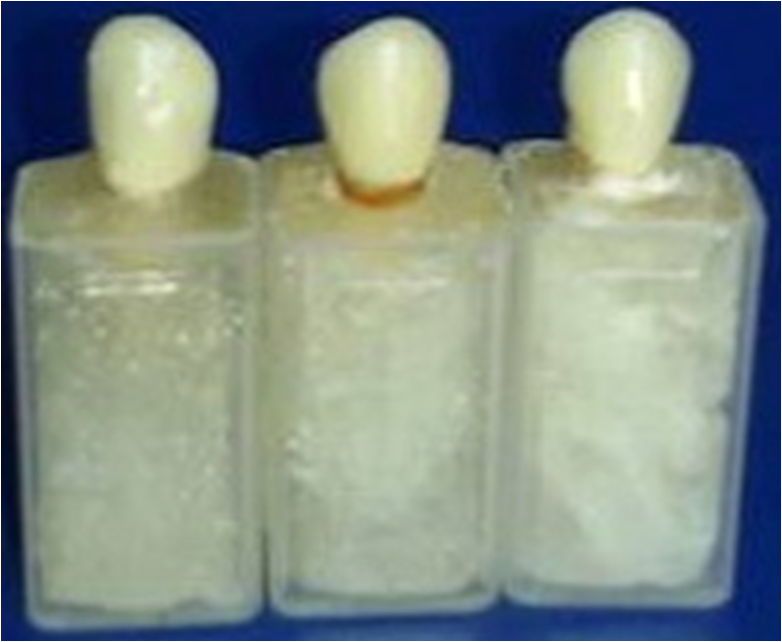
2.2. Mounting of the SamplesAn auto polymerizing acrylic resin block was used (Acrostone dental factory, Egypt). the root was covered with A layer of light body (Speedex, Coltenewhaledent, Switzerland) to represent the periodontal ligament. a specially designed square plastic mould (12 mm width and 18 mm length were used. All the root length was embedded vertically with the long axis, 2 mm above the cervical using a surveyor (Ney Surveyor, Dentsply, USA). Figure 1

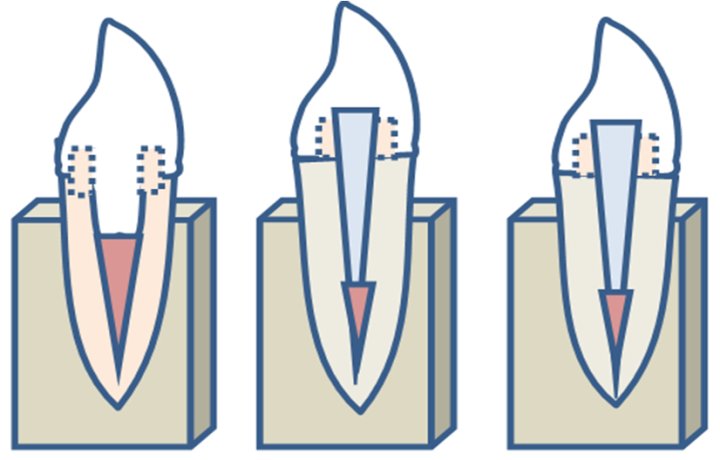
The obturated roots was divided into 3 groups of 8 samples for each group (n=8). according to the external fixed coronal restoration used:
Group 1: Full coverage porcelain fused metal crown (nickel chromium alloy copings (Realloy-N, EMF- Dentallegierungen, Germany) and porcelain veneering (ceramico IC ceramic Dentsply DeguDent GmbH Germany made in USA)
Group 2: Full coverage all-ceramic crown (IPS E-max, Ivoclar-Vivadent).
Group 3: Ceramic endocrown(IPS E-max, Ivoclar-Vivadent).
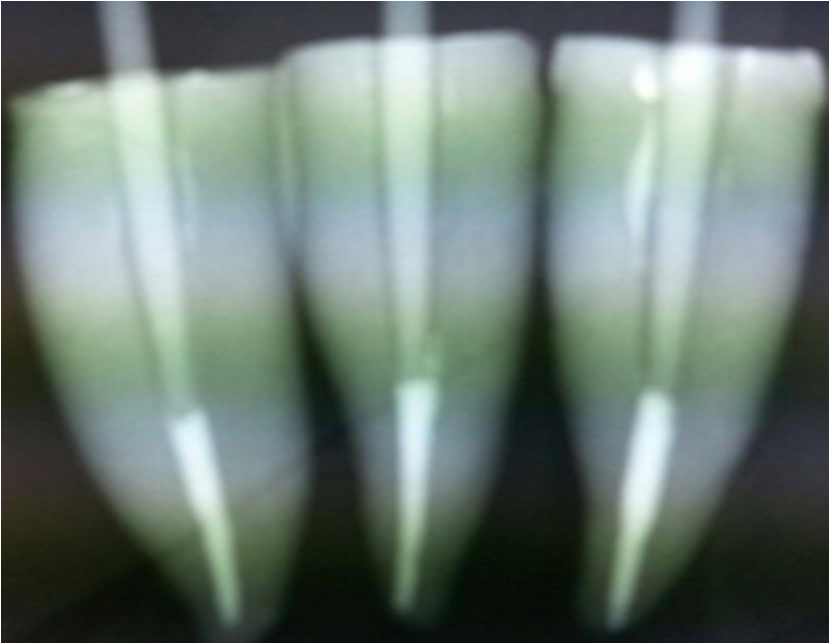
2.4. Root Preparation to Receive Fiber Post: for Group 1 and 2After complete setting of the obturated canals, the teeth of group 1 and 2, the canals was prepared to receive Fiber Post (RelyX , 3M, ESPE) using the drill of the same size and the same post system, to remove the gutta-percha, leaving 4 mm of the gutta-percha from the root apex. The coronal post level was adjusted to become 2 mm below the incisal edge, and was cemented using self-adhesive universal resin cement (RelyX ,Unicem , 3M,ESPE) . the activated capsule was triturated and dispensed to the post and the canal. the post was seated with pressure. the excess was removed and the Light cure was used for 40 seconds. Figure 2

For groups 1and 2, Composite core was built up, Composite core (Z250XT, 3MESPE, USA) was used, to build up the coronal portion with a standardize dimensions of the upper canine, with 4 mm height from the cervical, and the axial walls was prepared with slight convergence. For group 1, the teeth were prepared for full coverage porcelain fused metal crown.,0.8 mm deep chamfer finish line using a tapered round diamond stone, on sound tooth structure above the cervical. the height of axial wall was adjusted, and preparation of 0.2 mm circumferential ferrule. group 2, all samples were prepared to receive full coverage all ceramic crowns. Preparation of Supracervical 1 mm shoulder finish line on tooth structure was done, using a tapered flat diamond stone. axial wall heights were prepared ,0. 2 mm circumferential ferrule was prepared 3.
2.6. Group 3 Preparation for Endocrown ConstructionAll 8 teeth of group 3 were prepared for ceramic endocrown restorations. in the space of pulp chamber, a central inlay like cavity, with an oval anti-rotational shape was prepared with 5 mm depth from the cavo-surface margin. All the cavity point and line angles were rounded and smoothed. On tooth structure 1 mm cervical shoulder finish line was prepared using a flat tapered diamond stone. And 0.2 mm ferrule was circumferential the tooth.
2.7. Impression and Laboratory TechniquesAll the prepared samples of all groups: group 1: full coverage Porcelain fused metal Crown. group 2: full coverage all ceramic crowns, and group 3: ceramic endocrowns restoration, an individual heavy and light impression was made by poly-vinyl siloxane impression material (Virtual, Ivoclar-vivadent) and was poured using Super Hard die stone type IV (Diestone Type IV, denflo, perevestdenpro limited). regarding to the manufacturer’s directionsanickel chromium alloy copings (Realloy-N, EMF- Dentallegierungen, Germany), and porcelain veneering (ceramico IC ceramic Dentsply DeguDent GmbH Germany made in USA), full coverage Porcelain fused metal Crowns was constructed.
All ceramic crowns and endcrowns were constructed according to the manufacturer’s instructions. the injection technique was used for pressing IPS E-max (Ivoclar-Vivadent) for crowns fabrication.
Bonding procedure for external fixed coronal restorations: Figure 3

The all full coverage porcelain fused metal crowns were cleaned, dried, sandblasted and cemented with cement-it universal c & b resin cement according to the manufacturer’s instructions. (Clinical Technologies of Pentron , CT 06492 U.S.A). 10 min finger pressure, and the extruded cement was removed using a sharpened chisel. Bonded samples were stored in saline solution for 24hr.
2.9. Cementation of Full Coverage All-Ceramic Crowns and EndocrownsThe fitting surface of the all-ceramic crowns, either full coverage crowns or endocrownswere etched with 9.5% buffered hydrofluoric acid gel (Porcelain etch, Ultradent South Jordan, Utah, USA) for 1 min., washed and dried. Silane was used (Silane, Ultradent, South Jordan, Utah, USA) for 1 min. and dried. adhesive agent (Tetric N-Bond, IvoclarVivadent, Liechtenstein) was cured for 20 seconds. the adhesive was applied to the prepared tooth surface. each crown was cemented to its tooth sample with dual cure cement (Variolink N, IvoclarVivadent, Liechtenstein). and all excess was removed before curing.
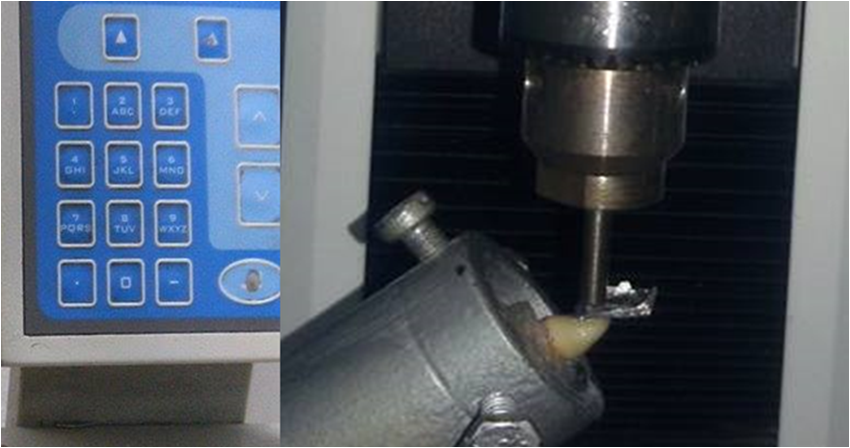
2.10. Measurement of Fracture ResistanceUsing a universal testing machine (Model LRX-plus; Lloyd Instrument Ltd., Fareham, UK). A 0.5 mm tin foil sheet was placed between the steel rode in the upper movable compartment of the machine and crown to ensure even stress distribution and minimize the transmission of local force peaks on the ceramic surface. Each sample was mounted into a special applicator in turn placed onto the lower fixed compartment with an inclination of 45 degrees and then loaded to failure using the upper plate of the machine. the round tip steel rode with a diameter of 3.6 mm placed at the center of the incisal surface of the sample. The samples subjected to a slowly increasing load at 1.0 mm per minute a constant crosshead speed until an audible crack or fracture occurred. automatically Load Newton (N) was recorded. using computer software (Nexygen-MT- 4.6; Lloyd Instruments). Figure 4

Mode of fracture for each sample was recorded using a digital microscope (Scope Capture Digital Microscope, Guangdong, China) at × 25 magnifications after fracture.
All the results were statistically analyzed, using one-way analysis of variance (ANOVA). and Tukey’s post hoc significance difference tests and the Differences were considered significant at P< 0.05.
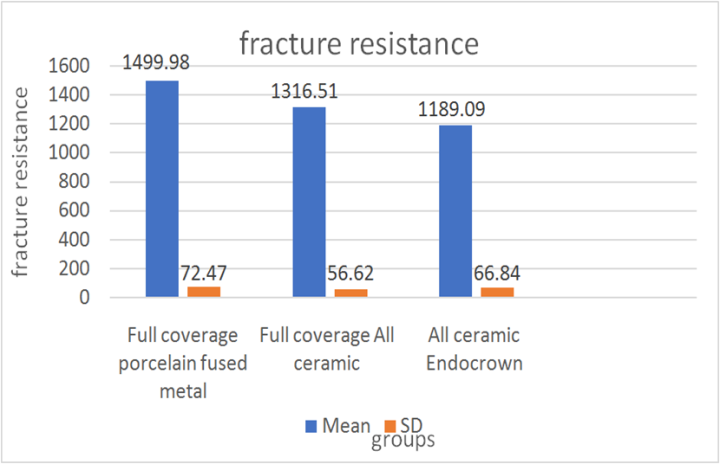
Mean fracture resistance and standard deviations (SD) of the tested groups are recorded in Table 1 and graphically drawn Figure 5.
As indicated by one-way ANOVA test, it was found that
group 1: Porcelain fused metal Crown
statistically significant (p <0.05) mean value (1499.98 ±72.47N).
group 2: all ceramic conventional crown
recorded statistically significant (p <0.05) highest mean value (1316.51 ±56.62N)
group 3: ceramic endocrown (1189.09 ±66.84N)
Tukey’s post-hoc test showed significant (P>0.05) difference between groups.

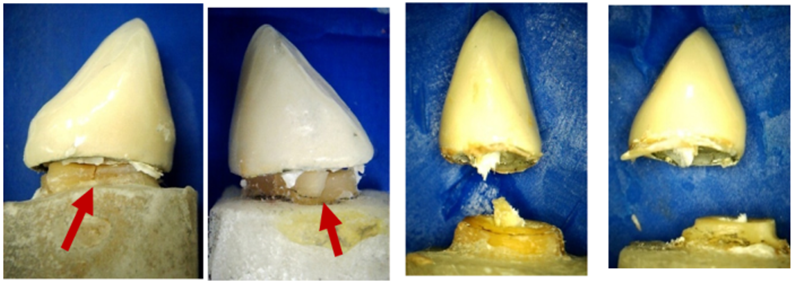
Different types of fracture were noticed in all groups. group 1 and 2, complete horizontal fracture of crown and core at the cervical area (total separation). the fiber post was fractured horizontally. In most samples the fracture pattern is favorable. the most type of fracture was above the CEJ. In some samples fracture of roots was occurred below the cervical area.
group 3, All ceramic endocrowns groups showed that the fracture below the CEJ. Figure 6
This study was to determine the effect of permanent fixed restoration on the fracture resistance of endodontic treated teeth. Three different types of external fixed coronal restoration materials and design with 3 groups was used. Group 1: full coverage porcelain fused metal crown, Group 2: full coverage all-ceramic crown and Group 3: ceramic Endocrown. coronal preparation was made with 2.0 mm ferrule preparation and post system (fiber posts) was used with both group 1 and 2. And endo crown preparation was used with group 3.
According to the statistical results of this study, it was found that mean fracture resistance ± standard deviations (SD) of the tested groups are recorded in Table 1 and graphically drawn Figure 5. As indicated by one-way ANOVA test. In this study one of choice, was to use full coverage porcelain fused metal restoration as a group, because its high strength, highest margin adaptation, and lesser tooth preparation .it was found that its fracture resistance is higher than the two other groups. Where statistically significant (p <0.05) with highest mean value (1499.98 ±72.47N). while, for group 2: all ceramic conventional crown, recorded statistically significant (p <0.05) with mean value (1316.51 ±56.62N). for group 3: ceramic endocrown .it was found that its fracture resistance is lower than the two other groups (1189.09 ±66.84N). According to the Tukey’s post-hoc test the significant (P>0.05) difference between the three groups was found.
many studies reported that endocrown restoration is a good option for badly damaged teeth and endodontically treated posterior. Some dentists recommended the idea of endocrown restoration for restoring the endodontically treated premolars 8, 9.
Some authors concluded that the fracture resistance of endodontically treated for the mandibular premolars all-ceramic crown and endocrown and glass fiber post-and core and with ferrule was increased more than that the preparation without ferrule also they concluded that the endodontically treated mandibular premolars should not be restored with endocrown in the absence of ferrule, so in this study we prefer to prepare the samples with o.2 ferrule 10.
othersfound by using the finite element that the premolars endocrown restorations was favorable. And others, found that the endodontically treated premolars with conventional and endocrown restorations not significantly differ. and This was explaned that the lower stress values of endocrown restorations because decrease the effect of multiple interfaces because endocrown consider as a single unit. And thicker occlusally than the conventional crown 11, 12, 13.
Some authors recorded that the high strength of Lithium disilicate ceramics and acid etching; enhance the micromechanical interlocking with the tooth surface. therefore, was used for construction of both conventional crowns and endocrowns because the adhesive properties of this type of ceramic crown. and this explain why the failure mode of debonding of either conventional crown or endocrown occur without fracture of restoration 10, 14.
Many researchers studied the strength of the restored with ceramic endocrowns and custom-made . They found that the anterior tooth restored with custom post and core was the lowest stresses. they concluded that, Endocrowns made of lithium disilicate ceramic are resistant to failure, and Posts with conventional crowns are widely recommended for anterior teeth restorations. and Leucite ceramic endocrowns may fracture during physiological loading 15.
Many authors evaluated the effect of depth of endocrown restoration design and post&crown and CAD/CAM composite or lithium disilicate glass-ceramic on the load-to-failure of endodontically treated without ferrule. they concluded that, a shallower deep endocrown composite more favorable than lithium disilicate and explained by their difference in elastic modulus. And the surface area of Shallow endocrown not enough for adhesive cement and the difference in fixed material have apparent effect in terms of load-to-failure. The more flexible material the better selection 16.
Researchers attempted to study the Shear forces, used an IPS e.max ceramic endocrown and a conventional restoration: metal post and glass fiber post and composite resin core, and concluded that, the resistance to fracture of endocrown better compared and the fracture is more favorable than the conventional restorations 17.
Researchers Studied the effect of endocrowns and glass fiber postretained crowns on the fracture resistance of endotreated teeth with different ceramics: glass fiber posts with lithium disilicate crowns, Lithium disilicate endo-crowns and Hybrid ceramic endo-crowns. They found that, all the fracture resistance loads were away the maximum forces of mastication and the fracture resistance of hybrid ceramic was higher. And favorable fracture pattern for hybrid ceramic 18.
In this study fiber post was used because more favorable and near modulus of elasticity(40Gpa) to dentin (20Gpa), lesser stress distribution, esthetic posts and translucent. better transverse strength and reinforces the intra-radicular tooth structure by creation of a monoblock. 5, 19, 20, 21 and this explain the post fractures the absence of root fracture in gr 1 and 2. therefore, this is significant for a clinical application because this type of fracture is easier to repair than unfavorable root fracture.
Within the limits of this study we can conclude that: The external fixed coronal restorations affect significantly in the resistance to Fracture of endodontically treaded teeth. the most of fracture pattern of full coverage restoration is more favorable.
| [1] | El-Damanhoury H, Haj-Ali R, and Platt J. Fracture resistance and microleakage of endocrowns utilizing three CAD-CAM blocks. J operative Dent 2015; 40: 201 - 10. | ||
| In article | View Article PubMed | ||
| [2] | Forberger N and Göhring T. Influence of the type of post and core on in vitro marginal continuity, fracture resistance, and fracture mode of Lithia disilicate-based all-ceramic crowns. J Prosthet Dent 2008; 100: 264-73. | ||
| In article | View Article | ||
| [3] | Abo-Elmagd AAA and Abdel-Aziz M. Influence of Marginal Preparation Design on Microleakage And Marginal Gap Of Endocrown Cemented With Adhesive Resin Cement. EDJ 2015; 61: 5481-5489. | ||
| In article | |||
| [4] | Lin C, Chang Y, Chang C, Pai C, and Huang S. Finite element and Weibull analyses to estimate failure risks in the ceramic endocrown and classical crown for endodontically treated maxillary premolar. Eur. J of Oral Science 2010; 118: 87-93. | ||
| In article | View Article PubMed | ||
| [5] | Abo-Elmagd AAA and Eid BM Effect of Post System and Thermo-Mechanical Cycling Treatments on Root Fracture of Teeth Restored with Porcelain Fused Metal Crown. EDJ 2016; 62: 4333-4342. | ||
| In article | |||
| [6] | Juloski J, Radovic I, Goracci C, Vulicevic ZR and Ferrari M. Ferrule effect: A literature review. J Endod 2012; 38: 11-9. | ||
| In article | View Article PubMed | ||
| [7] | Makade CS, Meshram GK, Warhadpande M, and Patil PG. A comparative evaluation of fracture resistance of endodontically treated teeth restored with different post core systems - an in-vitro study. J Adv Prosthodont 2011; 3: 90- 5. | ||
| In article | View Article PubMed | ||
| [8] | Fages M and Bennasar B. The endocrown: a different type of all-ceramic reconstruction for molars. J of Can Dental Assoc 2013; 79: 140. | ||
| In article | |||
| [9] | Lin C, Chang Y, Chang C, Pai C, Huang S. Finite element and Weibull analyses to estimate failure risks in the ceramic endocrown and classical crown for endodontically treated maxillary premolar. Eur J of Oral Scienc 2010; 118: 87-93. | ||
| In article | View Article PubMed | ||
| [10] | Abdel-Aziz M andAbo-Elmagd AAA. Effect of Endocrowns And Glass Fiber Post-Retained Crowns on The Fracture Resistance of Endodontically Treated Premolars. EDJ 2015; 61: 3203-3210. | ||
| In article | |||
| [11] | Lin C, Chang Y, and Pa C. Estimation of the risk of failure for an endodontically treated maxillary premolar with MODP preparation and CAD/CAM ceramic restorations. J of Endod 2009; 35: 139 - 45. | ||
| In article | View Article PubMed | ||
| [12] | Lin C, Chang Y, Hsieh S and Chang W. Estimation of the Failure Risk of a Maxillary Premolar with Different Crack Depths with endodontic treatment by computer-aided design/computer-aided manufacturing ceramic Restorations. J Endod. 2013; 39: 375-9. | ||
| In article | View Article PubMed | ||
| [13] | Lin C, Chang Y, Pai C. Evaluation of failure risks in ceramic restorations for endodontically treated premolar with MOD preparation. Dental Mater 2011; 2 7: 431-8. | ||
| In article | View Article PubMed | ||
| [14] | Biacchi G, and Basting R. Comparison of fracture strength of endocrowns and glass fiber post-retained conventional crowns. J operative Dent 2012; 37: 130 - 6. | ||
| In article | View Article PubMed | ||
| [15] | Dejak B . Strength comparison of anterior teeth restored with ceramic endocrowns vs custom-made post and cores. 2018; 171-176 | ||
| In article | View Article PubMed | ||
| [16] | Lise PDP , J D , TYU ,. Biomechanical behavior of endodontically treated premolars using different preparation designs and CAD/CAM materials. : 54-61. | ||
| In article | View Article PubMed | ||
| [17] | Atash R, Arab M, Duterme H, Cetik S. Comparison of resistance to fracture between three types of permanent restorations subjected to shear force: An in vitro study. The Journal of Indian Prosthodontic Society 2017; 17: Issue 3. | ||
| In article | View Article PubMed | ||
| [18] | Al-shibri S and Elguindy J. Fracture Resistance of Endodontically Treated Teeth Restored with Lithium Disilicate Crowns Retained with Fiber Posts Compared to Lithium Disilicate and CerasmartEndocrowns: In Vitro Study. Dentistry 2017; 7:12. | ||
| In article | View Article | ||
| [19] | Vidya N V and Deepa P C. A comparative evaluation of the fracture resistance of endodontically treated teeth with compromised intra radicular tooth structure using three different post system. People’s Journal of Scientific Research 2011; 4(1). | ||
| In article | |||
| [20] | Powers J M. Cements in Restorative dental materials. RG Craig, JM Powers (Eds.) 2002;11th Edn : 594-634. | ||
| In article | |||
| [21] | Bacchi A, Fernandes dos Santos M B, Pimentel M J, Caetano C R, Sinhoreti M A C, Consani R L X. Influence of post-thickness and material on the fracture strength of teeth with reduced coronal structure. Journal of Conservative Dentistry 2013; 16: 139-143. | ||
| In article | View Article PubMed | ||
Published with license by Science and Education Publishing, Copyright © 2020 Amal Abdallah A. Abo-Elmagd
 This work is licensed under a Creative Commons Attribution 4.0 International License. To view a copy of this license, visit
http://creativecommons.org/licenses/by/4.0/
This work is licensed under a Creative Commons Attribution 4.0 International License. To view a copy of this license, visit
http://creativecommons.org/licenses/by/4.0/
| [1] | El-Damanhoury H, Haj-Ali R, and Platt J. Fracture resistance and microleakage of endocrowns utilizing three CAD-CAM blocks. J operative Dent 2015; 40: 201 - 10. | ||
| In article | View Article PubMed | ||
| [2] | Forberger N and Göhring T. Influence of the type of post and core on in vitro marginal continuity, fracture resistance, and fracture mode of Lithia disilicate-based all-ceramic crowns. J Prosthet Dent 2008; 100: 264-73. | ||
| In article | View Article | ||
| [3] | Abo-Elmagd AAA and Abdel-Aziz M. Influence of Marginal Preparation Design on Microleakage And Marginal Gap Of Endocrown Cemented With Adhesive Resin Cement. EDJ 2015; 61: 5481-5489. | ||
| In article | |||
| [4] | Lin C, Chang Y, Chang C, Pai C, and Huang S. Finite element and Weibull analyses to estimate failure risks in the ceramic endocrown and classical crown for endodontically treated maxillary premolar. Eur. J of Oral Science 2010; 118: 87-93. | ||
| In article | View Article PubMed | ||
| [5] | Abo-Elmagd AAA and Eid BM Effect of Post System and Thermo-Mechanical Cycling Treatments on Root Fracture of Teeth Restored with Porcelain Fused Metal Crown. EDJ 2016; 62: 4333-4342. | ||
| In article | |||
| [6] | Juloski J, Radovic I, Goracci C, Vulicevic ZR and Ferrari M. Ferrule effect: A literature review. J Endod 2012; 38: 11-9. | ||
| In article | View Article PubMed | ||
| [7] | Makade CS, Meshram GK, Warhadpande M, and Patil PG. A comparative evaluation of fracture resistance of endodontically treated teeth restored with different post core systems - an in-vitro study. J Adv Prosthodont 2011; 3: 90- 5. | ||
| In article | View Article PubMed | ||
| [8] | Fages M and Bennasar B. The endocrown: a different type of all-ceramic reconstruction for molars. J of Can Dental Assoc 2013; 79: 140. | ||
| In article | |||
| [9] | Lin C, Chang Y, Chang C, Pai C, Huang S. Finite element and Weibull analyses to estimate failure risks in the ceramic endocrown and classical crown for endodontically treated maxillary premolar. Eur J of Oral Scienc 2010; 118: 87-93. | ||
| In article | View Article PubMed | ||
| [10] | Abdel-Aziz M andAbo-Elmagd AAA. Effect of Endocrowns And Glass Fiber Post-Retained Crowns on The Fracture Resistance of Endodontically Treated Premolars. EDJ 2015; 61: 3203-3210. | ||
| In article | |||
| [11] | Lin C, Chang Y, and Pa C. Estimation of the risk of failure for an endodontically treated maxillary premolar with MODP preparation and CAD/CAM ceramic restorations. J of Endod 2009; 35: 139 - 45. | ||
| In article | View Article PubMed | ||
| [12] | Lin C, Chang Y, Hsieh S and Chang W. Estimation of the Failure Risk of a Maxillary Premolar with Different Crack Depths with endodontic treatment by computer-aided design/computer-aided manufacturing ceramic Restorations. J Endod. 2013; 39: 375-9. | ||
| In article | View Article PubMed | ||
| [13] | Lin C, Chang Y, Pai C. Evaluation of failure risks in ceramic restorations for endodontically treated premolar with MOD preparation. Dental Mater 2011; 2 7: 431-8. | ||
| In article | View Article PubMed | ||
| [14] | Biacchi G, and Basting R. Comparison of fracture strength of endocrowns and glass fiber post-retained conventional crowns. J operative Dent 2012; 37: 130 - 6. | ||
| In article | View Article PubMed | ||
| [15] | Dejak B . Strength comparison of anterior teeth restored with ceramic endocrowns vs custom-made post and cores. 2018; 171-176 | ||
| In article | View Article PubMed | ||
| [16] | Lise PDP , J D , TYU ,. Biomechanical behavior of endodontically treated premolars using different preparation designs and CAD/CAM materials. : 54-61. | ||
| In article | View Article PubMed | ||
| [17] | Atash R, Arab M, Duterme H, Cetik S. Comparison of resistance to fracture between three types of permanent restorations subjected to shear force: An in vitro study. The Journal of Indian Prosthodontic Society 2017; 17: Issue 3. | ||
| In article | View Article PubMed | ||
| [18] | Al-shibri S and Elguindy J. Fracture Resistance of Endodontically Treated Teeth Restored with Lithium Disilicate Crowns Retained with Fiber Posts Compared to Lithium Disilicate and CerasmartEndocrowns: In Vitro Study. Dentistry 2017; 7:12. | ||
| In article | View Article | ||
| [19] | Vidya N V and Deepa P C. A comparative evaluation of the fracture resistance of endodontically treated teeth with compromised intra radicular tooth structure using three different post system. People’s Journal of Scientific Research 2011; 4(1). | ||
| In article | |||
| [20] | Powers J M. Cements in Restorative dental materials. RG Craig, JM Powers (Eds.) 2002;11th Edn : 594-634. | ||
| In article | |||
| [21] | Bacchi A, Fernandes dos Santos M B, Pimentel M J, Caetano C R, Sinhoreti M A C, Consani R L X. Influence of post-thickness and material on the fracture strength of teeth with reduced coronal structure. Journal of Conservative Dentistry 2013; 16: 139-143. | ||
| In article | View Article PubMed | ||