Because of its ease of application, cheap cost, and non-invasiveness, research on rheoencephalography (REG) parameters for the early identification of cerebrovascular atherosclerotic lesions is of significant interest to scientists. The purpose of neuromonitoring in both the neurosurgical critical care unit and during the evacuation of injured military service personnel is to avoid brain injury caused by cerebral blood flow autoregulation failure. There is currently no one measuring technique capable of monitoring brain injuries such as hypoxia, ischemia, high intracranial pressure, edema, intracranial hemorrhage, and vasospasm. The identical results obtained by laser Doppler flowmetry and rheoencephalography show that REG, like laser Doppler flowmetry, represents cerebral blood flow autoregulation. As a result, REG has the potential to be used as a continuous neuromonitoring approach. Therefore, we examined the available databases from prior REG investigations. We hope to organize the essential aspects concerning the equipment, methodologies, and REG wave findings based on document comparison and synthesis. Although REG has less clinical use in the diagnosis of cerebrovascular illness, it may offer information on changes in cerebral circulation that occur with age or diffuse cerebrovascular disease. In summary, our findings suggest that the bioimpedance technique (REG) may identify the first indication of cerebral arteriosclerosis, which is the loss of flexibility of cerebral arteries.
Recent research suggests that measuring the brain's electrical impedance through rheoencephalography (REG) may hold great promise as a non-invasive and continuous technique for monitoring cerebral blood flow autoregulation in humans. This method could potentially provide valuable insights into the functioning of the human brain without the need for invasive procedures. By allowing for the monitoring of cerebral blood flow autoregulation in real-time and over extended periods, REG could prove to be a valuable tool for studying a wide range of neurological conditions and disorders. With further research and development, REG could revolutionize the field of neuromonitoring and lead to significant advancements in our understanding of the human brain 1. Cerebral blood flow autoregulation (CBF AR) is an important mechanism that helps maintain adequate blood supply to the brain. This is especially crucial in times of fluctuations in blood pressure, which can occur in a variety of situations such as during exercise, stress, or changes in body position. When autoregulation fails, it can lead to inadequate blood flow to the brain, which can result in serious neurological consequences such as stroke, brain damage, or even death. Therefore, monitoring and maintaining cerebral blood flow autoregulation is an important aspect of managing patients with acute neurological diseases 2.
REG may offer information about changes in cerebral circulation that occur with age or diffuse cerebrovascular illness, even if it has little clinical utility in the diagnosis of cerebrovascular disease 3. The current research was carried out to get a fundamental knowledge of the potential of REG for application in the development of a non-invasive brain monitor capable of continually measuring the integrity of CBF AR. The capacity of REG to identify vasoreactivity makes it suitable as a prospective brain monitoring technique. REG has the potential to be used as a noninvasive, continuous neuromonitoring device in the neurosurgical critical care unit, during the treatment and transfer of injured military personnel, and in air and space research 1.
The capacity of REG to identify vasoreactivity makes it suitable as a prospective brain monitoring technique. With the application of the 'optimal cerebral perfusion pressure' paradigm (CPP), continuous CBF AR monitoring would have predictive significance, reveal pathological states, and perhaps impact treatment 4. Because it is non-invasive and provides for an accurate evaluation of both morphology and hemodynamics, Doppler ultrasonography of cerebral blood vessels is now utilized to diagnose cerebral vascular damage. However, pulse Doppler ultrasonography requires competence from the sonographer, is rather expensive, and is only available in a few specialist medical institutions. Furthermore, the deployment procedure takes time and is inappropriate for screening programs. As a result, REG is a viable choice. REG is a useful tool for determining cerebrovascular health and cerebral circulation. REG, unlike Doppler ultrasonography, can identify cerebrovascular atherosclerosis at an earlier stage 5, 6.
Moreover, CBF AR was assessed in rats during CO2 inhalation (a vasodilatory stimulus) in this work 1. There is a substantial link between cerebrovascular reactivity (CVR) and ventilatory response to CO2. CBF and its distribution are extremely sensitive to variations in arterial CO2 partial pressure (pCO2). This physiological response (cerebrovascular CO2 reactivity) is a critical homeostatic function that aids in the regulation and maintenance of central pH, which influences the respiratory central chemoreceptor stimulation. CBF rises in response to hypercapnia to wash out CO2 from brain tissue, therefore attenuating the rise in central pCO2; in contrast, hypocapnia promotes cerebral vasoconstriction, which decreases CBF and attenuates the decline in brain tissue pCO2 7. Carbon dioxide is the best vasoactive stimulation 8. Acetazolamide and CO2-induced cerebral vasomotor stimulation are viable approaches for measuring perfusion reserve loss owing to extracranial cerebrovascular occlusive illness 9.
Doppler ultrasonography of cerebral blood vessels is now utilized to examine cerebral vascular damage since it is non-invasive and provides for reliable evaluation of both morphology and hemodynamics. However, pulse Doppler ultrasonography requires the sonographer's competence, is rather expensive, and is only available in a few specialist medical institutions. Furthermore, the deployment method is time-consuming and inappropriate for screening programs. As a result, REG is an option to explore. REG is a useful tool for measuring cerebrovascular health and cerebral circulation. REG may identify cerebrovascular atherosclerosis earlier than Doppler ultrasound. This is also a non-invasive technology that is simple to use and may be utilized for continuous assessment in the diagnosis of cerebral atherosclerosis 10. Therefore, we conducted an analysis of the available databases from previous studies on REG. From the comparison and synthesis of documents, we wish to systematize the main points about the equipment, techniques, and REG wave results.
The gadget employs electrical bio-impedance to assess participants' cerebral artery flexibility owing to arteriosclerosis. The impedance pulse curve is known as REG when measured on the skull - a noninvasive method recognized by the United States Food and Drug Administration as a tool for assessing cerebral blood flow 11.
The processes for measuring REG were described and directed to the patient, who understood and behaved effectively throughout the process. Anthropometric measures (weight and height) were collected for each subject before obtaining measurements.
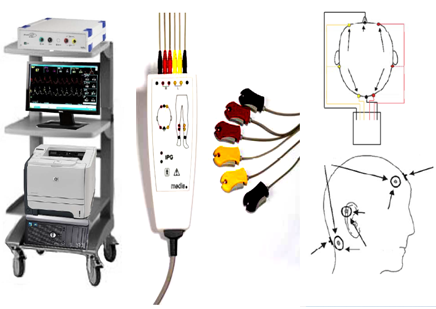
Can Tho University of Medicine and Pharmacy Hospital in Vietnam has been employing a VasoScreen 5000 REG meter (Medis GmbH, Ilmenau, Germany). The gadget is a REG II (second-generation REG recorder). It was a dual-channel (left and right) meter with one ECG channel (Figure 1a). The measuring technique was based on six electrodes (two emitters and four receivers) (Figure 1b). Measuring current (1.5mArms1%, 85kHz), basic impedance (0-200Ohm1%, 0-1.5Hz), impedance change (6.25Ohm2%, 0-1.5Hz), pulse wave (500mOhm2%, 0.2-120Hz), noise (1mOhm), and application (head, legs, arms) were all included in the rheography impedance. Input voltage (maximum 10mV AC 0,2-120Hz), CMMR (>90dB), noise voltage (10V), and test signal (1mV) were all present on an ECG channel. The primary power supply was adjusted to 115-230V 10%, 50-60 Hz, and 60VA. The machine made use of 8 circular aluminum electrodes with a diameter of 2 cm. By convention, the red electrode wire was on the right and the yellow electrode wire was on the left (Figure 1c). CardioVascular Lab software was used to examine the REG pulse wave. The data were undoubtedly generated using CardioVascular Lab software 10.
There were certain stages involved in measuring REG. To begin, the patient was measured in a comfortable sitting posture, with his back and head straight on a chair, his eyes closed, and his breathing steadily throughout the measurement.
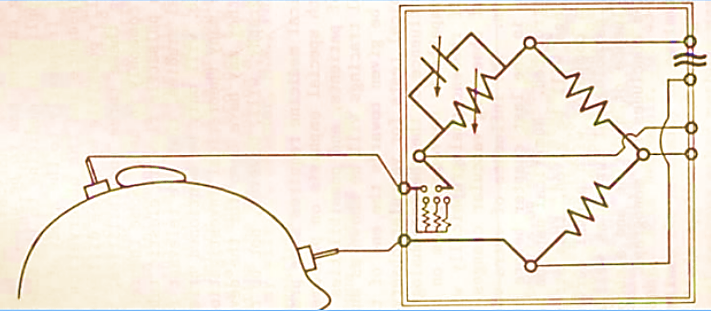
We attached the electrode with a rubber band. The rubber band was then tied around the landmarks: the center of the forehead in front, the occipital bone in behind, and the mastoid region behind the ear. We assessed blood flow characteristics in the forehead-mastoid, mastoid-occipital, and frontal-occipital leads on both hemispheres at the same time based on the Wheatstone bridge principle (Figure 2). The blood parameters were then kept in these three leads with the names Head-partial 1, 2, and 3 respectively.
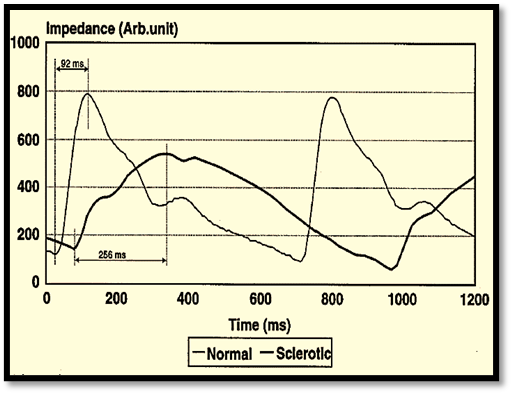
After recording, the blood circulation indicators would be printed on paper and recorded on a computer for analysis. The processed REG pulse pulses lasted 15 to 20 minutes. Each lead has two pulse waves averaged from the left and right sides. There are common discrepancies between a normal individual's REG waves and those of a sclerotic one. In normal patients, the peak time is around 92 milliseconds, while in sclerotic patients, it is around 256 milliseconds. This difference has pathological implications that are independent of heart rate (Figure 3) 12.


The data processing employed is the finest example of how REG development is an interdisciplinary issue. REG filtering was first implemented in the 1970s using an analog filter. Additional data processing modules based on analog circuitry were also developed 13. Osadchikh and Ronkin (1976) defined cerebrovascular atherosclerotic state as increased vascular tone and reduced blood flow intensity in REG 14.
Peak waves (sharp, obtuse, domed) and subwave (clear, hazy, nonexistent) are characteristics of REG waveforms. Typically, the curve features abrupt peaks and distinct subwaves. The parameters used to assess cerebral vascular tone have four values. Peak time is the amount of time it takes to travel from the first beginning point to the vertex of a REG wave. Peak width is the duration between two places on each side of a REG wave's vertex. Conduction time is the time it takes between the start of the QRS complex on an ECG to the commencement of a REG wave. The elasticity index (alpha/T) is the ratio of ascending branch time (α) to REG wave cycle duration (T). The metrics evaluating blood flow intensity have three values. The slope ratio is the ratio of the maximum slope of the ascending branch to the device's preset background impedance. The percentage of blood volume in each hemisphere of the brain in one minute is known as alternating blood flow (ABF). The rate of the peripheral impedance to the background impedance is defined as the impedance ratio 10.

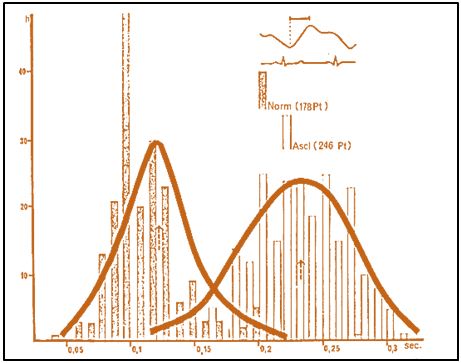
The data were averaged across 100 phases for each patient (Pt), which included 246 patients with cerebral arteriosclerosis (Ascl) and 246 patients with 178 normal individuals. They had all undergone carotid artery imaging. The incidence or case number (frequency) is the Y-axis's unit (Figure 4) 12. Atherosclerosis, a common cardiovascular disease, is characterized by the buildup of plaque in the arteries, which can lead to a reduction in blood flow and an increased risk of heart attack or stroke. In the majority of cases of atherosclerosis, there is a noticeable loss of the side wave crest, which is a common occurrence and can be indicative of this disease. The side wave crest refers to a wave pattern in the blood flow that is commonly seen in healthy individuals. However, in individuals with atherosclerosis, this wave pattern can be disrupted, leading to a loss of the side wave crest. This disruption is a result of the buildup of plaque in the arteries that causes the blood flow to become turbulent and disorganized. Therefore, the loss of the side wave crest is an important diagnostic indicator of atherosclerosis and should be closely monitored by healthcare professionals 15.
In the different stages of atherosclerotic disease, the waveform initially appears rounded or slightly flat (obtuse), with blurred subwaves. As the disease progresses, the waveform peaks become dome-shaped or plateaued, and the subwaves become very faint or disappear altogether. This pattern indicates increased cerebral vascular tone, which is indicative of decreased elasticity of the vascular wall. The study found that the peak time ranged from 200-230ms or more in the stage of evident atherosclerosis. As atherosclerosis progresses, vascular elasticity diminishes, resulting in greater cerebral vascular tone and an increase in peak time 16. In a study conducted by Bodo et al. on 546 subjects at high risk of cerebrovascular accidents, it was found that increasing peak time decreases arterial elasticity. The normal standard value for this parameter, an early marker of cerebral atherosclerosis, is 180ms. This parameter is a better indicator of early cerebral atherosclerosis compared to carotid Doppler ultrasound 17. The studies have shown the significant role of REG in diagnosing atherosclerosis in different subjects. This is demonstrated by an increase in vascular tone and a decrease in blood flow intensity in both hemispheres of the brain. While the results of each study on different disease groups vary, similarities can be observed when these groups are compared to their respective control groups. Perez and Guijarro have also suggested that the thickness of the scalp and extracranial circulation can influence REG waves [18-20] 18. Recent research has shown that waveform differences between extra and non-extracranial components are significant and could be used to distinguish between the two. However, it is important to note that a significant portion of the REG I signal is caused by a non-extracranial source, which means that it should not be relied upon as a footprint of the extracranial blood flow 21. According to the research, REG is a reliable method for assessing cerebral blood flow abnormalities. When monitoring the change in resistance of an organ, such as the brain, only the change in the amount of blood circulating through it affects the resistance, as other factors remain constant. Thus, monitoring the resistance change allows us to assess the cyclic state of that organ. The cranium can be viewed as a model of electrical charge, with the skin, muscle, and skull bones under each recording electrode represented by the charge cell. Therefore, changes in recorded electrical resistance mainly reflect the circulation of blood through the brain. When blood flow through the brain decreases, the resistance increases and the amperage decreases 22. According to a study, light-to-moderate alcohol consumption can decrease the risk of ischemic stroke by reducing atherothrombotic events, but the underlying mechanism is unclear. On the other hand, heavy drinking increases the risk of both hemorrhagic and ischemic strokes. Regular alcohol consumption can harm both neuronal tissue and cerebral arteries. The study measured the effects of regular alcohol consumption on the nervous system, including vascular, psychological, and cognitive deterioration and somatic comorbidity. The study found a striking difference between healthy older U.S. subjects and older alcoholic Hungarian subjects, which may be partially explained by higher Hungarian cardiovascular risk and stroke mortality compared to US data. The study used various methods to measure the effect of regular alcohol consumption on the nervous system, including REG anacrotic time. In 11 subjects in the Hungarian alcoholic group, pathological REG was observed. The correlation between increased REG and daily alcohol consumption supports the accelerated cerebrovascular aging of the alcoholic subjects. Further study will be performed for exclusion of higher Hungarian cardiovascular risk factors, which may influence the increased REG anacrotic time 23.
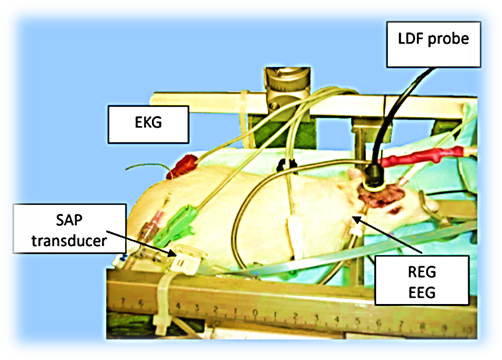
M. Bodo et al. conducted a cerebrovascular reactivity study in rats (Figure 5) in 2004 24.

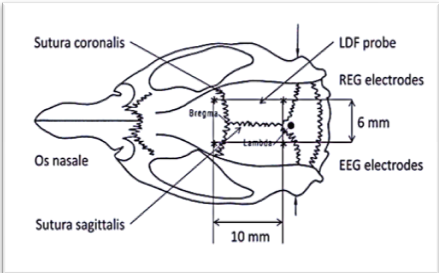
In 2016, they continued to examine the effects of CO2 inhalation on brain blood flow. The study involved twenty-eight male Wistar rats, each of which was exposed to three CO2 inhalation challenges. Brain blood flow was recorded using a laser Doppler flowmeter, while REG amplifiers were used to measure the brain's electrical activity. Each rat inhaled 15-20% CO2 gas for 30 seconds while the exhaled CO2 concentration was measured with a CO2 analyzer. Data were acquired at a 200Hz sampling rate and signals were stored in a Dell computer equipped with an analog/digital converter card with 16-bit resolution. The experiment involved securing the head of each rat using a gas anesthesia head holder designed for rats, and removing the skin to expose the cranium. Hydrogen peroxide was used to rinse the exposed bone before drilling four burr holes for the insertion of intracranial electrodes. Frontal electrodes were placed 2mm in front of the sutura coronalis and the inter-electrode distance was 6mm and 10mm. REG electrodes were placed at a 5mm depth and the EEG ground was inserted in neck muscle tissue. The electrodes were fixed to the skull with instant adhesive and dental acrylate, and were connected to cables and EEG and REG amplifiers. Additional amplifier channels were used for recording electroencephalograms, electrocardiograms, and respiration by thoracic impedance (Figure 6) 1.

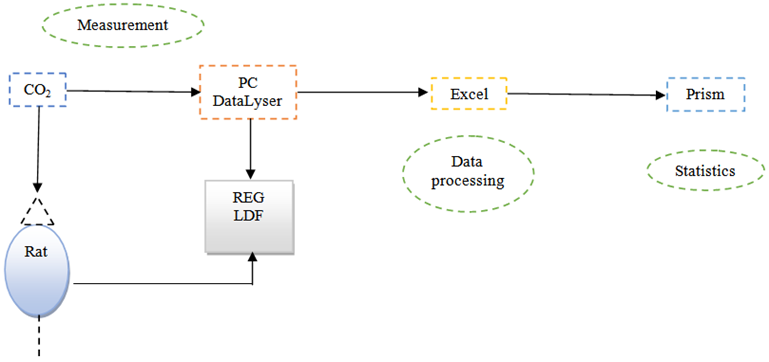
The data was processed using DataLyser (Figure 7), with respiratory subharmonics removed by a high-pass Chebyshev filter at 2 Hz and noise removed via a 0.1 Hz running average. The first derivative of REG was calculated, the signal was rectified and a running integral was calculated with a 5-second window. Basic statistics were calculated for 30-second periods marked by cursors during baseline and maximal amplitudes, and mean values were copied into an Excel spreadsheet. Mean amplitudes were represented as a percentage of the baseline and statistical analysis was performed using percentage values rather than mean amplitudes. GraphPad Prism software was used for statistical analysis, specifically receiver operator characteristics (ROC) 1.
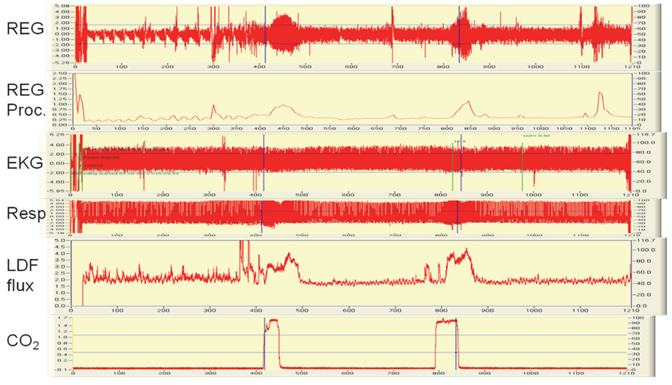
3.2. Data analyzingAfter exposing the subjects to CO2 inhalation, it was observed that there was a temporary and simultaneous increase in LDF flow and REG pulse amplitude. This indicates that the inhalation of CO2 had an impact on the blood flow in the skin and the vascular tone. These findings suggest that CO2 inhalation has a measurable effect on the physiological response of the human body, specifically on the cardiovascular system (Figure 8) 1.
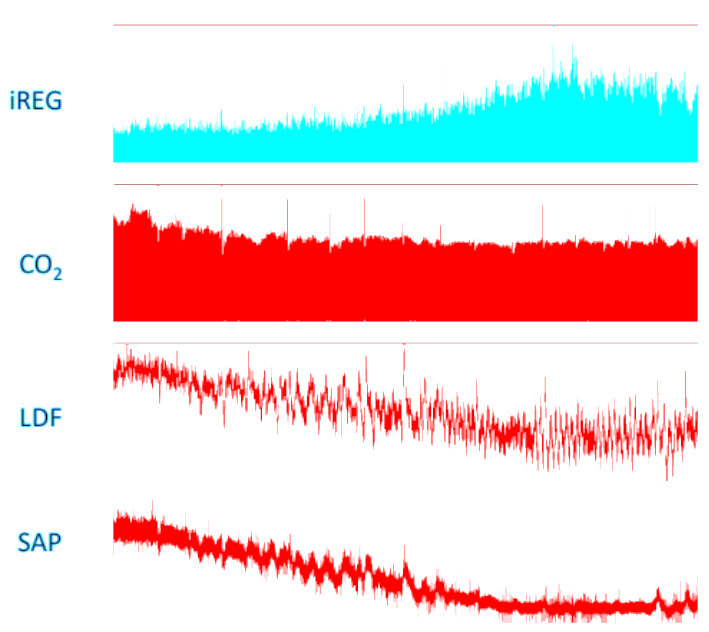
According to a study, cerebral blood flow (CBF) reactivity monitoring is an appropriate primary parameter to evaluate cerebral resuscitation due to a systemic or regional cerebral injury leading to a possible irreversible brain injury. However, the use of the electrical impedance method to estimate CBF is rare, as the method's anatomical background is not well understood. Additionally, the use of intracranial rheoencephalography (iREG) during hemorrhage and comparison of iREG to other CBF measurements have not been previously reported. The study hypothesized that iREG would reflect early cerebrovascular alteration (CBF autoregulation). To test this hypothesis, studies comparing iREG, laser Doppler flowmetry, and ultrasound were undertaken on anesthetized rats to define CBF changes during hemorrhage. The estimation of CBF was taken with intracranial, bipolar REG (REG I; n = 14), laser Doppler flowmetry (LDF; n = 3), and carotid flow by ultrasound (n = 11). Data were processed offline. During the initial phase of hemorrhage, when mean arterial blood pressure (MABP) was close to 40 mm Hg, intracranial REG amplitude transiently increased (80.94%); LDF (77.92%) and carotid flow (52.04%) decreased and changed with systemic arterial pressure 24.


The increase in intracranial REG amplitude suggests classical CBF autoregulation, demonstrating its close relationship to arteriolar changes. The studies indicate that iREG might reflect cerebrovascular responses more accurately than changes in local CBF measured by LDF and carotid flow. REG may indicate promise as a continuous, non-invasive life-sign monitoring tool with potential advantages over ultrasound, the CBF measurement technique normally applied in clinical practice. The results of the study suggest that further investigation is needed to determine the potential of iREG in clinical applications (Figure 9) 24.
The current investigation was carried out to get a basic knowledge of the potential of REG for application in the development of a non-invasive brain monitor capable of continually measuring the integrity of CBF AR. The capacity of REG to identify vasoreactivity makes it suitable as a prospective brain monitoring technique. REG has the potential to be used as a noninvasive, continuous neuromonitoring device in the neurosurgical critical care unit, during the treatment and transfer of injured service members, and in air and space research.
Recent research has explored the potential use of bioimpedance technique known as REG, to identify cerebrovascular atherosclerotic lesions. This non-invasive, low-cost, and easily-applied method can provide valuable insights into the health of cerebral arteries. While REG has limited clinical use in diagnosing cerebrovascular illness, it shows promise as a neuromonitoring tool during neurosurgical critical care and military medical evacuation, as well as an indicator of age-related changes or diffuse cerebrovascular disease. Moreover, recent studies suggest that REG can help identify the first signs of cerebral arteriosclerosis, which is characterized by a loss of flexibility in cerebral arteries. This information can prove to be crucial in identifying and managing the risk of cerebrovascular disease.
The potential of REG parameters to provide non-invasive, low-cost, and easily applicable monitoring of cerebral blood flow autoregulation makes it a valuable tool in the field of neurology. It can help in the identification of cerebrovascular atherosclerotic lesions, which can lead to the timely management of the disease. REG is a promising tool that can help in the identification and management of cerebrovascular diseases. Its non-invasive, low-cost, and easily applicable nature makes it a valuable tool in the field of neurology. It can provide valuable insights into the health of cerebral arteries and help in the timely management of cerebrovascular disease.
The authors state no conflict of interest.
This study was supported by Can Tho University of Medicine and Pharmacy. We would also like to thank Dr. Michael Bodo et al. for publishing many studies on REG so that we have enough data to complete this article.
| [1] | Bodo, M., Sheppard, R., Hall, A., Baruch, M., Laird, M., Tirumala, S., & Mahon, R. “Correlation of rheoencephalography and laser Doppler flow: a rat study”. Journal of Electrical Bioimpedance, 7(1), 55-58, 2016. | ||
| In article | View Article | ||
| [2] | Czosnyka M, Miller C. “Monitoring of cerebral autoregulation”. Neurocrit Care. 21 Suppl 2:95-102, 2014. | ||
| In article | View Article PubMed | ||
| [3] | McHenry L.C. “Rheoencephalography: a clinical appraisal”, Neurology, vol 15, 507-17, 1965.PMID: 14312772. | ||
| In article | View Article PubMed | ||
| [4] | Donnelly J, Aries MJ, Czosnyka M. “Further understanding of cerebral autoregulation at the bedside: possible implications for future therapy”. Expert Rev Neurother. 15:169-85, 2015. | ||
| In article | View Article PubMed | ||
| [5] | Heather Currie, Christine Williams. “Menopause, Cholesterol, and cardiovascular disease”, US Cardiology, vol 5(1), 12-14, 2008. | ||
| In article | View Article | ||
| [6] | Bodo M. “Studies in Rheoencephalography (REG)”, Journal of Electrical Bioimpedance, vol 1, 18-40, 2010. | ||
| In article | View Article | ||
| [7] | Ainslie PN, Duffin J. “Integration of cerebrovascular CO2 reactivity and chemoreflex control of breathing: mechanisms of regulation, measurement, and interpretation”. Am J Physiol Regul Integr Comp Physiol. 296:R1473-95, 2009. | ||
| In article | View Article PubMed | ||
| [8] | Fierstra J, Sobczyk O, Battisti-Charbonney A, Mandell DM, Poublanc J, Crawley AP, Mikulis DJ, Duffin J, Fisher JA. “Measuring cerebrovascular reactivity: what stimulus to use?” J Physiol. 591(Pt 23):5809-21, 2013. | ||
| In article | View Article PubMed | ||
| [9] | Nusbaum D, Clark J, Brady K, Kibler K, Sutton J, Easley RB. “Alteration in the lower limit of autoregulation with elevations in cephalic venous pressure”. Neurol Res. 36:1063-71, 2014. | ||
| In article | View Article PubMed | ||
| [10] | Nguyen Hoang Tin, Nguyen Trung Kien, Tran Duc Long, Le Thi Thuy An, Phung Minh Thu, Banh Thi Ngoc Truc, Vo Thi Trang & Michael Bodo. “Characteristics of Rheoencephalography and some associated factors on menopausal women”. Journal of Electrical Bioimpedance, 13(1), 78-87, 2022. | ||
| In article | View Article PubMed | ||
| [11] | Anonymous. Rheoencephalograph (a) Identification Code of Federal Regulations Title 21, vol 8, Sec 882.1825, Revised as of April 1, 1997, Washington DC: US Government Printing Office. | ||
| In article | |||
| [12] | Bodo M., Thuroczy G., Brockbank K., Sipos K. “Cerebrovascular aging assessment by Cerberus”. In: Klatz R, Goldman R. (eds). Anti-aging medical therapeutics, vol. II. Health Quest, Marina Del Rey, CA, chapter 13, pages 86-95, 1998. | ||
| In article | |||
| [13] | Bodo M. (1990). “Features of dynamics of rheoencephalographic parameters: experimental and clinical study”, Ph.D. dissertation in Russian, Sechenov Institute of Physiology, Academy of Sciences of the USSR, St. Petersburg; Hungarian Academy of Sciences, Budapest. | ||
| In article | |||
| [14] | Osadchikh A.I., Ronkin M.A. “Prognostic possibilities of the polyrheographic method in acute closed craniocerebral injury”, Sov Med, (3), pages 81-4, Russian, 1976. PMID: 968585. | ||
| In article | |||
| [15] | Jenkner F.L. “Rheoencephalography, a method for diagnosing cerebrovascular changes”, Confinica Neurologica, vol 19(1), pages 1-20, 1959. | ||
| In article | View Article | ||
| [16] | Yarullin K. “Clinical Rheoencephalography”, Medicine Publishing, Moscow, pages 108-162, 1990. | ||
| In article | |||
| [17] | Bodo M. et al. “Prevalence of Stroke/ Cardiovascular Risk Factors in rural Hungary - A cross-sectional descriptive study”, Ideggyogy Sz, vol 61(3-4), pages 87-96, 2008.https://pubmed.ncbi.nlm.nih.gov/18459449/ | ||
| In article | |||
| [18] | Perez J.J., Guijarro E., Barcia J.A. “Quantification of intracranial contribution to Rheoencephalograhy by a numerical model of the head”, Clinical - Neurophysiology, vol 111(7), pages 1306-1314, 2000. | ||
| In article | View Article PubMed | ||
| [19] | Perez J.J., Guijarro E., Barcia J.A. “Influence of the scalp thickness on the intracranial contribution to Rheoencephalograhy”, Physics in Medicine and Biology, vol 49(18), pages 4383-4394, 2004. | ||
| In article | View Article PubMed | ||
| [20] | Perez J.J., Guijarro E., Sancho J. “Spatiotemporal pattern of the extracranial component of the Rheoencephalograhy signal”, Physiological Measurement, vol 26 (6), pages 925-938, 2005. | ||
| In article | View Article PubMed | ||
| [21] | Perez J.J. “To what extent is the bipolar rheoencephalographic signal contaminated by scalp blood flow? A clinical study to quantify its extra and non-extracranial components”, BioMedical Engineering Online, 13:131, 2014. https://biomedical-engineering-online.biomedcentral.com/articles/10.1186/1475-925X-13-131 | ||
| In article | View Article PubMed | ||
| [22] | Nguyen Xuan Than. “Cerebral blood flow recording”, Neurological auxiliary diagnostic methods, Department of Neurology, Military Medical Academy, Medical Publishing House, Vietnam, pages 172-188, 2008. | ||
| In article | |||
| [23] | Szalay P, Sipos K, Szucs A, Bodo M. “Cerebrovascular alteration in alcoholic patients”, Journal of Cerebral Blood Flow & Metabolism.25(1_suppl):S145-S145,2005. | ||
| In article | View Article | ||
| [24] | Bodo M, Pearce FJ, Armonda RA. “Cerebral blood flow changes: rat studies in rheoencephalography. Physiol Meas. 25, pages 1371-1384, 2004. | ||
| In article | View Article PubMed | ||
Published with license by Science and Education Publishing, Copyright © 2023 Nguyen Hoang Tin, Tran Thai Thanh Tam and Phung Minh Thu
 This work is licensed under a Creative Commons Attribution 4.0 International License. To view a copy of this license, visit
http://creativecommons.org/licenses/by/4.0/
This work is licensed under a Creative Commons Attribution 4.0 International License. To view a copy of this license, visit
http://creativecommons.org/licenses/by/4.0/
| [1] | Bodo, M., Sheppard, R., Hall, A., Baruch, M., Laird, M., Tirumala, S., & Mahon, R. “Correlation of rheoencephalography and laser Doppler flow: a rat study”. Journal of Electrical Bioimpedance, 7(1), 55-58, 2016. | ||
| In article | View Article | ||
| [2] | Czosnyka M, Miller C. “Monitoring of cerebral autoregulation”. Neurocrit Care. 21 Suppl 2:95-102, 2014. | ||
| In article | View Article PubMed | ||
| [3] | McHenry L.C. “Rheoencephalography: a clinical appraisal”, Neurology, vol 15, 507-17, 1965.PMID: 14312772. | ||
| In article | View Article PubMed | ||
| [4] | Donnelly J, Aries MJ, Czosnyka M. “Further understanding of cerebral autoregulation at the bedside: possible implications for future therapy”. Expert Rev Neurother. 15:169-85, 2015. | ||
| In article | View Article PubMed | ||
| [5] | Heather Currie, Christine Williams. “Menopause, Cholesterol, and cardiovascular disease”, US Cardiology, vol 5(1), 12-14, 2008. | ||
| In article | View Article | ||
| [6] | Bodo M. “Studies in Rheoencephalography (REG)”, Journal of Electrical Bioimpedance, vol 1, 18-40, 2010. | ||
| In article | View Article | ||
| [7] | Ainslie PN, Duffin J. “Integration of cerebrovascular CO2 reactivity and chemoreflex control of breathing: mechanisms of regulation, measurement, and interpretation”. Am J Physiol Regul Integr Comp Physiol. 296:R1473-95, 2009. | ||
| In article | View Article PubMed | ||
| [8] | Fierstra J, Sobczyk O, Battisti-Charbonney A, Mandell DM, Poublanc J, Crawley AP, Mikulis DJ, Duffin J, Fisher JA. “Measuring cerebrovascular reactivity: what stimulus to use?” J Physiol. 591(Pt 23):5809-21, 2013. | ||
| In article | View Article PubMed | ||
| [9] | Nusbaum D, Clark J, Brady K, Kibler K, Sutton J, Easley RB. “Alteration in the lower limit of autoregulation with elevations in cephalic venous pressure”. Neurol Res. 36:1063-71, 2014. | ||
| In article | View Article PubMed | ||
| [10] | Nguyen Hoang Tin, Nguyen Trung Kien, Tran Duc Long, Le Thi Thuy An, Phung Minh Thu, Banh Thi Ngoc Truc, Vo Thi Trang & Michael Bodo. “Characteristics of Rheoencephalography and some associated factors on menopausal women”. Journal of Electrical Bioimpedance, 13(1), 78-87, 2022. | ||
| In article | View Article PubMed | ||
| [11] | Anonymous. Rheoencephalograph (a) Identification Code of Federal Regulations Title 21, vol 8, Sec 882.1825, Revised as of April 1, 1997, Washington DC: US Government Printing Office. | ||
| In article | |||
| [12] | Bodo M., Thuroczy G., Brockbank K., Sipos K. “Cerebrovascular aging assessment by Cerberus”. In: Klatz R, Goldman R. (eds). Anti-aging medical therapeutics, vol. II. Health Quest, Marina Del Rey, CA, chapter 13, pages 86-95, 1998. | ||
| In article | |||
| [13] | Bodo M. (1990). “Features of dynamics of rheoencephalographic parameters: experimental and clinical study”, Ph.D. dissertation in Russian, Sechenov Institute of Physiology, Academy of Sciences of the USSR, St. Petersburg; Hungarian Academy of Sciences, Budapest. | ||
| In article | |||
| [14] | Osadchikh A.I., Ronkin M.A. “Prognostic possibilities of the polyrheographic method in acute closed craniocerebral injury”, Sov Med, (3), pages 81-4, Russian, 1976. PMID: 968585. | ||
| In article | |||
| [15] | Jenkner F.L. “Rheoencephalography, a method for diagnosing cerebrovascular changes”, Confinica Neurologica, vol 19(1), pages 1-20, 1959. | ||
| In article | View Article | ||
| [16] | Yarullin K. “Clinical Rheoencephalography”, Medicine Publishing, Moscow, pages 108-162, 1990. | ||
| In article | |||
| [17] | Bodo M. et al. “Prevalence of Stroke/ Cardiovascular Risk Factors in rural Hungary - A cross-sectional descriptive study”, Ideggyogy Sz, vol 61(3-4), pages 87-96, 2008.https://pubmed.ncbi.nlm.nih.gov/18459449/ | ||
| In article | |||
| [18] | Perez J.J., Guijarro E., Barcia J.A. “Quantification of intracranial contribution to Rheoencephalograhy by a numerical model of the head”, Clinical - Neurophysiology, vol 111(7), pages 1306-1314, 2000. | ||
| In article | View Article PubMed | ||
| [19] | Perez J.J., Guijarro E., Barcia J.A. “Influence of the scalp thickness on the intracranial contribution to Rheoencephalograhy”, Physics in Medicine and Biology, vol 49(18), pages 4383-4394, 2004. | ||
| In article | View Article PubMed | ||
| [20] | Perez J.J., Guijarro E., Sancho J. “Spatiotemporal pattern of the extracranial component of the Rheoencephalograhy signal”, Physiological Measurement, vol 26 (6), pages 925-938, 2005. | ||
| In article | View Article PubMed | ||
| [21] | Perez J.J. “To what extent is the bipolar rheoencephalographic signal contaminated by scalp blood flow? A clinical study to quantify its extra and non-extracranial components”, BioMedical Engineering Online, 13:131, 2014. https://biomedical-engineering-online.biomedcentral.com/articles/10.1186/1475-925X-13-131 | ||
| In article | View Article PubMed | ||
| [22] | Nguyen Xuan Than. “Cerebral blood flow recording”, Neurological auxiliary diagnostic methods, Department of Neurology, Military Medical Academy, Medical Publishing House, Vietnam, pages 172-188, 2008. | ||
| In article | |||
| [23] | Szalay P, Sipos K, Szucs A, Bodo M. “Cerebrovascular alteration in alcoholic patients”, Journal of Cerebral Blood Flow & Metabolism.25(1_suppl):S145-S145,2005. | ||
| In article | View Article | ||
| [24] | Bodo M, Pearce FJ, Armonda RA. “Cerebral blood flow changes: rat studies in rheoencephalography. Physiol Meas. 25, pages 1371-1384, 2004. | ||
| In article | View Article PubMed | ||