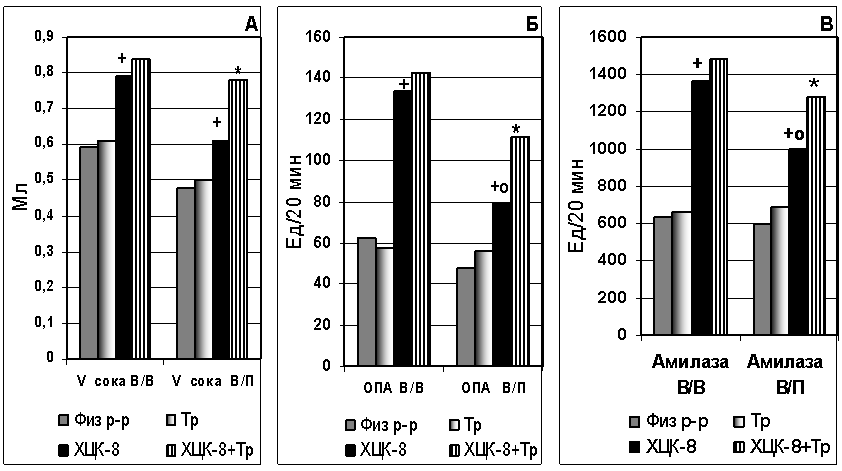
The effect of intraportal administration of trypsin on the degree of utilization of cholecystokinin short-chain peptide by the liver by the liver was studied in rats according to the degree of its influence on the secretory function of the pancreas. Studies were conducted on 56 rats in 8 series, 7 acute experiments in each series. Conclusions were made: in rats, the liver utilizes short-chain peptide CCK-8. Trypsin, when co-administered with CCK-8 in the peripheral vein, slightly increases the secretory activity of the pancreas and significantly when administered into the portal vein, which indicates that trypsin can reduce the ability of the liver to utilize the CCK-8 short chain peptide. This fact confirms the involvement of the liver in the change in utilization of short-chain peptides, which is one of the mechanisms regulating pancreatic secretory activity. Trypsin is also involved in these mechanisms of regulation of the activity of the digestive glands, which is new evidence of the existence of a physiological mechanism of the relationship between the gastrointestinal tract and the liver.
The relevance of studying pancreatic proteases injected by the digestive glands into the blood is important in connection with the large number of studies on protease-activated receptors that have appeared in recent years.
Receptors are located on the cell membranes of various organs and tissues, through which an increase or decrease in the functional activity of these organs and body tissues can be realized under the influence of pancreatic proteases 1.
It is suggested that pancreatic proteases should not be considered only from the traditional point of view as digestive enzymes, but additionally as signaling molecules that are actively involved in the spectrum of physiological and pathological conditions of both the gastrointestinal tract and other body systems.
It is proposed that proteases as a whole be considered hormones, and the formation in this connection of new signaling pathways, as new regulatory mechanisms in physiological conditions or new pathogenetic links in pathological conditions.
Also, protease-activated receptors are considered as an attractive object for the development of new drugs 2.
Earlier in the work of our laboratory, the participation of the liver in the utilization of short-chain peptide regulators (pentagastrin, leienkephalin and CCK-8) was shown, which can be considered as an additional modifying factor in the peptidergic mechanisms of regulation of the digestive glands 3.
It was also established in our laboratory that under the influence of intravenous administration of trypsin, the enzymatic excretion activity of the gastric glands increases 4.
Short-chain peptides containing up to 10 amino acids are of great importance in various regulation mechanisms, since they have receptors on the afferent nerve endings of peripheral neurons and on neurons of various parts of the central nervous system.
In the stomach and intestines, paracrine interconnect endocrine cells and neurons of the submucosal nerve plexus, mesenteric and afferent neurons.
During the ingestion of food into the gastrointestinal tract, the production of short chain peptides is significantly increased. It is also known that short-chain peptides more efficiently stimulate the secretion of digestive glands and cross the blood-brain barrier.
For example, due to CCK-8, they cause a feeling of satiety, that is, they provide a distant relationship between the cells of the digestive glands and various parts of the central nervous system.
With liver pathology (biliary cirrhosis), the utilization capacity of the liver decreases, CCK-8 increases in the peripheral blood, due to which encephalopathies develop 5, as well as pancreatic hypersecretory syndrome 6, 7.
There are mechanisms that limit the entry of short-chain peptides into peripheral blood. A part of short-chain peptides is utilized intraorganically by tissue and membrane proteases, another part - in the liver, after entering through the portal system 2, 8.
As a result of these mechanisms, additional channels of peptidergic regulation of the digestive glands are formed.
It was of interest to us to study the effect of trypsin on the utilization of CCK-8 by the liver, as a modifying factor in the mechanisms of regulation of the digestive glands.
To study in rats the effect of intraportal administration of trypsin on the degree of liver utilization of the short-chain cholecystokinin peptide (CCK-8) by its degree of influence on the secretory function of the pancreas.
The studies were performed on 56 rats in 8 series, 7 acute experiments in each series.
We studied the change in pancreatic secretion, in 1 series (control) when 0.3 ml of physiological solution was injected into the portal vein, in 2 series (control) when 0.3 ml of physiological solution was introduced into the peripheral vein.
In the 3 series (experimental), a short-chain peptide - CCK-8 - cholecystokinin (0.15 μg / kg) and secretin (0.15 μg / kg) were injected into 0.3 ml of physiological saline in the portal vein, in 4 series (experimental) - CCK-8 - cholecystokinin (0.15 μg / kg) and secretin (0.15 μg / kg) in 0.3 ml of physiological saline was injected into the peripheral vein. In series 5 (experimental), CCK-8 was injected into the portal vein - cholecystokinin (0.15 μg / kg) and secretin (0.15 μg / kg) together with trypsin at a dose (300 μg / kg) in 0.3 ml physiological solution, in the 6th series (experimental), cholecystokinin (0.15 μg / kg) and secretin (0.15 μg / kg) were injected into the peripheral vein of CCK-8 together with trypsin at a dose (300 μg / kg) of 0.3 ml of physiological saline.
In the 7th series (experimental), trypsin was injected into the portal vein at a dose (300 μg / kg) in 0.3 ml of physiological saline, in the 8th series (experimental) trypsin was injected into the peripheral vein at a dose (300 μg / kg) of 0.3 ml of physiological saline.
The study was performed under urethane anesthesia: intraperitoneally at a dose of 1.1 g / kg of body weight. Pancreatic juice was collected for 20 min in periods in a standard glass capillary for the determination of ESR, for 40 min (two 20 min period) before and 40 min (two 20 min period) after administration of intraportally or iv test substances.
As part of the pancreatic juice, we determined: the release of proteases by total proteolytic activity (OPA) by the spectrophotometric method 9, 10, the release of amylase by the photometric method 9, 10 by decreasing starch color.
The results were processed by the method of variation statistics with the calculation of average values (M), their errors (m) and the reliability of the difference between the compared Student-Fisher values (t). Results and its discussion. Under the influence of trypsin injected both into the peripheral vein and the portal vein, the volume of secreted pancreatic juice was slightly higher than after the introduction of physiological saline.
With the introduction of CCK-8, both in the peripheral vein and the portal vein, there was a significant increase in the volume of juice, relative to those with the introduction of physiological saline.
However, these parameters under the influence of CCK-8 introduced into the portal vein were not significantly lower than those when introduced into the peripheral vein.
The combined use of trypsin and CCK-8 caused an unreliable increase in the volume of juice when introduced into the peripheral vein and a significant increase when introduced into the portal vein (Figure A).
There was an insignificant decrease in OPA under the action of trypsin injected into the peripheral vein and an increase when introduced into the portal vein.
The introduction of CCK-8, both in the peripheral vein and in the portal vein, caused a significant increase in OPA compared with those after the introduction of physiological saline.
At the same time, under the influence of CCK-8 introduced into the portal vein, the release of OPA was significantly lower than those when introduced into the peripheral vein. With the combined use of trypsin and CCK-8, there was an unreliable increase in OPA when introduced into the peripheral vein and a significant increase when introduced into the portal vein, in relation to indicators using only CCK-8 (Figure B).
The excretion of pancreatic amylase under the influence of trypsin injected into both the peripheral vein and portal vein was not significantly higher than its excretion after the introduction of physiological saline.

Under the influence of CCK-8, introduced both into the peripheral vein and the portal vein, the release of pancreatic amylase was significantly higher than those after administration of physiological saline.
At the same time, amylase indices under the influence of CCK-8 introduced into the portal vein were significantly lower than its values when CCK-8 was introduced into the peripheral vein.
The combined use of trypsin and CCK-8 caused an unreliable increase in amylase in the composition of the pancreatic juice when introduced into the peripheral vein and a significant increase when introduced into the portal vein (Figure B).
With the introduction of trypsin into the peripheral vein, insignificant changes in all indicators in the composition of the pancreatic juice were noted, but more pronounced changes in these indicators were recorded when introduced into the portal vein.
It was established that when passing through the liver of short-chain CCK-8, a significant decrease in secretory effects occurs, which is expressed in a significant decrease in the total proteolytic activity and amylase indices.
In this case, the introduction of trypsin into the peripheral vein together with CCK-8 caused an unreliable increase in all considered indicators in relation to those indicators with the introduction of only CCK-8.
At the same time, the introduction of trypsin into the portal vein in conjunction with CCK-8 caused a significant increase in all considered indicators in relation to those indicators with the introduction of only CCK-8.
In rats, the liver utilizes the short-chain peptide CCK-8. Trypsin, when co-administered with CCK-8 into the peripheral vein, slightly increases the secretory activity of the pancreas and significantly when introduced into the portal vein, which indicates that trypsin can reduce the ability of the liver to utilize the short-chain CCK-8 peptide.
The results obtained confirm the participation of the liver in changing the utilization of short-chain peptides, which is one of the mechanisms for regulating the secretory activity of the pancreas.
Trypsin also takes part in these mechanisms of regulation of the digestive glands, which is new evidence of the physiological mechanism of the relationship of the gastrointestinal tract and liver.
| [1] | Ramachandran R., Hollenberg M.D. Proteinases and signaling: pathophysiologi-cal and therapeutic implications via PARs and more // Br. J. Pharmacol. –2008.– Vol. 153. – P. 263-282. | ||
| In article | View Article PubMed | ||
| [2] | Aleinik V.A., Babich S.M. The effect of various doses of trypsin on the change in liver utilization of pentagastrin // Vestnik TMA, 2013, No. 1, S. 13-16. | ||
| In article | |||
| [3] | Babich S. M., Aleinik V.A. Changes in gastric secretion with the introduction of pentagastrin and leu-enkephalin into the peripheral and portal veins // Journal of Postgraduate Doctor, Voronezh, 2010.- No. 5.2 (42) .- P.252-257. | ||
| In article | |||
| [4] | Bhattacharyya R. et al. A prospective pilot study of the prevalence of pancreatic disease in patients with alcohol related liver disease using faecal elastase-1 //Gut, 2011, Т.60, Suppl 1, С. A238-A238. | ||
| In article | View Article | ||
| [5] | Kawabata A., Matsunami M., Sekiguchi F. Gastrointestinal roles for proteinase-activated receptors in health and disease. Review // Br. J. Pharmacol.– 2008.– Vol. 153.– P. 230-240. | ||
| In article | View Article PubMed | ||
| [6] | Kalaitzakis E, Bjornsson E. Hepatic encephalopathy in patients with liver cirrhosis: is there a role of malnutrition//World J Gastroenterol, 2008, 14: 3438-3439. | ||
| In article | View Article PubMed | ||
| [7] | Ossovskaya V.S., Bunnett N.W. Protease-Activated Receptors: Contribution to Physiology and Disease// Physiol Rev.- 2004.- Vol.84. – P. 579-621. | ||
| In article | View Article PubMed | ||
| [8] | Katakura Y. et al. Pancreatic involvement in chronic viral hepatitis //World Journal of Gastroenterology: WJG, 2005, Т.11, №23, С. 3508. | ||
| In article | View Article PubMed | ||
| [9] | Korotko G. F., Aleinik V. A., Kurzanov A. N., Khamrakulov Sh. Trypsinogen as a modifier of peptidergic effects on the secretion of the gastric and pancreas // Ros. fiziol. journal them. I. M. Sechenov. - 1996 - T. 82. No. 8-9. - S. 87-95. | ||
| In article | |||
| [10] | Hoffmaster KA, Zamek-Gliszczynski MJ, Pollack GM, Brouwer KL. Hepatobiliary disposition of the metabolically stable opioid peptide [D-Pen2, D-Pen5]-enkephalin (DPDPE): pharmacokinetic consequences of the interplay between multiple transport system//J. Pharmacol. Exp. Ther., 2004, vol.311(3), P.1203-10. | ||
| In article | View Article PubMed | ||
Published with license by Science and Education Publishing, Copyright © 2022 Zhuraeva M.A., Ravzatov J.B. and Ashuralieva M. A.
 This work is licensed under a Creative Commons Attribution 4.0 International License. To view a copy of this license, visit
http://creativecommons.org/licenses/by/4.0/
This work is licensed under a Creative Commons Attribution 4.0 International License. To view a copy of this license, visit
http://creativecommons.org/licenses/by/4.0/
| [1] | Ramachandran R., Hollenberg M.D. Proteinases and signaling: pathophysiologi-cal and therapeutic implications via PARs and more // Br. J. Pharmacol. –2008.– Vol. 153. – P. 263-282. | ||
| In article | View Article PubMed | ||
| [2] | Aleinik V.A., Babich S.M. The effect of various doses of trypsin on the change in liver utilization of pentagastrin // Vestnik TMA, 2013, No. 1, S. 13-16. | ||
| In article | |||
| [3] | Babich S. M., Aleinik V.A. Changes in gastric secretion with the introduction of pentagastrin and leu-enkephalin into the peripheral and portal veins // Journal of Postgraduate Doctor, Voronezh, 2010.- No. 5.2 (42) .- P.252-257. | ||
| In article | |||
| [4] | Bhattacharyya R. et al. A prospective pilot study of the prevalence of pancreatic disease in patients with alcohol related liver disease using faecal elastase-1 //Gut, 2011, Т.60, Suppl 1, С. A238-A238. | ||
| In article | View Article | ||
| [5] | Kawabata A., Matsunami M., Sekiguchi F. Gastrointestinal roles for proteinase-activated receptors in health and disease. Review // Br. J. Pharmacol.– 2008.– Vol. 153.– P. 230-240. | ||
| In article | View Article PubMed | ||
| [6] | Kalaitzakis E, Bjornsson E. Hepatic encephalopathy in patients with liver cirrhosis: is there a role of malnutrition//World J Gastroenterol, 2008, 14: 3438-3439. | ||
| In article | View Article PubMed | ||
| [7] | Ossovskaya V.S., Bunnett N.W. Protease-Activated Receptors: Contribution to Physiology and Disease// Physiol Rev.- 2004.- Vol.84. – P. 579-621. | ||
| In article | View Article PubMed | ||
| [8] | Katakura Y. et al. Pancreatic involvement in chronic viral hepatitis //World Journal of Gastroenterology: WJG, 2005, Т.11, №23, С. 3508. | ||
| In article | View Article PubMed | ||
| [9] | Korotko G. F., Aleinik V. A., Kurzanov A. N., Khamrakulov Sh. Trypsinogen as a modifier of peptidergic effects on the secretion of the gastric and pancreas // Ros. fiziol. journal them. I. M. Sechenov. - 1996 - T. 82. No. 8-9. - S. 87-95. | ||
| In article | |||
| [10] | Hoffmaster KA, Zamek-Gliszczynski MJ, Pollack GM, Brouwer KL. Hepatobiliary disposition of the metabolically stable opioid peptide [D-Pen2, D-Pen5]-enkephalin (DPDPE): pharmacokinetic consequences of the interplay between multiple transport system//J. Pharmacol. Exp. Ther., 2004, vol.311(3), P.1203-10. | ||
| In article | View Article PubMed | ||