This study aims to highlight the impact of mining activities on the morphological dynamics of a sub-watershed of the Cavally River at Ity. To achieve this, a remote sensing-based monitoring of land use and land cover changes was carried out in conjunction with an assessment of morphological alterations of the Cavally River over the same period. Analyses were performed using Landsat TM, ETM+, and Sentinel-2 imagery from the years 1994, 2004, 2014, and 2024. The results revealed significant degradation of riparian vegetation in favour of agricultural and extractive activities, leading to alterations in the morphological parameters of the Cavally River. The regression of vegetation was associated with the expansion of settlements, bare soils, and cultivated land. The study highlighted deforestation and soil stripping processes driven by mining operations. The most significant morphological changes were observed along the river reach near the Ity mine. Here, the sinuosity index decreased from 1.79 to 1.24, resulting in the loss of three meanders and a transformation of a meandering reach into a sinuous one.The floodplain was redefined from 2024 onwards due to river training works that restricted left-bank lateral migration along the same reach. Mining operations by the SMI intensified over the last decade (2014–2024) within the Cavally River floodplain. These activities have impacted the lateral connectivity of the river, as evidenced by an increase in the confinement index from 17.89 to 39.68 between 2014 and 2024. Fluvial dynamics reveal an alternation between erosion and accretion processes. Over the three-decade period, the general trend has been one of erosion along river sections affected by both artisanal and industrial mining activities, due to bank artificialisation and sediment extraction for alluvial mining purposes. This underscores the need to monitor, mitigate, or restore the impacts of these activities on river systems.
The increase in population and economic activities near watercourses has led to a heightened risk of flooding in many river basins around the world 1. Among these activities are irrigation works for agriculture, large hydraulic infrastructures (such as dams, river crossings, and river diversions), and, notably, mining activities. The mining sector is a significant contributor to both national and local economies and has seen steady growth in recent years globally, and particularly in West Africa 2, 3. Owing to its perceived benefits, mining activities, especially gold extraction, have made auriferous zones hotspots for population influx, drawing individuals from diverse backgrounds who engage in artisanal exploitation of this resource 4. According to the literature 5, 6, 7, 8, 9 10, 11, 12, 13 such territorial developments significantly alter the hydrological and hydrodynamic functioning of river systems. The intensification of these activities across watersheds is recognised as one of the main drivers of fluvial erosion processes, and it contributes to changes in channel roughness and cross-sectional geometry 14, 15.
The watersheds of Côte d’Ivoire are subject to a range of anthropogenic activities 16, among which mining holds a prominent place. The Ivorian government has succeeded in creating an attractive investment climate and has allocated vast tracts of land to industrial and semi-industrial operators, thereby fostering a proliferation of mining activities 2, 3. The Cavally River basin, located in western Côte d’Ivoire, is no exception. Since the 1990s, the Ity Mining Company (Société des Mines d’Ity) has been extracting gold in the vicinity of the Cavally River 17. Furthermore, the opening of this mine attracted, from around 2002 onwards, a significant influx of artisanal gold miners who settled along both banks of the river, and in some cases, directly within the active channel. According to 18, the environmental modifications caused by gold panning in the Ity auriferous zone include the excavation of agricultural lands, pollution and destruction of riverbeds, deforestation, and loss of vegetative cover. Through dredging techniques, artisanal miners extract water and sediments from the riverbed and bring them to the surface. This practice degrades the sedimentary structure of the river and leads to severe bank erosion. Alterations to channel morphology, sediment transport, and water flow result in dysfunctions that disrupt aquatic ecosystems. Such impacts may arise from hydrological regime modifications due to river channelisation (recalibration, straightening, embankment construction) and the presence of weirs or dams 7, or from broader watershed pressures such as intensive agriculture, land artificialisation, and aggregate extraction 19. By their very nature, these developments and land uses degrade in-stream and floodplain habitats and diminish the resilience capacity of riverine ecosystems.
In response to these challenges, numerous studies have investigated the impacts of mining activities on various watersheds in Côte d’Ivoire. N’Cho et al. 20 examined soil contamination in artisanal mining sites in the Tonkpi region. Kouadio 21 assessed the levels of water and soil contamination by heavy metals (Hg, Pb, Cd) in gold panning zones across Côte d’Ivoire. Tiesse et al. 22 evaluated land use and land cover dynamics using remote sensing in the Tonkpi region. Gbamélé et al. 23 conducted an environmental impact assessment to evaluate chemical pollution in the gold mining environment of the Zouan-Hounien sub-prefecture. Hué et al. 18 studied the environmental transformations associated with artisanal gold mining in Ity, western Côte d’Ivoire. Kouassi et al. 24 developed a hydrological model of the Cavally River under intense anthropogenic pressure in the Zouan-Hounien department. They also carried out hydraulic modelling based on a diachronic analysis of the Cavally River’s morphology in response to these pressures.
It is true that all the aforementioned studies have addressed the issue of mining activities in the Zouan-Hounien department. However, the morphological assessment by 24, in particular, considers only the bankfull surface area as a form parameter. This limited approach reduces the effectiveness of such assessments in accurately describing the fluvial geomorphology of the Cavally River. Therefore, it becomes essential to consider a broader set of geomorphological indicators in order to establish meaningful links between observed changes in the river channel and their underlying causes. The main objective of this study is to establish a relationship between the alteration of the Cavally River and gold mining activities, using multi-temporal satellite imagery. Specifically, the study aims to: (1) assess the spatio-temporal dynamics of riparian vegetation along the Cavally River, and (2) analyse the evolution of the river’s morphometric parameters over time.
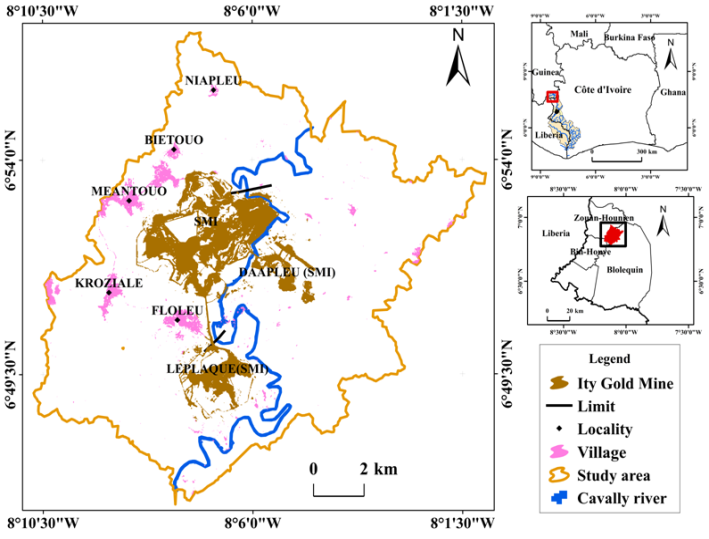
The Cavally River basin is a transboundary watershed located between longitudes 8°4ʹ and 7°7ʹ West and latitudes 6°8ʹ and 7°9ʹ North. The Cavally River originates in Guinea, north of Mount Nimba, at an altitude of 600 metres. With a total length of 700 km, the river channel forms a natural boundary between Côte d’Ivoire and Liberia along its middle and lower courses 25. The sub-watershed under study is situated in the Tonkpi region, between the departments of Zouan-Hounien and Bloléquin, in the vicinity of the Ity Mining Company (Société des Mines d’Ity – SMI). It lies between longitudes 8°01ʹ00ʺ and 8°10ʹ45ʺ West and latitudes 6°56ʹ25ʺ and 6°46ʹ25ʺ North, as shown in Figure 1.
Agriculture constitutes the main economic activity in the region. Industrial gold mining is conducted by the Ity Mining Company (SMI). Ity is the oldest gold mine in Côte d’Ivoire, with the first gold pour recorded in 1991. Since then, the mine has produced over 1.4 million ounces of gold. Endeavour acquired the Ity mine in 2015 and subsequently increased its stake to 85% in 2018 during the construction of the Carbon-In-Leach (CIL) plant 17. Artisanal and small-scale (illegal) gold mining is also prevalent in the region. It is the dominant activity along the Cavally River, where motorised pumps are used to extract sediment from the riverbed.
The selection of study sections is based on the various activities conducted in the vicinity of the river. This approach enables an assessment of both channel morphology and the underlying causative factors. Accordingly, a reach characterised by intense artisanal mining activities was selected upstream of the Ity Mining Company (Section or Reach 1). A second reach was then selected adjacent to the SMI site (Section 2), directly influenced by industrial mining operations. Further downstream from the SMI reach, a third reach (Section 3), less affected by mining activities, was also delineated (Figure 1).
2.2. DatasThe data used to assess land cover dynamics around the banks of the Cavally River consist of satellite imagery and ground-truthing data. The selection of satellite images was based on spatial resolution, availability, and image quality. Specifically, the dataset comprises four satellite images acquired from MSI-L2A, MSI-L1C, ETM, and TM sensors. The 1994 and 2004 images were obtained from the Landsat TM and ETM sensors, respectively, while the 2014 and 2024 images were derived from the Sentinel-2 MSI-L1C and MSI-L2A sensors (Table 1). Image acquisition was timed between December and February, corresponding to the dry season, in order to minimise cloud cover. Furthermore, dry season imagery allows for better differentiation between vegetation cover and other land cover types.
The data used for the hydromorphological analysis are similar to those selected for land cover assessment. However, two additional images acquired during the rainy season (2014 and 2024) from the Sentinel-2 satellite were also used. Dry season imagery was employed to characterise the morphology of the low-flow (or active) river channel, while rainy season imagery was used to highlight the extent and form of the high-flow (or floodplain) channel during peak discharge events. A Digital Elevation Model (DEM) was also utilised to delineate the alluvial plain.

The Modified Normalised Difference Water Index (MNDWI) was selected for the extraction of water bodies, as it enhances the reflectance of aquatic features while suppressing the reflectance of non-aquatic features present in the image. The extraction method employed is derived from the Normalised Difference Water Index (NDWI) developed by McFeeters 26. This water index is calculated using the reflectance values from the GREEN and near-infrared (NIR) bands, as expressed in Equation 1.
|
However, McFeeters’ NDWI is unable to fully distinguish built-up areas from aquatic features. This limitation may result in confusion between surrounding built-up zones and the water body of the Cavally River. To address this issue, the Modified NDWI (MNDWI) was preferred. This index replaces the NIR band in McFeeters’
NDWI with the Mid-Infrared (MIR or SWIR1) band as shown in Equation 2.
|
MNDWI ∈ [−1 ; 1]; Water ∈ [0 ; 1] Non-water ∈ [−1 ; 0]. The MNDWI algorithm was applied to all satellite images used in the study to delineate the outlines of the Cavally River.
A validation of the vector layers is necessary following their creation in order to ensure the reliability and credibility of the work carried out 27. In the context of wetland inventories, it is essential to minimise digitisation errors as much as possible 28. Accordingly, the delineations of the 2024 and 2014 boundaries were verified using Google Earth ortho-images dated 24/12/2024 and 19/01/2024, respectively. To achieve this, the extracted contours were overlaid onto the corresponding Google Earth ortho-images. This validation method was complemented by a field survey. The objective of the fieldwork was to collect the coordinates of the river’s boundaries along various sections of the Cavally River.
The selected hydro-morphometric parameters correspond to river response variables that reflect the channel's reaction to external changes. These are summarised in Table 2. They include: channel length (L), average bed area (A), bankfull width (W), bankfull depth (D), stream power (P), sinuosity index (SI), confinement index (CI), bank dynamics (erosion/accretion), and the mean direction of the low-flow channel (MLFC) 14, 29.
• Sinuosity Index
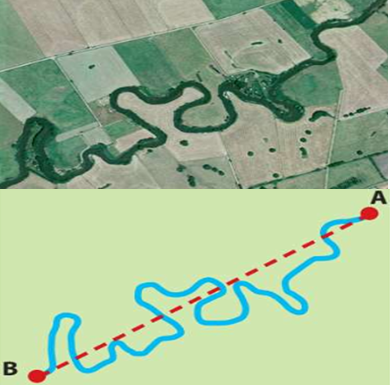
As the name suggests, this parameter quantifies the degree of sinuosity of a river channel. It is denoted as IS in French-language publications and P in English-language articles. The sinuosity of a river or a river reach is assessed by comparing the actual channel length to the straight-line distance between the upstream point (A) and the downstream point (B) (Figure 2).

According to Table 3, when the result lies between 1.25 and 1.5, the river is considered sinuous. If the value exceeds 1.5, it is classified as meandering 14.
• Confinement Index
The degree of confinement refers to the percentage of the riverbank that is in contact with valley sides or ancient terraces along the total length of both banks 30. In practical terms, it is assessed by calculating the ratio between the bankfull channel width and the width of the first terrace. If the width of the first terrace is only slightly greater than the channel width, the river is considered highly confined, as there is little to no alluvial floodplain. Conversely, if the first terrace is several times wider than the river channel, the river is considered unconfined. The authors identify three levels of confinement: confined, partially confined, and unconfined 29, 30.
The method adopted to assess land use dynamics combined satellite image processing techniques with field visits and on-site observations. The image processing phase began with radiometric and atmospheric corrections. Radiometric corrections enhance pixel reflectance, while atmospheric corrections reduce the effects of cloud cover and Harmattan dust 31. Land use assessment was conducted using QGIS 3.28, equipped with the Semi-Automatic Classification Plugin 32. The classification was based on five land use classes: water, bare soil, settlements, vegetation, and crops.
Validation of the land use maps involved verifying the actual presence of the predefined land use classes. During the validation process, 60 training plots were selected across the watershed: 21 in the water class, 10 in settlements, 4 in bare soil, 10 in vegetation, and 9 in crops. The selected training plots, along with historical imagery from Google Earth, were used to validate the land use maps for the years 1994, 2004, 2014, and 2024. The land use and land cover of the watershed area addressed in the study were the subject of a research paper 33 in which the methodology is clearly outlined, and the results, including the various confusion matrices, are presented. Here, a mask resulting from this previous work is shown, focusing solely on the land use and land cover of the banks of the Cavally River.
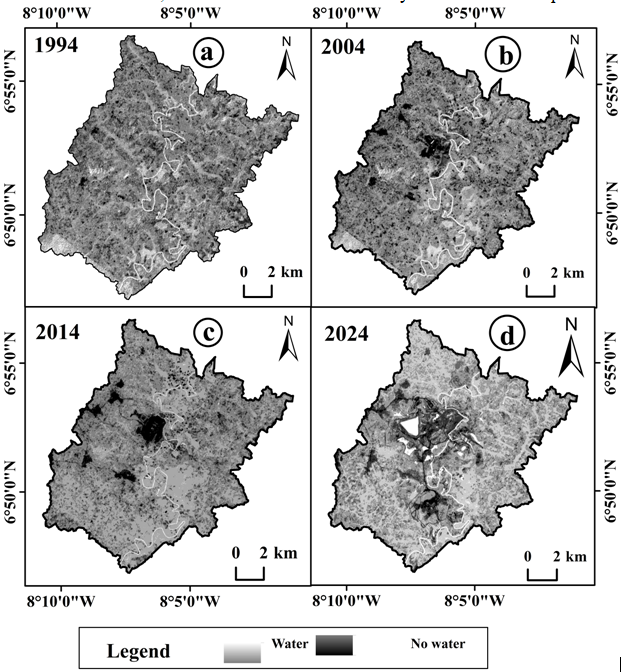
The extraction of river channel morphology represents the first step in the morphological analysis of the Cavally River. The Cavally River is visible in white for the years 1994, 2004, 2014, and 2024 in Figure 3. The spatial and temporal expansion of human activities, shown in black surrounding the river, is also clearly noticeable. This illustrates the high degree of anthropogenic pressure that the Cavally River basin has experienced over the years.


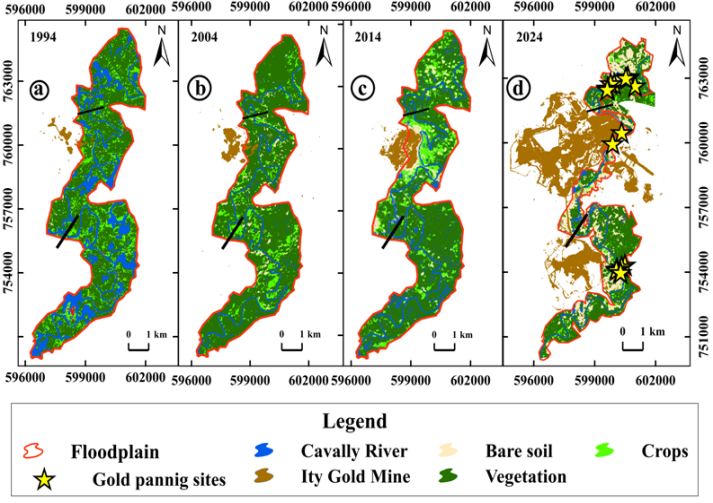
Figure 5 illustrates the evolution of functional riparian vegetation along the Cavally River and the spatial expansion of mining activities by SMI. Between 1994 and 2014 (Figures 5a and 5b), there were no significant changes in the riparian vegetation. However, the period from 2014 to 2024 has been marked by the expansion of both artisanal and industrial gold mining activities. In Reach 1, nearly all areas of bare soil are located in proximity to gold panning sites identified during field surveys. In Reach 2, the disappearance of riparian vegetation in favour of bare soil and built-up areas is primarily due to the expansion works carried out by SMI (Figure 5d). These activities have led to soil stripping, the construction of four diversion channels accompanied by bank protection measures and crossing structures. These developments were observed and confirmed during the field visit. As a result of this expansion, Reach 2 of the river is now entirely occupied by SMI’s operations. This is likely to increase the degree of channel confinement and reduce lateral connectivity. The riparian vegetation in Reach 3 has also undergone significant regression, giving way to bare soil.

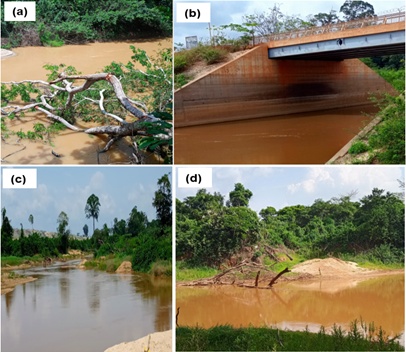
Riparian vegetation plays a crucial role in maintaining the ecological health of river systems and ensuring the usability of water resources by reducing the risk of contamination. However, gold miners, in their quest for gold, create numerous zones of disturbance by exposing root systems or, in some cases, clearing riparian vegetation to facilitate extraction. These uprooted plants are often left to accumulate within the active channel, obstructing hydraulic continuity (Figure 6a). Due to a lack of appropriate equipment, artisanal mining activities primarily target riverbed sediments for gold extraction. Mining occurs both along the banks and within the active channel. The removal of sediments from the banks increases the width of the river channel at these locations by expanding the mean channel bed (Figure 6c). Additionally, excavation within the active channel disrupts the natural balance between sediment deposition and erosion, which has direct consequences for the fluvial dynamics of the Cavally River (Figure 6d).

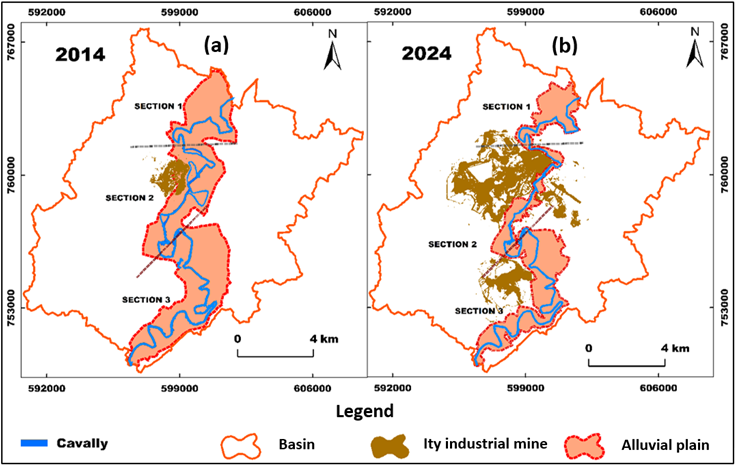
Figure 7 shows the evolution of the alluvial plain between 2014 and 2024, influenced by the expansion of operations by the Société des Mines d’Ity (SMI). From 2024 onwards, the boundaries of the alluvial plain have been redefined due to various river engineering works, such as the construction of hydraulic structures (Figure 6b), which have restricted the river’s lateral migration to the left bank in Reach 2.
SMI’s activities have intensified over the last decade (2014–2024) within the Cavally River’s alluvial plain. These interventions have had a notable impact on the river’s lateral connectivity, particularly in Reach S2. This is evidenced by the confinement index (CI), calculated for the different reaches, which increased from 17.89 in 2014 to 39.68 in 2024. These values still classify the Cavally River as an unconfined system. However, the increasing trend in CI indicates a shift towards greater confinement, reflecting a progressive reduction in lateral continuity.

The geometric parameters of the active channel represent key response variables that reflect the extent of the water surface (Table 4). The evolution of these parameters shows a fluctuating pattern. Overall, over the years, both channel width and stream power exhibit an increasing trend. These two parameters, which were relatively low in 2004, have shown consistent growth across all sections. The surface area of the water body has generally decreased, with the exception of Section S1, located upstream of the industrial mining activities, where an increase was observed.
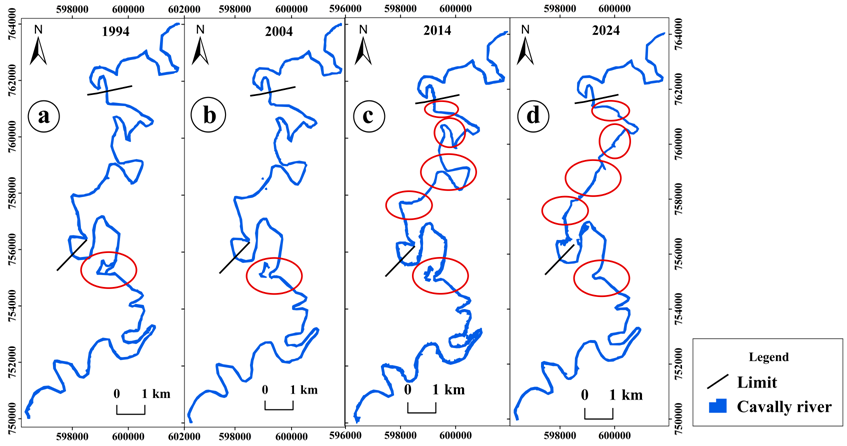
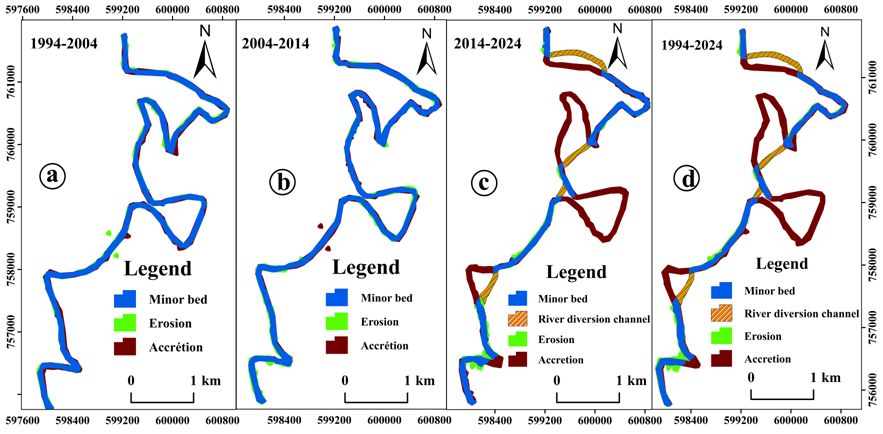
The most significant alterations, in decreasing order of magnitude, concern the active channel length, maximum slope, and sinuosity index, with respective coefficients of variation of 0.38, 0.15, and 0.12 (Table 5). Alterations in channel parameters are negligible for Reaches S3 and S1, whereas the most pronounced changes are observed in Reach 2. In Reach 2, the Cavally River has experienced a notable loss of its meanders, reflected in a considerable decrease in the sinuosity index between 2014 and 2024. The channel, which was previously meandering with a sinuosity index (SI) of 1.8 in 1994, became significantly straighter, with an SI of just 1.24 by 2024. It is worth recalling that a higher sinuosity index indicates a more sinuous river course.
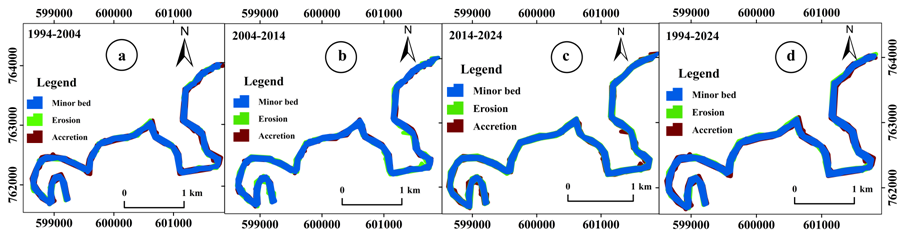
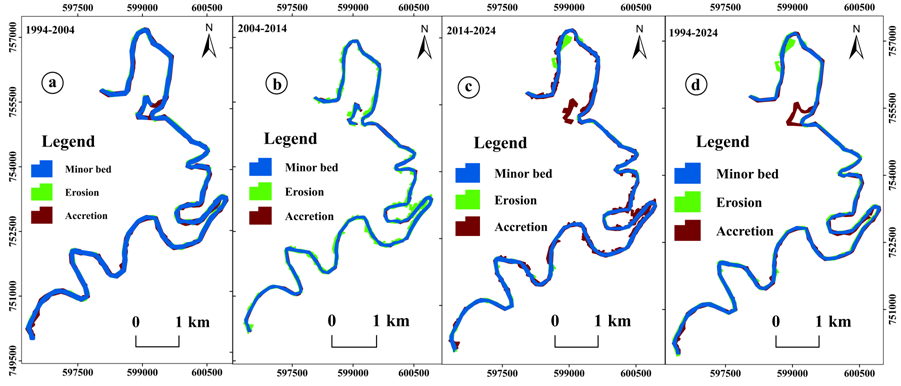
Bank dynamics also reflect the lateral movement of the Cavally River's margins, providing insight into the areas either lost to or occupied by the river between different time periods. The fluvial dynamics illustrated in Figures 8, 9, and 10 show eroded and accreted surfaces for each reach over the periods 1994–2004, 2004–2014, 2014–2024, and across the entire timeframe from 1994 to 2024. In these figures, green represents eroded land surfaces, while brown indicates sediment deposits formed in the preceding period. The river's behaviour displays an alternation between erosion and accretion processes. A dominant phase of accretion is observed in 2004 across all reaches, followed by prevailing erosion from 2014 to 2024. The evolution of erosion and accretion rates, particularly in Reach 3, reveals an alternating pattern between sediment deposition and erosion. Periods of accretion are followed by erosional phases, which are then succeeded by further sedimentation. Between 1994 and 2014, the river experienced less intense erosion and higher sediment deposition, whereas the period from 2004 to 2024 is characterised by significant erosion and marked degradation of the Cavally riverbanks.
Table 6 presents both the qualitative and quantitative evolution of erosion and accretion processes. The year 2004 recorded the highest sediment deposition, with 53.28 hectares of new deposits in Reach 3 — equivalent to 5.3 hectares per year. Conversely, the same reach experienced the greatest land loss in 2014, with 26.97 hectares of land eroded per decade. Over the three decades, the overall trend in Reaches 1 and 2 is one of erosion, largely driven by the impacts of artisanal and industrial mining activities, respectively. In contrast, Reach 3 is predominantly characterised by sediment deposition.


The results obtained show that the dynamics of land cover along the banks of the Cavally River from 1994 to 2024 have been characterised by the expansion of settlements, bare soils, and cultivated areas, accompanied by a regression of riparian vegetation and surface water bodies. This study has therefore highlighted the processes of deforestation and soil stripping driven by mining activities. Hué et al. 18 previously observed similar patterns around the Ity mine in the Zouan-Hounien region. These findings also align with those of 34 in the mining area of Bonikro, where 333.8 hectares of forest recorded one year before the mine’s opening shrank to just 15.4 hectares within nine years. This loss was primarily attributed to mining-related activities, including the opening of access tracks, mountain blasting, and the construction of mining galleries. Beyond industrial mining activities, deforestation has also been linked to the political and military crisis that began in Côte d’Ivoire in 2002. The region of Zouan-Hounien, rich in both gold and forest resources, was particularly affected. This crisis led to the withdrawal of forestry authorities, effectively opening the area to uncontrolled logging and illegal mining operations. Between 1994 and 2014, agricultural expansion also contributed significantly to land cover change. These findings are consistent with those of 35, who highlighted the major role of agriculture in deforestation processes.
The alluvial plain was redefined between 2014 and 2024 due to river engineering works that limited the Cavally River’s lateral migration on the left bank of Reach 2. During this period, mining activities by the SMI intensified in the alluvial plain, significantly impacting the river’s lateral connectivity, especially through the narrowing of Reach 2 and the loss of meanders in this section. This is supported by the increase in the confinement index, from 17.89 in 2014 to 39.68 in 2024, alongside a reduction in the sinuosity index. The expansion works carried out by the mine such as soil stripping, the construction of diversion canals with bank protections, and the installation of crossing structures have contributed to the degradation of both the lateral and longitudinal connectivity of the Cavally River. Similar impacts of mining on river continuity have been reported elsewhere. For example, a narrowing of up to 50% was observed in braided channels affected by gravel extraction, resulting in a shift from braided to sinuous patterns 36. However, studies also show that once gravel extraction stops, active channel widening can resume 37. It is important to note that river channelisation can have significant ecological consequences, such as the loss of natural habitats, fragmentation of aquatic ecosystems, and reduced biodiversity.
In general, over time, both channel width and stream power have shown an increasing trend. These two parameters, initially low in 2004, have steadily increased across all reaches. This alteration of geometric parameters is thus marked primarily by a widening of the channel, in agreement with the findings of 24 for the Cavally River. However, the surface area of the water body has declined, except in Reach 1, where alluvial gold mining (placer mining) is actively practiced. In these areas, artisanal miners extract alluvial sediments directly from the riverbanks and the active channel. Sediment extraction along the banks increases the width of the average channel bed, and consequently the river’s width at these points. Similar outcomes were observed in the Sa'dang River, where large-scale sand extraction led to reduced sediment deposition and morphological changes, including increased channel width 38. Gravel mining is considered one of the most detrimental activities affecting fluvial morphology, with significant impacts across spatial and temporal scales ranging from decades 29, 39 to centuries 36, 37. In France, gravel extraction in coastal rivers has caused beach erosion 40, while in Poland, coarse sediment removal has promoted the deposition of finer particles and led to channel incision 41.
The fluvial dynamics of the Cavally River exhibit alternating phases of erosion and accretion. The 1994–2014 period was characterised by less intense erosion and greater sediment production, whereas the 2014–2024 period has been marked by significant erosion and severe bank degradation. Over the three decades, the overall trend in Reaches 1 and 2 has been towards erosion, primarily due to artisanal and industrial mining, respectively. In other studies, incision caused by erosion has been strongly linked to in-channel gravel extraction 10, with average bed incision depths ranging from 4 to 10 metres 36. In some cases, incision continued even after extraction activities ceased 42. By contrast, Reach 3 exhibits a more balanced alternation between erosion and sedimentation. The sinuosity index, commonly used to characterise river form and to evaluate sediment transport and flow processes, significantly decreased in 2024 within the section impacted by industrial mining. The index dropped from 1.79 in 1994 to 1.24 in 2024, reflecting a loss of sinuosity that may have favoured sediment deposition in this part of the river.
The objective of this study was to characterise the morphological changes of the Cavally River in relation to gold mining activities within its watershed and along its channel. To this end, satellite imagery from 1994, 2004, 2014, and 2024 was processed and analysed. The evaluation of the Cavally River’s morphological dynamics over these different time periods reveals significant alterations in parameters closely linked to the type and expansion of adjacent mining activities. Specifically, an increase in river width, a shortening of the channel length, a reduction in sinuosity, increased confinement, bank erosion, and the degradation of riparian vegetation were all observed.
Based on this assessment, the morphological condition of the Cavally River is classified as poor in the reach adjacent to the industrial Ity mine, moderate in the upstream reach influenced by artisanal mining activities, and less impacted downstream although this lower reach still experiences indirect modifications due to upstream disturbances. The degradation of the Cavally River’s morphological quality is largely attributed to the intense pressure exerted by industrial mining at Ity, combined with the high concentration of artisanal gold mining activities within the channel, along the banks, and in associated hydraulic features of the river.
The findings clearly indicate that both legal and illegal mining activities have substantial impacts on the morphology of the Cavally River. This underscores the urgent need to reduce and/or regulate such activities near watercourses. Furthermore, a river basin restoration and management framework should be implemented to facilitate the monitoring and sustainable management of water resources. Finally, nationwide studies in fluvial geomorphology are essential to build a comprehensive database that will support the monitoring and protection of rivers across Côte d’Ivoire.
My thanks go to Dominique for his support with the various remote sensing treatments. I would like to thank my colleagues Moussa and Léréyaha for reading and revising the manuscript.
The author declares no conflicts of interest regarding the publication of this paper.
| [1] | W.-B. Chen and W.-C. Liu, “Modeling the influence of river cross-section data on a river stage using a two-dimensional/three-dimensional hydrodynamic model,” Water, vol. 9, no. 3, p. 203, Mar. 2017. | ||
| In article | View Article | ||
| [2] | Gouv.ci, “Développement du secteur minier : une croissance qui profite à l’État et aux communautés locales,” Portail officiel du Gouvernement de Côte d’Ivoire. Accessed: May 01, 2024. [Online]. | ||
| In article | |||
| [3] | T. Sauerwein, “Gold mining and development in Côte d’Ivoire: Trajectories, opportunities and oversights,” Land Use Policy, vol. 91, p. 104323, Feb. 2020. | ||
| In article | View Article | ||
| [4] | C. Soko, “L’ économie minière de l’orpaillage artisanal dans les sociétés post-conflit : jeux des acteurs et enjeux de développement et de coopération internationale. Étude de cas en Côte d’Ivoire,” Rev. organ. territ., vol. 28, no. 1, pp. 61–79, Sept. 2019. | ||
| In article | View Article | ||
| [5] | F. Arróspide, L. Mao, and C. Escauriaza, “Morphological evolution of the maipo river in central chile: influence of instream gravel mining,” Geomorphology, vol. 306, pp. 182–197, Apr. 2018. | ||
| In article | View Article | ||
| [6] | S. A. Brandt, “Classification of geomorphological effects downstream of dams,” CATENA, vol. 40, no. 4, pp. 375–401, Aug. 2000. | ||
| In article | View Article | ||
| [7] | X. Y. Chong, D. Vericat, R. J. Batalla, F. Y. Teo, K. S. P. Lee, and C. N. Gibbins, “A review of the impacts of dams on the hydromorphology of tropical rivers,” Science of The Total Environment, vol. 794, p. 148686, Nov. 2021. | ||
| In article | View Article PubMed | ||
| [8] | Z. Dibaba, “Human impacts on the natural canvas: geomorphology in environmental management,” Journal of Earth Science & Climatic Change, vol. 15, no. 2, p. 2, 2024. | ||
| In article | |||
| [9] | A. Ibisate, A. Ollero, and E. Díaz, “Influence of catchment processes on fluvial morphology and river habitats,” Limnetica, vol. 30, no. 2, pp. 169–182, Dec. 2011. | ||
| In article | View Article | ||
| [10] | G. M. Kondolf, “Hungry water: effects of dams and gravel mining on river channels,” Environmental Management, vol. 21, no. 4, pp. 533–551, July 1997. | ||
| In article | View Article PubMed | ||
| [11] | V. Lusiagustin and E. Kusratmoko, “Impact of sand mining activities on the environmental condition of the Komering river, South Sumatera,” presented at the INTERNATIONAL SYMPOSIUM ON CURRENT PROGRESS IN MATHEMATICS AND SCIENCES 2016 (ISCPMS 2016): Proceedings of the 2nd International Symposium on Current Progress in Mathematics and Sciences 2016, Depok, Jawa Barat, Indonesia, 2017, p. 030198. | ||
| In article | View Article | ||
| [12] | D. Mishra and N. D. Tiwari, “Derivation of mining sensitivity index of watershed (msiw) for assessing the impact of mining and quarrying on the satna river basin,” 2023, SSRN. | ||
| In article | View Article | ||
| [13] | A. Mudroch and J. A. Capobianco, “Impact of past mining activities on aquatic sediments in moira river basin, ontario,” Journal of Great Lakes Research, vol. 6, no. 2, pp. 121–128, Jan. 1980. | ||
| In article | View Article | ||
| [14] | J. R. Malavoi, C. C. Garnier, N. Landon, A. Recking, and P. Baran, Eléments de connaissance pour la gestion du transport solide en rivière. in ONEMA (Office National de l’Eau et des Milieux Aquatiques). France: ONEMA, 2011. [Online]. | ||
| In article | |||
| [15] | B. Rosier, J.-L. Boillat, and A. J. Schleiss, “Semi-empirical model for channel bed evolution due to lateral discharge withdrawal,” Journal of Hydraulic Research, vol. 48, no. 2, pp. 161–168, Apr. 2010. | ||
| In article | View Article | ||
| [16] | K. L. Kouassi, “Transport solide et modélisation de la sédimentation dans les lacs des barrages hydroélectriques de côte d’ivoire : cas du lac de Taabo,” Thèse De Doctorat, Université d’Abobo-Adjamé, Abidjan, Côte d’Ivoire, 2007. | ||
| In article | |||
| [17] | Endeavour Mining Corporation, “Technical report on the ity gold mine, Republic of Côte d’Ivoire,” Endeavour Minig. Ity: copyright., 2020. | ||
| In article | |||
| [18] | B. B. F. Hué, B. Kambiré, and D. A. Alla, “Mutations environnementales liées à l’orpaillage à Ity (Ouest de la Côte d’Ivoire),” Annales de l’Université de Moundou, Série A-FLASH, vol. 7, no. 2, pp. 133–151, 2020. | ||
| In article | |||
| [19] | P. G. Muiruri, J. A. Obando, and I. O. Mahiri, “Morphologic Response of a River Channel to Sand Mining in River Tyaa, Kitui County, Kenya,” j. of environ. & earth. sci., vol. 2, no. 2, pp. 12–18, Nov. 2020. | ||
| In article | View Article | ||
| [20] | O. C. N’Cho, I. Ouattara, Z. Ouattara, S. J.-P. Yeo, and B. Kamagate, “Soil and environment quality in artisanal small-scale mining areas in western Côte d’Ivoire,” World J. Adv. Res. Rev., vol. 20, no. 3, pp. 774–779, Dec. 2023. | ||
| In article | View Article | ||
| [21] | L. M. Kouadio, “Contribution à l’évaluation des niveaux de contamination des eaux et des sols des sites d’orpaillage clandestin et élimination des métaux (Hg, Pb, Cd) et de l’arsenic des eaux polluées, à l’aide des argiles de Côte d’Ivoire,” Université Félix Houphouet-Boigny de Cocody, Abidjan, Côte d’voire, 2023. [Online]. | ||
| In article | |||
| [22] | C. B. Tiesse, E. N. Wandan, and H. D. N’da, “Apport de la teledetection pour le suivi Spatio-temporel de L’occupation du sol dans la region montagneuse du tonkpi (Cote D’ivoire),” ESJ, vol. 13, no. 15, p. 310, 2017. | ||
| In article | View Article | ||
| [23] | K. S. Gbamélé, K. S. Konan, K. L. Kouassi, L. A. Brou, K. F. Konan, and B. D. Kouamé, “Evaluation de la contamination chimique des eaux souterraines par les activités anthropiques : cas de la zone d’ity-floleu sous-préfecture de ZouanHounien, ouest de la côte d’ivoire,” ESJ, vol. 16, no. 6, Feb. 2020. | ||
| In article | View Article | ||
| [24] | K. L. Kouassi et al., “1D-2D hydraulic modeling of a diversion channel on the cavally river in Zouan-Hounien, Côte d’Ivoire,” JWARP, vol. 11, no. 08, pp. 1036–1048, 2019. | ||
| In article | View Article | ||
| [25] | G. Girard, J. Sircoulon, and P. Touchebeuf de Lussigny, Aperçu sur les régimes hydrologiques de Côte d’Ivoire 1970. in ORSTOM (Office de la Recherche Scientifique et Technique d’Outre-Mer). 1970. | ||
| In article | |||
| [26] | S. K. McFeeters, “The use of the Normalized Difference Water Index (NDWI) in the delineation of open water features,” International Journal of Remote Sensing, vol. 17, no. 7, pp. 1425–1432, May 1996. | ||
| In article | View Article | ||
| [27] | Z. O. Onétié et al., “Apport Du SIG Et De L’analyse Multicritère Dans La Prospection Hydrogéologique Du Socle Précambrien De Gagnoa (Centre-Ouest De La Côte d’Ivoire),” ESJ, vol. 12, no. 23, p. 137, Aug. 2016. | ||
| In article | View Article | ||
| [28] | J. Fernandez, “Guide pour la numérisation d’un inventaire de zones humides : Logiciel ArcMap10,” Forum des marais Atlantiques, 2014. | ||
| In article | |||
| [29] | M. Rinaldi, N. Surian, F. Comiti, and M. Bussettini, “The Morphological Quality index (MQI) for stream evaluation and hydromorphological classification,” Italian Journal of Engineering Geology and Environment, no. 1, pp. 17–36, 2011. | ||
| In article | |||
| [30] | G. J. Brierley and K. A. Fryirs, Eds., Geomorphology and river management: applications of the river styles framework, 1st ed. Wiley, 2004. | ||
| In article | View Article | ||
| [31] | C. Song, C. E. Woodcock, K. C. Seto, M. P. Lenney, and S. A. Macomber, “Classification and change detection using landsat TM data,” Remote Sensing of Environment, vol. 75, no. 2, pp. 230–244, Feb. 2001. | ||
| In article | View Article | ||
| [32] | L. Congedo, “Semi-Automatic Classification Plugin: A Python tool for the download and processing of remote sensing images in QGIS,” JOSS, vol. 6, no. 64, p. 3172, Aug. 2021. | ||
| In article | View Article | ||
| [33] | S. Diallo et al., “Impact of mining activities on forest cover loss in the cavally river watershed,” IJAR, vol. 13, no. 09, pp. 791–798, Sept. 2025. | ||
| In article | |||
| [34] | L. Tia, S. F. Ayénon, and K. Koffi, “Impacts des exploitations aurifères industrielles sur le milieu naturel et les populations à bonikro (Côte d’Ivoire),” Revue de Géographie Tropicale et d’Environnement, vol. 2, pp. 61–73, 2018. | ||
| In article | |||
| [35] | C. Defo et al., “Dynamiques de l’occupation des sols et leurs effets sur l’eau de surfacedu bassin versant de la Kienké, Sud Cameroun (Afrique centrale),” TSM, no. 7–8, pp. 49–64, Aug. 2022. | ||
| In article | View Article | ||
| [36] | N. Surian and M. Rinaldi, “Morphological response to river engineering and management in alluvial channels in Italy,” Geomorphology, vol. 50, no. 4, pp. 307–326, Mar. 2003. | ||
| In article | View Article | ||
| [37] | F. Comiti, M. Da Canal, N. Surian, L. Mao, L. Picco, and M. A. Lenzi, “Channel adjustments and vegetation cover dynamics in a large gravel bed river over the last 200 years,” Geomorphology, vol. 125, no. 1, pp. 147–159, 2011. | ||
| In article | View Article | ||
| [38] | A. Arsyad, D. Rukmana, D. Salman, and I. Alimuddin, “Impact of sand mining on the changes of morphological and physical dynamics in Sa’dang River, Pinrang District, Indonesia,” J.Degrade.Min.Land Manage., vol. 8, no. 1, pp. 2451–2460, Sept. 2020. | ||
| In article | View Article | ||
| [39] | F. Arnaud, H. Piégay, L. Schmitt, A. J. Rollet, V. Ferrier, and D. Béal, “Historical geomorphic analysis (1932–2011) of a by-passed river reach in process-based restoration perspectives: The Old Rhine downstream of the Kembs diversion dam (France, Germany),” Geomorphology, vol. 236, pp. 163–177, 2015. | ||
| In article | View Article | ||
| [40] | S. Gaillot and H. Piégay, “Impact of gravel-mining on stream channel and coastal sediment supply: example of the calvi bay in corsica (France),” Journal of Coastal Research, vol. 15, no. 3, pp. 774–788, 1999. | ||
| In article | |||
| [41] | J. Zawiejska, B. Wyżga, and A. Radecki-Pawlik, “Variation in surface bed material along a mountain river modified by gravel extraction and channelization, the Czarny Dunajec, Polish Carpathians,” Geomorphology, vol. 231, pp. 353–366, Feb. 2015. | ||
| In article | View Article | ||
| [42] | J. P. Martín-Vide, C. Ferrer-Boix, and A. Ollero, “Incision due to gravel mining: Modeling a case study from the Gállego River, Spain,” Geomorphology, vol. 117, no. 3–4, pp. 261–271, May 2010. | ||
| In article | View Article | ||
Published with license by Science and Education Publishing, Copyright © 2025 Ismaïla Ouattara, Moussa Ouedraogo, Léréyaha Coulibaly, Kouadio Assemien François Yao, Sana Dominique Tuo, Zié Ouattara, Amidou Dao and Bamory Kamagaté
 This work is licensed under a Creative Commons Attribution 4.0 International License. To view a copy of this license, visit
http://creativecommons.org/licenses/by/4.0/
This work is licensed under a Creative Commons Attribution 4.0 International License. To view a copy of this license, visit
http://creativecommons.org/licenses/by/4.0/
| [1] | W.-B. Chen and W.-C. Liu, “Modeling the influence of river cross-section data on a river stage using a two-dimensional/three-dimensional hydrodynamic model,” Water, vol. 9, no. 3, p. 203, Mar. 2017. | ||
| In article | View Article | ||
| [2] | Gouv.ci, “Développement du secteur minier : une croissance qui profite à l’État et aux communautés locales,” Portail officiel du Gouvernement de Côte d’Ivoire. Accessed: May 01, 2024. [Online]. | ||
| In article | |||
| [3] | T. Sauerwein, “Gold mining and development in Côte d’Ivoire: Trajectories, opportunities and oversights,” Land Use Policy, vol. 91, p. 104323, Feb. 2020. | ||
| In article | View Article | ||
| [4] | C. Soko, “L’ économie minière de l’orpaillage artisanal dans les sociétés post-conflit : jeux des acteurs et enjeux de développement et de coopération internationale. Étude de cas en Côte d’Ivoire,” Rev. organ. territ., vol. 28, no. 1, pp. 61–79, Sept. 2019. | ||
| In article | View Article | ||
| [5] | F. Arróspide, L. Mao, and C. Escauriaza, “Morphological evolution of the maipo river in central chile: influence of instream gravel mining,” Geomorphology, vol. 306, pp. 182–197, Apr. 2018. | ||
| In article | View Article | ||
| [6] | S. A. Brandt, “Classification of geomorphological effects downstream of dams,” CATENA, vol. 40, no. 4, pp. 375–401, Aug. 2000. | ||
| In article | View Article | ||
| [7] | X. Y. Chong, D. Vericat, R. J. Batalla, F. Y. Teo, K. S. P. Lee, and C. N. Gibbins, “A review of the impacts of dams on the hydromorphology of tropical rivers,” Science of The Total Environment, vol. 794, p. 148686, Nov. 2021. | ||
| In article | View Article PubMed | ||
| [8] | Z. Dibaba, “Human impacts on the natural canvas: geomorphology in environmental management,” Journal of Earth Science & Climatic Change, vol. 15, no. 2, p. 2, 2024. | ||
| In article | |||
| [9] | A. Ibisate, A. Ollero, and E. Díaz, “Influence of catchment processes on fluvial morphology and river habitats,” Limnetica, vol. 30, no. 2, pp. 169–182, Dec. 2011. | ||
| In article | View Article | ||
| [10] | G. M. Kondolf, “Hungry water: effects of dams and gravel mining on river channels,” Environmental Management, vol. 21, no. 4, pp. 533–551, July 1997. | ||
| In article | View Article PubMed | ||
| [11] | V. Lusiagustin and E. Kusratmoko, “Impact of sand mining activities on the environmental condition of the Komering river, South Sumatera,” presented at the INTERNATIONAL SYMPOSIUM ON CURRENT PROGRESS IN MATHEMATICS AND SCIENCES 2016 (ISCPMS 2016): Proceedings of the 2nd International Symposium on Current Progress in Mathematics and Sciences 2016, Depok, Jawa Barat, Indonesia, 2017, p. 030198. | ||
| In article | View Article | ||
| [12] | D. Mishra and N. D. Tiwari, “Derivation of mining sensitivity index of watershed (msiw) for assessing the impact of mining and quarrying on the satna river basin,” 2023, SSRN. | ||
| In article | View Article | ||
| [13] | A. Mudroch and J. A. Capobianco, “Impact of past mining activities on aquatic sediments in moira river basin, ontario,” Journal of Great Lakes Research, vol. 6, no. 2, pp. 121–128, Jan. 1980. | ||
| In article | View Article | ||
| [14] | J. R. Malavoi, C. C. Garnier, N. Landon, A. Recking, and P. Baran, Eléments de connaissance pour la gestion du transport solide en rivière. in ONEMA (Office National de l’Eau et des Milieux Aquatiques). France: ONEMA, 2011. [Online]. | ||
| In article | |||
| [15] | B. Rosier, J.-L. Boillat, and A. J. Schleiss, “Semi-empirical model for channel bed evolution due to lateral discharge withdrawal,” Journal of Hydraulic Research, vol. 48, no. 2, pp. 161–168, Apr. 2010. | ||
| In article | View Article | ||
| [16] | K. L. Kouassi, “Transport solide et modélisation de la sédimentation dans les lacs des barrages hydroélectriques de côte d’ivoire : cas du lac de Taabo,” Thèse De Doctorat, Université d’Abobo-Adjamé, Abidjan, Côte d’Ivoire, 2007. | ||
| In article | |||
| [17] | Endeavour Mining Corporation, “Technical report on the ity gold mine, Republic of Côte d’Ivoire,” Endeavour Minig. Ity: copyright., 2020. | ||
| In article | |||
| [18] | B. B. F. Hué, B. Kambiré, and D. A. Alla, “Mutations environnementales liées à l’orpaillage à Ity (Ouest de la Côte d’Ivoire),” Annales de l’Université de Moundou, Série A-FLASH, vol. 7, no. 2, pp. 133–151, 2020. | ||
| In article | |||
| [19] | P. G. Muiruri, J. A. Obando, and I. O. Mahiri, “Morphologic Response of a River Channel to Sand Mining in River Tyaa, Kitui County, Kenya,” j. of environ. & earth. sci., vol. 2, no. 2, pp. 12–18, Nov. 2020. | ||
| In article | View Article | ||
| [20] | O. C. N’Cho, I. Ouattara, Z. Ouattara, S. J.-P. Yeo, and B. Kamagate, “Soil and environment quality in artisanal small-scale mining areas in western Côte d’Ivoire,” World J. Adv. Res. Rev., vol. 20, no. 3, pp. 774–779, Dec. 2023. | ||
| In article | View Article | ||
| [21] | L. M. Kouadio, “Contribution à l’évaluation des niveaux de contamination des eaux et des sols des sites d’orpaillage clandestin et élimination des métaux (Hg, Pb, Cd) et de l’arsenic des eaux polluées, à l’aide des argiles de Côte d’Ivoire,” Université Félix Houphouet-Boigny de Cocody, Abidjan, Côte d’voire, 2023. [Online]. | ||
| In article | |||
| [22] | C. B. Tiesse, E. N. Wandan, and H. D. N’da, “Apport de la teledetection pour le suivi Spatio-temporel de L’occupation du sol dans la region montagneuse du tonkpi (Cote D’ivoire),” ESJ, vol. 13, no. 15, p. 310, 2017. | ||
| In article | View Article | ||
| [23] | K. S. Gbamélé, K. S. Konan, K. L. Kouassi, L. A. Brou, K. F. Konan, and B. D. Kouamé, “Evaluation de la contamination chimique des eaux souterraines par les activités anthropiques : cas de la zone d’ity-floleu sous-préfecture de ZouanHounien, ouest de la côte d’ivoire,” ESJ, vol. 16, no. 6, Feb. 2020. | ||
| In article | View Article | ||
| [24] | K. L. Kouassi et al., “1D-2D hydraulic modeling of a diversion channel on the cavally river in Zouan-Hounien, Côte d’Ivoire,” JWARP, vol. 11, no. 08, pp. 1036–1048, 2019. | ||
| In article | View Article | ||
| [25] | G. Girard, J. Sircoulon, and P. Touchebeuf de Lussigny, Aperçu sur les régimes hydrologiques de Côte d’Ivoire 1970. in ORSTOM (Office de la Recherche Scientifique et Technique d’Outre-Mer). 1970. | ||
| In article | |||
| [26] | S. K. McFeeters, “The use of the Normalized Difference Water Index (NDWI) in the delineation of open water features,” International Journal of Remote Sensing, vol. 17, no. 7, pp. 1425–1432, May 1996. | ||
| In article | View Article | ||
| [27] | Z. O. Onétié et al., “Apport Du SIG Et De L’analyse Multicritère Dans La Prospection Hydrogéologique Du Socle Précambrien De Gagnoa (Centre-Ouest De La Côte d’Ivoire),” ESJ, vol. 12, no. 23, p. 137, Aug. 2016. | ||
| In article | View Article | ||
| [28] | J. Fernandez, “Guide pour la numérisation d’un inventaire de zones humides : Logiciel ArcMap10,” Forum des marais Atlantiques, 2014. | ||
| In article | |||
| [29] | M. Rinaldi, N. Surian, F. Comiti, and M. Bussettini, “The Morphological Quality index (MQI) for stream evaluation and hydromorphological classification,” Italian Journal of Engineering Geology and Environment, no. 1, pp. 17–36, 2011. | ||
| In article | |||
| [30] | G. J. Brierley and K. A. Fryirs, Eds., Geomorphology and river management: applications of the river styles framework, 1st ed. Wiley, 2004. | ||
| In article | View Article | ||
| [31] | C. Song, C. E. Woodcock, K. C. Seto, M. P. Lenney, and S. A. Macomber, “Classification and change detection using landsat TM data,” Remote Sensing of Environment, vol. 75, no. 2, pp. 230–244, Feb. 2001. | ||
| In article | View Article | ||
| [32] | L. Congedo, “Semi-Automatic Classification Plugin: A Python tool for the download and processing of remote sensing images in QGIS,” JOSS, vol. 6, no. 64, p. 3172, Aug. 2021. | ||
| In article | View Article | ||
| [33] | S. Diallo et al., “Impact of mining activities on forest cover loss in the cavally river watershed,” IJAR, vol. 13, no. 09, pp. 791–798, Sept. 2025. | ||
| In article | |||
| [34] | L. Tia, S. F. Ayénon, and K. Koffi, “Impacts des exploitations aurifères industrielles sur le milieu naturel et les populations à bonikro (Côte d’Ivoire),” Revue de Géographie Tropicale et d’Environnement, vol. 2, pp. 61–73, 2018. | ||
| In article | |||
| [35] | C. Defo et al., “Dynamiques de l’occupation des sols et leurs effets sur l’eau de surfacedu bassin versant de la Kienké, Sud Cameroun (Afrique centrale),” TSM, no. 7–8, pp. 49–64, Aug. 2022. | ||
| In article | View Article | ||
| [36] | N. Surian and M. Rinaldi, “Morphological response to river engineering and management in alluvial channels in Italy,” Geomorphology, vol. 50, no. 4, pp. 307–326, Mar. 2003. | ||
| In article | View Article | ||
| [37] | F. Comiti, M. Da Canal, N. Surian, L. Mao, L. Picco, and M. A. Lenzi, “Channel adjustments and vegetation cover dynamics in a large gravel bed river over the last 200 years,” Geomorphology, vol. 125, no. 1, pp. 147–159, 2011. | ||
| In article | View Article | ||
| [38] | A. Arsyad, D. Rukmana, D. Salman, and I. Alimuddin, “Impact of sand mining on the changes of morphological and physical dynamics in Sa’dang River, Pinrang District, Indonesia,” J.Degrade.Min.Land Manage., vol. 8, no. 1, pp. 2451–2460, Sept. 2020. | ||
| In article | View Article | ||
| [39] | F. Arnaud, H. Piégay, L. Schmitt, A. J. Rollet, V. Ferrier, and D. Béal, “Historical geomorphic analysis (1932–2011) of a by-passed river reach in process-based restoration perspectives: The Old Rhine downstream of the Kembs diversion dam (France, Germany),” Geomorphology, vol. 236, pp. 163–177, 2015. | ||
| In article | View Article | ||
| [40] | S. Gaillot and H. Piégay, “Impact of gravel-mining on stream channel and coastal sediment supply: example of the calvi bay in corsica (France),” Journal of Coastal Research, vol. 15, no. 3, pp. 774–788, 1999. | ||
| In article | |||
| [41] | J. Zawiejska, B. Wyżga, and A. Radecki-Pawlik, “Variation in surface bed material along a mountain river modified by gravel extraction and channelization, the Czarny Dunajec, Polish Carpathians,” Geomorphology, vol. 231, pp. 353–366, Feb. 2015. | ||
| In article | View Article | ||
| [42] | J. P. Martín-Vide, C. Ferrer-Boix, and A. Ollero, “Incision due to gravel mining: Modeling a case study from the Gállego River, Spain,” Geomorphology, vol. 117, no. 3–4, pp. 261–271, May 2010. | ||
| In article | View Article | ||