Gears, till now, are considered essential parts in the majority of mechanical machineries. Their applications are so wide that ranges from power transmission and changing of speed ratios between various mechanical units. During their life time they are subjected to continuous wear, fatigue, shocks, dynamic loads which results in gear damages or at least lowering their running performance. Replacing of the malfunctioning gear is, then, necessary. This require the change of both mating gears either through ready stored spare ones (which is normally unrealistic situation) or remanufacturing new pair of gears. This is not a direct case as gears, nowadays, are produced with profile modification which are known only at the manufacturing end. Thus, the user end has to work using the reverse technique to predict the most near acceptable design to manufacture the replacing pairs. This paper presents the parameters to be measured in the malfunctioning gear and the analysis followed that is needed to manufacture the newly replacing pair.
Gears are subjected to various types of loads (radial, tangential and axial loads) which have the nature of being static loads and dynamic loads. Although gears are running in lubricated environment and are originally manufactured from hardened materials or case-hardened ones, they suffer due to fatigue, dynamic shocks and continuous wear of being noisy performing or even broken parts. Replacing one gear is unacceptable as the mating gear is, also partially has gained some wear. The answer is to replace the two pairs either through getting new pair from the manufacturing source or producing, locally, new pair. The first is not available all the time, so manufacturing locally new pair is a must. This requires to deduce as much as possible the geometry, dimension, profile modification and all other relevance data needed to manufacture the new pair.
The geometrical parameters of gears are discussed and deduced in great number of references and handbooks beside those mentioned here 1, 2, 3, 4, 5. Repairing mal-functioning gears is almost impossible to be done through reimporting ready spare gears. The only way out is by using the reverse engineering techniques. Reverse engineering is a well-established technique in redesigning of parts 6, 7.
Gonzalez, et al 8 focused on the use of reverse engineering on gear reproduction. Parameters to be measured are given with a simple way of measuring them, together with their relevant equations. Unknown parameters were deduced. Among the parameters suggested is the span length which will not be considered in this paper as the wear in this parameter is usually high.
Ognyan Alipiev 9 discussed the reverse solution in determining the gear parameters. He, also, discussed the restricting conditions to avoid the undesired conditions such as undercutting, sharpening of teeth, interference and non-existing of contact ratio.
In this paper a detailed solution with a proposed software is aimed to re-determine the manufacturing parameters of gears taking the necessary limiting conditions into consideration.
The majority of malfunctioning gears may be attributed to broken teeth due to excessive stresses on worn areas or noisy running and non- uniformity of speed transmission which mainly caused by excessive wear in the teeth flanks. In all such cases the tip and the root diameters may not be affected because of the radial clearance.
So, the first objective is to measure the tip diameters or the root diameters. Measuring those diameters can be carried out easily using any external measuring instruments either directly if the gear has even number of teeth, or through measuring the radii for gears with odd number of teeth. The accuracy expected in measuring those parameters are within ± 0.0005 mm. which represents half the scale value of an ordinary external micrometer provided no wear.
Again, the helix angle at the tip diameters can be measured easily by getting a print of the teeth as the gear is rolled on a paper while it touches a straight edge to maintain a fixed direction. Although this is a rude way to measure the helix angle at the tip of the gear, it still an accepted way.
An important parameter to be measured is the center distance of the mating gears which can be measured from the holding mechanical unit in which the pair of gears are fitted. This is so critical as the objective of this reverse engineering is to produce the pair of gears and not only one of them.
Counting the number of teeth for the pair of meshed gears is a simple task, together with the measurement of the gear width using any external measuring instrument.
Of course, other parameters such as the span length measured by a span micrometer or the tooth thickness at successive depth measured by gear Vernier or an optical one or through measuring the base pitch measured by instrument such as Keillpart are possible, but in this paper the measurement of diameters will be considered as the flanks are the first to wear. Three approaches are considered in this paper:
Ÿ 1st approach is measuring the tip diameters, helix angle at tip of one gear and the center distance.
Ÿ 2nd approach is measuring the root diameters, helix angle at tip of one gear and the center distance.
Ÿ 3rd approach is measuring the tip and root diameters, helix angle at tip of a gear and the center distance.
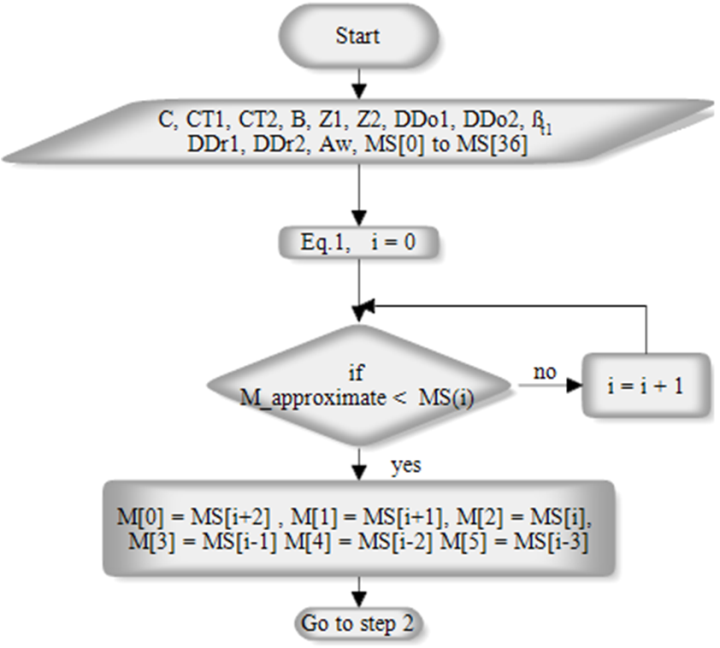
Step 1: This step is limited to determine the range of the required module by assuming that no correction is available and that the helix angle at the reference circle is taken as that measured at the tip; thus the approximate module can be determined using:
 | (1) |
It is safe to consider that the correct module falls within the surrounding ± 3 modules on the preferred values from M_approximate since the error in calculating the correct module results from neglecting the correction factor X1 and substituting the helix angle by a greater value than it should be. The preferred module are given in ref. 10. Figure 1 shows the flow chart for this step.

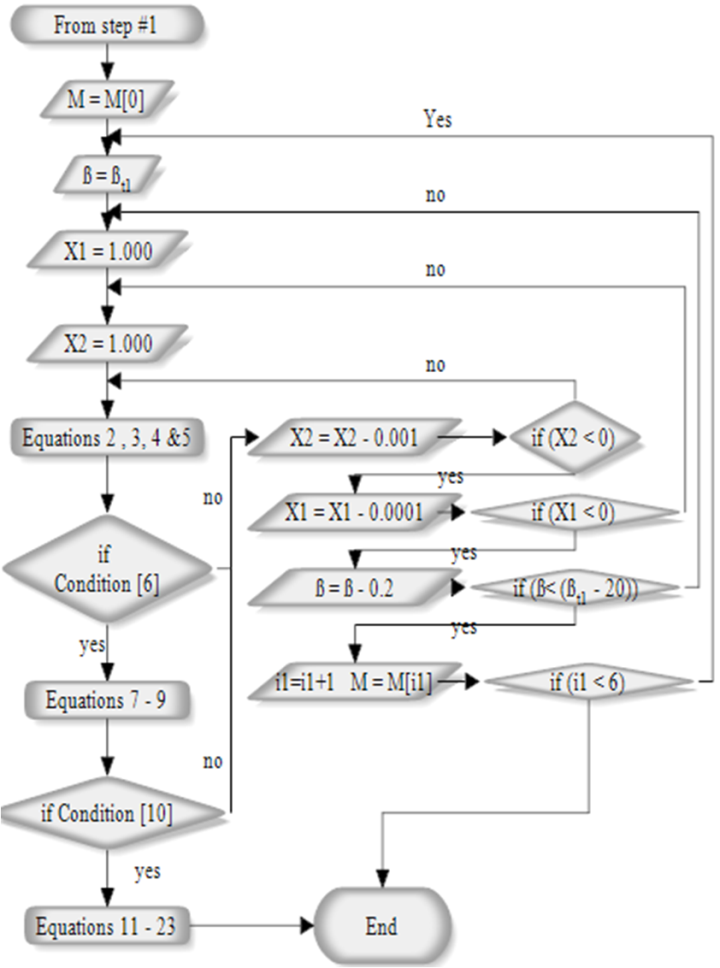
Step 2: This step determines the required values of the module, helix angle, corrections “X1 and X2” and the axis shift “Y”. through looping in the following ranges:
- The six computed modules “M”
- The helix angle varies from βt1 to (βt1- 20) in step of 0.1 deg.
- Each of the corrections X1 and X2 varies from 1.0 to -1.0 in step 0f 0.001.
- The axis shift “Y” is determined after getting the diameter of the reference circles
 | (2) |
 | (3) |
 | (4) |
 | (5) |
Iteration continues till the following condition is satisfied. The limits quoted in the condition are based on the estimated accuracy of the measured values.
 | (6) |
in case of approach #1
 | (6) |
in case of approach #2
 | (6) |
in case of approach #3
Where:
 | (7) |
 | (8) |
 | (9) |
Step 3: The results obtained from step 2 offer several solutions at different helix angle. To limit the number of solutions down to one, a following condition is added:
 | (10) |
All other parameters can be calculated:
 | (11) |
 | (12) |
 | (13) |
 | (14) |
 | (15) |
 | (16) |
 | (17) |
 | (18) |
 | (19) |
 | (20) |
 | (21) |
 | (22) |
 | (23) |
As the malfunctioning gear has suffered wear during its previous work, the measured values will not be the exact as the original values. For the diameters it is assumed that wear resulted in reducing each measured diameter by 0.1 mm. As for the measurement of the helix angle at the tip and since the procedure of measuring the helix angle through a printed trace is not very accurate, the value is assumed to be within ±1.0 deg.
The resulted values will be considered acceptable if:
- The obtained diameters should be within ± 0.001 mm from the measured values
- The obtained helix angle at tip should be within ± 1 deg
- The obtained center distance must be the same as measured.
- The teeth should not suffer sharpening as the tooth thickness at the tips is > 0.15 … 0.3 times the module 9
- The total contact ratio of the obtained gears is should be > 0.1 … 0.15 9.
Two cases are considered. The sets are given in Table 1. Each case will be considered in three approaches; namely:
Ÿ 1st approach is by assuming the measured parameters are the tip diameters of the two gears, the helix angle at the tip of one of the two gears and the center distance between the holding gear bearings.
Ÿ 2nd approach is by assuming the measured parameters are the root diameters of the two gears, the helix angle at the tip of one of the two gears and the center distance between the holding gear bearings.
Ÿ 3rd approach is by assuming the measured parameters are the tip and root diameters of one of the two gears, the helix angle at the tip of one of the two gears and the center distance between the holding gear bearings.
Table 2 gives the assumed measured values for the three approaches in both cases. The results obtained from each case has multi solutions satisfying the conditions that the tip and root diameters are within 0.001 mm from the input values. The variations were in the values of the X1, X2, Y & β. A further iteration is set to pick the nearest solution to the input values. Table 3 & Table 4 give the output results as compared to the standard values.
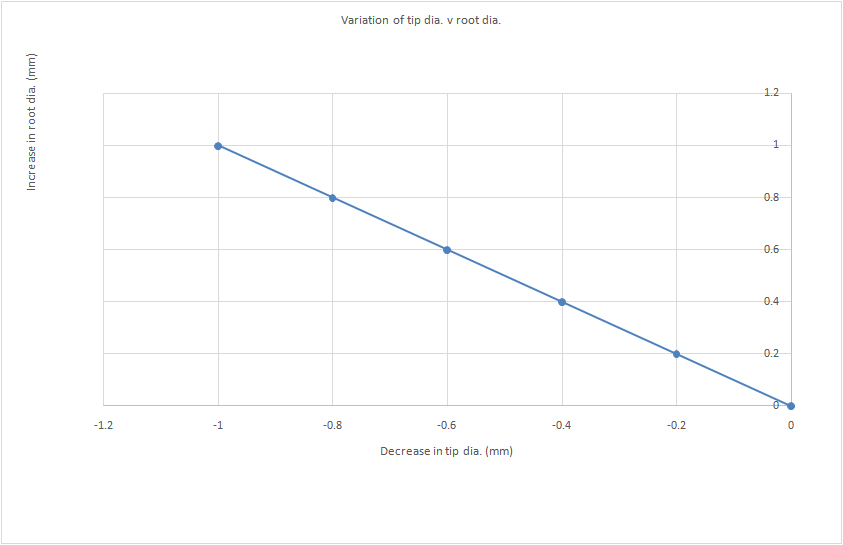
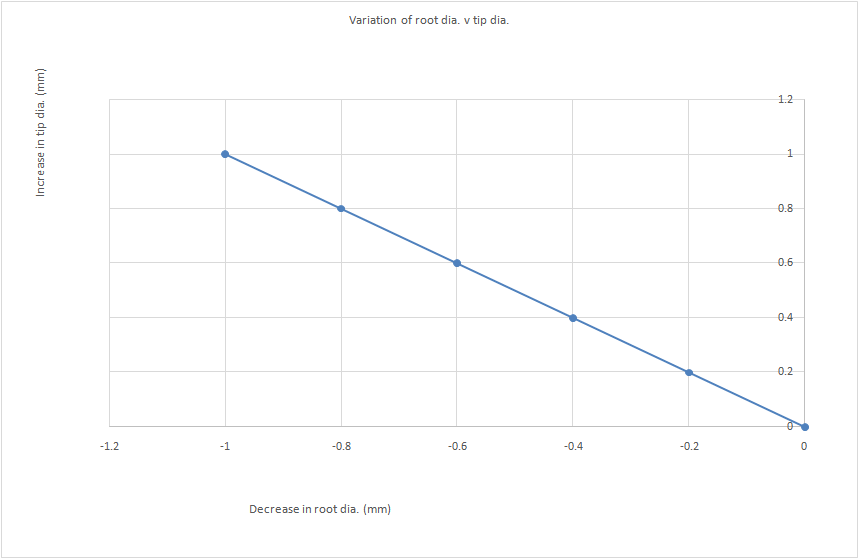
To study the effect of increasing the error in the assumed measured values, the tip diameters were decreased by different values and the corresponding root diameters were determined using approach #1. This was repeated in the opposite measurement using approach #2. The results Figure 3 & Figure 4 show that any decrease in the measurement of any of the diameters result in a corresponding increase in the other diameters. This means that with an error, say less than 0.1 mm will result in similar error in the obtained diameters which still much within the radial clearance (0.25M). Although the radial clearance between the mating teeth, the tooth height and the meshing diameters are not altered, but this should be taken carefully as the loads and stresses are not considered in this paper.

The methodology used in this paper proved an accurate and strong tool to re-find the geometrical gear parameters of mal-functioning gears through reverse engineering techniques. Since, getting exactly the original geometrical parameters are not possible due to the slight differences in the measured values than those of the original gear, the technique must be applied to re-design both meshed gears and not a single one. The key parameter in the solution is the correct measurement of the center distance from the gear housing as this determines the modification coefficient for the gears. The procedure works perfectly if tip diameters or root diameters were measured and provide several solutions. All diameters in the solutions are within 0.001 mm from the measured values. Helix angle at tip can be used to minimize the number of accepted solutions to one or two solutions. A reasonable error in the measured values has very little effect on obtained parameters.
Z1 , Z1 number of teeth for pinion and gear
CT1 & CT2 Coefficient of tangential modifications ( taken as 0.24 & -0.19)
C Radial clearance (taken as 0.25)
As Standard center distance
Aw Working center distance
Y Coefficient foe center distance modification
αt Pressure angle in transverse plane
αwt Working Pressure angle in transverse plane
h1 & h2 Addendums
ded1 & ded2 dedendums
H Tooth height
Dref1 & Dref2 Reference circle diameters
Db1 & Db2 Base circle diameters
Dw1 & Dw2 Working circle diameters
Dr1 & Dr2 Root circle diameters
αt_ref1 & αt_ref2 Pressure angle at reference circles in the transverse plane
αt_tip1 & αt_tip2 Pressure angle at tip circles in the transverse plane
βtip1 & βtip2 Helix angle at tip circles in the transverse plane
SP_ref1 & SP_ref2 Tooth thickness at reference circles in the transverse plane
TL1 & TL2 tooth thickness at tip circle
T.C.R. Total contact ratio
| [1] | Radzevich, Stephen P. (2012). Dudley's Handbook of Practical Gear Design and Manufacture (2nd ed.). Boca Raton, FL.: CRC Press, an imprint of Taylor & Francis Group. | ||
| In article | View Article | ||
| [2] | Gitin M. Maitra, Hand book of gear design, 2nd edition, Fifth reprint, Tata McGraw_Hill Publishing Company Limited, New Delhi. | ||
| In article | |||
| [3] | American Gear Manufacturers Association; American National Standards Institute, Gear Nomenclature, Definitions of Terms with Symbols (ANSI/AGMA 1012-G05 ed.), American Gear Manufacturers Association | ||
| In article | |||
| [4] | Machinery's Handbook. New York: Industrial Press. 2012. pp. 2125. | ||
| In article | |||
| [5] | https://www.sdp-si.com/resources/elements-of-metric-gear-technology/page3.php#Section6, “Elements 0f Metric gear technology”. | ||
| In article | |||
| [6] | Betim Shabani and Zoran Pandilov, “Analyzing and application of reverse engineering for design and development of mechanical parts”, Mechanical Engineering - Scientific Journal, Vol. 35, No. 2, pp. 89-96 (2017). | ||
| In article | |||
| [7] | Kumar, A.; Jain, P.K.; Pathak, P.M. (2014). Machine element reconstruction using integrated reverse engineering and rapid prototyping approach. In proceedings of the 26th All India Manufacturing Technology, Design and Research Conference (AIMTDR 2014). IIT Guwahati, Assam, India. December 12-14, 2014 (pp. 123-1, 123-5). | ||
| In article | |||
| [8] | Gonzalo González Rey, Alejandra García Toll, and Christian Irving Enrique Rodríguez González, “A Procedure to Determine the Unknown Geometry of External Cylindrical Gears”, https://www.researchgate.net/publication/294895629_A_Procedur e_To_Determine_the_Unknown_Geometry_of_External_Cylindri cal_Gears, 19, February 2016. | ||
| In article | |||
| [9] | Ognyan ALIPIEV, “Method of geometric calculation of involute helical gear drives, modified in two directions”, Annals Faculty of Engineering Hunedoara, International Journal of Engineering, ISSN: 1584-2665. | ||
| In article | |||
| [10] | ISO/DIS 21771:2007: "Gears - Cylindrical Involute Gears and Gear Pairs - Concepts and Geometry", International Organization for Standardization, (2007). | ||
| In article | |||
Published with license by Science and Education Publishing, Copyright © 2020 Omar Monir Koura
 This work is licensed under a Creative Commons Attribution 4.0 International License. To view a copy of this license, visit
http://creativecommons.org/licenses/by/4.0/
This work is licensed under a Creative Commons Attribution 4.0 International License. To view a copy of this license, visit
http://creativecommons.org/licenses/by/4.0/
| [1] | Radzevich, Stephen P. (2012). Dudley's Handbook of Practical Gear Design and Manufacture (2nd ed.). Boca Raton, FL.: CRC Press, an imprint of Taylor & Francis Group. | ||
| In article | View Article | ||
| [2] | Gitin M. Maitra, Hand book of gear design, 2nd edition, Fifth reprint, Tata McGraw_Hill Publishing Company Limited, New Delhi. | ||
| In article | |||
| [3] | American Gear Manufacturers Association; American National Standards Institute, Gear Nomenclature, Definitions of Terms with Symbols (ANSI/AGMA 1012-G05 ed.), American Gear Manufacturers Association | ||
| In article | |||
| [4] | Machinery's Handbook. New York: Industrial Press. 2012. pp. 2125. | ||
| In article | |||
| [5] | https://www.sdp-si.com/resources/elements-of-metric-gear-technology/page3.php#Section6, “Elements 0f Metric gear technology”. | ||
| In article | |||
| [6] | Betim Shabani and Zoran Pandilov, “Analyzing and application of reverse engineering for design and development of mechanical parts”, Mechanical Engineering - Scientific Journal, Vol. 35, No. 2, pp. 89-96 (2017). | ||
| In article | |||
| [7] | Kumar, A.; Jain, P.K.; Pathak, P.M. (2014). Machine element reconstruction using integrated reverse engineering and rapid prototyping approach. In proceedings of the 26th All India Manufacturing Technology, Design and Research Conference (AIMTDR 2014). IIT Guwahati, Assam, India. December 12-14, 2014 (pp. 123-1, 123-5). | ||
| In article | |||
| [8] | Gonzalo González Rey, Alejandra García Toll, and Christian Irving Enrique Rodríguez González, “A Procedure to Determine the Unknown Geometry of External Cylindrical Gears”, https://www.researchgate.net/publication/294895629_A_Procedur e_To_Determine_the_Unknown_Geometry_of_External_Cylindri cal_Gears, 19, February 2016. | ||
| In article | |||
| [9] | Ognyan ALIPIEV, “Method of geometric calculation of involute helical gear drives, modified in two directions”, Annals Faculty of Engineering Hunedoara, International Journal of Engineering, ISSN: 1584-2665. | ||
| In article | |||
| [10] | ISO/DIS 21771:2007: "Gears - Cylindrical Involute Gears and Gear Pairs - Concepts and Geometry", International Organization for Standardization, (2007). | ||
| In article | |||