Patients taking antipsychotic medications have a well-established increased risk of developing metabolic syndrome. These medications interfere with an intracellular signaling pathway leading to insulin resistance; that of which can lead to dangerous complications including diabetic ketoacidosis (DKA) and severe hypertriglyceridemia. We report a case of a 21-year-old man who developed DKA and severe hypertriglyceridemia secondary to the use of olanzapine used for the management of schizophrenia.
Patients taking atypical antipsychotic medications, such as olanzapine, have an increased risk of developing serious health conditions like metabolic syndrome; the mechanism of which involves the inhibition of glucose transport into cells, the eventual downregulation of insulin receptors, decreased glucose transporter proteins, and insulin resistance. These medications are associated with a wide-range of metabolic derangements including weight gain, diabetes mellitus, acute pancreatitis, diabetic ketoacidosis (DKA), and dyslipidemia. In fact, olanzapine has been associated with increased serum triglyceride levels at the end of an 8-week treatment course in patients with first-episode schizophrenia 1. Patients who have been prescribed the common olanzapine dose of 15mg may experience up to a 10kg weight increase during the first year of treatment 2.
We present a case of a recently diagnosed paranoid schizophrenic who developed DKA and severe hypertriglyceridemia secondary to the usage of olanzapine; prescribed for schizophrenia.
A 21-year-old male with a past medical history of schizophrenia on olanzapine was brought to the emergency department by his mother with complaints of slurred speech, abdominal pain, and multiple episodes of vomiting for the past day. These symptoms were preceded by 2 weeks of polydipsia and polyuria. The patient’s mother noticed his slurred speech and performed a fingerstick at home; revealing a glucose level of 478mg/dL, which prompted her to take the patient directly to the emergency department. Review of systems was negative and the patient denies any family history.
The patient was diagnosed with schizophrenia 7 months prior by his psychiatrist; who started him on nightly Olanzapine 15mg. He has been compliant with his medication. The patient and family have no history of hypertriglyceridemia or diabetes; his last HbA1c performed earlier that year was 5.3%.

On physical exam, the patient was found to be tachycardic to 110 beats /min and afebrile, with a BMI of 17.6kg/m2. His only notable exam finding was the appearance of multiple xanthomas of the skin along the upper torso (see Figure 1). Laboratory testing revealed a glucose level of 502mg/dL, HbA1c of 20.1%, triglyceride level of 4253mg/dL, total cholesterol of 753mg/dL, and HDL of 7.6mg/dL; that of which meets criteria for diagnosis of metabolic syndrome. His anion gap was 36mEq/L and urinalysis was positive for ketonuria and glycosuria. The patient was admitted to the medical ICU for metabolic acidosis in the setting of DKA and hypertriglyceridemia; and was started on intravenous fluids and insulin.
At this time, the patient’s olanzapine was discontinued due to its association with insulin resistance. Laboratory testing for antibodies to beta islet cells were found to be negative. His anion gap closed by the second day, however, the patient’s insulin drip was continued for an additional 48 hours in lieu of the hypertriglyceridemia. By the following day, he was able to start feeds and was placed on ultra short acting insulin and fibrate therapy. The insulin drip was stopped once triglycerides reached 200mg/dL; and continued trending downward to 129 mg/dL by the 8th hospital day. The patient was eventually downgraded to the medical floor and transferred to the inpatient psychiatry unit for further management.
Metabolic syndrome and subsequent complications such as DKA and hypertriglyceridemia continue to be a challenge when caring for patients with mental illness taking antipsychotic medications 3. Metabolic syndrome is diagnosed when a patient has three or more of the following: a waistline >40 inch for men or >35 inches for women; a blood pressure >130/85mmHg or taking antihypertensives; a triglyceride level >150mg/dL; a fasting glucose level >100mg/dL or taking hypoglycemic agents; or an HDL level <40mg/dL in men or <50mg/dL in women. In our patient, he meets criteria for metabolic syndrome given his laboratory studies; that of which is likely secondary to taking his nightly prescribed olanzapine medication.
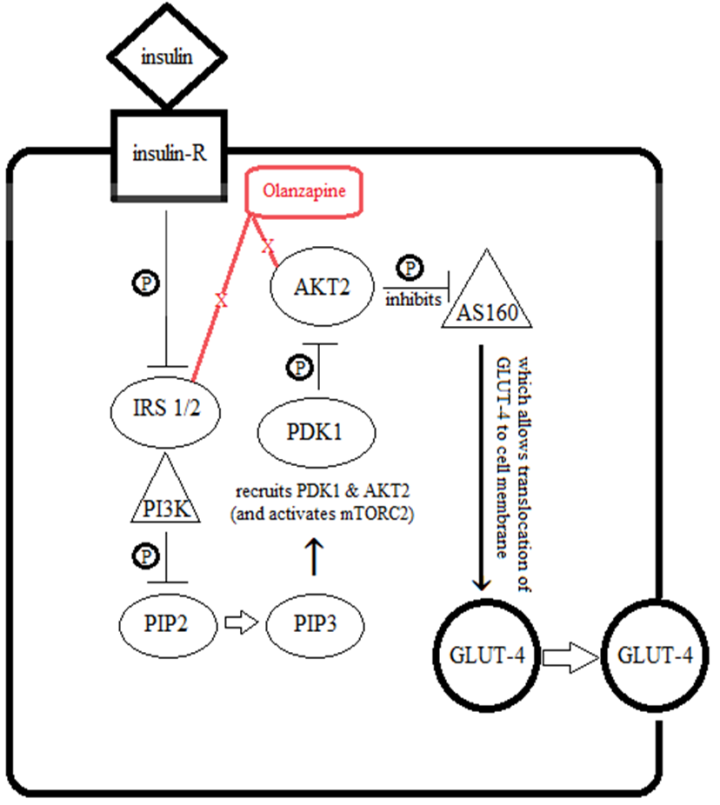
Insulin is primarily responsible for the promotion of glucose uptake from the blood into target cells through the phosphoinositide 3-kinase (PI3K)/AKT signal transduction pathway. The binding of insulin to an insulin receptor, a type of tyrosine kinase receptor, on a cell membrane triggers the autophosphorylation of tyrosine kinase residues; that of which allows for insulin-receptor substrates to bind (see Figure 2). In 2003, Wilson et al. found an association between new-onset glucose intolerance and the development of DKA 4. It has been theorized that olanzapine may block the phosphorylation of insulin-receptor substrate-1; therefore interfering with the entire PI3K second messenger system. Antipsychotics appear to decrease the activity of AKT2 directly which disallows the inhibition of AKT substrate 160. These mechanisms of insulin resistance decrease glucose transport into cells and inhibit glycolysis.
When the cellular transport of glucose is decreased, the body breaks down triglycerides stored in adipose tissue into free fatty acids and glycerol through the process of lipolysis. Through beta-oxidation, fatty acids are converted into acetyl-coA, which becomes abundant in the cytosol of the cell; therefore entering ketogenesis. The newly-formed ketone bodies enter the bloodstream and cause the blood to become acidic. They also enter the brainstem and activate the emetic center in the medulla; that of which likely caused the vomiting in our patient. Ketone body induced potassium derangement may lead to ileus and abdominal pain, as in our case above. Further, the iatrogenic effect of olanzapine leads to increased stress on the body; that of which stimulates the sympathetic nervous system to produce both epinephrine and norepinephrine. These stress hormones promote the release of glucagon via stimulation of alpha pancreatic cells; which activates metabolic pathways of gluconeogenesis, glycogenolysis, and further lipolysis. The ultimate outcome is the overproduction of glucose leading to osmotic diuresis, ketoacidosis, dehydration, and hyperosmolarity.

Olanzapine has also been associated with weight gain and hypertriglyceridemia, though the exact mechanism is unclear. It is possible that olanzapine contributes to adipocyte hypertrophy and excessive fat deposition leading to increased serum triglycerides 6. Some literature suggests a direct link between serum leptin levels, weight gain, and increased triglyceride levels 7. It is clear, however, that a high triglyceride level does contribute to insulin resistance. In the setting of insulin resistance, adipose tissue-dependent intracellular hormone sensitive lipase activity is increased; forming free fatty acids. Upon entering the liver, free fatty acids undergo esterification leading to increased formation of triglycerides. These triglycerides are transported via lipoproteins, hydrolyzed by lipoprotein lipase in blood vessels into free fatty acids, reabsorbed into adipose tissue, and will combine with glycerol to reform triglycerides; possibly explaining a link between insulin resistance and hypertriglyceridemia.
Olanzapine has an average half-life of 30 hours and will reach desirable levels in the blood in approximately one week. The drug primarily binds to plasma proteins like albumin and is metabolized in the liver by the cytochrome p450 system 8. Patients experience less extrapyramidal symptoms and anticholinergic side effects on olanzapine when compared to adverse reactions associated with typical neuroleptics.
In the case of our patient, one without significant risk factors for metabolic syndrome, it becomes clear that these metabolic derangements were secondary to use of olanzapine. This case emphasizes the importance of close follow-up of patients taking atypical antipsychotic medications, as well as the treatment approach for these life-threatening conditions managed in the critical care setting.
Patients taking olanzapine are at an increased risk for developing complications of metabolic syndrome such as DKA or severe hypertriglyceridemia. These patients will likely benefit from switching to an atypical antipsychotic with a more favorable metabolic profile. Patients will also benefit from significant lifestyle modification including increasing physical activity and adhering to a proper diet. It may be beneficial to consider other pharmacological therapies in conjunction with olanzapine such as topiramate, sibutramine, amantadine, or metformin 9, 10, 11.
Patients with antipsychotic-induced metabolic derangements should be closely followed and treated by both psychiatrists and diabetologists to ensure monitoring of adverse metabolic effects such as glucose metabolism abnormalities, lipid derangements, and weight gain. Patients taking olanzapine should be closely monitored by providers in order to prevent the complications presented in this case report.
Our case report did not receive any funding/financial support.
The authors of this case report have no competing interests.
Informed consent was obtained for the publication of this case report.
| [1] | Uçok A, Gaebel W. Side effects of atypical antipsychotics: a brief overview. World Psychiatry. 2008; 7(1): 58-62. | ||
| In article | View Article PubMed | ||
| [2] | Ball MP, Coons VB, Buchanan RW. A program for treating olanzapine-related weight gain. Psychiatr Serv. 2001; 52: 967-969. | ||
| In article | View Article PubMed | ||
| [3] | Hirowatari Y, Yoshida H, Kurosawa H, Doumitu KI, Tada N. Measurement of cholesterol of major serum lipoprotein classes by anion-exchange HPLC with perchlorate ion-containing eluent. J Lipid Res. 2003; 44(7): 1404-1412. | ||
| In article | View Article PubMed | ||
| [4] | Wilson DR, D'Souza L, Sarkar N, Newton M, Hammond C. New-onset diabetes and ketoacidosis with atypical antipsychotics. Schizophr Res. 2003; 59: 1-6. | ||
| In article | View Article | ||
| [5] | De Meyts P. The Insulin Receptor and Its Signal Transduction Network. [Updated 2016 Apr 27]. In: Feingold KR, Anawalt B, Boyce A, et al., editors. Endotext [Internet]. South Dartmouth (MA): MDText.com, Inc.; 2000-. Available from: https://www.ncbi.nlm.nih.gov/books/NBK378978/. | ||
| In article | |||
| [6] | Atmaca M, Kuloglu M, Tezcan E, Ustundag B. Serum leptin and triglyceride levels in patients on treatment with atypical antipsychotics. J Clin Psychiatry. 2003; 64(5): 598-604. | ||
| In article | View Article PubMed | ||
| [7] | Weston-GreenK, Huang XF, Lian J, Deng C. Effects of olanzapine on muscarinic M3 receptor binding density in the brain relates to weight gain, plasma insulin and metabolic hormone levels.Eur Neuropsychopharmacol. 2012; 22(5): 364-73. | ||
| In article | View Article PubMed | ||
| [8] | Thomas K, Saadabadi A. Olanzapine. [Updated 2020 Jul 18]. In: StatPearls [Internet]. Treasure Island (FL): StatPearls Publishing; 2020 Jan-. Available from: https://www.ncbi.nlm.nih.gov/books/NBK532903/. | ||
| In article | |||
| [9] | Generali JA, Cada DJ. Topiramate: antipsychotic-induced weight gain. Hosp Pharm. 2014; 49(4): 345-347. | ||
| In article | View Article | ||
| [10] | Praharaj SK, Sharma PS. Amantadine for olanzapine-induced weight gain: a systematic review and meta-analysis of randomized placebo-controlled trials. Ther Adv Psychopharmacol. 2012; 2(4): 151-156. | ||
| In article | View Article PubMed | ||
| [11] | van der Zwaal EM, Janhunen SK, Luijendijk MC, et al. Olanzapine and sibutramine have opposing effects on the motivation for palatable food. Behav Pharmacol. 2012; 23(2): 198-204. | ||
| In article | View Article PubMed | ||
Published with license by Science and Education Publishing, Copyright © 2021 Louis Costanzo, Chetana Pendkar, Amara Shafi and Joseph Gorga
 This work is licensed under a Creative Commons Attribution 4.0 International License. To view a copy of this license, visit
http://creativecommons.org/licenses/by/4.0/
This work is licensed under a Creative Commons Attribution 4.0 International License. To view a copy of this license, visit
http://creativecommons.org/licenses/by/4.0/
| [1] | Uçok A, Gaebel W. Side effects of atypical antipsychotics: a brief overview. World Psychiatry. 2008; 7(1): 58-62. | ||
| In article | View Article PubMed | ||
| [2] | Ball MP, Coons VB, Buchanan RW. A program for treating olanzapine-related weight gain. Psychiatr Serv. 2001; 52: 967-969. | ||
| In article | View Article PubMed | ||
| [3] | Hirowatari Y, Yoshida H, Kurosawa H, Doumitu KI, Tada N. Measurement of cholesterol of major serum lipoprotein classes by anion-exchange HPLC with perchlorate ion-containing eluent. J Lipid Res. 2003; 44(7): 1404-1412. | ||
| In article | View Article PubMed | ||
| [4] | Wilson DR, D'Souza L, Sarkar N, Newton M, Hammond C. New-onset diabetes and ketoacidosis with atypical antipsychotics. Schizophr Res. 2003; 59: 1-6. | ||
| In article | View Article | ||
| [5] | De Meyts P. The Insulin Receptor and Its Signal Transduction Network. [Updated 2016 Apr 27]. In: Feingold KR, Anawalt B, Boyce A, et al., editors. Endotext [Internet]. South Dartmouth (MA): MDText.com, Inc.; 2000-. Available from: https://www.ncbi.nlm.nih.gov/books/NBK378978/. | ||
| In article | |||
| [6] | Atmaca M, Kuloglu M, Tezcan E, Ustundag B. Serum leptin and triglyceride levels in patients on treatment with atypical antipsychotics. J Clin Psychiatry. 2003; 64(5): 598-604. | ||
| In article | View Article PubMed | ||
| [7] | Weston-GreenK, Huang XF, Lian J, Deng C. Effects of olanzapine on muscarinic M3 receptor binding density in the brain relates to weight gain, plasma insulin and metabolic hormone levels.Eur Neuropsychopharmacol. 2012; 22(5): 364-73. | ||
| In article | View Article PubMed | ||
| [8] | Thomas K, Saadabadi A. Olanzapine. [Updated 2020 Jul 18]. In: StatPearls [Internet]. Treasure Island (FL): StatPearls Publishing; 2020 Jan-. Available from: https://www.ncbi.nlm.nih.gov/books/NBK532903/. | ||
| In article | |||
| [9] | Generali JA, Cada DJ. Topiramate: antipsychotic-induced weight gain. Hosp Pharm. 2014; 49(4): 345-347. | ||
| In article | View Article | ||
| [10] | Praharaj SK, Sharma PS. Amantadine for olanzapine-induced weight gain: a systematic review and meta-analysis of randomized placebo-controlled trials. Ther Adv Psychopharmacol. 2012; 2(4): 151-156. | ||
| In article | View Article PubMed | ||
| [11] | van der Zwaal EM, Janhunen SK, Luijendijk MC, et al. Olanzapine and sibutramine have opposing effects on the motivation for palatable food. Behav Pharmacol. 2012; 23(2): 198-204. | ||
| In article | View Article PubMed | ||