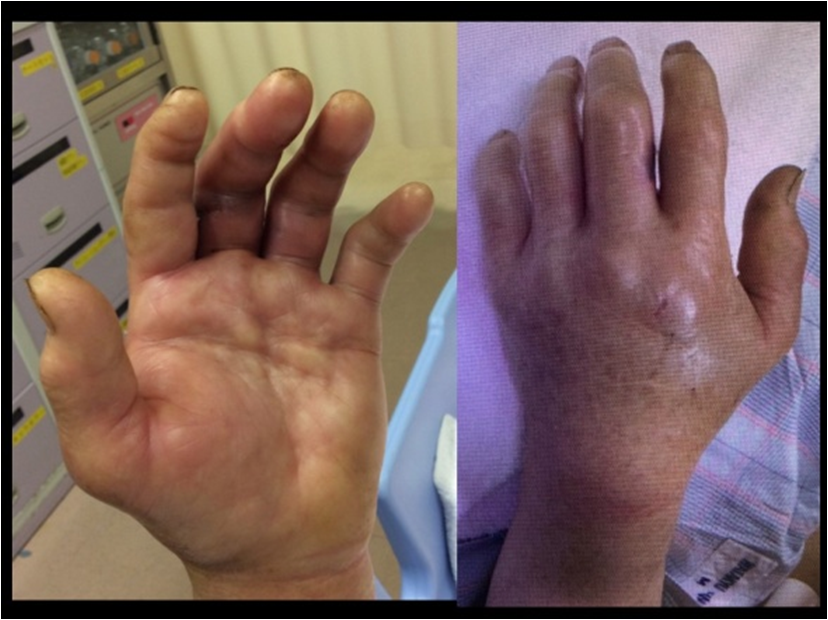
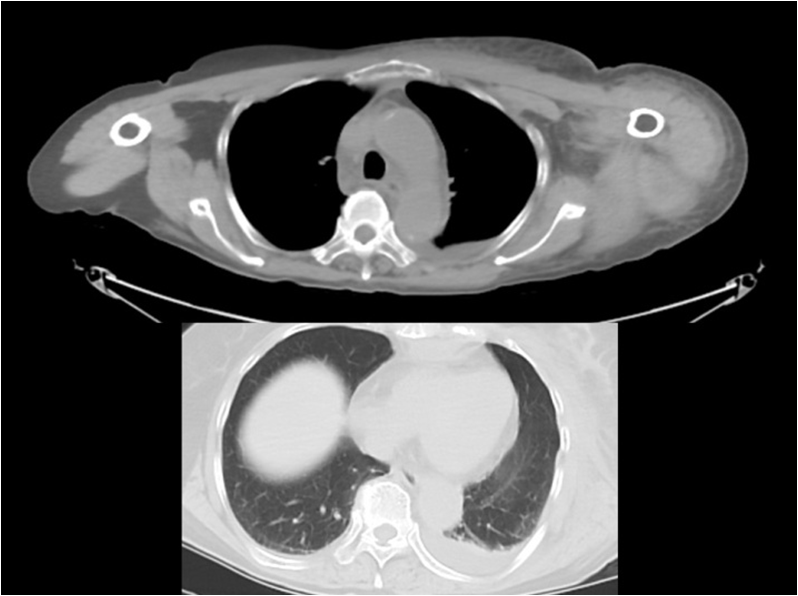
An 80-year-old woman had suffered a mamushi bite to the left hand 3 days ago and visited a local hospital. She was admitted for observation but received only tetanus toxoid, antibiotic and cepharanthine. Physicians hesitated to administer antivenin due to the risk of severe side effects, as she had previously received antivenin for mamushi bite at 50 years old. On the third day, the swelling had reached her left chest (grade V), so she was transferred to our hospital via ambulance. She had two bite wounds from a mamushi on her left hand and showed swelling with subcutaneous hemorrhaging from the finger to her chest and upper back. Chest computed tomography showed left pleural effusion. She underwent infusion of mamushi antivenin after premedication using a subcutaneous injection of 0.3 mg of adrenaline and drip infusion of 10 mg of chlorpheniramine, 20 mg of famotidine and 100 mg of hydrocortisone. She was not complicated with an anaphylactic reaction. After the infusion of the antivenin, her swelling and pleural infusion gradually improved, so she discharged on the seventh hospital day. Even after discharge, she showed no complication with serum sickness. This case showed a favorable course after a second infusion of antivenin using premedication. As there have been few reports of multiple infusions of antivenin for the same patient, a further analysis with the accumulation of similar cases is necessary.
The mamushi (Gloydius blomhoffii) is a pit viper responsible for 1.67 bites per 100,000 persons every 6 months and 10 deaths every year in Japan. 1 The mamushi venom mainly consists of multiple enzymes that work as hemolytic toxins, including phospholipase A2; neurotoxins, an alpha-toxin/beta-toxin; increased vascular permeability, arginine ester dehydrogenase; rhabdomyolysis, endopeptidase/bleeding factor (HR1 or HR2); platelet aggregation, L-amino acid oxidase. 2
Severe cases of mamushi bites usually require the administration of a horse-derived antivenin. 1 Basically, 6000 units of antivenin is administered immediately after the mamushi bite, and if symptoms improve, an additional 3000-6000 units is administered within a few hours. However, the antivenin has the potential to cause anaphylaxis (3.2%) and serum diseases (11%-12%); therefore, physicians tend to hesitate to apply this treatment in mild cases. 2, 3, 4, 5, 6 Multiple exposure to antivenin might result in severe anaphylaxis. 7, 8 However, there have been few reports of the treatment of such cases 8, 9, 10.
We herein report a case of a patient who received infusion of mamushi antivenin twice and obtained a favorable outcome with premedication.
An 80-year-old woman had suffered a mamushi bite to the left hand 3 days ago and visited a local hospital. She was admitted for observation but received only tetanus toxoid, antibiotic and cepharanthine. Physicians hesitated to administer antivenin due to the risk of severe side effects, as she had previously received antivenin for mamushi bite at 50 years old. On the third day, the swelling had reached her left chest (grade V), so she was transferred to our hospital via ambulance 12. She had history of hypertension and dyslipidemia.
Upon arrival, she showed clear consciousness. Her vital signs were as follows: blood pressure, 135/82 mmHg; heart rate, 90 beats per minute; respiratory rate, 20 breaths per minute; percutaneous saturation, 97% under room air; and temperature, 36.8 °C. She had two bite wounds from a mamushi on her left hand (Figure 1) and showed swelling with subcutaneous hemorrhaging from the finger to her chest and upper back.
The findings of chest roentgen, an electrocardiogram and cardiac echography were negative. Chest computed tomography showed left pleural effusion, in addition to subcutaneous swelling at left chest and upper back (Figure 2).


The results of biochemical analyses of the venous blood on arrival were as follows: white blood cells, 11,000/μl; hemoglobin, 11.2 g/dl; platelets, 41.3×10⁴/μl; total protein, 5.5 g/dL; albumin, 2.7 g/dL, glucose, 120 mg/dL; HbA1c, 6.1%; total bilirubin, 0.3 mg/dL; aspartate aminotransferase, 91 IU/L; alanine aminotransferase, 20 IU/L; amylase, 68 IU/L; blood urea nitrogen, 26.3 mg/dl; creatinine, 0.73 mg/dl; creatine phosphokinase, 2020 IU/L; sodium, 139 mEq/L; potassium, 5.0 mEq/L; chloride, 107 mEq/L; prothrombin time 11.1 (11.3) sec; activated partial thromboplastin time, 23.0 (26.7) sec; fibrinogen, 295 mg/dL; fibrin degradation product 17.5 μg/ml and CRP, 0.72 mg/dl.
She underwent infusion of mamushi antivenin after premedication with a subcutaneous injection of 0.3 mg of adrenaline and drip infusion of 10 mg of chlorpheniramine, 20 mg of famotidine and 100 mg of hydrocortisone. She was not complicated with an anaphylactic reaction. She also received 10 mg of cepharanthine and 3 g of cefazolin per day for 2 days. After the infusion of the antivenin, her swelling and pleural infusion gradually improved, so she was discharged on the seventh hospital day. Even after discharge, she showed no complication with serum sickness.
This case showed a favorable course after a second infusion of antivenin using premedication. Among severe cases of mamushi bite, there has been one report of a patient who underwent repeated infusion of antivenin within a few hours. 12 However, we were unable to find a report describing repeated infusion of mamushi antivenin across 30 years. Tateno et al. reported a study of 64 cases of mamushi bite. 8 Among them, three cases underwent repeated infusion of the antivenin without any premedication. The interval between the first and second bite was 1, 2, 5 years respectively. All three cases showed serum sickness after the second infusion of antivenin. While, 5 out of 61 cases showed serum sickness and 1 out of 61 cases showed anaphylactic reaction after the first infusion of antivenin. Makino et al. reported a study of 114 cases of mamushi bite. 9 Among them, only one case underwent repeated infusion of the antivenin without any premedication. The interval between the first and second bite was unknown, but the case showed hypotension, loss of consciousness and urticaria within eight days after the second infusion of antivenin. In addition, Zeng et al. reported a case of allergic reaction to antivenin in a 75-year-old man who had been bitten twice by the same snake within a month. While the patient did not show any allergic disorder after the first bite, 10 after the second infusion of antivenin, he had a pale face with a large erythematic area, rashes on the chest and swelling on the back with unstable circulation. Following the intramuscular injection of promethazine and intravenous injection of methylprednisolone, he achieved relief.
Most adverse reactions to the antivenin can be divided into two general categories: type I (immediate hypersensitivity), which are life-threatening reactions, and the more common type III (immune complex) reaction, which is characterized by serum sickness. 13, 14 The administration of epinephrine and antihistamines can be lifesaving in cases of type I reactions, while steroids and antihistamines can ameliorate type III reactions. 14 de Silva et al. reported the results of 1,007 patients from a randomized, double-blind, placebo-controlled trial of adrenaline, promethazine and hydrocortisone administered immediately before infusion of antivenin for snake bite. 15 Patients were monitored for adverse reactions for at least 96 h. They concluded that pretreatment with low-dose adrenaline was safe and reduced the risk of acute severe reactions to snake antivenin. They did not treat serum sickness. However, oral corticosteroids are given prophylactically after some uses of snake antivenin to prevent serum sickness in Australia, and there have been a few immediate or delayed reactions. 16 Prophylactic oral corticosteroids after antivenin administration may be responsible for this low reaction rate. 11 Accordingly, the combined use of adrenaline and steroids may have resulted in a favorable outcome without immediate or delayed adverse reactions in the present case.
This case showed a favorable course after a second infusion of antivenin using premedication. As there have been few reports of multiple infusions of antivenin for the same patient, a further analysis with the accumulation of similar cases is necessary.
The authors declare no conflicts of interest in association with the present study.
This work was supported in part by a Grant-in-Aid for Special Research in Subsidies for ordinary expenses of private schools from The Promotion and Mutual Aid Corporation for Private Schools of Japan.
| [1] | Toh-Yoon, E.W., Otani, Y. and Kabuto, S. “Severe Japanese Mamushi (Gloydius blomhoffii) bite”, Clin Case Rep, 5(9). 1548-49. Jul 2017. | ||
| In article | View Article PubMed | ||
| [2] | Ishikawa, K., Ohsaka, H., Omori, K., Obinata, M., Mishima, K., Oode, Y. and Yanagawa, Y. “Pregnant Woman Bitten by a Japanese Mamushi (Gloydius blomhoffii)”, Intern Med, 54(19). 2517-20. Oct 2015. | ||
| In article | View Article PubMed | ||
| [3] | Hifumi, T., Yamamoto, A., Morokuma, K, Ogasawara, T., Kiriu, N., Hasegawa, E., Inoue, J., Kato, H., Koido, Y. and Takahashi, M. “Surveillance of the clinical use of mamushi (Gloydius blomhoffii) antivenom in tertiary care centers in Japan”, Jpn J Infect Dis, 64. 373-376, Apr 2011. | ||
| In article | |||
| [4] | Hifumi T, Yamamoto A, Morokuma K, Okada, I., Kiriu, N., Ogasawara, T., Hasegawa, E., Kato, H., Inoue, J., Koido, Y. and Takahashi, M. “Clinical efficacy of antivenom and cepharanthine for the treatment of Mamushi (Gloydius blomhoffii) bites in tertiary care centers in Japan”, Jpn J Infect Dis, 66(1). 26-31. 2013. | ||
| In article | View Article PubMed | ||
| [5] | Maeshiro, Y. “Poisonous snake”, Jpn J Acute Med, 3. 1378-83. 1979. In Japanese | ||
| In article | |||
| [6] | Naito, H. “Is an antivenom necessary for mamushi bite?”, Jpn Med J, 3986. 24-27. 2000. In Japanese | ||
| In article | |||
| [7] | Smith, P.K., Hourihane, J.O.B. and Lieberman, P. “Risk multipliers for severe food anaphylaxis”, World Allergy Organ J, 8(1). 30. Nov 2015. | ||
| In article | View Article PubMed | ||
| [8] | Tateno, I., Sawai, Y., Makino, M., Kawamura, Z. and Ogonuki, T. “Relapse or reinfection in tetanus and diphtheria, and reenvenomation in mamushi and habu snake bites. Problems associated with reinjection of horse serum antitoxin or antivenom in man”, Jpn J Exp Med, 34. 125-34. Jun 1964. | ||
| In article | |||
| [9] | Makino, M., Yurugi, E., and Abe, J. “A study of 114 cases of viper bite. With special reference to the administration of antivenin”, J Jpn Surg Assoc, 49.1923-28. 1988. In Japanese. | ||
| In article | View Article | ||
| [10] | Zeng, F.J., Chen, C. and Liu, M.H. “Allergic reactions to antivenom in a patient bitten twice by the same snake within a month: A rare case report and literature review”, Chin J Traumatol, 20(5). 299-302. Oct 2017. | ||
| In article | View Article PubMed | ||
| [11] | Takeuchi, I., Omori, K., Nagasawa, H., Jitsuiki, K., Kondo, A., Ohsaka, H., Ishikawa, K. and Yanagawa, Y. “Prognostic indicators among laboratory data on arrival to assess the severity of mamushi bites”, J Rural Med, 14. 222-5. Nov 2019. | ||
| In article | View Article PubMed | ||
| [12] | Noda, K., Akiyama, N. and Seishi, I. “The effects of early treatment with anti−venom on length of hospital stay: Analysis of 46 cases of mamushi bites”, Chudoku Kenkyu, 30. 25-30. Mar 2017. In Japanese. | ||
| In article | |||
| [13] | Ameno, S., Ameno, K., Fuke, C., Kiryu, T., Sogo, K., Yodoya, J., Ijiri, I. and Tsunenari, S. “Detection of anti-horse serum antibody produced by injecting an antivenin or antitoxin”, Nihon Hoigaku Zasshi, 42. 161-8. Apr 1988. In Japanese. | ||
| In article | |||
| [14] | Otten, E.J. and McKimm, D. “Venomous snakebite in a patient allergic to horse serum”, Ann Emerg Med, 12(10). 624-7. Oct 1983. | ||
| In article | View Article | ||
| [15] | de Silva, H.A., Pathmeswaran, A., Ranasinha, C.D., Jayamanne, S., Samarakoon, S.B., Hittharage, A, Kalupahana, R., Ratnatilaka, G.A., Uluwatthage, W., Aronson, J.K., Armitage, J.M., Lalloo, D.G. and de Silva H.J. “Low-dose adrenaline, promethazine, and hydrocortisone in the prevention of acute adverse reactions to antivenom following snakebite: a randomized, double blind, placebo-controlled trial”, PLoS Med, 8. e1000435. May 2011. | ||
| In article | View Article PubMed | ||
| [16] | Sutherland, S.K. “Antivenom use in Australia. Premedication, adverse reactions and the use of venom detection kits”, Med J Aust, 157. 734-9. Dec 1992. | ||
| In article | View Article PubMed | ||
Published with license by Science and Education Publishing, Copyright © 2021 Ikuto Takeuchi, Kei Jitsuiki and Youichi Yanagawa
 This work is licensed under a Creative Commons Attribution 4.0 International License. To view a copy of this license, visit
http://creativecommons.org/licenses/by/4.0/
This work is licensed under a Creative Commons Attribution 4.0 International License. To view a copy of this license, visit
http://creativecommons.org/licenses/by/4.0/
| [1] | Toh-Yoon, E.W., Otani, Y. and Kabuto, S. “Severe Japanese Mamushi (Gloydius blomhoffii) bite”, Clin Case Rep, 5(9). 1548-49. Jul 2017. | ||
| In article | View Article PubMed | ||
| [2] | Ishikawa, K., Ohsaka, H., Omori, K., Obinata, M., Mishima, K., Oode, Y. and Yanagawa, Y. “Pregnant Woman Bitten by a Japanese Mamushi (Gloydius blomhoffii)”, Intern Med, 54(19). 2517-20. Oct 2015. | ||
| In article | View Article PubMed | ||
| [3] | Hifumi, T., Yamamoto, A., Morokuma, K, Ogasawara, T., Kiriu, N., Hasegawa, E., Inoue, J., Kato, H., Koido, Y. and Takahashi, M. “Surveillance of the clinical use of mamushi (Gloydius blomhoffii) antivenom in tertiary care centers in Japan”, Jpn J Infect Dis, 64. 373-376, Apr 2011. | ||
| In article | |||
| [4] | Hifumi T, Yamamoto A, Morokuma K, Okada, I., Kiriu, N., Ogasawara, T., Hasegawa, E., Kato, H., Inoue, J., Koido, Y. and Takahashi, M. “Clinical efficacy of antivenom and cepharanthine for the treatment of Mamushi (Gloydius blomhoffii) bites in tertiary care centers in Japan”, Jpn J Infect Dis, 66(1). 26-31. 2013. | ||
| In article | View Article PubMed | ||
| [5] | Maeshiro, Y. “Poisonous snake”, Jpn J Acute Med, 3. 1378-83. 1979. In Japanese | ||
| In article | |||
| [6] | Naito, H. “Is an antivenom necessary for mamushi bite?”, Jpn Med J, 3986. 24-27. 2000. In Japanese | ||
| In article | |||
| [7] | Smith, P.K., Hourihane, J.O.B. and Lieberman, P. “Risk multipliers for severe food anaphylaxis”, World Allergy Organ J, 8(1). 30. Nov 2015. | ||
| In article | View Article PubMed | ||
| [8] | Tateno, I., Sawai, Y., Makino, M., Kawamura, Z. and Ogonuki, T. “Relapse or reinfection in tetanus and diphtheria, and reenvenomation in mamushi and habu snake bites. Problems associated with reinjection of horse serum antitoxin or antivenom in man”, Jpn J Exp Med, 34. 125-34. Jun 1964. | ||
| In article | |||
| [9] | Makino, M., Yurugi, E., and Abe, J. “A study of 114 cases of viper bite. With special reference to the administration of antivenin”, J Jpn Surg Assoc, 49.1923-28. 1988. In Japanese. | ||
| In article | View Article | ||
| [10] | Zeng, F.J., Chen, C. and Liu, M.H. “Allergic reactions to antivenom in a patient bitten twice by the same snake within a month: A rare case report and literature review”, Chin J Traumatol, 20(5). 299-302. Oct 2017. | ||
| In article | View Article PubMed | ||
| [11] | Takeuchi, I., Omori, K., Nagasawa, H., Jitsuiki, K., Kondo, A., Ohsaka, H., Ishikawa, K. and Yanagawa, Y. “Prognostic indicators among laboratory data on arrival to assess the severity of mamushi bites”, J Rural Med, 14. 222-5. Nov 2019. | ||
| In article | View Article PubMed | ||
| [12] | Noda, K., Akiyama, N. and Seishi, I. “The effects of early treatment with anti−venom on length of hospital stay: Analysis of 46 cases of mamushi bites”, Chudoku Kenkyu, 30. 25-30. Mar 2017. In Japanese. | ||
| In article | |||
| [13] | Ameno, S., Ameno, K., Fuke, C., Kiryu, T., Sogo, K., Yodoya, J., Ijiri, I. and Tsunenari, S. “Detection of anti-horse serum antibody produced by injecting an antivenin or antitoxin”, Nihon Hoigaku Zasshi, 42. 161-8. Apr 1988. In Japanese. | ||
| In article | |||
| [14] | Otten, E.J. and McKimm, D. “Venomous snakebite in a patient allergic to horse serum”, Ann Emerg Med, 12(10). 624-7. Oct 1983. | ||
| In article | View Article | ||
| [15] | de Silva, H.A., Pathmeswaran, A., Ranasinha, C.D., Jayamanne, S., Samarakoon, S.B., Hittharage, A, Kalupahana, R., Ratnatilaka, G.A., Uluwatthage, W., Aronson, J.K., Armitage, J.M., Lalloo, D.G. and de Silva H.J. “Low-dose adrenaline, promethazine, and hydrocortisone in the prevention of acute adverse reactions to antivenom following snakebite: a randomized, double blind, placebo-controlled trial”, PLoS Med, 8. e1000435. May 2011. | ||
| In article | View Article PubMed | ||
| [16] | Sutherland, S.K. “Antivenom use in Australia. Premedication, adverse reactions and the use of venom detection kits”, Med J Aust, 157. 734-9. Dec 1992. | ||
| In article | View Article PubMed | ||