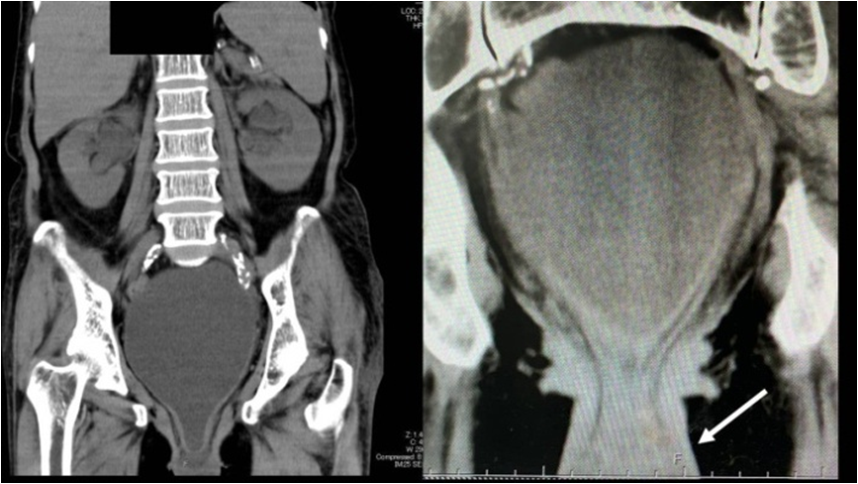
A 71-year-old woman with a history of diabetes mellitus, hypertension, dyslipidemia and ischemic heart disease, had appetite loss and difficulty moving. She had had one daughter via vaginal delivery. On arrival, she had uterine prolapse from the vagina, stage IV. Whole-body computed tomography indicated uterine prolapsed, distended bladder, bilateral hydro-ureter and nephrosis. An indwelling balloon catheter showed pyuria. The results of a biochemical blood analysis showed acute kidney infection and an inflammatory response. She underwent infusion of Ceftriaxone and was admitted to the general ward. On the second hospital day, she underwent insertion of an intravaginal ring. On the third hospital day, she showed improvement of inflammation and a return to the normal renal function. After physical rehabilitation, she was discharged on the 14th hospital day with an indwelling balloon catheter. We herein report a rare case of sepsis and renal dysfunction caused by uterine prolapse. A prompt diagnosis followed by early relief of the obstruction resulted in improvement of the renal function.
The causes of acute kidney injury (AKI) can be divided into three categories: prerenal (caused by a decreased renal perfusion, often because of volume depletion), intrinsic renal (caused by a process within the kidneys) and postrenal. 1 Postrenal causes typically result from obstruction of the urinary flow, and prostatic hypertrophy is the most common cause of obstruction in older men. Other postrenal causes are neurogenic bladder, retroperitoneal fibrosis, radiation, and rectal, prostate, or cervical cancer. 1, 2 Pelvic organ prolapse (POP) including that of the uterus, rarely but occasionally causes severe postrenal AKI. 3, 4, 5, 6
POP is a disturbing problem that affects many women and their quality of life. Weakness of the endopelvic fascia is the main factor in the etiology of POP. 3 All contribution for weakening of the pelvic floor connective tissue/collagen, allow the pelvic organs to prolapse through the vaginal walls. Such causative factors include the genetic background, history of childbirth and mode of delivery, history of hysterectomy, obesity, aging, menopausal state and the estrogen receptor ratio. 3 Clinical symptoms of uterine prolapse include a sensation of something falling within the body, discomfort, dragging in the abdomen, pain on standing, urination or bowel motion disturbance and sexual intercourse disturbance. 7
We herein report a rare case of sepsis and renal dysfunction caused by uterine prolapse. 2
A 71-year-old woman with a history of diabetes mellitus, hypertension, dyslipidemia and ischemic heart disease complained of appetite loss and difficulty of movement. She had had one daughter via vaginal delivery. She was transported to Numazu City Hospital by an ambulance.
On arrival, her vital signs were as follows: consciousness, clear; blood pressure, 104/64 mmHg; heart rate, 104 beats per minute; respiratory rate, 12 breaths per minute; percutaneous saturation, 96% under room air; body temperature, 35.6 °C. She had uterine prolapse from the vagina, stage IV. The results of a venous blood gas analysis were as follows: pH, 7.339; pCO2 35.1 mmHg; pO2, 14.9 mmHg; HCO3-, 18.7 mmol/L; base excess, -7.4 mmol/L; lactate, 2.6 mmol/L. An electrocardiogram was negative. Whole-body computed tomography indicated uterine prolapse, distended bladder, bilateral hydro-ureter and nephrosis (Figure 1). An indwelling balloon catheter showed pyuria. The main results of a biochemical blood analysis on arrival were as follows: white blood cell count, 6,600/μL; blood urea nitrogen (BUN), 68.1 mg/dL; creatinine (Crea), 3.07 mg/dL; sodium, 131 mEq/L; potassium, 4.5 mEq/L; chloride, 99 mEq/L; glucose 325 mg/dL; HbA1C, 7.3% and C-reactive protein, 14.5 mg/dL.
She underwent infusion of Ceftriaxone and was admitted to the general ward. On the second hospital day, her vital signs were stable and she underwent insertion of an intravaginal ring. On the third hospital day, she showed improvement of inflammation, her BUN and Crea levels returned to the normal range, and she regained her appetite and was able to feed herself. Culture of urine showed Candida glabrata, and a blood test showed a 600 pg/mL β-D glucan value, so she also underwent infusion of Itraconazole.
After physical rehabilitation, she was discharged on the 14th hospital day with an indwelling balloon catheter. She had to move far away to live with her daughter, so radical surgery for her uterine prolapse could not be performed.

We herein report a rare case of sepsis and renal dysfunction caused by uterine prolapse. There were three previous case reports, making this the fourth one. 4, 5, 6 Among them, the present case was the oldest. We summarized these present and previous cases in Table 1. All cases obtained a survival outcome, and AKI returned to normal by prompt appropriate treatment in two of the four cases.
POP complicated hydronephrosis in 3%-30% of cases, but complication of AKI was rare. 4, 8 The risk factors for complication with AKI in cases of POP were the duration and grade of POP, severity of hydronephrosis, preceding renal disease, diabetes mellitus, hypertension and urinary tract infection. 4 Diabetes mellitus and hypertension, in addition to hydronephrosis with urosepsis, in the present case may have resulted in the complication of acute kidney disease. However, the early drainage of the bladder, hydration and infusion of antibiotics resulted in obtaining a normal renal function in the present case.
The management options for POP include pessary and surgery. Vaginal pessaries have long been used for treatment of POP 5. These devices are inserted into the vagina to provide support to related pelvic structures, and to relieve pressure on the bladder and bowel 5. Surgical options for POP were previously colpocleisis, colposuspension, vaginal panhysterectomy, and anterior or posterior colporrhaphy. Recently, however, the transvaginal synthetic mesh kits in surgery are used for treatment of POP 5. The present case missed chance of radical surgery.
We herein report a rare case of sepsis and renal dysfunction caused by uterine prolapse. A prompt diagnosis followed by early relief of obstruction improved the renal function.
This work was supported in part by a Grant-in-Aid for Special Research in Subsidies for ordinary expenses of private schools from The Promotion and Mutual Aid Corporation for Private Schools of Japan.
| [1] | Rahman, M,, Shad, F. and Smith, M.C. “Acute kidney injury: A guide todiagnosis and management,” Am Fam Physician, 86(7). 631-9. Oct.2012. | ||
| In article | |||
| [2] | Yashi, M., Muraishi, O., Kobayashi, Y. and Tokue, A. “Gastrocystoplasty in a woman with radiation-induced ureteral obstruction and low-compliance bladder,” Urol Int, 61(1). 55-7. Oct 1998 | ||
| In article | View Article PubMed | ||
| [3] | Weintraub, A.Y., Glinter, H. and Marcus-Braun, N. “Narrative review of the epidemiology, diagnosis and pathophysiology of pelvic organ prolapsed,” Int Braz J Urol, 46(1). 5-14. Jan-Feb 2020. | ||
| In article | View Article PubMed | ||
| [4] | Lucassen, E.A., la Chapelle, C.F., Krouwel, E. and Groeneveld, M. “Renal failure caused by severe pelvic organ prolapsed,” BMJ Case Rep, 12(7). e229318. Jul 2019. | ||
| In article | View Article PubMed | ||
| [5] | Miyagi, A., Inaguma, Y., Tokoyoda, T., Nakajima, T., Sezaki, R. and Matsukawa, T. “A case of renal dysfunction caused by pelvic organ prolapsed,” CEN Case Rep, 6(2). 125-128. Nov 2017. | ||
| In article | View Article PubMed | ||
| [6] | Sato, S and Nishida, M. “Renal failure due to severe pelvic organ prolapsed,” J Gen Fam Med, 17(3). 249-51. 2016. | ||
| In article | View Article | ||
| [7] | Hemming, C., Constable, L., Goulao, B., Kilonzo, M., Boyers, D., Elders, A., Cooper, K., Smith, A., Freeman, R., Breeman, S., McDonald, A., Hagen, S., Montgomery, I., Norrie, J. and Glazener, C. “Surgical interventions for uterine prolapse and for vault prolapse: the two VUE RCTs,” Health Technol Assess, 24(13). 1-220. Mar 2020. | ||
| In article | View Article PubMed | ||
| [8] | Siddique, M., Ingraham, C., Kudish, B., Iglesia, C.B. and Polland, A. “Hydronephrosis associated with pelvic prgan prolapse: A systematic review,” Female Pelvic Med Reconstr Surg, 26(3): 212-8. Mar 2020. | ||
| In article | View Article PubMed | ||
Published with license by Science and Education Publishing, Copyright © 2021 Hiromasa Suzuki and Youichi Yanagawa
 This work is licensed under a Creative Commons Attribution 4.0 International License. To view a copy of this license, visit
http://creativecommons.org/licenses/by/4.0/
This work is licensed under a Creative Commons Attribution 4.0 International License. To view a copy of this license, visit
http://creativecommons.org/licenses/by/4.0/
| [1] | Rahman, M,, Shad, F. and Smith, M.C. “Acute kidney injury: A guide todiagnosis and management,” Am Fam Physician, 86(7). 631-9. Oct.2012. | ||
| In article | |||
| [2] | Yashi, M., Muraishi, O., Kobayashi, Y. and Tokue, A. “Gastrocystoplasty in a woman with radiation-induced ureteral obstruction and low-compliance bladder,” Urol Int, 61(1). 55-7. Oct 1998 | ||
| In article | View Article PubMed | ||
| [3] | Weintraub, A.Y., Glinter, H. and Marcus-Braun, N. “Narrative review of the epidemiology, diagnosis and pathophysiology of pelvic organ prolapsed,” Int Braz J Urol, 46(1). 5-14. Jan-Feb 2020. | ||
| In article | View Article PubMed | ||
| [4] | Lucassen, E.A., la Chapelle, C.F., Krouwel, E. and Groeneveld, M. “Renal failure caused by severe pelvic organ prolapsed,” BMJ Case Rep, 12(7). e229318. Jul 2019. | ||
| In article | View Article PubMed | ||
| [5] | Miyagi, A., Inaguma, Y., Tokoyoda, T., Nakajima, T., Sezaki, R. and Matsukawa, T. “A case of renal dysfunction caused by pelvic organ prolapsed,” CEN Case Rep, 6(2). 125-128. Nov 2017. | ||
| In article | View Article PubMed | ||
| [6] | Sato, S and Nishida, M. “Renal failure due to severe pelvic organ prolapsed,” J Gen Fam Med, 17(3). 249-51. 2016. | ||
| In article | View Article | ||
| [7] | Hemming, C., Constable, L., Goulao, B., Kilonzo, M., Boyers, D., Elders, A., Cooper, K., Smith, A., Freeman, R., Breeman, S., McDonald, A., Hagen, S., Montgomery, I., Norrie, J. and Glazener, C. “Surgical interventions for uterine prolapse and for vault prolapse: the two VUE RCTs,” Health Technol Assess, 24(13). 1-220. Mar 2020. | ||
| In article | View Article PubMed | ||
| [8] | Siddique, M., Ingraham, C., Kudish, B., Iglesia, C.B. and Polland, A. “Hydronephrosis associated with pelvic prgan prolapse: A systematic review,” Female Pelvic Med Reconstr Surg, 26(3): 212-8. Mar 2020. | ||
| In article | View Article PubMed | ||