Autoimmune metaplastic atrophic gastritis is an important pathological finding associated with neoplasia and pernicious anemia. Defined guidelines on surveillance endoscopy for this diagnosis are lacking. We present a rare case of a patient with a known history of pernicious anemia that presented with blood-tinged sputum. The patient underwent endoscopic evaluation with random gastric biopsies that showed a two-month progression from diffuse inflammation to intestinal metaplasia in the background of autoimmune metaplastic atrophic gastritis (AMAG) on surveillance endoscopy. AMAG is an important finding that deserves close endoscopic surveillance as complications can include autoimmune conditions, pernicious anemia,gastric carcinoid, and gastric adenocarcinoma.
Autoimmune metaplastic atrophic gastritis (AMAG) has been associated with both pernicious anemia and neoplasia. Currently, no defined official guidelines exist in the United States for the continued management and surveillance of this potentially pre-cancerous diagnosis. Risk factors leading to the development of gastric adenocarcinoma include pernicious anemia, metaplasia, and older age. 1, 2 Pittman et al. explored the diagnosis of AMAG among 113 patients over two years and found that the majority did not undergo serological testing and showed the importance of histological analysis to prevent morbidity. Histological findings include heavy full- thickening or deep lamina propria chronic inflammation with inflammatory destruction, infiltration of oxyntic mucosa by lymphocytes, metaplasia, eosinophils, and parietal cell pseudohypertrophy. 3
The pathophysiology of the development of pernicious anemia in AMAG is a result of immune-mediated destruction of parietal cells in the stomach leading to vitamin B12 (cobalamin) deficiency. Prevalence of pernicious anemia has been shown to be comparable in all populations although the African American and the Hispanic population may present with earlier symptoms. 2 Additionally, it has been associated with autoimmune conditions such as diabetes mellitus and autoimmune thyroiditis. Helicobacter Pylori (H. Pylori) infection may also be present in many cases of AMAG although they are separate entities 2, 4, 5 The consequences of pernicious anemia in this disease process includes symptoms of cobalamin deficiency including but not limited to paresthesia, subacute combined degeneration, and atrophic glossitis. Exploring parietal cell antibodies and intrinsic factor antibodies in biopsy proven AMAG may prove helpful as well. 6 Another concern is progression of hyperplasic enterochromaffin-like cells (ECL) to type 1 gastric carcinoids as a result of hypergastrinemia from hypochloridria. Hypergastrinemia, anti-parietal cell antibodies, and pernicious anemia is common along with symptoms of abdominal pain and bleeding. 7
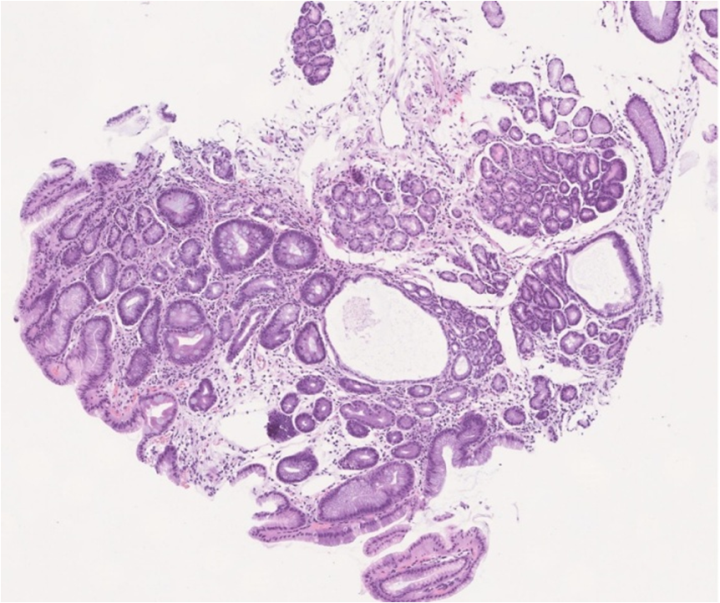
We present a case of a 69-year-old male with past medical history of hyperlipidemia, hypertension, diabetes, and pernicious anemia on B12 injections who initially presented with complaints of blood-tinged sputum. His symptoms were occurring weekly, typically post-prandially, and had been present for a year prior to presentation. He underwent esophagogastroduodenoscopy (EGD) which showed a single gastric polyp and non-bleeding erosive gastropathy. Random gastric biopsies of the stomach showed active gastritis. The localized gastric polyp was removed and histologically revealed adenomatous low-grade dysplasia. No gastric intestinal metaplasia was present initially. (Figure 1) He was then scheduled for a repeat EGD three months later to reevaluate the site of dysplasia.


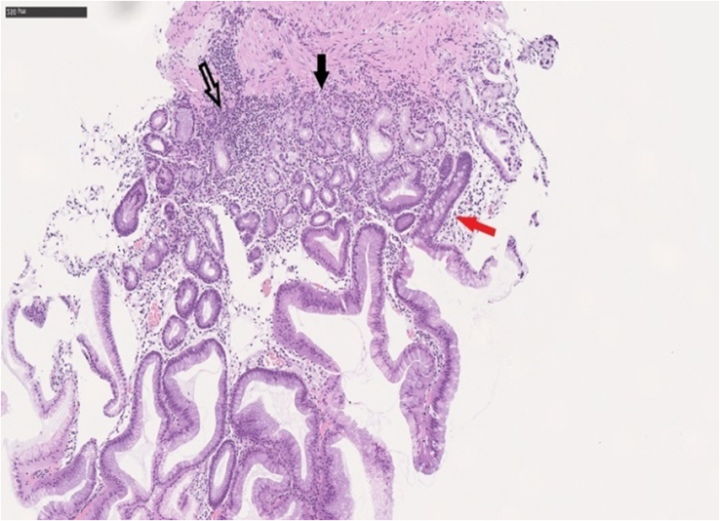
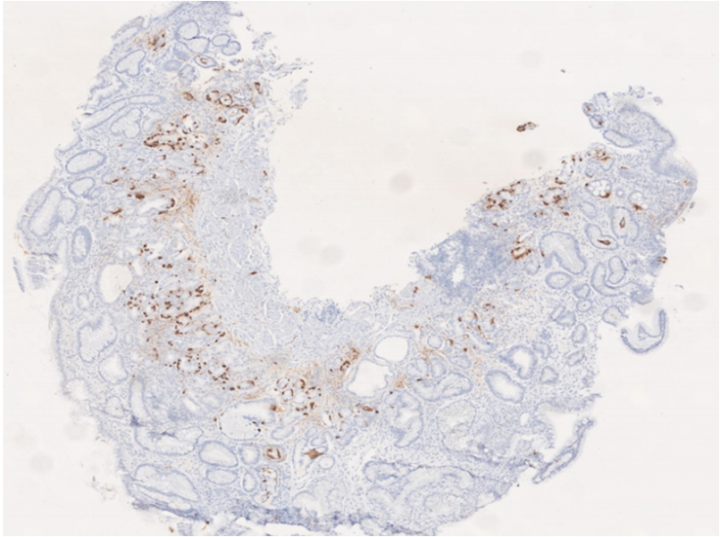
Subsequent EGD showed 2-3 mm semi-sessile gastric polyps with no stigmata of bleeding and a non-bleeding gastric ulcer in the pre-pyloric region of the stomach. Given the dysplastic polyp from the previous procedure, dedicated mapping gastric biopsies were performed, and this time histologic evaluation revealed intestinal metaplasia in a background of autoimmune metaplastic atrophic gastritis (negative for dysplasia and H. Pylori, Figure 2). Chromogranin on C1 showed linear and micronodular ECL-cell hyperplasia, supporting a diagnosis of AMAG. (Figure 3)
Autoimmune metaplastic atrophic gastritis involves a disruption of parietal cells; the target antigen is the parietal cell H+, K+ ATPase leading to their destruction and causing diminished acid and intrinsic factor secretion. 2, 8 Intrinsic factor is required for absorption of cobalamin. Lower acidity in the stomach causes somatostatin inhibition of acid secretion to be lower leading to gastrin secretion stimulating parietal cells to release more acid. Cobalamin deficiency can cause clinically significant neurologic manifestations and thus supplementation is recommended. Methylmalonic acid accumulation in B12 deficiency can directly affect myelin formation and thus cause these manifestations. Subacute combined degeneration results in loss of vibratory and position sensation with paresthesia. Peripheral neuropathy is also common in pernicious anemia and other mental health issues such as depression, mania, and dementia may occur. 9, 10 Exploration of autoimmune conditions including thyroiditis, vitiligo, and perioral autoimmune skin lesions is important as well as ruling out concomitant Helicobacter Pylori infection. 11
Type 1 gastric carcinoid and gastric adenocarcinoma can also develop in AMAG. This should be further evaluated with scheduled surveillance and endoscopic monitoring. While the United States has no defined guidelines, current European recommendations include surveillance EGD as frequent as annually, especially in patients with a significant family history of gastric malignancy. Nehme et al. showed 60% association of atrophic gastritis with gastric carcinoid highlighting the importance of gastric mapping biopsies. AMAG with intestinal metaplasia is particular linked to an increased risk of gastric malignancy as was seen in our patient. 12 Netazepide has been shown to decrease plasma level of Chromogranin A and tumor size. Somatostatin analogs can also be used to decreased gastrin levels. 13, 14 This can also be explored by computed tomography (CT) scanning and also can be associated with the MEN1 gene and in Zollinger Ellison syndrome. Pathological changes are due to loss of negative feedback by parietal cells on gastrin secretion. Fortunately they are often asymptomatic although may present with dyspepsia and indolent with 5 year survival rate. 11
Our patient had findings of pernicious anemia which was being treated with B12 injections. While initial gastric biopsies revealed generalized inflammation, repeat studies revealed progression to intestinal metaplasia in the presence of AMAG. Gastric polypectomy of the fundal and greater curvature polyps showed hyperplastic polyps; gastric mapping biopsies revealed intestinal metaplasia in the background of autoimmune metaplastic atrophic gastritis. The discrepancy between the two procedures in the gastric histologic findings can be explained by either rapid progression versus the need for dedicated gastric mapping biopsies to avoid missing affected areas and highlights the importance of surveillance endoscopy. Intestinal metaplasia is a predecessor lesion to both dysplasia and intestinal-type gastric adenocarcinoma. 15 Atrophic gastritis has been shown to have a seven-fold relative risk of gastric cancer. 16 Guidelines for surveillance of these complications are unclear. In patients without recurrent carcinoid- it may be yearly initially but can progress to every four years however there is no standard of care currently. 17 Development of a standardized gastric biopsy protocol may prove beneficial for more precise investigation. Atrophic metaplastic autoimmune gastritis is an important pathological finding that deserves close endoscopic surveillance and treatment as complications can include pernicious anemia, autoimmune conditions, gastric carcinoid and gastric adenocarcinoma.
The authors have no conflict of interest to declare and no financial disclosures. The authors have no competing interests to declare.
Gastrointestinal (GI)
Autoimmune metaplastic atrophic gastritis (AMAG)
Helicobacter Pylori (H. Pylori)
Enterochromaffin like cell (ECL)
Esophagogastroduodenoscopy (EGD)
| [1] | Vannella L, Lahner E, Osborn J, et al. Risk factors for progression to gastric neoplastic lesions in patients with atrophic gastritis. Aliment Pharmacol Ther. 2010; 31(9): 1042-1050. | ||
| In article | View Article PubMed | ||
| [2] | Park JY, Lam-Himlin D, Vemulapalli R. Review of autoimmune metaplastic atrophic gastritis. Gastrointest Endosc. 2013; 77(2): 284-292. | ||
| In article | View Article PubMed | ||
| [3] | Pittman ME, Voltaggio L, Bhaijee F, Robertson SA, Montgomery EA. Autoimmune metaplastic atrophic gastritis. Am J Surg Pathol. 2015; 39(12): 1611-1620. | ||
| In article | View Article PubMed | ||
| [4] | De Block CEM, De Leeuw IH, Van Gaal LF. High Prevalence of Manifestations of Gastric Autoimmunity in Parietal Cell Antibody- Positive Type 1 (Insulin-Dependent) Diabetic Patients 1. J Clin Endocrinol Metab. 1999; 84(11): 4062-4067. | ||
| In article | View Article PubMed | ||
| [5] | Lahner E, Centanni M, Agnello G, et al. Occurrence and Risk Factors for Autoimmune Thyroid Disease in Patients with Atrophic Body Gastritis. Am J Med. 2008; 121(2): 136-141. | ||
| In article | View Article PubMed | ||
| [6] | Lahner E, Norman GL, Severi C, et al. Reassessment of intrinsic factor and parietal cell autoantibodies in atrophic gastritis with respect to cobalamin deficiency. Am J Gastroenterol. 2009; 104(8): 2071-2079. | ||
| In article | View Article PubMed | ||
| [7] | Hung OY, Maithel SK, Willingham FF, Farris AB, Kauh JS. Hypergastrinemia, type 1 gastric carcinoid tumors: Diagnosis and management. J Clin Oncol. 2011; 29(25): e713-e715. | ||
| In article | View Article PubMed | ||
| [8] | Karlsson FA, Burman P, Loof L, Mardh S. Major parietal cell antigen in autoimmune gastritis with pernicious anemia is the acid-producing H+,K+-adenosine triphosphate of the stomach. J Clin Invest. 1988; 81(2): 475-479. | ||
| In article | View Article PubMed | ||
| [9] | Vasconcelos OM, Poehm EH, McCarter RJ, Campbell WW, Quezado ZMN. Potential outcome factors in subacute combined degeneration: Review of observational studies. J Gen Intern Med. 2006; 21(10): 1063-1068. | ||
| In article | View Article PubMed | ||
| [10] | Metzler D, Miller WH, Stephen Edwards C. Psychiatric Manifestation of Vitamin B-12 Deficiency: An Update. Jefferson J Psychiatry. Published online 1991. | ||
| In article | View Article | ||
| [11] | Minalyan A, Benhammou JN, Artashesyan A, Lewis MS, Pisegna JR. Autoimmune atrophic gastritis: Current perspectives. Clin Exp Gastroenterol. 2017; 10: 19-27. | ||
| In article | View Article PubMed | ||
| [12] | Nehme, Fredy; Green, Michael; Salyers, William; Tofteland N. Case Series of Autoimmune Metaplastic Atrophic Gastritis and Association with Neuroendocrine Tumors of the Stomach. Am J Gastroenterol. 2016; 111(p): S1149. | ||
| In article | View Article | ||
| [13] | Moore AR, Boyce M, Steele IA, Campbell F, Varro A, Pritchard DM. Netazepide, a Gastrin Receptor Antagonist, Normalises Tumour Biomarkers and Causes Regression of Type 1 Gastric Neuroendocrine Tumours in a Nonrandomised Trial of Patients with Chronic Atrophic Gastritis. PLoS One. 2013; 8(10). | ||
| In article | View Article PubMed | ||
| [14] | Massironi S, Zilli A, Fanetti I, Ciafardini C, Conte D, Peracchi M. Intermittent treatment of recurrent type-1 gastric carcinoids with somatostatin analogues in patients with chronic autoimmune atrophic gastritis. Dig Liver Dis. 2015; 47(11): 978-983. | ||
| In article | View Article PubMed | ||
| [15] | Kapadia CR. Gastric atrophy, metaplasia, and dysplasia: A clinical perspective. In: Journal of Clinical Gastroenterology. Vol 36. J Clin Gastroenterol; 2003. | ||
| In article | View Article PubMed | ||
| [16] | Vannella L, Lahner E, Osborn J, Annibale B. Systematic review: Gastric cancer incidence in pernicious anaemia. Aliment Pharmacol Ther. 2013; 37(4): 375-382. | ||
| In article | View Article PubMed | ||
| [17] | Merola E, Sbrozzi-Vanni A, Panzuto F, et al. Type I Gastric Carcinoids: A Prospective Study on Endoscopic Management and Recurrence Rate. Neuroendocrinology. 2012; 95(3): 207-213. | ||
| In article | View Article PubMed | ||
Published with license by Science and Education Publishing, Copyright © 2021 Shawn Philip, Luz Sullivan and Nour Parsa
 This work is licensed under a Creative Commons Attribution 4.0 International License. To view a copy of this license, visit
http://creativecommons.org/licenses/by/4.0/
This work is licensed under a Creative Commons Attribution 4.0 International License. To view a copy of this license, visit
http://creativecommons.org/licenses/by/4.0/
| [1] | Vannella L, Lahner E, Osborn J, et al. Risk factors for progression to gastric neoplastic lesions in patients with atrophic gastritis. Aliment Pharmacol Ther. 2010; 31(9): 1042-1050. | ||
| In article | View Article PubMed | ||
| [2] | Park JY, Lam-Himlin D, Vemulapalli R. Review of autoimmune metaplastic atrophic gastritis. Gastrointest Endosc. 2013; 77(2): 284-292. | ||
| In article | View Article PubMed | ||
| [3] | Pittman ME, Voltaggio L, Bhaijee F, Robertson SA, Montgomery EA. Autoimmune metaplastic atrophic gastritis. Am J Surg Pathol. 2015; 39(12): 1611-1620. | ||
| In article | View Article PubMed | ||
| [4] | De Block CEM, De Leeuw IH, Van Gaal LF. High Prevalence of Manifestations of Gastric Autoimmunity in Parietal Cell Antibody- Positive Type 1 (Insulin-Dependent) Diabetic Patients 1. J Clin Endocrinol Metab. 1999; 84(11): 4062-4067. | ||
| In article | View Article PubMed | ||
| [5] | Lahner E, Centanni M, Agnello G, et al. Occurrence and Risk Factors for Autoimmune Thyroid Disease in Patients with Atrophic Body Gastritis. Am J Med. 2008; 121(2): 136-141. | ||
| In article | View Article PubMed | ||
| [6] | Lahner E, Norman GL, Severi C, et al. Reassessment of intrinsic factor and parietal cell autoantibodies in atrophic gastritis with respect to cobalamin deficiency. Am J Gastroenterol. 2009; 104(8): 2071-2079. | ||
| In article | View Article PubMed | ||
| [7] | Hung OY, Maithel SK, Willingham FF, Farris AB, Kauh JS. Hypergastrinemia, type 1 gastric carcinoid tumors: Diagnosis and management. J Clin Oncol. 2011; 29(25): e713-e715. | ||
| In article | View Article PubMed | ||
| [8] | Karlsson FA, Burman P, Loof L, Mardh S. Major parietal cell antigen in autoimmune gastritis with pernicious anemia is the acid-producing H+,K+-adenosine triphosphate of the stomach. J Clin Invest. 1988; 81(2): 475-479. | ||
| In article | View Article PubMed | ||
| [9] | Vasconcelos OM, Poehm EH, McCarter RJ, Campbell WW, Quezado ZMN. Potential outcome factors in subacute combined degeneration: Review of observational studies. J Gen Intern Med. 2006; 21(10): 1063-1068. | ||
| In article | View Article PubMed | ||
| [10] | Metzler D, Miller WH, Stephen Edwards C. Psychiatric Manifestation of Vitamin B-12 Deficiency: An Update. Jefferson J Psychiatry. Published online 1991. | ||
| In article | View Article | ||
| [11] | Minalyan A, Benhammou JN, Artashesyan A, Lewis MS, Pisegna JR. Autoimmune atrophic gastritis: Current perspectives. Clin Exp Gastroenterol. 2017; 10: 19-27. | ||
| In article | View Article PubMed | ||
| [12] | Nehme, Fredy; Green, Michael; Salyers, William; Tofteland N. Case Series of Autoimmune Metaplastic Atrophic Gastritis and Association with Neuroendocrine Tumors of the Stomach. Am J Gastroenterol. 2016; 111(p): S1149. | ||
| In article | View Article | ||
| [13] | Moore AR, Boyce M, Steele IA, Campbell F, Varro A, Pritchard DM. Netazepide, a Gastrin Receptor Antagonist, Normalises Tumour Biomarkers and Causes Regression of Type 1 Gastric Neuroendocrine Tumours in a Nonrandomised Trial of Patients with Chronic Atrophic Gastritis. PLoS One. 2013; 8(10). | ||
| In article | View Article PubMed | ||
| [14] | Massironi S, Zilli A, Fanetti I, Ciafardini C, Conte D, Peracchi M. Intermittent treatment of recurrent type-1 gastric carcinoids with somatostatin analogues in patients with chronic autoimmune atrophic gastritis. Dig Liver Dis. 2015; 47(11): 978-983. | ||
| In article | View Article PubMed | ||
| [15] | Kapadia CR. Gastric atrophy, metaplasia, and dysplasia: A clinical perspective. In: Journal of Clinical Gastroenterology. Vol 36. J Clin Gastroenterol; 2003. | ||
| In article | View Article PubMed | ||
| [16] | Vannella L, Lahner E, Osborn J, Annibale B. Systematic review: Gastric cancer incidence in pernicious anaemia. Aliment Pharmacol Ther. 2013; 37(4): 375-382. | ||
| In article | View Article PubMed | ||
| [17] | Merola E, Sbrozzi-Vanni A, Panzuto F, et al. Type I Gastric Carcinoids: A Prospective Study on Endoscopic Management and Recurrence Rate. Neuroendocrinology. 2012; 95(3): 207-213. | ||
| In article | View Article PubMed | ||