Sporadic Creutzfeldt-Jakob disease (sCJD) is a rare and fatal spongiform encephalopathy characterized by rapidly progressive dementia and myoclonus. The rarity of this disease and its variable initial presentation make early diagnosis fairly challenging, especially considering it is a diagnosis of exclusion. We present a case of a patient initially admitted for sudden onset of confusion, memory loss, dysmetria, and ataxia after a recent diagnosis of Waldenstrom’s Macroglobulinemia. Within four weeks, after work-up for suspected Bing-Neel syndrome and failure to respond to appropriate symptomatic treatment, acute deterioration of mental status, akinetic mutism, and myoclonus were evident & Cerebrospinal fluid (CSF) analysis was positive for protein 14-3-3. Brain magnetic resonance imaging (MRI) showed hyperintensities in the cortex and basal ganglia in diffusion-weighted imaging (DWI). The probable diagnosis of sCJD was reached based on the patient’s unresponsiveness to treatment, clinical features, characteristic findings on MRI, as well as positive 14-3-3 CSF assay.
Waldenstrom’s macroglobulinemia (WM) is a rare clinicopathologic entity demonstrating infiltration of bone marrow by clonal lymphoplasmacytic cells and a monoclonal IgM gammopathy in the blood. It has an incidence of three per million per year and approximately 1400 cases are diagnosed in the USA annually 1. The median age at diagnosis is 70 years, with less than 10% of patients being diagnosed under 50 years of age. The etiology of WM is unknown, as no obvious causative or predisposing factors have been identified. However, a recurrent mutation of the MYD88 gene (MYD88 L265P) is present in the vast majority of patients with WM, highlighting the somatic nature of the disease 2. Affected patients may develop symptoms related to infiltration of hematopoietic organs or other tissues (anemia, lymphadenopathy, hepatosplenomegaly) and/or symptoms related to the IgM monoclonal protein in their blood, such as hyperviscosity, blurred vision, raynaud phenomenon, and peripheral neuropathy. However, most patients with WM present with nonspecific constitutional symptoms or may be asymptomatic at diagnosis as was the case with this patient.
Bing-Neel Syndrome (BNS) is a rare disease manifestation of Waldenstrom's macroglobulinemia that results from infiltration of the central nervous system by malignant lymphoplasmacytic cells. The incidence of BNS is unknown, but in a retrospective cohort study of 1,523 WM patients, only 13 patients (0.8%) were diagnosed with BNS, suggesting a very low prevalence. The presentation of Bing Neel syndrome may be very diverse and includes headaches, cognitive deficits, paresis, and psychiatric symptoms. Other than the presence of WM, no risk factors were identified for BNS 3.
Creutzfeldt-Jakob disease (CJD) is a transmissible, progressive, and fatal human prion disease characterized by rapidly progressing dementia (RPD) and myoclonus. It can be divided into four categories: sporadic (sCJD), familial (fCJD), iatrogenic (iCJD), and variant forms (vCJD). sCJD accounts for 85-95% of total CJD cases and the incidence is approximately one per one million annually 4. The mean age of onset is between 57 and 62 years of age, although rare cases in young adults and those over 80 years of age have been reported. Sporadic CJD should be suspected when patients present with rapidly progressive dementia, cerebellar function abnormalities, and pyramidal/extrapyramidal signs. However, aberrant behaviors, such as anxiety, irritability, social withdrawal, subtle changes in memory, judgment difficulties, and other psychiatric symptoms are frequently reported as early signs. Therefore, early in its course, sCJD may be easily overlooked.
We report a case of sCJD that initially presented with cognitive impairment, behavioral changes, and extrapyramidal signs; the patient's dementia progressed rapidly and subsequent myoclonic jerks and akinetic mutism were evident at the end stage.
A 79-year-old Caucasian female presents to clinic for a routine 6-month follow-up as well as to discuss routine lab results from earlier in the week. Her reasons for the visit include hyperlipidemia, hypertension, and hypothyroidism and she states that she has been “doing well” since her last visit. Her vital signs were remarkable for an elevated blood pressure and her labs revealed a new-onset macrocytosis and leukocytosis with elevated immunoglobulins. Terazosin 1mg at bedtime was added to the patient’s medication list and an SPEP, folate and B12 were ordered to evaluate abnormal lab results. Patient was asked to come back in a month to reevaluate.
Patient presents to clinic roughly 3 weeks later for her 1-month f/u regarding her uncontrolled HTN and abnormal lab values. She reports feeling “lethargic, shaky and unsteady” since starting the terazosin and mentions that her blood pressure is usually “good” when she checks at home. Her vital signs were remarkable for an elevated blood pressure as well as a tachycardia, and her SPEP was significant for an M-spike, indicating a possible diagnosis of WM. Terazosin was discontinued and chlorthalidone 25mg and KCL once daily were added to medication list. Patient was asked to come back in a month to reevaluate.
Patient presents to clinic 3-days later with “continued shakiness that seems to be getting worse.” She reports sudden-onset of intermittent episodes of involuntary, variable bilateral arm, hand, and leg movement around two weeks ago and is currently experiencing involuntary movements on physical exam. No inciting event was discovered, and an MRI revealed no abnormalities.
Three days later, Patient presents to ED with sudden-onset of confusion and worsening involuntary movements but remains good historian and responsive. She has bilateral upper extremity tremors, dysmetria, and ataxia on physical exam. EEG showed left, post-hemispheric slowing and lumbar puncture was significant for elevated protein and mononuclear cells. Bone marrow biopsy with subsequent flow cytometry indicated lymphoplasmacytic involvement. Three sessions of plasmapheresis were completed which demonstrated IgM improvement on serology but did not impact disease course as patient continued to deteriorate neurologically.
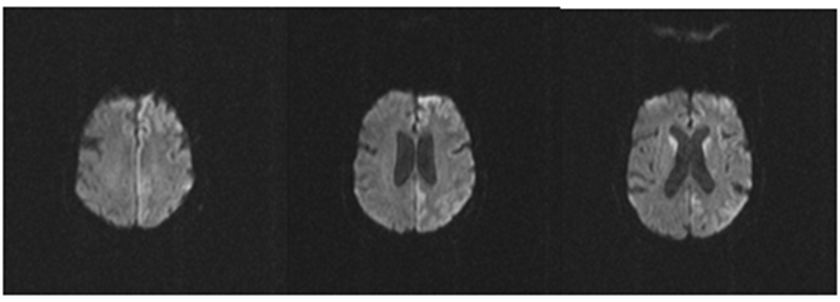
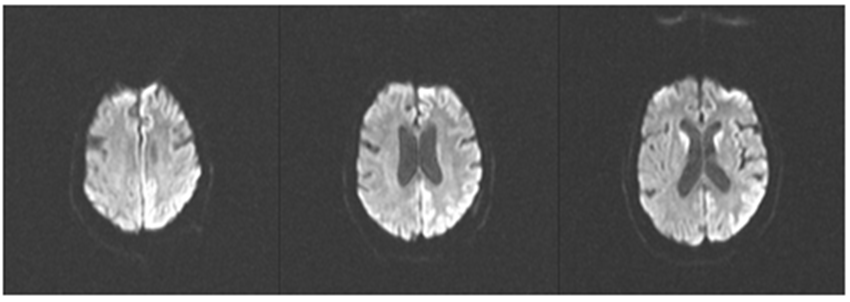
Nine-days after admission, patient demonstrates a significant decline in clinical status, becoming more confused, uncooperative, and combative during the evening hours and ultimately requiring restraints due to pulling out her IV. Despite plasmapheresis, she develops anisocoria and continues to experience dysmetria and dyskinesia on physical exam, indicating a potential alternative diagnosis to WM– possibly BNS. Repeat MRI shows an increased cortical signal involving the left frontal, temporal and parietal lobes with involvement of the caudate nuclei and putamen bilaterally. Repeat LP reveals an insignificant number of lymphocytes which is insufficient to diagnose lymphomatous involvement of the CSF. Her bone marrow biopsy is sent for analysis and revealed MYD88+. Given the progressive neurological decline in the setting of newly diagnosed WM and no other clear explanation for her symptoms, she was treated for BNS with systemic chemotherapy with bendamustine plus rituximab and intrathecal methotrexate.
Patient required intubation for the repeat MRI due to her combativeness and is having issues tolerating room air afterwards. She is transferred to the ICU for monitoring, where she continues to deteriorate neurologically despite intrathecal chemotherapy. She demonstrates no limb movement or phonation but responds to some commands and opens eyes when her name is called.
After several days on the ventilator, she is eventually able to be weaned off onto CPAP. However, she is more or less in a comatose state at this point and is now unresponsive to any type of commands. She is having slight spontaneous movement bilaterally in her extremities, indicating possible myoclonus. Results from the previous LP is positive for the 14-3-3 protein. Repeat MRI is performed to confirm findings from previous MRI which showed the cortical ribbon sign. Family is informed about the diagnosis and its uniformly fatal prognosis. Family denies proceeding with confirmatory brain biopsy. Palliative care and hospice are enlisted to help the patient and family transition to end-of-life care.


It is of great prognostic value to diagnose sCJD at the first clinical encounter so that the patient does not have to go through unnecessary medical workup during their last remaining months of life. However, the diagnosis of sCJD is ultimately one of exclusion. Therefore, even if there are pathognomonic findings for sCJD, as seen in our patient, all other causes of disease should be ruled out beforehand. This is because sCJD is a uniformly fatal disease and its diagnostic tests are not without error. This can be seen from a study where 825 patients with RPD were evaluated to determine the cause of their disease. The diagnostic breakdown of this group was determined to be: 54% prion disease (37% probable or definite sporadic; 15% genetic, and 2% acquired), 28% undetermined (due to insufficient records, although most met criteria for possible CJD), and, importantly, 18% with other non-prion conditions, many of which were treatable. So, while the majority of patients with RPD have underlying prion disease such as CJD, over 18% percent of patients will potentially have RPD due to an underlying treatable condition, which would be missed by a presumptive diagnosis of CJD. Furthermore, establishing diagnosis of sCJD in early stages is fairly difficult due to the extremely low incidence and highly varied initial symptoms. Also, the most commonly used clinical criteria for probable sCJD does not allow for early diagnosis of CJD. A major problem with these criteria is that they include signs or symptoms, such as akinetic mutism and the characteristic EEG, that often do not occur until the late stages of disease. These criteria also do not include features that are often early signs of the illness, such as behavioral changes or aphasia. One study determined that the first presenting symptom in 114 sCJD subjects was cognitive (39% of patients), followed by cerebellar (21%), behavioral (20%), constitutional (20%), sensory (11%), motor (9%) and visual (7%). Three of these categories - behavioral, constitutional and sensory symptoms (e.g., headache, malaise, vertigo, etc..) - are not included in current diagnostic criteria 5.
We present a probable sCJD case with typical symptoms and clinical course, especially at the end stage; however, the correct diagnosis was not reached during the early course of the disease. This was not only due to the aforementioned challenges, but also because her symptoms presented after she was diagnosed with WM, and, therefore, Hyperviscosity syndrome (HVS) and BNS had to be excluded as potential causes for her RPD. HVS and BNS are both sequelae of WM that can present with acute neurologic symptoms and so were included in our differential diagnosis when evaluating the cause of this patients RPD. HVS was ruled out early due to only a high-normal serum viscosity and unresponsiveness to plasmapheresis when her IgM serology returned to normal. Furthermore, patients with HVS develop neurologic sequelae slowly over years and typically only manifest a sensory ataxia with impaired gait and mild to moderate distal muscle weakness, whereas our patient had a much more severe neurologic manifestation of disease. Only once HVS was ruled out did BNS become a consideration. This was primarily due to the patient’s failure to respond to plasmapheresis as well as positive MYD88 testing on bone marrow biopsy 6. Unlike HVS, BNS usually develops over weeks to months, and typically presents with cognitive decline, aphasia, psychiatric symptoms, cerebellar dysfunction, impairment of consciousness, and paresis. This presentation of illness is much more in line with our patient’s presentation in the clinical case and is why it was explored so heavily. In order to diagnose BNS, either (1) a direct biopsy of the affected CNS tissue demonstrating lymphoplasmacytic lymphoma; or (2) a CSF analysis demonstrating cytological detail supportive of lymphoplasmacytic lymphoma, plus the presence of monoclonal B cells evidenced by flow cytometry or molecular technique such as Ig rearrangement analysis or MYD88 mutation is needed. Our patient did not have monoclonal B cell infiltration of CSF on MFC or findings of lymphoplasmacytic lymphoma on cytology and consequently did not meet the diagnostic criteria for BNS. Furthermore, the family declined brain biopsy, and this excluded the possibility of confirming the diagnosis via this route. Despite the grim diagnosis, the patient received intrathecal and systemic chemotherapy to treat BNS due to her rapidly deteriorating neurological status and it was only after treatment failure that the diagnosis of sCJD was seriously considered 3.
Similar to BNS, the definitive neuropathological diagnosis of sCJD depends on brain biopsy or autopsy. However, this may not be feasible in clinical practice due to the risks associated with attaining an adequate sample of brain tissue for analysis. Therefore, the Centers for Disease Control (CDC) proposed a probable diagnosis of sCJD based on four criteria: (1) progressive dementia; (2) at least two out of the four following clinical features: a) myoclonus; b) visual or cerebellar disturbance; c) pyramidal/extrapyramidal dysfunction; and/or d) akinetic mutism; (3) a typical electroencephalogram and/or a positive 14-3-3 CSF assay and/or magnetic resonance imaging (MRI) high signal abnormalities on diffusion-weighted imaging (DWI) or fluid-attenuated inversion recovery (FLAIR); and (4) routine investigations for dementia are unremarkable for other alternative diagnoses. DWI and FLAIR imaging of a brain MRI can be utilized for the diagnosis of sCJD with fairly high sensitivity (91%) and specificity (95%) 7. The typical and specific diagnostic pattern is gray matter hyperintensities in the cortex, striatum, and/or posterior thalamus. These findings strongly correspond with the MRI results of our patient. Furthermore, greater hyperintensities in DWI imaging versus FLAIR imaging as well as associated restricted diffusion are more common in sCJD than in any other RPDs 8. This was particularly helpful in our patient, as the differentiation of sCJD from other prion diseases was made easier by the presence of a restricted diffusion pattern on MRI. A characteristic EEG showing periodic sharp wave complexes (PSWCs) can also be used as an adjunctive non-invasive method to diagnose sCJD. However, the sensitivity of the typical EEG findings is generally low and so the fact that our patient’s EEG did not show PSWCs, does not exclude the diagnosis of sCJD 9. Lastly, in a systematic review of 1,849 patients with suspected sCJD, the assays of CSF 14-3-3 protein possessed a sensitivity of 92% and specificity of 86% in diagnosing sCJD 10. Our patient’s 14-3-3 protein assay was positive, further highlighting sCJD as the more probable diagnosis for the patient. So, in our case, although neither brain biopsy nor autopsy was done for definitive diagnosis, the patient’s clinical features, brain MRI, and positive 14-3-3 CSF assay fit all of the aforementioned CDC criteria, making sCJD our suspected diagnosis for this patient.
Virtually all patients diagnosed with WM have the MYD88 mutation 11. Since our patient did not start to manifest symptoms until after being diagnosed with WM, it was thought that perhaps the MYD88 mutation had predisposed her to developing sCJD. This is because sCJD is brought on by somatic mutations acquired throughout life and the MYD88 mutation is one such mutation. Furthermore, our patient is not the typical demographic for an sCJD patient due to her age and lack of risk factors, signifying the possibility of extenuating circumstances with regards to the development of disease. However, a study showed that the kinetics of prion pathogenesis in MYD88 (myeloid differentiation primary-response protein 88)-deficient mice inoculated with prions (by the intraperitoneal route) are identical to the kinetics observed in the wild-type control mice. This suggests that signaling by TLR1, -2, -6, and -9 (mediated by the adapter protein MYD88) is probably not involved in prion recognition and signaling and that the relationship between sCJD and MYD88 mutation is one of correlation at best, rather than causation as originally thought 12.
Clinicians should suspect sporadic CJD in the setting of new-onset dementia with concomitant behavioral disturbances, cerebellar signs, or psychiatric symptoms. In the absence of brain biopsy/autopsy, diagnosis can be established with clinical features, MRI, EEG, and CSF 14-3-3-protein analysis. This case is atypical in that our patient developed sCJD later than the average age, had a relatively quick progression of the disease, and the fact that she was worked up for BNS in an effort to exclude all other possible treatable diagnoses. We hope that through writing this case report, we can showcase the workup of this patient since we did not see any similar cases while doing our literature review. Because of the low incidence of CJD, the body of literature out there regarding this disease is equally low, and so we think it will be a welcomed addition to existing literature.
Thank you to Dr. George Ehringer M.D. & Dr. Eric Harris D.O. for guiding me through this process and ensuring everything written is factual to the best of our knowledge by reviewing the case report beforehand.
| [1] | Groves FD, Travis LB, Devesa SS, et al.: Waldenstrom’s macroglobulinemia: incidence patterns in the United States, 1988-1994. Cancer. 1998 Mar 15; 82(6): 1078-81. | ||
| In article | View Article | ||
| [2] | Treon SP, Xu L, Yang G, et al.: MYD88 L265P somatic mutation in Waldenstrom’s macroglobulinemia. N Engl J Med 367:826-833. | ||
| In article | View Article PubMed | ||
| [3] | Minnema MC, Kimby E, D'Sa S, et al.: Guideline for the diagnosis, treatment and response criteria for Bing-Neel syndrome. Haematologica. 2017; 102(1): 43-51. | ||
| In article | View Article PubMed PubMed | ||
| [4] | Ladogana A, Puopolo M, Croes EA, et al.: Mortality from Creutzfeldt–Jakob disease and related disorders in Europe, Australia, and Canada. Neurology. 2005; 64(9): 1586-1591. | ||
| In article | View Article PubMed | ||
| [5] | Geschwind MD, Haman A, Miller BL. Rapidly progressive dementia. Neurol Clin. 2007; 25(3): 783-vii. | ||
| In article | View Article PubMed PubMed | ||
| [6] | Poulain S, Boyle EM, Roumier C, et al.: MYD88 L265P mutation contributes to the diagnosis of Bing-Neel syndrome. Br J Haematol 167: 506-513. | ||
| In article | View Article PubMed | ||
| [7] | Young GS, Geschwind MD, Fischbein NJ, et al.: Diffusion-weighted and fluid-attenuated inversion recovery imaging in Creutzfeldt-Jakob disease: high sensitivity and specificity for diagnosis. AJNR Am J Neuroradiol. 2005, 26: 1551-62. | ||
| In article | |||
| [8] | Vitali P, Maccagnano E, Caverzasi E, et al.: Diffusion-weighted MRI hyperintensity patterns differentiate CJD from other rapid dementias. Neurology. 2011, 76: 1711-19. | ||
| In article | View Article PubMed PubMed | ||
| [9] | Manix M, Kalakoti P, Henry M, et al.: Creutzfeldt-Jakob disease: updated diagnostic criteria, treatment algorithm, and the utility of brainbiopsy. NeurosurgFocus. 2015, 39: E2. | ||
| In article | View Article PubMed | ||
| [10] | Muayqil T, Gronseth G, Camicioli R: Evidence-based guideline: diagnostic accuracy of CSF 14-3-3 protein in sporadic Creutzfeldt-Jakob disease. Report of the guideline development subcommittee of the American Academy of Neurology. Neurology. 2012, 79: 1499-506. | ||
| In article | View Article PubMed PubMed | ||
| [11] | Varettoni M, Arcaini L, Zibellini S, et al.: Prevalence and clinical significance of the MYD88 (L265P) somatic mutation in Waldenstrom’s macroglobulinemia and related lymphoid neoplasms. Blood (2013) 121: 2522-8. | ||
| In article | View Article PubMed | ||
| [12] | Aguzzi A, Calella AM: Prions: protein aggregation and infectious diseases. PhysiolRev. 2009; 89(4): 1105-1152. | ||
| In article | View Article PubMed | ||
Published with license by Science and Education Publishing, Copyright © 2020 Peter Rafferty
 This work is licensed under a Creative Commons Attribution 4.0 International License. To view a copy of this license, visit
http://creativecommons.org/licenses/by/4.0/
This work is licensed under a Creative Commons Attribution 4.0 International License. To view a copy of this license, visit
http://creativecommons.org/licenses/by/4.0/
| [1] | Groves FD, Travis LB, Devesa SS, et al.: Waldenstrom’s macroglobulinemia: incidence patterns in the United States, 1988-1994. Cancer. 1998 Mar 15; 82(6): 1078-81. | ||
| In article | View Article | ||
| [2] | Treon SP, Xu L, Yang G, et al.: MYD88 L265P somatic mutation in Waldenstrom’s macroglobulinemia. N Engl J Med 367:826-833. | ||
| In article | View Article PubMed | ||
| [3] | Minnema MC, Kimby E, D'Sa S, et al.: Guideline for the diagnosis, treatment and response criteria for Bing-Neel syndrome. Haematologica. 2017; 102(1): 43-51. | ||
| In article | View Article PubMed PubMed | ||
| [4] | Ladogana A, Puopolo M, Croes EA, et al.: Mortality from Creutzfeldt–Jakob disease and related disorders in Europe, Australia, and Canada. Neurology. 2005; 64(9): 1586-1591. | ||
| In article | View Article PubMed | ||
| [5] | Geschwind MD, Haman A, Miller BL. Rapidly progressive dementia. Neurol Clin. 2007; 25(3): 783-vii. | ||
| In article | View Article PubMed PubMed | ||
| [6] | Poulain S, Boyle EM, Roumier C, et al.: MYD88 L265P mutation contributes to the diagnosis of Bing-Neel syndrome. Br J Haematol 167: 506-513. | ||
| In article | View Article PubMed | ||
| [7] | Young GS, Geschwind MD, Fischbein NJ, et al.: Diffusion-weighted and fluid-attenuated inversion recovery imaging in Creutzfeldt-Jakob disease: high sensitivity and specificity for diagnosis. AJNR Am J Neuroradiol. 2005, 26: 1551-62. | ||
| In article | |||
| [8] | Vitali P, Maccagnano E, Caverzasi E, et al.: Diffusion-weighted MRI hyperintensity patterns differentiate CJD from other rapid dementias. Neurology. 2011, 76: 1711-19. | ||
| In article | View Article PubMed PubMed | ||
| [9] | Manix M, Kalakoti P, Henry M, et al.: Creutzfeldt-Jakob disease: updated diagnostic criteria, treatment algorithm, and the utility of brainbiopsy. NeurosurgFocus. 2015, 39: E2. | ||
| In article | View Article PubMed | ||
| [10] | Muayqil T, Gronseth G, Camicioli R: Evidence-based guideline: diagnostic accuracy of CSF 14-3-3 protein in sporadic Creutzfeldt-Jakob disease. Report of the guideline development subcommittee of the American Academy of Neurology. Neurology. 2012, 79: 1499-506. | ||
| In article | View Article PubMed PubMed | ||
| [11] | Varettoni M, Arcaini L, Zibellini S, et al.: Prevalence and clinical significance of the MYD88 (L265P) somatic mutation in Waldenstrom’s macroglobulinemia and related lymphoid neoplasms. Blood (2013) 121: 2522-8. | ||
| In article | View Article PubMed | ||
| [12] | Aguzzi A, Calella AM: Prions: protein aggregation and infectious diseases. PhysiolRev. 2009; 89(4): 1105-1152. | ||
| In article | View Article PubMed | ||


 MRI showing increased signaling involving the cortex of the left parietal lobe as well as the posterior lateral left temporal lobe and involving the left frontal lobe and left insula (cortical ribbon sign).)