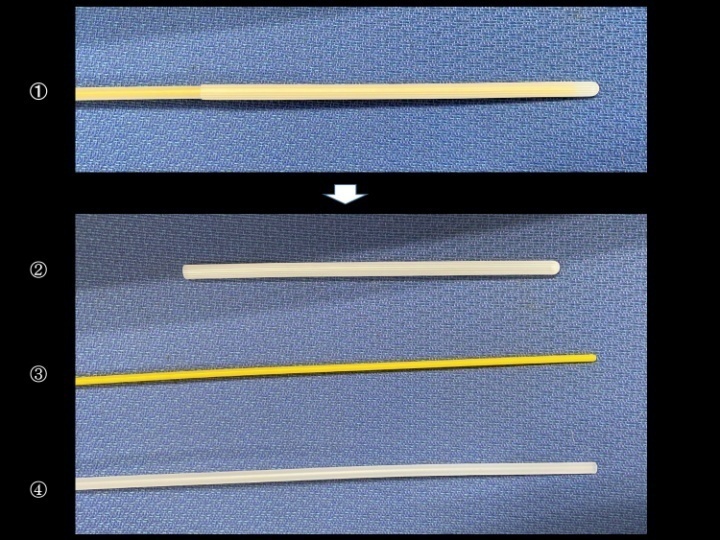
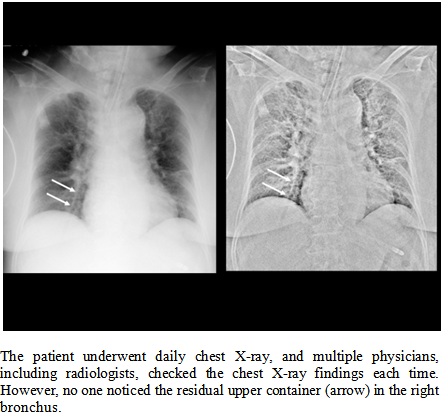
We report a case of a tracheal tube exchanger container as a bronchial foreign body in a 75-year-old woman suffered multiple injuries. She needed tracheal intubation and mechanical ventilation for repeated operations and intensive care. On day 2, she showed hypoxia. A physician on duty exchanged the tracheal tube using a tracheal tube exchanger (TTE) with containers consisting of an upper and lower potion. After exchanging the tracheal tube, the upper container remained in right bronchus. From days 3 to 9, she underwent daily chest X-ray, and multiple physicians checked the chest X-ray images each time. However, no one noticed the residual upper container in the right bronchus. She was extubated on day 8. After transportation for skin graft, she expectorated the upper container spontaneously. As a preventive measure to avoid the occurrence of iatrogenic accidents, our hospital decided to sterilize the TTE without containers.
A tracheal tube exchanger (TTE) is a flexible hollow bougie with a frosted surface and depth marks to facilitate quick and efficient endotracheal tube exchange or replacement without using a laryngoscope. The internal lumen of the TTE allows for spontaneous breathing during tube exchange. The TTE is recommended to be used when a patient with airway difficulty undergoes tracheal intubation repeatedly, according to the European Difficult Airway Society. 1
Use of a TTE increases the first-pass success rate in patients with known or suspected airway difficulty and decreases the incidence of complications in patients in tolerant of extubation and requiring tracheal reintubation. 2 In the COVID-19 pandemic, to minimize aerosolization of viral particles, a TTE may be used to exchange a tracheal tube smoothly. 3
We herein report an iatrogenic accident after using a TTE that resulted in a bronchial foreign body in the form of a TTE container.
A 75-year-old woman was struck by a car while walking in an orthopedical clinic’s parking area. She had hypertension and gonarthrosis. She received first aid on site and was transported to our hospital by an ambulance and helicopter during the COVID pandemic.
Upon arrival, she had a clear consciousness, and her vital signs were stable. Her physiological findings included hip and bilateral leg tenderness with right foot degloving injury and skin defect. Radiological studies showed left minor lung contusion, ischial stable fractures and bilateral leg fractures. She underwent urgent wound debridement and irrigation requiring negative pressure wound therapy at the right foot, external fixation of the right leg open fracture, transfusion and massive infusion and antibiotics under general anesthesia with tracheal intubation.
During the operation, she showed ST depression on a precordial electrocardiogram. This was diagnosed as acute coronary syndrome by a cardiophysician. She was transferred to an intensive-care unit after the operation without extubation. On day 2, she did not show a refilling state and therefore it was deemed that she would need repeated wound treatments under anesthesia. As a result, extubation was not attempted. That night, she developed hypoxia. A physician on duty deemed her hypoxia to have been induced by tracheal tube obstruction, so he decided to exchange the tracheal tube using a TTE. As the physician was not very experienced in using the TTE, he used the device with containers that had all been sterilized together. The containers were separated into an upper and lower potion (Figure 1). After exchanging the tracheal tube, the upper container remained in the right bronchus. However, the patient’s hypoxia improved, so the physician did not notice the container remaining in the right bronchus.

On day 3, the patient became complicated with pneumonia requiring subsequent antibiotics. From days 3 to 9, she underwent daily chest X-ray, and multiple physicians, including radiologists, checked her chest X-ray findings each time. However, no one noticed the residual upper container in the right bronchus (Figure 2). After the improvement of her respiratory function, she was extubated on day 8. On day 10, she was transferred to another hospital to receive a skin graft for the right skin defect. After transportation, she expectorated the upper container spontaneously while coughing After the expectoration, her course was uneventful, and she was discharged from the hospital.
Tracheal-bronchial foreign bodies tend to occur in infants but can also occur in adults. [4-10] 4 The foreign body is typically food. [4-10] 4 A search of PubMed were carried out to identify articles using the key words "tube exchanger foreign body". One article was found, describing a case of TTE failure resulting in the deposition of a foreign body in a patient’s tracheobronchial tree, which was incidentally found when the tracheal tube was repositioned using bronchospcopy. 11 Accordingly, the present case represents the second case of a TTE-related bronchial foreign body and the first case involving a TTE container.
Lin et al. reported cases of foreign body aspiration into the lower airway in 17 geriatric patients, allover 65 years old. 8 The most common symptoms among these patients were cough and sputum (15 cases, 88%), dyspnea (6 cases, 35%), hemoptysis (4 cases, 24%), fever (2 cases, 11%) and chest pain (1 case, 5%) in total. Only three of these patients were diagnosed definitely without delay. Another 14 were misdiagnosed with pneumonia or lung cancer, and the delay in the diagnosis ranged from 1 month to 3 years. 8 The main type of foreign body was food (14 cases, 82%), and the remaining cases involved iatrogenic foreign bodies, such as dentures and trachea cannulas after tracheal incision (3 cases, 18%). The authors found that the clinical features of airway foreign-body aspiration were usually obscure, and non-specific symptoms, the absence of or ignorance of the aspiration history and a lack of direct evidence concerning the existence of a foreign body, even on chest computed tomography, were suggested as reasons for a misdiagnosis or delayed diagnosis. 8 The present case also involved difficulty diagnosing the foreign body using chest roentgen, similar to previous reports, which resulted in a misdiagnosis. 4, 10
Bronchial foreign body may lead to suffocation or pneumonia, which can result in a fatal outcome. As a preventive measure to avoid the occurrence of iatrogenic accidents, our hospital decided to sterilize the TTE without containers.
Grant: This work was supported in part by a Grant-in-Aid for Special Research in Subsidies for ordinary expenses of private schools from The Promotion and Mutual Aid Corporation for Private Schools of Japan. (No grant number)
The authors declare no conflicts of interest in association with this study.
| [1] | Difficult Airway Society Extubation Guidelines Group, Popat M, Mitchell V, Dravid R, Patel A, Swampillai C, Higgs A. Difficult Airway Society Guidelines for the management of tracheal extubation. Anaesthesia. 2012; 67: 318-340. | ||
| In article | View Article PubMed | ||
| [2] | Mort TC. Continuous Airway Access for the Difficult Extubation: The Efficacy of the Airway Exchange Catheter. Anesth Analg. 2007; 105: 1357-1362. | ||
| In article | View Article PubMed | ||
| [3] | Onayemi A, Pai BHP. Endo tracheal tube exchange in a COVID positive patient. J Clin Anesth. 2020 Nov; 66: 109941. | ||
| In article | View Article PubMed | ||
| [4] | Sersar SI, Rizk WH, Bilal M, El Diasty MM, Eltantawy TA, Abdelhakam BB, et al.Inhaled foreign bodies: presentation, management and value of history and plain chest radiography in delayed presentation. Otolaryngol Head Neck Surg. 2006;134: 92-9. | ||
| In article | View Article PubMed | ||
| [5] | Huankang Z, Kuanlin X, Xiaolin H, Witt D.Comparison between tracheal foreign body and bronchial foreign body: a review of 1,007 cases.Int J Pediatr Otorhinolaryngol. 2012;76: 1719-25. | ||
| In article | View Article PubMed | ||
| [6] | Daniilidis J, Symeonidis B, Triaridis K, Kouloulas A. Foreign body in the airways: a review of 90 cases. Arch Otolaryngol. 1977; 103: 570-3. | ||
| In article | View Article PubMed | ||
| [7] | Baharloo F, Veyckemans F, Francis C, Biettlot MP, Rodenstein DO. Tracheobronchial foreign bodies: presentation and management in children and adults. Chest. 1999; 115: 1357-62. | ||
| In article | View Article PubMed | ||
| [8] | Lin L, Lv L, Wang Y, Zha X, Tang F, Liu X. The clinical features of foreign body aspiration into the lower airway in geriatric patients. Clin Interv Aging. 2014; 9: 1613-8. | ||
| In article | View Article PubMed | ||
| [9] | Boyd M, Chatterjee A, Chiles C, Chin R Jr. Tracheobronchial foreign body aspiration in adults. South Med J. 2009; 102: 171-4. | ||
| In article | View Article PubMed | ||
| [10] | Loo CM, Hsu AA, Eng P, Ong YY. Case series of bronchoscopic removal of tracheobronchial foreign body in six adults. Ann Acad Med Singap. 1998;27:849-53. | ||
| In article | |||
| [11] | Andrews BW, Targ AG. Fragmentation of tube exchanger. Anesth Analg. 1995; 80: 638-9. | ||
| In article | View Article PubMed | ||
Published with license by Science and Education Publishing, Copyright © 2023 Ken-ichi Muramatsu. and Youichi Yanagawa
 This work is licensed under a Creative Commons Attribution 4.0 International License. To view a copy of this license, visit
http://creativecommons.org/licenses/by/4.0/
This work is licensed under a Creative Commons Attribution 4.0 International License. To view a copy of this license, visit
http://creativecommons.org/licenses/by/4.0/
| [1] | Difficult Airway Society Extubation Guidelines Group, Popat M, Mitchell V, Dravid R, Patel A, Swampillai C, Higgs A. Difficult Airway Society Guidelines for the management of tracheal extubation. Anaesthesia. 2012; 67: 318-340. | ||
| In article | View Article PubMed | ||
| [2] | Mort TC. Continuous Airway Access for the Difficult Extubation: The Efficacy of the Airway Exchange Catheter. Anesth Analg. 2007; 105: 1357-1362. | ||
| In article | View Article PubMed | ||
| [3] | Onayemi A, Pai BHP. Endo tracheal tube exchange in a COVID positive patient. J Clin Anesth. 2020 Nov; 66: 109941. | ||
| In article | View Article PubMed | ||
| [4] | Sersar SI, Rizk WH, Bilal M, El Diasty MM, Eltantawy TA, Abdelhakam BB, et al.Inhaled foreign bodies: presentation, management and value of history and plain chest radiography in delayed presentation. Otolaryngol Head Neck Surg. 2006;134: 92-9. | ||
| In article | View Article PubMed | ||
| [5] | Huankang Z, Kuanlin X, Xiaolin H, Witt D.Comparison between tracheal foreign body and bronchial foreign body: a review of 1,007 cases.Int J Pediatr Otorhinolaryngol. 2012;76: 1719-25. | ||
| In article | View Article PubMed | ||
| [6] | Daniilidis J, Symeonidis B, Triaridis K, Kouloulas A. Foreign body in the airways: a review of 90 cases. Arch Otolaryngol. 1977; 103: 570-3. | ||
| In article | View Article PubMed | ||
| [7] | Baharloo F, Veyckemans F, Francis C, Biettlot MP, Rodenstein DO. Tracheobronchial foreign bodies: presentation and management in children and adults. Chest. 1999; 115: 1357-62. | ||
| In article | View Article PubMed | ||
| [8] | Lin L, Lv L, Wang Y, Zha X, Tang F, Liu X. The clinical features of foreign body aspiration into the lower airway in geriatric patients. Clin Interv Aging. 2014; 9: 1613-8. | ||
| In article | View Article PubMed | ||
| [9] | Boyd M, Chatterjee A, Chiles C, Chin R Jr. Tracheobronchial foreign body aspiration in adults. South Med J. 2009; 102: 171-4. | ||
| In article | View Article PubMed | ||
| [10] | Loo CM, Hsu AA, Eng P, Ong YY. Case series of bronchoscopic removal of tracheobronchial foreign body in six adults. Ann Acad Med Singap. 1998;27:849-53. | ||
| In article | |||
| [11] | Andrews BW, Targ AG. Fragmentation of tube exchanger. Anesth Analg. 1995; 80: 638-9. | ||
| In article | View Article PubMed | ||