We present a case of iatrogenic distal coronary artery obstruction secondary to staples recently used to control massive bleeding from cardiac stab wound. Coronary artery occlusion was discovered on elective cardiac catheterization done for anginal chest pains a few weeks after initial cardiac laceration repair surgery. Due to the potential risk of coronary artery rupture with endovascular intervention in this case with metallic staples around the distal coronary artery, conservative management was adopted. This is a case of a rare but clinically important iatrogenic complication.
Iatrogenic occlusion of major coronary arteries is a rare complication. Most of the cases of iatrogenic coronary artery obstruction are related to trauma or surgery. Presentation of such cases may vary from no symptoms to angina, acute myocardial infarction 1 or regional wall motion abnormalities on echocardiogram. Management includes surgical relief of the sutures/staples, percutaneous intervention, or conservative management depending on the clinical situation. Our case report highlights the case of iatrogenic distal coronary artery obstruction, which was managed conservatively.
A 44-year-old man was brought to the Emergency Room (ER) after sustaining multiple stab wounds to his chest. He was found to have left sided hemothorax on chest X-ray for which left sided chest tube was inserted immediately. Despite adequate fluid resuscitation, the patient remained severely hypotensive. A computed tomography (CT) scan revealed significant hemopericardium for which the patient was emergently taken to the operating room for pericardial window.
Upon incising pericardium for the pericardial window, there was a gush of bright red blood for which a decision was made to perform an urgent median sternotomy. A 3.5 centimeter, full thickness laceration was found in the right ventricle leading to a loss of approximately four liters of blood in total during the entire procedure.
Multiple attempts were made to control bleeding; including digital pressure, staples and suturing around the balloon of a Foley’s catheter. Massive transfusion protocol was initiated during which the patient received 5 liters of crystalloids and 10 units of packed red blood cells after which the patient was transferred to the critical care unit.
On postoperative day 3, he was successfully extubated. After removal of mediastinal tubes, a transesophageal echocardiogram was done which did not show any evidence of hemopericardium. A repeat chest X-ray also showed resolution of hemothorax after removal of left sided chest tube. On postoperative day 13, the patient was discharged home in a stable condition.
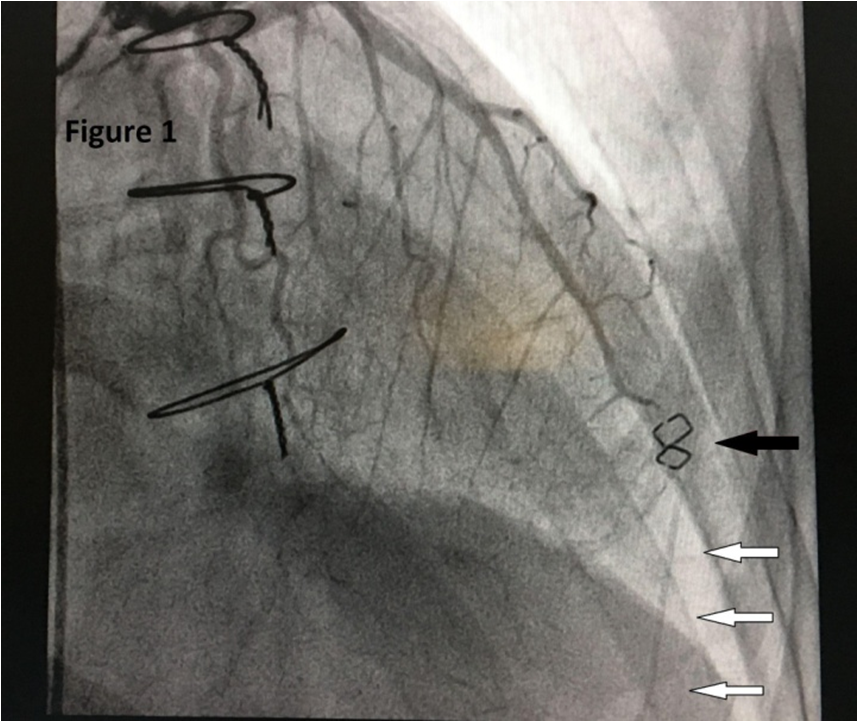
Two weeks after discharge from the hospital, the patient again presented to ER with a complaint of exertional chest pains. A pharmacological nuclear stress test showed apical perfusion defect and dyskinesia. An elective cardiac catheterization was performed which showed cardiac staples obstructing apical left anterior descending artery (LAD) which was being filled distally by collaterals (as shown in Figure 1). No intervention was done due to formation of collaterals, the small caliber of the vessel and due to the risk of rupture of the coronary artery surrounded by the recently placed metallic staples. Medical treatment was advised. Patient was started on aspirin 81 mg daily, Atorvastatin 40 mg daily and Metoprolol Tartrate 25 mg twice daily. Patient responded well to medical therapy with improvement in symptoms. Follow up transthoracic echocardiogram showed improvement in wall motion abnormalities.

Staples or metallic sutures can be used for rapid control of bleeding in cardiac stab wounds 2. While cardiac suturing can potentially expose the operator to contaminated needle stick injury in emergent cases, cardiac stapling is a safer and highly effective approach in controlling bleeding from cardiac stab wounds 3, 4. Areas of coronary arteries, if stapled, should be replaced by the sutures under the vessel 5, 6. Intraoperative fluorescence angiography, if available, can be used to check the patency of the vessels 6. Lacerations of distal coronaries can be ligated safely 5, 7. Complete transection of proximal coronary arteries can be either ligated or observed 5 or may require off-pump coronary artery bypass in selected cases 5, 7, 8. Accidental ligation of major coronary arteries found after cardiorrhaphy might require either surgical relief of the suture or endovascular recanalization depending upon the clinical situation 1.
To our knowledge, only a few cases 1, 9, 10 of iatrogenic coronary artery obstruction found postoperatively have been reported; one of which required immediate percutaneous intervention 1 while another one was found years after cardiorrhaphy and was medically observed without intervention 7. In our case, the iatrogenic obstruction was distal and in a narrow coronary artery which was considered not to be safe for endovascular intervention because of the risk of rupture of the coronary artery and metallic nature of the staple around it.
It is important to understand risk versus benefits to decide whether attempts at recanalization of occluded coronary arteries with metallic staples around the vessel are essential or not while keeping the risk of vessel rupture in mind. In cases with myocardial infarction or proximal occlusive lesions, surgical or percutaneous treatment options might be necessary. However in cases of distal obstruction or lesions with already formed collaterals, intervention might not be necessary. Cardiac function of such patients should be followed serially while continuing medical management.
None.
None.
None.
Verbal consent was obtained from the patient. No patient identifiers are present in the case report.
Muhammad Shabbir Ijaz is the corresponding author. Syed Ali Akhtar Tirmizi is co-author. Muhammad Usman Mustafa, Nawal Usman Mustafa, Mahvish Afza and Mashal Mumtaz are reviewers.
Any inquiries regarding supporting data availability of this study should be directed to the corresponding author.
| [1] | Tortoledo F1, Izaguirre L, Trujillo MH, Tortoledo MA. Endovascular repair of accidental ligation of the right coronary artery during cardiorrhaphy for penetrating heart wound. Cardiol Rev. 2003 Nov-Dec; 11(6): 303-5. | ||
| In article | View Article PubMed | ||
| [2] | Shamoun JM, Barraza KR, Jurkovich GJ, Salley RK. In extremis use of staples for cardiorrhaphy in penetrating cardiac trauma: a case report. J trauma. 1989; Nov; 29(11): 1589-91. | ||
| In article | View Article PubMed | ||
| [3] | Macho JR, Markison RE, Schecter WP. Cardiac stapling in the management of penetrating injuries of the heart: rapid control of hemorrhage and decreased risk of personal contamination. J Trauma. 1993 May; 34(5):711-5; discussion 715-6. | ||
| In article | View Article PubMed | ||
| [4] | Chapman GT, Frame SB. Repair of penetrating cardiac injury using skin staples. Tenn Med. 1996 Jul; 89(7): 249-51. PMID: 8705898. | ||
| In article | |||
| [5] | Demetriades D, Zakaluzny S. Cardiac Injuries. Demetriades D, Inaba K, Velmahos G. Atlas of Surgical Techniques in Trauma. Cambridge University Press, 2015: 120-121. | ||
| In article | View Article | ||
| [6] | Nimesh D. Desai MD, Fuad Moussa, MD, Steve K. Singh, MD, Peter Chu, MD, Stephen E. Fremes, MD. Intraoperative fluorescence angiography to determine the extent of injury after penetrating cardiac trauma. Journal of thoracic and cardiovascular surgery. 2008; 136: 218-219. | ||
| In article | View Article PubMed | ||
| [7] | Karin E1, Greenberg R, Avital S, Aladgem D, Kluger Y. The management of stab wounds to the heart with laceration of the left anterior descending coronary artery. Eur J Emerg Med. 2001 Dec; 8(4): 321-3. | ||
| In article | View Article PubMed | ||
| [8] | Reissman P1, Rivkind A, Jurim O, Simon D. Case report: the management of penetrating cardiac trauma with major coronary artery injury--is cardiopulmonary bypass essential? J Trauma. 1992 Nov; 33(5): 773-5. | ||
| In article | View Article PubMed | ||
| [9] | Mazza F, Messore T, Adesso L, De Majo AM, Corvino A, Nulli A, Giuffrida G. [Iatrogenic occlusion of the anterior descending branch of the left coronary artery. Description of a case]. G Ital Cardiol. 1981; 11(3): 394-7. | ||
| In article | |||
| [10] | Izgi A1, Futbolcu H, Kirma C, Mansuroglu D, Tanalp AC. Iatrogenic coronary artery stenosis and late ventricular septal defect after penetrating cardiac trauma repair. J Card Surg. 2006 May-Jun; 21(3): 284-5. | ||
| In article | View Article PubMed | ||
Published with license by Science and Education Publishing, Copyright © 2022 Muhammad Shabbir Ijaz, Syed Ali Akhtar Tirmizi, Muhammad Usman Mustafa, Nawal Usman Mustafa, Mahvish Afza and Mashal Mumtaz
 This work is licensed under a Creative Commons Attribution 4.0 International License. To view a copy of this license, visit
http://creativecommons.org/licenses/by/4.0/
This work is licensed under a Creative Commons Attribution 4.0 International License. To view a copy of this license, visit
http://creativecommons.org/licenses/by/4.0/
| [1] | Tortoledo F1, Izaguirre L, Trujillo MH, Tortoledo MA. Endovascular repair of accidental ligation of the right coronary artery during cardiorrhaphy for penetrating heart wound. Cardiol Rev. 2003 Nov-Dec; 11(6): 303-5. | ||
| In article | View Article PubMed | ||
| [2] | Shamoun JM, Barraza KR, Jurkovich GJ, Salley RK. In extremis use of staples for cardiorrhaphy in penetrating cardiac trauma: a case report. J trauma. 1989; Nov; 29(11): 1589-91. | ||
| In article | View Article PubMed | ||
| [3] | Macho JR, Markison RE, Schecter WP. Cardiac stapling in the management of penetrating injuries of the heart: rapid control of hemorrhage and decreased risk of personal contamination. J Trauma. 1993 May; 34(5):711-5; discussion 715-6. | ||
| In article | View Article PubMed | ||
| [4] | Chapman GT, Frame SB. Repair of penetrating cardiac injury using skin staples. Tenn Med. 1996 Jul; 89(7): 249-51. PMID: 8705898. | ||
| In article | |||
| [5] | Demetriades D, Zakaluzny S. Cardiac Injuries. Demetriades D, Inaba K, Velmahos G. Atlas of Surgical Techniques in Trauma. Cambridge University Press, 2015: 120-121. | ||
| In article | View Article | ||
| [6] | Nimesh D. Desai MD, Fuad Moussa, MD, Steve K. Singh, MD, Peter Chu, MD, Stephen E. Fremes, MD. Intraoperative fluorescence angiography to determine the extent of injury after penetrating cardiac trauma. Journal of thoracic and cardiovascular surgery. 2008; 136: 218-219. | ||
| In article | View Article PubMed | ||
| [7] | Karin E1, Greenberg R, Avital S, Aladgem D, Kluger Y. The management of stab wounds to the heart with laceration of the left anterior descending coronary artery. Eur J Emerg Med. 2001 Dec; 8(4): 321-3. | ||
| In article | View Article PubMed | ||
| [8] | Reissman P1, Rivkind A, Jurim O, Simon D. Case report: the management of penetrating cardiac trauma with major coronary artery injury--is cardiopulmonary bypass essential? J Trauma. 1992 Nov; 33(5): 773-5. | ||
| In article | View Article PubMed | ||
| [9] | Mazza F, Messore T, Adesso L, De Majo AM, Corvino A, Nulli A, Giuffrida G. [Iatrogenic occlusion of the anterior descending branch of the left coronary artery. Description of a case]. G Ital Cardiol. 1981; 11(3): 394-7. | ||
| In article | |||
| [10] | Izgi A1, Futbolcu H, Kirma C, Mansuroglu D, Tanalp AC. Iatrogenic coronary artery stenosis and late ventricular septal defect after penetrating cardiac trauma repair. J Card Surg. 2006 May-Jun; 21(3): 284-5. | ||
| In article | View Article PubMed | ||