Introduction: Pure large cell neuroendocrine carcinoma (LCNEC) of the endometrium is a rare and inadequately researched gynecologic malignancy with an aggressive course. Our knowledge of pure LCNEC of the endometrium is restricted to case reports. Herein, we describe a very rare case of pure LCNEC of the endometrium. Case presentation: A 70-year-old female presented with post-menopausal uterine bleeding and abdomino-pelvic pain. A sufficient sample endometrial biopsy showed benign endometrial tissue. We performed total abdominal hysterectomy with bilateral salpingo-oophorectomy and the final histopathology and immunohistochemistry established the diagnosis of a pure type of LCNEC of the endometrium (positive for Synaptophysin, CD56, focal Pan-CK, P53, and OCT3/4). Conclusion: A pure LCNEC of the endometrium is extremely uncommon and is often mistaken for a poorly differentiated endometrial carcinoma. Pure LCNEC of the endometrium is a difficult diagnosis to establish. That is why, high clinical suspicion index is required along with performing histological and immunohistochemical testing. Although rare, it is very important to include pure LCNEC of the endometrium in the differential diagnosis of abnormal uterine bleeding and/or abdomino-pelvic pain, especially in the postmenopausal sitting.
Neuroendocrine cell tumors (NETs) are uncommon tumors that arise from cells of the neuroendocrine lineage. NETs are categorized into low-grade and high-grade tumors based on their pathological basis. However, NETs are also classified according to their differentiation level, ranging from well to poorly differentiated tumors 1. Large cell neuroendocrine carcinoma (LCNEC) is an aggressive subclass of high-grade NETs. LCNEC most commonly originates in the thorax. However, it has also been reported to appear in the head and neck regions, the alimentary, hepatobiliary, genitourinary, and gynecologic tracts 2. NETs of the female genital tract are rare and aggressive neoplasms that usually involve the cervix, ovary, or endometrium 3. LCNEC of the endometrium is an extremely rare and aggressive malignancy that is often difficult to identify and treat. The first case of LCNET of the endometrium was recognized in 2004 4. LCNETs of the endometrium resemble those of the lung in the context of histology and immunohistochemistry. In general, each neuroendocrine tumor (NEC) typically expresses at least one neuroendocrine marker such as chromogranin, synaptophysin, NSE, and/or CD56 in more than 10% of malignant cells 5. Due to the rarity of the disease, its management is still a mystery. However, surgery is the first line of management 6. Herein, we report a case of endometrial pure LCNET. Broadening awareness of these unique malignancies could play a crucial role in their early detection and appropriate intervention.
S.Q., a 70-year-old Palestinian married woman (gravida 5, para 4), with a body mass index (BMI) of 34, having no history of gynecologic abnormalities, came to our attention for the assessment of abnormal post-menopausal uterine bleeding and dull pelvic pain of two-month duration. Physical examination showed an enlargement of the uterus. The laboratory evaluation was unremarkable and did not show anemia. Trans-vaginal ultrasound (TVUS) and computed tomography (CT) scan were performed and revealed an 11*10 cm non-vascular mass in the endometrium; an enlarged uterus measuring 18 cm in longitudinal axis and 15 cm in transverse axis with increased endometrial wall thickness; cervix had a normal appearance, parametrium was free of disease, and no lymphadenopathy was detected. An endometrial biopsy was obtained and did not disclose any pathological features. On the 15th day following admission, the patient underwent a total abdominal hysterectomy with bilateral salpingo-oophorectomy (TAHBSO) with regional lymph node dissection. She did not receive chemotherapy. The purpose of the surgical intervention was to eliminate the intra-abdominal tumor, which was causing her symptoms, and to obtain a definitive pathologic diagnosis.
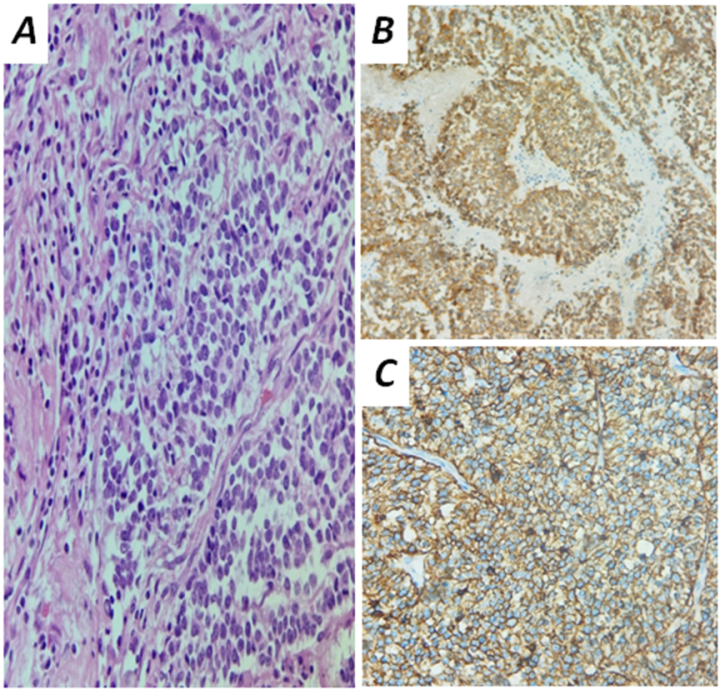
Grossly, the uterus was diffusely enlarged and the tumor necrotic mass seemed to arise from the endometrium, measuring 11*10*10 cm with about 90% of myometrial invasion. Uterine serosa, cervical stroma, fallopian tubes, and ovaries were not involved. Histologic examination of the uterine mass showed solid sheets of large cells with a moderate amount of cytoplasm and large nuclei. The mitotic count of the tumor cells was >10 per 10 high power field with marked necrosis. Immunohistochemistry demonstrated diffuse positivity for Synaptophysin, CD56, Pan-CK (focal), P53 (20%), and OCT3/4 (mainly cytoplasmic), and Immunoonegativity for ER, CD10, WT1, PAX8, and SALL4. All of these features were consistent with a diagnosis of pure large cell neuroendocrine carcinoma (LCNEC) of the endometrium (Figure 1 A, B & C). The patient's postoperative 50-day period was uneventful, and the patient was disease free without receiving any adjuvant therapy during that period.

Large cell neuroendocrine carcinoma of the endometrium (LCNEC) is a very rare malignancy of the female genital tract. LCNEC is one of three primary types of endometrial neuroendocrine malignancies, which also include small cell neuroendocrine carcinoma (SCNEC) and carcinoid tumors 7. The WHO defines LCNEC as a malignant tumor composed of large cells that show neuroendocrine differentiation 8.
The median age of presentation of LCNEC of the endometrium is 71 years at diagnosis 6, and the most common presenting symptom is postmenopausal vaginal bleeding 6. In our case, the patient’s age was 70 years, and she presented with postmenopausal vaginal bleeding, which is consistent with most reported cases.
Dilation and curettage were done, and the examined biopsy was not suggestive of neuroendocrine malignancy. The diagnosis of LCNEC by endometrial biopsy is challenging as it may be mistaken for other types of poorly differentiated endometrial malignancies 9. The definitive diagnosis of LCNEC can only be made based on the histopathological examination of the resected tumor 10.
A preoperative lower abdominal computed tomography (CT) scan was done and showed uterine enlargement with a large endometrial mass. Total abdominal hysterectomy with bilateral salpingo-oophorectomy was done, with lymph node dissection. As in most cases of LCNEC, this one was diagnosed based on post-resection biopsy. Surgery is the first step in the management, which should involve at least hysterectomy and bilateral salpingo-oophorectomy (BSO) 6.
Post-operative management may include chemotherapy and/or radiotherapy 6. There is no specific chemotherapy regimen for LCNEC, and cases are treated based on the treatment protocols of SCNEC for the lung 11. Neoadjuvant chemotherapy may be considered in cases with preoperative diagnosis as surgical management is partially helpful 12.
The 2015 WHO classification of lung tumors describes the pathological features of LCNEC as large cells with a high nuclear to cytoplasmic ratio, high mitotic rates (>10 per 10 HPF), extensive tumor necrosis, positivity for one or more immunohistochemical neuroendocrine markers, and the presence of neuroendocrine growth patterns 13. In this case, microscopic examination of the tumor revealed solid sheets of large cells with a moderate amount of cytoplasm and large nuclei. The mitotic count of the tumor cells was >10 per 10 high power fields with marked necrosis. The pathological examination of the uterus revealed a 90% invasion of the myometrium with free serosa. Both fallopian tubes, ovaries, cervical stroma, lower uterine segment, and all regional lymph nodes were free of malignancy. The examined lymph nodes were the right and left common iliac lymph nodes and the left external iliac lymph nodes.
Immunohistochemical stanning is the best diagnostic tool for LCNEC, with synaptophysin, chromogranin, and CD56 being the most commonly used. LCNEC is aggressive in its nature, and most cases are present at late stages with distant metastasis. It is characterized by rapid progression, poor prognosis, and/or post operative recurrence 14.
Pure large cell neuroendocrine carcinoma (LCNEC) of the endometrium is an extremely rare female reproductive tract malignancy with an aggressive course. The most common clinical presentation of pure LCNEC of the endometrium is abnormal uterine bleeding with or without abdominosa-pelvic pain. Endometrial biopsy is usually non-diagnostic. LCNEC of the endometrium is often mistaken for poorly differentiated endometrial carcinomas. Therefore, histo-pathological findings and immunohistochemistry are necessary in establishing a diagnosis of LCNEC of the endometrium. In this case study, we affirm the significance of suspecting LCNEC of the endometrium in women complaining of abnormal uterine bleeding and/or abdomino-pelvic pain, especially in the postmenopausal period.
We appreciate the assistance given to us by the hospital management and the head of the medical records department towards completing this project.
| [1] | Tsou MH, Tan TD, Cheng SH, Chiou YK. “Small cell carcinoma of the uterine cervix with large cell neuroendocrine carcinoma component”. Gynecologic oncology. 1; 68(1): 69-72. Jan 1998. | ||
| In article | View Article PubMed | ||
| [2] | Gardner GJ, Reidy-Lagunes D, Gehrig PA. “Neuroendocrine tumors of the gynecologic tract: A Society of Gynecologic Oncology (SGO) clinical document”. Gynecologic oncology. 1; 122(1): 190-8. Jul 2011 | ||
| In article | View Article PubMed | ||
| [3] | Eichhorn JH, Young RH. “Neuroendocrine tumors of the genital tract”. Pathology Patterns Reviews. 1; 115(suppl_1): S94-112. Jun 2001. | ||
| In article | View Article PubMed | ||
| [4] | Erhan Y, Dikmen Y, Yucebilgin MS, Zekioglu O, Mgoyi L, Terek MC. “Large cell neuroendocrine carcinoma of the uterine corpus metastatic to brain and lung: case report and review of the literature”. European journal of gynaecological oncology. 1; 25(1): 109-12. Jan 2004. | ||
| In article | |||
| [5] | Kulesza B, Litak J, Mazurek M, Nogalski A. “Initial factors affecting 6-month outcome of patients undergoing surgery for acute post-traumatic subdural and epidural hematoma”. Folia Medica.; 62(1): 94-104. Mar 2020. | ||
| In article | View Article PubMed | ||
| [6] | Nguyen ML, Han L, Minors AM, Bentley-Hibbert S, Pradhan TS, Pua TL, Tedjarati SS. “Rare large cell neuroendocrine tumor of the endometrium: a case report and review of the literature”. International Journal of surgery case reports. 1; 4(8): 651-5. Jan 2013. | ||
| In article | View Article PubMed | ||
| [7] | Oliva E, Carcangiu ML, Carinelli SG, Ip P, Loening T, Longacre TA, Nucci MR, Prat J, Zaloudek CJ. Blaustein's Pathology of the Female Genital Tract, Springer US, 2018. In WHO classification of tumours of female reproductive tract (pp. 135-1473). Lyon: IARC Press. | ||
| In article | |||
| [8] | Shahabi S, Pellicciotta I, Hou J, Graceffa S, Huang GS, Samuelson RN, Goldberg GL. “Clinical utility of chromogranin A and octreotide in large cell neuro endocrine carcinoma of the uterine corpus”. Rare tumors. 11; 3(4): 129-31. Oct 2011. | ||
| In article | View Article PubMed | ||
| [9] | Makihara N, Maeda T, Nishimura M, Deguchi M, Sonoyama A, Nakabayashi K, Kawakami F, Itoh T, Yamada H. “Large cell neuroendocrine carcinoma originating from the uterine endometrium: a report on magnetic resonance features of 2 cases with very rare and aggressive tumor”. Rare Tumors. 25; 4(3): 118-21. Jul 2012. | ||
| In article | View Article PubMed | ||
| [10] | Hiroshima K, Mino-Kenudson M. “Update on large cell neuroendocrine carcinoma”. Translational lung cancer research.; 6(5): 530. Oct 2017. | ||
| In article | View Article PubMed | ||
| [11] | Matsumoto H, Nasu K, Kai K, Nishida M, Narahara H, Nishida H. “Combined large-cell neuroendocrine carcinoma and endometrioid adenocarcinoma of the endometrium: a case report and survey of related literature”. Journal of Obstetrics and Gynaecology Research.; 42(2): 206-10. Feb 2016. | ||
| In article | View Article PubMed | ||
| [12] | Burkeen G, Chauhan A, Agrawal R, Raiker R, Kolesar J, Anthony L, Evers BM, Arnold S. “Gynecologic large cell neuroendocrine carcinoma: a review”. Rare tumors.; 12: 2036361320968401. Oct 2020. | ||
| In article | View Article PubMed | ||
| [13] | Travis WD, Brambilla E, Nicholson AG, Yatabe Y, Austin JH, Beasley MB, Chirieac LR, Dacic S, Duhig E, Flieder DB, Geisinger K. “The 2015 World Health Organization classification of lung tumors: impact of genetic, clinical and radiologic advances since the 2004 classification”. Journal of thoracic oncology. 1; 10(9): 1243-60. Sep 2015. | ||
| In article | View Article PubMed | ||
| [14] | Jenny C, Kimball K, Kilgore L, Boone J. “Large cell neuroendocrine carcinoma of the endometrium: a report and review of the literature”. Gynecologic Oncology Reports. 1; 28: 96-100. May 2019. | ||
| In article | View Article PubMed | ||
Published with license by Science and Education Publishing, Copyright © 2022 Oadi N. Shrateh, Ali N. Obeidat, Maysam Hamarsheh, Mohand Abulihya and Mashhour Naasan
 This work is licensed under a Creative Commons Attribution 4.0 International License. To view a copy of this license, visit
http://creativecommons.org/licenses/by/4.0/
This work is licensed under a Creative Commons Attribution 4.0 International License. To view a copy of this license, visit
http://creativecommons.org/licenses/by/4.0/
| [1] | Tsou MH, Tan TD, Cheng SH, Chiou YK. “Small cell carcinoma of the uterine cervix with large cell neuroendocrine carcinoma component”. Gynecologic oncology. 1; 68(1): 69-72. Jan 1998. | ||
| In article | View Article PubMed | ||
| [2] | Gardner GJ, Reidy-Lagunes D, Gehrig PA. “Neuroendocrine tumors of the gynecologic tract: A Society of Gynecologic Oncology (SGO) clinical document”. Gynecologic oncology. 1; 122(1): 190-8. Jul 2011 | ||
| In article | View Article PubMed | ||
| [3] | Eichhorn JH, Young RH. “Neuroendocrine tumors of the genital tract”. Pathology Patterns Reviews. 1; 115(suppl_1): S94-112. Jun 2001. | ||
| In article | View Article PubMed | ||
| [4] | Erhan Y, Dikmen Y, Yucebilgin MS, Zekioglu O, Mgoyi L, Terek MC. “Large cell neuroendocrine carcinoma of the uterine corpus metastatic to brain and lung: case report and review of the literature”. European journal of gynaecological oncology. 1; 25(1): 109-12. Jan 2004. | ||
| In article | |||
| [5] | Kulesza B, Litak J, Mazurek M, Nogalski A. “Initial factors affecting 6-month outcome of patients undergoing surgery for acute post-traumatic subdural and epidural hematoma”. Folia Medica.; 62(1): 94-104. Mar 2020. | ||
| In article | View Article PubMed | ||
| [6] | Nguyen ML, Han L, Minors AM, Bentley-Hibbert S, Pradhan TS, Pua TL, Tedjarati SS. “Rare large cell neuroendocrine tumor of the endometrium: a case report and review of the literature”. International Journal of surgery case reports. 1; 4(8): 651-5. Jan 2013. | ||
| In article | View Article PubMed | ||
| [7] | Oliva E, Carcangiu ML, Carinelli SG, Ip P, Loening T, Longacre TA, Nucci MR, Prat J, Zaloudek CJ. Blaustein's Pathology of the Female Genital Tract, Springer US, 2018. In WHO classification of tumours of female reproductive tract (pp. 135-1473). Lyon: IARC Press. | ||
| In article | |||
| [8] | Shahabi S, Pellicciotta I, Hou J, Graceffa S, Huang GS, Samuelson RN, Goldberg GL. “Clinical utility of chromogranin A and octreotide in large cell neuro endocrine carcinoma of the uterine corpus”. Rare tumors. 11; 3(4): 129-31. Oct 2011. | ||
| In article | View Article PubMed | ||
| [9] | Makihara N, Maeda T, Nishimura M, Deguchi M, Sonoyama A, Nakabayashi K, Kawakami F, Itoh T, Yamada H. “Large cell neuroendocrine carcinoma originating from the uterine endometrium: a report on magnetic resonance features of 2 cases with very rare and aggressive tumor”. Rare Tumors. 25; 4(3): 118-21. Jul 2012. | ||
| In article | View Article PubMed | ||
| [10] | Hiroshima K, Mino-Kenudson M. “Update on large cell neuroendocrine carcinoma”. Translational lung cancer research.; 6(5): 530. Oct 2017. | ||
| In article | View Article PubMed | ||
| [11] | Matsumoto H, Nasu K, Kai K, Nishida M, Narahara H, Nishida H. “Combined large-cell neuroendocrine carcinoma and endometrioid adenocarcinoma of the endometrium: a case report and survey of related literature”. Journal of Obstetrics and Gynaecology Research.; 42(2): 206-10. Feb 2016. | ||
| In article | View Article PubMed | ||
| [12] | Burkeen G, Chauhan A, Agrawal R, Raiker R, Kolesar J, Anthony L, Evers BM, Arnold S. “Gynecologic large cell neuroendocrine carcinoma: a review”. Rare tumors.; 12: 2036361320968401. Oct 2020. | ||
| In article | View Article PubMed | ||
| [13] | Travis WD, Brambilla E, Nicholson AG, Yatabe Y, Austin JH, Beasley MB, Chirieac LR, Dacic S, Duhig E, Flieder DB, Geisinger K. “The 2015 World Health Organization classification of lung tumors: impact of genetic, clinical and radiologic advances since the 2004 classification”. Journal of thoracic oncology. 1; 10(9): 1243-60. Sep 2015. | ||
| In article | View Article PubMed | ||
| [14] | Jenny C, Kimball K, Kilgore L, Boone J. “Large cell neuroendocrine carcinoma of the endometrium: a report and review of the literature”. Gynecologic Oncology Reports. 1; 28: 96-100. May 2019. | ||
| In article | View Article PubMed | ||