Adult intussusception is a rare entity that differs from childhood intussusception. It can be challenging to diagnose due to its nonspecific presentation. In this case report we discuss an 18 year old female who presented with unspecific abdominal pain and was diagnosed with intussusception on CT. Further workup showed a mass and biopsy confirmed a lymphoma.
Intussusception is defined as sliding or telescoping of a proximal segment of the GI tract towards the adjacent distal segment. Adult Intussusception is distinct from pediatric intussusception in multiple aspects. It represents the leading cause of intestinal obstruction in the pediatric population younger than 3 years old. Whereas in adults it is an infrequent rare entity which contributes to 5% of cases of bowel obstruction 1. It is usually benign in children but in adults it is commonly associated with a pathological condition. Diagnosis can be difficult due to the nonspecific symptoms adults present with, but it can be reliably identified on computed tomography or MRI which can give a clue to other associated or underlying diseases. In pediatrics, Ultrasound is the gold standard for evaluating a suspected intussusception, with a sensitivity of 97.9%, specificity of 97.8%, positive predictive value of 86.6%, and negative predictive value of 99.7% 2.
An 18 year old female, with no known previous comorbidities, presented to our hospital for a second opinion of her abdominal pain that started few weeks before her presentation.
Pain was mainly in the mid abdomen and right lower quadrant, no vomiting, no fever. She had bleeding per rectum. No weight loss. No previous similar attacks. No previous medical or surgical issues, and no family history of any cancer.
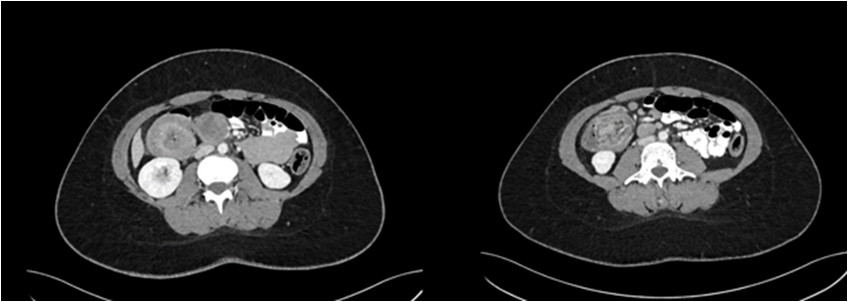
Patient had a computed tomography (CT) scan in the previous hospital which reported to have lymphadenopathy and intussusception in the hepatic flexure (Figure 1).
On examination patient had a palpable mass in the mid abdomen and right lower quadrant with tenderness, otherwise rest of the examination was unremarkable.


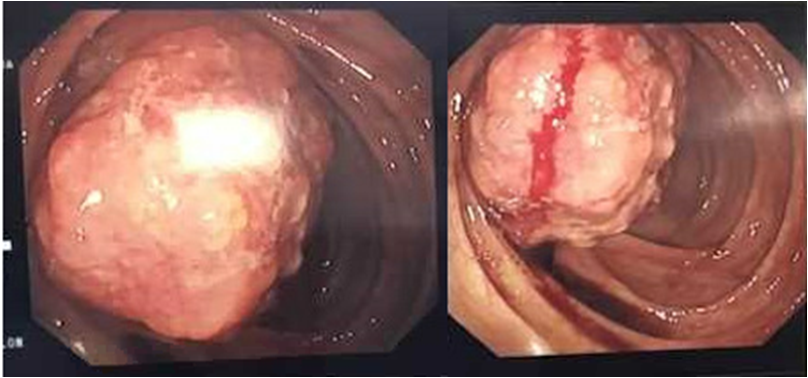
For further workup an endoscopy was planned. Colonoscopy showed a large colonic mass obstructing the ileocecal valve (Figure 2). Biopsy showed lymphoma, and CT staging showed soft tissue fullness noted in the retrosternal anterior mediastinum. Discussion was done in the Oncology Tumour Board, and the decision was to start her on chemotherapy.
Patient was admitted before the introduction of chemotherapy due to drop of her haemoglobin (Hgb) to 6.8g/L and transfusion was started. Bone Marrow aspiration was done CD10 positive, BCL-2 negative high grade B-cell lymphoma, stage 2 A, Ki-67 proliferation index >95 and EBV-EBER CISH is positive in tumor cells.
Patient was started on chemotherapy and decided to continue her treatment abroad.
While intussusception is the leading cause of intestinal obstruction in children it is much less common in adults, constitutes only 1%- 5% of all bowel obstructions. 1 The overall incidence of intussusception in adulthood has been estimated to be around 2–3 cases/1,000,000 population/year. 3 Intussusception equally affects males and females. 4
Intussusception usually can be caused by an intraluminal lesion, mural (focal area of aperistalis), or extra luminal (adhesions) process. 5 Adult intussusceptions are generally categorized into three major types according to their site in the alimentary tract: entero-enteric which is limited to the small bowel, ileo-colic or ileo-cecal in which ileum invaginated through the ileo-cecal valve and colon-colic which is confined to the colon. 6 Adult intussusception occurs in the small bowel in 52% of the cases and large bowel in 38% with 10% involving the stomach and surgical stomas. Additionally it can be classified according to the etiology (benign, malignant or idiopathic). Renzulli and Candinas stated that 60% of small bowel intussusceptions in adults are caused by benign lesions. 7 The remainders are caused by malignancy (30%) or are idiopathic (10%).
Ninety-five per cent of intussusceptions in children are idiopathic, whereas 90% of intussusceptions in adults have identifiable leading point. 8 Reported lesions or conditions that are associated with intussusception in adults include inflammatory polyps, lipomas, leiomyomas, leiomyosarcomas, Meckel’s diverticula, metastatic lesions (from melanoma, breast and lung), malignant fibrous histiocytomas, lymphomas, carcinoid tumours, adenocarcinomas, Peutz-Jeghers syndrome, Henoch–Schönlein purpura, Crohn’s disease, strictures, lymphadenitis and human immunodeficiency virus related infections/malignancies. Trauma and operative factors (eg anastomosis sites, adhesions) are also associated intussusception in adults. 9
In this case report, an18 years old female, previously healthy, diagnosed on CT with hepatic flexure intussusception caused by GI lymphoma. The simple explanation for this incident is that the lymphoma lesion acts as a leading point which can lead to intussusception at the involved area of the bowel. Primary GI lymphoma constitutes only about 1%-4% of all gastrointestinal malignancies. It is worth mentioning that also the most common extra-nodal site involved by lymphoma is gastro-intestinal tract accounting for 5%-20% of all cases. 10 Almost 90% of the primary gastrointestinal lymphomas are histopathologically B cell tumors, most commonly non-Hodgkin’s diffuse large B cell lymphoma
Specific risk factors have been associated in the pathogenesis of gastrointestinal lymphoma including Helicobacter pylori (H. pylori), human immunodeficiency virus (HIV), coeliac disease, Campylobacter jejuni (C. jejuni), Epstein-Barr virus (EBV), hepatitis-B virus (HBV), human T-cell lymphotropic virus-1 (HTLV-1), inflammatory bowel disease and immunosuppression. 11
High-grade B-cell lymphoma (HGBL) is a newly introduced category in the updated 2016 revision of the World Health Organization (WHO) classification, which primarily replaces “B-cell lymphoma, unclassifiable, with features intermediate between a diffuse large B cell lymphoma (DLBCL) and the Burkitt lymphoma (BL) (BCLU, DLBCL/BL).” Currently, HGBL comprises 2 types of lymphomas: HGBL with MYC and BCL2 and/or BCL6 rearrangements (HGBL, R) and high-grade B-cell lymphomas, not otherwise specified (HGBL, NOS). HGBL, NOS do not contain MYC and BCL2 or BCL6 gene rearrangements, but present morphologies between DLBCL and BL. 12
Although the incidence of HGBL, NOS is low, it is accounting for 3% of the adult invasive B-cell lymphomas, and has a median age of onset of 55 (18–80) years. It's reported to be higher in males than in females. 13 The age of this patient was atypical and she presented with a huge colonic mass diagnosed on CT and later on biopsy as HGBL, she was previously healthy with no family history of lymphoma or malignancies.
In our case report the lymphoma has positive Ki-67 index and according to 28 studies done for this type of lymphoma. A total of 4112 patients were enrolled in these studies which were published between 1990 and 2013. Of these 28 studies, 11 studies were prospective, while 17 were retrospective. It showed that 78.0% of cases had high Ki-67 (> 90%), and the median Ki-67 was 90 %. 14
Due to the limited knowledge and research on HGBL, NOS, there is no international consensus on a standard therapeutic approach for this lymphoma. 15 HGBL, NOS is associated with a high degree of malignancy, short survival period, and substantial extranodal involvement. High-intensity chemotherapy may improve patient prognosis. While a standard treatment has not been established for HGBL, NOS, there are many chemotherapy regimens have been used at the National Comprehensive Cancer Network member institutions: R-CHOP (rituximab, cyclophosphamide, doxorubicin, vincristine), DA-EPOCH-R (rituximab, dose-adjusted doxorubicin, cyclophosphamide, vincristine, etoposide, prednisone), and others, Those chemotherapy regimens can be implemented in consolidation with a high-dose therapy with an autologous hematopoietic stem cell transplantation (ASCT).
EBV-EBER CISH is positive in tumor cells in this case which can reflect poor prognosis according to the most studies that correlated EBV and the prognosis of non-Hodgkin lymphoma. Basically, cells with latent EBV infection express EBER protein and may express other proteins such as EBNA and LMP proteins. 16 EBV also induces the NFκB pathway, which may be required for survival of the cells in lymphoma.
The main presenting symptoms of adult intussusceptions are nonspecific, and the majority of cases in adults have been reported as chronic consistent with partial obstruction, and it also depends on the site of the intussusception. Despite this, patients with relatively short history presentations (like in our case report) have also been described although these are much less common. Intermittent nonspecific abdominal pain is the most common presenting symptom in patients with intussusception, followed by nausea vomiting, bleeding. Abdominal mass during clinical examination is reported in 24-42% of adult patients with intussusception. Other associated symptoms such as weight loss and constipation may indicate the presence of an associated serious underlying pathology (for example: malignancy). 17
The clinical diagnosis of intussusception in adults is often delayed and challenging. Abdominal ultrasonography can also be used to check for small bowel intussusception in adults, however, it is still considered to be operator dependent. Abdominal x-ray might show signs of bowel obstruction but lacks sensitivity and specificity in diagnosing small bowel obstruction.
CT of the abdomen is to be the radiological investigation of choice, with a sensitivity of 71.4-87.5% and a specificity of 100%, abdominal CT findings that might indicate the presence of intussusception include the ‘target’ or ‘doughnut’ signs. 18 As well as a sausage-shaped mass or pitchfork image, signs of intestinal obstruction and loss of the classic three-layer appearance due to impaired mesenteric circulation. Also it helps in identification of the lead point lesions. Additionally, it will help in staging the patient with suspected malignancy causing the intussusceptions.
In pediatric population, Upper gastrointestinal contrast series may show a “stacked coin” or “coil-spring” appearance, while a barium enema examination may be useful in patients with colo-colic or ileo-colic intussusception, during which a “cup-shaped” filling defect or “spiral” or “coil-spring” appearances are characteristically identified. However, these studies are contraindicated in patients suspected to have bowel obstruction owing to the risk of perforation. In addition, endoscopic approaches such as enteroscopy, capsule endoscopy and colonoscopy have been used in establishing the diagnosis in elective cases. 19
In colo-colic intussusceptions, preoperative colonoscopy can be useful in identifying underlying pathology and may assist in planning appropriate surgery. 20 However, colonic biopsy should be performed with caution due to the increased risk for perforation due to tissue ischemia. In our case, the biopsy was taken during the colonoscopy with very precaution measures and it helped to reach the underlying diagnosis and plan for the best management.
Although randomized clinical trials comparing operative and non operative approaches for adult intussusceptions are lacking, since the diagnosis itself in adults is rare and the lack of reporting the cases can add up to this. Beside most of the time the management would be surgical without trying the non-operative management. Reduction of the intussuscepted bowel with barium or air is not indicated in adults unlike in the pediatric age group. This is due to the significant rate of other pathologies associated with bowel intussusception in adults. As a result, bowel intussusception in adults is a condition that commonly warrants surgical intervention. Especially an operative approach is necessary in patients who present with bowel obstruction, those with mass seen on imaging, those with constitutional symptoms of malignancy (such as weight loss, anorexia, night sweats, etc.), and those with colo-colic and ileo-colic intussusception (given their higher association with malignancy). 21 Adults with entero-enteric intussusceptions shorter than 3.5 cm and without any of the above-mentioned features are often self-limiting and may be considered for non-operative management. 22 The high incidence of malignancy associated with colonic intussusception perhaps justifies performing a primary oncological resection of the affected bowel without reduction attempts. Reduction carries risks of perforation and the theoretical possibility of tumor seeding, also it increased risk of anastomotic complications of the manipulated friable and edematous bowel tissue. 22 Moreover, reduction should not be attempted if there are signs of inflammation or ischemia of the bowel wall.
It is widely reported that, for right-sided colonic intussusceptions, resection and primary anastomosis can be carried out safely, while for left-sided cases resection with construction of a colostomy and re-anastomosis at a second stage is considered safer. 1 When a preoperative diagnosis of a benign lesion is established, the operating surgeon may reduce the intussusception and proceed, if necessary, to limited resection. In addition, minimally invasive techniques have been used successfully in selected cases. The choice of using a laparoscopic or open procedure depends on the clinical condition of the patient and especially on the surgeons advanced laparoscopic experience.
The results of a controlled clinical trial demonstrated that the outcome following chemotherapy (10-year survival rate of 92%) was superior to that of surgery alone or surgery in combination with chemotherapy (10-year survival rate of 28% and 82%, respectively). Hence, chemotherapy is considered the optimum treatment for primary gastrointestinal B-cell lymphoma. 23 However, this reported patient preferred to continue her management abroad because of personal issues. Since then she did not follow in our hospital.
In general the prognosis of adult intussusception is largely dependent on the underlying pathology. If malignancy is found, possible chemotherapy should be considered after doing the appropriate staging, alongside with further surgical resection.
Intussusception in adults is an infrequent cause of bowel obstruction but can be a challenge to diagnose due to the nonspecific presentation. The most useful tool for investigation is an abdominal CT. Treatment in adults is most often surgical and requires resection of the involved bowel without attempted reduction due to the commonly associated secondary pathological condition 3.
Malignancy should be considered in adults with intussusception, as those malignant lesions, like lymphoma, can act as leading points and lead to intussusception. GI tract is the most common extra nodal sites for lymphoma. Treatment of lymphoma is multimodal, with surgical resection and chemotherapy being the mainstay of the management.
| [1] | Azar T, Berger DL. Adult intussusception. Ann Surg. 1997; 226: 134-138. | ||
| In article | View Article PubMed | ||
| [2] | Hryhorczuk AL, Strouse PJ. Validation of US as a first-line diagnostic test for assessment of pediatric ileocolic intussusception. Pediatr Radiol. 2009; 39(10): 1075-1079. | ||
| In article | View Article PubMed | ||
| [3] | Yalamarthi S, Smith RC. Adult intussusception: case reports and review of literature. Postgrad Med J. 2005 Mar; 81(953): 174-7. | ||
| In article | View Article PubMed | ||
| [4] | Marinis A, Yiallourou A, Samanides L, Dafnios N, Anastasopoulos G, Vassiliou I, et al. Intussusception of the bowel in adults: a review. World J Gastroenterol. 2009 Jan; 15(4): 407-11. | ||
| In article | View Article PubMed | ||
| [5] | Reymond RD. The mechanism of intussusception: a theoretical analysis of the phenomenon. Br J Radiol 1972; 45: 1-7. | ||
| In article | View Article PubMed | ||
| [6] | Zubaidi A, Al-Saif F, Silverman R. Adult intussusception: A retrospective review. Dis Colon Rectum 2006; 49: 1546-51. | ||
| In article | View Article PubMed | ||
| [7] | Renzulli P, Candinas D. Idiopathic small-bowel intussusception in an adult. CMAJ 2010; E148. | ||
| In article | View Article PubMed | ||
| [8] | Lu T, Chng YM. Adult intussusception. Perm J. 2015; 19(1): 79-81. | ||
| In article | |||
| [9] | Akbulut S. Intussusception due to inflammatory fibroid polyp: A case report and comprehensive literature review Sami Akbulut. World J Gastroenterol 2012; 18: 5745-52. | ||
| In article | View Article PubMed | ||
| [10] | Freeman C, Berg JW, Cutler SJ. Occurrence and prognosis of extranodal lymphomas. Cancer 1971; 29: 251-60. | ||
| In article | View Article | ||
| [11] | Müller AMS, Ihorst G, Mertelsmann R, Engelhardt M. Epidemiology of nonHodgkin’s lymphoma (NHL): Trends, geographic distribution, and aetiology. Ann Hematol 2005; 84: 1-12. | ||
| In article | View Article PubMed | ||
| [12] | Szumera-cieckiewicz A, Rymkiewicz G, Grygalewicz B, et al. Comprehensive histopathological diagnostics of aggressive B-cell lymphomas based on the updated criteria of the World Health Organisation’s 2017 classification. Polish J Pathol. 2018; 69(1): 1-19. | ||
| In article | View Article PubMed | ||
| [13] | Li S, Lin P, Medeiros LJ. Advances in pathological understanding of high-grade B cell lymphomas. Expert Rev Hematol. 2018; 11(8): 637-648. | ||
| In article | View Article PubMed | ||
| [14] | Hans CP, Weisenburger DD, Greiner TC, et al. Confirmation of the molecular classification of diffuse large B-cell lymphoma by immunohistochemistry using a tissue microarray. Blood. 2004; 103(1): 275-282. | ||
| In article | View Article PubMed | ||
| [15] | Novo M, Castellino A, Nicolosi M, et al. High-grade B-cell lymphoma: how to diagnose and treat. Expert Rev Hematol. 2019; 12(7): 497-506. | ||
| In article | View Article PubMed | ||
| [16] | Cohen JI, Wang F, Mannick J, Kieff E. Epstein–Barr virus nuclear protein 2 is a key determinant of lymphocyte transformation. Proc Natl Acad Sci USA. 1989; 86: 9558-9562. | ||
| In article | View Article PubMed | ||
| [17] | Barussaud M, Regenet N, Briennon X, de Kerviler B, Pessaux P, Kohneh-Sharhi N, Lehur PA, Hamy A, Leborgne J, le Neel JC, Mirallie E. Clinical spectrum and surgical approach of adult intussusceptions: a multicentric study. Int J Colorectal Dis. 2006; 21: 834-839. | ||
| In article | View Article PubMed | ||
| [18] | Belhamidi MS, Kaoukabi A, Krimou H, Menfaa M, Sakit F, Choho K. Lymphome colique révélé par invagination iléo-caecale chez l’adulte: à propos d’un cas Pan AfrMed2018: 30: 105. | ||
| In article | View Article | ||
| [19] | Begos DG, Sandor A, Modlin IM. The diagnosis and management of adult intussusception. Am J Surg. 1997; 173: 88-94. | ||
| In article | View Article | ||
| [20] | Marsicovetere P, Ivatury SJ, White B, Holubar SD. Intestinal Intussusception: Etiology, Diagnosis, and Treatment. Clin Colon Rectal Surg. 2017 Feb; 30(1):30-9. | ||
| In article | View Article PubMed | ||
| [21] | Rea JD, Lockhart ME, Yarbrough DE, Leeth RR, Bledsoe SE, Clements RH. Approach to management of intussusception in adults: a new paradigm in the computed tomography era. Am Surg. 2007 Nov; 73(11): 1098-105. | ||
| In article | View Article PubMed | ||
| [22] | Reijnen HA, Joosten HJ, de Boer HH. Diagnosis and treatment of adult intussusception. Am J Surg. 1989; 158: 25-28. | ||
| In article | View Article | ||
| [23] | Avilés A, Nambo MJ, Neri N, Huerta-Guzmán J, Cuadra I, Alvarado I, et al. The role of surgery in primary gastric lymphoma: Results of a controlled clinical trial. Ann Surg. 2004; 240: 44-50. | ||
| In article | View Article PubMed | ||
Published with license by Science and Education Publishing, Copyright © 2022 M. El Habiel, F. Alharmoodi, M. Almatrooshi and K. Kessler
 This work is licensed under a Creative Commons Attribution 4.0 International License. To view a copy of this license, visit
http://creativecommons.org/licenses/by/4.0/
This work is licensed under a Creative Commons Attribution 4.0 International License. To view a copy of this license, visit
http://creativecommons.org/licenses/by/4.0/
| [1] | Azar T, Berger DL. Adult intussusception. Ann Surg. 1997; 226: 134-138. | ||
| In article | View Article PubMed | ||
| [2] | Hryhorczuk AL, Strouse PJ. Validation of US as a first-line diagnostic test for assessment of pediatric ileocolic intussusception. Pediatr Radiol. 2009; 39(10): 1075-1079. | ||
| In article | View Article PubMed | ||
| [3] | Yalamarthi S, Smith RC. Adult intussusception: case reports and review of literature. Postgrad Med J. 2005 Mar; 81(953): 174-7. | ||
| In article | View Article PubMed | ||
| [4] | Marinis A, Yiallourou A, Samanides L, Dafnios N, Anastasopoulos G, Vassiliou I, et al. Intussusception of the bowel in adults: a review. World J Gastroenterol. 2009 Jan; 15(4): 407-11. | ||
| In article | View Article PubMed | ||
| [5] | Reymond RD. The mechanism of intussusception: a theoretical analysis of the phenomenon. Br J Radiol 1972; 45: 1-7. | ||
| In article | View Article PubMed | ||
| [6] | Zubaidi A, Al-Saif F, Silverman R. Adult intussusception: A retrospective review. Dis Colon Rectum 2006; 49: 1546-51. | ||
| In article | View Article PubMed | ||
| [7] | Renzulli P, Candinas D. Idiopathic small-bowel intussusception in an adult. CMAJ 2010; E148. | ||
| In article | View Article PubMed | ||
| [8] | Lu T, Chng YM. Adult intussusception. Perm J. 2015; 19(1): 79-81. | ||
| In article | |||
| [9] | Akbulut S. Intussusception due to inflammatory fibroid polyp: A case report and comprehensive literature review Sami Akbulut. World J Gastroenterol 2012; 18: 5745-52. | ||
| In article | View Article PubMed | ||
| [10] | Freeman C, Berg JW, Cutler SJ. Occurrence and prognosis of extranodal lymphomas. Cancer 1971; 29: 251-60. | ||
| In article | View Article | ||
| [11] | Müller AMS, Ihorst G, Mertelsmann R, Engelhardt M. Epidemiology of nonHodgkin’s lymphoma (NHL): Trends, geographic distribution, and aetiology. Ann Hematol 2005; 84: 1-12. | ||
| In article | View Article PubMed | ||
| [12] | Szumera-cieckiewicz A, Rymkiewicz G, Grygalewicz B, et al. Comprehensive histopathological diagnostics of aggressive B-cell lymphomas based on the updated criteria of the World Health Organisation’s 2017 classification. Polish J Pathol. 2018; 69(1): 1-19. | ||
| In article | View Article PubMed | ||
| [13] | Li S, Lin P, Medeiros LJ. Advances in pathological understanding of high-grade B cell lymphomas. Expert Rev Hematol. 2018; 11(8): 637-648. | ||
| In article | View Article PubMed | ||
| [14] | Hans CP, Weisenburger DD, Greiner TC, et al. Confirmation of the molecular classification of diffuse large B-cell lymphoma by immunohistochemistry using a tissue microarray. Blood. 2004; 103(1): 275-282. | ||
| In article | View Article PubMed | ||
| [15] | Novo M, Castellino A, Nicolosi M, et al. High-grade B-cell lymphoma: how to diagnose and treat. Expert Rev Hematol. 2019; 12(7): 497-506. | ||
| In article | View Article PubMed | ||
| [16] | Cohen JI, Wang F, Mannick J, Kieff E. Epstein–Barr virus nuclear protein 2 is a key determinant of lymphocyte transformation. Proc Natl Acad Sci USA. 1989; 86: 9558-9562. | ||
| In article | View Article PubMed | ||
| [17] | Barussaud M, Regenet N, Briennon X, de Kerviler B, Pessaux P, Kohneh-Sharhi N, Lehur PA, Hamy A, Leborgne J, le Neel JC, Mirallie E. Clinical spectrum and surgical approach of adult intussusceptions: a multicentric study. Int J Colorectal Dis. 2006; 21: 834-839. | ||
| In article | View Article PubMed | ||
| [18] | Belhamidi MS, Kaoukabi A, Krimou H, Menfaa M, Sakit F, Choho K. Lymphome colique révélé par invagination iléo-caecale chez l’adulte: à propos d’un cas Pan AfrMed2018: 30: 105. | ||
| In article | View Article | ||
| [19] | Begos DG, Sandor A, Modlin IM. The diagnosis and management of adult intussusception. Am J Surg. 1997; 173: 88-94. | ||
| In article | View Article | ||
| [20] | Marsicovetere P, Ivatury SJ, White B, Holubar SD. Intestinal Intussusception: Etiology, Diagnosis, and Treatment. Clin Colon Rectal Surg. 2017 Feb; 30(1):30-9. | ||
| In article | View Article PubMed | ||
| [21] | Rea JD, Lockhart ME, Yarbrough DE, Leeth RR, Bledsoe SE, Clements RH. Approach to management of intussusception in adults: a new paradigm in the computed tomography era. Am Surg. 2007 Nov; 73(11): 1098-105. | ||
| In article | View Article PubMed | ||
| [22] | Reijnen HA, Joosten HJ, de Boer HH. Diagnosis and treatment of adult intussusception. Am J Surg. 1989; 158: 25-28. | ||
| In article | View Article | ||
| [23] | Avilés A, Nambo MJ, Neri N, Huerta-Guzmán J, Cuadra I, Alvarado I, et al. The role of surgery in primary gastric lymphoma: Results of a controlled clinical trial. Ann Surg. 2004; 240: 44-50. | ||
| In article | View Article PubMed | ||