Immunoglobulin G4-related sclerosing cholangitis (IgG4-SC) is a clinical entity recognized as a biliary manifestation within the spectrum of the systemic disorder known as IgG4-related disease (IgG4-RD). The prevalence of this disease is frequently underestimated since it can be misdiagnosed as cholangiocarcinoma or primary sclerosing cholangitis. 90% of patients present with coexistent autoimmune pancreatitis (AIP), while only 10% of the patients present with isolated biliary involvement. Here, we present a rare case of a 54-year-old gentleman who presented to our hospital with abdominal pain and cholestatic liver injury found to have IgG4-SC in the absence of pancreatitis. IgG4-SC represents a chronic inflammatory state which is usually seen in the fifth and sixth decades of life. These patients frequently present with symptoms characterized by obstructive jaundice, pruritus, and abdominal discomfort. Approximately 90% of the patients will have an elevation of serum IgG4 levels (≥140 mg/dL). Characteristic imagining findings include thickening of common bile duct wall, narrowing of the long segments and dilation of the upstream biliary system, and no evidence of biliary masses. Although it is frequently associated with autoimmune pancreatitis, it can present as an isolated disease. Hence, IgG4 sclerosing cholangitis should be part of the differential diagnosis of patients presenting with biliary strictures. It is of utmost importance to differentiate IgG4-SC from its frequent mimickers such as primary biliary cholangitis (PBC), primary sclerosing cholangitis (PSC), and pancreato-biliary malignancies since therapeutic strategies and outcomes differ significantly between these clinical entities. Glucocorticoids are the first-line treatment and immunomodulatory drugs are used in patients with disease relapse after steroid therapy, which is seen in 50-60% of cases.
This is a 51-year-old male patient with no past medical history who presented with right upper quadrant abdominal pain with jaundice for the last week prior to admission. The pain was described as sharp, non-radiating, 8/10 in severity, and associated with subjective fever and chills. His temperature was 100.4 F, heart rate 112/min, respiratory rate 18/min, blood pressure 121/73 mmHg, and oxygen saturation 96% on room air. Physical examination was remarkable for scleral icterus and right upper quadrant tenderness. Hematological investigations were remarkable for WBCs 24 [4.8 – 10.8 K/UL] with 90 % polymorphonuclear leukocytes, lactic acid 3.6 [0.5 – 2.2 mmol/L], AST 97 [15 - 41 U/L], ALT 150 [14 – 54 U/L], total bilirubin 8.6 [0.4 – 2 MG/DL], alkaline phosphatase 369 [38 – 126 U/L], and CA-19-9 level of 609 [0.0 – 35.0 U/ml]. The patient was admitted on IV fluids and Piperacillin/tazobactam empirically. Blood culture then showed Klebsiella pneumoniae.
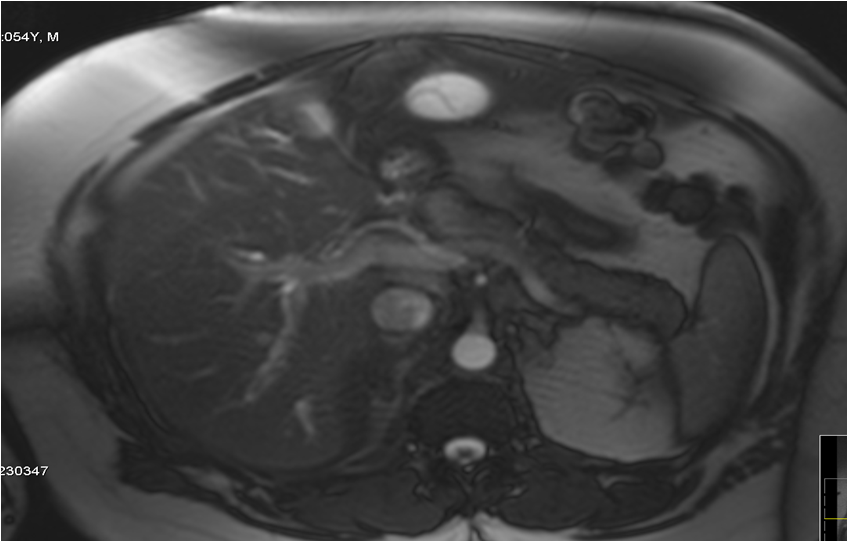
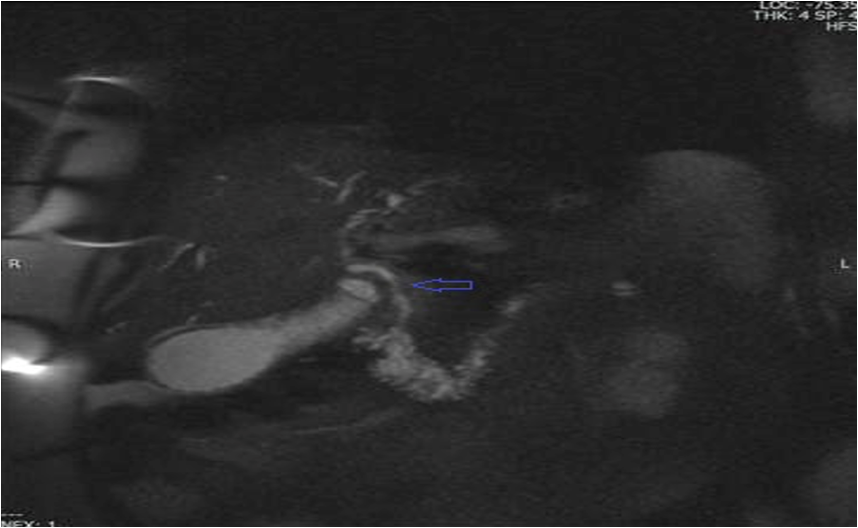
MRI abdomen demonstrated fluid distended gall bladder with distended cystic duct, no gall stones were visualized, intrahepatic biliary duct dilatation, multiple areas of narrowing with a poorly visualized hepatic duct which could be related to stricture, and beaded appearance involving the common bile duct (Figures 1 and 2). ERCP showed mucosal abnormalities at the common bile duct bifurcation with common hepatic duct stricture. Multiple sites biliary biopsies were taken, and a plastic stent was placed into the common bile duct. Pathology showed fragments of papillary adenoma and mucosal tissue with chronic inflammation. Immunostaining was performed and showed IgG4 positive plasma cells 15 per HPF with a serum IgG4/IgG ratio of 14 %. Further investigations showed negative anti-mitochondrial antibody (< 20 units), anti-smooth muscle antibody, ANA, and hepatitis B & C markers. The patient improved clinically with down-trending bilirubin and clear the infection process. His clinical presentation, imaging studies, and immunostaining results were consistent with IgG4-SC complicated with ascending cholangitis. The patient was discharged on a high dose of prednisone with a tapering dose in the following weeks. Repeated blood tests 6 weeks after the discharge showed a remarkable improvement with an alkaline phosphatase of 102 [38 – 126 U/L], total bilirubin of 0.7 [0.4 – 2 MG/DL], and CA 19-9 was 13 [0.0 – 35.0 U/ml]. The patient has been following up in the outpatient setting for more than 6 years without evidence of pancreatitis.
Immunoglobulin G4-related sclerosing cholangitis (IgG4-SC) is a rare immune-mediated inflammatory disease with unknown prevalence. There are no definite epidemiologic studies done yet to identify the disease prevalence as the disease recognition continues to grow. It has been estimated to be 0.28 to 1.08 per 100,000 population in Japan, however; this seems to be an underestimation of the true disease prevalence 1. IgG4-SC is a part of the large spectrum of immunoglobulin G4-related disease (IgG4-RD) where many organs (such as the pancreas, stomach, and retroperitoneum, among others) can be affected simultaneously or consecutively. More than half of the patients with autoimmune pancreatitis (AIP) will have IgG4-SC, and most of the patients with IgG4-SC have AIP 2. Our patient presented with isolated IgG4-SC with no evidence of autoimmune pancreatitis or other affected organs.


The pathophysiology of IgG4-RD is still unclear. The diseases related to IgG4 earned their name from the high titer of IgG in that patient population. IgG4 consists of < 5% of total serum IgG in a normal population, but in some patients, it accounts for > 50 % of total serum IgG. Interestingly, the IgG4 antibody titer often remains high during the period of remission which indicates the less pathogenic rule of IgG4 in IgG4-RD 3. The pathogenesis seems to be driven by both B and T cells, where the CD4 T cells play the main role, and they are sustained by continuous antigen presentation by cells of the B lymphocyte lineage. The T follicular helper cells on the other hand produce cytokines such as IL-4 that develop the germinal center within the affected organs and stimulate the IgG4 class switch 3.
Patients with IgG4-SC usually present clinically with obstructive jaundice and abdominal pain. Diabetes mellitus or steatorrhea can be manifestations of pancreatic involvement. Besides the serum markers of obstructive jaundice such as elevated ALP, GGT and serum bilirubin, IgG4, tumor markers (CA 19-9), ANA, and RF are often elevated. Our patient presented with ascending obstructive cholangitis with elevated IgG4 and CA 19-9 4. IgG4 can be elevated in other diseases such as sclerosing cholangitis and can be normal in around 20 % of patients with AIP 4. Bile duct imaging can show narrowing on different levels, creating different differential diagnoses. Hilar level stenosis can mimic Klatskin tumors. Distal bile duct stenosis makes chronic pancreatitis and cholangiocarcinoma possible differentials. Diffuse intra and extra-hepatic biliary strictures mimic primary sclerosing cholangitis (PSC) 5, 6. Given the broad differential diagnoses and imaging findings similarities with no specific serum markers, the diagnosis of IgG4-SC is often challenging. Bile duct or liver biopsy in IgG4-SC usually shows infiltration by IgG4+ B cells and CD4+ T cells. The presence of > 10 IgG4 positive plasma cells per high power field has high specificity for IgG4-SC (90 %), however; high false-positive results are also seen in PSC and pancreaticobiliary carcinoma 7. Responding to a short course of oral steroids for 2-4 weeks supports the diagnosis of IgG4-SC in uncertain cases.
Corticosteroids are the first-line treatment for IgG4-related diseases. Although the patients usually respond to steroids, relapse is common after discontinuation or tapering the dose. Steroids should be titrated to the lowest effective dose to decrease the side effects. An open-label trial of 30 patients with IgG4 RD showed a response in 97 % of the patients after two doses of rituximab and 40 % at 12 months 8. Azathioprine is another alternative for patients who are nonresponding to steroids or to avoid the systemic side effect of steroids 9. Our patient was treated with prednisone with a good clinical response.
High suspicion index for this clinical entity should be kept by clinicians in a patient presenting with obstructive jaundice and abdominal pain for differentiating it from its frequent mimickers such as primary biliary cholangitis (PBC), primary sclerosing cholangitis (PSC), and pancreato-biliary malignancies since therapeutic strategies and outcomes differ significantly among them.
| [1] | Umehara, H., Okazaki, K., Masaki, Y., Kawano, M., Yamamoto, M., Saeki, T., Matsui, S., Sumida, T., Mimori, T., Tanaka, Y., Tsubota, K., Yoshino, T., Kawa, S., Suzuki, R., Takegami, T., Tomosugi, N., Kurose, N., Ishigaki, Y., Azumi, A., Kojima, M., Nakamura, S., and Inoue, D, “A novel clinical entity, IgG4-related disease (IgG4RD): general concept and details,” Mod Rheumatol. 22(1):1-14. Feb 2012. | ||
| In article | View Article PubMed | ||
| [2] | Ghazale, A., Chari, S.T., Zhang, L., Smyrk, T.C., Takahashi, N., Levy, M.J., Topazian, M.D., Clain, J.E., Pearson, R.K., Petersen, B.T., Vege, S.S., Lindor, K., Farnell, M.B, “Immunoglobulin G4-associated cholangitis: clinical profile and response to therapy,” Gastroenterology. 134(3):706-15. Mar 2008. | ||
| In article | View Article PubMed | ||
| [3] | Mattoo, H., Mahajan, V.S., Maehara, T., Deshpande, V., Della-Torre, E., Wallace, Z.S., Kulikova, M., Drijvers, J.M., Daccache, J., Carruthers, M.N., Castelino, F.V., Stone, J.R., Stone, J.H., Pillai, S, “Clonal expansion of CD4(+) cytotoxic T lymphocytes in patients with IgG4-related disease,” J Allergy Clin Immunol. 138(3):825-838. Sep 2016. | ||
| In article | View Article PubMed | ||
| [4] | Hubers, L.M., Maillette, De Buy Wenniger, L.J., Doorenspleet, M.E., Klarenbeek, P.L., Verheij, J., Rauws, E.A., Van Gulik, T.M., Oude, Elferink R.P., Van de Graaf, S.F., De Vries, N., Beuers, U, “IgG4-associated cholangitis: a comprehensive review,” Clin Rev Allergy Immunol. 48(2-3): 198-206. Jun 2015. | ||
| In article | View Article PubMed | ||
| [5] | Maillette de Buy Wenniger, L., Rauws, E.A., Beuers, U, “What an endoscopist should know about immunoglobulin-G4-associated disease of the pancreas and biliary tree,” Endoscopy. 44(1):66-73. Jan2012 Jan; 44(1): 66-73. | ||
| In article | View Article PubMed | ||
| [6] | Kloek, J.J., Van Delden, O.M., Erdogan, D., Ten Kate F.J., Rauws, E.A., Busch O.R., Gouma, D.J., Van Gulik, T.M, “Differentiation of malignant and benign proximal bile duct strictures: the diagnostic dilemma”, World J Gastroenterol. 28; 14(32): 5032-8. Aug 2008. | ||
| In article | View Article PubMed | ||
| [7] | Kawakami, H., Zen, Y., Kuwatani, M., Eto, K., Haba, S., Yamato, H., Shinada, K., Kubota, K., Asaka, M, “IgG4-related sclerosing cholangitis and autoimmune pancreatitis: histological assessment of biopsies from Vater's ampulla and the bile duct,” J Gastroenterol Hepatol. 25(10):1648-55. Oct 2010. | ||
| In article | View Article PubMed | ||
| [8] | Carruthers, M.N., Topazian, M.D., Khosroshahi, A., Witzig, T.E., Wallace, Z.S., Hart, P.A., Deshpande, V., Smyrk, T.C., Chari, S., Stone, J.H, “Rituximab for IgG4-related disease: a prospective, open-label trial,” Ann Rheum Dis. 74(6):1171-7. Jun 2015. | ||
| In article | View Article PubMed | ||
| [9] | Hart, P.A., Topazian, M.D., Witzig, T.E., Clain, J.E., Gleeson, F.C., Klebig, R.R., Levy, M.J., Pearson, R.K., Petersen, B.T., Smyrk, T.C., Sugumar, A., Takahashi, N., Vege, S.S., Chari, S.T, “Treatment of relapsing autoimmune pancreatitis with immunomodulators and rituximab: the Mayo Clinic experience,” Gut. 62(11): 1607-15. Nov 2013. | ||
| In article | View Article PubMed | ||
Published with license by Science and Education Publishing, Copyright © 2022 Walaa Hammad, Qirat Jawed, Islam Younes, Ana Romero, Jesus Romero, Asnia Latif and Fareeha Abid
 This work is licensed under a Creative Commons Attribution 4.0 International License. To view a copy of this license, visit
http://creativecommons.org/licenses/by/4.0/
This work is licensed under a Creative Commons Attribution 4.0 International License. To view a copy of this license, visit
http://creativecommons.org/licenses/by/4.0/
| [1] | Umehara, H., Okazaki, K., Masaki, Y., Kawano, M., Yamamoto, M., Saeki, T., Matsui, S., Sumida, T., Mimori, T., Tanaka, Y., Tsubota, K., Yoshino, T., Kawa, S., Suzuki, R., Takegami, T., Tomosugi, N., Kurose, N., Ishigaki, Y., Azumi, A., Kojima, M., Nakamura, S., and Inoue, D, “A novel clinical entity, IgG4-related disease (IgG4RD): general concept and details,” Mod Rheumatol. 22(1):1-14. Feb 2012. | ||
| In article | View Article PubMed | ||
| [2] | Ghazale, A., Chari, S.T., Zhang, L., Smyrk, T.C., Takahashi, N., Levy, M.J., Topazian, M.D., Clain, J.E., Pearson, R.K., Petersen, B.T., Vege, S.S., Lindor, K., Farnell, M.B, “Immunoglobulin G4-associated cholangitis: clinical profile and response to therapy,” Gastroenterology. 134(3):706-15. Mar 2008. | ||
| In article | View Article PubMed | ||
| [3] | Mattoo, H., Mahajan, V.S., Maehara, T., Deshpande, V., Della-Torre, E., Wallace, Z.S., Kulikova, M., Drijvers, J.M., Daccache, J., Carruthers, M.N., Castelino, F.V., Stone, J.R., Stone, J.H., Pillai, S, “Clonal expansion of CD4(+) cytotoxic T lymphocytes in patients with IgG4-related disease,” J Allergy Clin Immunol. 138(3):825-838. Sep 2016. | ||
| In article | View Article PubMed | ||
| [4] | Hubers, L.M., Maillette, De Buy Wenniger, L.J., Doorenspleet, M.E., Klarenbeek, P.L., Verheij, J., Rauws, E.A., Van Gulik, T.M., Oude, Elferink R.P., Van de Graaf, S.F., De Vries, N., Beuers, U, “IgG4-associated cholangitis: a comprehensive review,” Clin Rev Allergy Immunol. 48(2-3): 198-206. Jun 2015. | ||
| In article | View Article PubMed | ||
| [5] | Maillette de Buy Wenniger, L., Rauws, E.A., Beuers, U, “What an endoscopist should know about immunoglobulin-G4-associated disease of the pancreas and biliary tree,” Endoscopy. 44(1):66-73. Jan2012 Jan; 44(1): 66-73. | ||
| In article | View Article PubMed | ||
| [6] | Kloek, J.J., Van Delden, O.M., Erdogan, D., Ten Kate F.J., Rauws, E.A., Busch O.R., Gouma, D.J., Van Gulik, T.M, “Differentiation of malignant and benign proximal bile duct strictures: the diagnostic dilemma”, World J Gastroenterol. 28; 14(32): 5032-8. Aug 2008. | ||
| In article | View Article PubMed | ||
| [7] | Kawakami, H., Zen, Y., Kuwatani, M., Eto, K., Haba, S., Yamato, H., Shinada, K., Kubota, K., Asaka, M, “IgG4-related sclerosing cholangitis and autoimmune pancreatitis: histological assessment of biopsies from Vater's ampulla and the bile duct,” J Gastroenterol Hepatol. 25(10):1648-55. Oct 2010. | ||
| In article | View Article PubMed | ||
| [8] | Carruthers, M.N., Topazian, M.D., Khosroshahi, A., Witzig, T.E., Wallace, Z.S., Hart, P.A., Deshpande, V., Smyrk, T.C., Chari, S., Stone, J.H, “Rituximab for IgG4-related disease: a prospective, open-label trial,” Ann Rheum Dis. 74(6):1171-7. Jun 2015. | ||
| In article | View Article PubMed | ||
| [9] | Hart, P.A., Topazian, M.D., Witzig, T.E., Clain, J.E., Gleeson, F.C., Klebig, R.R., Levy, M.J., Pearson, R.K., Petersen, B.T., Smyrk, T.C., Sugumar, A., Takahashi, N., Vege, S.S., Chari, S.T, “Treatment of relapsing autoimmune pancreatitis with immunomodulators and rituximab: the Mayo Clinic experience,” Gut. 62(11): 1607-15. Nov 2013. | ||
| In article | View Article PubMed | ||