Drying is a key technology for the preservation and processing of citrus fruits; however, its effects on bioactive compounds, antioxidant properties, and quality attributes vary considerably by method. This study aims to quantitatively evaluate the effects of different drying methods on the bioactive compounds, antioxidant activities, and colorimetric parameters of citrus matrices using a multilevel meta-analysis conducted in accordance with PRISMA guidelines. A total of 23 studies comprising 413 effect estimates were included. Effect sizes were calculated using multilevel random-effects models estimated by restricted maximum likelihood (REML) and combined with a robust variance estimate. The results show significant decreases in vitamin C content (34%), total phenolic compounds (29.4%), and total flavonoids (37.8%) after drying compared with fresh or control samples. Freeze-drying generally exhibits the best retention of bioactive compounds, while solar and hot air drying result in the greatest losses. Conversely, some variables, notably ABTS activity and narirutin content, show apparent increases after drying (>100% retention), which can be attributed to improved extractability or concentration effects rather than a true increase in compounds. Colorimetric parameters are relatively less affected by drying processes. High heterogeneity (I² > 98%) is observed for most variables studied, reflecting the diversity of citrus matrices, drying conditions, and analytical methods used, thereby justifying subgroup analyses. This meta-analysis therefore provides quantitative data to guide the selection of appropriate drying technologies to preserve the functional quality of citrus-derived products.
Citrus fruits represent a significant share of global fruit production and are widely processed into juices and derivative products. Approximately one-third of total production is destined for industrial processing, generating substantial quantities of co-products 1. Peels and pulps, which comprise 50 to 65% of the fruit's weight, are a rich source of bioactive compounds, including polyphenols, flavonoids, and vitamin C, and are recognized for their nutraceutical properties 1. Long considered waste, these co-products are now attracting increasing interest as valuable functional ingredients in the food industry 2. Recent studies have also highlighted the potential of citrus fruits and their co-products in developing functional foods and nutraceutical ingredients for sustainable food applications 3, 4. Dehydration is a key step in the management and valorization of these matrices. Drying reduces water activity, extends shelf life, and limits microbial growth, while also facilitating the extraction of phenolic compounds 1, 5. However, drying conditions strongly influence the stability and recovery of bioactive compounds. High temperatures generally promote the degradation of heat-sensitive compounds and decrease antioxidant activity, while moderate conditions can improve polyphenol extractability by disrupting cell walls 1. Thus, the effect of drying results from a complex balance between degradation and the release of bioactive compounds. Conventional techniques, such as hot-air or solar drying, are widely used for their simplicity and low cost, but they often lead to significant losses of vitamins, polyphenols, and organoleptic qualities 1. Conversely, freeze-drying better preserves nutrients, color, and aroma thanks to low temperatures and reduced pressure, though it incurs a high energy cost 2. In parallel, several emerging technologies, including microwave, infrared, and vacuum drying, have been developed to simultaneously improve product quality and process efficiency. These technologies modify heat and mass transfer as well as the structure of plant matrices, directly influencing the accessibility of bioactive compounds 1. Recent studies have also shown that innovative drying technologies can improve flavonoid retention and antioxidant capacity, depending on thermal parameters and plant matrix characteristics 4. Despite these advances, comparing the effects of different technologies remains difficult due to the wide variability in operating conditions, pretreatments, and matrices studied. Furthermore, literature remains fragmented, with studies often focusing on a single technology or a limited number of compounds. This methodological heterogeneity limits the identification of optimal drying strategies for preserving the bioactive compounds of citrus fruits 1. To date, quantitative data that simultaneously integrate the effects of different drying technologies on the bioactive compounds, antioxidant properties, and colorimetric attributes of citrus matrices remain limited. In this context, the present study aims to conduct a multilevel quantitative meta-analysis to evaluate the effect of the main drying methods on the retention of bioactive compounds, antioxidant activities, and colorimetric parameters of citrus matrices. This approach also aims to identify the main sources of heterogeneity associated with drying technologies, operating conditions, and matrix characteristics, thereby providing scientific data to guide the selection of drying strategies for the preservation and valorization of citrus-derived products.
A literature search was conducted in accordance with PRISMA recommendations, using the Web of Science, Scopus, and PubMed as bibliographic databases, with complementary searches conducted through ScienceDirect, SpringerLink, and Wiley Online Library. The search was initially conducted between September 2024 and February 2025 and updated in July 2026. Grey literature was explored via Google Scholar, and the references of selected articles were manually reviewed. References were managed using Zotero, and study selection was performed independently by two reviewers.
2.2. Inclusion and Exclusion CriteriaExperimental studies published between 2010 and 2026 on citrus matrices subjected to various drying processes were included. The variables studied included bioactive compounds, antioxidant activities, and colorimetric parameters. Studies without usable quantitative data, as well as reviews and conference proceedings, were excluded.
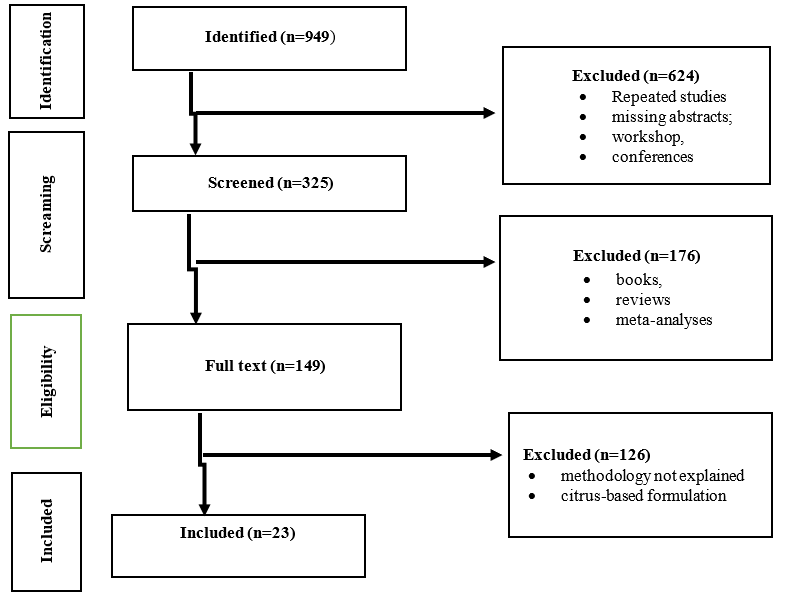
2.3. Study SelectionAfter removing duplicates, titles, abstracts, and full texts were independently reviewed by two reviewers. Discrepancies were resolved by consensus. The selection process is presented in the PRISMA diagram.
2.4. Data Extraction and ManagementThe extracted information concerned study characteristics, drying conditions, response variables, and statistical parameters (mean, standard deviation, and sample size). Additional information related to the evaluated citrus matrices and drying methods was also recorded when available. The extracted data were used for qualitative description of the selected studies and quantitative synthesis. Multiple comparisons from the same study were retained to maximize the available information while accounting for dependence among observations in the statistical analyses.
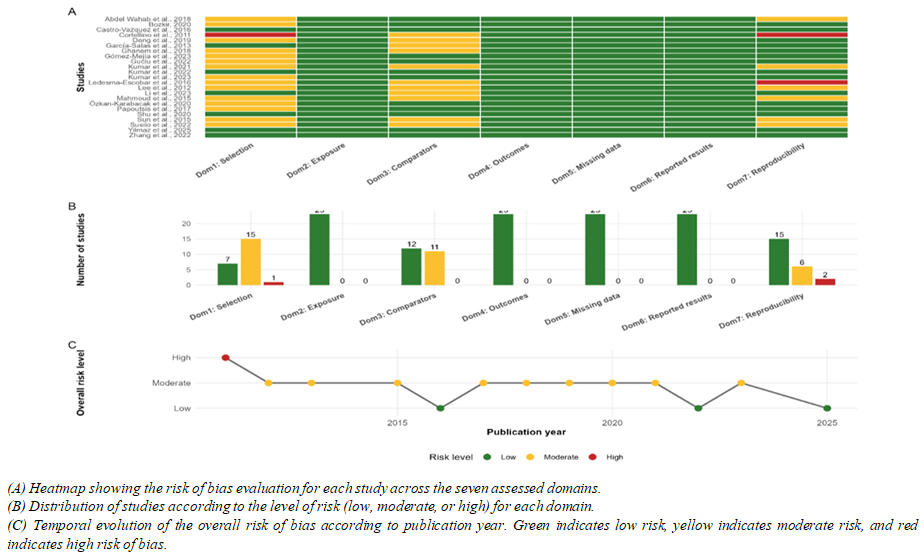
2.5. Quality Assessment and Risk of BiasThe risk of bias was assessed using a framework adapted for experimental studies in food science, inspired by the Joanna Briggs Institute and Cochrane approaches. The results were summarized in heat maps and domain-level distributions.
2.6. Data AnalysisAll statistical analyses were performed using RStudio. Effect sizes were calculated as log response ratios (logRR) or standardized mean differences (SMDs), depending on the outcome variable and measurement scale. Because multiple effect sizes could be extracted from the same study, multilevel random-effects models were fitted using restricted maximum likelihood (REML), with effect sizes nested within studies. Cluster-robust variance estimation with CR2 correction was applied to account for within-study dependence. Heterogeneity was assessed using Cochran’s Q test, I² statistics, and variance components from the multilevel models. Subgroup analyses and meta-regression models were conducted to explore potential sources of heterogeneity related to drying methods and study characteristics. Sensitivity analyses were performed using a leave-one-study-out approach, sequentially removing each study's effect sizes to assess the robustness of the pooled estimates. Potential small-study effects were assessed using funnel plots and Egger’s regression test when at least 10 independent studies were available. Funnel plot asymmetry was interpreted cautiously as an indication of potential publication bias. The certainty of evidence was qualitatively evaluated using an approach adapted from GRADE principles.
The study selection followed PRISMA guidelines and is summarized in Figure 1. A total of 949 articles were identified. After removing duplicates and screening titles and abstracts, 624 articles were excluded. Thus, 325 articles were retained for further analysis. Of these, an additional 176 documents were excluded, including books, literature reviews, and meta-analyses. The remaining 149 articles underwent full-text review. Following this step, 126 studies were excluded for failing to meet the predefined eligibility criteria. These exclusions mainly concerned studies involving citrus-based formulations, composite or mixed matrices containing citrus ingredients rather than direct citrus matrices subjected to controlled drying treatments, as well as studies lacking sufficient methodological details or quantitative data required for meta-analysis. Finally, 23 studies were included in the qualitative and quantitative synthesis.

PRISMA flowchart describing the study selection process for the systematic review. A total of 949 records were initially identified. After screening and eligibility assessment, 23 studies were included in the final analysis. Reasons for exclusion at each stage are indicated in the diagram.
3.2. Characteristics of the Included StudiesTable 1 presents the distribution of the variables studied, the number of corresponding studies, and the number of associated independent comparisons, distinguishing between solid and liquid matrices. A total of 413 independent comparisons were extracted from the 23 included studies presented in Table 2. Total phenolic compounds (TPC) constitute the most documented variable, with 108 comparisons from 8 studies. Colorimetric parameters (L*, a*, b*, ΔE) are reported in 6 studies, totaling 61 comparisons. Antioxidant activity measured by DPPH is described in 6 studies (48 comparisons), while FRAP and ABTS tests are reported in 5 studies (39 comparisons) and 1 study (6 comparisons), respectively. Vitamin C is analyzed across 6 studies, yielding 47 comparisons. Regarding specific flavonoids, hesperidin was reported in two studies (22 comparisons), naringin in three studies (24 comparisons), narirutin in one study (16 comparisons), and neohesperidin in two studies (8 comparisons). Total flavonoids (TFC) were described in 4 studies, totaling 34 comparisons. Most comparisons involved solid matrices, including whole fruits, citrus peels, and pomace. Liquid matrices were underrepresented and were used only for DPPH antioxidant activity analysis.
The drying methods identified in the included studies were grouped into different technological categories, namely freeze-drying (FD), hot air drying (HAD), infrared drying (IR), microwave drying (MW), vacuum drying (VD), solar or shade drying (SUN), spray drying (SD), and hybrid processes (HYBRID) (Supplementary Table S1). For each category, several names and technological variants were identified in the literature. This terminological diversity necessitated harmonizing the methods into standardized analytical categories to allow comparison within the meta-analysis.
Table 3 presents a descriptive summary of the operating parameters for the identified drying methods, including the number of observations, temperatures, and treatment times. Median temperatures range from 52.5°C for freeze-drying to 150°C for spray drying, while the other processes fall between 22.5°C and 80°C. Drying times also exhibit significant variability, ranging from 35 minutes for microwave drying to 4320 minutes for solar drying.
The risk-of-bias assessment revealed a predominance of low-to-moderate levels across most studies. However, some limitations were identified, particularly regarding reproducibility and the description of experimental conditions. Variability between methodological domains was also observed, suggesting heterogeneous quality among the included studies. The detailed results of this assessment are presented in Figure 2, which shows the distribution of bias levels across studies and domains.
3.3. Results of the Meta-analysisThe overall results of the multilevel meta-analysis are presented in Table 4. Overall, the drying processes resulted in significant changes in several bioactive compounds and functional properties. Vitamin C showed a significant decrease (logRR = -0.416; 95% CI [-0.608; -0.223]), corresponding to a mean retention of 66%. Similarly, total polyphenols (TPC) and total flavonoids (TFC) showed decreases (logRR = -0.334 and -0.475), with mean retentions of 71.6% and 62.2%, respectively. Regarding antioxidant activities, ABTS activity showed a significant increase (logRR = 0.968), corresponding to a mean retention of 263%. In contrast, DPPH and FRAP activities did not show significant changes. Specific flavonoids showed variable results depending on the compounds studied. Hesperidin (logRR = -0.947), naringin (logRR = -0.077), and neohesperidin (logRR = -0.785) showed no significant changes, while narirutin showed a significant increase (logRR = 0.769), corresponding to a mean retention of 215.7%. The colorimetric parameters L*, a*, and b* showed no significant changes. The overall color change (ΔE), expressed as SMD, also showed no significant effect. High heterogeneity was observed across most of the variables studied, with I² values exceeding 98%.
High heterogeneity was observed for almost all variables studied, with I² values exceeding 98%. The variable ΔE had an I² value of 59.4%. Cochran's tests (Q) were significant for all analyses (p < 0.001). Detailed Q and I² values are presented in Table 4.
•Regarding bioactive compounds and antioxidant activities
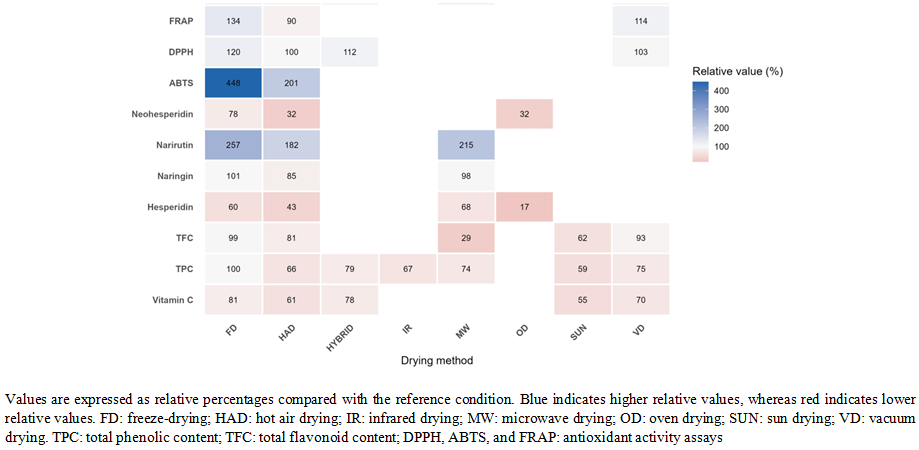
The effects of the different drying methods are illustrated in Figure 3. For vitamin C, the observed retention rates were 81.4% for freeze-drying (FD), 70.1% for vacuum drying (VD), 61.0% for hot air drying (HAD), and 55.0% for solar drying (SUN). For total polyphenols (TPC), the observed retention rates were 99.6% for FD, 75.4% for VD, 73.7% for MW, 65.6% for HAD, and 58.6% for SUN. For total flavonoids (TFC), the retention rates were 98.7% for FD, 93.2% for VD, 81.5% for HAD, 62.3% for SUN, and 28.7% for MW. Specific flavonoids also showed variations depending on the drying method. For hesperidin, the observed retention rates were 59.6% for FD, 43.3% for HAD, 67.8% for MW, and 17.0% for OD. For naringin, the observed values were 100.6% for FD, 85.2% for HAD, and 98.2% for MW. For narirutin, the observed retention rates were 256.7% for FD, 182.0% for HAD, and 215.2% for MW. Neohesperidin showed retention rates of 78.1% for FD, 31.7% for HAD, and 32.1% for OD. Antioxidant activities also varied depending on the drying method. For ABTS, the observed retention rates were 448.2% for FD and 201.0% for HAD. For DPPH, the observed values were 119.9% for FD, 102.5% for VD, and 99.7% for HAD. Regarding FRAP, the observed retention rates were 133.7% for FD, 113.7% for VD, and 89.6% for HAD. Detailed results for all variables, including specific flavonoids and colorimetric parameters, are provided inTable S2.


•Regarding colorimetric parameters
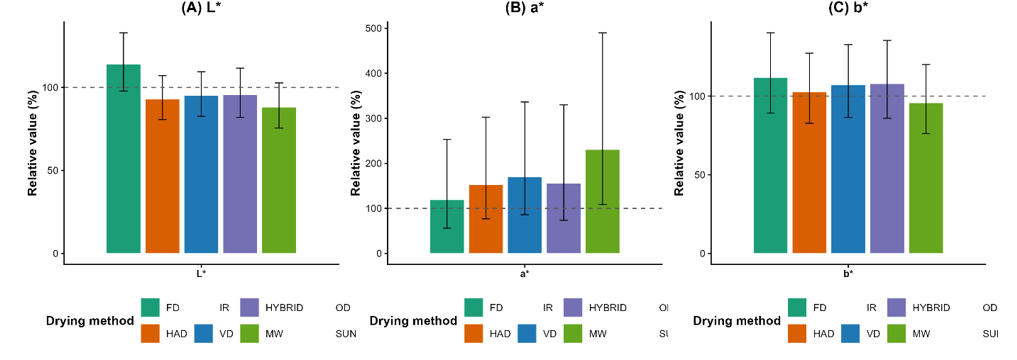
The colorimetric parameters L*, a*, b*, and ΔE did not show significant variation across the drying methods (Figure 4). For ΔE specifically, the estimates, expressed as standardized mean differences (SMDs), ranged from 80.98 to 113.02 depending on the method (Table S2), with confidence intervals that systematically included zero, confirming the absence of a significant effect.
The results of the overall tests of the effects of the drying methods revealed significant effects of the drying methods for several variables, including vitamin C (QM = 63.53; p < 0.001), total polyphenols (TPC) (QM = 15.87; p = 0.026), ABTS activity (QM = 141.27; p < 0.001), FRAP activity (QM = 12.17; p = 0.007), narirutin (QM = 43.85; p < 0.001), neohesperidin (QM = 8.27; p = 0.041), as well as the colorimetric parameters L* (QM = 58.52; p < 0.001), a* (QM = 14.80; p = 0.011) and b* (QM = 14.80; p = 0.011). 13.83; p = 0.017). No significant effect was observed for DPPH, hesperidin, naringin, and ΔE. Detailed results are presented in Table S3.
Meta-regressions revealed significant associations between temperature and the colorimetric parameters L* (estimate = -0.0015; 95% CI [-0.003; -0.000]; p = 0.021) and a* (estimate = 0.0198; 95% CI [0.011; 0.029]; p < 0.001). Drying time was also significantly associated with a* (estimate = 0.0030; 95% CI [0.002; 0.004]; p < 0.001). In contrast, no significant association was observed between total polyphenols (TPC) and temperature (estimate = -0.0014; 95% CI [-0.005, 0.002]; p = 0.443) or duration (estimate = 0.0000; 95% CI [-0.000, 0.000]; p = 0.253), nor between b* and temperature (estimate = -0.0001; 95% CI [-0.003, 0.002]; p = 0.965). The results are provided in Supplementary Table S4.
Leave-one-study-out sensitivity analysis was performed to assess the stability of the overall estimates. Excluding each study in turn did not significantly change the effect sizes for the variables studied. The overall estimates remained generally stable across all analyses. Summary and detailed results of the sensitivity analyses are presented in Supplementary Table S5. The corresponding influence plots are shown in Figures S1, S2, and S3 for bioactive compounds and flavonoids, antioxidant activities, and colorimetric parameters, respectively.
Publication bias was assessed using funnel plots and Egger's test when sufficient studies were available. Funnel plots show variable distributions depending on the parameters studied. Visual asymmetries are observed for some variables. Funnel plots corresponding to bioactive compounds, specific flavonoids, and antioxidant activities are shown in Figure S4, while those for colorimetric parameters are shown in Figure S5. Detailed results of Egger's tests are presented in Supplementary Table S6.
The results of this meta-analysis show that drying processes generally reduce the levels of the main bioactive compounds in citrus matrices. Vitamin C appears to be one of the most sensitive compounds, with an average retention of 66% and a significant decrease (logRR = -0.416). Total polyphenols (TPC) and total flavonoids (TFC) also show significant decreases, with average retentions of 71.6% and 62.2%, respectively. These results confirm the high sensitivity of vitamin C to thermal and oxidative treatments, as reported by Santos and Silva 28. The decrease in phenolic and flavonoid compounds is also consistent with the observations of Kumar et al. 15. However, the differences observed among the variables suggest varying levels of stability that depend on the chemical structure, cellular localization, and thermal sensitivity of the bioactive compounds.
4.2. Effects of Drying MethodsSubgroup analyses reveal significant differences between drying technologies. Freeze-drying (FD) exhibits the highest retention rates for vitamin C (81.4%), TPCs (99.6%), and TFCs (98.7%), confirming its effectiveness in preserving heat-sensitive compounds through low temperatures and limited oxidative processes 15. Conversely, solar drying (SUN) and hot air drying (HAD) result in the greatest losses, likely due to prolonged exposure to heat and oxygen 29. Microwave drying (MW) shows more contrasting effects, with good retention of TPCs (73.7%) but a significant decrease in TFCs (28.7%), suggesting variable effects depending on the nature of the compounds 30. Despite the good performance of freeze-drying, its energy cost limits its industrial application. In this context, hybrid processes appear as promising alternatives, offering an interesting compromise between preservation of bioactive compounds, energy efficiency, and industrial applicability for the sustainable valorization of citrus matrices and co-products.
4.3. Behavior of Specific FlavonoidsSpecific flavonoids exhibit contrasting responses depending on the compound and drying method. Hesperidin shows relatively low retention under HAD (43.3%) and OD (17.0%), while higher values are observed under FD (59.6%) and MW (67.8%). Naringin exhibits retention close to 100%, while narirutin reaches very high values under FD (256.7%) and MW (215.2%). These retentions exceeding 100% likely reflect apparent relative increases in the measured concentrations after drying. Several mechanisms can explain these observations, including the disruption of cellular structures, which improves the extractability of phenolic compounds 31, as well as certain chemical transformations induced by heat treatment 16. These results are consistent with previous studies reporting an apparent improvement in some flavonoids after drying 15. Conversely, neohesperidin exhibits lower retention, suggesting greater instability under prolonged heat treatment.
4.4. Antioxidant ActivitiesAntioxidant activities vary depending on the analytical test. ABTS activity shows the most significant increases, with retentions reaching 448.2% under FD and 201.0% under HAD, while DPPH and FRAP show more moderate variations. These differences may be related to the specific chemical mechanisms assessed by each method. The observed increases have already been reported in the literature and may be associated with improved extractability of phenolic compounds or the formation of new antioxidant compounds resulting from Maillard reactions 16, 29. Chen et al. specifically point out that certain drying conditions can increase apparent antioxidant activity by releasing bound compounds or transforming complex molecules 29. The coexistence of decreases in bioactive compounds and increases in certain antioxidant activities illustrates the complexity of the transformations induced by drying processes.
4.5. Colorimetric ParametersThe colorimetric parameters L*, a*, and b* did not show significant variation across the overall analyses, although some differences were observed depending on the drying method. Meta-regression analyses, in particular, showed significant associations between temperature and the parameters L* and a*. Regarding ΔE, the observed estimates ranged from 80.98 to 113.02 across drying methods, with no overall significant effect. These results are generally consistent with several studies reporting that some biochemical changes induced by drying do not necessarily translate into significant visual changes 32. The variability observed between studies may be related to differences in matrices, operating conditions, and instrumental methods used for color evaluation.
4.6. Heterogeneity of ResultsOne of the main findings of this study is the very high heterogeneity observed across most variables, with I² values exceeding 98%. This heterogeneity is confirmed by significant Q tests across all analyses. This variability can be explained by several factors, including the diversity of the matrices studied, differences in operating conditions, applied pretreatments, and the heterogeneity of analytical methods used between studies 29. Meta-regression analyses show that certain parameters, particularly temperature, significantly influence some colorimetric variables. However, these factors only explain a limited portion of the observed heterogeneity.
4.7. Strengths and Limitations of the StudyThis study has several important strengths. To our knowledge, it is one of the first multilevel meta-analyses dedicated to the effects of drying processes on the bioactive compounds and functional properties of citrus matrices. The use of multilevel models with REML estimation and robust CR2 variance accounted for dependence among comparisons within the same study. The simultaneous integration of bioactive compounds, specific flavonoids, antioxidant activities, and colorimetric parameters is also a significant advantage. However, several limitations must be highlighted. The number of studies remains limited for certain variables, particularly specific flavonoids and some antioxidant activities. Furthermore, the high heterogeneity observed limits the generalizability of the overall estimates. Finally, methodological differences across studies complicate direct comparisons of results. However, the use of cluster-robust (CR2) inference yielded reliable estimates of uncertainty while accounting for dependence among effect sizes from the same studies (Supplementary Table S7). The assessment of the certainty of evidence revealed variable levels of confidence across the evaluated parameters, mainly due to high heterogeneity and the limited number of available studies for certain outcomes. The detailed results of this evaluation are presented in Supplementary Table S8.
4.8. Implications and PerspectivesThe results obtained highlight the importance of selecting drying technologies to preserve bioactive compounds in citrus fruits. Freeze-drying appears to be the most effective method overall, although some alternative technologies may offer specific advantages depending on the compounds studied. These results open up avenues for optimizing citrus processing methods and valorizing co-products rich in bioactive compounds. Future studies using standardized protocols and more in-depth mechanistic approaches will be necessary to better understand the transformations induced by drying processes.
Drying processes are important strategies for the preservation, stabilization, and valorization of citrus matrices. However, their effects on nutritional and functional attributes remain highly variable depending on the drying technology used, the operating conditions applied, and the characteristics of the matrices studied. This multilevel meta-analysis provides quantitative data on the impact of drying processes on the biochemical composition, antioxidant properties, and colorimetric quality of citrus matrices. Overall, drying significantly reduces the levels of the main bioactive compounds, including vitamin C, total phenolic compounds, and total flavonoids, confirming their sensitivity to thermal and oxidative stresses. Among the technologies evaluated, freeze-drying showed the best capacity for retaining bioactive compounds, while solar drying and hot air drying were associated with the greatest losses. However, responses for specific flavonoids and antioxidant activity varied with the compounds and the analytical methods used, suggesting that drying-induced changes result from both degradation and changes in compound extractability. Retention rates exceeding 100%, observed for certain parameters such as narirutin content and some antioxidant activities, should therefore be interpreted as apparent increases related to concentration effects or improved extractability rather than actual compound synthesis. Colorimetric parameters generally appear more stable, although some variations may occur depending on processing conditions. The significant heterogeneity observed between studies highlights the important influence of citrus matrices, drying technology parameters, and analytical methodologies, emphasizing the need for more standardized experimental protocols. Overall, these results provide scientific evidence to guide the selection of appropriate drying strategies to preserve functional quality and enhance the valorization potential of citrus products and by-products.
The authors received no specific funding for this work and declared no conflicts of interest.
Ana-kpan Dome Vincent Bekuoné Somé: Conceptualization, Methodology, Investigation, Data curation, Formal analysis,Writing original draft; Mamounata Diao: Conceptualization, Methodology, Validation, Supervision, Writing review & editing; Rocksane Octavia Kiswendsida Nikiema: Investigation, Data curation, Literature screening, Writing review & editing;
David Bazié: Methodology, Validation, Writing review & editing;
Désiré Ouaro: Investigation, Data curation, Risk of bias assessment, Writing review & editing;
Zakaria Dindané: Investigation, Data curation, Risk of bias assessment, Writing review & editing;
Roger Dakuyo: Data curation, Validation, Writing review & editing;
Fréderic Anderson Konkobo: Investigation, Data curation, Writing review & editing
Hemayoro Sama: Validation, Writing review & editing; Samson Guenné: Validation, Writing review & editing; Mamoudou Hama Dicko: Supervision and Validation
|
|
|
|
|
| [1] | Özcan, MM, Ghafoor, K, Al Juhaimi, F, Uslu, N, Babiker, EE, Mohamed Ahmed, IA, Almusallam, IA. Influence of drying techniques on bioactive properties, phenolic compounds and fatty acid compositions of dried lemon and orangepeel powders.Journal of Food Science and Technology, 58(1), 147–158. | ||
| In article | View Article PubMed | ||
| [2] | Yao, J, Chen, W, Fan, K. Novel Efficient Physical Technologies for Enhancing Freeze Drying of Fruits and Vegetables: A Review.Foods, 12(23), 4321, 2023. | ||
| In article | View Article PubMed | ||
| [3] | Liu, S, Lou, Y, Li, Y, Zhang, J, Li, P, Yang, B, Gu, Q. Review of phytochemical and nutritional characteristics and food applications of Citrus L. fruits.Frontiers in Nutrition, 9, 968604. | ||
| In article | View Article PubMed | ||
| [4] | Kumar, D, Ladaniya, MS, Gurjar, M, Mendke, S, Kumar, S, and Ghosh, D. Elucidation of flavanones, phenols and antioxidant capacity influenced by drying methods from physiologically dropped underutilized Citrus grandis fruits.Frontiers in Plant Science, 14, 1193635. | ||
| In article | View Article PubMed | ||
| [5] | Alp, D, Bulantekin, Ö. The microbiological quality of various foods dried by applying different drying methods: a review.European Food Research and Technology, 247(6), 1333–1343. | ||
| In article | View Article PubMed | ||
| [6] | Ghanem, N, Mihoubi, D, Bonazzi, C, Kechaou, N, Boudhrioua, N. Drying Characteristics of Lemon By-product (Citrus limon. v. lunari): Effects of Drying Modes on Quality Attributes Kinetics. Waste and Biomass Valorization, 11(1), 303–322. | ||
| In article | View Article | ||
| [7] | Susilo, B, Rohim, A, Filayati, MAJ. Vacuum drying as a natural preservation method of post-harvest lemon might accelerate drying duration and produce the high-quality of dried lemon slices. Food Science and Technology, 42, e58722. | ||
| In article | View Article | ||
| [8] | Bozkir, H. Effects of hot air, vacuum infrared, and vacuum microwave dryers on the drying kinetics and quality characteristics of orange slices. Journal of Food Process Engineering, 43(10), e13485. | ||
| In article | View Article | ||
| [9] | Özkan‐Karabacak, A, Acoğlu, B, Yolci Ömeroğlu, P, Çopur, ÖU. Microwave pre‐treatment for vacuum drying of orange slices: Drying characteristics, rehydration capacity and quality properties, Journal of Food Process Engineering, 43(11), e13511. | ||
| In article | View Article | ||
| [10] | Deng, L, Mujumdar, AS, Yang, W, Zhang, Q, Zheng, Z, Wu, M, Xiao, H. Hot air impingement drying kinetics and quality attributes of orange peel. Journal of Food Processing and Preservation, 44(1). | ||
| In article | View Article | ||
| [11] | Castro-Vazquez, L, Alañón, ME, Rodríguez-Robledo, V, Pérez-Coello, MS, Hermosín-Gutierrez, I, Díaz-Maroto, MC, Jordán, J, Galindo, MF, Arroyo-Jiménez, MDM. Bioactive Flavonoids, Antioxidant Behaviour, and Cytoprotective Effects of Dried Grapefruit Peels (Citrus paradisiMacf.). Oxidative Medicine and Cellular Longevity, 2016 (1), 8915729. | ||
| In article | View Article PubMed | ||
| [12] | Papoutsis, K, Pristijono, P, Golding, JB, Stathopoulos, CE, Bowyer, MC, Scarlett, CJ, Vuong, QV. Effect of vacuum‐drying, hot air‐drying and freeze‐drying on polyphenols and antioxidant capacity of lemon ( Citruslimon ) pomace aqueous extracts, International Journal of Food Science & Technology, 52(4), 880–887. | ||
| In article | View Article | ||
| [13] | Ledesma-Escobar, CA, Priego-Capote, F, Luque De Castro, MD. Comparative Study of the Effect of Sample Pretreatment and Extraction on the Determination of Flavonoids from Lemon (Citrus limon). PLOS ONE, 11(1), e0148056. | ||
| In article | View Article PubMed | ||
| [14] | Kumar, D, Ladaniya, MS, Gurjar, M, Kumar, S, Mendke, S. Quantification of Flavonoids, Phenols and Antioxidant Potential from Dropped Citrus reticulata Blanco Fruits Influenced by Drying Techniques. Molecules, 26(14), 4159. | ||
| In article | View Article PubMed | ||
| [15] | Kumar, D, Ladaniya, MS, Gurjar, M, Kumar, S. Impact of drying methods on natural antioxidants, phenols and flavanones of immature dropped Citrus sinensis L. Osbeck fruits.Scientific Reports, 12(1), 6684. | ||
| In article | View Article PubMed | ||
| [16] | Sun, Y, Shen, Y, Liu, D, Ye, X. Effects of drying methods on phytochemical compounds and antioxidant activity of physiologically dropped un-matured citrus fruits.LWT - Food Science and Technology, 60(2), 1269–1275. | ||
| In article | View Article | ||
| [17] | Guclu, G, Polat, S, Kelebek, H, Capanoglu, E, Selli, S. Elucidation of the impact of four different drying methods on the phenolics, volatiles, and color properties of the peels of four types of citrus fruits. Journal of the Science of Food and Agriculture, 102(13), 6036–6046. | ||
| In article | View Article PubMed | ||
| [18] | Li, S, Mao, X, Guo, L, Zhou, Z. Comparative Analysis of the Impact of Three Drying Methods on the Properties of Citrus reticulata Blanco cv. Dahongpao Powder and Solid Drinks. Foods, 12(13), 2514. | ||
| In article | View Article PubMed | ||
| [19] | Abdelwahab, AS and Abouelyazeed, A. Bioactive compounds in some citrus peels as affected by drying processes and quality evaluation of cakes supplemented with citrus peels powder. Journal of the Advances in Agricultural Researches, 23, (1), 44–67. | ||
| In article | |||
| [20] | Marwa, HM, Azza, AA-A, Ferial. Effect of Some Different Drying Methods on the Chemical Analysis of Citrus By-Products. Research Journal of Pharmaceutical Biological and Chemical Sciences, 6(6), 105–116. | ||
| In article | |||
| [21] | Gómez-Mejía, E, Sacristán, I, Rosales-Conrado, N, León-González, ME, Madrid, Y. Effect of Storage and Drying Treatments on Antioxidant Activity and Phenolic Composition of Lemon and Clementine Peel Extracts, Molecules, 28(4), 1624. | ||
| In article | View Article PubMed | ||
| [22] | Shu, B, Wu, G, Wang, Z, Wang, J, Huang, F, Dong, L, Zhang, R, Wang, Y, Su, D. The effect of microwave vacuum drying process on citrus: drying kinetics, physicochemical composition and antioxidant activity of dried citrus (Citrus reticulata Blanco) peel. Journal of Food Measurement and Characterization, 14(5), 2443–2452. | ||
| In article | View Article | ||
| [23] | García-Salas, P, Gómez-Caravaca, AM, Arráez-Román, D, Segura-Carretero, A, Guerra-Hernández, E, García-Villanova, B, Fernández-Gutiérrez, A. Influence of technological processes on phenolic compounds, organic acids, furanic derivatives, and antioxidant activity of whole-lemon powder. Food Chemistry, 141(2), 869–878. | ||
| In article | View Article PubMed | ||
| [24] | Cortellino, G, Gobbi, S, Torreggiani, D. New prospects for high quality ingredients obtained from citrus fruit peel. Procedia Food Science, 1, 1848–1853. | ||
| In article | View Article | ||
| [25] | Lai, C, Liang, Y, Zhang, L, Huang, J, Kaliaperumal, K, Jiang, Y, Zhang, J. Variations of Bioactive Phytochemicals and Antioxidant Capacity of Navel Orange Peel in Response to Different Drying Methods, Antioxidants, 11(8), 1543. | ||
| In article | View Article PubMed | ||
| [26] | Yilmaz, D, Tekin-Cakmak, ZH, Karasu, S. Impact of Ultrasound Pretreatment and Temperature on Drying Kinetics and Quality Characteristics of Blood Orange Slices: Comparison with Different Drying Methods. Processes, 13(5), 1596. | ||
| In article | View Article | ||
| [27] | Lee, C-W, Oh, H-J, Han, S-H, Lim, S-B. Effects of hot air and freeze drying methods on physicochemical properties of citrus ‘hallabong’ powders. Food Science and Biotechnology, 21(6), 1633–1639. | ||
| In article | View Article | ||
| [28] | Santos, PHS, Silva, MA. Retention of Vitamin C in Drying Processes of Fruits and Vegetables—A Review. Drying Technology, 26(12), 1421–1437. | ||
| In article | View Article | ||
| [29] | ElGamal, R, Song, C, Rayan, AM, Liu, C, Al-Rejaie, S, ElMasry, G. Thermal Degradation of Bioactive Compounds during Drying Process of Horticultural and Agronomic Products: A Comprehensive Overview.Agronomy, 13(6), 1580. | ||
| In article | View Article | ||
| [30] | Li, L, Zhang, M, Chitrakar, B, Jiang, H. Effect of combined drying method on phytochemical components, antioxidant capacity and hygroscopicity of Huyou (Citrus changshanensis) fruit.LWT, 123, 109102. | ||
| In article | View Article | ||
| [31] | Baruroh, D, Suselo, YH, Kusumawati, R, Dono Indarto. Effect of Freeze-Drying, Spray-Drying, and Foam-Mat-Drying Encapsulation Techniques on Vitamin C Level in Fruit Powder: A Scoping Review.Journal of Health and Nutrition Research, 4(3), 1036–1047. | ||
| In article | View Article | ||
| [32] | Silva-Espinoza, MA, Ayed, C, Foster, T, Camacho, MDM, Martínez-Navarrete, N. The Impact of Freeze-Drying Conditions on the Physico-Chemical Properties and Bioactive Compounds of a Freeze-Dried Orange Puree.Foods, 9(1), 32. | ||
| In article | View Article PubMed | ||
Published with license by Science and Education Publishing, Copyright © 2026 Ana-kpan Dome Vincent BEKUONÉ SOMÉ, Mamounata DIAO, Rocksane Octavia Kiswendsida NIKIEMA, David BAZIÉ, Désiré OUARO, Zakaria DINDANÉ, Roger DAKUYO, Fréderic Anderson KONKOBO, Hemayoro SAMA, Samson GUENNÉ, Crépin Ibingou DIBALA and Mamoudou Hama DICKO
 This work is licensed under a Creative Commons Attribution 4.0 International License. To view a copy of this license, visit
http://creativecommons.org/licenses/by/4.0/
This work is licensed under a Creative Commons Attribution 4.0 International License. To view a copy of this license, visit
http://creativecommons.org/licenses/by/4.0/
| [1] | Özcan, MM, Ghafoor, K, Al Juhaimi, F, Uslu, N, Babiker, EE, Mohamed Ahmed, IA, Almusallam, IA. Influence of drying techniques on bioactive properties, phenolic compounds and fatty acid compositions of dried lemon and orangepeel powders.Journal of Food Science and Technology, 58(1), 147–158. | ||
| In article | View Article PubMed | ||
| [2] | Yao, J, Chen, W, Fan, K. Novel Efficient Physical Technologies for Enhancing Freeze Drying of Fruits and Vegetables: A Review.Foods, 12(23), 4321, 2023. | ||
| In article | View Article PubMed | ||
| [3] | Liu, S, Lou, Y, Li, Y, Zhang, J, Li, P, Yang, B, Gu, Q. Review of phytochemical and nutritional characteristics and food applications of Citrus L. fruits.Frontiers in Nutrition, 9, 968604. | ||
| In article | View Article PubMed | ||
| [4] | Kumar, D, Ladaniya, MS, Gurjar, M, Mendke, S, Kumar, S, and Ghosh, D. Elucidation of flavanones, phenols and antioxidant capacity influenced by drying methods from physiologically dropped underutilized Citrus grandis fruits.Frontiers in Plant Science, 14, 1193635. | ||
| In article | View Article PubMed | ||
| [5] | Alp, D, Bulantekin, Ö. The microbiological quality of various foods dried by applying different drying methods: a review.European Food Research and Technology, 247(6), 1333–1343. | ||
| In article | View Article PubMed | ||
| [6] | Ghanem, N, Mihoubi, D, Bonazzi, C, Kechaou, N, Boudhrioua, N. Drying Characteristics of Lemon By-product (Citrus limon. v. lunari): Effects of Drying Modes on Quality Attributes Kinetics. Waste and Biomass Valorization, 11(1), 303–322. | ||
| In article | View Article | ||
| [7] | Susilo, B, Rohim, A, Filayati, MAJ. Vacuum drying as a natural preservation method of post-harvest lemon might accelerate drying duration and produce the high-quality of dried lemon slices. Food Science and Technology, 42, e58722. | ||
| In article | View Article | ||
| [8] | Bozkir, H. Effects of hot air, vacuum infrared, and vacuum microwave dryers on the drying kinetics and quality characteristics of orange slices. Journal of Food Process Engineering, 43(10), e13485. | ||
| In article | View Article | ||
| [9] | Özkan‐Karabacak, A, Acoğlu, B, Yolci Ömeroğlu, P, Çopur, ÖU. Microwave pre‐treatment for vacuum drying of orange slices: Drying characteristics, rehydration capacity and quality properties, Journal of Food Process Engineering, 43(11), e13511. | ||
| In article | View Article | ||
| [10] | Deng, L, Mujumdar, AS, Yang, W, Zhang, Q, Zheng, Z, Wu, M, Xiao, H. Hot air impingement drying kinetics and quality attributes of orange peel. Journal of Food Processing and Preservation, 44(1). | ||
| In article | View Article | ||
| [11] | Castro-Vazquez, L, Alañón, ME, Rodríguez-Robledo, V, Pérez-Coello, MS, Hermosín-Gutierrez, I, Díaz-Maroto, MC, Jordán, J, Galindo, MF, Arroyo-Jiménez, MDM. Bioactive Flavonoids, Antioxidant Behaviour, and Cytoprotective Effects of Dried Grapefruit Peels (Citrus paradisiMacf.). Oxidative Medicine and Cellular Longevity, 2016 (1), 8915729. | ||
| In article | View Article PubMed | ||
| [12] | Papoutsis, K, Pristijono, P, Golding, JB, Stathopoulos, CE, Bowyer, MC, Scarlett, CJ, Vuong, QV. Effect of vacuum‐drying, hot air‐drying and freeze‐drying on polyphenols and antioxidant capacity of lemon ( Citruslimon ) pomace aqueous extracts, International Journal of Food Science & Technology, 52(4), 880–887. | ||
| In article | View Article | ||
| [13] | Ledesma-Escobar, CA, Priego-Capote, F, Luque De Castro, MD. Comparative Study of the Effect of Sample Pretreatment and Extraction on the Determination of Flavonoids from Lemon (Citrus limon). PLOS ONE, 11(1), e0148056. | ||
| In article | View Article PubMed | ||
| [14] | Kumar, D, Ladaniya, MS, Gurjar, M, Kumar, S, Mendke, S. Quantification of Flavonoids, Phenols and Antioxidant Potential from Dropped Citrus reticulata Blanco Fruits Influenced by Drying Techniques. Molecules, 26(14), 4159. | ||
| In article | View Article PubMed | ||
| [15] | Kumar, D, Ladaniya, MS, Gurjar, M, Kumar, S. Impact of drying methods on natural antioxidants, phenols and flavanones of immature dropped Citrus sinensis L. Osbeck fruits.Scientific Reports, 12(1), 6684. | ||
| In article | View Article PubMed | ||
| [16] | Sun, Y, Shen, Y, Liu, D, Ye, X. Effects of drying methods on phytochemical compounds and antioxidant activity of physiologically dropped un-matured citrus fruits.LWT - Food Science and Technology, 60(2), 1269–1275. | ||
| In article | View Article | ||
| [17] | Guclu, G, Polat, S, Kelebek, H, Capanoglu, E, Selli, S. Elucidation of the impact of four different drying methods on the phenolics, volatiles, and color properties of the peels of four types of citrus fruits. Journal of the Science of Food and Agriculture, 102(13), 6036–6046. | ||
| In article | View Article PubMed | ||
| [18] | Li, S, Mao, X, Guo, L, Zhou, Z. Comparative Analysis of the Impact of Three Drying Methods on the Properties of Citrus reticulata Blanco cv. Dahongpao Powder and Solid Drinks. Foods, 12(13), 2514. | ||
| In article | View Article PubMed | ||
| [19] | Abdelwahab, AS and Abouelyazeed, A. Bioactive compounds in some citrus peels as affected by drying processes and quality evaluation of cakes supplemented with citrus peels powder. Journal of the Advances in Agricultural Researches, 23, (1), 44–67. | ||
| In article | |||
| [20] | Marwa, HM, Azza, AA-A, Ferial. Effect of Some Different Drying Methods on the Chemical Analysis of Citrus By-Products. Research Journal of Pharmaceutical Biological and Chemical Sciences, 6(6), 105–116. | ||
| In article | |||
| [21] | Gómez-Mejía, E, Sacristán, I, Rosales-Conrado, N, León-González, ME, Madrid, Y. Effect of Storage and Drying Treatments on Antioxidant Activity and Phenolic Composition of Lemon and Clementine Peel Extracts, Molecules, 28(4), 1624. | ||
| In article | View Article PubMed | ||
| [22] | Shu, B, Wu, G, Wang, Z, Wang, J, Huang, F, Dong, L, Zhang, R, Wang, Y, Su, D. The effect of microwave vacuum drying process on citrus: drying kinetics, physicochemical composition and antioxidant activity of dried citrus (Citrus reticulata Blanco) peel. Journal of Food Measurement and Characterization, 14(5), 2443–2452. | ||
| In article | View Article | ||
| [23] | García-Salas, P, Gómez-Caravaca, AM, Arráez-Román, D, Segura-Carretero, A, Guerra-Hernández, E, García-Villanova, B, Fernández-Gutiérrez, A. Influence of technological processes on phenolic compounds, organic acids, furanic derivatives, and antioxidant activity of whole-lemon powder. Food Chemistry, 141(2), 869–878. | ||
| In article | View Article PubMed | ||
| [24] | Cortellino, G, Gobbi, S, Torreggiani, D. New prospects for high quality ingredients obtained from citrus fruit peel. Procedia Food Science, 1, 1848–1853. | ||
| In article | View Article | ||
| [25] | Lai, C, Liang, Y, Zhang, L, Huang, J, Kaliaperumal, K, Jiang, Y, Zhang, J. Variations of Bioactive Phytochemicals and Antioxidant Capacity of Navel Orange Peel in Response to Different Drying Methods, Antioxidants, 11(8), 1543. | ||
| In article | View Article PubMed | ||
| [26] | Yilmaz, D, Tekin-Cakmak, ZH, Karasu, S. Impact of Ultrasound Pretreatment and Temperature on Drying Kinetics and Quality Characteristics of Blood Orange Slices: Comparison with Different Drying Methods. Processes, 13(5), 1596. | ||
| In article | View Article | ||
| [27] | Lee, C-W, Oh, H-J, Han, S-H, Lim, S-B. Effects of hot air and freeze drying methods on physicochemical properties of citrus ‘hallabong’ powders. Food Science and Biotechnology, 21(6), 1633–1639. | ||
| In article | View Article | ||
| [28] | Santos, PHS, Silva, MA. Retention of Vitamin C in Drying Processes of Fruits and Vegetables—A Review. Drying Technology, 26(12), 1421–1437. | ||
| In article | View Article | ||
| [29] | ElGamal, R, Song, C, Rayan, AM, Liu, C, Al-Rejaie, S, ElMasry, G. Thermal Degradation of Bioactive Compounds during Drying Process of Horticultural and Agronomic Products: A Comprehensive Overview.Agronomy, 13(6), 1580. | ||
| In article | View Article | ||
| [30] | Li, L, Zhang, M, Chitrakar, B, Jiang, H. Effect of combined drying method on phytochemical components, antioxidant capacity and hygroscopicity of Huyou (Citrus changshanensis) fruit.LWT, 123, 109102. | ||
| In article | View Article | ||
| [31] | Baruroh, D, Suselo, YH, Kusumawati, R, Dono Indarto. Effect of Freeze-Drying, Spray-Drying, and Foam-Mat-Drying Encapsulation Techniques on Vitamin C Level in Fruit Powder: A Scoping Review.Journal of Health and Nutrition Research, 4(3), 1036–1047. | ||
| In article | View Article | ||
| [32] | Silva-Espinoza, MA, Ayed, C, Foster, T, Camacho, MDM, Martínez-Navarrete, N. The Impact of Freeze-Drying Conditions on the Physico-Chemical Properties and Bioactive Compounds of a Freeze-Dried Orange Puree.Foods, 9(1), 32. | ||
| In article | View Article PubMed | ||