Agro-industrial food wastes, including onion peels and cauliflower leaves, are rich in bioactive compounds like polyphenols, carotenoids, flavonoids, and polysaccharides. This study prepared colored extracts from these wastes and evaluated their bioactive contents and application in sugar confectionery products, Bonboni and Lolypup. Onion skin ethanolic extract (OSE) exhibited higher total phenolics (397.67 ± 9.88 mg GAE/g) and flavonoids (39.11 ± 3.14 mg resveratrol equivalent/g), while cauliflower leaves aquatic extract (CLA) contained higher carotenoids (131.17 ± 8.12 mg rutin equivalent/g) and polysaccharides (116.12 ± 7.15 mg starch/g). Anthocyanin contents were similar in both extracts. CLA also showed higher lutein (81.43 ± 6.09 mg/g) and alkaloids (15.73 ± 1.04 µg atropine/g), whereas OSE had more terpenoids (34.21 ± 3.04 µg/g). Incorporating these extracts into Bonboni and Lolypup significantly increased bioactive compound levels compared to controls. Antioxidant activity tests revealed high antioxidant percentages for OSE (89.21%) and CLA (90.65%), though synthetic standards BHT and α-tocopherol exhibited superior activity. Fortified sweets showed enhanced antioxidant activity which recorded 47.69% and 51.83% for Bonboni + CLE and Lolypup + OSE than the controlled samples. β-carotene bleaching and DPPH assays confirmed moderate antioxidant effects of the extracts and products, with IC50 values indicating reduced activity after incorporation. Microbial analysis demonstrated that adding extracts suppressed bacterial and fungal growth during 60 days of room temperature storage, with total plate counts increasing to 1232±38 cfu/g for Lolypup + OSE versus 2780±45 cfu/g in controls. Sensory evaluation showed improved appearance, color, taste, odor, texture, and overall acceptability in enriched products, with Bonboni + CLA achieving top scores (appearance 9.12 ± 0.07, texture 9.17 ± 0.20, acceptability 9.13 ± 0.06). These results support the valorization of agro-industrial wastes as natural functional ingredients to enhance food quality and shelf life.
|
Food quality refers to the set of attributes and characteristics that determine the acceptability of food to consumers, including sensory, nutritional, microbiological, and safety-related factors. According to Nwadi and Okonkwo, 1 food quality encompasses both external features, such as color, texture, appearance, and aroma, and internal attributes like nutrient content and safety. From a consumer perspective, the sensory characteristics are often the most immediate determinants of quality, while producers and regulatory agencies emphasize microbiological safety and nutritional adequacy 2. Food safety is a critical component of food quality, as contamination by biological, chemical, or physical hazards can pose serious health risks 3. Nutritional quality, another key dimension, relates to the presence of essential nutrients such as proteins, vitamins, and minerals that contribute to human health 4.
In recent years, the importance of food quality has expanded beyond immediate consumption to include broader societal concerns such as sustainability, ethical sourcing, and environmental impact. Sustainable food systems aim to maintain food quality while minimizing resource use and ecological footprint 5. Ensuring high-quality food is not only crucial for public health but also for economic development, as consumer trust and product marketability are closely tied to consistent quality standards 6. Moreover, with the increasing globalization of food markets, harmonized quality regulations and certifications such as ISO 22000 have become essential for international 7.
Food quality encompasses a range of attributes that determine the acceptability of food to consumers, including sensory characteristics, nutritional content, and safety. However, the inclusion of artificial additives and colorants in food products has raised significant health concerns. These synthetic substances, commonly used to enhance the appearance, taste, and shelf-life of processed foods, have been linked to various adverse health effects. Artificial food colorings, such as tartrazine, erythrosine, and sunset yellow, are among the most scrutinized additives. Studies have shown that these dyes can cause allergic reactions, including urticaria, rhinitis, and angioedema, particularly in sensitive individuals 8. Additionally, there is evidence suggesting that artificial colors may exacerbate symptoms of attention-deficit hyperactivity disorder (ADHD) in children 9, 10. The mechanisms underlying these effects are thought to involve neurotoxicity, oxidative stress, and alterations in neurotransmitter function 11, 12.
Beyond behavioral issues, some artificial colorants have been implicated in more severe health problems. For instance, erythrosine has been associated with thyroid tumors in animal studies, raising concerns about its safety in food products 13. Similarly, the use of brominated vegetable oil (BVO) in beverages has been linked to neurological damage and endocrine disruption, leading to its ban in several countries (Brominated vegetable oil, 2024). The consumption of these additives is particularly concerning among children, who are more susceptible to their harmful effects due to their developing bodies and higher intake relative to body weight 8. Despite regulatory measures, the widespread use of artificial additives in processed foods continues to pose a significant public health challenge.
Sugar confectionery, which includes sweets such as candies, chocolates, jellies, and toffees, plays a significant role in global food markets and cultural practices. As of 2023, the global sugar confectionery market was valued at over USD 85 billion, driven by increased urbanization, rising disposable income, and a growing demand for convenient snack options 14. These products are particularly appealing to children due to their sweet taste, colorful appearance, and aggressive marketing strategies 15. While occasional consumption of sugar confectionery may be harmless, excessive intake is associated with several health concerns, especially in children. Frequent consumption contributes to a higher risk of obesity, insulin resistance, and dental caries 16. Moreover, sugar-rich diets are often energy-dense and nutrient-poor, leading to poor dietary quality among young consumers 17.
Another major concern in sugar confectionery production is the use of artificial additives and synthetic colorants. Colors such as Tartrazine (E102), Sunset Yellow (E110), and Allura Red (E129) are commonly added to enhance visual appeal. However, several studies have linked these additives to behavioral problems in children, including increased hyperactivity and attention deficits 18, 19. Regulatory agencies have taken notice, with the European Union mandating warning labels for products containing certain dyes, and the U.S. FDA currently reviewing the long-term safety of these substances 20, 21. In light of these risks, public health authorities recommend limiting children's access to sugar confectionery and encouraging consumption of natural and minimally processed alternatives 17. Educating parents and caregivers about these issues remains essential in reducing childhood exposure to harmful food components.
Agro-industrial food wastes refer to the by-products generated during the industrial processing of agricultural raw materials, including fruit peels, seeds, pulps, pomace, bran, and husks. These wastes, though often discarded, are rich in bioactive compounds such as polyphenols, dietary fibers, natural pigments, and essential oils 22. Globally, food systems produce nearly 1.3 billion tonnes of food waste each year, with a substantial portion originating from industrial processing stages 23 Economically, these residues represent untapped resources; when effectively utilized, they offer cost-efficient and sustainable alternatives to synthetic food additives and colorants. The valorization of agro-industrial by-products has become a vital component of the circular economy, creating added value while minimizing environmental pollution 24.
A growing body of research supports the use of agro-industrial residues as sources of natural food colorants and functional ingredients. For instance, grape pomace is a valuable source of anthocyanins, tomato skins are rich in lycopene, beetroot waste yields betalains, and citrus peels contain flavonoids and carotenoids 25. These natural pigments not only impart vibrant colors but also possess health-promoting properties. Functional ingredients derived from these wastes exhibit antioxidant, anti-obesity, anti-inflammatory, antimicrobial, and anticancer activities, making them suitable for application in food preservation and nutritional enhancement 26. Additionally, dietary fibers extracted from cereal brans and fruit pulps have prebiotic properties, contributing to improved gut health and immune function 27. Integrating agro-industrial waste valorization into modern food systems plays a crucial role in advancing sustainability by aligning with multiple Sustainable Development Goals (SDGs). This approach not only reduces the volume of food waste generated during industrial processing but also transforms these residues into value-added products with functional and nutritional benefits. As noted by Benavides et al., 27 the extraction of natural additives and bioactive compounds from such waste supports environmentally responsible practices, including reduced reliance on synthetic additives, lower production costs, and the promotion of zero-waste models. Ultimately, this strategy enhances economic efficiency, supports public health through the incorporation of natural and functional ingredients, and contributes significantly to reducing the environmental footprint of food production.
In line with all the aforementioned objectives, the present study was conducted with the aim of preparing certain colored extracts from selected agro-industrial food wastes that are commonly available both locally and globally (onion peels and cauliflower leaves), and to investigate the biologically active and bioactive compounds present in these extracts. Additionally, the study explored the potential application of these functional ingredients to improve the nutritional and health quality of an important food product, sugar confectionery (bonbons and lollipops).
Fresh samples of cauliflower (Brassica oleracea) leaves were collected in December 2023 through coordination with local farmers in various villages around Shebin El-Kom City, Menoufia Governorate, Egypt. Onion (Allium cepa) skins were sourced from the New Bani Suef Company for Preservation, Dehydration, and Industrialization of Vegetables, located in Bani Suef El-Goudida City, east of the Nile, Bani Suef, Egypt.
Standards of bioactive compounds such as gallic acid (GA), catechin (CA), α-tocopherol, linalool, ursolic acid, and butylated hydroxytoluene (BHT), along with DPPH (2,2-diphenyl-1-picrylhydrazyl), copper sulfate (CuSO₄), dimethyl sulfoxide (DMSO), and various vitamins, were obtained from Sigma Chemical Co., St. Louis, MO, USA. Unless otherwise noted, all other chemicals, solvents, and reagents used were of analytical grade and procured from El-Ghomhorya Company for Trading Drugs, Chemicals, and Medical Instruments, Cairo, Egypt.
A UV-160A spectrophotometer (Shimadzu Corporation, Kyoto, Japan) was utilized to measure absorbance for various analytical assays. For determining mineral content, an atomic absorption spectrophotometer (Perkin-Elmer, Model 2380, Waltham, MA, USA) was employed. Total nitrogen was measured using a semi-automatic Micro-Kjeldahl apparatus from Velp, Italy, and crude fat was quantified with a Soxhlet semi-automatic extractor, also from Velp, Italy.
2.2. MethodsThe preparation of cauliflower leaf and onion skin powders followed the procedure described by Elhassaneen et al., 28. Initially, the plant materials were washed thoroughly to eliminate surface contaminants. Cauliflower leaves were dried in a horizontal forced air oven (Velp Inc., Italy) at 70°C for 10 hours, while onion skins were dried at 60°C for 4 hours until reaching a final moisture content of approximately 7%. The dried materials were ground using a Moulinex miller (Moulinex Egypt, ElAraby Co., Benha, Egypt). The resulting fine powder was passed through an 80-mesh sieve, packed in polyethylene bags, and stored at 4°C for subsequent analyses.
Dried plant materials (20 grams) were extracted using 180 ml of solvent. For onion skin, 80% aqueous ethanol (distilled water: ethanol) was used, while cauliflower leaf was extracted using distilled water only. The extraction process was conducted in an orbital shaker (Unimax 1010, Heidolph Instruments GmbH & Co. KG, Germany) for 3 hours at 60°C (ethanolic extraction) and 80°C (aqueous extraction). The mixtures were filtered through Whatman No. 5 filter paper with a Buchner funnel. Solvent removal was performed using a rotary evaporator (Laborata 4000; Heidolph Instruments GmbH & Co. KG, Germany) under reduced pressure—organic solvents at 40°C and water at 60°C. Extracts were then stored at 4°C until further use.
The table (1) presents the formulation of two candy products—Bonboni and Lolypup—showing both the weight (in grams) and percentage composition of each ingredient. This table showcases a comparative formulation strategy using both traditional confectionery components (ES: 464-1/2005 and ES: 464-2/2006) and novel functional ingredients derived from vegetable waste. The inclusion of onion skin ethanolic extract (OSE) in Lolypup and cauliflower leaves aquatic extract (CLA) in Bonboni introduces potential health benefits and aligns with sustainable food processing practices. Additionally, both recipes maintain consistency in sweetness and texture through similar levels of sucrose and glucose syrup.
Bonboni is manufactured in accordance with the Egyptian Standard Specifications (ES: 464-1/2005 and ES: 464-2/2006). Sugar, glucose syrup, and water are placed in a stainless steel pot and heated over medium heat with continuous stirring until the sugar is completely dissolved. The mixture is then boiled until it reaches a temperature of 145-150°C (the hard crack stage), using a candy thermometer to accurately control the temperature. Once the desired temperature is reached, the mixture is removed from the heat, and cauliflower leaf extract and spearmint oil are added and mixed thoroughly. The mixture is then poured into non-stick molds or onto a lightly oiled surface and left to cool and solidify.
Lolypup is manufactured in accordance with the Egyptian Standard Specifications (ES: 464-1/2005 and ES: 464-2/2006). As with Bonboni, sugar, water, and glucose syrup are mixed and heated until dissolved. The mixture is cooked to the hard crack stage by boiling it until it reaches 145–150°C. After removing the mixture from the heat, onion peel extract and spearmint oil are added. The mixture is then poured into lollipop molds (containing sticks) and left to cool and take the shape of a “Lolypup.”
The chemical composition of the onion skin and cauliflower leaf powders was assessed to determine their nutritional components. This analysis included measurements of moisture content, crude protein (determined by calculating total nitrogen × 6.25 using the micro-Kjeldahl method with a semi-automatic analyzer from Velp, Italy), crude fat (extracted using a Soxhlet system from Velp, Italy, with petroleum ether as the solvent), ash, crude fiber, and total dietary fiber. These analyses were conducted according to the standard procedures described by AOAC, 29. The carbohydrate percentage was derived indirectly by subtracting the combined percentages of moisture, protein, fat, ash, and fiber from 100%, using the formula:
Carbohydrates (%) = 100 - (% moisture + % protein + % fat + % ash + % fiber).
The total phenolic content in extracts derived from onion skins and cauliflower leaves was analyzed using the Folin-Ciocalteu method, following the protocols of Singleton and Rossi, 30 and Wolfe et al., 31. The results were presented as gallic acid equivalents (GAE). Carotenoids were quantified in 80% acetone extracts using the procedure described by Litchenthaler, 32 and reported as micrograms of carotenoids per gram of dried extract. Total flavonoid content was determined via a colorimetric assay based on the method of Zhisen et al., 33, with catechin used as the standard. The values were calculated using the standard curve equation: y = 0.0003x - 0.0117, r² = 0.9827, and expressed as milligrams of catechin equivalents (CAE) per gram of dry extract. Polysaccharide concentration was estimated using the method reported by Vazirian et al., 34 where starch served as the standard. Results were expressed in milligrams of starch equivalents per gram of dry weight (dw). The total terpenoid content was extracted and measured in accordance with Ghorai et al., 35 using linalool as the reference compound, with outcomes given in milligrams of linalool equivalents per gram of dw. Total triterpenoids were evaluated following the procedure by Schneider et al., 36 using ursolic acid as a reference. The content was expressed in milligrams of ursolic acid per 100 grams. Anthocyanin levels were measured according to Sharif et al., 37 and expressed as milligrams of cyanidin-3,5-diglucoside per 100 grams. Tannin content was determined based on the method of Van-Burden and Robinson, 38 using gallic acid (GA) to establish the calibration curve. Lastly, total alkaloids were measured following the procedure described by Zhao and Wang, 39 with atropine used as the reference for creating the calibration curve, allowing for estimation of alkaloid concentration in the samples.
The antioxidant potential (AA) of extracts from onion skin, cauliflower leaves, and derived products, along with standard antioxidants such as α-tocopherol and BHT, was assessed using the β-carotene bleaching (BCB) method, adapted from the procedure established by Marco 40. In this method, 1 mL of a β-carotene solution (0.2 mg/mL in chloroform) was transferred into a 50 mL round-bottom flask, followed by the addition of 0.02 mL linoleic acid and 0.2 mL of Tween 20. To this mixture, 0.2 mL of either 80% methanol (as the control), a plant extract, or a reference standard was added. After the organic solvent was removed under vacuum at ambient temperature, 50 mL of oxygen-saturated distilled water was introduced, and the mixture was vortexed to form a stable emulsion. The resulting solution was incubated at 50°C for two hours to induce thermal auto-oxidation. Absorbance at 470 nm was measured at 10-minute intervals using a Beckman DU-50 spectrophotometer. The degradation rate of β-carotene was evaluated via linear regression analysis. Each test was conducted in triplicate. Four methods were employed to determine antioxidant activity:
A plot of absorbance over time was used to generate a slope; the absolute value of this slope represented the antioxidant value (AOX), following the method by Al-Saikhan et al 41.
Antioxidant activity (AA) was also calculated as a percentage of inhibition relative to the control using the formula: AA (%) = [(R control − R sample) / R control] × 100, where R control and R sample represent the β-carotene degradation rates in the control and sample mixtures, respectively.
The oxidation rate ratio (ORR) was calculated based on the approach by Marinova et al. 42 using the formula: ORR = R sample / R control.
The antioxidant activity coefficient (AAC) was determined using the method of Mallet et al 43, with the formula:
AAC = [(AbsS₁₂₀ − AbsC₁₂₀) / (AbsC₀ − AbsC₁₂₀)] × 100,
where AbsS₁₂₀ is the absorbance of the sample at 120 minutes, AbsC₁₂₀ is the absorbance of the control at 120 minutes, and AbsC₀ is the absorbance of the control at the initial time point.
The capacity of onion skin, cauliflower leaves, and related products to scavenge free radicals was assessed using the DPPH assay, as described by Desmarchelier et al., 44. A reaction mixture was prepared by combining 2.4 mL of a 0.1 mM methanolic DPPH solution with 1.6 mL of extract at varying concentrations (ranging from 12.5 to 150 μg/mL). This mixture was vigorously vortexed and allowed to stand in darkness at room temperature for 30 minutes. Post-incubation, the absorbance was read at 517 nm using a UV-160A spectrophotometer (Shimadzu Corporation, Kyoto, Japan). Butylated hydroxytoluene (BHT) served as the positive control. The DPPH radical scavenging efficiency was calculated using the equation:
Scavenging activity (%) = [(A₀ − A₁) / A₀] × 100,
Where: A₀ is the absorbance of the control (without extract), and A₁ is the absorbance after the addition of the extract or BHT. The resulting inhibition percentages were plotted against the concentrations to determine the IC₅₀ value from the dose-response curve.
Total bacterial counts of frozen vegetables samples were determined according to the American Public Association, 45 by plating suitable dilution in duplicates using nutrient agar medium 46. This medium consists of: beef extract (3 g/L), bacto peptone (5g/L), agar (15 g/L), sodium chloride (5 g/L) and distilled water to 1000 ml PH 7. Plates were incubated at 32ºC for 3 days before counting and recording the results.
Potato dextrose agar recommended by the Oxoid Manual, 47 was used for the enumeration of molds and yeast’s. This medium consists of: potatoes extract (4 g/L), dextrose (20 g/L), agar (15 g/L) and PH (5.6). Plates were incubated at 20 – 25 º before counting.
A sensory assessment was conducted with a panel of 10 postgraduate students from Menoufia University, Shebin El-Kom, Egypt. Each participant received six sweet product samples, randomly placed on a rectangular plastic tray. The samples were individually sealed in pouches and labeled with unique three-digit codes to ensure anonymity. The sample set included four different composite sweet variants and one control sample without plant extract additions. To maintain palate neutrality, water was provided for rinsing between tastings. Panelists evaluated six sensory attributes: color, appearance, odor, taste, texture, and overall acceptability, using the 9-point hedonic scale. The scale ranged from 1 = dislike extremely to 9 = like extremely.
2.3. Statistical AnalysisAll experimental measurements were carried out in triplicate to ensure accuracy, repeatability, and reliability of the results. The data obtained from these repeated trials were statistically analyzed and expressed as the mean ± standard deviation (SD), which provides a measure of central tendency and the degree of variability within the dataset. Statistical analysis was performed using Student's t-test, and data were processed using MINITAB version 12 (Minitab Inc., State College, PA, USA).
The data presented in Table 2 underscore the chemical composition and nutritional potential of two underutilized vegetable by-products, onion skin powder (OSP) and cauliflower leaf powder (CLP), highlighting their applicability in functional food development due to their richness in dietary fiber, minerals, and plant-based proteins. Notably, CLP exhibited significantly higher moisture content (8.09 ± 0.65%) than OSP (6.22 ± 0.41%), suggesting that OSP may offer better shelf-stability, a claim supported by previous studies such as Buvaneswari et al., 48 and Florina et al., 49. In terms of protein, CLP surpassed OSP (7.21 ± 0.59% vs. 4.01 ± 0.12%), aligning with the nutritional profiles reported by Wani et al., 50 and Tukassar, 51, thus positioning CLP as a promising ingredient for protein enrichment, especially in plant-based diets. Conversely, OSP demonstrated a significantly higher crude fat content (8.98 ± 0.84%) compared to CLP (2.08 ± 0.12%), likely due to the presence of lipid-soluble compounds such as quercetin and sulfur compounds, as noted by Florina et al., 49, enhancing OSP’s functional value. The most pronounced disparity between the two powders was in crude fiber content, where OSP (21.89 ± 2.11%) far exceeded CLP (13.98 ± 0.94%), corroborating findings by Michalak-Majewska et al., 52 and emphasizing OSP’s potential for digestive health applications. Mineral content, as indicated by ash values, was also significantly higher in OSP (7.01 ± 0.63%) than in CLP (3.02 ± 0.10%), with studies like Chadorshabi et al., 53 confirming the abundance of calcium, potassium, and phosphorus in onion skins. On the other hand, CLP presented higher carbohydrate levels (65.62 ± 1.98%) compared to OSP (51.89 ± 2.37%), a trait attributed to its starch and sugar content, as documented by Buvaneswari et al., 48 making CLP an energy-dense ingredient. Additionally, such data are in accordance with that observed by several authors 28, 54, 55. Collectively, these findings affirm the potential of vegetable by-products as valuable functional ingredients: OSP’s high fiber, fat, and mineral content suits applications aimed at gut health and micronutrient enhancement, while CLP’s elevated protein and carbohydrate levels make it suitable for protein- and energy-fortified food products. This aligns with current sustainability trends promoting the valorization of agricultural waste to enhance nutritional profiles, support food security, and minimize environmental impact 49, 53.
Table 3 presents a comparative profile of key bioactive compounds in onion skin ethanolic (OSE) and cauliflower leaves aquatic (CLA) extracts, revealing distinct phytochemical compositions attributable to both plant species and extraction methods. OSE demonstrated a significantly higher total phenolic content (397.67±9.88 mg GAE/g) compared to CLA (181.12 ± 11.45 mg GAE/g), corroborating prior studies which identify onion skins as a rich source of phenolics with potent antioxidant activities 56, 57. Phenolic compounds are widely recognized for their free radical scavenging abilities, contributing to the prevention of oxidative stress-related chronic diseases 58. Conversely, CLA showed a markedly higher concentration of total carotenoids (131.17 ± 8.12 mg rutin equivalent/g) relative to OSE (16.98 ± 2.01 mg/g). This aligns with findings that cauliflower leaves are rich in carotenoids such as lutein and beta-carotene, essential for eye health and possessing anti-inflammatory properties 59, 60. The aquatic extraction used for CLA likely preserved carotenoids more effectively than the ethanolic extraction employed for onion skin, as carotenoids are sensitive to solvent polarity and extraction conditions 61. Total flavonoids were significantly higher in OSE (39.11 ± 3.14 mg resveratrol equivalent/g) than in CLA (16.14 ± 1.22 mg/g), consistent with the flavonoid-rich nature of onion skin, particularly quercetin and kaempferol derivatives, which exhibit anti-inflammatory and antioxidant effects 62, 63. Ethanolic solvents are known to efficiently extract flavonoids due to their solubility characteristics, explaining the higher flavonoid content in OSE 64. Total anthocyanins content was comparable between OSE and CLA, with values of 14.67 ± 0.94 mg/g and 11.60 ± 1.16 mg/g, respectively. Anthocyanins are potent antioxidants linked to cardiovascular and neuroprotective effects 65 and the similar levels suggest both extracts could contribute similarly to these health benefits. Polysaccharide content was higher in CLA (116.12 ± 7.15 mg starch/g) compared to OSE (89.45 ± 4.67 mg/g). Plant polysaccharides function as prebiotics and immunomodulators, which may support gut health and overall immunity 59. The aquatic extraction method is favorable for retaining high molecular weight carbohydrates like polysaccharides, accounting for this observation. Terpenoids, with recognized antimicrobial and anti-inflammatory properties 66 were more abundant in OSE (34.21 ± 3.04 µg/g) than CLA (21.71 ± 3.07 µg/g). Conversely, CLA had a significantly higher triterpenoid content (30.53 ± 4.1 µg/g) compared to OSE (14.06 ± 1.03 µg/g), compounds known for anticancer and anti-inflammatory effects 67. These variations reflect the inherent metabolic profiles of the plants as well as the selective extraction efficiency of solvents. Tannin levels were similar between the two extracts (2.12 ± 0.06 mg/g in OSE and 4.30 ± 0.62 mg/g in CLA), both contributing antioxidant and antimicrobial activities 68. Lutein, a carotenoid vital for eye health, was substantially higher in CLA (81.43 ± 6.09 mg/g) compared to OSE (6.04 ± 0.44 mg/g), highlighting the potential use of CLA as a natural source for lutein-enriched functional foods 60. Kaempferol concentrations were slightly higher in OSE (0.605 ± 0.013 mg/g) compared to CLA (0.483 ± 0.06 mg/g), consistent with the known flavonoid profile of onion skin and its associated antioxidant properties 63. Lastly, total alkaloid content was notably higher in CLA (15.73 ± 1.04 µg atropine/g) than in OSE (8.23 ± 0.77 µg/g). Alkaloids exhibit diverse pharmacological activities including anti-inflammatory and analgesic effects, further supporting the therapeutic potential of CLA 69. The differences observed can be explained by the plant species’ intrinsic biochemical makeup and the polarity and efficiency of extraction solvents—aqueous extraction favoring water-soluble compounds such as polysaccharides and carotenoids, while ethanolic extraction enhances recovery of phenolics and flavonoids 64. The significance of these compounds lies in their combined antioxidant, anti-inflammatory, antimicrobial, and anticancer effects, making these extracts promising candidates for functional food ingredients and nutraceuticals development 70.
3.3. Comprehensive Analysis of Bioactive Compounds in Bonboni and Lolypup Products Supplemented with Onion Skin Ethanolic (OSE) and Cauliflower Leaves Aquatic (CLA) ExtractsTable 4 clearly demonstrates a remarkable enhancement of various bioactive compounds in Bonboni and Lolypup products upon supplementation with cauliflower leaves aquatic (CLA) and onion skin ethanolic (OSE) extracts, respectively, whereas the controls exhibited no detectable levels of these compounds. Both Bonboni + CLA and Lolypup + OSE showed substantial increases in total phenolics, aligning with previous studies that identify onion skins and cauliflower leaves as rich sources of potent antioxidant phenolics mitigating oxidative stress linked to chronic diseases 56, 57, 58. Carotenoid content was notably higher in Bonboni + CLA than in Lolypup + OSE, reflecting the higher intrinsic carotenoid levels in cauliflower leaves and the efficacy of aquatic extraction in preserving these compounds compared to ethanolic extraction for onion skin 59, 60. Conversely, flavonoids were more abundant in Lolypup + OSE, consistent with the flavonoid-rich nature of onion skins and their enhanced solubility in ethanol 62. Anthocyanins were also elevated, with Bonboni + CLA surpassing Lolypup + OSE, reinforcing the antioxidant and cardiovascular benefits of these pigments 65. The significantly higher polysaccharide content in Bonboni + CLA highlights the advantage of aquatic extraction in preserving prebiotic carbohydrates important for gut health 59. Terpenoids and triterpenoids were markedly greater in Bonboni + CLA, underscoring their antimicrobial and anticancer potential 66, 67. Similarly, tannins and lutein, both with antioxidant and eye health benefits—were substantially higher in Bonboni + CLA, affirming CLA’s value for functional food development 60, 68. Kaempferol and alkaloids, known for anti-inflammatory and pharmacological properties, were also more abundant in Bonboni + CLA, suggesting enhanced therapeutic potential 63, 69. These differences arise primarily from the distinct phytochemical profiles of the source plants and the extraction methods, with aqueous extraction favoring water-soluble compounds like polysaccharides and carotenoids, while ethanolic extraction favors flavonoids and phenolics 64. The presence and increase of these bioactive compounds are significant due to their well-documented antioxidant, anti-inflammatory, antimicrobial, and anticancer effects, supporting the feasibility of enriching food products with plant extracts to meet growing consumer demand for nutraceutical-rich foods 57, 70. Phenolics, a broad class of bioactive compounds, primarily function as antioxidants by scavenging free radicals and chelating metals, thereby modulating oxidative stress and inflammation and offering protection against chronic diseases including cardiovascular disorders and cancer 58, 70. Carotenoids such as lutein act as potent antioxidants and photoprotective agents critical for eye health by preventing age-related macular degeneration and enhancing immune responses 60, 71. Flavonoids, a diverse subgroup of phenolics, exhibit strong anti-inflammatory, antiviral, and anticancer activities by modulating cell signaling pathways and inhibiting enzymes 57, 72. Polysaccharides from plants and algae show immunomodulatory, antiviral, and antitumor effects through enhancement of macrophage function and cytokine stimulation 73, 74. Anthocyanins, pigments responsible for red to blue coloration in plants, provide antioxidant, anti-inflammatory, and cardiovascular protective benefits by improving endothelial function and reducing oxidative damage 75. Terpenoids and triterpenoids, structurally diverse compounds, contribute anti-inflammatory, antimicrobial, and anticancer effects by interfering with signaling cascades and inducing apoptosis in malignant cells 76, 77. Tannins are polyphenolic compounds exhibiting strong antioxidant and antimicrobial properties, including protein precipitation which underlies their astringent taste and roles in gut health and pathogen inhibition 78, 79. Lutein, a carotenoid concentrated in the retina, protects against oxidative stress and light-induced damage, supporting visual performance and reducing risks of cataracts and macular degeneration 60, 80. Kaempferol, a flavonoid widely found in fruits and vegetables, exhibits antioxidant, anti-inflammatory, and anticancer activities through modulation of apoptotic pathways and inhibition of oxidative stress 63.
3.4. Antioxidant Activity of Different Extracts Compared to StandardsData in Table 5 indicated that the antioxidant activity of onion skin ethanolic extract (OSE) and cauliflower leaves aquatic extract (CLE) was assessed and compared with synthetic standards BHT (butylated hydroxytoluene) at two concentrations and α-tocopherol, as well as a control, using a set of comprehensive parameters—antioxidant value (AOX), antioxidant activity percentage (AA%), oxidation rate ratio (ORR), and antioxidant activity coefficient (AAC)—to provide an integrated evaluation of antioxidative performance. Both OSE and CLE exhibited strong antioxidant activities, recording AOX values of 0.061 ± 0.011 A/h and 0.053 ± 0.016 A/h, and high AA% values of 89.21% and 90.65%, respectively, consistent with earlier findings that underscore the potent free radical scavenging abilities of flavonoid- and phenolic-rich onion skins 56, 57 and phenolic- and carotenoid-rich cauliflower leaves 59. Notably, CLE showed a marginal advantage over OSE in antioxidant activity percentage and coefficient (AAC: 748.22 ± 30.24 vs. 723.19 ± 24.56), possibly due to the efficient retention of water-soluble antioxidants such as polysaccharides and carotenoids during aqueous extraction, which may act synergistically to quench singlet oxygen or enhance stability 61. Compared to these natural extracts, synthetic antioxidants—BHT and α-tocopherol—demonstrated markedly superior antioxidant activities, with AOX values of 0.017 ± 0.004 and 0.013 ± 0.002 A/h, and AA% of 96.98% and 97.64%, respectively, reflecting their well-established efficacy in lipid oxidation inhibition and radical scavenging 68, 70, and further confirmed by higher AAC values (858.27 ± 22.57 for BHT and 869.74 ± 18.44 for α-tocopherol). The control sample, lacking any antioxidant addition, showed the highest oxidation rate (AOX: 0.565 ± 0.031 A/h), validating the sensitivity of the method. The slight variations between OSE and CLE in AOX and AAC values can be explained by the nature of their bioactive constituents and extraction solvents—ethanol being more efficient in recovering flavonoids and phenolic acids, known for metal chelation and hydrogen donation 62, 63 while water extraction tends to preserve hydrophilic antioxidants and compounds like polysaccharides and carotenoids, which contribute through different antioxidative mechanisms 59, 60. These findings align with a wide range of previous studies examining antioxidant profiles in plant materials 54, 55, 81 82, 83, 84 85, 86, 87 88, 89, which consistently report a strong correlation between antioxidant capacity and the presence of diverse phytochemicals including flavonoids, phenolic acids, carotenoids, terpenoids, tannins, anthocyanins, alkaloids, and polysaccharides. The functional roles of these compounds go beyond radical scavenging, extending to modulation of oxidative stress-related pathways implicated in chronic diseases such as obesity, cardiovascular diseases, neurodegenerative disorders, and cancer 28, 58 67, 90 91, 92 93, 94. Importantly, these findings support the application of natural antioxidants like those in OSE and CLE as safer and multifunctional alternatives to synthetic antioxidants, which—despite their potency—may pose long-term toxicity or health concerns 69.
3.5. Antioxidant Activities of Different Products Compared to StandardsData in Table 6 indicated that the antioxidant activity of commercial sweet products Lolypup and Bonboni, tested both alone and in combination with natural plant extracts, namely onion skin ethanolic extract (OSE) and cauliflower leaves aquatic extract (CLE), as assessed and compared against standard antioxidants (BHT and α-tocopherol) and a control, using comprehensive parameters such as antioxidant value (AOX, A/h), antioxidant activity percentage (AA%), oxidation rate ratio (ORR), and antioxidant activity coefficient (AAC). The results revealed that Lolypup and Bonboni, in their unmodified forms, exhibited no antioxidant activity (AOX = 0, AA% = 0), highlighting the absence of intrinsic antioxidant capacity, which is typical for many food items lacking functional bioactives 70. However, upon fortification with OSE and CLE respectively, both products demonstrated significant improvements: Lolypup + OSE recorded an AOX of 0.27 ± 0.021 A/h and AA% of 51.83 ± 4.41%, while Bonboni + CLE showed a slightly higher AOX of 0.296 ± 0.022 A/h but a marginally lower AA% of 47.69 ± 4.61%, indicating that the inclusion of natural extracts enhanced their antioxidative performance. This enhancement is attributable to the presence of bioactive phenolics, flavonoids, and carotenoids in OSE and CLE, compounds known for their radical scavenging, metal chelation, and lipid peroxidation inhibition properties, as supported by earlier studies 56, 59. Despite these improvements, the antioxidant activity of the fortified sweets was still significantly lower than that of the standards; BHT at 50 mg/L and 100 mg/L exhibited superior antioxidant efficacy (AA% of 88.06 ± 2.47% and 96.98 ± 1.16%, respectively), and α-tocopherol at 50 mg/L demonstrated the highest AA% (97.64 ± 2.13%), reaffirming its efficiency as a lipid-soluble antioxidant that disrupts lipid oxidation chain reactions 60, 63. The reduced activity of OSE and CLE in food systems compared to isolated antioxidant standards is likely due to the dilution effect within complex food matrices, possible antagonistic interactions between antioxidants and food ingredients, and matrix-related constraints on compound bioavailability or stability 95. Furthermore, food systems often harbor pro-oxidants such as metal ions or unsaturated lipids that can accelerate oxidative reactions and diminish antioxidant efficacy. Nonetheless, the moderate yet significant antioxidant effects observed in the enriched products confirm the relevance of phenolics and carotenoids, which exert antioxidant action through hydrogen atom donation, radical quenching, and metal ion chelation 58, 61. These findings not only support the potential health-promoting and preservative benefits of OSE and CLE but also highlight their viability as natural antioxidant alternatives in food applications. In conclusion, although synthetic antioxidants like BHT and α-tocopherol remain more potent under controlled conditions, the integration of natural plant extracts into food matrices such as Lolypup and Bonboni significantly enhances their antioxidant properties, representing a valuable step toward clean-label, plant-based antioxidant strategies for improved food quality and health outcomes.
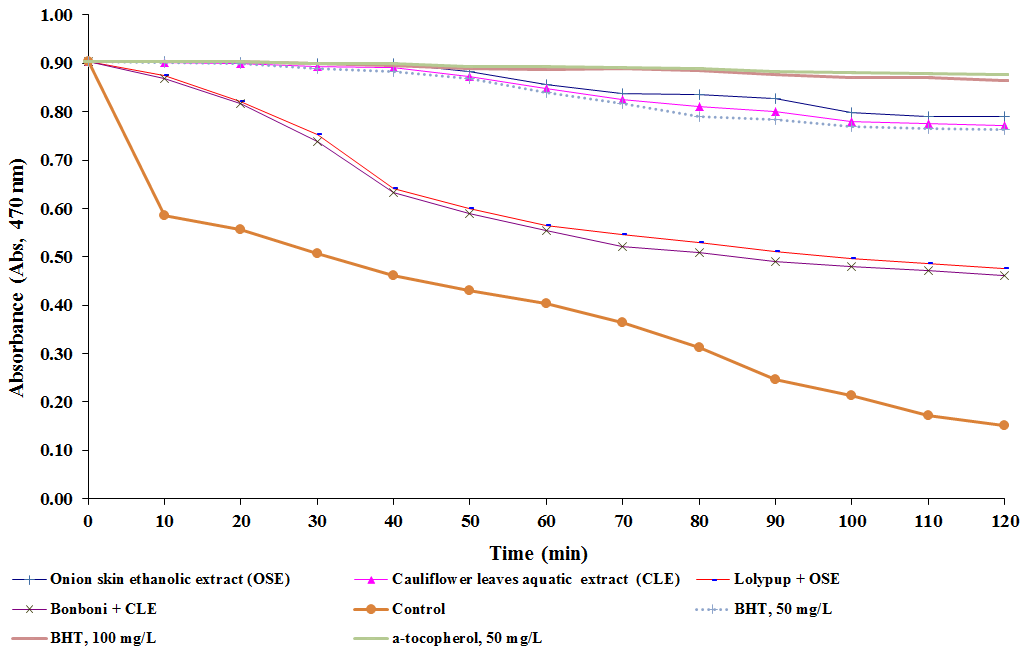
Table 7 and Figure 1 presents the antioxidant activity of various extracts and sweet product formulations evaluated using the β-carotene bleaching (BCB) assay over 120 minutes, with α-tocopherol (50 mg/L) serving as the standard reference. This assay assesses the ability of antioxidants to inhibit lipid peroxidation by tracking the discoloration of β-carotene in a linoleic acid emulsion under oxidative stress, where a slower decline in absorbance reflects stronger antioxidant efficacy. As expected, the control sample lacking antioxidants showed the most rapid β-carotene degradation, dropping from 0.903 to 0.151, affirming the necessity of antioxidant protection 96. Among tested agents, BHT at 100 mg/L and α-tocopherol exhibited the highest protective effects, maintaining absorbance above 0.86, which aligns with their established efficacy as chain-breaking antioxidants that scavenge lipid peroxyl radicals and stabilize free radicals 60, 97. Moderate protection was observed with BHT at 50 mg/L, onion skin ethanolic extract (OSE), and cauliflower leaves aquatic extract (CLE), all stabilizing absorbance around 0.76–0.79, suggesting that phenolic compounds like quercetin in OSE and chlorogenic acid and ascorbic acid in CLE provide appreciable antioxidant activity 56, 59. However, the antioxidant performance of the food formulations—Lolypup + OSE and Bonboni + CLE, was lower, with absorbance declining to ~0.47, indicating only moderate antioxidant potential. This decline is likely due to dilution of active compounds in the food matrix and possible interactions with other ingredients, such as lipids, proteins, and carbohydrates, which may hinder antioxidant functionality 95. Food matrices may also introduce pro-oxidants or transition metal ions that catalyze oxidative reactions, further reducing efficacy 70. The application of the BCB method has been widely validated for assessing antioxidant activity in various plant extracts 83, 90, 91, 98, 99, reinforcing its utility here. The superior results from α-tocopherol and high-dose BHT are attributed to their stable chemical structure and efficient free radical scavenging mechanisms, whereas natural extracts like OSE and CLE, though rich in bioactive compounds, contain complex phytochemical mixtures that may exhibit reduced potency per unit compared to pure synthetic antioxidants 12, 80. Nonetheless, these natural compounds are increasingly valued not only for their antioxidant capacity but also for additional health benefits such as anti-inflammatory, antidiabetic, and anticancer properties 65, 92.The moderate activity observed in food-extract combinations underscores the challenge of translating in vitro antioxidant performance to real food systems, where formulation, storage, and matrix complexity influence bioactivity and stability, highlighting the need for optimized concentrations and formulation strategies to achieve desired protective effects 59.

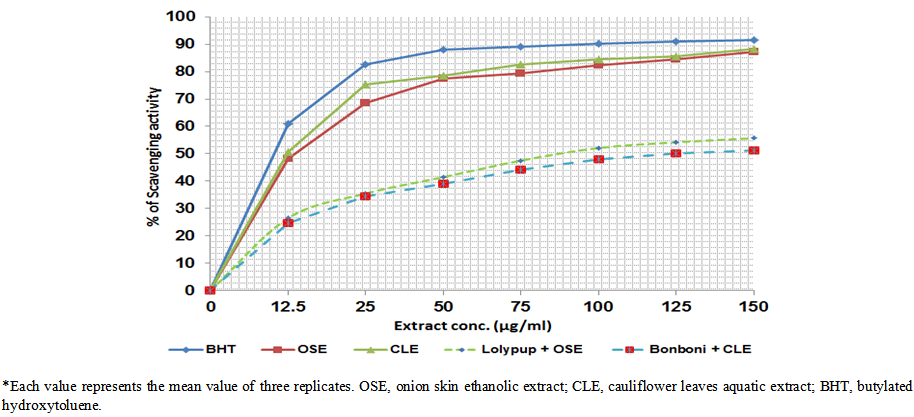
Table 8 and Table 9 and Figure 2 presents the half maximal inhibitory concentration (IC50) values from the DPPH free radical scavenging assay for BHT (a synthetic antioxidant), onion skin ethanolic extract (OSE), cauliflower leaves aqueous extract (CLE), and their respective food product formulations Lolypup + OSE and Bonboni + CLE, where lower IC50 values denote stronger antioxidant activity. BHT recorded the lowest IC50 (11.25 ± 0.17 μg/mL), confirming its potent antioxidant capacity in line with its widespread use in food preservation 95, 97. The natural extracts OSE (15.18 ± 0.81 μg/mL) and CLE (14.14 ± 0.69 μg/mL) also demonstrated substantial antioxidant potential, supported by studies showing that onion skins are rich in quercetin and other flavonoids 56while cauliflower leaves provide phenolics and vitamin C with similar activity (Zhang et al., 2022). However, when incorporated into food matrices, Lolypup + OSE (92.04 ± 0.93 μg/mL) and Bonboni + CLE (142.05 ± 0.78 μg/mL) showed significantly higher IC50 values, reflecting reduced antioxidant efficacy. This reduction is likely due to the dilution of active compounds in the food matrix and interactions with ingredients like fats, proteins, and carbohydrates, which can limit bioavailability or inactivate antioxidant compounds 70, 95. Additionally, food processing and storage may degrade or alter antioxidant molecules, further diminishing their potency 58. These differences highlight the complexity of translating antioxidant effects from isolated extracts to real food systems, where matrix components may hinder the stability or effectiveness of bioactive compounds or even promote oxidation by introducing pro-oxidant factors like metal ions 70. Interestingly, CLE outperformed OSE slightly, which may result from its broader spectrum of water-soluble antioxidants like ascorbic acid and synergistic phenolic acid 59, though Bonboni + CLE still had a higher IC50 than Lolypup + OSE, likely due to variations in food formulation and processing. The use of DPPH assay in this context is consistent with numerous earlier investigations on plant-derived antioxidant extracts containing compounds found in OSE and CLE 54, 85, 87, 89, 100, 101, 102 which confirmed the ability of these compounds to donate electrons or hydrogen atoms, thereby neutralizing free radicals. Phenolic compounds such as quercetin and chlorogenic acid are widely recognized for this function, offering protection against oxidative stress-related conditions including obesity, cancer, diabetes, cardiovascular and neurodegenerative diseases, and organ dysfunctions 58, 63, 88, 89, 103. Therefore, although the antioxidant activity is reduced in the final food products compared to the pure extracts, incorporating OSE and CLE into sweets not only aids preservation but may also confer functional health benefits.

The incorporation of plant extracts into sweet products has attracted increasing interest due to their potential antimicrobial properties, and this study investigates the total plate count (TPC) of Lolypup and Bonboni sweets, both with and without the addition of Onion Skin Ethanolic Extract (OSE) and Cauliflower Leaves Aquatic Extract (CLE), when stored at room temperature for 60 days. As shown in Table 10, there are significant differences in microbial growth between treated and untreated samples, indicating the effectiveness of these natural additives in reducing bacterial proliferation over time. For example, the TPC in Lolypup + OSE increased from 175±11 cfu/g on Day 0 to only 1232±38 cfu/g on Day 60, compared to 2780±45 cfu/g in the untreated control, while Bonboni + CLE showed a rise from 170±15 cfu/g to just 1390±28 cfu/g, compared to 2820±55 cfu/g in the untreated Bonboni, clearly demonstrating the antimicrobial potential of these plant-based additives. These results are consistent with previous findings; Sagar and Pareek, 104 reported that onion skin extract, due to its high content of phenolic compounds, significantly inhibits the growth of foodborne pathogens, while Zhang et al., 59 found that polyphenols in cauliflower leaves, such as chlorogenic and gallic acids, exhibit strong antimicrobial activity and can prolong food shelf life. The reduction in microbial growth in the treated samples can be attributed to bioactive compounds like flavonoids (e.g., quercetin and kaempferol in onion skin) and polyphenols in cauliflower leaves, which interfere with bacterial cell wall synthesis and metabolic pathways. These findings highlight the potential of OSE and CLE as natural preservatives that can safely enhance the microbiological quality and shelf life of sweet products, offering a promising alternative to synthetic chemical preservatives in line with growing consumer demand for clean-label and health-conscious food options.
The incorporation of plant extracts into sweet products has attracted growing interest due to their promising antimicrobial properties, and this study evaluates the Total Yeast and Mold Count (TYMC) in Lolypup and Bonboni sweets, both with and without the addition of Onion Skin Ethanolic Extract (OSE) and Cauliflower Leaves Aquatic Extract (CLE), stored at room temperature for 60 days. The data presented in Table 11 show considerable differences in fungal growth across treated and untreated products, with TYMC in Lolypup + OSE increasing from 30±4 cfu/g at day 0 to 222±10 cfu/g by day 60, compared to a higher 288±15 cfu/g in the untreated control, and TYMC in Bonboni + CLE rising from 25±2 cfu/g to only 214±8 cfu/g, versus 252±12 cfu/g in the untreated Bonboni, indicating that both plant extracts significantly suppressed fungal proliferation over time. These results are consistent with extensive prior studies demonstrating the antimicrobial potential of plant-derived compounds; for example, Sagar and Pareek, 104 reported the strong antifungal activity of onion skin extract, largely due to its high content of phenolics such as quercetin and kaempferol, while Zhang et al., 59 confirmed the antimicrobial effects of cauliflower leaf polyphenols like chlorogenic and gallic acids in food preservation. The reduction in total yeast and mold count (TYMC) in the treated samples can be directly attributed to these bioactive compounds that interfere with fungal cell structure and metabolic pathways, making them effective natural preservatives. The significant differences in microbial load between treated and control samples not only validate the antimicrobial function of OSE and CLE but also support their use in enhancing the microbiological safety and extending the shelf life of sweet products as clean-label alternatives to synthetic preservatives.
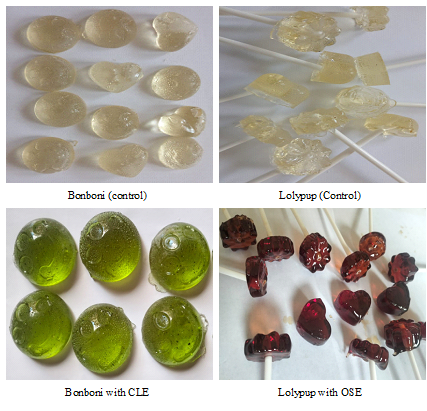
Table 12 presents sensory evaluation scores for two food products, Lolypup and Bonboni, both alone and after enrichment with onion skin ethanolic extract (OSE) and cauliflower leaves aquatic extract (CLE), where attributes such as appearance, color, taste, odor, texture, and overall acceptability were rated by ten trained panelists. The data reveal statistically significant improvements (p ≤ 0.05) in most sensory attributes upon addition of OSE and CLE compared to controls. Specifically, the appearance and color scores were notably enhanced, with Bonboni + CLE achieving the highest ratings (9.12 ± 0.07 for appearance and 8.35 ± 0.13 for color), attributed to natural pigments like flavonoids and carotenoids in the extracts that improve visual appeal 28, 105, 106. Similar enhancements in processed foods have been linked to pigment enrichment and reduced browning 107, 108. Taste and odor scores also increased for Lolypup + OSE (8.37 ± 0.15) and Bonboni + CLE (8.54 ± 0.12), although differences were less pronounced; this aligns with findings that phenolic-rich vegetable extracts can mask off-flavors and add mild aromatic qualities through bioactive compounds such as quercetin and phenolic acids interacting with taste receptors and volatile compounds 70, 109, 110. Texture improvements were significant, particularly for Bonboni + CLE (9.17 ± 0.20), likely due to polysaccharides and fibers enhancing mouthfeel, water retention, and structural integrity, as supported by related research on plant extract fortification 111, 112, 113. Overall acceptability scores were higher in enriched products (Lolypup + OSE at 9.03 ± 0.09 and Bonboni + CLE at 9.13 ± 0.06), consistent with the trend that antioxidant-rich natural extracts improve sensory quality and consumer preference 95, 97. These positive sensory effects are attributed to the synergistic action of phenolics, pigments, and antioxidants that enhance appearance and flavor while contributing to product stability and shelf-life by mitigating oxidation and reducing rancidity and off-flavors 97, 110. The significant sensory improvements highlight the potential for vegetable by-products as natural food additives in response to growing consumer demand for clean-label, functional foods 114, with added health benefits linked to the antioxidant properties of these extracts reducing risks of chronic diseases 63.
This study demonstrated the effective extraction and application of bioactive compounds from agro-industrial food wastes, namely onion skins and cauliflower leaves, to enhance the nutritional and functional qualities of sugar confectionery products, Bonboni and Lolypup. The onion skin ethanolic extract (OSE) was notably rich in phenolics, flavonoids, and terpenoids, whereas the cauliflower leaves aquatic extract (CLA) contained higher levels of carotenoids, polysaccharides, triterpenoids, and lutein. These distinct phytochemical compositions contributed to improved antioxidant activities and antimicrobial effects in the fortified candies, as shown by enhanced free radical scavenging, inhibition of lipid peroxidation, and a significant reduction in microbial growth during 60 days of storage. Although the antioxidant capacities of the enriched sweets were elevated compared to the unfortified controls, they remained lower than synthetic antioxidants such as BHT and α-tocopherol. Sensory evaluations also revealed that the inclusion of these natural extracts positively influenced the products’ appearance, color, taste, texture, and overall acceptability, suggesting a favorable consumer response alongside health benefits. Collectively, these findings highlight the potential of utilizing agro-industrial food wastes as sustainable, value-added sources of functional ingredients, supporting circular economy objectives and offering natural alternatives to synthetic additives. This strategy not only improves the quality and health attributes of food products but also promotes waste reduction and environmental sustainability.

The authors sincerely thank and appreciate all the farmers from the villages of Shebin Al-Kom Center, Menoufia Governorate, for their efforts and assistance during the collection of cauliflower leaf samples. Additionally, the authors express their sincere gratitude to the staff of New Bani Suef Company for the Preservation, Dehydration, and Industrialization of Vegetables, located in Bani Suef El-Goudida City, east of the Nile, Bani Suef, Egypt, for their contribution of onion skin samples.
Authors declared no competing of interest whatsoever
The ethical issues of the current work was reviewed and approved by the Scientific Research Ethics Committee, Faculty of Home Economics, Menoufia University, Shebin El-Kom, Egypt (Approval # 12- SREC- 01-2023).
Yousif Elhassaneen contributed to the preparation and development of the study protocol, oversaw the practical experimental phase, retrieved conceptual information, reviewed and validated the results and statistical analyses, and assisted in preparing and reviewing the manuscript. Olfat Abd El-Moez conducted the practical experiments, collected, tabulated, and interpreted the results, retrieved the necessary information and concepts, and prepared the manuscript draft. Mai Garib and Tarek Abd El-Rahman assisted in preparing the study protocol, supervised the practical experiments, retrieved conceptual information, validated the study results, and contributed to drafting the manuscript.
AA, antioxidant activity; AAC, antioxidant activity coefficient; Abs, absorbance; ADHD, attention-deficit hyperactivity disorder; AOX, antioxidant value; BCB, β -Carotene Bleaching; BD, BHT, butylated hydroxyltoluene; CA, catechine; CLA, cauliflower leaves aquatic extract; DPPH, 2,2-diphenyl-1-picrylhydrazyl; FAO, Food Agriculture Organization; FDA, Food Drug Administration; GA, gallic acid; IC₅₀, half maximal inhibitory concentration; ORR, oxidation rate ratio; OSE, onion skin ethanolic extract; ROS, reactive oxygen species; SDGs, Sustainable Development Goals; TPC, total plate count; TYMC, total yeast and mold count.
| [1] | Nwadi, O. M. M., & Okonkwo, T. M. (2021). Definition and Components of Food Quality: A Review. 7th NIFST Regional Food Science and Technology Summit, Enugu, Nigeria. | ||
| In article | |||
| [2] | Motarjemi, Y., & Lelieveld, H. L. M. (2014). Food Safety Management: A Practical Guide for the Food Industry. Academic Press, USA. | ||
| In article | |||
| [3] | FAO. (2004). Food Safety and Quality in Europe: Aspects Concerning in Particular Quality, Nutritional Balance, the Importance of Agricultural Land and Cultural Heritage (“Terroirs”). Twenty-fourth FAO Regional Conference for Europe, Montpellier, France, 5–7 May 2004. | ||
| In article | |||
| [4] | FAO & WHO. (2010). Codex Alimentarius: Food Safety and Quality. World Health Organization and Food and Agriculture Organization of the United Nations. | ||
| In article | |||
| [5] | FAO. (2018). Sustainable Food Systems: Concept and Framework. Food and Agriculture Organization of the United Nations, Rome. | ||
| In article | |||
| [6] | Bilska, B., Wronka, M., Kołożyn-Krajewska, D., & Roszkowska, A. (2014). Quality Assurance in Food Production: A Review. Polish Journal of Food and Nutrition Sciences, 64(3), 157–165. | ||
| In article | |||
| [7] | Jin, S., Zhou, J., & Ye, J. (2008). Adoption of HACCP System in the Chinese Food Industry: A Comparative Analysis. Food Control, 19(9), 823–828. | ||
| In article | View Article | ||
| [8] | Polônio, M.L.T., & Peres, F. (2009). Consumo de aditivos alimentares e efeitos à saúde: desafios para a saúde pública brasileira. Cadernos de Saúde Pública, 25(8), 1653–1666. | ||
| In article | View Article PubMed | ||
| [9] | Schab, D.W., & Trinh, N.H.T. (2004). Do artificial food colors promote hyperactivity in children with hyperactive syndromes? A meta-analysis of double-blind placebo-controlled trials. Journal of Developmental & Behavioral Pediatrics, 25(6), 423–434. | ||
| In article | View Article PubMed | ||
| [10] | Kanarek, R.B. (2011). Artificial food dyes and attention deficit hyperactivity disorder. Nutrition Reviews, 69(7), 385–391. | ||
| In article | View Article PubMed | ||
| [11] | Miller, M., Marunganathan, M., & Guru, S. (2022). Biochemical processes mediating neurotoxicity induced by synthetic food dyes: A review of current evidence. Science of the Total Environment, 835, 155505. | ||
| In article | |||
| [12] | Marunganathan, M., & Guru, S. (2024). Biochemical processes mediating neurotoxicity induced by synthetic food dyes: A review of current evidence. Science of the Total Environment, 835, 155505. | ||
| In article | |||
| [13] | Erythrosine. (2025). In Wikipedia. .https:// en.wikipedia.org/ wiki/Erythrosine Brominated vegetable oil. (2024). In Wikipedia. https://en.wikipedia.org/wiki/ Brominated_vegetable_oil. | ||
| In article | |||
| [14] | Smith, L. M., Anderson, R. T., Chen, Y., & Gonzales, D. (2023). Global trends and innovation in sugar confectionery. Journal of Food Industry Research, 45(3), 221–235. | ||
| In article | |||
| [15] | Malik, V. S., Schulze, M. B., & Hu, F. B. (2016). Intake of sugar-sweetened beverages and weight gain: a systematic review. The American Journal of Clinical Nutrition, 103(2), 315–323. | ||
| In article | |||
| [16] | Moynihan, P. J., & Kelly, S. A. (2014). Effect on caries of restricting sugars intake: systematic review to inform WHO guidelines. Journal of Dental Research, 93(1), 8–18. | ||
| In article | View Article PubMed | ||
| [17] | World Health Organization (WHO). (2015). Guideline: Sugars intake for adults and children. Geneva: WHO Press. Schab, D.W., & Trinh, N.H.T. (2004). Do artificial food colors promote hyperactivity in children with hyperactive syndromes? A meta-analysis of double-blind placebo-controlled trials. Journal of Developmental & Behavioral Pediatrics, 25(6), 423–434. | ||
| In article | View Article PubMed | ||
| [18] | McCann, D., Barrett, A., Cooper, A., Crumpler, D., Dalen, L., Grimshaw, K., Kitchin, E., Lok, K., Porteous, L., Prince, E., Sonuga-Barke, E., Warner, J. O., & Stevenson, J. (2007). Food additives and hyperactive behaviour in 3-year-old and 8/9-year-old children in the community: A randomised, double-blinded, placebo-controlled trial. The Lancet, 370(9598), 1560–1567. | ||
| In article | View Article PubMed | ||
| [19] | Rowe, K. S., & Rowe, K. J. (1994). Synthetic food coloring and behavior: A dose-response effect in a double-blind, placebo-controlled, repeated-measures study. Journal of Pediatrics, 125(5), 691–698. | ||
| In article | View Article PubMed | ||
| [20] | European Food Safety Authority (EFSA). (2010). Scientific opinion on the re-evaluation of food colours E102, E104, E110, E122, E124, and E129. EFSA Journal, 8(6), 153–242. | ||
| In article | |||
| [21] | U.S. Food and Drug Administration (FDA). (2024). Proposed action on synthetic food dyes and public health. FDA Reports, 32(1), 5–12. | ||
| In article | |||
| [22] | Galanakis, C. M. (2012). Recovery of high added-value components from food wastes: Conventional, emerging technologies and commercialized applications. Trends in Food Science & Technology, 26(2), 68–87. | ||
| In article | View Article | ||
| [23] | Gustavsson, J., Cederberg, C., Sonesson, U., Van Otterdijk, R., & Meybeck, A. (2011). Global Food Losses and Food Waste: Extent, Causes and Prevention. Rome: FAO. pp. 1–37. | ||
| In article | |||
| [24] | Mirabella, N., Castellani, V., & Sala, S. (2014). Current options for the valorization of food manufacturing waste: A review. Journal of Cleaner Production, 65, 28–41. | ||
| In article | View Article | ||
| [25] | Kumar, Y., Yadav, D. N., Ahmad, T., & Narsaiah, K. (2020). Recent trends in the use of natural antioxidants for meat and meat products. Comprehensive Reviews in Food Science and Food Safety, 19(4), 2025–2047. | ||
| In article | |||
| [26] | Reis, S. F., Vicente, A. A., & Teixeira, J. A. (2020). Extraction and purification of natural pigments from fruit and vegetable industrial by-products. Food Chemistry, 313, 126145. | ||
| In article | |||
| [27] | Benavides, A., Cortés, A., Fernández-López, J., Viuda-Martos, M., Pérez-Álvarez, J. A., & Arraez-Roman, D. (2018). Valorization of fruit by-products: Novel trends and potential health benefits. Journal of Food Quality, 2018, Article ID 4837645, pp. 1–12. | ||
| In article | |||
| [28] | Elhassaneen, Y. A., Afifi1, T.A. Elhefny, M.A. & Bayomi, A.I. 2024-a. Effect of Silybum marianum Seeds Extract Intervention on Biochemical Parameters, Histological Changes, and Apoptosis and Cell Cycle of Liver Tissue in Benzo[a]pyrene Injected Rats. American Journal of Food and Nutrition, 12 (1), 1-15. | ||
| In article | View Article | ||
| [29] | Association of Official Analytical Chemists (AOAC). (1995). Official methods of the Association of Official Analytical Chemists. (16th ed.). Arlington, Virginia: AOAC. | ||
| In article | |||
| [30] | Singleton, V. L., & Rossi, J. A., Jr. (1965). Colorimetry of total phenolics with phosphomolybdic-phosphotungstic acid reagents. American Journal of Enology and Viticulture, 16, 144-158. | ||
| In article | View Article | ||
| [31] | Wolfe K, Wu X, Liu RH (2003). Antioxidant activity of apple peels. J Agric Food Chem. 51:609–614. | ||
| In article | View Article PubMed | ||
| [32] | Litchenthaler, H.K. 1987. Chlorophylls and carotenoids: pigments of photosynthetic biomembranes. Methods in Enzymology, 148: 350-383. | ||
| In article | View Article | ||
| [33] | Zhishen, J., Mengcheng, T. and Jianming, W. 1999. The determination of flavonoid contents in mulberry and their scavenging effects on superoxide radicals. Food Chem., 64: 555–559. | ||
| In article | View Article | ||
| [34] | Vazirian, M., Dianat, S., Manayi, A., Ziari, R., Mousazadeh, A., Emran, H., Saeidnia, S., & Amanzadeh, Y. (2014). Anti-inflammatory effect, total polysaccharide, total phenolics content and antioxidant activity of the aqueous extract of three basidiomycetes. Research Journal of Pharmacognosy, 1, 13-19. | ||
| In article | |||
| [35] | Ghorai, N., Chakraborty, S., Guchhait, S., Saha, S., & Biswas, S. (2012). Estimation of total terpenoids concentration in plant tissues using a monoterpene, Linalool as standard reagent: Protocol Exchange. Protocol Exchange, 1-6. | ||
| In article | View Article | ||
| [36] | Schneider, P., Hosseiny, S.S., Szczotka, M.; Jordan, V. & Schlitter, K. 2009. Rapid solubility determination of the triterpenes oleanolic acid and ursolic acid by UV-spectroscopy in different solvents. 2(2): 85-87 | ||
| In article | View Article | ||
| [37] | Sharif, A., Saim, N., Jasmani, H., & Ahmad, W. Y. W. (2010). Effects of solvent and temperature on the extraction of colorant from onion (Allium cepa) skin using pressurized liquid extraction. Asian Journal of Applied Sciences, 3, 262-268. | ||
| In article | View Article | ||
| [38] | Van-Burden T.P. and Robinson W.C. 1981. Fonnation of complexes between protein and tannic acid. Journal of Agricultural andFood Chemistry 1: 77. | ||
| In article | |||
| [39] | Zhao, J., & Wang, M. Y. (2010). Colorimetric determination of total alkaloids in plant extracts. Journal of Analytical Methods in Chemistry, 2010, Article ID 482476, 6 pages. | ||
| In article | |||
| [40] | Marco, G. (1968). A rapid method for evaluation of antioxidants. Journal of the American Oil Chemists' Society, 45, 594-598. | ||
| In article | View Article | ||
| [41] | Al-Saikhan, M. S., Howard, L. R., & Miller, J. C., Jr. (1995). Antioxidant activity and total phenolics in different genotypes of potato (Solanum tuberosum L.). Journal of Food Science, 60(2), 341-343. | ||
| In article | View Article | ||
| [42] | Marinova, E., Yanishlieva, N., & Kostova, I. (1994). Antioxidative action of the ethanolic extract and some hydroxycoumarins of Fraxinus ornus bark. Food Chemistry, 51, 125-132. | ||
| In article | View Article | ||
| [43] | Mallet, J. F., Cerrati, C., Ucciani, E., Gamisana, J., & Gruber, M. (1994). Antioxidant activity of plant leaves in relation to their α-tocopherol content. Food Chemistry, 49, 61-65. | ||
| In article | View Article | ||
| [44] | Desmarchelier, C., Bermudez, M. J. N., Coussio, J., Ciccia, G., & Boveris, A. (1997). Antioxidant and prooxidant activities in aqueous extract of Argentine plants. International Journal of Pharmacognosy, 35, 116-120. | ||
| In article | View Article | ||
| [45] | American Public Health Association (APHA). (1978). "Methods for the examination of water and waste water, " 5th ed., Washington,182-256. | ||
| In article | |||
| [46] | Difco Manual of Dehydrate Culture Media and reagents procedures (1966). Nith. Ed. Difco Laboratories, Detroitt, Michigan, USA. | ||
| In article | |||
| [47] | Oxoid Manual of Culture Media (1962). Pub. By the Oxoid Division, Oxo. Hd, South Work Bridage, Rd. London, S.E. | ||
| In article | |||
| [48] | Buvaneswari, K. M., Usharani, K. S., & Rajeswari, R. (2014). Estimation of Macro-Nutrients in Domestically Processed Cauliflower Leaf Powder. International Journal of Science and Research (IJSR), 3(3), 2094–2096. | ||
| In article | |||
| [49] | Florina S., , & (2023). A comprehensive review on bioactive compounds, health benefits, and potential food applications of onion (Allium cepa L.) skin waste. 141(3):104173. | ||
| In article | View Article | ||
| [50] | Wani, T. A., Sogi, D. S., & Singh, P. (2011). Characterization and functional properties of watermelon seed protein isolates and their application in the development of protein-rich wheat flour tortillas. LWT - Food Science and Technology, 44(7), 1534–1540. | ||
| In article | |||
| [51] | Tukassar, A., Shukat, R., Iahtisham-Ul-Haq, Butt, M.S., Nayik, G.A., Ramniwas, S., Al Obaid, S, Ali Alharbi, S., Ansari, M.J., Konstantinos, I. & Sarwar, N. (2023). Compositional profiling and sensory analysis of cauliflower by-products-enriched muffins. Food Sci Nutr. 2023 Jul 20; 11(10): 6020-6031. | ||
| In article | View Article PubMed | ||
| [52] | Michalak-Majewska, M., Krystyjan, M., Gumul, D., Gil, M., & Mika, M. (2020). Influence of onion skin powder on nutritional and quality attributes of wheat pasta. PLOS ONE, 15(1), e0227942. | ||
| In article | View Article PubMed | ||
| [53] | Chadorshabi, S. N., Aliakbarlu, J., & Khaneghah, A. M. (2022). Bioactive compounds from vegetable by-products and their use as natural preservatives in food systems: A review. Antioxidants, 11(5), 1011. | ||
| In article | |||
| [54] | Aly, A., Elbassyouny, G., & Elhassaneen, Y. (2017). Studies on the antioxidant properties of vegetables processing by-products extract and their roles in the alleviation of health complications caused by diabetes in rats. Proceeding of the 1st International Conference of the Faculty of Specific Education, Kafrelsheikh University, "Specific Sciences, their Developmental Role and Challenges of Labor Market”, 1-24, 24-27 October, 2017, Sharm El-Sheikh, Egypt. | ||
| In article | |||
| [55] | Hallabo, S. A., Helmy, S. A., Elhassaneen, Y., & Shaaban, M. (2018). Utilization of mango, onion and potato peels as sources of bioactive compounds in biscuits processing. Bioscience Research, 15(4), 3647–3657. | ||
| In article | |||
| [56] | Stoica, F., Aprodu, I., Enachi, E., Stănciuc, N., & Condurache, M. (2021). Extraction and characterization of bioactive compounds from onion skins. Food Chemistry, 338, 128104. | ||
| In article | |||
| [57] | Kumar, S., & Pandey, A. K. (2013). Chemistry and biological activities of flavonoids: an overview. The Scientific World Journal, 2013, 162750. | ||
| In article | View Article PubMed | ||
| [58] | Pandey, K. B., & Rizvi, S. I. (2009). Plant polyphenols as dietary antioxidants in human health and disease. Oxidative Medicine and Cellular Longevity, 2(5), 270–278. | ||
| In article | View Article PubMed | ||
| [59] | Zhang, L., Song, Z., & Lin, Y. (2022). Extraction and bioactivities of polysaccharides from cauliflower leaves. Carbohydrate Polymers, 287, 119324. | ||
| In article | |||
| [60] | Krinsky, N. I., Landrum, J. T., & Bone, R. A. (2003). Biological mechanisms of the protective role of lutein and zeaxanthin in the eye. Annual Review of Nutrition, 23, 171–201. | ||
| In article | View Article PubMed | ||
| [61] | Delgado-Vargas, F., Jiménez, A. R., & Paredes-López, O. (2000). Natural pigments: Carotenoids, anthocyanins, and betalains, Characteristics, biosynthesis, processing, and stability. Critical Reviews in Food Science and Nutrition, 40(3), 173–289. | ||
| In article | View Article PubMed | ||
| [62] | Amoako, D., Awika, J.M., Oseguera, T.L., & Rooney, L.W. (2015). Flavonoid content and antioxidant activity of onion skin extracts. Food Chemistry, 176, 468–475. | ||
| In article | |||
| [63] | Calderón-Montaño, J. M., Burgos-Morón, E., Pérez-Guerrero, C., & López-Lázaro, M. (2011). A review on the dietary flavonoid kaempferol. Mini Reviews in Medicinal Chemistry, 11(4), 298–344. | ||
| In article | View Article PubMed | ||
| [64] | Saptarini, N.M. & Wardati. Y. (2020). Effect of Extraction Methods on Antioxidant Activity of Papery Skin Extracts and Fractions of Maja Cipanas Onion (Allium cepa L. var. ascalonicum). Scientific World Journal. 2020: 3280534. | ||
| In article | View Article PubMed | ||
| [65] | He, J., & Giusti, M. M. (2010). Anthocyanins: natural colorants with health-promoting properties. Annual Review of Food Science and Technology, 1, 163–187. | ||
| In article | View Article PubMed | ||
| [66] | Croteau, R., Kutchan, T. M., & Lewis, N. G. (2000). Natural products (secondary metabolites). In Biochemistry & Molecular Biology of Plants (pp. 1250–1318). American Society of Plant Physiologists. | ||
| In article | |||
| [67] | Shanmugam, M. K., Dai, X., Kumar, A. P., Tan, B. K., Sethi, G., & Bishayee, A. (2013). Ursolic acid in cancer prevention and treatment: Molecular targets, pharmacokinetics, and clinical studies. Biochemical Pharmacology, 85(11), 1579–1587. | ||
| In article | View Article PubMed | ||
| [68] | Haslam, E. (1996). Natural polyphenols (vegetable tannins) as drugs: possible modes of action. Journal of Natural Products, 59(2), 205–215. | ||
| In article | View Article PubMed | ||
| [69] | Wink, M. (2015). Alkaloids: Biochemistry, Ecology, and Medicinal Applications. In Annual Plant Reviews, Volume 49 (pp. 1–45). Wiley-Blackwell. | ||
| In article | |||
| [70] | Manach, C., Scalbert, A., Morand, C., Rémésy, C., & Jiménez, L. (2004). Polyphenols: Food sources and bioavailability. The American Journal of Clinical Nutrition, 79(5), 727-747. | ||
| In article | View Article PubMed | ||
| [71] | Delcourt, C., Carrière, I., Delcourt, J., Coron, F., Cougnard-Gregoire, A., & Barberger-Gateau, P. (2006). The association of carotenoids with age-related macular degeneration. Surveys in Ophthalmology, 51(6), 541-555. | ||
| In article | |||
| [72] | Middleton Delgado-Vargas, F., Jiménez, A. R., & Paredes-López, O. (2000). Natural pigments: Carotenoids, anthocyanins, and betalains, characteristics, biosynthesis, processing, and stability. Critical Reviews in Food Science and Nutrition, 40(3), 173–289. | ||
| In article | View Article PubMed | ||
| [73] | Wasser, S.P. (2002). Medicinal mushrooms as a source of antitumor and immunomodulating polysaccharides. Applied Microbiology and Biotechnology, 60(3), 258-274. | ||
| In article | View Article PubMed | ||
| [74] | Zhang, L., Zhang, F., Zhang, D., & Yang, L. (2014). Polysaccharides from natural resources exhibit biological activities: An overview. International Journal of Biological Macromolecules, 69, 236-242. | ||
| In article | |||
| [75] | Prior, R.L., & Wu, X. (2006). Anthocyanins: Structural characteristics that result in unique metabolic patterns and biological activities. Free Radical Research, 40(10), 1014-1028. | ||
| In article | View Article PubMed | ||
| [76] | Saxena, A., Bhatia, A., & Yadav, R. (2012). Terpenoids as potential therapeutic agents for the management of cancer. Journal of Pharmacy and Bioallied Sciences, 4(3), 241-249. | ||
| In article | |||
| [77] | Wagner, H., & Ulrich-Merzenich, G. (2009). Synergy research: Approaching a new generation of phytopharmaceuticals. Phytomedicine, 16(2-3), 97-110. | ||
| In article | View Article PubMed | ||
| [78] | Scalbert, A. (1991). Antimicrobial properties of tannins. Phytochemistry, 30(12), 3875-3883. | ||
| In article | View Article | ||
| [79] | Chung, K.T., Wong, T.Y., Wei, C.I., Huang, Y.W., & Lin, Y. (1998). Tannins and human health: A review. Critical Reviews in Food Science and Nutrition, 38(6), 421-464. | ||
| In article | View Article PubMed | ||
| [80] | Ma, L., & Lin, X.M. (2010). Effects of lutein and zeaxanthin on aspects of eye health. Journal of the Science of Food and Agriculture, 90(1), 2-12. | ||
| In article | View Article PubMed | ||
| [81] | Elhassaneen, Y. Sherif Ragab and Raghda Mashal 2016-b. Improvement of Bioactive Compounds Content and Antioxidant Properties in Crackers with the Incorporation of Prickly Pear and Potato Peels Powder". International Journal of Nutrition and Food Sciences, 5 (1): 53-61. | ||
| In article | View Article | ||
| [82] | Mashal, R. M. (2016). Technological and chemical studies on the fortification of bakery products with phytochemicals. Ph.D. Thesis in Nutrition and Food Science, Faculty of Home Economics, Minoufiya University, Egypt. | ||
| In article | |||
| [83] | Sayed Ahmed, S. (2016). Nutritional and technological studies on the effect of phytochemicals on obesity injuries and their related diseases using experimental animals. Ph.D. Thesis in Home Economics (Nutrition and Food Science), Faculty of Specific Education, Port Said University, Egypt. | ||
| In article | |||
| [84] | El-Nassag, D., Ghamry, H., & Elhassaneen, Y. (2019). Stevia (Stevia rebaudiana) leaves: Chemical composition, bioactive compounds, antioxidant activities, antihyperglycemic and antiatherogenic effects. Journal of Studies and Searches of Specific Education, 5(1), 157-180. http:// www.jse.zu.edu.eg/ index.php/jse/article/view/97/96. | ||
| In article | |||
| [85] | Abd Elalal, N., El Seedy, G., 4& Elhassaneen, Y. (2021). Chemical composition, nutritional value, bioactive compounds content and biological activities of the brown alga (Sargassum subrepandum) collected from the Mediterranean Sea, Egypt. Alexandria Science Exchange Journal, 42(4), 893-906. | ||
| In article | View Article | ||
| [86] | Elhassaneen, Y., , S., , S. and , M. 2019. Effect of Some Plant Parts Powder on Obesity Complications of Obese Rats. Journal of Home Economics, ): 83-106. | ||
| In article | |||
| [87] | Elhassaneen, Y., Sayed Ahmed, S. A., & Fayez, S. A. (2021). Bioactive compounds and antioxidant activities of brown algae collected from the shores of the Egyptian seas. Port Saied Specific Research Journal (PSSRJ), 14(2), 645-665. | ||
| In article | |||
| [88] | Gharib, M. A. Abd Elalal, N.S. and. Elhassaneen, Y.A. 2022. A Study of the Correlation Between Dyslipidemia and Iron Deficiency Anemia in Egyptian Adult Subjects. Alexandria Science Exchange Journal, 43, (1): 44-63. | ||
| In article | View Article | ||
| [89] | Elhassaneen, Y. A., ElBassouny, G. M., Hassan, R. H., & Meharam, E. B. (2023). Application of natural extracts in beef meatballs to prevent chemical and bacteriological spoilage agents, and extend its storage life. American Journal of Food Science and Technology, 11(4), 118-130. | ||
| In article | View Article | ||
| [90] | Elhassaneen, Y. A., & Abd Elhady, Y. A. (2014). Onion peel powder alleviates acrylamide-induced cytotoxicity and immunotoxicity in liver cell culture. Life Science Journal, 11(7), 381–388. . | ||
| In article | |||
| [91] | Elhassaneen, Y., Goarge, S., Sayed, R., & Younis, M. (2016). Onion, orange and prickly pear peel extracts mixed with beef meatballs ameliorate the effect of alloxan-induced diabetic rats. American Journal of Pharmacology and Phytotherapy, 1(1), 15–24. | ||
| In article | |||
| [92] | Elhassaneen, Y. A., Khader, S. A., Gharib, M. A. , Abd-ElAziz, Y.. E. 2024-b. Possible Protective Roles of Poinciana (Delonix regia) Seeds Against Carbon Tetrachloride-induced Biochemical and Histological Disorders in Rat Liver. American Journal of Medical Sciences and Medicine, 12(1): 1-15. | ||
| In article | View Article | ||
| [93] | Ismail, N. S., Elhassaneen, Y. A., & Abd El-Aziz, A. A. (2024). Study the potential effect of dietary intervention with strawberry and cauliflower leaves on oxidative stress, inflammation, insulin resistance and histological alterations in diet-induced obese rats. Alexandria Science Exchange Journal, 45(3), 513–533. | ||
| In article | View Article | ||
| [94] | Elhassaneen, Y. A., Garib, M. A., Bayomi, A. I., & Salama, E. E. (2025). Benzo[a]pyrene induced toxicity and molecular damage in liver of rats: Possible protective effects of onion (Allium cepa) skin extract. American Journal of Food and Nutrition, 13(1), 32–47. | ||
| In article | View Article | ||
| [95] | Shahidi, F., & Ambigaipalan, P. (2015). Phenolics and polyphenolics in foods, beverages and spices:Antioxidant activity and health effects – A review. Journal of Functional Foods, 18, 820–897. | ||
| In article | View Article | ||
| [96] | Jayaprakasha, G. K., Singh, R. P., & Sakariah, K. K. (2001). Antioxidant activity of grape seed (Vitis vinifera) extracts on peroxidation models in vitro. Food Chemistry, 73(3), 285–290. | ||
| In article | View Article | ||
| [97] | Kulisic, T., Radonic, A., Katalinic, V., & Milos, M. (2004). Use of different methods for testing antioxidative activity of oregano essential oil. Food Chemistry, 85(4), 633–640. | ||
| In article | View Article | ||
| [98] | Elhassaneen, Y. and Sanad, M. I. 2009. Phenolics, Selenium, Vitamin C, Amino Acids and Pungency Levels and Antioxidant Activities of Two Egyptian Onion Varieties". American J. of Food Technology. 4(6): 241-254. [ISSN 1557- 4571] [http://direct.bl.uk/bld/SearchResults.do | ||
| In article | View Article | ||
| [99] | Aly, A and Sadeek, R. 2018. Nutritional Properties, Bioactive compounds content and rheological Analysis of Quinoa (Chenopodium quinoa) seeds flour: Application in Cake . Proceeding of the 2nd Scientific International Conference of the Faculty of Specific Education, Minia University, 14-15 April, Minia, Egypt | ||
| In article | |||
| [100] | El-Gamal, N. T. (2020). Studies on the antioxidant activities of brown algae and their effects on obesity and osteoporosis in rats. Ph.D. Thesis in Nutrition and Food Science, Faculty of Home Economics, Minoufiya University, Shebin El-Kom, Egypt. | ||
| In article | |||
| [101] | Fayez, S. A. (2022). Effect of brown algae on obesity and its complications induced by high-fat diets in rats. Ph.D. Thesis in Nutrition and Food Science, Faculty of Specific Education, Port Said University, Port Said, Egypt. | ||
| In article | |||
| [102] | Gouda, D. O., Elhassaneen, Y. A. and Saad, H. H. (2024). Date (Phoenix dactylifera var. Khalas) Seed Extracts Rich in Bioactive Compounds and Antioxidant Activities: Potential Preventive Effects Against Atherosclerosis and Lipid Oxidation in Model Systems. Alexandria Science Exchange Journal, 45 (3): 535-550. | ||
| In article | View Article | ||
| [103] | Mahran, M. Z., & Elhassaneen, Y. A. (2023). Attenuation of benzo[a]pyrene-induced oxidative stress and cell apoptosis in albino rats by wild milk thistle (Silybum marianum L.) seeds extract. Egyptian Journal of Chemistry, 66(SI: 13), 1671-1687. | ||
| In article | View Article | ||
| [104] | Sagar, N. A., & Pareek, S. (2020). Antimicrobial assessment of polyphenolic extracts from onion (Allium cepa L.) skin of fifteen cultivars by sonication-assisted extraction method. Heliyon, 6(11), e05478. | ||
| In article | View Article PubMed | ||
| [105] | Hwang, E. S., Kim, J. A., & Lee, M. H. (2019). Influence of natural pigments on color and antioxidant activity of food products. Food Science and Biotechnology, 28(1), 1-12. | ||
| In article | View Article PubMed | ||
| [106] | Tsai, Y. C., Huang, C. C., & Lee, C. Y. (2016). Effects of natural pigments from vegetables on food color and antioxidant activity. Food Chemistry, 196, 1136-1144. | ||
| In article | |||
| [107] | Kähkönen, M. P., Hopia, A. I., Heinonen, M., & Österberg, M. (2001). Antioxidant activity of plant extracts containing phenolic compounds. Journal of Agricultural and Food Chemistry, 49(3), 407-414. | ||
| In article | |||
| [108] | Sun-Waterhouse, D. (2011). The development of fruit-based functional foods targeting the health and wellness market: A review. International Journal of Food Science & Technology, 46(2), 197-217. | ||
| In article | View Article | ||
| [109] | Das, S., Mishra, A., & Mohanty, S. (2019). Impact of phenolic compounds on sensory properties of foods. Food Quality and Safety, 3(2), 115–126. | ||
| In article | |||
| [110] | Dewanto, V., Wu, X., Adom, K. K., & Liu, R. H. (2002). Thermal processing enhances the nutritional value of tomatoes by increasing total antioxidant activity. Journal of Agricultural and Food Chemistry, 50(10), 3010-3014. | ||
| In article | View Article PubMed | ||
| [111] | Sila, D. N., Figueroa-Espinoza, M. C., & Davidov-Pardo, G. (2009). Role of polysaccharides in food texture and functionality. Food Hydrocolloids, 23(8), 2075-2081. | ||
| In article | |||
| [112] | Jayathilakan, K., Sultana, K., Radhakrishna, K., & Bawa, A. S. (2012). Utilization of byproducts and waste materials from meat, poultry and fish processing industries: A review. Journal of Food Science and Technology, 49(3), 278-293. | ||
| In article | View Article PubMed | ||
| [113] | Martínez, L., Colmenero, F. J., & Carballo, J. (2016). Influence of plant extracts on texture and oxidative stability of meat products. Meat Science, 115, 68-74. | ||
| In article | |||
| [114] | Aschemann-Witzel, J., Ares, G., & Bianchi, F. (2019). Clean-label foods: Trends, consumer preferences and challenges. Trends in Food Science & Technology, 93, 50-58. | ||
| In article | |||
Published with license by Science and Education Publishing, Copyright © 2025 Yousif A. Elhassaneen, Mai A. Garib, Tarek M. Abd El-Rahman and Olfat S. Abd El-Moez
 This work is licensed under a Creative Commons Attribution 4.0 International License. To view a copy of this license, visit
http://creativecommons.org/licenses/by/4.0/
This work is licensed under a Creative Commons Attribution 4.0 International License. To view a copy of this license, visit
http://creativecommons.org/licenses/by/4.0/
| [1] | Nwadi, O. M. M., & Okonkwo, T. M. (2021). Definition and Components of Food Quality: A Review. 7th NIFST Regional Food Science and Technology Summit, Enugu, Nigeria. | ||
| In article | |||
| [2] | Motarjemi, Y., & Lelieveld, H. L. M. (2014). Food Safety Management: A Practical Guide for the Food Industry. Academic Press, USA. | ||
| In article | |||
| [3] | FAO. (2004). Food Safety and Quality in Europe: Aspects Concerning in Particular Quality, Nutritional Balance, the Importance of Agricultural Land and Cultural Heritage (“Terroirs”). Twenty-fourth FAO Regional Conference for Europe, Montpellier, France, 5–7 May 2004. | ||
| In article | |||
| [4] | FAO & WHO. (2010). Codex Alimentarius: Food Safety and Quality. World Health Organization and Food and Agriculture Organization of the United Nations. | ||
| In article | |||
| [5] | FAO. (2018). Sustainable Food Systems: Concept and Framework. Food and Agriculture Organization of the United Nations, Rome. | ||
| In article | |||
| [6] | Bilska, B., Wronka, M., Kołożyn-Krajewska, D., & Roszkowska, A. (2014). Quality Assurance in Food Production: A Review. Polish Journal of Food and Nutrition Sciences, 64(3), 157–165. | ||
| In article | |||
| [7] | Jin, S., Zhou, J., & Ye, J. (2008). Adoption of HACCP System in the Chinese Food Industry: A Comparative Analysis. Food Control, 19(9), 823–828. | ||
| In article | View Article | ||
| [8] | Polônio, M.L.T., & Peres, F. (2009). Consumo de aditivos alimentares e efeitos à saúde: desafios para a saúde pública brasileira. Cadernos de Saúde Pública, 25(8), 1653–1666. | ||
| In article | View Article PubMed | ||
| [9] | Schab, D.W., & Trinh, N.H.T. (2004). Do artificial food colors promote hyperactivity in children with hyperactive syndromes? A meta-analysis of double-blind placebo-controlled trials. Journal of Developmental & Behavioral Pediatrics, 25(6), 423–434. | ||
| In article | View Article PubMed | ||
| [10] | Kanarek, R.B. (2011). Artificial food dyes and attention deficit hyperactivity disorder. Nutrition Reviews, 69(7), 385–391. | ||
| In article | View Article PubMed | ||
| [11] | Miller, M., Marunganathan, M., & Guru, S. (2022). Biochemical processes mediating neurotoxicity induced by synthetic food dyes: A review of current evidence. Science of the Total Environment, 835, 155505. | ||
| In article | |||
| [12] | Marunganathan, M., & Guru, S. (2024). Biochemical processes mediating neurotoxicity induced by synthetic food dyes: A review of current evidence. Science of the Total Environment, 835, 155505. | ||
| In article | |||
| [13] | Erythrosine. (2025). In Wikipedia. .https:// en.wikipedia.org/ wiki/Erythrosine Brominated vegetable oil. (2024). In Wikipedia. https://en.wikipedia.org/wiki/ Brominated_vegetable_oil. | ||
| In article | |||
| [14] | Smith, L. M., Anderson, R. T., Chen, Y., & Gonzales, D. (2023). Global trends and innovation in sugar confectionery. Journal of Food Industry Research, 45(3), 221–235. | ||
| In article | |||
| [15] | Malik, V. S., Schulze, M. B., & Hu, F. B. (2016). Intake of sugar-sweetened beverages and weight gain: a systematic review. The American Journal of Clinical Nutrition, 103(2), 315–323. | ||
| In article | |||
| [16] | Moynihan, P. J., & Kelly, S. A. (2014). Effect on caries of restricting sugars intake: systematic review to inform WHO guidelines. Journal of Dental Research, 93(1), 8–18. | ||
| In article | View Article PubMed | ||
| [17] | World Health Organization (WHO). (2015). Guideline: Sugars intake for adults and children. Geneva: WHO Press. Schab, D.W., & Trinh, N.H.T. (2004). Do artificial food colors promote hyperactivity in children with hyperactive syndromes? A meta-analysis of double-blind placebo-controlled trials. Journal of Developmental & Behavioral Pediatrics, 25(6), 423–434. | ||
| In article | View Article PubMed | ||
| [18] | McCann, D., Barrett, A., Cooper, A., Crumpler, D., Dalen, L., Grimshaw, K., Kitchin, E., Lok, K., Porteous, L., Prince, E., Sonuga-Barke, E., Warner, J. O., & Stevenson, J. (2007). Food additives and hyperactive behaviour in 3-year-old and 8/9-year-old children in the community: A randomised, double-blinded, placebo-controlled trial. The Lancet, 370(9598), 1560–1567. | ||
| In article | View Article PubMed | ||
| [19] | Rowe, K. S., & Rowe, K. J. (1994). Synthetic food coloring and behavior: A dose-response effect in a double-blind, placebo-controlled, repeated-measures study. Journal of Pediatrics, 125(5), 691–698. | ||
| In article | View Article PubMed | ||
| [20] | European Food Safety Authority (EFSA). (2010). Scientific opinion on the re-evaluation of food colours E102, E104, E110, E122, E124, and E129. EFSA Journal, 8(6), 153–242. | ||
| In article | |||
| [21] | U.S. Food and Drug Administration (FDA). (2024). Proposed action on synthetic food dyes and public health. FDA Reports, 32(1), 5–12. | ||
| In article | |||
| [22] | Galanakis, C. M. (2012). Recovery of high added-value components from food wastes: Conventional, emerging technologies and commercialized applications. Trends in Food Science & Technology, 26(2), 68–87. | ||
| In article | View Article | ||
| [23] | Gustavsson, J., Cederberg, C., Sonesson, U., Van Otterdijk, R., & Meybeck, A. (2011). Global Food Losses and Food Waste: Extent, Causes and Prevention. Rome: FAO. pp. 1–37. | ||
| In article | |||
| [24] | Mirabella, N., Castellani, V., & Sala, S. (2014). Current options for the valorization of food manufacturing waste: A review. Journal of Cleaner Production, 65, 28–41. | ||
| In article | View Article | ||
| [25] | Kumar, Y., Yadav, D. N., Ahmad, T., & Narsaiah, K. (2020). Recent trends in the use of natural antioxidants for meat and meat products. Comprehensive Reviews in Food Science and Food Safety, 19(4), 2025–2047. | ||
| In article | |||
| [26] | Reis, S. F., Vicente, A. A., & Teixeira, J. A. (2020). Extraction and purification of natural pigments from fruit and vegetable industrial by-products. Food Chemistry, 313, 126145. | ||
| In article | |||
| [27] | Benavides, A., Cortés, A., Fernández-López, J., Viuda-Martos, M., Pérez-Álvarez, J. A., & Arraez-Roman, D. (2018). Valorization of fruit by-products: Novel trends and potential health benefits. Journal of Food Quality, 2018, Article ID 4837645, pp. 1–12. | ||
| In article | |||
| [28] | Elhassaneen, Y. A., Afifi1, T.A. Elhefny, M.A. & Bayomi, A.I. 2024-a. Effect of Silybum marianum Seeds Extract Intervention on Biochemical Parameters, Histological Changes, and Apoptosis and Cell Cycle of Liver Tissue in Benzo[a]pyrene Injected Rats. American Journal of Food and Nutrition, 12 (1), 1-15. | ||
| In article | View Article | ||
| [29] | Association of Official Analytical Chemists (AOAC). (1995). Official methods of the Association of Official Analytical Chemists. (16th ed.). Arlington, Virginia: AOAC. | ||
| In article | |||
| [30] | Singleton, V. L., & Rossi, J. A., Jr. (1965). Colorimetry of total phenolics with phosphomolybdic-phosphotungstic acid reagents. American Journal of Enology and Viticulture, 16, 144-158. | ||
| In article | View Article | ||
| [31] | Wolfe K, Wu X, Liu RH (2003). Antioxidant activity of apple peels. J Agric Food Chem. 51:609–614. | ||
| In article | View Article PubMed | ||
| [32] | Litchenthaler, H.K. 1987. Chlorophylls and carotenoids: pigments of photosynthetic biomembranes. Methods in Enzymology, 148: 350-383. | ||
| In article | View Article | ||
| [33] | Zhishen, J., Mengcheng, T. and Jianming, W. 1999. The determination of flavonoid contents in mulberry and their scavenging effects on superoxide radicals. Food Chem., 64: 555–559. | ||
| In article | View Article | ||
| [34] | Vazirian, M., Dianat, S., Manayi, A., Ziari, R., Mousazadeh, A., Emran, H., Saeidnia, S., & Amanzadeh, Y. (2014). Anti-inflammatory effect, total polysaccharide, total phenolics content and antioxidant activity of the aqueous extract of three basidiomycetes. Research Journal of Pharmacognosy, 1, 13-19. | ||
| In article | |||
| [35] | Ghorai, N., Chakraborty, S., Guchhait, S., Saha, S., & Biswas, S. (2012). Estimation of total terpenoids concentration in plant tissues using a monoterpene, Linalool as standard reagent: Protocol Exchange. Protocol Exchange, 1-6. | ||
| In article | View Article | ||
| [36] | Schneider, P., Hosseiny, S.S., Szczotka, M.; Jordan, V. & Schlitter, K. 2009. Rapid solubility determination of the triterpenes oleanolic acid and ursolic acid by UV-spectroscopy in different solvents. 2(2): 85-87 | ||
| In article | View Article | ||
| [37] | Sharif, A., Saim, N., Jasmani, H., & Ahmad, W. Y. W. (2010). Effects of solvent and temperature on the extraction of colorant from onion (Allium cepa) skin using pressurized liquid extraction. Asian Journal of Applied Sciences, 3, 262-268. | ||
| In article | View Article | ||
| [38] | Van-Burden T.P. and Robinson W.C. 1981. Fonnation of complexes between protein and tannic acid. Journal of Agricultural andFood Chemistry 1: 77. | ||
| In article | |||
| [39] | Zhao, J., & Wang, M. Y. (2010). Colorimetric determination of total alkaloids in plant extracts. Journal of Analytical Methods in Chemistry, 2010, Article ID 482476, 6 pages. | ||
| In article | |||
| [40] | Marco, G. (1968). A rapid method for evaluation of antioxidants. Journal of the American Oil Chemists' Society, 45, 594-598. | ||
| In article | View Article | ||
| [41] | Al-Saikhan, M. S., Howard, L. R., & Miller, J. C., Jr. (1995). Antioxidant activity and total phenolics in different genotypes of potato (Solanum tuberosum L.). Journal of Food Science, 60(2), 341-343. | ||
| In article | View Article | ||
| [42] | Marinova, E., Yanishlieva, N., & Kostova, I. (1994). Antioxidative action of the ethanolic extract and some hydroxycoumarins of Fraxinus ornus bark. Food Chemistry, 51, 125-132. | ||
| In article | View Article | ||
| [43] | Mallet, J. F., Cerrati, C., Ucciani, E., Gamisana, J., & Gruber, M. (1994). Antioxidant activity of plant leaves in relation to their α-tocopherol content. Food Chemistry, 49, 61-65. | ||
| In article | View Article | ||
| [44] | Desmarchelier, C., Bermudez, M. J. N., Coussio, J., Ciccia, G., & Boveris, A. (1997). Antioxidant and prooxidant activities in aqueous extract of Argentine plants. International Journal of Pharmacognosy, 35, 116-120. | ||
| In article | View Article | ||
| [45] | American Public Health Association (APHA). (1978). "Methods for the examination of water and waste water, " 5th ed., Washington,182-256. | ||
| In article | |||
| [46] | Difco Manual of Dehydrate Culture Media and reagents procedures (1966). Nith. Ed. Difco Laboratories, Detroitt, Michigan, USA. | ||
| In article | |||
| [47] | Oxoid Manual of Culture Media (1962). Pub. By the Oxoid Division, Oxo. Hd, South Work Bridage, Rd. London, S.E. | ||
| In article | |||
| [48] | Buvaneswari, K. M., Usharani, K. S., & Rajeswari, R. (2014). Estimation of Macro-Nutrients in Domestically Processed Cauliflower Leaf Powder. International Journal of Science and Research (IJSR), 3(3), 2094–2096. | ||
| In article | |||
| [49] | Florina S., , & (2023). A comprehensive review on bioactive compounds, health benefits, and potential food applications of onion (Allium cepa L.) skin waste. 141(3):104173. | ||
| In article | View Article | ||
| [50] | Wani, T. A., Sogi, D. S., & Singh, P. (2011). Characterization and functional properties of watermelon seed protein isolates and their application in the development of protein-rich wheat flour tortillas. LWT - Food Science and Technology, 44(7), 1534–1540. | ||
| In article | |||
| [51] | Tukassar, A., Shukat, R., Iahtisham-Ul-Haq, Butt, M.S., Nayik, G.A., Ramniwas, S., Al Obaid, S, Ali Alharbi, S., Ansari, M.J., Konstantinos, I. & Sarwar, N. (2023). Compositional profiling and sensory analysis of cauliflower by-products-enriched muffins. Food Sci Nutr. 2023 Jul 20; 11(10): 6020-6031. | ||
| In article | View Article PubMed | ||
| [52] | Michalak-Majewska, M., Krystyjan, M., Gumul, D., Gil, M., & Mika, M. (2020). Influence of onion skin powder on nutritional and quality attributes of wheat pasta. PLOS ONE, 15(1), e0227942. | ||
| In article | View Article PubMed | ||
| [53] | Chadorshabi, S. N., Aliakbarlu, J., & Khaneghah, A. M. (2022). Bioactive compounds from vegetable by-products and their use as natural preservatives in food systems: A review. Antioxidants, 11(5), 1011. | ||
| In article | |||
| [54] | Aly, A., Elbassyouny, G., & Elhassaneen, Y. (2017). Studies on the antioxidant properties of vegetables processing by-products extract and their roles in the alleviation of health complications caused by diabetes in rats. Proceeding of the 1st International Conference of the Faculty of Specific Education, Kafrelsheikh University, "Specific Sciences, their Developmental Role and Challenges of Labor Market”, 1-24, 24-27 October, 2017, Sharm El-Sheikh, Egypt. | ||
| In article | |||
| [55] | Hallabo, S. A., Helmy, S. A., Elhassaneen, Y., & Shaaban, M. (2018). Utilization of mango, onion and potato peels as sources of bioactive compounds in biscuits processing. Bioscience Research, 15(4), 3647–3657. | ||
| In article | |||
| [56] | Stoica, F., Aprodu, I., Enachi, E., Stănciuc, N., & Condurache, M. (2021). Extraction and characterization of bioactive compounds from onion skins. Food Chemistry, 338, 128104. | ||
| In article | |||
| [57] | Kumar, S., & Pandey, A. K. (2013). Chemistry and biological activities of flavonoids: an overview. The Scientific World Journal, 2013, 162750. | ||
| In article | View Article PubMed | ||
| [58] | Pandey, K. B., & Rizvi, S. I. (2009). Plant polyphenols as dietary antioxidants in human health and disease. Oxidative Medicine and Cellular Longevity, 2(5), 270–278. | ||
| In article | View Article PubMed | ||
| [59] | Zhang, L., Song, Z., & Lin, Y. (2022). Extraction and bioactivities of polysaccharides from cauliflower leaves. Carbohydrate Polymers, 287, 119324. | ||
| In article | |||
| [60] | Krinsky, N. I., Landrum, J. T., & Bone, R. A. (2003). Biological mechanisms of the protective role of lutein and zeaxanthin in the eye. Annual Review of Nutrition, 23, 171–201. | ||
| In article | View Article PubMed | ||
| [61] | Delgado-Vargas, F., Jiménez, A. R., & Paredes-López, O. (2000). Natural pigments: Carotenoids, anthocyanins, and betalains, Characteristics, biosynthesis, processing, and stability. Critical Reviews in Food Science and Nutrition, 40(3), 173–289. | ||
| In article | View Article PubMed | ||
| [62] | Amoako, D., Awika, J.M., Oseguera, T.L., & Rooney, L.W. (2015). Flavonoid content and antioxidant activity of onion skin extracts. Food Chemistry, 176, 468–475. | ||
| In article | |||
| [63] | Calderón-Montaño, J. M., Burgos-Morón, E., Pérez-Guerrero, C., & López-Lázaro, M. (2011). A review on the dietary flavonoid kaempferol. Mini Reviews in Medicinal Chemistry, 11(4), 298–344. | ||
| In article | View Article PubMed | ||
| [64] | Saptarini, N.M. & Wardati. Y. (2020). Effect of Extraction Methods on Antioxidant Activity of Papery Skin Extracts and Fractions of Maja Cipanas Onion (Allium cepa L. var. ascalonicum). Scientific World Journal. 2020: 3280534. | ||
| In article | View Article PubMed | ||
| [65] | He, J., & Giusti, M. M. (2010). Anthocyanins: natural colorants with health-promoting properties. Annual Review of Food Science and Technology, 1, 163–187. | ||
| In article | View Article PubMed | ||
| [66] | Croteau, R., Kutchan, T. M., & Lewis, N. G. (2000). Natural products (secondary metabolites). In Biochemistry & Molecular Biology of Plants (pp. 1250–1318). American Society of Plant Physiologists. | ||
| In article | |||
| [67] | Shanmugam, M. K., Dai, X., Kumar, A. P., Tan, B. K., Sethi, G., & Bishayee, A. (2013). Ursolic acid in cancer prevention and treatment: Molecular targets, pharmacokinetics, and clinical studies. Biochemical Pharmacology, 85(11), 1579–1587. | ||
| In article | View Article PubMed | ||
| [68] | Haslam, E. (1996). Natural polyphenols (vegetable tannins) as drugs: possible modes of action. Journal of Natural Products, 59(2), 205–215. | ||
| In article | View Article PubMed | ||
| [69] | Wink, M. (2015). Alkaloids: Biochemistry, Ecology, and Medicinal Applications. In Annual Plant Reviews, Volume 49 (pp. 1–45). Wiley-Blackwell. | ||
| In article | |||
| [70] | Manach, C., Scalbert, A., Morand, C., Rémésy, C., & Jiménez, L. (2004). Polyphenols: Food sources and bioavailability. The American Journal of Clinical Nutrition, 79(5), 727-747. | ||
| In article | View Article PubMed | ||
| [71] | Delcourt, C., Carrière, I., Delcourt, J., Coron, F., Cougnard-Gregoire, A., & Barberger-Gateau, P. (2006). The association of carotenoids with age-related macular degeneration. Surveys in Ophthalmology, 51(6), 541-555. | ||
| In article | |||
| [72] | Middleton Delgado-Vargas, F., Jiménez, A. R., & Paredes-López, O. (2000). Natural pigments: Carotenoids, anthocyanins, and betalains, characteristics, biosynthesis, processing, and stability. Critical Reviews in Food Science and Nutrition, 40(3), 173–289. | ||
| In article | View Article PubMed | ||
| [73] | Wasser, S.P. (2002). Medicinal mushrooms as a source of antitumor and immunomodulating polysaccharides. Applied Microbiology and Biotechnology, 60(3), 258-274. | ||
| In article | View Article PubMed | ||
| [74] | Zhang, L., Zhang, F., Zhang, D., & Yang, L. (2014). Polysaccharides from natural resources exhibit biological activities: An overview. International Journal of Biological Macromolecules, 69, 236-242. | ||
| In article | |||
| [75] | Prior, R.L., & Wu, X. (2006). Anthocyanins: Structural characteristics that result in unique metabolic patterns and biological activities. Free Radical Research, 40(10), 1014-1028. | ||
| In article | View Article PubMed | ||
| [76] | Saxena, A., Bhatia, A., & Yadav, R. (2012). Terpenoids as potential therapeutic agents for the management of cancer. Journal of Pharmacy and Bioallied Sciences, 4(3), 241-249. | ||
| In article | |||
| [77] | Wagner, H., & Ulrich-Merzenich, G. (2009). Synergy research: Approaching a new generation of phytopharmaceuticals. Phytomedicine, 16(2-3), 97-110. | ||
| In article | View Article PubMed | ||
| [78] | Scalbert, A. (1991). Antimicrobial properties of tannins. Phytochemistry, 30(12), 3875-3883. | ||
| In article | View Article | ||
| [79] | Chung, K.T., Wong, T.Y., Wei, C.I., Huang, Y.W., & Lin, Y. (1998). Tannins and human health: A review. Critical Reviews in Food Science and Nutrition, 38(6), 421-464. | ||
| In article | View Article PubMed | ||
| [80] | Ma, L., & Lin, X.M. (2010). Effects of lutein and zeaxanthin on aspects of eye health. Journal of the Science of Food and Agriculture, 90(1), 2-12. | ||
| In article | View Article PubMed | ||
| [81] | Elhassaneen, Y. Sherif Ragab and Raghda Mashal 2016-b. Improvement of Bioactive Compounds Content and Antioxidant Properties in Crackers with the Incorporation of Prickly Pear and Potato Peels Powder". International Journal of Nutrition and Food Sciences, 5 (1): 53-61. | ||
| In article | View Article | ||
| [82] | Mashal, R. M. (2016). Technological and chemical studies on the fortification of bakery products with phytochemicals. Ph.D. Thesis in Nutrition and Food Science, Faculty of Home Economics, Minoufiya University, Egypt. | ||
| In article | |||
| [83] | Sayed Ahmed, S. (2016). Nutritional and technological studies on the effect of phytochemicals on obesity injuries and their related diseases using experimental animals. Ph.D. Thesis in Home Economics (Nutrition and Food Science), Faculty of Specific Education, Port Said University, Egypt. | ||
| In article | |||
| [84] | El-Nassag, D., Ghamry, H., & Elhassaneen, Y. (2019). Stevia (Stevia rebaudiana) leaves: Chemical composition, bioactive compounds, antioxidant activities, antihyperglycemic and antiatherogenic effects. Journal of Studies and Searches of Specific Education, 5(1), 157-180. http:// www.jse.zu.edu.eg/ index.php/jse/article/view/97/96. | ||
| In article | |||
| [85] | Abd Elalal, N., El Seedy, G., 4& Elhassaneen, Y. (2021). Chemical composition, nutritional value, bioactive compounds content and biological activities of the brown alga (Sargassum subrepandum) collected from the Mediterranean Sea, Egypt. Alexandria Science Exchange Journal, 42(4), 893-906. | ||
| In article | View Article | ||
| [86] | Elhassaneen, Y., , S., , S. and , M. 2019. Effect of Some Plant Parts Powder on Obesity Complications of Obese Rats. Journal of Home Economics, ): 83-106. | ||
| In article | |||
| [87] | Elhassaneen, Y., Sayed Ahmed, S. A., & Fayez, S. A. (2021). Bioactive compounds and antioxidant activities of brown algae collected from the shores of the Egyptian seas. Port Saied Specific Research Journal (PSSRJ), 14(2), 645-665. | ||
| In article | |||
| [88] | Gharib, M. A. Abd Elalal, N.S. and. Elhassaneen, Y.A. 2022. A Study of the Correlation Between Dyslipidemia and Iron Deficiency Anemia in Egyptian Adult Subjects. Alexandria Science Exchange Journal, 43, (1): 44-63. | ||
| In article | View Article | ||
| [89] | Elhassaneen, Y. A., ElBassouny, G. M., Hassan, R. H., & Meharam, E. B. (2023). Application of natural extracts in beef meatballs to prevent chemical and bacteriological spoilage agents, and extend its storage life. American Journal of Food Science and Technology, 11(4), 118-130. | ||
| In article | View Article | ||
| [90] | Elhassaneen, Y. A., & Abd Elhady, Y. A. (2014). Onion peel powder alleviates acrylamide-induced cytotoxicity and immunotoxicity in liver cell culture. Life Science Journal, 11(7), 381–388. . | ||
| In article | |||
| [91] | Elhassaneen, Y., Goarge, S., Sayed, R., & Younis, M. (2016). Onion, orange and prickly pear peel extracts mixed with beef meatballs ameliorate the effect of alloxan-induced diabetic rats. American Journal of Pharmacology and Phytotherapy, 1(1), 15–24. | ||
| In article | |||
| [92] | Elhassaneen, Y. A., Khader, S. A., Gharib, M. A. , Abd-ElAziz, Y.. E. 2024-b. Possible Protective Roles of Poinciana (Delonix regia) Seeds Against Carbon Tetrachloride-induced Biochemical and Histological Disorders in Rat Liver. American Journal of Medical Sciences and Medicine, 12(1): 1-15. | ||
| In article | View Article | ||
| [93] | Ismail, N. S., Elhassaneen, Y. A., & Abd El-Aziz, A. A. (2024). Study the potential effect of dietary intervention with strawberry and cauliflower leaves on oxidative stress, inflammation, insulin resistance and histological alterations in diet-induced obese rats. Alexandria Science Exchange Journal, 45(3), 513–533. | ||
| In article | View Article | ||
| [94] | Elhassaneen, Y. A., Garib, M. A., Bayomi, A. I., & Salama, E. E. (2025). Benzo[a]pyrene induced toxicity and molecular damage in liver of rats: Possible protective effects of onion (Allium cepa) skin extract. American Journal of Food and Nutrition, 13(1), 32–47. | ||
| In article | View Article | ||
| [95] | Shahidi, F., & Ambigaipalan, P. (2015). Phenolics and polyphenolics in foods, beverages and spices:Antioxidant activity and health effects – A review. Journal of Functional Foods, 18, 820–897. | ||
| In article | View Article | ||
| [96] | Jayaprakasha, G. K., Singh, R. P., & Sakariah, K. K. (2001). Antioxidant activity of grape seed (Vitis vinifera) extracts on peroxidation models in vitro. Food Chemistry, 73(3), 285–290. | ||
| In article | View Article | ||
| [97] | Kulisic, T., Radonic, A., Katalinic, V., & Milos, M. (2004). Use of different methods for testing antioxidative activity of oregano essential oil. Food Chemistry, 85(4), 633–640. | ||
| In article | View Article | ||
| [98] | Elhassaneen, Y. and Sanad, M. I. 2009. Phenolics, Selenium, Vitamin C, Amino Acids and Pungency Levels and Antioxidant Activities of Two Egyptian Onion Varieties". American J. of Food Technology. 4(6): 241-254. [ISSN 1557- 4571] [http://direct.bl.uk/bld/SearchResults.do | ||
| In article | View Article | ||
| [99] | Aly, A and Sadeek, R. 2018. Nutritional Properties, Bioactive compounds content and rheological Analysis of Quinoa (Chenopodium quinoa) seeds flour: Application in Cake . Proceeding of the 2nd Scientific International Conference of the Faculty of Specific Education, Minia University, 14-15 April, Minia, Egypt | ||
| In article | |||
| [100] | El-Gamal, N. T. (2020). Studies on the antioxidant activities of brown algae and their effects on obesity and osteoporosis in rats. Ph.D. Thesis in Nutrition and Food Science, Faculty of Home Economics, Minoufiya University, Shebin El-Kom, Egypt. | ||
| In article | |||
| [101] | Fayez, S. A. (2022). Effect of brown algae on obesity and its complications induced by high-fat diets in rats. Ph.D. Thesis in Nutrition and Food Science, Faculty of Specific Education, Port Said University, Port Said, Egypt. | ||
| In article | |||
| [102] | Gouda, D. O., Elhassaneen, Y. A. and Saad, H. H. (2024). Date (Phoenix dactylifera var. Khalas) Seed Extracts Rich in Bioactive Compounds and Antioxidant Activities: Potential Preventive Effects Against Atherosclerosis and Lipid Oxidation in Model Systems. Alexandria Science Exchange Journal, 45 (3): 535-550. | ||
| In article | View Article | ||
| [103] | Mahran, M. Z., & Elhassaneen, Y. A. (2023). Attenuation of benzo[a]pyrene-induced oxidative stress and cell apoptosis in albino rats by wild milk thistle (Silybum marianum L.) seeds extract. Egyptian Journal of Chemistry, 66(SI: 13), 1671-1687. | ||
| In article | View Article | ||
| [104] | Sagar, N. A., & Pareek, S. (2020). Antimicrobial assessment of polyphenolic extracts from onion (Allium cepa L.) skin of fifteen cultivars by sonication-assisted extraction method. Heliyon, 6(11), e05478. | ||
| In article | View Article PubMed | ||
| [105] | Hwang, E. S., Kim, J. A., & Lee, M. H. (2019). Influence of natural pigments on color and antioxidant activity of food products. Food Science and Biotechnology, 28(1), 1-12. | ||
| In article | View Article PubMed | ||
| [106] | Tsai, Y. C., Huang, C. C., & Lee, C. Y. (2016). Effects of natural pigments from vegetables on food color and antioxidant activity. Food Chemistry, 196, 1136-1144. | ||
| In article | |||
| [107] | Kähkönen, M. P., Hopia, A. I., Heinonen, M., & Österberg, M. (2001). Antioxidant activity of plant extracts containing phenolic compounds. Journal of Agricultural and Food Chemistry, 49(3), 407-414. | ||
| In article | |||
| [108] | Sun-Waterhouse, D. (2011). The development of fruit-based functional foods targeting the health and wellness market: A review. International Journal of Food Science & Technology, 46(2), 197-217. | ||
| In article | View Article | ||
| [109] | Das, S., Mishra, A., & Mohanty, S. (2019). Impact of phenolic compounds on sensory properties of foods. Food Quality and Safety, 3(2), 115–126. | ||
| In article | |||
| [110] | Dewanto, V., Wu, X., Adom, K. K., & Liu, R. H. (2002). Thermal processing enhances the nutritional value of tomatoes by increasing total antioxidant activity. Journal of Agricultural and Food Chemistry, 50(10), 3010-3014. | ||
| In article | View Article PubMed | ||
| [111] | Sila, D. N., Figueroa-Espinoza, M. C., & Davidov-Pardo, G. (2009). Role of polysaccharides in food texture and functionality. Food Hydrocolloids, 23(8), 2075-2081. | ||
| In article | |||
| [112] | Jayathilakan, K., Sultana, K., Radhakrishna, K., & Bawa, A. S. (2012). Utilization of byproducts and waste materials from meat, poultry and fish processing industries: A review. Journal of Food Science and Technology, 49(3), 278-293. | ||
| In article | View Article PubMed | ||
| [113] | Martínez, L., Colmenero, F. J., & Carballo, J. (2016). Influence of plant extracts on texture and oxidative stability of meat products. Meat Science, 115, 68-74. | ||
| In article | |||
| [114] | Aschemann-Witzel, J., Ares, G., & Bianchi, F. (2019). Clean-label foods: Trends, consumer preferences and challenges. Trends in Food Science & Technology, 93, 50-58. | ||
| In article | |||