Knowledge of infant feeding practices is important for developing strategies that can help to improve infant nutrition. In this work, we described breastfeeding practice in a rural community in Burkina Faso. We followed forty-six mothers who agreed to exclusively breastfeed their babies up to 6 months. Anthropometry was used to assess the infants’ nutrition status and the deuterium oxide dose-to-mother technique applied to estimate the babies’ breastmilk intake (BM) and non-milk oral water intake (non-BM). We found out malnutrition was present during all the follow-up, with a high rate of wasting at the first month (18.6%) and also at 6 months (22.7%). The BM intake increased significantly (p=0.0000) from 570.0 ± 205.7 g/day at birth month to 848.5 ± 175.6 g/day at 2-3 months and reached the maximum of 923.1 ± 184.2 g/day at 4-5 months. Non-BM consumption was minimal at 4-5 months (9.5 ± 67.4 g/day) and maximal at 6 months (187.5 ± 191.6 g/day). Looking at the cross-sectional measurements, the exclusive breastfeeding practice (EBF) was optimal at 4-5 months (88.4% (95% CI:78.8-98.0), n=43) but the longitudinal evaluation since birth revealed that this rate was significantly lower (55.0% (95% CI: 39.6-70.4), n=40, p=0.0007). The study showed there was a hidden inadequate practice of EBF up to 6 months, contrary to the commitment and report of the mothers. Our results will supplement the existing information on breastfeeding practices in the country.
In the first two years of life, breastfeeding saves lives, shields children from disease, boosts brain development and guarantees children a safe and nutritious food source that prevents malnutrition 1. The term malnutrition addresses 3 broad groups of conditions: undernutrition, which includes wasting (low weight-for-height), stunting (low height-for-age or low length-for-age) and underweight (low weight-for-age); micronutrient-related malnutrition, which includes micronutrient deficiencies (a lack of important vitamins and minerals) or micronutrient excess; and overweight, obesity and diet-related non-communicable diseases (such as heart disease, stroke, diabetes and some cancers) 2. Stunting and wasting remain public health problems in low-income countries, where 4.7% of children are simultaneously affected by both, a condition associated with a 4.8 times increase in mortality 1. Recent evidence shows that stunting and wasting might already be present at birth, and that the incidence of both conditions peaks in the first 6 months of life 3.
In Burkina Faso, developing country the population lives in the majority in rural areas with limited resources 4, malnutrition remains one of the most common causes of morbidity and mortality among children under 5 in the country 5. Since 2009, the country installs a system of control of malnutrition by evaluating infant nutritional status and feeding practice through national nutrition surveys. The surveys showed that the prevalence of stunting among infants of 0-23 months passed from 35.1% in 2009 to 27.3% in 2016; underweight passed from 26% to 19.2% and wasting from 11.3% to 7.6% and exclusive breastfeeding up to 6 months was 16% in 2009 and 55.5% in 2016 6. The PMA (Performance Monitoring and Accountability) survey of 2017 indicated that 73% of babies aged 0-1 month, 53% of those aged 2-3 months, and 25% of those aged 4-5 months were exclusively breastfed 7 in the country. Savadogo et al. found that proportion of infant 0-5.9 months of age who are fed only with breastmilk was 40% in rural areas in 2017 8.
In fact, breastfeeding is widespread in the country, and policy for breastfeeding follows the international recommendation to breastfeed within an hour of birth, exclusively breastfeed for the first 6 months, introduce appropriate supplemental food from 6 months and keep breastfeeding until 2 years old or beyond 9, 10, 11. Exclusive breastfeeding (EBF) assessment is usually based on maternal report through cross-sectional measurements during national surveys in which it is difficult to validate the mothers’ declarations on infants’ feeding practice. There is also a lack of data regarding the amount of milk consumed by infants during breastfeeding evaluations, meaning that there is no evidence that infants are being fed enough on demand in order to meet their energy and micronutrient needs.
It is possible to assess the amount of breast milk consumed by the babies and water from sources other than breast milk using the deuterium oxide dose-to-mother technique. The method has been used in several studies in different countries [12-28] as the deuterium is safe 29; the technique is non-invasive, and the procedure does not interfere with the infant’s normal feeding pattern 16. In this work we described the infants’ nutritional status, the breastmilk intake (BM) and the evolution of exclusive breastfeeding practice (EBF) among mother-baby pairs from baby birth up to 6 months in a rural area of Burkina Faso using the dose-to-mother technique (DMT). The primary aim was to better understand breastfeeding practice in the country. That could help to document the data on infant feeding practice using a method different from the conventional one and it could contribute to find a better strategy to improve infant nutrition in the country.
It was a longitudinal descriptive study with 4 cross-sectional measurements on mother-baby pairs from baby birth up to 6 months. At each visit, anthropometry measurements were done and, we assessed breastfeeding practice using the “deuterium oxide dose-to-mother technique”.
2.2. SubjectsWe conducted the study in Kou valley, a rural area in the region of “Hauts-Bassins” at 30 km in the west of Bobo-Dioulasso. For convenience, we recruited forty-six mother-baby pairs at the health center no later than 2 weeks after the baby’s birth. Mothers received counseling on breastfeeding at inclusion as during antenatal visits. We have also sensitized mothers and health workers on the safety of deuterium 29. Participants were required to exclusively breastfeed their babies and remain in the area for the duration of follow-up, as well as accept the deuterium dose for the four evaluations. The two-compartment model used for the breastmilk calculation, with the mother being one compartment and the baby being the other 30, did not enable the inclusion of a breastfeeding mother with twins. During the follow-up, the exclusion criteria were pregnancy and leaving the area. The study received the approval of the Institutional Ethical committee (CEICM2008/04/002) and the mothers signed an informed consent form before we could recruit them.
2.3. Follow-up and DMT (Dose-to-Mother Technique) ApplicationAfter anthropometric measurement and baseline saliva sample collection from the mother and her baby at day 0, an accurate dose of 30g of deuterium oxide (D2O) was given to the mother. The mother fed the baby as usual and the baby received the deuterium from his mother through breast milk. Saliva was collected from the mother and the baby on days 1, 2, 3, 4, 13, and 14 after the dose was administered. The day 0 and 14 activities were conducted at the health center and samples were taken from day 1 to day 13 at the participants’ homes or workplaces.
2.4. Anthropometry MeasurementThe measurements were done on day 0 and day 14. The mothers were weighed in light clothing with an electronic scale (SECA 280) to the nearest 0.1 kg and their height was measured with a stadiometer (SECA 226) to the closest 0.1 cm. The babies were weighted naked with a precision of 10g using an electronic scale (SECA 374) and we measured their length with an infantometer (SECA 417) near to 0.1 cm.
2.5. Deuterium AdministrationThe deuterium was administrated to the mother after ensuring that baseline saliva samples were collected from her and her baby. Then 30g of labeled D2O (Deuterium oxide 99.9 atom% D, Sigma-Aldrich) prepared in 60 ml polypropylene bottle and weighted near 0.001g was given to the mother with a straw and 20ml of drinking water added twice to the bottle followed the dose in order to ensure that the entire D2O was absorbed.
2.6. Saliva Sample CollectionAfter ensuring that she has not eaten or drunk anything for at least 30 minutes before collection, saliva was collected from the mother using a sterile cotton wool ball to soak up saliva. The mother transferred the cotton ball directly from her mouth to a 20 ml syringe, then after, saliva was pressed in a 5 ml vial (NUNC 5ml cryo-tube with internal screw caps). Sample collection in the baby was performed by putting the sterile cotton balls in the hollow of the cheeks. To make sure the baby didn’t swallow the cotton, he was never left unattended during the procedure. The balls were removed by hand and transferred into a 10ml syringe in order to be pressed into a 2 ml tube. All personnel involved had to wear food preparation gloves during the procedure. Daily samples were transported from the field in electric cool-box (4°C) to be frozen at -20°C at the Health Sciences Research Institute (Institut de Recherche en Sciences de la Santé, Direction Regional de l’Ouest (IRSS-DRO)) in Bobo-Dioulasso, Burkina Faso.
2.7. Laboratory AnalysisDeuterium enrichment in saliva was measured by Fourier Transformed Infrared Spectrometer (FTIR 8400S, Shimadzu) at IRSS-DRO’s nutrition laboratory according to the standard operating procedure (SOP) described in the International Atomic Energy Agency (IAEA) handbook 30. Each post dose saliva sample was analyzed twice using the pre-dose sample as baseline and we used as a reference for the analysis a standard prepared in the laboratory by dilution of deuterium oxide in drinking water and validated by a calibration curve as stated in the SOP. Then, the deuterium enrichment was determined by comparing the sample spectrum to the standard spectrum using the “Isotope” software of MRC-HNR, UK (Medical Research Council collaborative center for Human Nutrition Research, United Kingdom).
2.8. Data management and Statistical AnalysisThe babies’ growth indicators (weight for length Z-score (WLZ), length for age Z-score (LAZ), and weight for age Z-score (WAZ) were calculated using WHO Anthro V3.1.0 software according to WHO growth standard 31. Any Z<-2 was identified as malnutrition and Z<-3 as severe malnutrition.
The calculation of breastmilk intake (BM) and oral water intake from sources other than breastmilk (non-BM) was performed by fitting the deuterium enrichment data to a model for water turnover in the mother and in the baby using standard excel spreadsheets 13, 30. The sum of the squares of difference between observed and fitted values for mother and baby data combined, the mean square error was minimized using the solver function.
We validated the calculation after the square root-mean-square error (SRMSE) reduction according to the inequation 1, otherwise a correction was made as described elsewhere 32:
 | (1) |
where Em is the enrichment measured by FTIR. Then, exclusive breastfeeding was assessed according to the inequation 2 33
 | (2) |
The end data, entered Excel 2016 (Microsoft Office, USA), were analyzed with STATA 13 (StataCorp Texas, USA). We developed descriptive statistic. Means were compared using a t-test (paired and unpaired) and proportions were compared using the z-test. Any difference was statistically significant for the p-value < 0.05.
At inclusion, the mother mean age was 24.28 years, with 2 children alive for 3 pregnancies and they all had the same occupation, which was rice production. Within the babies, 12.8% were born with low birth weight. From 46 mother-baby dyads, 44 finished the 6 months assessment. Table 1 gives the participants’ socio-anthropometric characteristic at inclusion.
The babies’ mean weight increased significantly (p=0.0000) from 2.98 ± 0.53 kg at birth month to 5.44 ± 0.81 kg at 2-3 months, then to 6.55 ± 0.93 kg at 4-5 months. All the babies doubled their birth weight before 6 months. But malnutrition was present according to all the indicator. Table 2 summarizes the evolution of the nutritional parameter up to 6 months.
Final data were available from 43 dyads in the first month, 46 dyads at 2-3 months, 43 at 4-5 months and 42 at 6 months. Globally, BM intake increased significantly (p= 0.0005) from 570.0 ± 205.7g/day at birth month to 848.5± 175.6 g/day at 2-3 months and reached the maximum of 923.1 ± 184.2 g/day at 4-5 months while the non-BM was minimal (9.5 ± 67.4 g/day) as mentioned in Table 3. After 6 months, the BM did not significantly change but the non-BM increased enormously (p=0.0000) to 187.5 ± 191.6 g/day.
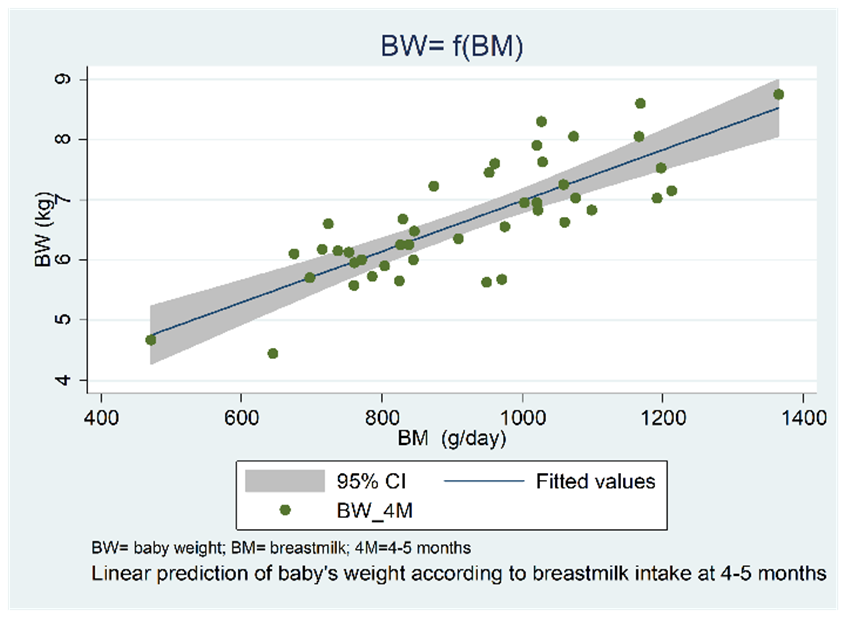
At each period, the infants’ weight was positively correlated to the breastmilk intake, and the correlation was strong at 4-5 months (r=0.8051, p=0.0000, n=43). Figure 1 gives the linear prediction of baby weight at 4-5 months according to the quantity of breastmilk they consumed during that period.

The EBF practice, based on cross-sectional measurement (Table 4), was optimum at 4-5 months with 88.4% (95% CI: 78.8-98.0; n=43). But when we analyzed breastfeeding practice through longitudinal measurement since birth, the proportion of infant who were exclusively breastfed from birth up to 5 months was significantly reduced (p= 0.0007) to 55.0% (95% CI: 39.6-70.4, n=40).
Knowledge on breastfeeding practice and infant nutritional status is a key factor to consider when designing interventions to prevent under-nutrition in the first 2 years. We used the stable isotope technique to analyze breastfeeding practices in a rural area of Burkina Faso. The anthropometry showed that the babies’ weight increased quickly from the first to the 6th month, and yet malnutrition was still present with the most significant rate of wasting in the birth month (18.6%) and six months (22.7%). Recent evidence shows that stunting and wasting might already be present at birth, and that the incidence of both conditions peaks in the first 6 months of life 3. In our study, some infants were born with a low weight, and others could experience a decrease in weight due to breastfeeding difficulties. In addition, at 6 months when transitioning to complementary feeding, introducing other foods could be a challenge when breastmilk intake declines. It is highly essential to breastfeed within the initial hour of birth and to maintain it on demand in order to swiftly cover all the needs up to 6 months.
Analyzing the BM intake, we remarked it reached the maximum at 4-5 months (923.1 ± 184.2g/day). The mean was in line with that found in 10 countries in 2010 28 and other subsequent studies [28, 34-36], particularly in Morocco at 3 and 6 months (741.9 ± 281.7g/day and 843.6 ± 415.6 g/day) 34 and in Botswana at 6 months (838.09 g/day ± 248.09 g/day) 36. The infant’s mean weight was consistently correlated with the amount of breastmilk they consumed at each period (r=0.8051 at 4-5 months), highlighting the preponderance of breastfeeding but the deciding factor was the amount of non-breastmilk that determined who was truly exclusively breastfed or not.
After analyzing the EBF practice, we noted that at each cross-sectional evaluation, some mothers introduced into their baby’s diet a fluid other than breast milk and the group of EBF women changed from one period to the next showing the discontinuous practice of EBF among mothers even though the difference in EBF rate was not significant between periods (79.1% at 1 month, 73.9% at 2-3 months, and 88.4% at 4-5 months). Finally, after comparing the cross-sectional measurements to the longitudinal assessments, particularly at 4-5 months, we noticed a significant reduction (p<0.0007) of the EBF rate from 88.4% to 55.0%. So. referring to the definition of EBF up to 6 months; we confirmed the cross-sectional measurement overestimates enormously the real proportion of EBF (difference of 33.4% at 4-5 months). It was early shown that there was a discrepancy between EBF rate based on maternal report and that based on the DMT 37; now in addition, our study showed that a unique assessment at a certain point does not reveal that moms have really practiced exclusive breastfeeding up to that point, even if the evaluation is done using the deuterium dilution technique.
We performed the evaluation among mothers who agreed to breastfeed exclusively up to 6 months and contrary to their willingness and report, very early some mothers introduced other foods (or sources of water) in the babies’ diet as shown by the EBF rate that was 79.02% at first month and decreased to 55.0% after 4-5 months according to the longitudinal assessment. The decrease of exclusive breastfeeding until 6 months showed the real non-compliance of this practice by mothers who had accepted it. We found in that community that there were difficulties with the strict implementation of the exclusive breastfeeding recommendation. However, in low income country, it should be well introduced in rural areas where living conditions are precarious (low income and lack of hygiene) as we know breast milk is free, readily available and reduces the risk of infection 38. Whatever their will, some lactating women are not far enough along in their projects to breastfeed exclusively, and they often find themselves helpless in the face of social and cultural stresses. After a survey on breastfeeding knowledge among low-income women in Côte d’Ivoire, the difficulties related to the decline in exclusive breastfeeding were attributed to insufficient production of breast milk, fatigue, daily occupation of the mother, pain and cracking of the nipple, stress, poor health of the mother and atrophy of the mammary gland 39. It was also reported that, while mothers have limited powers to decide, grandmothers and husbands have the key role in decisions about breastfeeding, and that shows the need to more engage the support of partners and relatives through community-driven policies and integrated interventions that address social and cultural barriers throughout the prenatal and postnatal period 40. To prolong the exclusive breastfeeding, women need more guidance and help than what is offered by health services.
Using a stable isotope technique, we provided data on the quantity of milk consumed by the babies and evaluated exclusive breastfeeding in a rural community of Burkina Faso. It will contribute to more document the data on infant feeding practice in the country. We remarked that there could be a hidden inadequate EBF practice after comparing the cross-sectional measurement with longitudinal one. The study opens the perspective to more investigate on the different methods and techniques used to assess breastfeeding practice (maternal report, dose-to-mother technique, cross-sectional and longitudinal assessment) in order to determine the more accurate procedure that could be applied for breastfeeding evaluation.
ZAN, OJB and SH designed the study; CNMJD and OCT conducted field activities and laboratory analysis; CNMJD and SMAS analyzed the data and the first draft was written by CNMJD. All the authors approved the final manuscript.
The study has been supported by the technical cooperation of IAEA with materials providing and staff training through BKF6004. Many thanks to the study participants. Particularly thanks to our lab assistant, Bationo Richard.
| [1] | UNICEF. Early childhood nutrition: Preventing malnutrition in infants and young children. 2021 [cited 2021 28/11/2021]; Available from: https://www.unicef.org/nutrition/early-childhood-nutrition. | ||
| In article | |||
| [2] | Organization, W.H. Malnutrition. 2021 [cited 2021 02/10/21]; Available from: https://www.who.int/news-room/fact-sheets/detail/malnutrition. | ||
| In article | |||
| [3] | Victora, C.G., et al., Revisiting maternal and child undernutrition in low-income and middle-income countries: variable progress towards an unfinished agenda The Lancet, 2021. Maternal and Child Undernutrition Progress 1 (397): p. 1388-99. | ||
| In article | View Article PubMed | ||
| [4] | INSD, Recensement général de la population et de l’habitation de 2006 (RGPH-2006). Rapport de synthèse des rapports d’analyse,Ouagadougou, Burkina Faso. 2009, Institut National de la Statistique et de la Démographie. | ||
| In article | |||
| [5] | GBD, Burkina Faso. Global Burden of Disease, risk and injuries of 2010., 2014. | ||
| In article | |||
| [6] | Direction de la Nutrition, National Nutrition Survey SMART 2016, in Enquête nutritionnelle nationale. 2016, Direction de la Nutrition, Ministère de la Santé: Burkina Faso, 2016. | ||
| In article | |||
| [7] | ISSP. Burkina Faso | PMA Data PMA Nutrition survey. Keys results 2017. Burkina Faso | PMA Data 2020 [cited 2021; Available from: https://www.pmadata.org › countries › burkina-faso. | ||
| In article | |||
| [8] | Savadogo LGB, Ilboudo B, and Kinda M, Exclusive Breastfeeding Practice and Its Factors in Rural Areas of Burkina Faso. . Open Journal of Epidemiology 2018. 8: p. 67-75. | ||
| In article | View Article | ||
| [9] | WHO, The Optimal Duration of Exclusive Breastfeeding, A systematic review. 2002, World Health Organization: Geneva. | ||
| In article | |||
| [10] | Kramer MS and Kakuma R, Optimal duration of exclusive breastfeeding. Cochrane Database of Systematic Reviews. Cochrane, 2012 (8. Art. No.: CD003517.). | ||
| In article | View Article | ||
| [11] | WHO, Nutrient Adequacy of exclusive breastfeeding for the term infant during the first six months of life. 2002, Geneva: World Health Organization. 57. | ||
| In article | |||
| [12] | Coward, W.A., et al., New method for measuring milk intakes in breast-fed babies. Lancet 1979. 2: 13-4. | ||
| In article | View Article PubMed | ||
| [13] | Coward, W.A., et al., Breast-milk intake measurement in mixed fed infants by administration of deuterium oxide to their mothers. Hum Nutr-Clin Nutr, 1982. 36C: p. 141-148. | ||
| In article | |||
| [14] | Butte NF, et al., Evaluation of the deuterium dilution technique against the test-weighing procedure for the determination of breast milk intake. Am J Clin Nutr, 1983. 37(6): 996-1003. | ||
| In article | View Article PubMed | ||
| [15] | Orr-Ewing, A., P. Heywoog, and A.W. Coward, Longitudinal measurements of breast milk output by a 2H2O tracer technique in rural Papua New Guinea women. Hum Nutr Clin Nutr 1986. 40C: 451-67. | ||
| In article | |||
| [16] | Butte, N.F., et al., Human -milk intake measure by administration of deuterium oxide to the mother: a comparison with the test-weighting technique. Am J Clin Nutr, 1988. 47: p. 815-821. | ||
| In article | View Article PubMed | ||
| [17] | Fjeld CR, Brown KH, and Schoeller DA, Validation of the deuterium oxide method for measuring average daily milk intake in infants. Am J Clin Nutr 1988. 48(3): 671-9. | ||
| In article | View Article PubMed | ||
| [18] | Butte NF and Al, Human milk intake and growth faltering of rural Mesoamerindian infants. American. Journal of Clinical Nutrition, 1992. 55: 1109-1116. | ||
| In article | View Article PubMed | ||
| [19] | Wells, J.C. and P.S. Davies, Correction for environmental water influx in measurment of milk volume intake by deuterium turnover in infants. Early Human Develop., 1995. 41: p. 177-182. | ||
| In article | View Article PubMed | ||
| [20] | Caire G, et al., Measurement of deuterium oxide by infrared spectroscopy and isotope ratio mass spectrometry for quantifying daily milk intake in breastfed infants and maternal body fat. Food Nutr Bull 2002. 23(3 Suppl): 38-41. | ||
| In article | View Article PubMed | ||
| [21] | Cissé, A.S., et al., Use of Fourier transformed infrared spectrophotometer (FTIR) for determination of breast milk output by the deuterium dilution among Senegalese women. Food Nutr. Bull, 2002. 23(3): p. 138-141. | ||
| In article | View Article PubMed | ||
| [22] | Cissé AR and et al., Stable isotope aided evaluation of Community Nutrition Program: effect of food supplementation schemes on maternal and infant nutritional status. Food Nutr. Bull, 2002. 23(3): p. 169-173. | ||
| In article | View Article | ||
| [23] | Albernaz E and et al., lactating counseling increases breast-feeding duration but not breastmilk intake as measured by isotopic methods. Journal: J. Nutr, 2003. 133: p. 205-210. | ||
| In article | View Article PubMed | ||
| [24] | Haisma, H., et al., Breast milk and energy intake in exclusively, predominantly and partially breast-fed infants. Eur. J. Clin. Nutr., 2003. 57: p. 1633-1642. | ||
| In article | View Article PubMed | ||
| [25] | Ettyang GA and et al., Assessment of body composition and breastmilk volume in lactating mothers in pastoral communities in Pokot, Kenya, using deuterium oxide Ann. Nutr. Metabol., 2005. 49:110-117. | ||
| In article | View Article PubMed | ||
| [26] | Hinke H, Coward WA, and Albernaz E, 2H2O turnover method as a means to detect bias in estimations of intake of non breast milk liquids in breast-fed infants. Eur. J. Clin. Nutr., 2005. 59: p. 93-100. | ||
| In article | View Article PubMed | ||
| [27] | Moore SE, et al., Use of stable techniques to validate infant feeding practice reported by Bangladeshi women receiving breastfeeding counseling. Am.J. Clin. Nutr., 2007. 85: p. 1075-1082. | ||
| In article | View Article PubMed | ||
| [28] | DaCosta TMH, et al., How Much Human Milk Do Infants Consume? Data from 12 Countries Using a Standardized Stable Isotope Methodology. The Journal of Nutrition, 2010. | ||
| In article | View Article PubMed | ||
| [29] | Jones, P.J. and S.T. Leatherdale, Stable isotopes in clinical research: safety reaffirmed Clin. Sci., 1991. 80: p. 277-280. | ||
| In article | View Article PubMed | ||
| [30] | IAEA, Stable Isotopes Technique to Assess Intake of Human Milk in Breastfed Infant, in IAEA Human Health Series n°7, IAEA, Editor. 2010: Vienna. | ||
| In article | |||
| [31] | WHO child growth standards. Length, height for-age, weight-for-age, weight-for-length and body mass index-for age. Methods and development., in WHO Multicentre Growth Reference Study Group. 2006, Genève, Organisation mondiale de la Santé, 2006. | ||
| In article | |||
| [32] | Coulibaly ND, et al., Validation of data provided by the deuterium oxide dose-to-mother technique for better evaluation of breastfeeding practice. Open J Food Nutri Res, 2019. 1(1): p. 08-16. | ||
| In article | View Article | ||
| [33] | Liu, Z., et al., Development of a nonlinear hierarchical model to describe the disposition of deuterium in mother–infant pairs to assess exclusive breastfeeding practice. Journal of Pharmacokinetics and Pharmacodynamics, 2019. 46: p. 1-13. | ||
| In article | View Article PubMed | ||
| [34] | Choua G, et al., Quantitative Assessment of Breastfeeding Practices and Maternal Body Composition in Moroccan Lactating Women during Six Months after Birth Using Stable Isotopic Dilution Technique. International Journal of Maternal and Child Health, 2013. 1(3): 45-50. | ||
| In article | View Article | ||
| [35] | Bandara, T., et al., The Deuterium Oxide–to-the-Mother Method Documents Adequate Breast-Milk Intake among Sri Lankan Infants. Journal of Nutrition, 2015. 145: 1325-9. | ||
| In article | View Article PubMed | ||
| [36] | Motswagole, B.S., et al., Application of the deuterium-oxide dose-to-mother technique to determine the exclusivity of breastfeedingin women in Kanye, Botswana. S Afr J Clin Nutr, 2015. 28(3): 128-133. | ||
| In article | View Article | ||
| [37] | Gabriel Nama Medoua, et al., Breastfeeding practices of Cameroonian mothers determined by dietary recall since birth and the dose-to-the-mother deuterium-oxide turnover technique. Maternal and Child Nutrition, 2011. | ||
| In article | View Article PubMed | ||
| [38] | ANAES, Allaitement maternel: les bénéfices pour la santé de l’enfnat et de sa mère. 2005, Paris: Agence national d’accréditation et d’évaluation en santé. | ||
| In article | |||
| [39] | Adepo, Y.P., et al., Knowledge of Breastfeeding Practices for Infants Aged 0 to 6 Months from the Municipality of Abobo (Abidjan, Ivory Coast). American Journal of Food and Nutrition, 2022. 10(2): p. 40-44. | ||
| In article | View Article | ||
| [40] | Friday Ilop Joseph and Jane Earland, A qualitative exploration of the sociocultural determinants of exclusive breastfeeding practices among rural mothers, North West Nigeria. International Breastfeeding Journal., 2019. 14: p. 38. | ||
| In article | View Article PubMed | ||
Published with license by Science and Education Publishing, Copyright © 2023 Coulibaly Nadine Mireille Josepha Danielle, Ouedraogo Cesaire Tania, Zeba Augustin Nawidimbasba, Sorgho Hermann, Somda Manituo Aymard Serge and Ouedraogo Jean-Bosco
 This work is licensed under a Creative Commons Attribution 4.0 International License. To view a copy of this license, visit
http://creativecommons.org/licenses/by/4.0/
This work is licensed under a Creative Commons Attribution 4.0 International License. To view a copy of this license, visit
http://creativecommons.org/licenses/by/4.0/
| [1] | UNICEF. Early childhood nutrition: Preventing malnutrition in infants and young children. 2021 [cited 2021 28/11/2021]; Available from: https://www.unicef.org/nutrition/early-childhood-nutrition. | ||
| In article | |||
| [2] | Organization, W.H. Malnutrition. 2021 [cited 2021 02/10/21]; Available from: https://www.who.int/news-room/fact-sheets/detail/malnutrition. | ||
| In article | |||
| [3] | Victora, C.G., et al., Revisiting maternal and child undernutrition in low-income and middle-income countries: variable progress towards an unfinished agenda The Lancet, 2021. Maternal and Child Undernutrition Progress 1 (397): p. 1388-99. | ||
| In article | View Article PubMed | ||
| [4] | INSD, Recensement général de la population et de l’habitation de 2006 (RGPH-2006). Rapport de synthèse des rapports d’analyse,Ouagadougou, Burkina Faso. 2009, Institut National de la Statistique et de la Démographie. | ||
| In article | |||
| [5] | GBD, Burkina Faso. Global Burden of Disease, risk and injuries of 2010., 2014. | ||
| In article | |||
| [6] | Direction de la Nutrition, National Nutrition Survey SMART 2016, in Enquête nutritionnelle nationale. 2016, Direction de la Nutrition, Ministère de la Santé: Burkina Faso, 2016. | ||
| In article | |||
| [7] | ISSP. Burkina Faso | PMA Data PMA Nutrition survey. Keys results 2017. Burkina Faso | PMA Data 2020 [cited 2021; Available from: https://www.pmadata.org › countries › burkina-faso. | ||
| In article | |||
| [8] | Savadogo LGB, Ilboudo B, and Kinda M, Exclusive Breastfeeding Practice and Its Factors in Rural Areas of Burkina Faso. . Open Journal of Epidemiology 2018. 8: p. 67-75. | ||
| In article | View Article | ||
| [9] | WHO, The Optimal Duration of Exclusive Breastfeeding, A systematic review. 2002, World Health Organization: Geneva. | ||
| In article | |||
| [10] | Kramer MS and Kakuma R, Optimal duration of exclusive breastfeeding. Cochrane Database of Systematic Reviews. Cochrane, 2012 (8. Art. No.: CD003517.). | ||
| In article | View Article | ||
| [11] | WHO, Nutrient Adequacy of exclusive breastfeeding for the term infant during the first six months of life. 2002, Geneva: World Health Organization. 57. | ||
| In article | |||
| [12] | Coward, W.A., et al., New method for measuring milk intakes in breast-fed babies. Lancet 1979. 2: 13-4. | ||
| In article | View Article PubMed | ||
| [13] | Coward, W.A., et al., Breast-milk intake measurement in mixed fed infants by administration of deuterium oxide to their mothers. Hum Nutr-Clin Nutr, 1982. 36C: p. 141-148. | ||
| In article | |||
| [14] | Butte NF, et al., Evaluation of the deuterium dilution technique against the test-weighing procedure for the determination of breast milk intake. Am J Clin Nutr, 1983. 37(6): 996-1003. | ||
| In article | View Article PubMed | ||
| [15] | Orr-Ewing, A., P. Heywoog, and A.W. Coward, Longitudinal measurements of breast milk output by a 2H2O tracer technique in rural Papua New Guinea women. Hum Nutr Clin Nutr 1986. 40C: 451-67. | ||
| In article | |||
| [16] | Butte, N.F., et al., Human -milk intake measure by administration of deuterium oxide to the mother: a comparison with the test-weighting technique. Am J Clin Nutr, 1988. 47: p. 815-821. | ||
| In article | View Article PubMed | ||
| [17] | Fjeld CR, Brown KH, and Schoeller DA, Validation of the deuterium oxide method for measuring average daily milk intake in infants. Am J Clin Nutr 1988. 48(3): 671-9. | ||
| In article | View Article PubMed | ||
| [18] | Butte NF and Al, Human milk intake and growth faltering of rural Mesoamerindian infants. American. Journal of Clinical Nutrition, 1992. 55: 1109-1116. | ||
| In article | View Article PubMed | ||
| [19] | Wells, J.C. and P.S. Davies, Correction for environmental water influx in measurment of milk volume intake by deuterium turnover in infants. Early Human Develop., 1995. 41: p. 177-182. | ||
| In article | View Article PubMed | ||
| [20] | Caire G, et al., Measurement of deuterium oxide by infrared spectroscopy and isotope ratio mass spectrometry for quantifying daily milk intake in breastfed infants and maternal body fat. Food Nutr Bull 2002. 23(3 Suppl): 38-41. | ||
| In article | View Article PubMed | ||
| [21] | Cissé, A.S., et al., Use of Fourier transformed infrared spectrophotometer (FTIR) for determination of breast milk output by the deuterium dilution among Senegalese women. Food Nutr. Bull, 2002. 23(3): p. 138-141. | ||
| In article | View Article PubMed | ||
| [22] | Cissé AR and et al., Stable isotope aided evaluation of Community Nutrition Program: effect of food supplementation schemes on maternal and infant nutritional status. Food Nutr. Bull, 2002. 23(3): p. 169-173. | ||
| In article | View Article | ||
| [23] | Albernaz E and et al., lactating counseling increases breast-feeding duration but not breastmilk intake as measured by isotopic methods. Journal: J. Nutr, 2003. 133: p. 205-210. | ||
| In article | View Article PubMed | ||
| [24] | Haisma, H., et al., Breast milk and energy intake in exclusively, predominantly and partially breast-fed infants. Eur. J. Clin. Nutr., 2003. 57: p. 1633-1642. | ||
| In article | View Article PubMed | ||
| [25] | Ettyang GA and et al., Assessment of body composition and breastmilk volume in lactating mothers in pastoral communities in Pokot, Kenya, using deuterium oxide Ann. Nutr. Metabol., 2005. 49:110-117. | ||
| In article | View Article PubMed | ||
| [26] | Hinke H, Coward WA, and Albernaz E, 2H2O turnover method as a means to detect bias in estimations of intake of non breast milk liquids in breast-fed infants. Eur. J. Clin. Nutr., 2005. 59: p. 93-100. | ||
| In article | View Article PubMed | ||
| [27] | Moore SE, et al., Use of stable techniques to validate infant feeding practice reported by Bangladeshi women receiving breastfeeding counseling. Am.J. Clin. Nutr., 2007. 85: p. 1075-1082. | ||
| In article | View Article PubMed | ||
| [28] | DaCosta TMH, et al., How Much Human Milk Do Infants Consume? Data from 12 Countries Using a Standardized Stable Isotope Methodology. The Journal of Nutrition, 2010. | ||
| In article | View Article PubMed | ||
| [29] | Jones, P.J. and S.T. Leatherdale, Stable isotopes in clinical research: safety reaffirmed Clin. Sci., 1991. 80: p. 277-280. | ||
| In article | View Article PubMed | ||
| [30] | IAEA, Stable Isotopes Technique to Assess Intake of Human Milk in Breastfed Infant, in IAEA Human Health Series n°7, IAEA, Editor. 2010: Vienna. | ||
| In article | |||
| [31] | WHO child growth standards. Length, height for-age, weight-for-age, weight-for-length and body mass index-for age. Methods and development., in WHO Multicentre Growth Reference Study Group. 2006, Genève, Organisation mondiale de la Santé, 2006. | ||
| In article | |||
| [32] | Coulibaly ND, et al., Validation of data provided by the deuterium oxide dose-to-mother technique for better evaluation of breastfeeding practice. Open J Food Nutri Res, 2019. 1(1): p. 08-16. | ||
| In article | View Article | ||
| [33] | Liu, Z., et al., Development of a nonlinear hierarchical model to describe the disposition of deuterium in mother–infant pairs to assess exclusive breastfeeding practice. Journal of Pharmacokinetics and Pharmacodynamics, 2019. 46: p. 1-13. | ||
| In article | View Article PubMed | ||
| [34] | Choua G, et al., Quantitative Assessment of Breastfeeding Practices and Maternal Body Composition in Moroccan Lactating Women during Six Months after Birth Using Stable Isotopic Dilution Technique. International Journal of Maternal and Child Health, 2013. 1(3): 45-50. | ||
| In article | View Article | ||
| [35] | Bandara, T., et al., The Deuterium Oxide–to-the-Mother Method Documents Adequate Breast-Milk Intake among Sri Lankan Infants. Journal of Nutrition, 2015. 145: 1325-9. | ||
| In article | View Article PubMed | ||
| [36] | Motswagole, B.S., et al., Application of the deuterium-oxide dose-to-mother technique to determine the exclusivity of breastfeedingin women in Kanye, Botswana. S Afr J Clin Nutr, 2015. 28(3): 128-133. | ||
| In article | View Article | ||
| [37] | Gabriel Nama Medoua, et al., Breastfeeding practices of Cameroonian mothers determined by dietary recall since birth and the dose-to-the-mother deuterium-oxide turnover technique. Maternal and Child Nutrition, 2011. | ||
| In article | View Article PubMed | ||
| [38] | ANAES, Allaitement maternel: les bénéfices pour la santé de l’enfnat et de sa mère. 2005, Paris: Agence national d’accréditation et d’évaluation en santé. | ||
| In article | |||
| [39] | Adepo, Y.P., et al., Knowledge of Breastfeeding Practices for Infants Aged 0 to 6 Months from the Municipality of Abobo (Abidjan, Ivory Coast). American Journal of Food and Nutrition, 2022. 10(2): p. 40-44. | ||
| In article | View Article | ||
| [40] | Friday Ilop Joseph and Jane Earland, A qualitative exploration of the sociocultural determinants of exclusive breastfeeding practices among rural mothers, North West Nigeria. International Breastfeeding Journal., 2019. 14: p. 38. | ||
| In article | View Article PubMed | ||