This paper presents an analytical study of photovoltaic (PV) power generation of two regions in Saudi Arabia. Renewable energy resources have recently been acknowledged as a vital component of global economic stability, particularly in countries like Saudi Arabia. Saudi Arabia is a vibrant country that is experiencing significant population increase, which has resulted in high electricity usage. Because of the strong solar radiation, huge rainless area, and lengthy sunlight, Saudi Arabia has a bright future in terms of using solar energy more broadly. As a result, the Saudi Arabian government has invested billions of dollars in large-scale renewable and sustainable energy projects around the country, backed by strong funding. Saudi Arabia wants to boost solar power output to meet a large amount of the country's prospective energy needs. Various installations and research projects are currently being carried out throughout the kingdom to meet its solar power ambitions. As a result, it is critical to keep up with the latest developments in the solar business in the country. Development and Research (R&D). In this work a simulation (PVsyst 7.1) software program to simulate the installation of PV cells on two regions of Saudi Arabia including Al-Al-Riyadh and Al-Jubail regions. Also, the possibility of using the tracker system to track the sunshine and generate more power from PV systems is discussed. This paper presents, however, is a partnership and it intends to examine the existing state, growth, potential, resources, sustainability performance, and prospects of renewable energy in Saudi Arabia in accordance with Saudi Vision 2030.
In Saudi Arabia, the electric power generation aims to raise the capacity to 120 GW through 2032 by fast growth of the country's economy over the last decade. The current high loads necessitate proper and sufficient power generation However, hazardous gas emissions such as nitrogen oxides (NO, NO2 & N2O), sulfur oxides (SO2 & SO3), and carbon oxides (CO2 & CO3) are well known to be a major cause of pollution and have a severe impact on human health due to conventional production utilizing fossil fuels (CO & CO2). Globally, there are significant diversifications in energy sources, as well as the strengthening of renewable energy possibilities. The most essential motivations for such endeavors are environmental preservation, increased energy production, and economic growth. Indeed, it is no exaggeration to argue that the world is gradually transitioning from a hydrocarbon-dependent economy to a sustainable one. However, it is worth noting that the prospect of renewable energy in major oil producers, particularly in countries that are heavily reliant on oil, has received relatively little attention 1. As a result, there has been an associated paucity of research. These countries should not only recognize specific renewable energy resources to secure their energy and economic futures, but they should also not overlook their potential essential role in achieving a healthier future for future generations. The Saudi Arabia's main oil powerhouse is an interesting case to be considered in this regard 1.
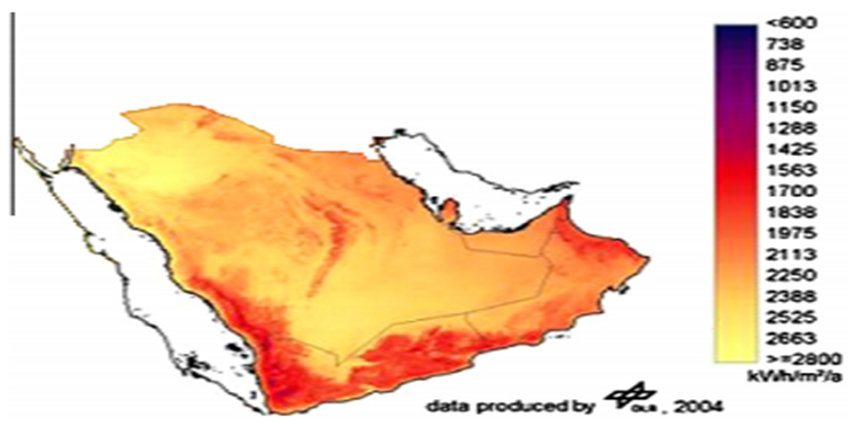
As a result, it is critical to discover a new strategy to support Saudi Arabia's present conventional generating while simultaneously protecting the environment and human health. Saudi Arabia has become one of the major solar PV energy producers because to its advantageous location in the so-called sun belt, which includes vast desert area and year-round clear sky. Saudi Arabia receives an average of 2200 thermal kWh/m2 of energy from the sun 1. Figure 1 shows the Solar resource maps of Saudi Arabia.

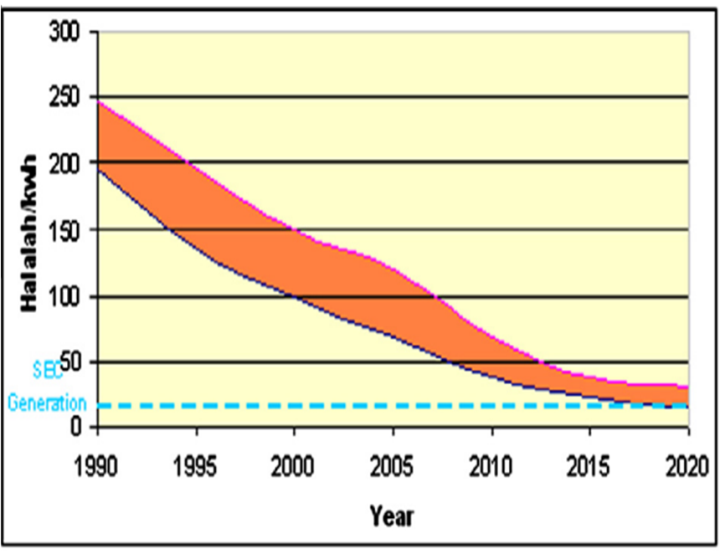
Saudi Arabia is in the heart of one of the world's most productive solar power zones, receiving the most powerful type of sunlight 4. Saudi Arabia is a huge country, covering 2.3 million square kilometers. It is a reasonably wealthy country, and electricity demand is increasing at a pace of roughly 5% per year 5. The cost of conventional generating including indirect charges, as determined by the government, is around 0.32 SR/kWh by 2015, or by 2020 under the worst-case scenario of high solar energy costs, the latest amount will be competitive with PV projects as shown in Figure 2. The total price of conventional generation, including indirect costs, vs solar energy is represented by the last approach to comparison. When prices are not subsidized by the government and indirect expenses are included in, solar energy is currently more cost-effective than traditional generating. As a result, strategy C is the most convenient state because it is comparable to Saudi Arabia's current energy policy. By 2020, solar energy is predicted to be cost competitive with conventional power sources 6.
The buildings consume half of the world's energy production in developing countries. PV arrays, rather than large-scale projects like solar plants, could be beneficial to both customers and the country when used in the construction of individual buildings. PV technology will assist communities in reducing pollution while also assisting the power grid during periods of heavy demand 8. Saudi Arabia's electricity demand is increasing at a rate of 5.8% per year 9, owing to a variety of factors including fast-growing economies, population expansion, low electricity prices, and a lack of interest in energy conservation 10. In 2008, the country consumed 35 GW and was unable to meet all peak-time demand, resulting in power shortages in some locations; by 2023, this volume is predicted to climb to 70 GW 11. Saudi Arabia's development boom and population explosion have resulted in a rise in electricity demand. The constant high demands necessitate an adequate and sufficient power supply. This clearly contributes to the depletion of fossil fuels, causing environmental concerns. However, environmental pollutant gases such as nitric oxide, nitrogen dioxide, and nitrous oxide, as well as carbon oxides, are believed to be the primary cause of environmental contamination and the repercussions for human health from traditional fossil fuels. As a result, there is a significant national desire for alternative energy sources that are environmentally sustainable and can easily supply the country's demands in the post-oil period. In Saudi Arabia, an alternative strategy to support current traditional Saudi generations that also protects the environment and human health should be established. This entails devising some new strategies for dealing with rising statistics.
Small, distributed operations throughout Saudi Arabia demonstrated the efficiency and operating efficiency of PV systems in extracting electricity in the 1970s, demonstrating their compatibility for local climates. Solar energy is a renewable and infinite form of electricity generation. It was shown to offer numerous advantages and significant economic benefits, as well as being prospective for future application. Saudi Arabia's annual population expansion exacerbates energy consumption, ensuring that the residential sector consumes more than half of the country's annual power output 12.
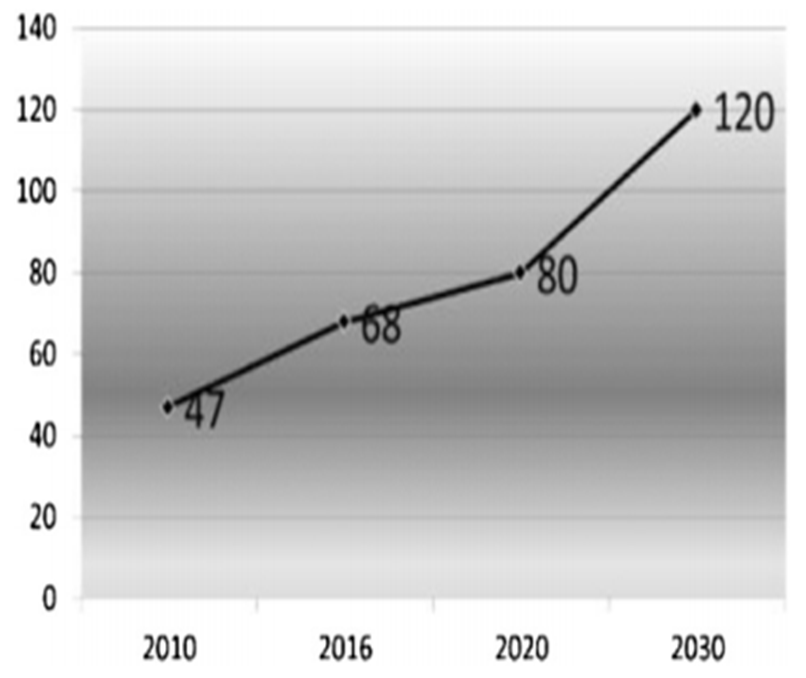
Saudi Arabia is the OPEC's largest oil producer, accounting for roughly one-fifth of the world's proven oil reserves (Organization of Petroleum Exporting Countries). Saudi Arabia is poised to remain the world's greatest net oil exporter, thanks to significant investments in the oil sector and low production costs. Saudi oil output in 2011 was 544 million tons (Mt), with net exports of 355 Mt in the same year (IEA, 2012). Saudi Arabia's power generation capacity is expected to reach 120 GW in the next two decades (GWe) as shown in Figure 3. The need for energy utilities has increased because of Saudi Arabia's fast rising population and industrial infrastructure, as well as low electricity costs (averaging 8 percent annual growth over the period). In certain sections of the country, this rapid load increase has resulted in shortages, brownouts, blackouts, and power rationing. Electricity demand, which is currently around 50 GWe (roughly 200 TWh) of annual production, is expected to rise from 80 GWe by 2020 to more than 120 GWe by 2030, according to the government 13.
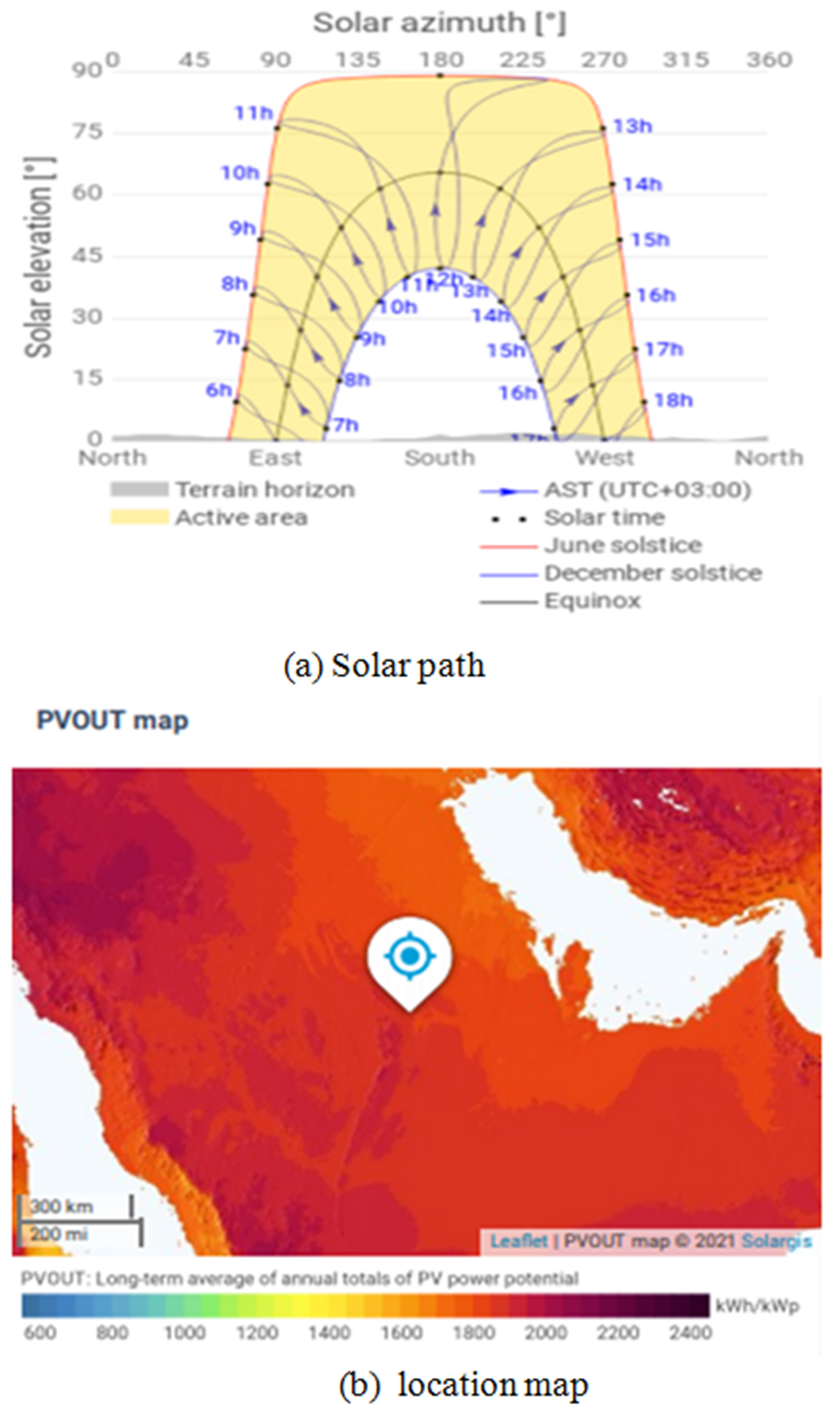
The first site studied for installing PV stations in this work was on Al-Riyadh. The installation of PV systems is near a power plants 10 of Saudi Electricity Company. That makes the connection of PV systems directly with grid and with small distance of distribution lines. All calculations and simulation have been accomplished by (PVsyst 7.1) program and GLOBAL SOLAR ATLAS. The estimated power generation for each site is 200 MWp. The coordinates of this study in Al-Riyadh are (Latitude 24.413684 °N, Longitude, 47.008009 °E) and Altitude is 511 meters. Figure 4 (a,b) shows the Solar path at Al-Riyadh from JAN to DEC & location map.


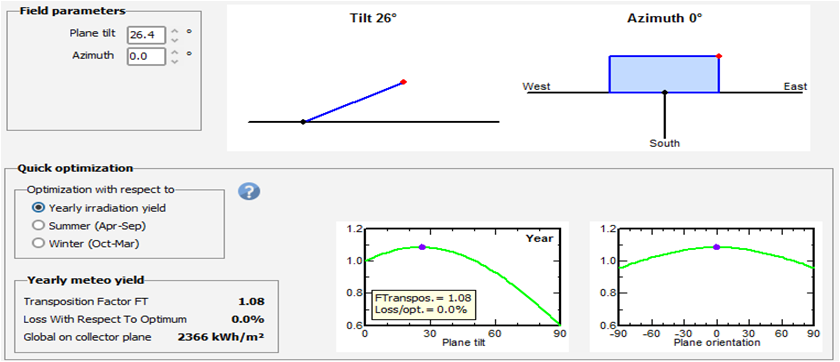
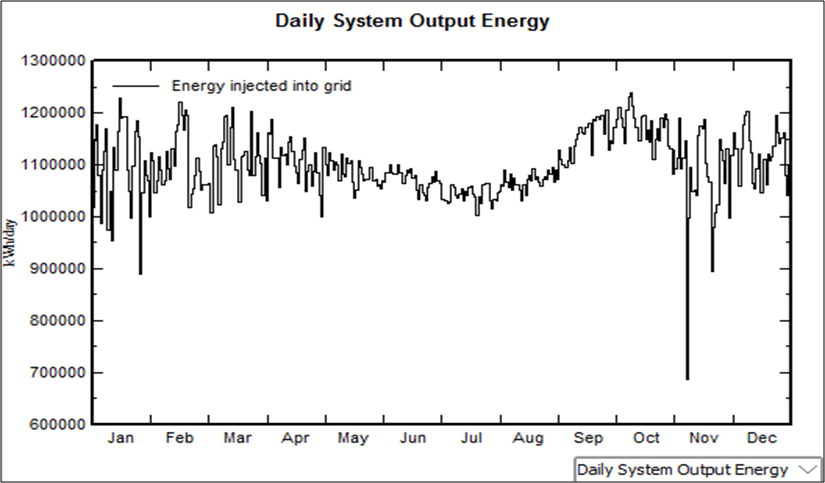
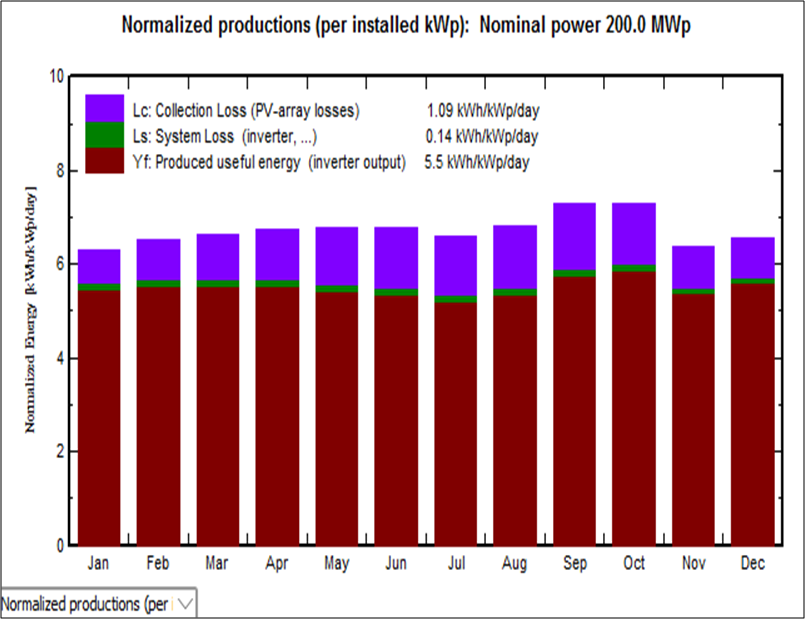
Figure 5 shows the best tilt and Azimuth angle for Al-Riyadh site, the best tilt angle is 30.0 degree that give maximum power from PV panels. The data of sun path are collected from Metronome program. Figure 6 shows the daily system output energy of Al-Riyadh site. Figure 7 shows the Normalized productions/KWp Al-Riyadh site.
In this system will use around (363636) PV modules with unit nominal power (550wp) that generate 200MWp, also the design connection of modules will be (25974 strings) * (14 series). Table 1 shows the total power generation of Al-Riyadh project is 401535 MWh with performance ratio (81.8).
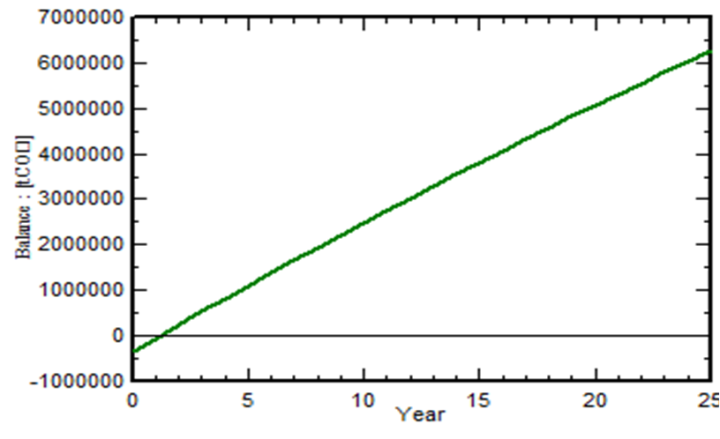
The CO2 emissions saved from this project equal 250654.719 tCO2 per year, and the lifetime of PV system is between 25 to 30 years. For 25 years of lifetime the project can save around 6.26 million tons of CO2 emissions as shown in Figure 8.
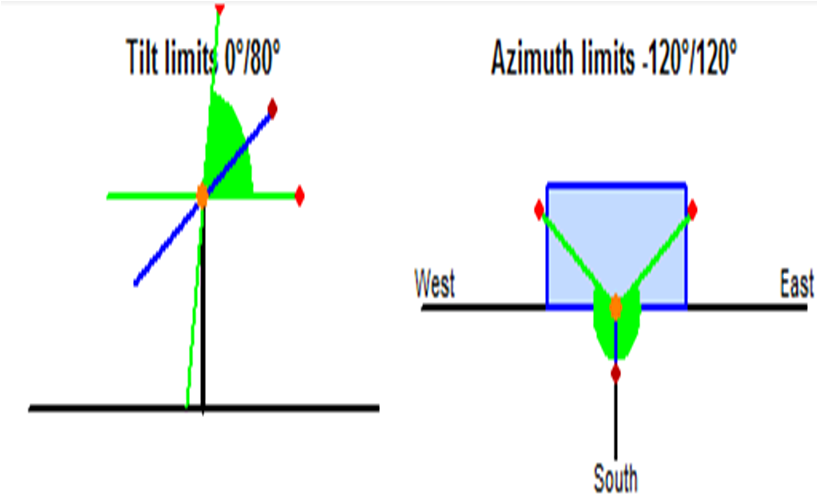
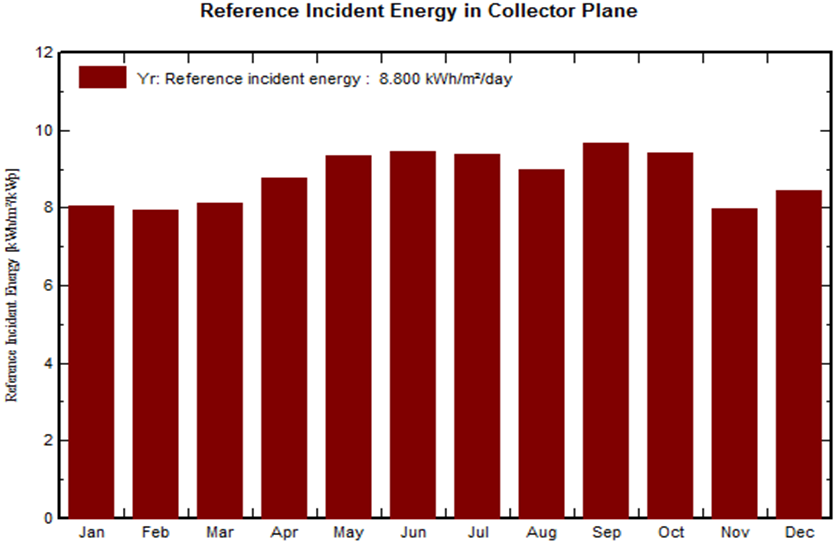
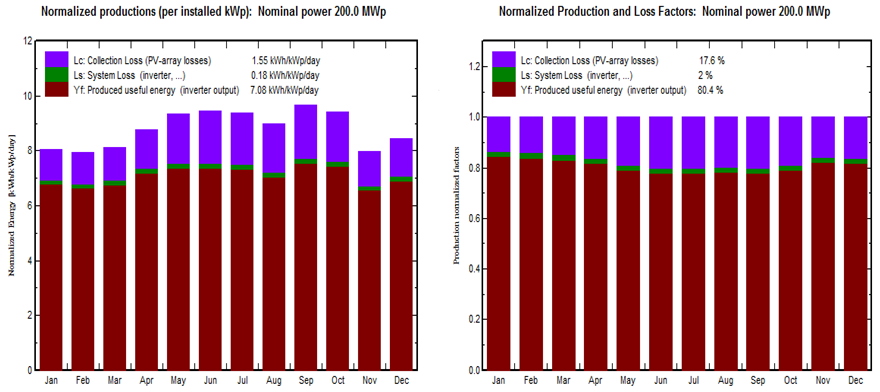
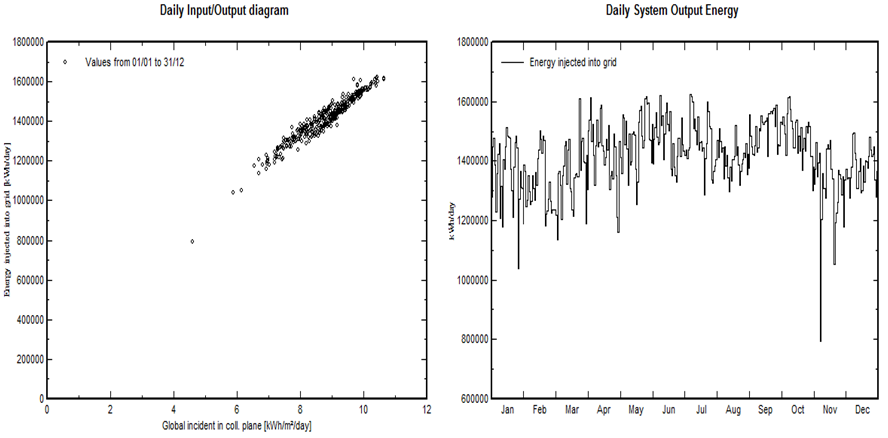
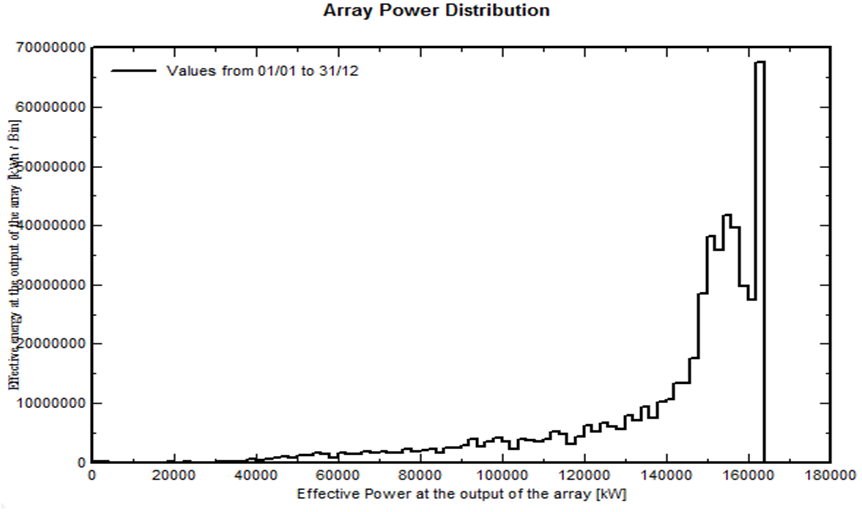
Al-Riyadh site with two axis tracking will show the total energy production from the same amount or size PV farm by using the two-tracking axis of sun light and how much CO2 emission saved. Figure 9 shows the best tilt and Azimuth angle for Al-Riyadh site, the best tilt angle limits are (0/80) degree and Azimuth limits is (-120/120) degree that give maximum power from PV panels. Figure 10 shows the reference incident energy in collector plane of Al-Riyadh site with two axis tracking system. Figure 11 shows the Normalized production and loss factors & Normalized production of Al-Riyadh site with two axis tracking system. Figure 12 shows the Daily input/output diagram (kwh/m2/day) & Daily system output Energy (kwh/day) of Al-Riyadh PV project with two axis tracking system. Figure 13 shows the Array power distribution of Al-Riyadh site with two axis tracking system.


Table 2 shows the total power generation of Al-Riyadh project is 516498 MWh with performance ratio (80.4%).
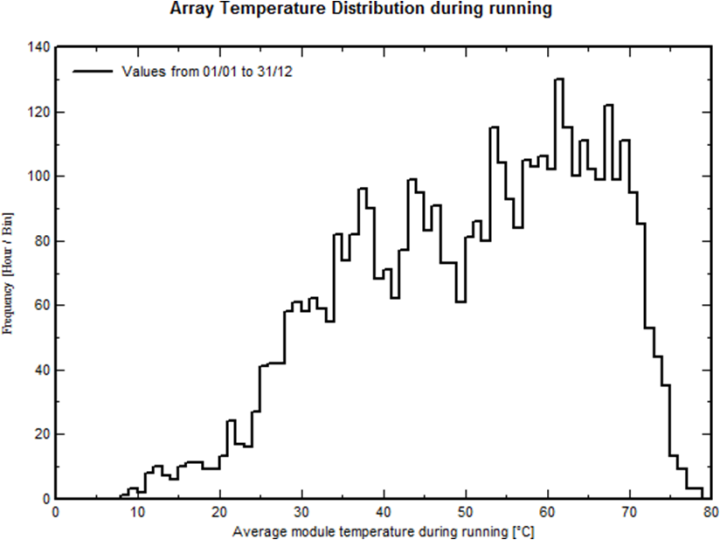
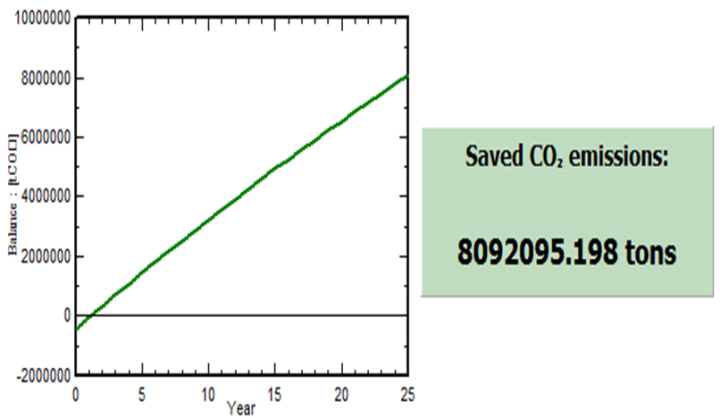
The CO2 emissions saved from this project equal 323683.808 tCO2 per year, and the lifetime of PV system is between 25 to 30 years. For 25 years of lifetime the project can save around 8.09 million tons of CO2 emissions as shown in Figure 14. Figure 15 shows the Array temperature distribution during running of Yanbu project.


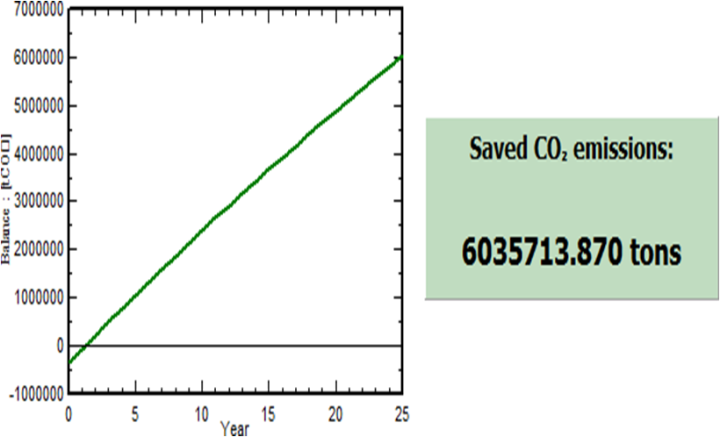
The CO2 emissions saved from this project equal 241428.5 tCO2 per year, and the lifetime of PV system is between 25 to 30 years. For 25 years of lifetime the project can save around 6 million tons of CO2 emissions as shown in Figure 16.

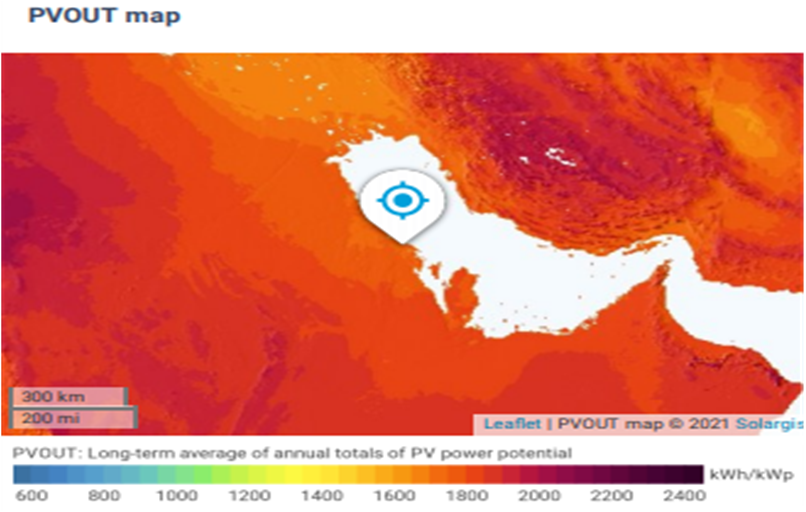
The second site studied for installing PV station on is in Al-Jubail city. Al-Jubail city is located near the Saudi Electricity Company that is easy to connect PV systems directly with grid and with small distance of distribution lines. Figure 17 shows the Solar path at Al-Jubail from JAN to DEC & location map.

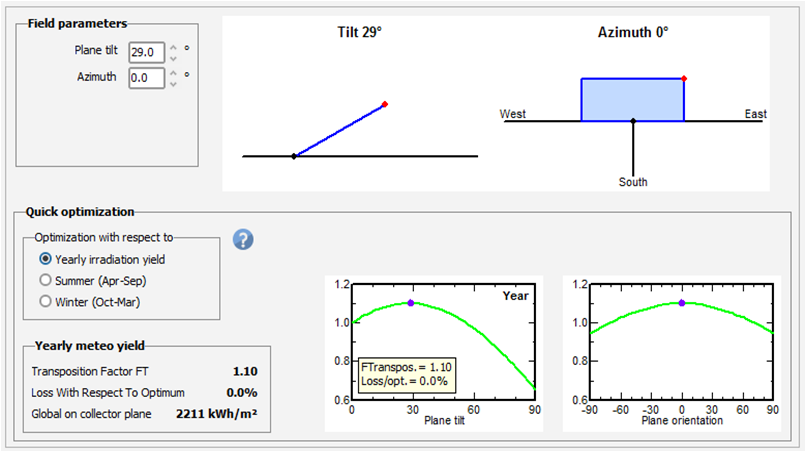
Figure 18 shows the best tilt and Azimuth angle for Al-Jubail site, the best tilt angle is 29.0 degree with zero-degree Azimuth that give maximum power from PV panels.

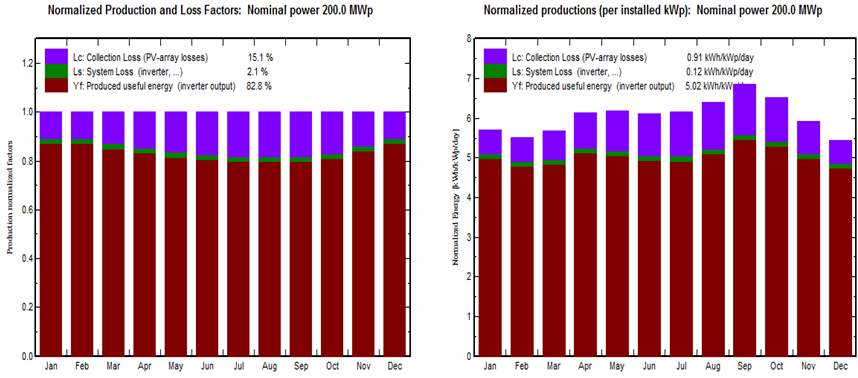
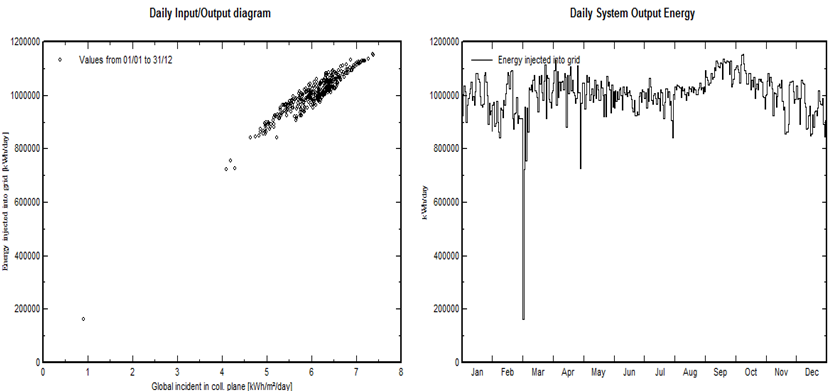
In this system will use around (363636) PV modules with unit nominal power (550wp) that generate 200MWp, also the design connection of modules will be (25974 strings) *(14 series). Figure 19 shows the Normalized production and loss factors & Normalized production of Al-Jubail project. Figure 20 shows the Daily input/output diagram (kwh/m2/day) & Daily system output Energy (kwh/day) of Al-Jubail PV project. Figure 21 shows the output distribution on grid for Al-Jubail site.

Table 3 shows the total power generation of Al-Jubail project is 366186 MWh with performance ratio (82.8%).


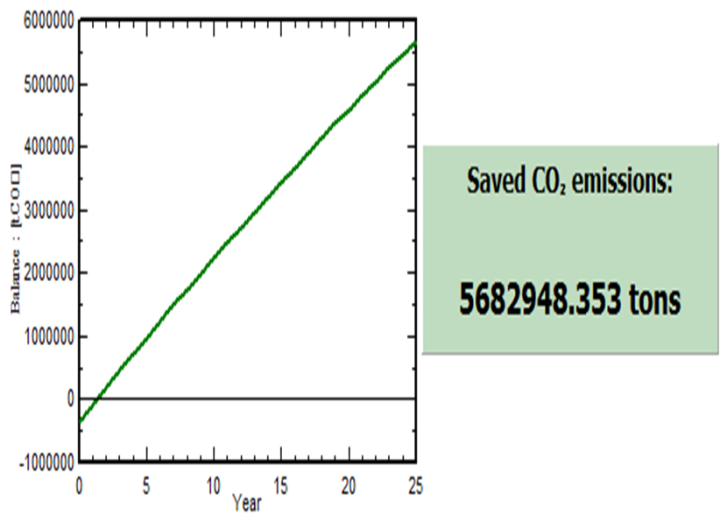
The CO2 emissions saved from this project equal 227317.934 tCO2 per year, and the lifetime of PV system is between 25 to 30 years. For 25 years of lifetime the project can save around 5.68 million tons of CO2 emissions. Figure 22 shows the CO2 emissions saved at Al-Jubail site.

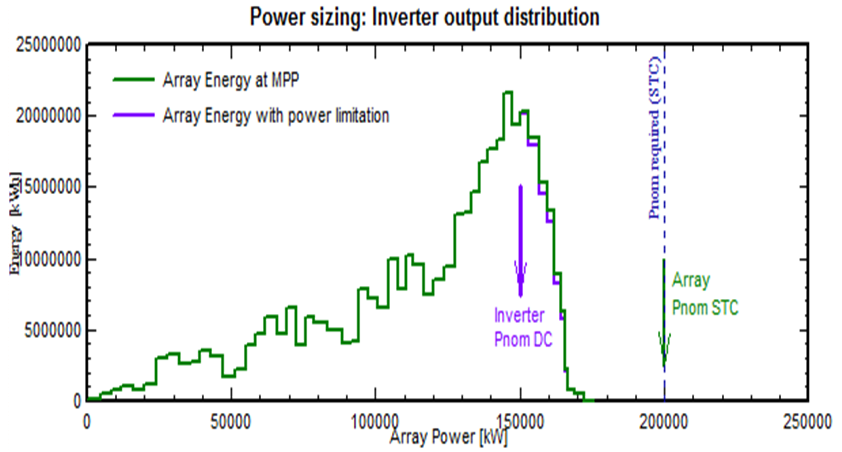
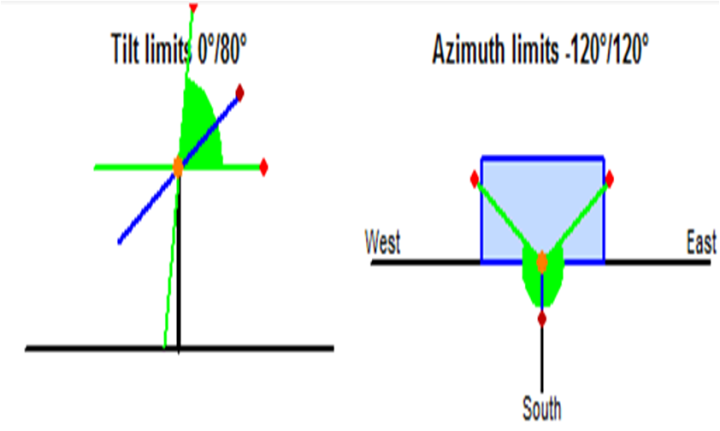
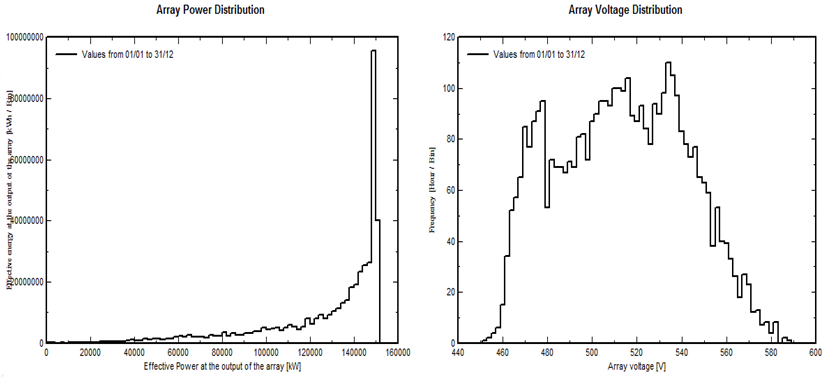
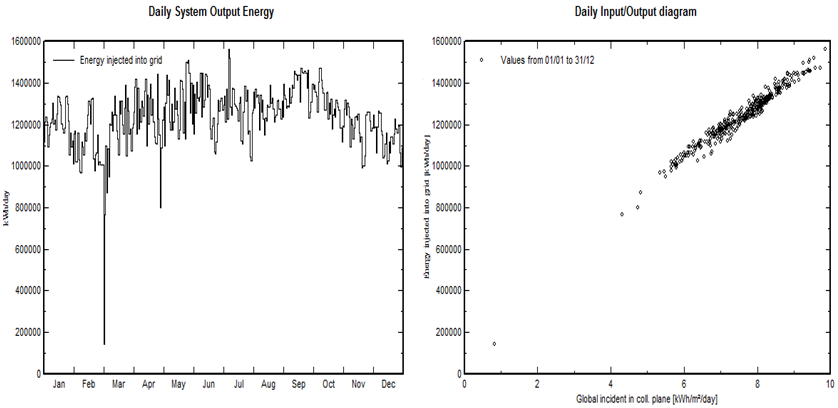
Al-Jubail site was also studied to generate the power using PV system with two axis tracking system. This system will show the total energy production from the same amount or size PV farm by using the two-tracking axis of sun light and how much CO2 emission saved. Figure 23 shows the best tilt and Azimuth angle for Al-Jubail site, the best tilt angle limits is (0/80) degree and Azimuth limits is (-120/120) degree that give maximum power from PV panels. Figure 24 shows the Array power distribution & Array voltage distribution of Al-Jubail site with two axis tracking system. Figure 25 shows the Daily input/output diagram (kwh/m2/day) & Daily system output Energy (kwh/day) of Al-Jubail PV project with two axis tracking system.


Table 4 shows the total power generation of Al-Jubail project is 452439 MWh with performance ratio (81.7%).
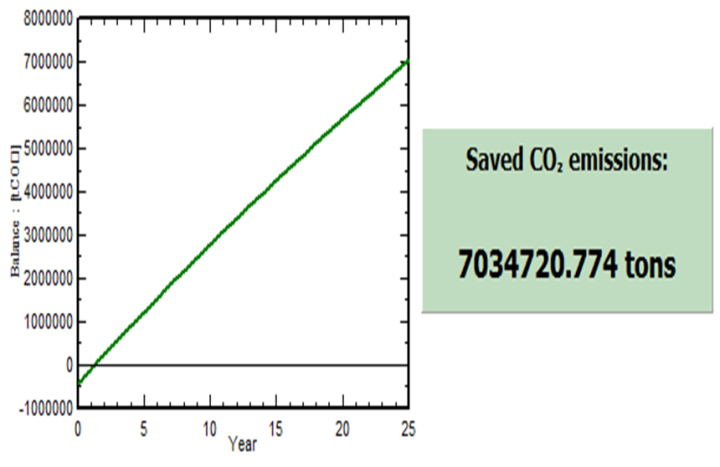
The CO2 emissions saved from this project equal 281388.831 tCO2 per year, and the lifetime of PV system is between 25 to 30 years. For 25 years of lifetime the project can save around 7.03 million tons of CO2 emissions. Figure 26 shows the CO2 emissions saved at Al-Jubail site with two axis tracking system.
An analytical analysis of utilizing PV system energy in two Saudi Arabian locations was reported in this paper. The research investigated the potential of connecting the PV system to the grid, as well as calculating the amount of CO2 emissions that may be avoided by using renewable energy to generate electricity. The installation of PV cells on two regions in Saudi Arabia was simulated using a modeling tool. It was considered whether the tracker system could be used to follow the sun and generate more power from PV systems. The findings of this study revealed that installing PV panels near power plants in two places in Saudi Arabia will reduce the country's reliance on oil. Furthermore, CO2 emissions will be reduced. Without the tracking system, the total generated electricity from the Al-Riyadh PV station is estimated to be 401535 MW/h, while with the tracking system, it will be 516498876 KW/h for 25 years period. The total generated electricity from the Al-Jubail PV station is estimated to be 366186 MW/h without the tracking system and 452439656 KW/h for 25 years period.
| [1] | Hepbasli, A., & Alsuhaibani, Z. (2011). A key review on present status and future directions of solar energy studies and applications in Saudi Arabia. Renewable and sustainable energy reviews, 15(9), 5021-5050. | ||
| In article | View Article | ||
| [2] | Chen, H. H., Kang, H. Y., & Lee, A. H. (2010). Strategic selection of suitable projects for hybrid solar-wind power generation systems. Renewable and Sustainable Energy Reviews, 14(1), 413-421. | ||
| In article | View Article | ||
| [3] | https://solargis.com/maps-and-gis-data/download/saudi-arabia. | ||
| In article | |||
| [4] | Dargin J. Saudi Arabia, UAE promote energy from sun and wind. Oil & Gas Journal 2009;107(12): 18-22. | ||
| In article | |||
| [5] | Said, S. A. M., El-Amin, I. M., & Al-Shehri, A. M. (2004, April). Renewable energy potentials in Saudi Arabia. In Beirut regional Collaboration Workshop on energy efficiency and renewable energy technology, American University of Beirut (pp. 76-82). | ||
| In article | |||
| [6] | Clover, I. China, Saudi Arabia to cooperate on renewable energy development, PV Magazine, 9 August 2014. | ||
| In article | |||
| [7] | AlGhamdi, A. (2020). Saudi Arabia. Energy Report (No. ks-2020-dp25). | ||
| In article | View Article | ||
| [8] | Mulvaney, D.: Photovoltaic (PV) Industry Primer Overview of PV manufacturers, technologies, supply chains, performance standards and certifications. Report prepared for Green Electronics Council, 2015. | ||
| In article | |||
| [9] | Ministry of Water and Electricity, Office of the Deputy Minister Information & Statistic Centre. Electricity: Growth and Development in the Kingdom of Saudi Arabia, 2007. | ||
| In article | |||
| [10] | Al-Saleh YM. A glimpse into the status and prospect of renewables in oil-producing countries; with a special reference to the Saudi Arabia of Saudi Arabia. Geopolitics of Energy vol. 29(11): pp. 2-13, 2007. | ||
| In article | |||
| [11] | Al-Saleh, Yasser M., and Hanan M. Taleb. “The Economic Viability of Solar Photovoltaics within the Saudi Residential Sector.” In Conference On Technology & Sustainability in the Built Environment, pp. 747-758. 2010. | ||
| In article | |||
| [12] | Chukwuka, C., Folly, K.A. Overview of concentrated photovoltaic (CPV) cells. J. Power Energy Eng. Vol. 2, pp. 1-8, 2014. | ||
| In article | View Article | ||
| [13] | AlGhamdi, Abeer. 2020. “Solar Energy in Saudi Arabia.” KAPSARC Data Insight. | ||
| In article | |||
| [14] | Saudi Arabian Monetary Authority (SAMA). 2019. “Yearly statistics.” Accessed February 2020. http:// www.sama.gov.sa/en-US/EconomicReports/Pages/YearlyStatistics.aspx. | ||
| In article | |||
| [15] | “Global Market Outlook for Photovoltaic 2014-2018”, Editor: Tom Rowe, Principal authors and analysts: Gaëtan Masson (iCARES Consulting), Sinead Orlandi, Manoël Rekinger, EPIA European Photovoltaic Industry Association, http://www.epia.org/fileadmin/user_upload/Publications/44_epia_gmo_report_ver_17_mr.pdf. | ||
| In article | |||
| [16] | Peter Fairley, “Topaz Turns On 9 Million Solar Panels”, IEEE Spectrum, 01.15 | ||
| In article | |||
| [17] | Zimmer, T. 6. Photovoltaic cell types. | ||
| In article | |||
| [18] | Electricity from Sunlight: “An Introduction to Photovoltaics” (Hardcover), Paul A. Lynn, John Wiley & Sons, 2010. | ||
| In article | |||
| [19] | Fraunhofer Institute for Solar Energy Systems ISE, “Photovoltaics Report”, 24 October 2014, http://www.ise.fraunhofer.de/de/downloads/pdf- files/aktuelles/photovoltaics-report- in-englischer-sprache.pdf. | ||
| In article | |||
Published with license by Science and Education Publishing, Copyright © 2021 Ghormallah S. Alzahrani and Ahmed M. Nahhas
 This work is licensed under a Creative Commons Attribution 4.0 International License. To view a copy of this license, visit
http://creativecommons.org/licenses/by/4.0/
This work is licensed under a Creative Commons Attribution 4.0 International License. To view a copy of this license, visit
http://creativecommons.org/licenses/by/4.0/
| [1] | Hepbasli, A., & Alsuhaibani, Z. (2011). A key review on present status and future directions of solar energy studies and applications in Saudi Arabia. Renewable and sustainable energy reviews, 15(9), 5021-5050. | ||
| In article | View Article | ||
| [2] | Chen, H. H., Kang, H. Y., & Lee, A. H. (2010). Strategic selection of suitable projects for hybrid solar-wind power generation systems. Renewable and Sustainable Energy Reviews, 14(1), 413-421. | ||
| In article | View Article | ||
| [3] | https://solargis.com/maps-and-gis-data/download/saudi-arabia. | ||
| In article | |||
| [4] | Dargin J. Saudi Arabia, UAE promote energy from sun and wind. Oil & Gas Journal 2009;107(12): 18-22. | ||
| In article | |||
| [5] | Said, S. A. M., El-Amin, I. M., & Al-Shehri, A. M. (2004, April). Renewable energy potentials in Saudi Arabia. In Beirut regional Collaboration Workshop on energy efficiency and renewable energy technology, American University of Beirut (pp. 76-82). | ||
| In article | |||
| [6] | Clover, I. China, Saudi Arabia to cooperate on renewable energy development, PV Magazine, 9 August 2014. | ||
| In article | |||
| [7] | AlGhamdi, A. (2020). Saudi Arabia. Energy Report (No. ks-2020-dp25). | ||
| In article | View Article | ||
| [8] | Mulvaney, D.: Photovoltaic (PV) Industry Primer Overview of PV manufacturers, technologies, supply chains, performance standards and certifications. Report prepared for Green Electronics Council, 2015. | ||
| In article | |||
| [9] | Ministry of Water and Electricity, Office of the Deputy Minister Information & Statistic Centre. Electricity: Growth and Development in the Kingdom of Saudi Arabia, 2007. | ||
| In article | |||
| [10] | Al-Saleh YM. A glimpse into the status and prospect of renewables in oil-producing countries; with a special reference to the Saudi Arabia of Saudi Arabia. Geopolitics of Energy vol. 29(11): pp. 2-13, 2007. | ||
| In article | |||
| [11] | Al-Saleh, Yasser M., and Hanan M. Taleb. “The Economic Viability of Solar Photovoltaics within the Saudi Residential Sector.” In Conference On Technology & Sustainability in the Built Environment, pp. 747-758. 2010. | ||
| In article | |||
| [12] | Chukwuka, C., Folly, K.A. Overview of concentrated photovoltaic (CPV) cells. J. Power Energy Eng. Vol. 2, pp. 1-8, 2014. | ||
| In article | View Article | ||
| [13] | AlGhamdi, Abeer. 2020. “Solar Energy in Saudi Arabia.” KAPSARC Data Insight. | ||
| In article | |||
| [14] | Saudi Arabian Monetary Authority (SAMA). 2019. “Yearly statistics.” Accessed February 2020. http:// www.sama.gov.sa/en-US/EconomicReports/Pages/YearlyStatistics.aspx. | ||
| In article | |||
| [15] | “Global Market Outlook for Photovoltaic 2014-2018”, Editor: Tom Rowe, Principal authors and analysts: Gaëtan Masson (iCARES Consulting), Sinead Orlandi, Manoël Rekinger, EPIA European Photovoltaic Industry Association, http://www.epia.org/fileadmin/user_upload/Publications/44_epia_gmo_report_ver_17_mr.pdf. | ||
| In article | |||
| [16] | Peter Fairley, “Topaz Turns On 9 Million Solar Panels”, IEEE Spectrum, 01.15 | ||
| In article | |||
| [17] | Zimmer, T. 6. Photovoltaic cell types. | ||
| In article | |||
| [18] | Electricity from Sunlight: “An Introduction to Photovoltaics” (Hardcover), Paul A. Lynn, John Wiley & Sons, 2010. | ||
| In article | |||
| [19] | Fraunhofer Institute for Solar Energy Systems ISE, “Photovoltaics Report”, 24 October 2014, http://www.ise.fraunhofer.de/de/downloads/pdf- files/aktuelles/photovoltaics-report- in-englischer-sprache.pdf. | ||
| In article | |||