In the paper, we study the influence of the tunneling effect recombination inside the interface absorber/ CdS and the effect of surface treatment in the absorber of solar cell CIGS Cu-rich. This study will be done with neutrals defects and charged defects. Whatever the charge of the defect, we noted that the cell efficiency decreases with this recombination and increases with the surface treatment. We have also observed that this surface treatment is more efficient and the recombination by tunnel effect is much more harmful when the defects are charged.
CIGS Solar cell Cu-poor have the best efficiency compared CIGS solar cell Cu-rich. This fact is opposed to the previsions made after characterization of its absorbers. Indeed, the Cu-rich absorber has good transport proprieties, less recombination’s, and is more doped than Cu-poor absorber. In view of all these remarks, it would be expected the best efficiency for the CIGS Cu-rich solar cell, the reality is opposite, hence the question: why the solar cell with Cu-rich absorber doesn’t answer our expectations? Many scientist in the solar energy tried to give answer. S.Siebientritt and al. attribute this counter performance at the phenomena of tunneling effect recombination inside the interface absorber layer / buffer layer 1. So far, many questions have been asked about the different phenomena that occur at this interface. Actually, it isn’t still possible to say that only this tunnel recombination is at the origin of this under performance.
To explain this, a comparison between these two types of cell was done. Indeed the performance of solar cell Cu-poor, was attributed to the fact that the absorber/ CdS interface is Cu-poor. This observation is confirmed by the results of many characterization methods 2. So, many and different method of surface treatment are developed 3. These surface treatments have the aim of transforming the Cu-rich absorber to Cu-poor or to decrease the doping at the surface of the Cu-rich absorber. The results observed after these treatments were very interesting, the performance of the solar cell with Cu-rich absorber is increase.
This paper have for aim the modelling of the influence of the tunnel recombination in interface between buffer layer and Cu-rich absorber layer, and the study of the effect of surface treatment of this absorber Cu-rich on the electrical performance of this cells. All simulations are done which the SCAPS software. Different comparisons will be made:
• Cu-rich solar cell with tunnel effect and without tunnel effect
• Cu-rich solar cell treated and no treated
• Cu-rich solar cell treated and Cu-poor solar cell.
All comparisons will be made in two case: neutrals defects and charged defects of absorber.
The recombination assisted by tunnel effect will be activated for the solar cell with Cu-rich absorber. To show the influence of this recombination, a comparison with solar cell absorber Cu-rich without tunnel recombination will be done.
The Table 1 presents our simulation parameter. The Table 2 gives us the interface proprieties p-Cu (In, Ga) Se2 /n-CdS and the different layers.
To show the influence of the charge of defects according tunnel recombination, we will do the simulation by changing the types of charge. The Table 1 is not change and the Table 2 the types of charges will be modified.
To show the influence of surface treatment on the performance of solar cells CIGS based Cu-rich absorber, a comparison between the electrical characteristics before and after surface treatment will be done. The effect of surface treatment will materialized the diminution of the doping and the recombination assisted tunnel effect in the modeling.
The Table 4 presents our parameters of simulation. The Table 5 gives us the interface proprieties p-CIGS /n-CdS and the different layers.
To show the influence of the charge of defects according the surface treatment, we will do the simulation by modifying the types of charge. The Table 4 is not change, in the Table 5 the types of charges will be modified.
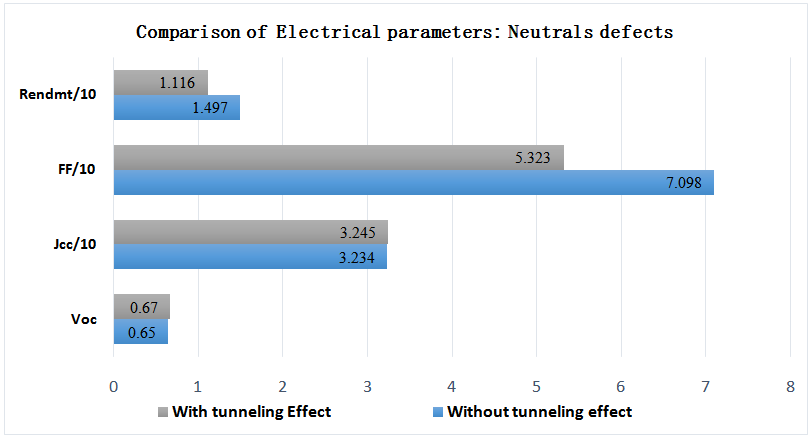
The Table 7 summarizes the simulation results of both following situations: Cu-rich solar cell with tunnel effect and Cu-rich solar cell without tunnel effect.
The analysis of these results allows us to see the influence of tunneling recombination at the CIGS / CdS interface. Indeed, we observe a decrease of the efficiency with this recombination. This observation is justified since this recombination at the interface constitutes an important trap for the photocreated minority carriers. This minority carriers generated at the base have difficulty to pass through the absorbant layer / buffer layer junction and causes a deficit of carriers collected on the front face. The consequence of this observation is a decrease of the efficiency. However we find that Voc and Jcc are fairly comparable. This small difference is not negligible because it has a strong influence on the fill factor and the efficiency. Indeed, the fill factor of the situation without tunneling effect remains higher than that with tunneling effect.

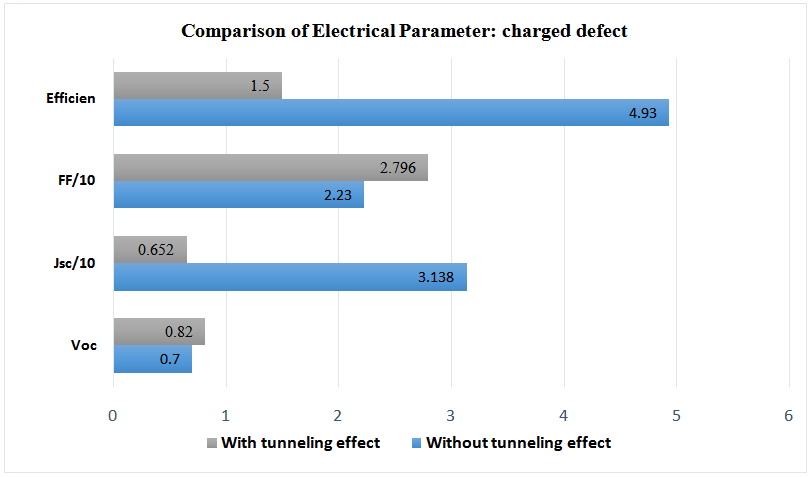
The Table 8 summarize the simulation results of two next situations: solar cell Cu-rich with effect tunneling effect and solar cell Cu-rich without tunneling effect.
As with neutral defects, we note that the evolution of efficiency is the same with charged defects. We note that the impact of tunneling effect always decreases the efficiency of the cell, regardless of the charge type of the defects. We note that in the case of the tunneling effect with charged defects, the short circuit current remains relatively low.
Indeed, the charged defects cause localized potential differentials which increase the consequences of the tunneling effect. The capacities of the recombination sites at the grain boundaries and the interface are reinforced. This explains the fall of the short-circuit current to 6.52 mA.cm-2. However, the general weakness of the yield with the charged defects can be explained by the recombination and the instability created by the different opposing charges with probable fluctuations 5. This weakness was accentuated by the tunnel effect in the first situation. Also the open circuit voltage varies virtually in the same proportions but remains relatively low with the charged defects.

In order to show the interest and the influence of surface treatment in the CIGS solar cell based Cu-rich absorber, double comparison can be done. The first comparison concern the solar cell with treated Cu-rich absorber against the same not treated absorber. This comparison is necessary to show the interest of surface treatment. The second comparison will concern the Cu-rich solar cell treated and Cu-poor solar cell to show the influence of this treatment in the amelioration of electrical performance of these Cu-rich cells. The performance of Cu-poor solar cell are extracted in the reference 5. The comparison will be with neutral defects and charged defect too.
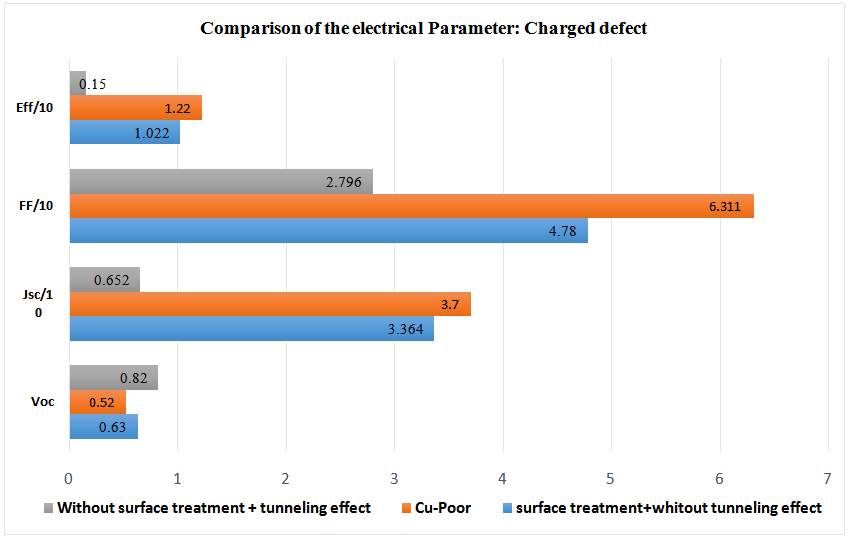
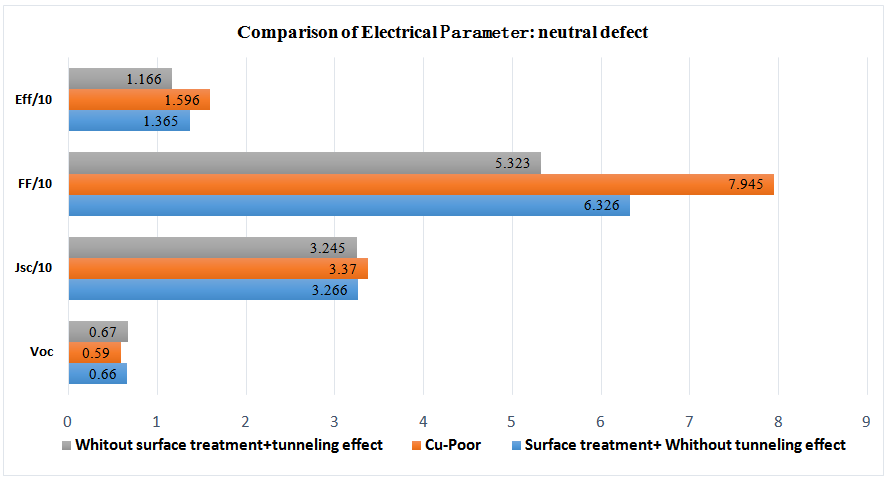
The Table 9 summarize the results of simulation of surface treatment on the Cu-rich cell solar, the results of the solar cell without surface treatment emerge to case 2 and the results of the Cu-poor cell solar. These last situations are showed here to make easy the comparison with surface treated Cu-rich solar cell.
According to the analysis of data in Table 9, the interest of surface treatment is to increase the efficiency of Cu-rich solar cell. We note a definite increase of this efficiency with the surface treatment. This improvement indicate us a decrease of the interface recombination (CIGS/CdS). The value of the open circuit voltage are almost equal and we note the same trend for the short-circuit currents. For the fill factor (FF), a difference of 10% is noted.
Concerning the comparison between the Cu-rich solar cell treated and the Cu-poor solar cell (Table 9), we note a decrease of the difference of the efficiency. In fact, the efficiency of the treated cell get closer to of the once of the solar cell Cu-poor. Which shows that the remarkable influence of this surface treatment on the performance of CIGS Cu-rich solar cell. The open circuit voltage of the treated cell is superior to the one of cell Cu-poor, hence a possible increase and improvement of the final efficiency. On the other hand, the short circuit current and the fill factor stay superiors in the Cu-poor cell.

The Table 10 summarize the results of simulation of surface treatment on the Cu-rich solar cell, the results of the solar cell without surface treatment emerge to case 2 and the results of the Cu-poor solar cell. The only difference with the previous case is the defects type.
The increase sense is same with charged defects than with the neutral defect. The surface treatment combined with the change of charge type in the Cu-rich cell, have no effect on the order of the efficiency. We note that if the defects are charged, the impact of surface treatment on the efficiency is very important. The gap of efficiency between treated Cu-rich cell and no treated Cu-rich solar cell is almost 10%. The interest of surface treatment is very significant if the defects are charged.
The results of this paper have allowed to draw several conclusions. The recombination assisted tunneling effect in the interface Cu-rich CIGS absorber / Buffer Layer CdS is more important if the defect of absorber are charged with a considerable decrease of the efficiency of 11.66 to 1.50% respectively for neutral defects to charged defect. This tendency is observed in the influence of the surface treatment, a strong impact of this treatment on the electrical performances is observed with the charged defects. The gap of efficiency between the cells with Cu-rich absorber treated and no treated increases from 1.99 to 8.72 % respectively with of the neutral defect and with the charged defect. In short, both neutral defects and charged defect, the recombination assisted tunneling effect decreases the efficiency and the surface treatment have a positive effect for the improvement of electrical performances of Cu-rich CIGS solar cell.
Marc BURGELMAN, University of GENK in Belgium for his agreement to use SCAPS software. To all members of thins films group of semiconductor Laboratory of the Science and Technical Faculty of Cheikh Anta DIOP University, DAKAR-SENEGAL.
| [1] | Fogg, B.J, Persuasive technology: using computers to change what we think and do, Morgan Kaufmann Publishers, Boston, 2003, 30-35. | ||
| In article | View Article | ||
| [2] | Hirsh, H., Coen, M.H., Mozer, M.C., Hasha, R. and Flanagan, J.L, “Room service, AI-style,” IEEE intelligent systems, 14 (2). 8-19. Jul.2002. | ||
| In article | View Article | ||
| [3] | T. Eckes, The Developmental Social Psychology of Gender, Lawrence Erlbaum, 2000. [E-book] Available: netLibrary e-book. | ||
| In article | View Article | ||
| [4] | SOCE Mouhamadou Mamour, DIENG Moustapha, EHEMBA Alain Kassine, DIALLO Demba, WADE Ibrahima; Influence of the doping of the absorber and the charged defects on the electrical performance of CIGS solar cells, Laboratory of semiconductor and Solar Energy; Physics Department, Faculty of Science and Technology University CHEIKH Anta DIOP, DAKAR-SENEGAL, International Journal of Scientific and Research Publications, Volume 5, Issue 10, October 2015 1 ISSN 2250-3153 | ||
| In article | |||
| [5] | B.I. Shklovskii, A.L. Efros, Electronic Properties of Doped Semiconductors, Springer-Verlag, Berlin, 1984 | ||
| In article | View Article | ||
Published with license by Science and Education Publishing, Copyright © 2017 Mouhamadou M. Soce, Alain K. Ehemba, Ousmane Diagne, Djimba Niane and Moustapha Dieng
 This work is licensed under a Creative Commons Attribution 4.0 International License. To view a copy of this license, visit
http://creativecommons.org/licenses/by/4.0/
This work is licensed under a Creative Commons Attribution 4.0 International License. To view a copy of this license, visit
http://creativecommons.org/licenses/by/4.0/
| [1] | Fogg, B.J, Persuasive technology: using computers to change what we think and do, Morgan Kaufmann Publishers, Boston, 2003, 30-35. | ||
| In article | View Article | ||
| [2] | Hirsh, H., Coen, M.H., Mozer, M.C., Hasha, R. and Flanagan, J.L, “Room service, AI-style,” IEEE intelligent systems, 14 (2). 8-19. Jul.2002. | ||
| In article | View Article | ||
| [3] | T. Eckes, The Developmental Social Psychology of Gender, Lawrence Erlbaum, 2000. [E-book] Available: netLibrary e-book. | ||
| In article | View Article | ||
| [4] | SOCE Mouhamadou Mamour, DIENG Moustapha, EHEMBA Alain Kassine, DIALLO Demba, WADE Ibrahima; Influence of the doping of the absorber and the charged defects on the electrical performance of CIGS solar cells, Laboratory of semiconductor and Solar Energy; Physics Department, Faculty of Science and Technology University CHEIKH Anta DIOP, DAKAR-SENEGAL, International Journal of Scientific and Research Publications, Volume 5, Issue 10, October 2015 1 ISSN 2250-3153 | ||
| In article | |||
| [5] | B.I. Shklovskii, A.L. Efros, Electronic Properties of Doped Semiconductors, Springer-Verlag, Berlin, 1984 | ||
| In article | View Article | ||


 Se2 [4])


)


)
)
)
)