In this paper, we have studied the influence of the optimum thickness of the base of a series vertical-junction solar cell, under polychromatic illumination and magnetic field, on transition and dark capacitances. The expressions for minority carrier density, photovoltage, and capacitance are derived by solving the diffusion equation for minority carriers, based on boundary conditions involving recombination velocities at the junction (Sf) and in the back zone (Sb). The profile of capacitance versus photovoltage for each value of optimum thickness obtained from the magnetic field is then presented, in order to determine the value of transition and dark capacitances for each value of optimum thickness. The evolution of open-circuit photovoltage (Vco) as a function of magnetic field and optimum base thickness is described at the end.
In today's solar energy domain, the main focus of research is on increasing the efficiency of solar cells. For this reason, it is important to characterize solar cells to limit recombination in volume and surface area, and ultimately increase their capacity for better carrier collection. These recombination parameters can be studied under static or dynamic regime 1, 2, 3, 4, 5.
In this work, we study the effect of the magnetic field and the optimum thickness deduced from the magnetic field 4, 6, 7, 8, 9, 10 on the capacitance of the series-connected vertical junction solar cell in static conditions, under polychromatic illumination 11, 12, 13.
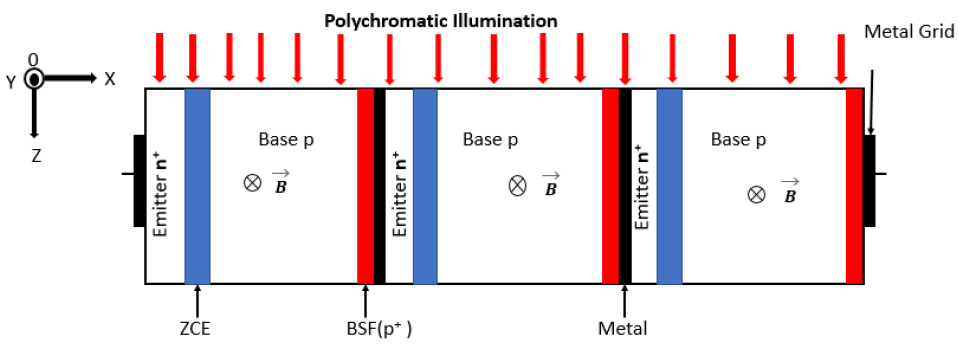
The series vertical-junction solar cell is an assembly of N+/P/P+ photovoltaic cells connected in series by a metal, with illumination parallel to the plane of the space charge zone. 13, 14, 15 (Figure 1).
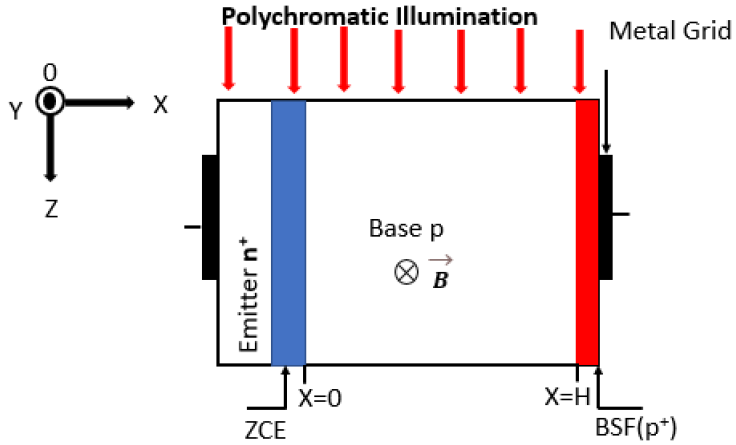
Figure 2 shows a schematic diagram of a series vertical junction solar cell unit under polychromatic illumination and a magnetic field.
The various parts of the series vertical junction silicon solar cell unit are:
The n+ -type emitter: it is thin (0.5-1μm), heavily doped with donor atoms (1017 to 1019 atoms per cm3) and covered with a metal contact that collects the photocreated electrical charges.
The p-type base: This part is relatively lightly doped (1015 to 1017 atoms per cm3) in acceptor atoms. Its thickness is much greater than that of the emitter. Being p-type (doped with acceptor atoms), this part of the structure has a deficit of electrons (minority charge carriers in the base).
The emitter-base junction (Space Charge Zone): between the two zones of the two differently doped semiconductors (the n-type emitter and the p-type base), there is a junction where a very intense electric field prevails, allowing the separation of the electron-hole pairs photogenerated in the base arriving at this junction.


Using magneto-transport theory, the continuity equation for the density of minority charge carriers photogenerated in the base of a series vertical junction solar cell under polychromatic illumination, magnetic field and static regime is writte 4, 6, 11:
 | (1) |
𝛿(𝑥) is the density of excess minority charge carriers photogenerated in the base of the solar cell. 𝜏 is the minority carrier lifetime in the base, defined by the Einstein relation:
 | (2) |
𝐿(𝐵) is the diffusion length of excess minority charge carriers in the base.
𝐷(𝐵) is the diffusion coefficient of minority carriers in the basis 4, 6, 9, it is defined by:
 | (3) |
𝐷0 is the diffusion coefficient in the absence of the magnetic field, μ is the mobility of minority carriers
The expression for the generation rate of minority carriers at depth z in the base is given by the following expression:
 | (4) |
Where 𝑎𝑖 and 𝑏𝑖 are tabulated solar radiation coefficients and depend on the absorption coefficient of silicon with wavelength 16. It correlates the experimental illuminance level with the reference illuminance level taken from AM 1.5.
Solving the continuity equation:
The expression for the continuity equation of comes from:
 | (5) |
The solution to this equation is in the following form:
 | (6) |
The coefficients 𝐴(𝑆𝑓, 𝑆𝑏, 𝑧, 𝐵) and 𝐶(𝑆𝑓, 𝑆𝑏, 𝑧, 𝐵) are determined from the boundary conditions.
Boundary conditions:
 | (7) |
Sf is the recombination velocity of minority charge carriers at the junction, imposed by the external charge, and reflects the flow of minority carriers through the junction 4, 17, 18, 19.
 | (8) |
Sb is the recombination velocity of the excess minority charge carriers in the rear zone of the solar cell 17, 18, 20, 21, 22. It characterizes the loss of carriers in the rear zone. The existence of the backside electric field (BSF) enables photogenerated minority carriers from the backside zone (p/p+ junction) to be sent back to the emitter-base junction to participate in the photocurrent.
2.3. Photocurrent Density, Photovoltage and CapacitanceThe expression for photocurrent density is determined from the density of minority charge carriers using Fick's law. It is given by the following expression:
 | (9) |
q is elementary charge
The expression for the photovoltage across the solar cell under illumination is given by the Boltzmann relation below.
 | (10) |
Kb is Boltzmann's constant, T is the absolute temperature, Nb is the doping rate in the base and ni is the intrinsic electron concentration.
The space charge zone of a silicon solar cell between the emitter and the base can be likened to a planar capacitor whose capacitance is proportional to the junction area and inversely proportional to the extension of the space charge zone 23, 24. The capacitance is due to the diffusion of excess minority charge carriers across the junction. The expression for capacitance is given by the following relationship 23, 25:
 | (11) |
After calculating and developing this expression, we find:
 | (12) |
 (12) is the thermal voltage.
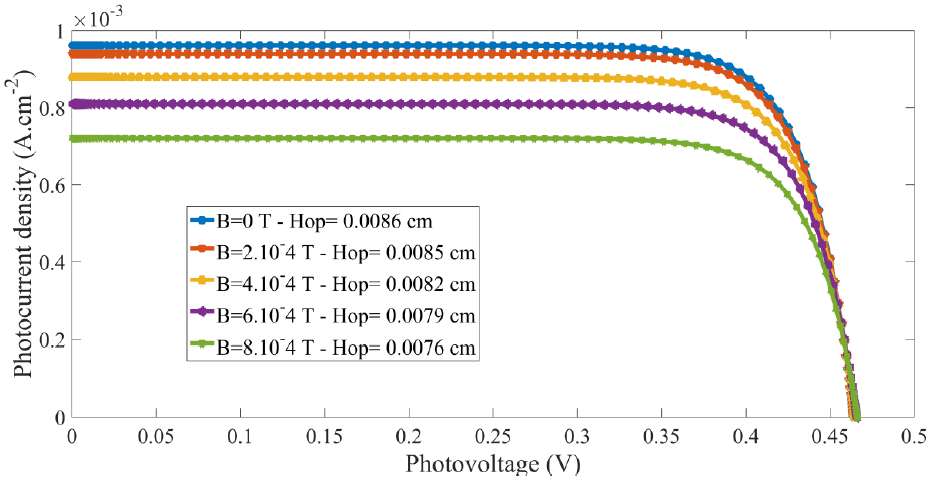
Figure 3 shows the Jph (Sf, Sb, z B, Hop) -Vph (Sf, Sb, z, B, Hop) characteristic profile of the solar cell under polychromat ic illumination for different values of the magnetic field and different values of the optimum thickness imposed by the magnetic field.
This profile was obtained by varying the minority carrier recombination velocity (Sf). At low values of Sf we have open-circuit photovoltage. At high values of the minority carrier recombination velocity (Sf), we obtain the short-circuit phocurrent density.
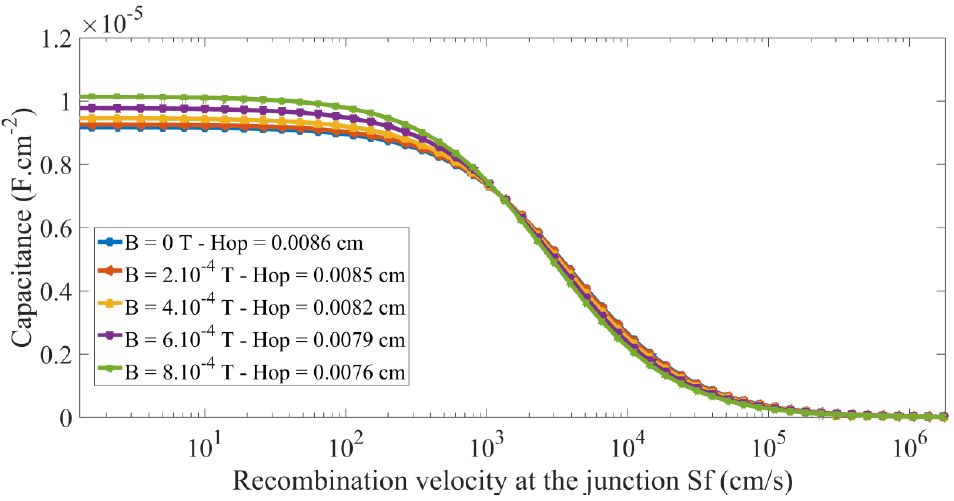
Figure 4 shows the capacitance profile as a function of the minority carrier recombination velocity at the junction for different magnetic field values corresponding to different values of the optimum solar cell base thickness.


In the vicinity of the open circuit, i.e. at low values of the minority carrier recombination velocity at the junction, the capacitance is at its maximum. This corresponds to a narrowing of the space charge zone. Excess photogenerated minority charge carriers are then stored close to the junction. At high junction recombination velocities (near the short circuit), the capacitance is very low. The space charge zone is enlarged. Indeed, as the junction recombination velocity tends towards its higher values, the flow of minority charge carriers across the junction increases, and the quantity of stored carriers in the vicinity of the junction decreases.
However, the capacitance in the vicinity of the open circuit increases with the magnetic field, but decreases slightly in the vicinity of the short circuit. This phenomenon is linked to the increase in the density of excess minority charge carriers near the junction due to the magnetic field.
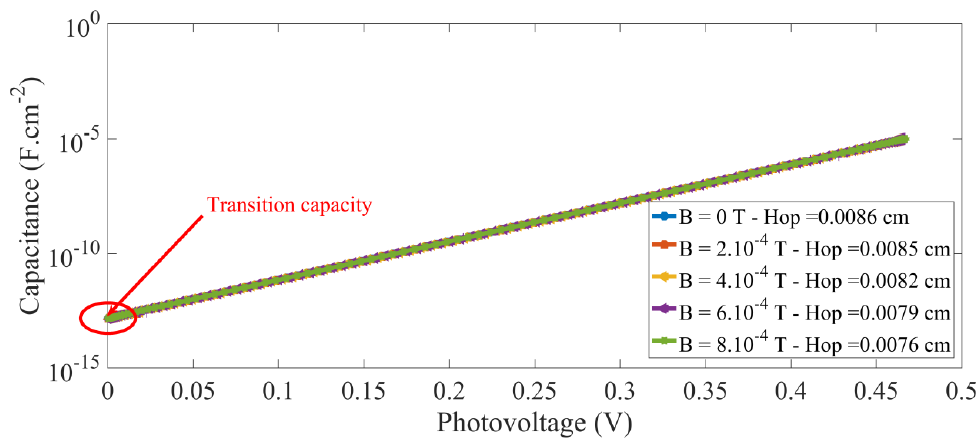
3.1. Determining Transition Capacitance CTFigure 5 shows the evolution of capacitance as a function of photovoltage under the influence of the magnetic field and the corresponding optimum thickness.
The figure above (Figure 5) shows that capacitance is a linear function of photovoltage, with a strictly positive slope. This shows that capacitance increases with photovoltage.
The transition capacitance can be obtained from the ordinate at the origin. In this region, there are almost no free carriers.
It is also noted that the different curves obtained from different values of the magnetic field and the corresponding optimum thickness have the same slope and therefore the same ordinate at the origin. It can be said that the transition capacitance does not depend on the value of the applied magnetic field.
The table below gives the values of transition capacitance, dark capacitance and open-circuit voltage for each value of the optimum thickness imposed by the applied magnetic field. These results are very similar to those of 26.
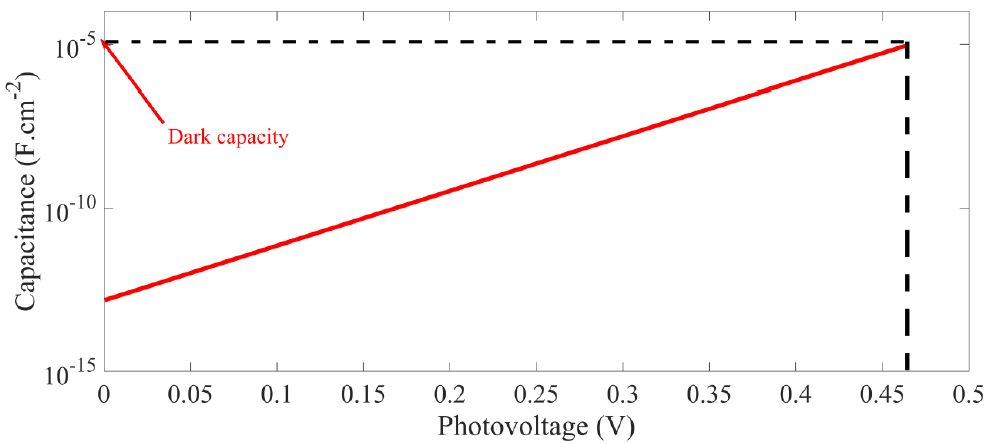
3.2. Determining Dark CapacitanceDark capacitance is the capacitance recorded without illumination. It corresponds to zero photocurant density. Figure 6 shows the technique used to determine dark capacitance.
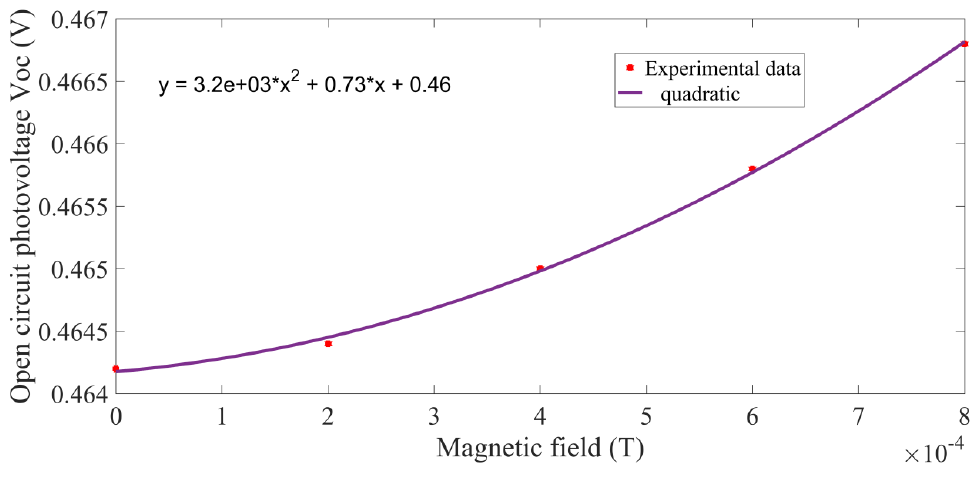
Figure 7 shows the evolution of open-circuit photovoltage as a function of magnetic field.
Figure 7 shows that the photovoltage of the open circuit increases as the magnetic field increases. This is because, as the magnetic field increases, the density of minority carriers near the junction increases.
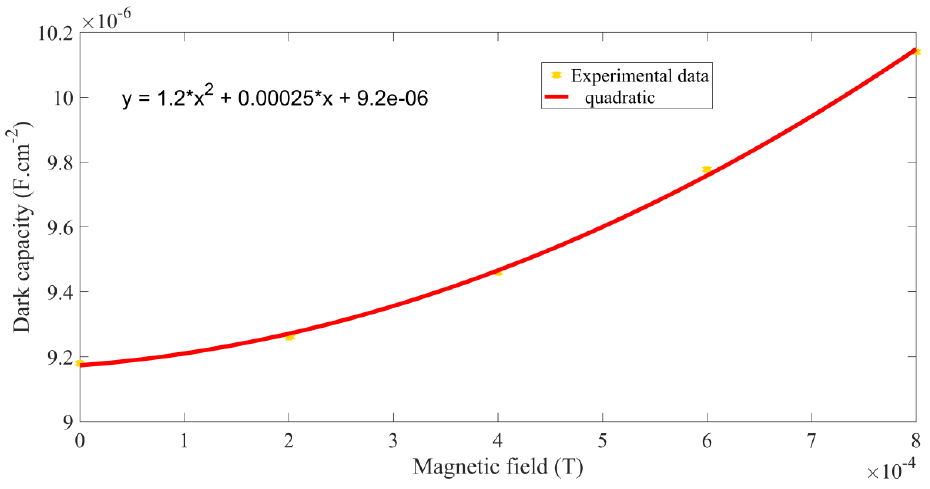
Figure 8 shows the dark capacitance profile as a function of magnetic field.
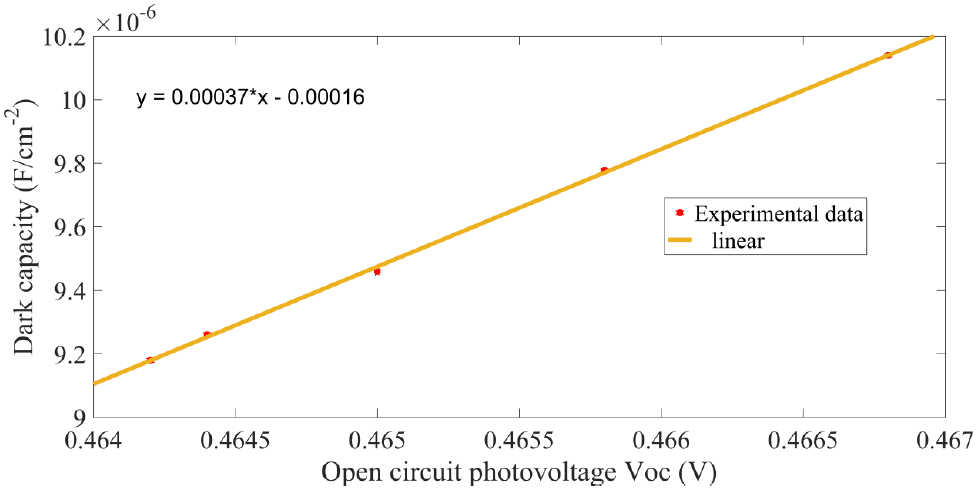
Figure 9 shows the evolution of dark capacitance as a function of open-circuit photovoltage. The capacitance increases with increasing photovoltage.
The mathematical correlation equation is given by:
 | (13) |


In this paper, the influence of the optimum base thickness (imposed by the applied magnetic field) on the capacitance of the series vertical-junction silicon solar cell under polychromatic illumination was studied. Expressions for photovoltage and capacitance, obtained by solving the continuity equation for the density of minority carriers in the base in the static regime, the evolution of capacitance as a function of the velocity of minority carriers at the junction and that of capacitance as a function of photovoltage have been studied for different values of magnetic field and corresponding optimum thickness. Figure 5 illustrates the determination of transition capacitance and open-circuit photovoltage, for each value of the optimum base thickness imposed by the magnetic field. The evolution of open-circuit photovoltage as a function of magnetic field and optimum base thickness has also been studied in this article.
| [1] | Diallo, H.L., Wereme, A., Maiga, A.S. and Sissoko, G. (2008). New approach of both junction and back surface recombination velocities in a 3D modelling study of a polycrystalline silicon solar cell. The European Physical Journal Applied Physics, 42, pp.203-211. | ||
| In article | View Article | ||
| [2] | Stokes, E. D. and Chu, T. L. (1977). Diffusion Lengths in Solar Cells From Short-Circuit Current Measurements. Applied Physics Letters, Vol. 30, No8, pp.425-426. | ||
| In article | View Article | ||
| [3] | Sissoko, G., Nanéma, E., Corréa, A., Biteye, P.M., Adj, M. and N’Diaye, A.L. (1998). Silicon Solar Cell Recombination Parameters Determination Using the Illuminated I-V Characteristic. World Renewable Energy Congress, Florence, 20-25 September 1998, 1847 1851. | ||
| In article | |||
| [4] | Vardayan, R.R., Kerst, U., Wawer, P., Nell, M.N. and Wagemann, H.G (1998). Method of Measurement of All Recombination Parameters in the Base Region of Solar Cells. Proceedings of 2nd Conference and Exhibition on Photovoltaic Solar Energy Conversion, Vienna, 6-10 July 1998, 191-193. | ||
| In article | |||
| [5] | Jung, T.-W., Lindholm, F.A. and Neugroschel, A. (1984). Unifying View of Transient Responses for Determining Lifetime and Surface Recombination Velocity in Silicon Diodes and Back-Surface-Field Solar Cells, with Application to Experimental Short-Circuit-Current Decay. IEEE Transactions on Electron Devices, 31, 588- 595. | ||
| In article | View Article | ||
| [6] | Betse, Y., Ritte, D., Bahir, G., Cohen, S. and Sperling, J. (1995). Measurement of the minority carrier mobility in the base of heterojunction bipolar transistors using a magnetotransport method”, Appl. Phys. Lett., Vol. 67, No. 13, Pp. 1883-1884. | ||
| In article | View Article | ||
| [7] | Diop, G., Ba, H. Y., Thiam, N., Traore, Y., Dione, B., Ba, M. A., Diop, P., Diop, M. S., Mballo, O. and Sissoko, G. (1019). Base thickness optimization of a vertical series junction silicon solar cell under magnetic field by the concept of back surface recombination velocity of minority carrier. ARPN Journal of Engineering and Applied Sciences, Vol. 14, No. 23, pp.4078 4085. | ||
| In article | |||
| [8] | Faye, D., Gueye, S., Ndiaye, M., Ba, M. L., Diatta, I., Traore, Y., Diop, M. S., Diop, G., Diao, A. and Sissoko, G. (2020). Lamella silicon solar cell under both temperature and magnetic field: width optimum determination. https:// www.scirp.org/ journal/ jemaa. | ||
| In article | View Article | ||
| [9] | Flohr, Th. and Helbig, R. (1989). Determination of Minority-Carrier Lifetime and Surface Recombination Velocity by Optical-Beam Induced-Current Measurements at Different Light Wavelengths. Journal of Applied Physics, 66, 3060-3065. | ||
| In article | View Article | ||
| [10] | Diop M.S., Ba H.Y., Thiam N., Diatta I., Traore Y., Ba M.L., Sow E.H., Mballo O. and Sissoko G. (2019). Surface Recombination Concept as Applied to Determinate Silicon Solar Cell Base Optimum Thickness with Doping Level Effect. World Journal of Condensed Matter Physics, 9, 102-111. | ||
| In article | View Article | ||
| [11] | Gover, A. and Stella, P. (1974). Vertical Multijunction Solar-Cell One-Dimensional Analysis. IEEE. | ||
| In article | View Article | ||
| [12] | Wise, J.F. (1970). Vertical Junction Hardened Solar Cell. US Patent 3, 690-953. | ||
| In article | |||
| [13] | Terheiden, B., Hahn, G., Fath, P. and Bucher, E. (2000). The Lamella Silicon Solar Cell. 16th European Photovoltaic Solar Energy Conference, Glasgow, pp.1377-1380. | ||
| In article | |||
| [14] | Hu, C., Carney, J.K. and Frank, R.I. (1977). New Analysis of a High Voltage Vertical Multijunction Solar Cell. Journal of Applied Physics, 48, 442-444. | ||
| In article | View Article | ||
| [15] | Sarfaty, R., Cherkun, A., Pozner, R., Segev, G., Zeierman, E., Flitsanov, Y., Kribus, A. and Rosenwaks, Y. (2011). Vertical Junction Si Micro-Cells for Concentrating Photovoltaics. Proceedings of the 26th European Photovoltaic Solar Energy Conference and Exhibition, Hamburg, 5-6 September 2011, 145-147. | ||
| In article | |||
| [16] | Furlan, J. and Amon, S. (1985). Approximation of the Carrier Generation Rate in Illuminated Silicon. Solid-State Electronics, 28, 1241 1243. | ||
| In article | View Article | ||
| [17] | Sissoko, G., Museruka, C., Corréa, A., Gaye, I. and Ndiaye, A.L. (1996). Light Spectral Effect on Recombination Parameters of Silicon Solar Cell. World Renewable Energy Congress, Pergamon, Part III, pp.1487-1490. | ||
| In article | |||
| [18] | Joardar, K., Dondero, R.C. and Schroda, D.K. (1989) A Critical Analysis of the Small- Signal Voltage-Decay Technique for Minority Carrier Lifetime Measurement in Solar Cells. Solid-State Electronics, 32, pp.479-483. | ||
| In article | View Article | ||
| [19] | Sissoko, G., Sivoththanam, S., Rodot, M. and Mialhe, P (1992). Constant Illumination-Induced Open Circuit Voltage Decay (CIOCVD) Method, as Applied to High Efficiency Si Solar Cells for Bulk and Back Surface Characterization. 11 th European Photovoltaic Solar Energy Conference and Exhibition, Montreux, pp.352-354. | ||
| In article | |||
| [20] | Rose, B.H. and Weaver, H.T. (1983). Determination of Effective Surface Recombination Velocity and MinorityCarrier Lifetime in High Efficiency Si Solar Cells. Journal of Applied Physics, 54, pp.238-247. | ||
| In article | View Article | ||
| [21] | Fossum, J.G. (1977). Physical Operation of Back-Surface-Field Silicon Solar Cells. IEEE Transactions on Electron Devices, 2, pp.322 325. | ||
| In article | View Article | ||
| [22] | Diasse, O., Diao, A., Ly, I., Diouf, M.S., Diatta, I., Mane, R.,Traore, Y and Sissoko, G. (2018), Back Surface Recombination Velocity Modeling in White Biased Silicon Solar Cell under Steady State. journal of Modern Physics, 9, 189-201. | ||
| In article | View Article | ||
| [23] | MBODJI, S. (2009). Etude en modélisation de l’élargissement de la zone de charge d’espace et de la capacité de transition d’une photopile bifaciale au silicium polycristallin sous éclairement monochromatique constant. Thèse de 3ème Cycle, U.C.A.D, Dakar, Sénégal. | ||
| In article | |||
| [24] | Böer, K. W. (2010). Introduction to Space Charge Effects in Semiconductors. Springer Series in Solid-State Sciences. | ||
| In article | View Article | ||
| [25] | Mbodji, S., Mbow, B., Barro, F. I., & Sissoko, G. (2011). A 3D model for thickness and diffusion capacitance of emitter-base junction determination in a bifacial polycrystalline solar cell under real operating condition. Turk J Phys, 35, 281 – 291. | ||
| In article | View Article | ||
| [26] | Mauro, P., Daren, P., Jai Prakash, S and al.(2021) The effect of capacitance on high-efficiency photovoltaic modules : a review of testing methods and related uncertainties, journal of Physics D :Appl.Phys. 54 193001. | ||
| In article | View Article | ||
Published with license by Science and Education Publishing, Copyright © 2025 Dibor FAYE, Pape DIOP, Babou DIONE and Mamadou yacine BA
 This work is licensed under a Creative Commons Attribution 4.0 International License. To view a copy of this license, visit
http://creativecommons.org/licenses/by/4.0/
This work is licensed under a Creative Commons Attribution 4.0 International License. To view a copy of this license, visit
http://creativecommons.org/licenses/by/4.0/
| [1] | Diallo, H.L., Wereme, A., Maiga, A.S. and Sissoko, G. (2008). New approach of both junction and back surface recombination velocities in a 3D modelling study of a polycrystalline silicon solar cell. The European Physical Journal Applied Physics, 42, pp.203-211. | ||
| In article | View Article | ||
| [2] | Stokes, E. D. and Chu, T. L. (1977). Diffusion Lengths in Solar Cells From Short-Circuit Current Measurements. Applied Physics Letters, Vol. 30, No8, pp.425-426. | ||
| In article | View Article | ||
| [3] | Sissoko, G., Nanéma, E., Corréa, A., Biteye, P.M., Adj, M. and N’Diaye, A.L. (1998). Silicon Solar Cell Recombination Parameters Determination Using the Illuminated I-V Characteristic. World Renewable Energy Congress, Florence, 20-25 September 1998, 1847 1851. | ||
| In article | |||
| [4] | Vardayan, R.R., Kerst, U., Wawer, P., Nell, M.N. and Wagemann, H.G (1998). Method of Measurement of All Recombination Parameters in the Base Region of Solar Cells. Proceedings of 2nd Conference and Exhibition on Photovoltaic Solar Energy Conversion, Vienna, 6-10 July 1998, 191-193. | ||
| In article | |||
| [5] | Jung, T.-W., Lindholm, F.A. and Neugroschel, A. (1984). Unifying View of Transient Responses for Determining Lifetime and Surface Recombination Velocity in Silicon Diodes and Back-Surface-Field Solar Cells, with Application to Experimental Short-Circuit-Current Decay. IEEE Transactions on Electron Devices, 31, 588- 595. | ||
| In article | View Article | ||
| [6] | Betse, Y., Ritte, D., Bahir, G., Cohen, S. and Sperling, J. (1995). Measurement of the minority carrier mobility in the base of heterojunction bipolar transistors using a magnetotransport method”, Appl. Phys. Lett., Vol. 67, No. 13, Pp. 1883-1884. | ||
| In article | View Article | ||
| [7] | Diop, G., Ba, H. Y., Thiam, N., Traore, Y., Dione, B., Ba, M. A., Diop, P., Diop, M. S., Mballo, O. and Sissoko, G. (1019). Base thickness optimization of a vertical series junction silicon solar cell under magnetic field by the concept of back surface recombination velocity of minority carrier. ARPN Journal of Engineering and Applied Sciences, Vol. 14, No. 23, pp.4078 4085. | ||
| In article | |||
| [8] | Faye, D., Gueye, S., Ndiaye, M., Ba, M. L., Diatta, I., Traore, Y., Diop, M. S., Diop, G., Diao, A. and Sissoko, G. (2020). Lamella silicon solar cell under both temperature and magnetic field: width optimum determination. https:// www.scirp.org/ journal/ jemaa. | ||
| In article | View Article | ||
| [9] | Flohr, Th. and Helbig, R. (1989). Determination of Minority-Carrier Lifetime and Surface Recombination Velocity by Optical-Beam Induced-Current Measurements at Different Light Wavelengths. Journal of Applied Physics, 66, 3060-3065. | ||
| In article | View Article | ||
| [10] | Diop M.S., Ba H.Y., Thiam N., Diatta I., Traore Y., Ba M.L., Sow E.H., Mballo O. and Sissoko G. (2019). Surface Recombination Concept as Applied to Determinate Silicon Solar Cell Base Optimum Thickness with Doping Level Effect. World Journal of Condensed Matter Physics, 9, 102-111. | ||
| In article | View Article | ||
| [11] | Gover, A. and Stella, P. (1974). Vertical Multijunction Solar-Cell One-Dimensional Analysis. IEEE. | ||
| In article | View Article | ||
| [12] | Wise, J.F. (1970). Vertical Junction Hardened Solar Cell. US Patent 3, 690-953. | ||
| In article | |||
| [13] | Terheiden, B., Hahn, G., Fath, P. and Bucher, E. (2000). The Lamella Silicon Solar Cell. 16th European Photovoltaic Solar Energy Conference, Glasgow, pp.1377-1380. | ||
| In article | |||
| [14] | Hu, C., Carney, J.K. and Frank, R.I. (1977). New Analysis of a High Voltage Vertical Multijunction Solar Cell. Journal of Applied Physics, 48, 442-444. | ||
| In article | View Article | ||
| [15] | Sarfaty, R., Cherkun, A., Pozner, R., Segev, G., Zeierman, E., Flitsanov, Y., Kribus, A. and Rosenwaks, Y. (2011). Vertical Junction Si Micro-Cells for Concentrating Photovoltaics. Proceedings of the 26th European Photovoltaic Solar Energy Conference and Exhibition, Hamburg, 5-6 September 2011, 145-147. | ||
| In article | |||
| [16] | Furlan, J. and Amon, S. (1985). Approximation of the Carrier Generation Rate in Illuminated Silicon. Solid-State Electronics, 28, 1241 1243. | ||
| In article | View Article | ||
| [17] | Sissoko, G., Museruka, C., Corréa, A., Gaye, I. and Ndiaye, A.L. (1996). Light Spectral Effect on Recombination Parameters of Silicon Solar Cell. World Renewable Energy Congress, Pergamon, Part III, pp.1487-1490. | ||
| In article | |||
| [18] | Joardar, K., Dondero, R.C. and Schroda, D.K. (1989) A Critical Analysis of the Small- Signal Voltage-Decay Technique for Minority Carrier Lifetime Measurement in Solar Cells. Solid-State Electronics, 32, pp.479-483. | ||
| In article | View Article | ||
| [19] | Sissoko, G., Sivoththanam, S., Rodot, M. and Mialhe, P (1992). Constant Illumination-Induced Open Circuit Voltage Decay (CIOCVD) Method, as Applied to High Efficiency Si Solar Cells for Bulk and Back Surface Characterization. 11 th European Photovoltaic Solar Energy Conference and Exhibition, Montreux, pp.352-354. | ||
| In article | |||
| [20] | Rose, B.H. and Weaver, H.T. (1983). Determination of Effective Surface Recombination Velocity and MinorityCarrier Lifetime in High Efficiency Si Solar Cells. Journal of Applied Physics, 54, pp.238-247. | ||
| In article | View Article | ||
| [21] | Fossum, J.G. (1977). Physical Operation of Back-Surface-Field Silicon Solar Cells. IEEE Transactions on Electron Devices, 2, pp.322 325. | ||
| In article | View Article | ||
| [22] | Diasse, O., Diao, A., Ly, I., Diouf, M.S., Diatta, I., Mane, R.,Traore, Y and Sissoko, G. (2018), Back Surface Recombination Velocity Modeling in White Biased Silicon Solar Cell under Steady State. journal of Modern Physics, 9, 189-201. | ||
| In article | View Article | ||
| [23] | MBODJI, S. (2009). Etude en modélisation de l’élargissement de la zone de charge d’espace et de la capacité de transition d’une photopile bifaciale au silicium polycristallin sous éclairement monochromatique constant. Thèse de 3ème Cycle, U.C.A.D, Dakar, Sénégal. | ||
| In article | |||
| [24] | Böer, K. W. (2010). Introduction to Space Charge Effects in Semiconductors. Springer Series in Solid-State Sciences. | ||
| In article | View Article | ||
| [25] | Mbodji, S., Mbow, B., Barro, F. I., & Sissoko, G. (2011). A 3D model for thickness and diffusion capacitance of emitter-base junction determination in a bifacial polycrystalline solar cell under real operating condition. Turk J Phys, 35, 281 – 291. | ||
| In article | View Article | ||
| [26] | Mauro, P., Daren, P., Jai Prakash, S and al.(2021) The effect of capacitance on high-efficiency photovoltaic modules : a review of testing methods and related uncertainties, journal of Physics D :Appl.Phys. 54 193001. | ||
| In article | View Article | ||