The torsion as observable of electromagnetic field interacting with matter is studied under geometrical invariance and its corresponding energy spectra, using in this last, an adaptation of censorship device of matter for Hall Effect sensor considering the kinematic invariance of the particle in movement. After are developed and obtained some application of studied field torsion.
The study of torsion has that see as the double curvature of a space or body, which is result of interaction of two fields, where one field is the electromagnetic field and other a field relative to the matter, which is the gravitational field in a wide sense.
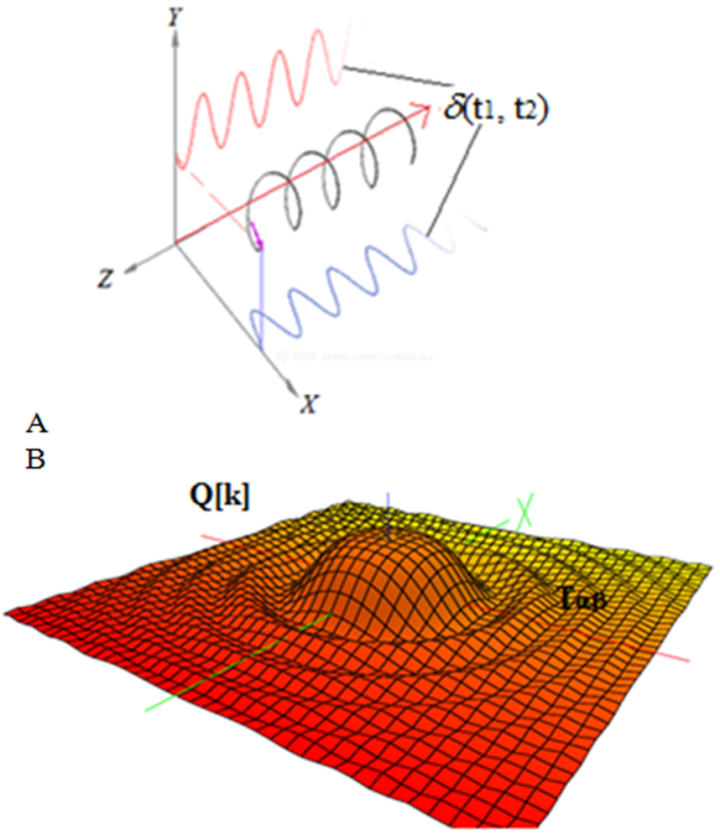
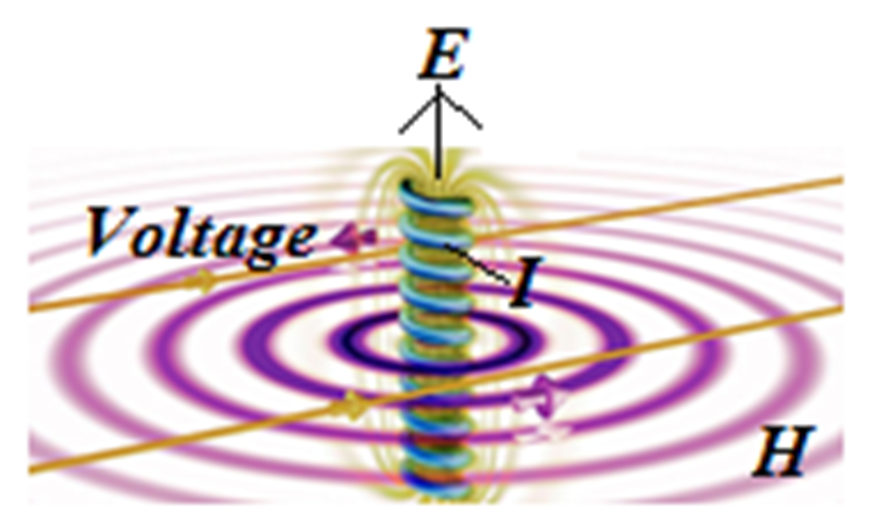
Likewise, studies realized in the space-time, establish that torsion born from the matter spins which under the action of the electromagnetic field produce spin-waves whose geometrical invariants are spinors in the invariant theory 1, 2 (see Figure 1).

This was formulated in a first conjecture.
Conjecture 1.1. The curvature in spinor-twistor framework can be perceived with the appearing of the torsion and the anti-self-dual fields 2.
The spin-waves can be detected indirectly under electronics analysis and using an electromagnetic particle as dilaton 5, 6 to a movement type generated whose torsion can be constant in all space 4. Likewise, are obtained signals of the form
 | (1) |
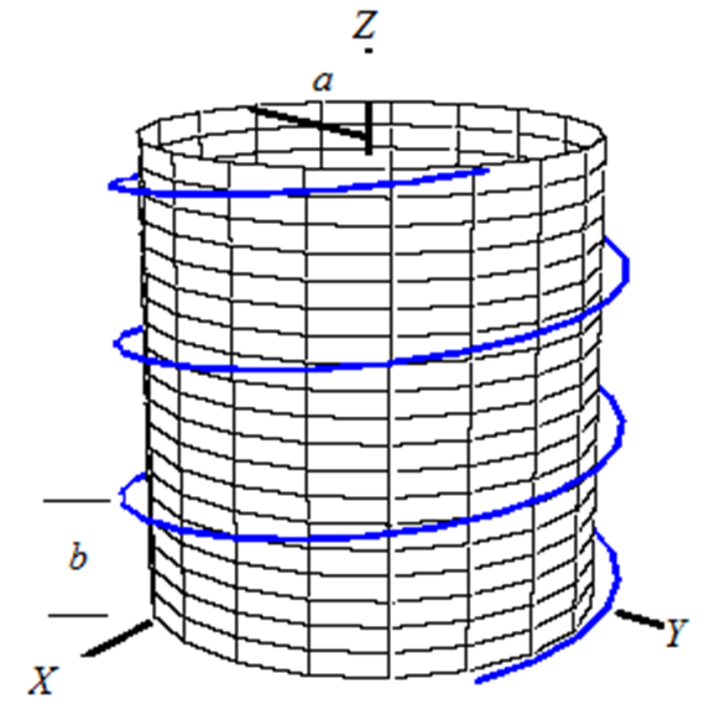
These signals evidence the torsion under permanent torsion conditions in a torsion detector designed under special rotating conditions of a dilaton or particle that reveals the torsion in the space-time 2, 4 under action of an electromagnetic field considering the kinematic invariance. Then chooses a trajectory in our electronic device of constant torsion{1} (Figure 2).

Likewise, for several researches and results obtained on the curvature energy and torsion 2, 3, 5, 6, 7, 8, 9, has been conjectured that:
Conjecture 1.2 (F. Bulnes). The torsion is the geometrical invariant of the interaction between energy and space.
This permit establish dualities and correspondences between invariants of different nature. As for example, in some works 2, 3, the torsion tensor is analysed as dual image in a contorted space embedding of the matter-energy interaction described by the energy-matter tensor. Of fact, the torsion effect phenomena exist as interaction between energy-vacuum, which produces movement. Then we require to define other tensor called kinematic contorsion tensor to establish in the level of energy the duality defined between torsion in gravity 11.
The torsion as invariant of energy-space stays defined as:
 | (2) |
Where
 | (3) |
Then finally, the torsion tensor can be written as
 | (4) |
which involves only energy through waves called spinors and on space-time points defined under the spinor correspondence{2}
 | (5) |
This can be expressed ordinariness as the appearing of waves in the space-time agitation when a field acts from a microscopic point of view in the existence of energy in the space. This energy can be an indium of gravity, which the scientists measure as gravitational waves when are involved other aspects in the field equations.
Then our research, in this step will be develop an improved second device of electronic nature (there is one 4) to detect and measure in an indirect way the existence of torsion as a mechanism of interaction between two fields.
From a point of view of the field theory, torsion is a high evidence of the birth gravity and its consequences until our days with the gravitational waves detected from astronomical observatories.
However, the limitations of the our purely electronic devices only let see and interpret using the arguments of geometry, certain traces of electronic signals of the torsion evidence considering an electromagnetic field determined in certain voltage range and a movement of cylindrical trajectory, which as we know, is the constant torsion. The kinematics studied from kinematic tensor (movement choose of dilaton) reveals the other part of torsion required in this study.
For the sensing of magnetic field is used the following signal theorem.
Theorem. 2.1. (F. Bulnes) We consider the spectral curvature  in a curved surface
  The functional torsion due to the force
 that moves a particle along the height
  and helix of angle of
  is given by:
 | (6) |
Proof. We consider a space curve  general helix in the general signal construction (see the Figure 2). Then for the Lancret criteria,
  10 is a general helix if and only if its torsion and curvature comply:
 | (7) |
In particular, for the curvature and torsion value of the cylindrical helix we have that:
 | (8) |
Then the screw effect will be obtained using the field of equations{3}
 |
{4}
producing the screw surface with torsion  The appearing of waves in the space-time agitation when a field acts from a microscopic level in the existence of energy in the space produces the screw effect (see the Figure 3). Then by duality of the wave spectra, we have{5}
 | (9) |
where the kernel of the transform involves the waves that interact in a space  in
in  and
and plane having terms
  being the projections of a helix in the space on the
  and
and  planes (Figure 3).
Likewise,
 | (10) |
Using the inverse Fourier transform to define a torsion signal of direct time, we have that:
 |

 (Einstein energy-matter tensor) in supermassive body.
  is the electromagnetic charge interacting with the energy-matter. In our experiments the charge will be the force expressed by
  used in the servo-system for go up or throw the dilaton in the trajectory
Corollary (F. Bulnes) 2.1. The torsion energy is its curvature energy.
Proof. The two energies are equal if their energy densities are equal. Then we consider the 2-dimensional Fourier transform
 |
The corresponding spinor representation of the spectral torsion considering (2) is
 | (11) |
However, the expression of spinor spectra  is not easy to obtain, because is required a microscopic treatment of the behavior of quantum particles that are sources of the torsion.
Likewise, this treatment could seems some “plane” in some aspects, but on  and the current density,
  stays linked in an expression, possibly in a major order{6} when we can establish with clarity of the possible, sources of torsion 6. Since analyze the interactions between fermions of many generations (dispersion) can be determinant, at least for prove the appearing of torsion in the microscopic scale. In the torsion, phenomena there are many aspects around of the effects obtained of the interacting between fermions and the role of the neutrinos production that conform the beginning of the Universe. Such and as can be viewed, the description of the gravity phenomena, not can be un-linked of the torsion for the proper fermionic nature of the phenomena from the Big Bang.
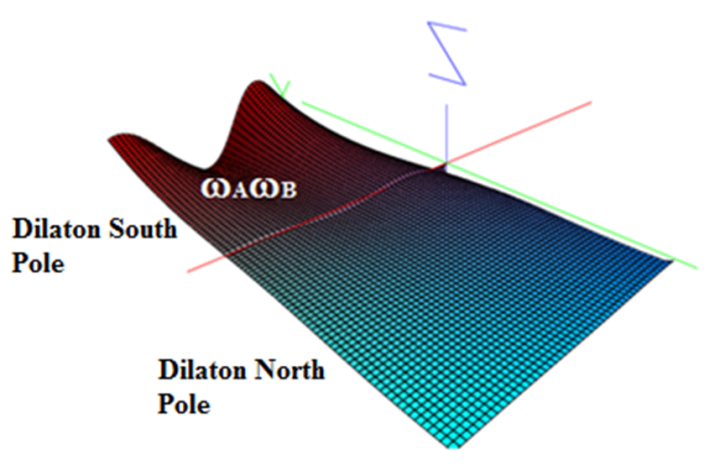
Then the oscillations that can be descriptive through spinors can be through the mixture of dilaton oscillations and neutrinos/anti-neutrinos could be measured through spinors. However, we need establish the front of “waves” in this scale 12. In a correct duality, the waves are dual to the kinematic tensor image in the field gravity equations 2, 3, 4. In this research the kinematic tensor give us trajectories or movement curves associated to the torsion through the spinor waves 4 (Figure 4).


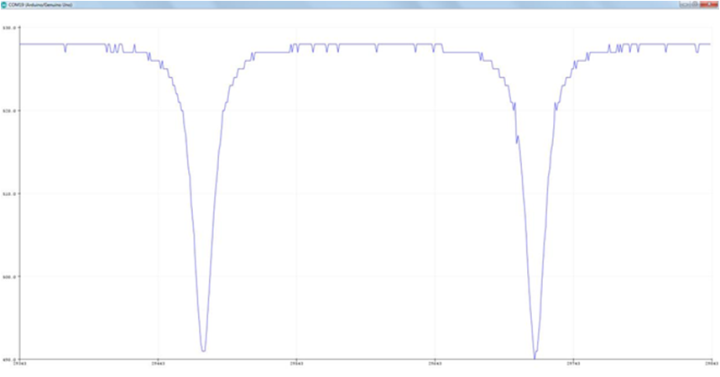
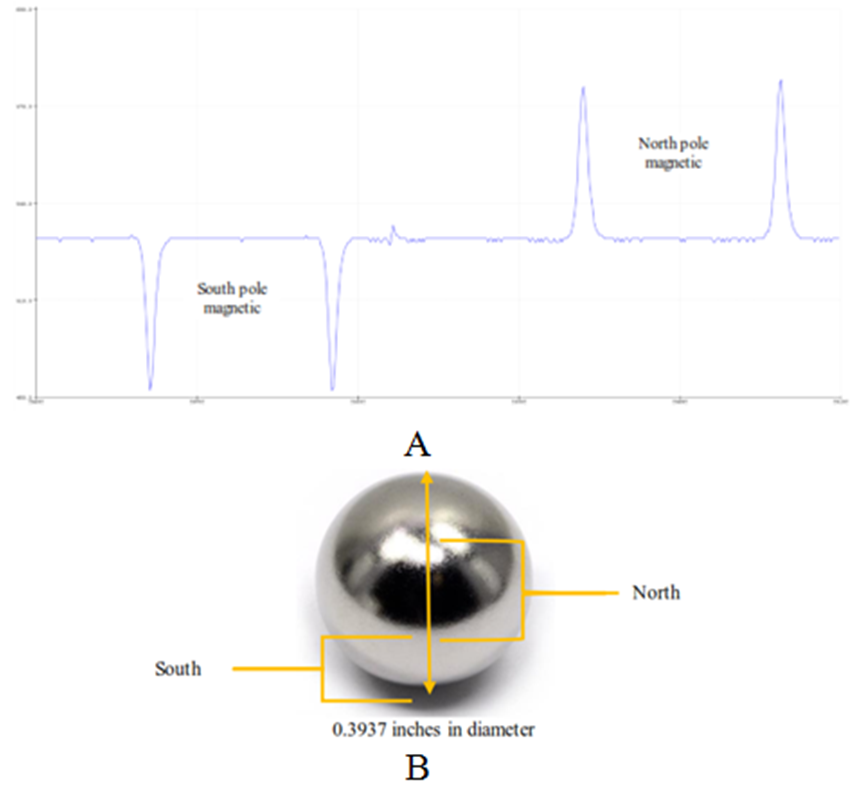
For the detection of the red portion is required a quantum Hall sensor. However, the indirect measures by our Hall sensor are useful. The signal curves (Figure 5) correspond to south pole of the dilaton.
For the sensing of magnetic field is used a module of Hall Effect KY-024 (see the Figure 6), which has a sensor of linear Hall Effect SS49E. This linear Hall Effect component will obtain an output voltage proportional to the magnetic field magnitude detected with a sensibility of the order of 1.4mV/Gauss., permitting also the orientation magnetic field detection 13, 14, 15.


The proportionality mentioned before stays established in the following lemma.
Lemma 3.1. We consider a sensor Hall device . The current deflection detected for the magnetic field change and the sensor produces per volume unit a torsion energy:
 | (12) |
where  is the electric current,
  is the radius of a spire,
  is a distance which could correspond to a cycle of the cylindrical spiral when is re-walked a distance
  on its axis (see the Figure 2).
The sensor Hall device , can be defined as the topological vector space (see Figure 8):
 |
The action with the dilaton mechanism (spiral movement mechanism) will have a voltage interval.
The before lemma determine the torsion obtained by the magnetic field in a point in a conductor where transit current.


Proof. The detection of sensor Hall device  , is realised through of magnetic field variation produced for a deflection of current. Due to that the magnetic field intensity
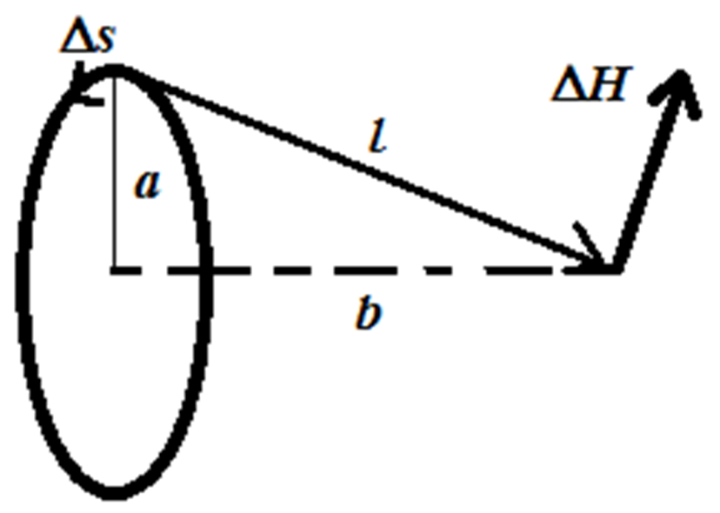
  linearly depends of the current intensity, summing the fields produced for all segments will be obtained the total magnetic field produced for the spire where flows the current, without the spatial currents extended in the neighbourhood (see Figure 8). Then we can characterize as a vector a spire segment. Likewise, we have that a segment
  displace us a length
  which will contribute in
 to the field, being the quantity of this increment
 | (13) |
being  the distance of a point
  to the spire segment, having the value
  See the Figure 9.

For our experiments we can ignore the value of  which is very little to be considered.
Likewise,
 | (14) |
Then the total magnetic field is:
 | (15) |
However, we remember that the Effect Hall sensor deflects the current to create a potential through magnetic field  then considering the Ohm’s law to relate potential with current and characterizing this deflection (or deviation) as curvature, further to use the corollary 2. 1, we have that:
 | (16) |
where substituting (15) in (16) we have:
 | (17) |
which being considered a cylindrical helix trajectory for the sensing, the torsion (17) has its corresponding geometrical term of constant torsion
 | (18) |
The corresponding dimensional analysis 8{7}
 | (19) |
which finally will be which is the torsion unit from a point of geometrical purely view 7.
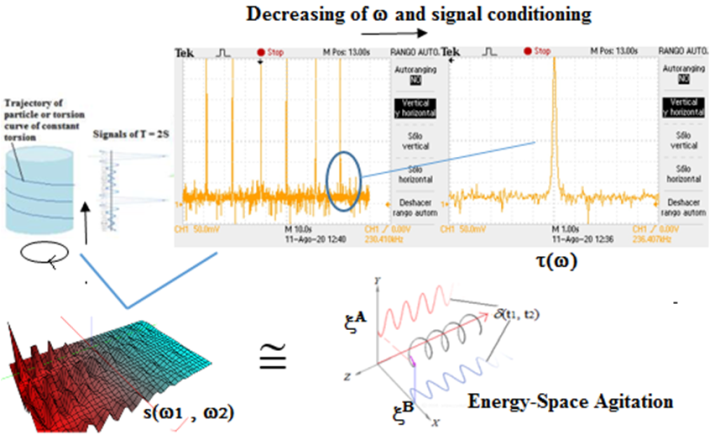
The torsion must be detected under conditions of movement. Likewise, by the lemma 3. 1, the produced magnetic field in the dilaton must be (17) and is necessary decrease the cycles for seconds of the turns for that these are detectable by the Hall type sensor (with low velocity). Why? Because per each roportional to each
  detected there is a variation of electric tension of
 which does not detectable the voltage
 in the sensor. Then to be able to measure it is necessary to condition the signal. The signal condition will be with the initial constant voltage signal
  , which is a rectangular signal of conditioning. Here
  {8} is an amplifier factor of the voltage for be detectable. Then the spectra of energy of the torsion will be (Figure 10):
 |
which is a signal type that evidences a torsion indicium in the space-time (see expression (1)) for the interaction of the magnetic field of the proper dilaton and the movement of this dilaton inside of the gravitational field of the Earth and energy-space agitation due the kinematics dilaton (Figure 11).

 Constant torsion detected as spectral torsion. The frequency is decreased until 121.56Hz.
 Observe the smoothing of the before signal for the spinors. This energy surface is for the case in the electronics
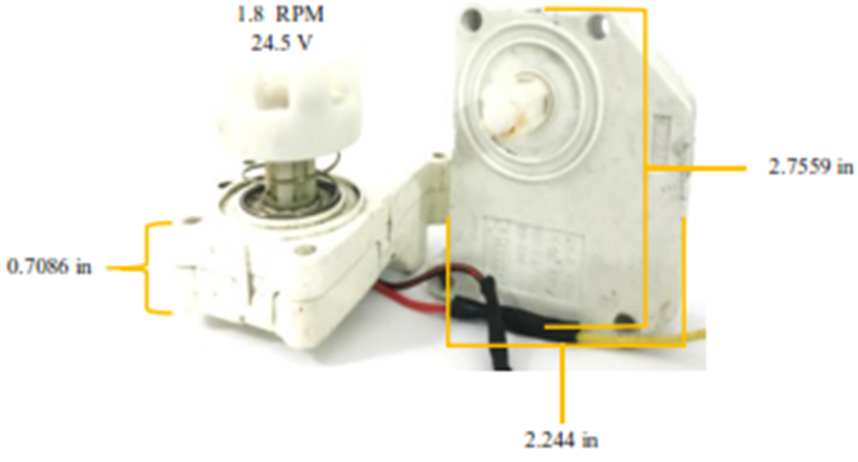
For the signal conditioning established before has been added an operational amplifier as a differentiator (or receiver) and with the potentiometer adjust the set point or reference electrical tension comparing with the output electrical tension obtaining the  quantity required for the detection of the Hall type sensor. Likewise, is used a motor-reductor to define the linear and rotational movement whose torsion
  with the characteristics given in the Table 1, Figure 12.

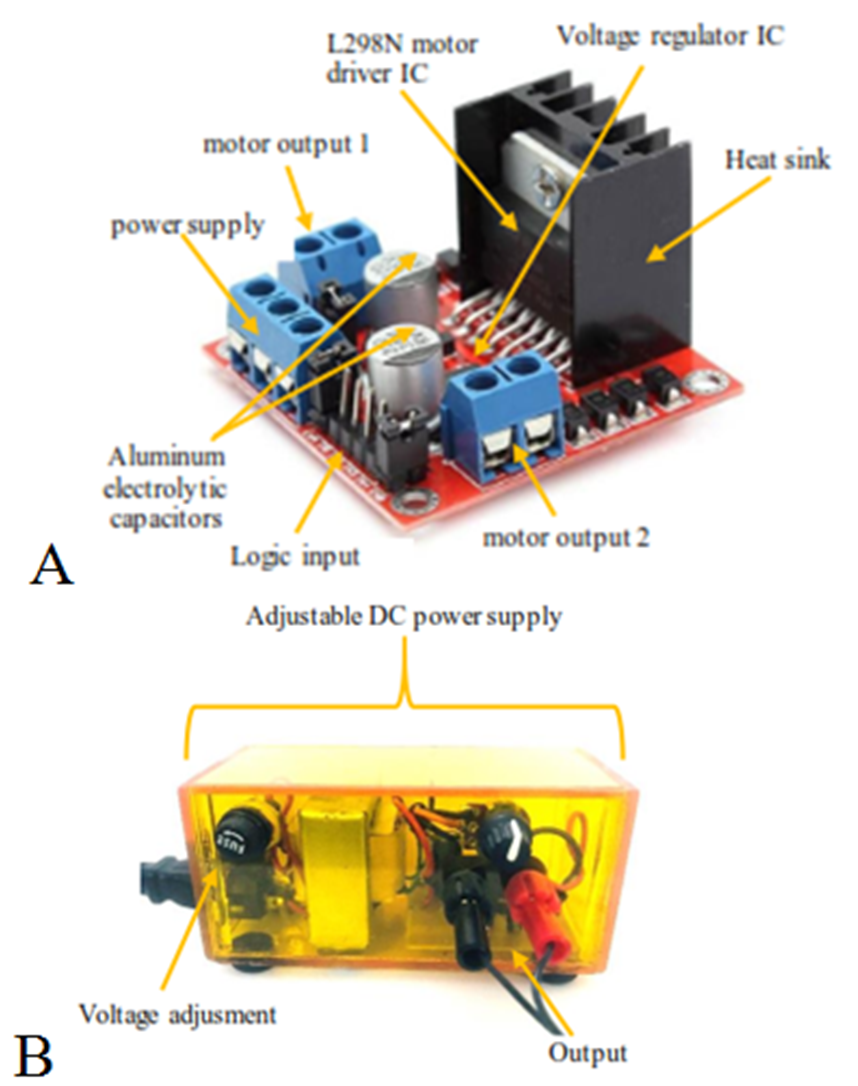
The spin control of the actuators has been implemented through a double H-bridge incorporated in the module L298N, which permit us control the direction of the DC-motor functioning, steps motors, solenoids and any other inductive charge for pass them to output current for channel until  This module bases its functioning in the CI 298. In the following Figure 13, shows the module and its electrical characteristics in the Table 1.

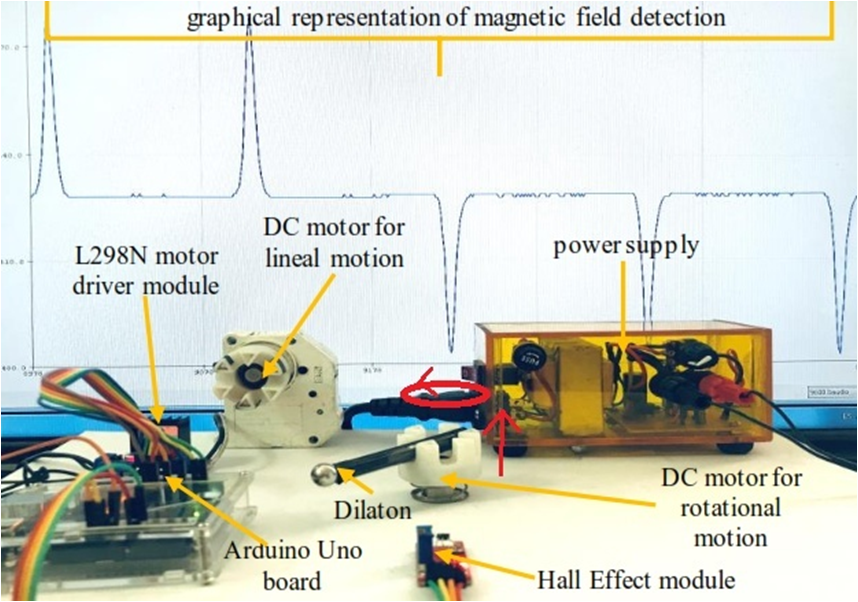
In the Figure 14, is showed the system functioning. At the background is appreciated the motor-reductor through which will be generated the linear movement. In the centre is showed the second motor-reductor, which will realise the rotational movement. The Arduino uno plate controls both actuators. In this, was designed the code for that both actuators spin for a determined time to a direction, these are stopped and change the spin direction.
The digital output signals are sending to the module L298N, for control electrically the change of spin direction and the feeding of the actuators. The feeding comes from the dimmable feeding source of DC. In this part of dilaton advance was fixed to the motor-reductor that generates the rotational movement, which is spinning to a velocity of 1.8 rpm, where among more near pass this of the Hall sensor, is induced to the voltage output proportional to the detected magnetic field, as the integral (15) predicted. This proportional voltage is sending to a of the analogic inputs of the Arduino uno plate. The behaviour of the magnetic field detection by the Hall sensor is observed in the graph given in the Figure 5, considering the detection of signals corresponding to the dilaton hemispheres in an oscillation (also see the Figure 7 A).
Finally, we have the all magnetic-dynamical system used to detect and sense the torsion indirectly considering all foreseen before (see the Figure 10).

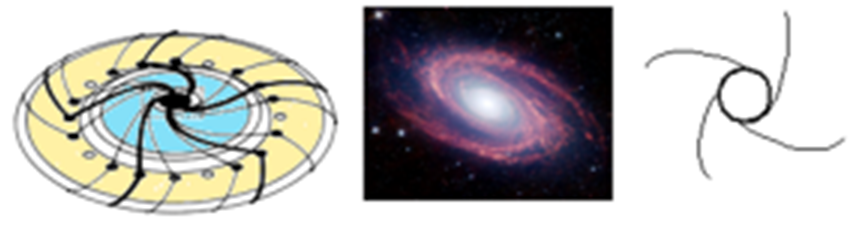
The magnetic field is generated in the blue central part of the vehicle (reactor) and establishes the spin direction of the movement geodesics of the vehicle to displace it (that is to say deflects de electrical current inside the reactor) 16.

This very similar to the realized for the lines orientation of magnetic field of a galaxy (see Figure 15), which makes that rotates and does their displacement through the universe 2. This is realized through a torsion process 17.
4.2. Mental ManipulatingIn psychotronics studies for cure of mental processes is used the association of wave lengths and frequencies through colors combining and sounds of low frequencies, considering further a geometry that produce torsion, which can interchange the spin of energy state of the mind to be cured 18.
We can establish different dualities in field theory, geometry and movement for relate the interaction between two fields or movement of bodies in presence of an electromagnetic field for detect and measure torsion. The torsion is a field observable, which in geometry is a second curvature. From a point of view of the field theory, torsion is a high evidence of the birth gravity and its consequences until our days with the gravitational waves detected from astronomical observatories.
Through electronics is designed an analogue of the measurement of torsion as evidence of gravitational waves existence with an experiment to give some insight what has been studied in the gravitation theories, but with a modern study focus, using invariants as are the twistors and spinors for macroscopic and microscopic field theory.

However, the limitations of the our purely electronic devices only let see and interpret using the arguments of geometry, certain traces of electronic signals of the torsion evidence considering an magnetic field determined in certain voltage range and a movement of cylindrical trajectory, which as we know, is the constant torsion. However, this verifies the conjecture 1. 2., and some theorems established in other studies in theoretical physics and mathematical physics. Likewise, using a Hall type sensor is detected the variation of the magnetic field produced from a magnetic dilation 19, which is moved along a cylindrical spiral where the matter agitates the space and from which emanates gravity, also interacts with the magnetic field of the proper dilaton (Figure 16).
The methods and results of the research are on themes parallel and related to the gravity (no gravity precisely) considering this method as analogous to detect gravity waves, but in this case detect waves of torsion in an indirect way through the kinematic tensor that characterizes the trajectories, then we see the indicium as the signals (1) and Figure 10.
The electronics work has been very fine and we are very grateful with the help given for Rene Rivera-Roldán, Elec. Eng., Chief of Electronics Engineering Division of TESCHA, who supported with measurement equipment in circumstances of covid-19, for the research.
 Spectral curvature or curvature energy. This is given in
 8.
8.
 Real ordinary space or 3-dimensional real space.
 Topological vector space that represents the Hall type sensor space (or sensing space).
 Torsion energy or spectra of torsion. Also given in
 4.
4.
 Unitary vector used in the definition of the normal curvature. This is
  where
where and
and  are the principal vectors of the surface in the space.
 Spinor in a transformation law of a coordinate system
  to a coordinate system
 Fourier transform operator.
 Angular frequency given for
 Spectral spinor surface. This in the quantum case models the gravitational waves related with the field torsion.
1. We choose the cylindrical spiral of vector equation:
 |
Then its torsion is:
 10.
10.
2. In duality the twistor correspondence rule of points is  Here
Here  and
and  correspond to spinor and twistor points of the space-time. The energy-space invariants are the spinors
  and twistors
  where
where  and
and  are the corresponding Weyl spinors. Likewise, Points in the Minkowski space are related to subspaces of twistor space through the correspondence relation:
3.  and
and  are the unitary tangent vector and bi-normal vector of the Frenet-Serret apparatus 10.
4. Here  where
where 
5. The corresponding Fourier transform property used is the duality.
6. The microscopic torsion theory involving the solution of the field equations:
 |
7. Remember that the torsion is a second curvature.
8. Here  must produce a difference of 1.4mV, which is detectable (remove noising). Then
| [1] | R. Penrose, W. Rindler (1984) Volume 1: Two-Spinor Calculus and Relativistic Fields, Cambridge University Press, United Kingdom. | ||
| In article | |||
| [2] | Bulnes, F., Stropovsvky, Y. and Rabinovich, I. (2017) Curvature Energy and Their Spectrum in the Spinor-Twistor Framework: Torsion as Indicium of Gravitational Waves. Journal of Modern Physics, 8, 1723-1736. | ||
| In article | View Article | ||
| [3] | Bulnes, F. (2017) Detection and Measurement of Quantum Gravity by a Curvature Energy Sensor: H-States of Curvature Energy, Recent Studies in Perturbation Theory. In: Uzunov, D., Ed., InTech, https://www.intechopen.com/books/recent-studies-in- perturbation-theory/detection-and-measurement-of-quantum- gravity-by-a-curvature-energy-sensor-h-states-of-curvature-ener https://doi.org/10.5772/68026. | ||
| In article | |||
| [4] | Bulnes, F. Martínez, I. Zamudio, O. Navarro, E. (2020) Kinematic-Energy Measurements of the Torsion Tensor in Space-Time. In: Bulnes, F., Ed., Intech, https://www.intechopen.com/online-first/kinematic-energy- measurements-of-the-torsion-tensor-in-space-time. | ||
| In article | View Article | ||
| [5] | F. Bulnes, "Electromagnetic Gauges and Maxwell Lagrangians Applied to the Determination of Curvature in the Space-Time and their Applications," Journal of Electromagnetic Analysis and Applications, Vol. 4 No. 6, 2012, pp. 252-266. | ||
| In article | View Article | ||
| [6] | M. A. Ramírez. I. Ramírez, O. Ramírez, F. Bulnes, Field Ramifications: The Energy-Vacuum Interaction that Produces Movement, Journal on Photonics and Spintronics, Vol. 2 (4), 2013, pp4-11. | ||
| In article | |||
| [7] | F. Bulnes, I. Martínez, A. Mendoza and M. Landa, "Design and Development of an Electronic Sensor to Detect and Measure Curvature of Spaces Using Curvature Energy," Journal of Sensor Technology, Vol. 2 No. 3, 2012, pp. 116-126. | ||
| In article | View Article | ||
| [8] | Bulnes F, Martínez I, Zamudio O. Fine curvature measurements through curvature energy and their gauging and sensoring in the space. In: Yurish SY, editor. Spain: Advances in Sensors Reviews 4, IFSA; 2016. | ||
| In article | |||
| [9] | Bulnes F, Martínez I, Zamudio O, Negrete G. Electronic sensor prototype to detect and measure curvature through their curvature energy. Science Journal of Circuits, Systems and Signal Processing. 2015;4(5):41-54. | ||
| In article | View Article | ||
| [10] | Kobayashi, K. and Nomizu, K. (1969) Foundations of Differential Geometry. Vol. 2, Wiley and Sons, New York. | ||
| In article | |||
| [11] | Bulnes F. Gravity, curvature and energy: Gravitational field intentionality to the cohesion and union of the universe. In: Zouaghi T, editor. Gravity and Geoscience Applications, Industrial Technology and Quantum Aspect. London, UK: Intech Open; 20 December 2017. Available from: https://www.intechopen.com/books/gravitygeoscience- applications-industrialtechnology-and-quantum-aspect/gravity- curvature-and-energygravitational-field-intentionality-to- thecohesion-and-union-of-the-uni. | ||
| In article | View Article | ||
| [12] | S. Gorbuis, E. Guivenchy, Torsion Matter and their Corresponding Dirac Equations on Neutrinos and Matter/anti-Matter Asymmetries (Part II: gravitations insights), Journal on Photonics and Spintronics, Vol. 4 (1), 2015, pp15-25. | ||
| In article | |||
| [13] | Tracy M. Boone, Liesl Folks, J. A. Katine, Ernesto E. Marinero, Nathaniel Smith, B.A. Gurney, Magnetic Sensitivity in Mesoscopic EMR Devices in I-V-I-V Configuration, Materials Science, Physics 65th Annual Device Research Conference. | ||
| In article | |||
| [14] | 2007 (First Publication: 1 June 2007). M-A. Paun, J-M Sallese, Hall Effect Sensors Design, Integration and Behavior Analysis, Journal of Sensor and Actuator Networks 2(1):85-97 • March 2013. | ||
| In article | View Article | ||
| [15] | B.A. Gurney, J. R. Childress, Max Sebastian Carey, R Fontana, The evolution of read back sensors for magnetic recording, Physics 61st Device Research Conference. Conference 2003. | ||
| In article | |||
| [16] | F. Bulnes and A. Álvarez, "Homological Electromagnetism and Electromagnetic Demonstrations on the Existence of Superconducting Effects Necessaries to Magnetic Levitation/Suspension," Journal of Electromagnetic Analysis and Applications, Vol. 5 No. 6, 2013, pp. 255-263. | ||
| In article | View Article | ||
| [17] | E. Guivenchy, “Torsion Matter and their Corresponding Dirac Equations on Neutrinos and Matter/anti-Matter Asymmetries (Part I: scattering difference between Neutrinos/anti-Neutrinos),” Journal on Photonics and Spintronics, Vol. 3, no. 4, pp9-18. | ||
| In article | |||
| [18] | F. Bulnes, “The Anxiety Factor in the Dimension of the Symptom Space and their Elimination for Nano-Metric Actions of Quantum Mono-Pharmacists,” Drug Discovery and Therapy World Congress 2013, 3-6 June, Boston Massachusetts, USA, 2013. | ||
| In article | |||
| [19] | F. Bulnes, J. C. García-Limón: https://youtu.be/0s5H8w6JfyA. | ||
| In article | |||
Published with license by Science and Education Publishing, Copyright © 2020 Dr. Francisco Bulnes, A J. C. García-Limón, L. A. Ortiz-Dumas and V. A. Sánchez-Suarez
 This work is licensed under a Creative Commons Attribution 4.0 International License. To view a copy of this license, visit
http://creativecommons.org/licenses/by/4.0/
This work is licensed under a Creative Commons Attribution 4.0 International License. To view a copy of this license, visit
http://creativecommons.org/licenses/by/4.0/
(Einstein energy-matter tensor) in supermassive body. is the electromagnetic charge interacting with the energy-matter. In our experiments the charge will be the force expressed by used in the servo-system for go up or throw the dilaton in the trajectory| [1] | R. Penrose, W. Rindler (1984) Volume 1: Two-Spinor Calculus and Relativistic Fields, Cambridge University Press, United Kingdom. | ||
| In article | |||
| [2] | Bulnes, F., Stropovsvky, Y. and Rabinovich, I. (2017) Curvature Energy and Their Spectrum in the Spinor-Twistor Framework: Torsion as Indicium of Gravitational Waves. Journal of Modern Physics, 8, 1723-1736. | ||
| In article | View Article | ||
| [3] | Bulnes, F. (2017) Detection and Measurement of Quantum Gravity by a Curvature Energy Sensor: H-States of Curvature Energy, Recent Studies in Perturbation Theory. In: Uzunov, D., Ed., InTech, https://www.intechopen.com/books/recent-studies-in- perturbation-theory/detection-and-measurement-of-quantum- gravity-by-a-curvature-energy-sensor-h-states-of-curvature-ener https://doi.org/10.5772/68026. | ||
| In article | |||
| [4] | Bulnes, F. Martínez, I. Zamudio, O. Navarro, E. (2020) Kinematic-Energy Measurements of the Torsion Tensor in Space-Time. In: Bulnes, F., Ed., Intech, https://www.intechopen.com/online-first/kinematic-energy- measurements-of-the-torsion-tensor-in-space-time. | ||
| In article | View Article | ||
| [5] | F. Bulnes, "Electromagnetic Gauges and Maxwell Lagrangians Applied to the Determination of Curvature in the Space-Time and their Applications," Journal of Electromagnetic Analysis and Applications, Vol. 4 No. 6, 2012, pp. 252-266. | ||
| In article | View Article | ||
| [6] | M. A. Ramírez. I. Ramírez, O. Ramírez, F. Bulnes, Field Ramifications: The Energy-Vacuum Interaction that Produces Movement, Journal on Photonics and Spintronics, Vol. 2 (4), 2013, pp4-11. | ||
| In article | |||
| [7] | F. Bulnes, I. Martínez, A. Mendoza and M. Landa, "Design and Development of an Electronic Sensor to Detect and Measure Curvature of Spaces Using Curvature Energy," Journal of Sensor Technology, Vol. 2 No. 3, 2012, pp. 116-126. | ||
| In article | View Article | ||
| [8] | Bulnes F, Martínez I, Zamudio O. Fine curvature measurements through curvature energy and their gauging and sensoring in the space. In: Yurish SY, editor. Spain: Advances in Sensors Reviews 4, IFSA; 2016. | ||
| In article | |||
| [9] | Bulnes F, Martínez I, Zamudio O, Negrete G. Electronic sensor prototype to detect and measure curvature through their curvature energy. Science Journal of Circuits, Systems and Signal Processing. 2015;4(5):41-54. | ||
| In article | View Article | ||
| [10] | Kobayashi, K. and Nomizu, K. (1969) Foundations of Differential Geometry. Vol. 2, Wiley and Sons, New York. | ||
| In article | |||
| [11] | Bulnes F. Gravity, curvature and energy: Gravitational field intentionality to the cohesion and union of the universe. In: Zouaghi T, editor. Gravity and Geoscience Applications, Industrial Technology and Quantum Aspect. London, UK: Intech Open; 20 December 2017. Available from: https://www.intechopen.com/books/gravitygeoscience- applications-industrialtechnology-and-quantum-aspect/gravity- curvature-and-energygravitational-field-intentionality-to- thecohesion-and-union-of-the-uni. | ||
| In article | View Article | ||
| [12] | S. Gorbuis, E. Guivenchy, Torsion Matter and their Corresponding Dirac Equations on Neutrinos and Matter/anti-Matter Asymmetries (Part II: gravitations insights), Journal on Photonics and Spintronics, Vol. 4 (1), 2015, pp15-25. | ||
| In article | |||
| [13] | Tracy M. Boone, Liesl Folks, J. A. Katine, Ernesto E. Marinero, Nathaniel Smith, B.A. Gurney, Magnetic Sensitivity in Mesoscopic EMR Devices in I-V-I-V Configuration, Materials Science, Physics 65th Annual Device Research Conference. | ||
| In article | |||
| [14] | 2007 (First Publication: 1 June 2007). M-A. Paun, J-M Sallese, Hall Effect Sensors Design, Integration and Behavior Analysis, Journal of Sensor and Actuator Networks 2(1):85-97 • March 2013. | ||
| In article | View Article | ||
| [15] | B.A. Gurney, J. R. Childress, Max Sebastian Carey, R Fontana, The evolution of read back sensors for magnetic recording, Physics 61st Device Research Conference. Conference 2003. | ||
| In article | |||
| [16] | F. Bulnes and A. Álvarez, "Homological Electromagnetism and Electromagnetic Demonstrations on the Existence of Superconducting Effects Necessaries to Magnetic Levitation/Suspension," Journal of Electromagnetic Analysis and Applications, Vol. 5 No. 6, 2013, pp. 255-263. | ||
| In article | View Article | ||
| [17] | E. Guivenchy, “Torsion Matter and their Corresponding Dirac Equations on Neutrinos and Matter/anti-Matter Asymmetries (Part I: scattering difference between Neutrinos/anti-Neutrinos),” Journal on Photonics and Spintronics, Vol. 3, no. 4, pp9-18. | ||
| In article | |||
| [18] | F. Bulnes, “The Anxiety Factor in the Dimension of the Symptom Space and their Elimination for Nano-Metric Actions of Quantum Mono-Pharmacists,” Drug Discovery and Therapy World Congress 2013, 3-6 June, Boston Massachusetts, USA, 2013. | ||
| In article | |||
| [19] | F. Bulnes, J. C. García-Limón: https://youtu.be/0s5H8w6JfyA. | ||
| In article | |||