It is difficult to balance the power between demand and generation in electrical networks with the rise of distributed energy resources (DERs), especially for the uncertainty of renewable generation. Smart grid concepts have been developed to solve this problem. A set of distributed generation, demand flexibility and energy storage devices are locally managed to minimize the local total generation cost. However, impacts of energy storage on micro-grid has not been explored yet. In this paper, a local smart market based on a multi-agent system is presented to provide for the quantitative evidence of the beneficial impact of flexibility enabled by demand flexibility and energy storage in limiting market power by distributed generation (DG) units. Quantitative analysis is proposed by a bi-level optimization model of the micro-grid setting, accounting for the operational constraints of energy storage. This bi-level problem is solved after converting it into a Mathematical Program with Equilibrium Constraints (MPEC) and linearizing the latter through suitable techniques. Case studies demonstrate the effectiveness of the proposed method.
Several authors consider micro-grid as the evolution of the electrical network 1, 2. They supposed that renewable energies should be distributed in the networks, information technologies should be used for their control, and that flexible demand and storage systems should be necessaries for balancing energy in the grid and avoiding curtailment 3.
The main disadvantage of micro-grid is that it needs more complex distributed control systems. The Multi-Agent Systems (MAS) 4 converge with smart grid because agents are autonomous, share information and can move by information networks. These features make MAS a good candidate to develop control and management systems for smart grids. Several market models for smart grid based on multi-agent have been developed 5, 6.
A local market defining the rules to exchange energy among producers and consumers is required. Ramos et al. 7 did a review of local markets from a flexibility view, where the main characteristic of the smart grids is their possibility to offer flexibility in the contracts from the existing wholesale markets, from the creation of a separate platform, and from a reserve market approach.
The mechanisms used to set the price are two: pay-as-cleared pricing and pay-as-bid pricing. In the first method, an auctioneer matches demand and generation, and all participants pay the price of the last technology to enter. Double-sided auctions consist of an auctioneer that collects the offers and bids from all agents and with an auction that determines the winning offers 8, 9, 10. The main problem with this method is the course of dimensionality. Some authors 11, 12, 13, 14, 15, 16 used simultaneous auctions to solve it. In the second method, buyers submit a price-quantity bid and the sellers paid this price for the amount desired. This method is less used, but it is easier to understand in small communities as a micro-grid. In other methods, the market can be oriented to price when the price determines the amount of energy that every actor will produce or consume 15, 16. And it can be oriented to resources when the price is determined to assign all resources 17, 18, 19, 20, 21.
The method presented in this paper has several characteristics that make it different and easy. It is oriented to small communities and non-experts. The price is fixed by pay-as-bid and pay-as-offer pricing method, which it is more beneficial for everyone. The local market allows maintaining differences in prices. And it is an incentive to create micro-grids and improve them. The energy exchange among local agents allows ensuring the competition among generators. This paper provides quantitative evidence of the beneficial impact of flexibility enabled by energy storage in limiting market power by DG units. Quantitative analysis is supported by a bi-level optimization model of the imperfect electricity market setting, whose upper level represents the profit maximization objective of strategic DG units and the lower level represents the local market clearing including the time coupling operational constraints of energy storage. This bi-level problem is solved after converting it to a Mathematical Program with Equilibrium Constraints (MPEC), by replacing the lower level problem by its equivalent Karush-Kuhn Tucker (KKT) optimality conditions. Case studies with this MPEC model on a test market quantitatively demonstrate the benefits of energy storage in reducing the generation profit increase driven by the exercise of market power by generation companies.
The rest of this paper is organized as follows. Section III outlines models of generation and energy storage market participants. Section IV formulates the bi-level optimization problem and the corresponding MPEC problem expressing the decision making of strategic DG units. Case studies and illustrative results are presented in Section V. Finally; Section VI discusses conclusions of this work.
A. Strategic Generation Companies
For presentation clarity reasons and without loss of generality, we assume that each generation company owns a single generation unit, in which the quadratic cost function, linear marginal cost function and output limits are as follows:
 | (1) |
 | (2) |
 | (3) |
Strategic generation companies can exercise market power through either submitting offers higher than their actual marginal costs (i.e., economic withholding) 1. Following the model employed in 4, 22, 23, the strategic marginal cost function is expressed by Eq.(4), where the value of the decision variable  represents the strategic behavior of DG unit
  at time period
  .
.
 | (4) |
If  , DG unit
  behaves competitively and reveals its actual marginal costs to the market at
  . If
. If  , DG unit
  behaves strategically and reports higher than its actual marginal costs to the market at
  . DG unit
  should determine the value of
  by accounting for the trade-off between higher market clearing price and lower clearing quantity. More specifically, a higher
  will tend to increase the market price at
  , but at the same time it will tend to decrease the quantity sold by DG unit
  at
at  , since companies with lower submitted costs may replace
  in the merit order and / or the demand side and the energy storage may reduce the demand at
  .
.
B. Energy Storage
Single energy storage  unit in the system is assumed, the operational characteristics of which are expressed by Eq.(5)- Eq.(9). Constraint Eq.(5) expresses the energy balance in the storage unit including charging and discharging losses. Constraint Eq.(6) corresponds to its maximum depth of discharge and state of charge ratings. Constraints Eq.(7)-Eq.(8) represent its power limits. For the sake of simplicity, the storage energy content at the start and the end of the examined temporal horizon are assumed Eq.(9).
 | (5) |
 | (6) |
 | (7) |
 | (8) |
 | (9) |
A. Bi-level Structure
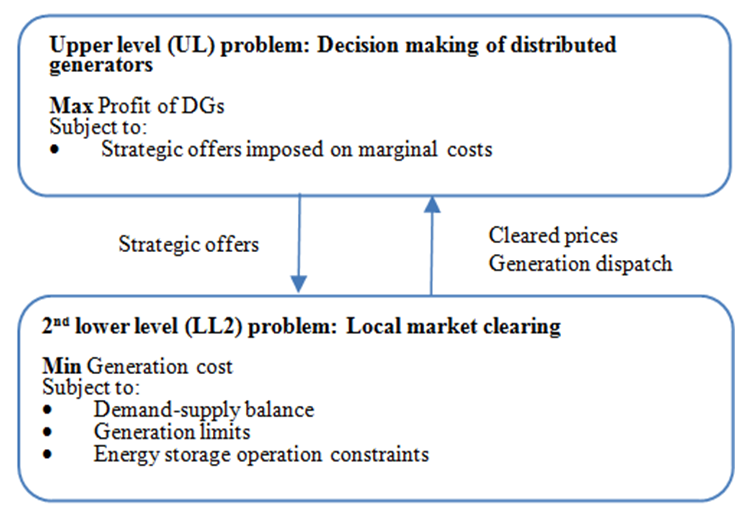
The interaction between distributed generators and the local market operator is structured as Figure 1. The upper-level decision maker of distributed generators submits their strategic offers to the lower level local market operator. The local market operator collects the strategic offers submitted by the upper level distributed generators and other competitive distributed generators as well as the system over demand, then clears the market day-ahead according to the supply-demand curve.

B. Bi-level Optimization Model
Following the approach employed in 22, 27, the decision making of strategic DG unit is modeled through a bi-level optimization problem. The upper level determines the optimal offering strategies by maximizing the profit of the DG unit and is subject to the lower level problem representing the market clearing process including the operational constraints of energy storage. These two problems are coupled since the offering strategies determined by the upper-level problem affect the objective function of the lower level problem while the market clearing price and generation dispatch determined by the lower level problem affect the objective function of the upper-level problem. The bi-level optimization model representing this monopoly setting is formulated as follows:
(Upper level)
 | (10) |
Subject to:
 | (11) |
(Lower level)
 | (12) |
Where:
 | (13) |
Subject to:
 | (14) |
 | (15) |
 | (16) |
 | (17) |
 | (18) |
 | (19) |
 | (20) |
The objective function Eq.(10) of the upper-level problem constitutes the total profit of the DG unit. This problem is subject to the limits of the strategic offer variables Eq.(11) and the lower level problem Eq.(12)-Eq.(20). The latter represents the micro-grid local market clearing process at each time-period, minimizing total generation cost Eq.(12). The constraints subject to demand-supply balance Eq.(14) (the Lagrangian multipliers of which constitute the market clearing prices), generation output limits Eq.(15) and the operational constraints of the energy storage Eq.(26)-Eq.(20), with a fixed demand profile.
C. MPEC Formulation
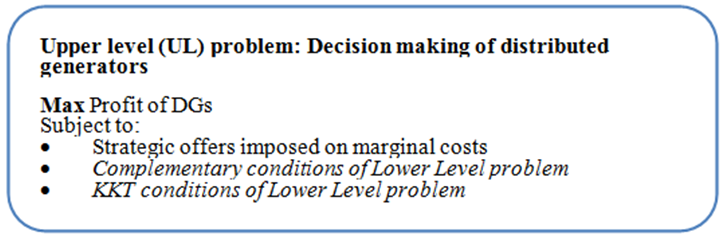
To solve the above-given bi-level optimization problem, the lower level problem is replaced by its KKT optimality conditions, which is enabled by the continuity and convexity of the lower level problem.

This converts the bi-level problem into a Mathematical Program with Equilibrium Constraints (MPEC). The MPEC is formulated as follows:
 | (21) |
Where:
 | (22) |
Subject to:
 | (23) |
 | (24) |
 | (25) |
 | (26) |
 | (27) |
 | (28) |
 | (29) |
 | (30) |
 | (31) |
 | (32) |
 | (33) |
 | (34) |
 | (35) |
 | (36) |
 | (37) |
 | (38) |
The set of decision variables Eq.(22) includes the decision variables of the upper level and the lower level problem as well as the Lagrangian multipliers associated with the constraints of, the lower level problem. The KKT optimality conditions of the lower level problem correspond to equations Eq.(31)-Eq.(38).
A. Test Data and Implementation
The examined studies demonstrate the impact of energy storage on the market power exercised by generation companies in a test market with the day-ahead horizon, hourly resolution and generation/demand data reflecting the general properties of a micro-grid system.
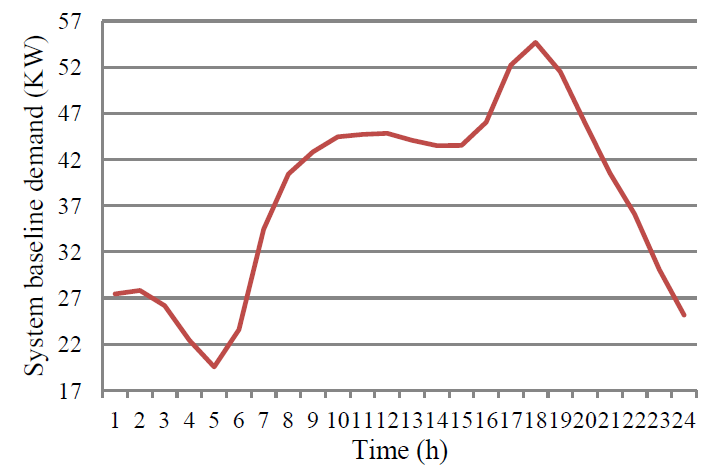
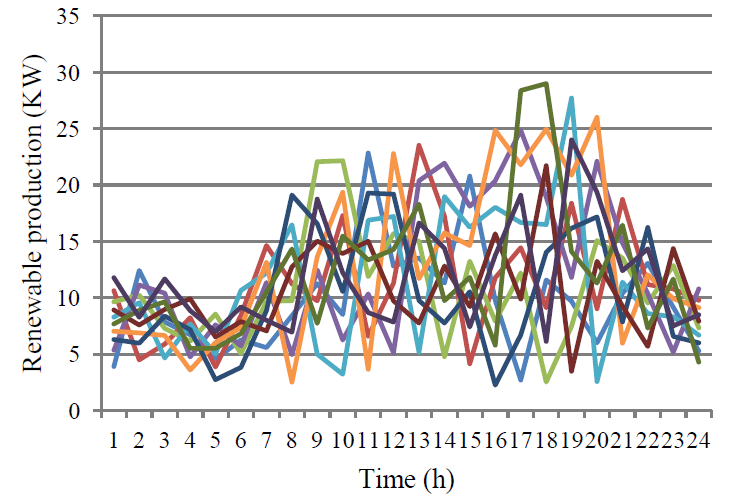
The micro-grid system includes 7 DG units, the cost coefficients and maximum output limits of which are given in Table 1. Figure 3 presents the demand profile  , which follow the daily pattern of consumers’ activities. We assume that the expected power output of renewable generation in the micro-grid is 10% of the system baseline demand, and following the normal distribution with 10 equal-probability scenarios, presented in Figure 4.


In order to analyze the impact of energy storage, different scenarios are examined regarding the size of energy storage, as expressed by its capacity  as a percentage
  of the daily energy demand. The assumed values of the rest of the energy storage operational parameters are given in Table 2.
The MILP problem has been coded and solved using the optimization software FICOTM Xpress 28 on a computer with a 6-core 3.47 GHz Intel(R) Xeon(R) X5690 processor and 192 GB of RAM. The average computational time required for solving the MILP problem across all the examined scenarios was around 10s.
B. Impact of Energy Storage
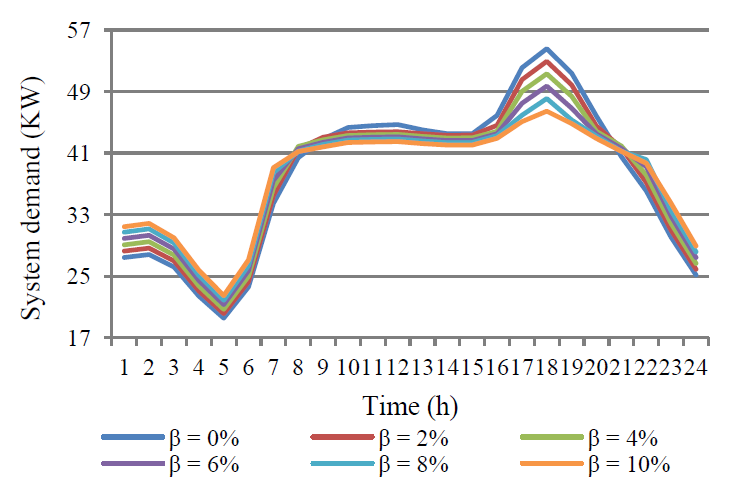
The exercise of market power by the generation side increases its profit while it decreases the utility of the demand side. Figure 5 presents the system demand with different energy storage capacity scenarios. It can be found that as the capacity increases, more and more energy is stored during the peak periods with low price and discharged during the periods with high prices, leading to a flatter system demand.


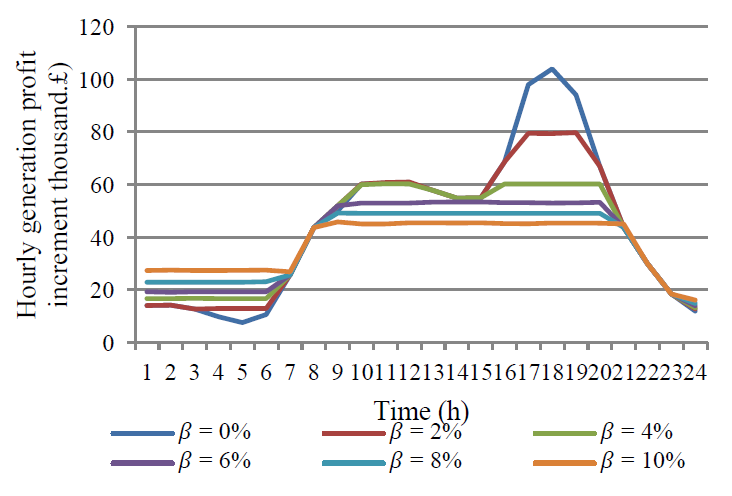
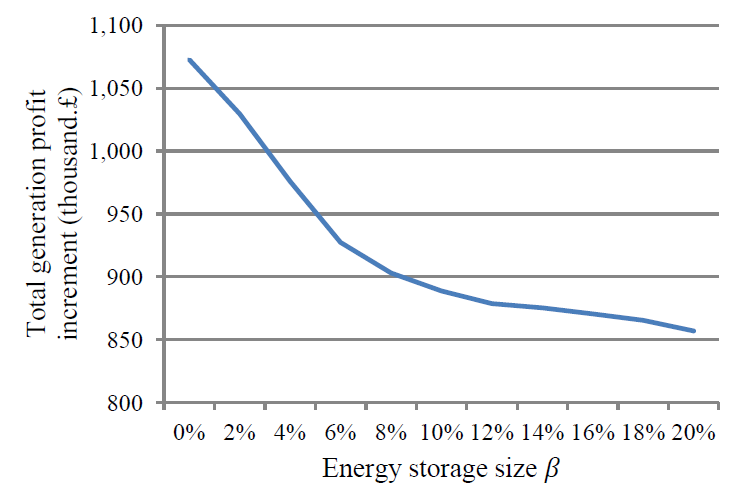
Figure 6 present the increment of the generation side’s hourly profit driven by the exercise of market power, i.e. the difference between the profit obtained under strategic generation behavior (as determined by the solution of the MPEC problem Eq.(21)-Eq.(38)) and the profit obtained under competitive generation behavior (as determined by the solution of the market clearing problem Eq.(12)-Eq.(20) with  ), for different scenarios of energy storage capacity. The energy storage reduces the hourly generation profit increment during peak hours and increases it during off-peak hours, with the former reduction being significantly higher than the latter increase. These effects are enhanced as the size of energy storage is increased. Due to the fact that the positive impact of energy storage during peak hours is more significant than its negative impact during off-peak hours, the total (daily) generation profit increment driven by the exercise of market power are significantly reduced as the size of energy storage is increased, as illustrated in Figure 7. This result means that deployment of energy storage reduces the generation profit made by the exercise of market power, and allows consumers to more efficiently preserve their economic surplus against generation companies’ strategic behavior.
This paper has provided for the theoretical and quantitative evidence of the beneficial impact of energy storage in limiting market power by strategic generation companies. Theoretical explanation of this impact has been presented through a simple price-quantity graph, demonstrating that storage reduces the extent of exercised market power at peak periods and increases it at off-peak periods, with the former reduction dominating the latter increase and resulting in an overall positive impact. Quantitative analysis has been supported by a bi-level optimization model of imperfect electricity markets, accounting for the time-coupling operational constraints of energy storage and solved by converting it to an MPEC. Case studies with this MPEC model on a test market with the day ahead horizon and hourly resolution have quantitatively demonstrated the benefits of storage in limiting market power. Increasing storage capacity has been shown to reduce the generation profit made by the exercise of market power, and allow consumers to more effectively preserve their economic surplus against generation companies’ strategic behavior.
The authors would like to thank the financial support provide by the National Science Foundation under Grant 61273142, Foundation for Six Talents by Jiangsu Province (2012-DZXX-045), Priority Academic Program Development of Jiangsu Higher Education Institutions (PADP), and Technology research project of Ministry of public security of China (grant number 2015JSYJC029).
The authors indicate no potential conflicts of interest.
A. Indices
 : Index of time periods, running from 1 to
 : Index of DG units, running from 1 to
 : Index of generation blocks, running from 1 to
 : Index of consumers, running from 1 to
 : Index of energy storage units, running from 1 to
 : Index of uncertainty scenarios, running from 1 to
B. Parameters
 : Linear cost coefficient of generation company
  (£/MW)
 : Quadratic cost coefficient of generation company
  (£/MW2)
 : Maximum power output limit of generation company
  (MW)
(MW)
 : Power input of consumer
  at time period
  (MW)
(MW)
 : Power limit of energy storage
  (MW)
(MW)
 : Capacity of energy storage
  (MWh)
(MWh)
 : Minimum energy limit of energy storage
  (MWh)
(MWh)
 : Maximum energy limit of energy storage
  (MWh)
(MWh)
 : Initial energy level in energy storage
  (MWh)
(MWh)
 : Charging efficiency of energy storage
 : Discharging efficiency of energy storage
 : Power output of distributed renewable units
  at time period
  for uncertainty scenario
  (MW)
(MW)
 : Probability for uncertainty scenario
C. Variables
 : Strategic offer variable of DG units
  at time period
  for uncertainty scenario
 : Power output of DG units
  at time period
  for uncertainty scenario
  (MW)
(MW)
 : Charging power of energy storage
  at time period
  for uncertainty scenario
  (MW)
(MW)
 : Discharging power of energy storage
  at time period
  for uncertainty scenario
  (MW)
(MW)
 : Energy level in energy storage
  at the end of time period
  for uncertainty scenario
  (MW)
(MW)
 : Market clearing price at time period
  for uncertainty scenario
  (£/MW)
D. Functions
 : Cost of block
  of DG units
  at time period
  (£)
(£)
 : Marginal cost of block
  of DG units
  at time period
  (£/MW)
 : Strategic marginal cost of block
  of DG units
  at time period
  (£/MW)
| [1] | P. Crossley, A. Bevizof. “Smart energy systems: Transitioning renewables onto the grid”. Renewable Energy Focus, Vol. 11, Issue 5, September–October 2010, Pages 54-56, 58-59. | ||
| In article | View Article | ||
| [2] | Menniti D., Sorrentino N., Pinnarelli A., Burgio A., Brusco G., Belli G., “In the future Smart Cities: Coordination of micro Smart Grids in a Virtual Energy District”, 2014 International Symposium on Power Electronics, Electrical Drives, Automation and Motion (SPEEDAM), pp. 676-682. | ||
| In article | View Article | ||
| [3] | Menniti D., Pinnarelli A., Sorrentino N., Burgio A., Belli G., “Management of storage systems in local electricity market to avoid renewable power curtailment in distribution network”, 2014 Australiasian Universities Power Engineering Conference (AUPEC), pp. 1-5. | ||
| In article | View Article | ||
| [4] | A. Dimeas, N. Hatziargyriou. “A Multi‐Agent System for Microgrids”. Power Engineering Society General Meeting, 2004, Vol. 1, pp. 55-58. | ||
| In article | View Article | ||
| [5] | I. Lopez-Rodriguez, M. Hernandez-Tejera, A. Luis Lopez. “Methods for the management of distributed electricity networks using software agents and market mechanisms: A survey”. Electric Power Systems Research, 2016, No. 136, pp. 362-369. | ||
| In article | View Article | ||
| [6] | P. Ringler, D. Keles,W. Fichtner. “Agent-based modeling and simulation of smart electricity grids and markets – A literature review”. Renewable and Sustainable Energy Reviews, 57 (2016), 205-215. | ||
| In article | View Article | ||
| [7] | A. Ramos, C. De Jonghe, V. G??mez, and R. Belmans, “Realizing the smart grid’s potential: Defining local markets for flexibility,” Util. Policy, vol. 40, pp. 26-35, 2016. | ||
| In article | View Article | ||
| [8] | D. Friedman, J. Rust, The Double Auction Market: Institutions, Theories, and Evidence, vol. 14, Westview Press, 1993. | ||
| In article | View Article | ||
| [9] | A.L. Dimeas, N. Hatziargyriou, A multiagent system for microgrids, in: IEEEPower Engineering Society General Meeting, No. 55-58, 2004. | ||
| In article | View Article | ||
| [10] | B. Ramachandran, S. Srivastava, C. Edrington, D. Cartes, An intelligent auction scheme for smart grid market using a hybrid immune algorithm, IEEE Trans. Ind. Electr. 58 (10) (2011) 4603-4612. | ||
| In article | View Article | ||
| [11] | Y.K. Penya, N. Jennings, Combinatorial markets for efficient electricity management, in: IEEE/WIC/ACM Int. Conf. on Intelligent Agent Technology, 2005, pp.626-632. | ||
| In article | View Article | ||
| [12] | M. Amin, D. Ballard, Defining new markets for intelligent agents, IT Prof. 2 (4) (2000) 29-35. | ||
| In article | View Article | ||
| [13] | T. Sandholm, S. Suri, Market clearability, in: International Joint Conference on Artifical Intelligence, vol. 17, 2001, pp. 1145-1151. | ||
| In article | |||
| [14] | V.D. Dang, N.R. Jennings, Optimal clearing algorithms for multi-unit single-item and multi-unit combinatorial auctions with demand-supply function bidding, in: Proceedings of the 5th International Conference on Electronic Commerce,ICEC’03, ACM, New York, NY, USA, 2003, pp. 25-30. | ||
| In article | View Article | ||
| [15] | W. Vickrey, Counter speculation, auctions, and competitive sealed tenders, J. Fin. 16 (1) (1961) 8-37. | ||
| In article | View Article | ||
| [16] | I. Lopez-Rodriguez, M. Hernandez-Tejera, Infrastructure based on supernodes and software agents for the implementation of energy markets in demand-response programs, Appl. Energy 158 (2015) 1-11. | ||
| In article | View Article | ||
| [17] | T. Arnheiter, Modeling and simulation of an agent-based decentralized two-commodity power market, in: International Conference on Multi-agent Systems, 2000, pp. 361-362. | ||
| In article | View Article | ||
| [18] | T. Logenthiran, D. Srinivasan, D. Wong, Multi-agent coordination for DER in a microgrid, in: ICSET 2008. IEEE International Conference on Sustainable Energy Technologies, 2008, pp. 77-82. | ||
| In article | View Article | ||
| [19] | F. Ygge, J.M. Akkermans, Power load management as a computational market, in: Second International Conference on Multi-Agent Systems, ICMAS 1996,Kyoto, Japan, AAAI Press, 1996, pp. 393-400. | ||
| In article | |||
| [20] | F. Ygge, H. Akkermans, Resource-oriented multi-commodity market algorithms, Auton. Agents Multi agent Syst. 3 (2000) 53-71. [42] Energy Interoperation - version 1.0. | ||
| In article | View Article | ||
| [21] | ECN, CRISP: Distributed intelligence in critical infrastructures for sustainable power, 2006 http://www.crisp.ecn.nl/. | ||
| In article | View Article | ||
| [22] | M. Black and G. Strbac, “Value of bulk energy storage for managing wind power fluctuations,” IEEE Trans. Energy Convers., vol. 22, no. 1, pp. 197-205, Mar. 2007. | ||
| In article | View Article | ||
| [23] | C. A. Hill, M. C. Such, D. Chen, J. Gonzalez, and W. M. Grady, “Battery energy storage for enabling integration of distributed solar power generation,” IEEE Trans. Smart Grid, vol. 3, pp. 850-857, Jun. 2012. | ||
| In article | View Article | ||
| [24] | A. D. Lamont, “Assessing the economic value and optimal structure of large-scale electricity storage,” IEEE Trans. Power Syst., vol. 28, no. 2, pp. 911-921, May 2013. | ||
| In article | View Article | ||
| [25] | D. Pudjianto, M. Aunedi, P. Djapic, and G. Strbac, “Whole-systems assessment of the value of energy storage in low-carbon electricity systems,” IEEE Trans. Smart Grid, vol. 5, pp. 1098-1109, 2014. | ||
| In article | View Article | ||
| [26] | C. Suazo-Martinez, E. Pereira-Bonvallet, R. Palma-Behnke and Xiaoping Zhang, “Impacts of Energy Storage on Short-Term Operation Planning Under Centralized Spot Markets,” IEEE Trans. Smart Grid, vol. 5, pp. 1110-1118, 2014. | ||
| In article | View Article | ||
| [27] | A. Awad, J. Fuller, T. EL-Fouly, and M. Salama, “Impact of energy storage systems on electricity market equilibrium,” IEEE Trans. Sustain. Energy, vol. 5, no. 3, pp. 875-885, July 2014. | ||
| In article | View Article | ||
| [28] | FICO XPRESS website, http://www.fico.com/en/Products/DMTools/Pages/FICO-Xpress-Optimization-Suite.aspx. | ||
| In article | View Article | ||
Published with license by Science and Education Publishing, Copyright © 2018 Mian Khuram Ahsan, Tianhong Pan and Zhengming Li
 This work is licensed under a Creative Commons Attribution 4.0 International License. To view a copy of this license, visit
http://creativecommons.org/licenses/by/4.0/
This work is licensed under a Creative Commons Attribution 4.0 International License. To view a copy of this license, visit
http://creativecommons.org/licenses/by/4.0/
| [1] | P. Crossley, A. Bevizof. “Smart energy systems: Transitioning renewables onto the grid”. Renewable Energy Focus, Vol. 11, Issue 5, September–October 2010, Pages 54-56, 58-59. | ||
| In article | View Article | ||
| [2] | Menniti D., Sorrentino N., Pinnarelli A., Burgio A., Brusco G., Belli G., “In the future Smart Cities: Coordination of micro Smart Grids in a Virtual Energy District”, 2014 International Symposium on Power Electronics, Electrical Drives, Automation and Motion (SPEEDAM), pp. 676-682. | ||
| In article | View Article | ||
| [3] | Menniti D., Pinnarelli A., Sorrentino N., Burgio A., Belli G., “Management of storage systems in local electricity market to avoid renewable power curtailment in distribution network”, 2014 Australiasian Universities Power Engineering Conference (AUPEC), pp. 1-5. | ||
| In article | View Article | ||
| [4] | A. Dimeas, N. Hatziargyriou. “A Multi‐Agent System for Microgrids”. Power Engineering Society General Meeting, 2004, Vol. 1, pp. 55-58. | ||
| In article | View Article | ||
| [5] | I. Lopez-Rodriguez, M. Hernandez-Tejera, A. Luis Lopez. “Methods for the management of distributed electricity networks using software agents and market mechanisms: A survey”. Electric Power Systems Research, 2016, No. 136, pp. 362-369. | ||
| In article | View Article | ||
| [6] | P. Ringler, D. Keles,W. Fichtner. “Agent-based modeling and simulation of smart electricity grids and markets – A literature review”. Renewable and Sustainable Energy Reviews, 57 (2016), 205-215. | ||
| In article | View Article | ||
| [7] | A. Ramos, C. De Jonghe, V. G??mez, and R. Belmans, “Realizing the smart grid’s potential: Defining local markets for flexibility,” Util. Policy, vol. 40, pp. 26-35, 2016. | ||
| In article | View Article | ||
| [8] | D. Friedman, J. Rust, The Double Auction Market: Institutions, Theories, and Evidence, vol. 14, Westview Press, 1993. | ||
| In article | View Article | ||
| [9] | A.L. Dimeas, N. Hatziargyriou, A multiagent system for microgrids, in: IEEEPower Engineering Society General Meeting, No. 55-58, 2004. | ||
| In article | View Article | ||
| [10] | B. Ramachandran, S. Srivastava, C. Edrington, D. Cartes, An intelligent auction scheme for smart grid market using a hybrid immune algorithm, IEEE Trans. Ind. Electr. 58 (10) (2011) 4603-4612. | ||
| In article | View Article | ||
| [11] | Y.K. Penya, N. Jennings, Combinatorial markets for efficient electricity management, in: IEEE/WIC/ACM Int. Conf. on Intelligent Agent Technology, 2005, pp.626-632. | ||
| In article | View Article | ||
| [12] | M. Amin, D. Ballard, Defining new markets for intelligent agents, IT Prof. 2 (4) (2000) 29-35. | ||
| In article | View Article | ||
| [13] | T. Sandholm, S. Suri, Market clearability, in: International Joint Conference on Artifical Intelligence, vol. 17, 2001, pp. 1145-1151. | ||
| In article | |||
| [14] | V.D. Dang, N.R. Jennings, Optimal clearing algorithms for multi-unit single-item and multi-unit combinatorial auctions with demand-supply function bidding, in: Proceedings of the 5th International Conference on Electronic Commerce,ICEC’03, ACM, New York, NY, USA, 2003, pp. 25-30. | ||
| In article | View Article | ||
| [15] | W. Vickrey, Counter speculation, auctions, and competitive sealed tenders, J. Fin. 16 (1) (1961) 8-37. | ||
| In article | View Article | ||
| [16] | I. Lopez-Rodriguez, M. Hernandez-Tejera, Infrastructure based on supernodes and software agents for the implementation of energy markets in demand-response programs, Appl. Energy 158 (2015) 1-11. | ||
| In article | View Article | ||
| [17] | T. Arnheiter, Modeling and simulation of an agent-based decentralized two-commodity power market, in: International Conference on Multi-agent Systems, 2000, pp. 361-362. | ||
| In article | View Article | ||
| [18] | T. Logenthiran, D. Srinivasan, D. Wong, Multi-agent coordination for DER in a microgrid, in: ICSET 2008. IEEE International Conference on Sustainable Energy Technologies, 2008, pp. 77-82. | ||
| In article | View Article | ||
| [19] | F. Ygge, J.M. Akkermans, Power load management as a computational market, in: Second International Conference on Multi-Agent Systems, ICMAS 1996,Kyoto, Japan, AAAI Press, 1996, pp. 393-400. | ||
| In article | |||
| [20] | F. Ygge, H. Akkermans, Resource-oriented multi-commodity market algorithms, Auton. Agents Multi agent Syst. 3 (2000) 53-71. [42] Energy Interoperation - version 1.0. | ||
| In article | View Article | ||
| [21] | ECN, CRISP: Distributed intelligence in critical infrastructures for sustainable power, 2006 http://www.crisp.ecn.nl/. | ||
| In article | View Article | ||
| [22] | M. Black and G. Strbac, “Value of bulk energy storage for managing wind power fluctuations,” IEEE Trans. Energy Convers., vol. 22, no. 1, pp. 197-205, Mar. 2007. | ||
| In article | View Article | ||
| [23] | C. A. Hill, M. C. Such, D. Chen, J. Gonzalez, and W. M. Grady, “Battery energy storage for enabling integration of distributed solar power generation,” IEEE Trans. Smart Grid, vol. 3, pp. 850-857, Jun. 2012. | ||
| In article | View Article | ||
| [24] | A. D. Lamont, “Assessing the economic value and optimal structure of large-scale electricity storage,” IEEE Trans. Power Syst., vol. 28, no. 2, pp. 911-921, May 2013. | ||
| In article | View Article | ||
| [25] | D. Pudjianto, M. Aunedi, P. Djapic, and G. Strbac, “Whole-systems assessment of the value of energy storage in low-carbon electricity systems,” IEEE Trans. Smart Grid, vol. 5, pp. 1098-1109, 2014. | ||
| In article | View Article | ||
| [26] | C. Suazo-Martinez, E. Pereira-Bonvallet, R. Palma-Behnke and Xiaoping Zhang, “Impacts of Energy Storage on Short-Term Operation Planning Under Centralized Spot Markets,” IEEE Trans. Smart Grid, vol. 5, pp. 1110-1118, 2014. | ||
| In article | View Article | ||
| [27] | A. Awad, J. Fuller, T. EL-Fouly, and M. Salama, “Impact of energy storage systems on electricity market equilibrium,” IEEE Trans. Sustain. Energy, vol. 5, no. 3, pp. 875-885, July 2014. | ||
| In article | View Article | ||
| [28] | FICO XPRESS website, http://www.fico.com/en/Products/DMTools/Pages/FICO-Xpress-Optimization-Suite.aspx. | ||
| In article | View Article | ||