Ras signal regulates the pathway activity through the extracellular signal regulated kinase (ERK1/2) phosphorylation, Ras mutations or abnormal activation will lead to cancer. In order to study the effects on MCF-7 breast cancer cells proliferation and migration when histone H4K16 acetylating (H4K16ac) in activated Ras signaling pathway, we did a series of experiments. Western blot was used to detect the expression level of ERK1/2, p-ERK1/2, H4 and H4K16ac in different transfected groups. Immunohistochemical technique was used to detect the levels of p-ERK1/2 and H4K16ac in breast cancer tissues and adjacent tissues. The mutant plasmids were constructed to activate cellular Ras signaling pathway and to simulate intracellular H4K16ac. The proliferation ability of cells was detected by CCK-8 technology, and the migration ability of cells was detected by Transwell. In the control group, the activated Ras signal group, and the simulated H4K16ac group, the relative expression levels of p-ERK1/2 were 0.285±0.017, 0.407±0.026, 0.373±0.028; the relative expression levels of H4K16ac were 0.331±0.013, 0.082±0.005, 0.082±0.007. The expression of p-ERK1/2 in breast cancer tissue and adjacent tissue was 0.064±0.001 and 0.051±0.001, respectively; the expression of H4K16ac was 0.028±0.003 and 0.063±0.005, respectively. The proliferation and migration of cancer cells increased by 34.8% and 103.1% respectively (p<0.05), when the Ras signaling pathway was activated. Compared with the cancer cells activated Ras signal pathway, the proliferation and migration of cells simulated H4K16ac were decreased by 25.1% and 42.7% respectively (p<0.05). We demonstrated that after the Ras signal pathway was activated, the expression level of p-ERK1/2 rose, resulting in the decrease of H4K16ac. The increase of H4K16ac will inhibit the Ras signaling pathway activity, thus inhibit proliferation and migration of breast cancer cells. H4K16ac plays an important role in proliferation and migration from breast cancer tissues to normal breast tissues.
Breast cancer is the most common cancer in females in China. There will be approximately 429105 and 259827 new breast cancer cases, and 124002 and 44094 breast cancer deaths in China and the USA, respectively 1. With the deepening of research, researchers found that simple genetic mutation or DNA sequence changes cannot explain the occurrence and development of all cancers 2. Alterations in other heritable material other than DNA genetic information can also lead to tumorigenesis, including DNA methylation 3, histone acetylation 4, and noncoding RNAs 5.
The Ras signaling pathway is a known signaling pathway involved in tumorigenesis 6, 7. Ras is a protein kinase mainly involved in mediating signaling pathways including Ras-PI3K (phosphatidylinositol 3-kinase), Ras-MAPK (mitogen-activated protein kinase) and Ras-Ral GEF (ralguanine nucleotide exchange factor) 8. The function mainly involves the regulation of cell proliferation and differentiation 9. Under normal circumstances, Ras is in an inactive state when bound to GDP, and becomes an active state after binding to GTP 10. At this time, the Ras signal is only temporarily active, because the intracellular GTPase-activating protein (GTPase-activating protein, GAP) will activate GTPase in time, which can degrade the GTP bound by Ras 11; and Ras itself also has a low level of GTPase activity, which can degrade the GTP bound to it, and promote the combination of Ras and GDP to become an inactive state 11. Under pathological conditions, Ras will combine with GTP for a long time to uncontrol cell proliferation and cause malignant transformation of cells 12.
Histones are the basic structural proteins of chromatin, and the N-terminus can be post-translationally modified by acetylation 13. The transcription of Ras genes and the expression of Ras proteins are both regulated by histone acetylation modifications 13, 14. Histone acetylation is coordinated and catalyzed by histone acetylase (HATs) and histone deacetylase (HDACs), and the modification site usually occurs at the N-terminal conserved lysine (Lys) residue 15. Histone acetylation can regulate the transcription of Ras gene, the level of acetylation promotes gene transcription, and the level of acetylation inhibits gene transcription 16. Histone acetylation can regulate the transcription of Ras gene, the level of acetylation promotes gene transcription, and the level of acetylation inhibits gene transcription 17. Studies have shown that inhibiting the phosphorylation of Raf and ERK can inhibit the activity of the Ras/Raf/ERK signaling pathway, thereby inhibiting the malignant occurrence of breast cancer cells 18. Through experiments, we found that histone H4 lysine acetylation at position 16 (H4K16ac) is regulated by the Ras-MAPK signaling pathway in human cancer cells, and changes in its modification levels are directly related to tumorigenesis 19.
Ras-Raf-Mek-MAPK is a known tumor signaling pathway that can control tumor cell proliferation and migration by activating the Ras pathway 20. Recently, we detected that after abnormal activation of Ras pathway in breast cancer cells, its MAPK pathway activity was up-regulated, resulting in increased levels of phosphorylated extracellular signal-regulated protein kinase (p-ERK1/2), lysine 16 of histone H4 Levels of acid acetylation (H4K16ac) were reduced, and these changes resulted in enhanced proliferation and migration of cells. We speculate that altered acetylation levels at this specific site may be involved in Ras tumorigenic signaling, a process that is associated with cancer cell heterogeneity regulation. Therefore, it is proposed to construct a histone H4K16 site mutation plasmid to simulate the acetylation state of this site, interfere with Ras tumorigenic signal transmission, and observe whether it can reverse the state of cell proliferation and migration, in order to provide data support for the individualized treatment of this tumor.
All studies performed with human cancer specimen and mice were approved by the Ethics Committee and Animal Care Committee of Tangshan People's Hospital, and informed consent was obtained from all patients.
2.2. Tissue SpecimensTissue specimens were obtained from Tangshan People's Hospital, 30 cases of breast cancer tissues and paracancerous tissues in corresponding parts that were surgically removed from December 2020 to December 2021. All patients did not undergo radiotherapy and chemotherapy before surgery. After pathological identification, the taken human tissues were fixed with aldehyde, embedded in paraffin, and sectioned.
2.3. Cell LinesHuman MCF-7 cells were obtained from the Cell Culture Center of Peking Union Medical College. The cells were maintained in DMEM medium (Invitrogen, USA) supplemented with 10% fetal bovine serum (FBS) (Biological Industries, Israel) and 1% Penicillin/Streptomycin (Solarbio, China) at 37°C with 5% CO2.
2.4. AntibodiesAntibodies against H3 (Abcam, USA, ab1791, 1:1000), Anti-Histone H4 (acetyl K16) (Abcam, USA, ab109463, 1:1000), Anti-Histone H4 (Abcam, USA, ab61255, 1:500), MAP Kinase (Abcam, USA, ab4696), p-ERK1/2 (Abcam, USA, ab176316, 1:1000) were purchased from Abcam (Shanghai, China). PV-9000 Polymer Detection System for Immuno-Histological Staining was purchased from Zhongshan Golden Bridge Biotechnology Co., Ltd (Beijing, China).
2.5. Transfection of Gene Expression PlasmidsThe Ras-MAPK signaling pathway activation plasmid pBabe-H-RasG12V/T35S (12276) was purchased from Addgene, and cloned into the EGFP-tagged pEGFP-N1 plasmid (Ras). Plasmid pEGFP-N1-H4K16Q (Q) and wild-type pEGFP-N1-H4 (H4) plasmid were constructed by using pEGFP-N1 (N1) empty vector plasmid to simulate H4K16 acetylation modification state.
MCF-7 cells were seeded in 6-well plates (2×10⁵/well) and incubated overnight. The cells at 50% confluence were transfected with plasmids using the Lipofectamine 2000 transfection reagent (Invitrogen, USA) and incubated. Forty-eight hours post-transfection, the cells were collected. Overexpression efficiency were tested by western blot. The experiments were repeated 3 times.
2.6. Western BlotTotal cell lysates were obtained from MCF-7 cells RIPA buffer (Beyotime Institute of Biotechnology P0013B, Haimen, Jiangsu, China). Protein concentrations in the samples were determined by the BCA protein assay kit (Pierce, Rockford, IL USA). Cell lysate was loaded and run on a 10% SDS-PAGE, and the protein was transferred to a PVDF membrane (Millipore, Billerica, MA, USA) using the BioRad Semi-dry transfer system (BioRad, Hercules, CA, USA). The membrane was incubated with the primary antibody followed by the secondary alkaline phosphatase-conjugated the goat anti-rabbit (ZB-2301 dilution 1:5000, Zhongshan Golden Bridge, China) and goat anti-mouse antibodies (ZB-2305 dilution 1:5000, Zhongshan Golden Bridge, China). Dilution was performed 1000-fold for all of the antibodies. Protein expression levels in patient samples were examined by Western blot and quantified with ImageJ software. Protein expression levels in tumor samples were normalized to those of paired normal tissues (P<0.01, Pearson’s chisquare test).
2.7. ImmunohistochemistryAll tissue slides were evaluated and scored by a qualified pathologist. The expression of p-ERK1/2 and H4K16ac were determined by cytoplasmic staining intensity and positive cell rate. According to the staining intensity, the results were as follows: no staining (0), weak staining (1), medium staining (2), and strong staining (3). The positive cell rate was graded as < 5% (0), 6%~25% (1), 26%-50% (2), and > 50% (3). The final score is the sum of the above two scores.
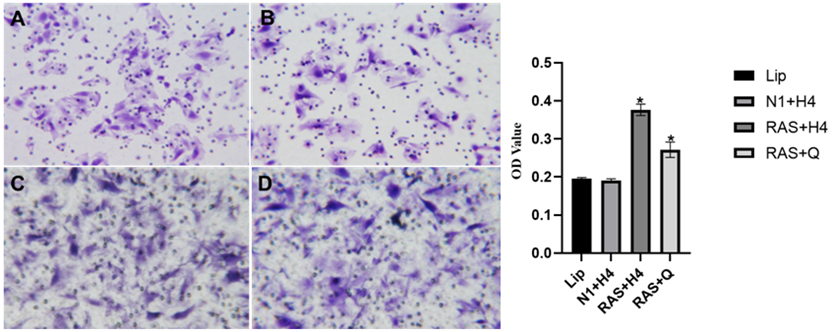
2.8. Transwell AssayTranswell assay was performed as described previously 21. Pore filters of 8μm were used in the Transwell system (Costar, Boston, MA, USA). About 9×10³ cells in 0.6 mL serum-free medium were seeded on the upper chambers after transfection, and the lower chambers were filled with medium supplemented with 10% fetal bovine serum. After culturing in a CO2 incubator for 13 h, the cells that moved to the lower surface of the membrane were fixed with methanol and dyed with 0.6% crystal violet; the A570 of the cells was tested following washing with cold acetic acid.
2.9. Cell Counting Kit-8Cell proliferation assays were performed using Cell Counting Kit-8 (CCK-8; Dojindo Molecular Technologies, Inc., Kumamoto, Japan), according to the manufacturer's instructions. The cells were seeded into 96-well microtiter plates at a density of 7.0x10³ cells/well and cultured for 24 h. The cells were then treated with increasing concentrations of 5-aza-CdR (0, 5, 10, 15 µM) for 5 days. Subsequently, 10 µl CCK-8 solution was added to each well. The absorbance was measured at 450 nm using a microplate reader, and a calibration curve was prepared using the data obtained from standardized wells that contained known numbers of viable cells. Each experiment was performed in 5 replicate wells and repeated 3 times independently.
2.10. StatisticsGraphpad prism 9.0 was used for data analysis and graphing of the experimental data, and chi-square test and t test were performed. The test standard P<0.05 is considered statistically significant.
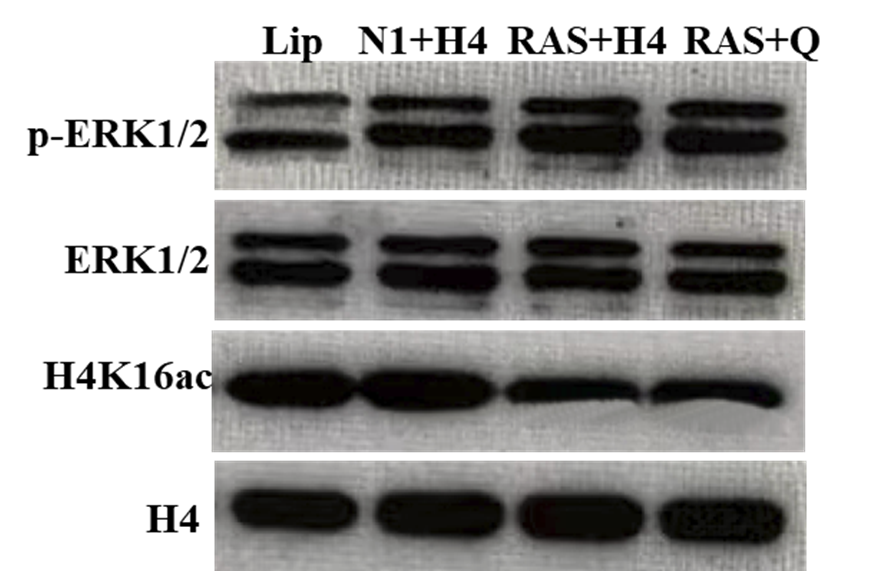
In the experiment, we constructed pEGFP-N1-Ras G12V/T35S(Ras) plasmid to activate the Ras-MAPK pathway in MCF-7 breast cancer cells. The pEGFP-N1-H4K16Q (Q) plasmid was constructed to mimic the acetylation state of histone H4K16 (H4K16ac). The transfection experiment was divided into 3 groups, pEGFP-N1-H4 plasmid and Ras pathway activation plasmid pEGFP-N1-Ras G12V/T35S (Ras+H4), pEGFP-N1-Ras G12V/T35S plasmid and mock H4K16 The acetylated pEGFP-N1-H4K16Q plasmid (Ras+Q), pEGFP-N1-H4 plasmid and pEGFP-N1 plasmid (H4+N1) were co-transfected into MCF-7 breast cancer cells. After 48 hours of transfection, the protein was extracted, and the protein expression in MCF-7 breast cancer cells was analyzed by Western blot, with ERK1/2 and H4 as internal references (P<0.05) (Figure 1).

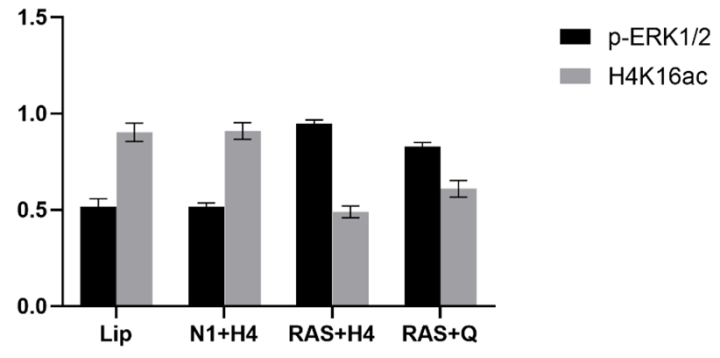
The results showed that p-ERK1/2 levels (Figure 2) downstream of the Ras signaling pathway were detected in the MCF-7 breast cancer cells of the activated Ras signaling pathway group (Ras+H4) compared with the transfection empty plasmid group (N1+H4) H4K16ac increased while H4K16ac decreased, the difference was statistically significant (P<0.05) (Figure 2). Compared with the transfected empty plasmid group (N1+H4), the level of p-ERK1/2 increased and the level of H4K16ac decreased in MCF-7 breast cancer cells that activated the Ras signaling pathway and mimicked the H4K16ac group (Ras+Q) (Figure 2). The difference was statistically significant (P<0.05). The results showed that the pEGFP-N1-Ras G12V/T35S plasmid successfully activated the Ras pathway in MCF-7 breast cancer cells. Activation of the Ras pathway resulted in increased levels of p-ERK1/2 and decreased H4K16ac in MCF-7 breast cancer cells.

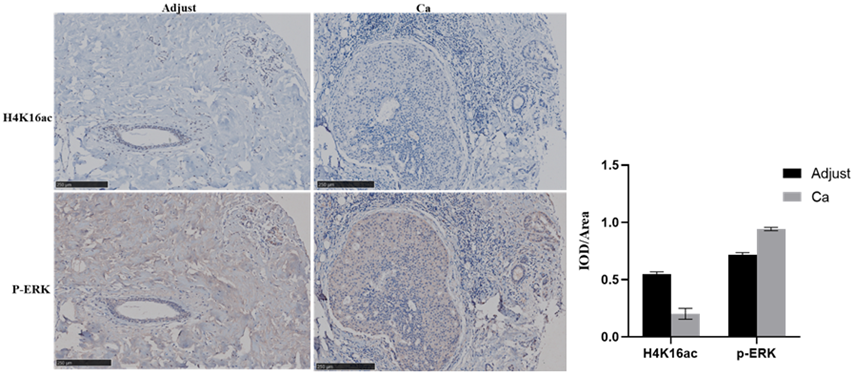
Immunohistochemical results showed that p-ERK1/2 was mainly localized in the cytoplasm as yellow particles of various sizes. H4K16ac was mainly localized in the nucleus as brown-yellow granules of varying thickness. ERK1/2 and H4 were used as internal references, respectively, and the relative expression level of the target protein was expressed by the ratio of the target protein to the corresponding internal reference protein (Figure 3). We found that the expression of p-ERK1/2 in tumor tissue (T) was higher than that in peritumoral tissue (N) (P<0.05), and the expression of H4K16ac in tumor tissue (T) was much lower than that in corresponding peritumoral tissue (N) (P<0.05) (Figure 3).

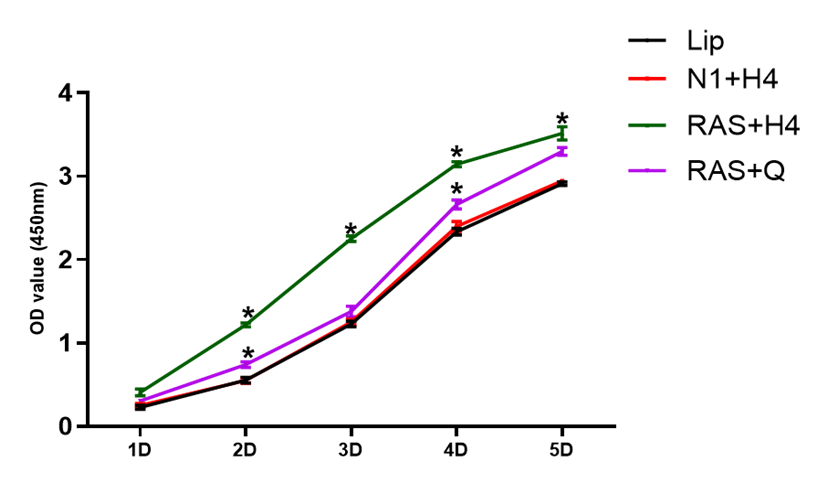
Through proliferation experiments, we found, compared with the MCF-7 breast cancer cells transfected with the empty plasmid group (H4+N1), when the Ras signaling pathway was activated (Ras+H4), the MCF-7 breast cancer cells the proliferative ability of the cells was enhanced by 34.8% (P<0.05). Through proliferation experiments, we found (Figure 4), compared with the MCF-7 breast cancer cells transfected with the empty plasmid group (H4+N1), when the Ras signaling pathway was activated (Ras+H4), the MCF-7 breast cancer cells The proliferative ability of the cells was enhanced by 34.8% (P<0.05). Compared with MCF-7 breast cancer cells that activated the Ras signaling pathway (Ras+H4), the proliferation ability of MCF-7 breast cancer cells co-transfected with the mimic H4K16ac mutant plasmid group (Ras+Q) decreased by 25.1%. Compared with the transfection empty plasmid group (H4+N1), the proliferation ability of MCF-7 breast cancer cells in the non-transfection group (Lip) had no significant difference (P>0.05) (Figure 4).

Cell migration experiments showed that the number of MCF-7 breast cancer cells in the activated Ras signaling pathway (Ras+H4) group was significantly more than that in the transfected empty plasmid (H4+N1) group (Figure 5), mimicking H4K16ac (The number of penetrating cells in the Ras+Q) group was significantly less than that in the activated Ras signaling pathway (Ras+H4) group (Figure 5). After the Transwell membrane was eluted by dipping in glacial acetic acid, the absorbance was detected at 450 nm by a microplate reader. Compared with MCF-7 breast cancer cells transfected with empty plasmid (H4+N1), after activating the Ras signaling pathway (Ras+H4), the migration ability of breast cells was enhanced by 103.1% (P<0.05). Compared with MCF-7 breast cancer cells that activated the Ras signaling pathway (Ras+H4), the migration ability of MCF-7 breast cancer cells transfected with the mimic H4K16ac mutant plasmid group (Ras+Q) was reduced by 42.7% (P<0.05). Compared with the control group without transfection (Figure 5), there was no significant difference in the migration ability of MCF-7 breast cancer cells in the transfected empty plasmid group (H4+N1) (Figure 5) (P>0.05).

Ras pathway is a classic human tumor-related signaling pathway 6. Studies have found that Ras overexpression or abnormal activation of the pathway has been detected in various tumors, including breast cancer, confirming that abnormal Ras pathway function is related to the occurrence of malignant tumors 22. Ras protein kinase is encoded by Ras gene, and the main signaling pathways mediated by Ras protein kinase include Ras-PI3K, Ras-MAPK and Ras-Ral GEF 23. These signaling pathways mainly regulate cell proliferation, differentiation and other functions 23. Abnormally activated Ras signaling can cause uncontrolled cell proliferation and lead to malignant transformation of cells 23.
Histone H4 lysine 16 acetylation (H4K16ac) has been implicated in tumorigenesis and heterogeneity 21. In some tumorigenesis processes, H4K16ac leads to the silencing of tumor suppressor genes, and H4K16ac is also thought to indirectly regulate gene transcription 24. Changes in H4K16ac levels have been reported to produce somewhat different outcomes, and it has been found that H4K16ac can also be detected in repressed promoter regions of silenced genes 21. H4K16ac was found to be a downstream target of Notch signaling pathway in liver cancer and breast cancer. H4K16ac is involved in Notch signaling and regulates tumor cell proliferation and migration 10.
In this study, after the activation of the Ras pathway in MCF-7 breast cancer cells, the activity of MAPK pathway, one of its major downstream branches, was up-regulated, the level of phosphorylated ERK1/2 (p-ERK1/2) was increased and H4K16ac was decreased, and the proliferation of cells was reduced. Capabilities and migration capabilities are then enhanced. Elevated levels of H4K16ac in cancer cells cause a decrease in p-ERK1/2 activity, resulting in a reduction in the proliferative and migratory capacity of cancer cells. It indicated that the increased level of H4K16ac in MCF-7 breast cancer cells could indeed inhibit the proliferation and migration of cancer cells. ERK signaling plays an important role in breast cancer cell proliferation and migration 25, 26, and H4K16ac may serve as an important target for breast cancer therapy. We not only discovered breast cancer induced by the Ras-MAPK-ERK-H4K16ac pathway, but also provided a new basis for personalized therapy for breast cancer.
This work was supported by Science and Technology Project of Tangshan (No. 19130213g) and 2021Hebei Medical Science Research Project (20210492).
All authors declare no conflicts of interest in this study.
| [1] | XIA C, DONG X, LI H, et al. Cancer statistics in China and United States, 2022: profiles, trends, and determinants [J]. Chinese medical journal, 2022, 135(05): 584-90. | ||
| In article | View Article PubMed | ||
| [2] | SONDKA Z, BAMFORD S, COLE C G, et al. The COSMIC Cancer Gene Census: describing genetic dysfunction across all human cancers [J]. Nature Reviews Cancer, 2018, 18(11): 696-705. | ||
| In article | View Article PubMed | ||
| [3] | JIN B, LI Y, ROBERTSON K D. DNA methylation: superior or subordinate in the epigenetic hierarchy? [J]. Genes & cancer, 2011, 2(6): 607-17. | ||
| In article | View Article PubMed | ||
| [4] | BRUHN C, BASTIANELLO G, FOIANI M. Cancer cell histone density links global histone acetylation, mitochondrial proteome and histone acetylase inhibitor sensitivity [J]. Communications biology, 2022, 5(1): 1-15. | ||
| In article | View Article PubMed | ||
| [5] | WEI L, SUN J, ZHANG N, et al. Noncoding RNAs in gastric cancer: implications for drug resistance [J]. Molecular Cancer, 2020, 19(1): 1-17. | ||
| In article | View Article PubMed | ||
| [6] | FERNáNDEZ-MEDARDE A, SANTOS E. Ras in cancer and developmental diseases [J]. Genes & cancer, 2011, 2(3): 344-58. | ||
| In article | View Article PubMed | ||
| [7] | PRIOR I A, LEWIS P D, MATTOS C. A comprehensive survey of Ras mutations in cancer [J]. Cancer research, 2012, 72(10): 2457-67. | ||
| In article | View Article PubMed | ||
| [8] | SCHöNEBORN H, RAUDZUS F, COPPEY M, et al. Perspectives of RAS and RHEB GTPase signaling pathways in regenerating brain neurons [J]. International journal of molecular sciences, 2018, 19(12): 4052. | ||
| In article | View Article PubMed | ||
| [9] | SORIANO O, ALCóN-PéREZ M, VICENTE-MANZANARES M, et al. The crossroads between RAS and RHO signaling pathways in cellular transformation, motility and contraction [J]. Genes, 2021, 12(6): 819. | ||
| In article | View Article PubMed | ||
| [10] | LIU D, MAO Y, GU X, et al. Unveiling the “invisible” druggable conformations of GDP-bound inactive Ras [J]. Proceedings of the National Academy of Sciences, 2021, 118(11): e2024725118. | ||
| In article | View Article PubMed | ||
| [11] | NUSSINOV R, JANG H, GURSOY A, et al. Inhibition of nonfunctional Ras [J]. Cell Chemical Biology, 2021, 28(2): 121-33. | ||
| In article | View Article PubMed | ||
| [12] | CARARO-LOPES E, DIAS M H, DA SILVA M S, et al. Autophagy buffers Ras-induced genotoxic stress enabling malignant transformation in keratinocytes primed by human papillomavirus [J]. Cell death & disease, 2021, 12(2): 1-16. | ||
| In article | View Article PubMed | ||
| [13] | DESJARLAIS R, TUMMINO P J. Role of histone-modifying enzymes and their complexes in regulation of chromatin biology [J]. Biochemistry, 2016, 55(11): 1584-99. | ||
| In article | View Article PubMed | ||
| [14] | CAMPBELL S L, PHILIPS M R. Post-translational modification of RAS proteins [J]. Current Opinion in Structural Biology, 2021, 71(180-92. | ||
| In article | View Article PubMed | ||
| [15] | CHENG Y, HE C, WANG M, et al. Targeting epigenetic regulators for cancer therapy: mechanisms and advances in clinical trials [J]. Signal transduction and targeted therapy, 2019, 4(1): 1-39. | ||
| In article | View Article PubMed | ||
| [16] | SHVEDUNOVA M, AKHTAR A. Modulation of cellular processes by histone and non-histone protein acetylation [J]. Nature Reviews Molecular Cell Biology, 2022, 23(5): 329-49. | ||
| In article | View Article PubMed | ||
| [17] | LEE H-T, OH S, YOO H, et al. The key role of DNA methylation and histone acetylation in epigenetics of atherosclerosis [J]. Journal of lipid and atherosclerosis, 2020, 9(3): 419. | ||
| In article | View Article PubMed | ||
| [18] | XIE J, QIAN Y-Y, YANG Y, et al. Isothiocyanate From Moringa oleifera Seeds Inhibits the Growth and Migration of Renal Cancer Cells by Regulating the PTP1B-dependent Src/Ras/Raf/ERK Signaling Pathway [J]. Frontiers in cell and developmental biology, 2021, 9(4): 342-56. | ||
| In article | View Article PubMed | ||
| [19] | WANG H, WANG Y, LI D. The PCAF/WSTF/MOF Complex Regulates H3K9ac and H4K16ac in Breast Cancer Cells [J]. American Journal of Cancer, 2022, 9(1): 4-9. | ||
| In article | View Article | ||
| [20] | MARTINELLI E, MORGILLO F, TROIANI T, et al. Cancer resistance to therapies against the EGFR-RAS-RAF pathway: the role of MEK [J]. Cancer treatment reviews, 2017, 53(4): 61-9. | ||
| In article | View Article PubMed | ||
| [21] | LIU Y, XING Z B, WANG S Q, et al. MDM 2–MOF–H4K16ac axis contributes to tumorigenesis induced by Notch [J]. The FEBS Journal, 2014, 281(15): 3315-24. | ||
| In article | View Article PubMed | ||
| [22] | PUNEKAR S R, VELCHETI V, NEEL B G, et al. The current state of the art and future trends in RAS-targeted cancer therapies [J]. Nature Reviews Clinical Oncology, 2022, 19(10): 637-55. | ||
| In article | View Article PubMed | ||
| [23] | MOON A. Ras Signaling in Breast Cancer [M]. Translational Research in Breast Cancer. Springer. 2021: 81-101. | ||
| In article | View Article PubMed | ||
| [24] | PENG P-H, LAI J C-Y, CHANG J-S, et al. Induction of epithelial-mesenchymal transition (EMT) by hypoxia-induced lncRNA RP11-367G18. 1 through regulating the histone 4 lysine 16 acetylation (H4K16Ac) mark [J]. American Journal of Cancer Research, 2021, 11(6): 2618. | ||
| In article | |||
| [25] | ZHOU X, LI T, CHEN Y, et al. Mesenchymal stem cellderived extracellular vesicles promote the in vitro proliferation and migration of breast cancer cells through the activation of the ERK pathway [J]. International journal of oncology, 2019, 54(5): 1843-52. | ||
| In article | View Article PubMed | ||
| [26] | ACEVEDO-DíAZ A, MORALES-CABáN B M, ZAYAS-SANTIAGO A, et al. SCAMP3 Regulates EGFR and Promotes Proliferation and Migration of Triple-Negative Breast Cancer Cells through the Modulation of AKT, ERK, and STAT3 Signaling Pathways [J]. Cancers, 2022, 14(11): 2807. | ||
| In article | View Article PubMed | ||
Published with license by Science and Education Publishing, Copyright © 2022 Yaqi Wang, Shunli Zhang, Jie Ma, Hong Wang, Nan Jiang, Yang Wang, Jun Zhang, Zhuo Wang and Jinghua Zhang
 This work is licensed under a Creative Commons Attribution 4.0 International License. To view a copy of this license, visit
http://creativecommons.org/licenses/by/4.0/
This work is licensed under a Creative Commons Attribution 4.0 International License. To view a copy of this license, visit
http://creativecommons.org/licenses/by/4.0/
| [1] | XIA C, DONG X, LI H, et al. Cancer statistics in China and United States, 2022: profiles, trends, and determinants [J]. Chinese medical journal, 2022, 135(05): 584-90. | ||
| In article | View Article PubMed | ||
| [2] | SONDKA Z, BAMFORD S, COLE C G, et al. The COSMIC Cancer Gene Census: describing genetic dysfunction across all human cancers [J]. Nature Reviews Cancer, 2018, 18(11): 696-705. | ||
| In article | View Article PubMed | ||
| [3] | JIN B, LI Y, ROBERTSON K D. DNA methylation: superior or subordinate in the epigenetic hierarchy? [J]. Genes & cancer, 2011, 2(6): 607-17. | ||
| In article | View Article PubMed | ||
| [4] | BRUHN C, BASTIANELLO G, FOIANI M. Cancer cell histone density links global histone acetylation, mitochondrial proteome and histone acetylase inhibitor sensitivity [J]. Communications biology, 2022, 5(1): 1-15. | ||
| In article | View Article PubMed | ||
| [5] | WEI L, SUN J, ZHANG N, et al. Noncoding RNAs in gastric cancer: implications for drug resistance [J]. Molecular Cancer, 2020, 19(1): 1-17. | ||
| In article | View Article PubMed | ||
| [6] | FERNáNDEZ-MEDARDE A, SANTOS E. Ras in cancer and developmental diseases [J]. Genes & cancer, 2011, 2(3): 344-58. | ||
| In article | View Article PubMed | ||
| [7] | PRIOR I A, LEWIS P D, MATTOS C. A comprehensive survey of Ras mutations in cancer [J]. Cancer research, 2012, 72(10): 2457-67. | ||
| In article | View Article PubMed | ||
| [8] | SCHöNEBORN H, RAUDZUS F, COPPEY M, et al. Perspectives of RAS and RHEB GTPase signaling pathways in regenerating brain neurons [J]. International journal of molecular sciences, 2018, 19(12): 4052. | ||
| In article | View Article PubMed | ||
| [9] | SORIANO O, ALCóN-PéREZ M, VICENTE-MANZANARES M, et al. The crossroads between RAS and RHO signaling pathways in cellular transformation, motility and contraction [J]. Genes, 2021, 12(6): 819. | ||
| In article | View Article PubMed | ||
| [10] | LIU D, MAO Y, GU X, et al. Unveiling the “invisible” druggable conformations of GDP-bound inactive Ras [J]. Proceedings of the National Academy of Sciences, 2021, 118(11): e2024725118. | ||
| In article | View Article PubMed | ||
| [11] | NUSSINOV R, JANG H, GURSOY A, et al. Inhibition of nonfunctional Ras [J]. Cell Chemical Biology, 2021, 28(2): 121-33. | ||
| In article | View Article PubMed | ||
| [12] | CARARO-LOPES E, DIAS M H, DA SILVA M S, et al. Autophagy buffers Ras-induced genotoxic stress enabling malignant transformation in keratinocytes primed by human papillomavirus [J]. Cell death & disease, 2021, 12(2): 1-16. | ||
| In article | View Article PubMed | ||
| [13] | DESJARLAIS R, TUMMINO P J. Role of histone-modifying enzymes and their complexes in regulation of chromatin biology [J]. Biochemistry, 2016, 55(11): 1584-99. | ||
| In article | View Article PubMed | ||
| [14] | CAMPBELL S L, PHILIPS M R. Post-translational modification of RAS proteins [J]. Current Opinion in Structural Biology, 2021, 71(180-92. | ||
| In article | View Article PubMed | ||
| [15] | CHENG Y, HE C, WANG M, et al. Targeting epigenetic regulators for cancer therapy: mechanisms and advances in clinical trials [J]. Signal transduction and targeted therapy, 2019, 4(1): 1-39. | ||
| In article | View Article PubMed | ||
| [16] | SHVEDUNOVA M, AKHTAR A. Modulation of cellular processes by histone and non-histone protein acetylation [J]. Nature Reviews Molecular Cell Biology, 2022, 23(5): 329-49. | ||
| In article | View Article PubMed | ||
| [17] | LEE H-T, OH S, YOO H, et al. The key role of DNA methylation and histone acetylation in epigenetics of atherosclerosis [J]. Journal of lipid and atherosclerosis, 2020, 9(3): 419. | ||
| In article | View Article PubMed | ||
| [18] | XIE J, QIAN Y-Y, YANG Y, et al. Isothiocyanate From Moringa oleifera Seeds Inhibits the Growth and Migration of Renal Cancer Cells by Regulating the PTP1B-dependent Src/Ras/Raf/ERK Signaling Pathway [J]. Frontiers in cell and developmental biology, 2021, 9(4): 342-56. | ||
| In article | View Article PubMed | ||
| [19] | WANG H, WANG Y, LI D. The PCAF/WSTF/MOF Complex Regulates H3K9ac and H4K16ac in Breast Cancer Cells [J]. American Journal of Cancer, 2022, 9(1): 4-9. | ||
| In article | View Article | ||
| [20] | MARTINELLI E, MORGILLO F, TROIANI T, et al. Cancer resistance to therapies against the EGFR-RAS-RAF pathway: the role of MEK [J]. Cancer treatment reviews, 2017, 53(4): 61-9. | ||
| In article | View Article PubMed | ||
| [21] | LIU Y, XING Z B, WANG S Q, et al. MDM 2–MOF–H4K16ac axis contributes to tumorigenesis induced by Notch [J]. The FEBS Journal, 2014, 281(15): 3315-24. | ||
| In article | View Article PubMed | ||
| [22] | PUNEKAR S R, VELCHETI V, NEEL B G, et al. The current state of the art and future trends in RAS-targeted cancer therapies [J]. Nature Reviews Clinical Oncology, 2022, 19(10): 637-55. | ||
| In article | View Article PubMed | ||
| [23] | MOON A. Ras Signaling in Breast Cancer [M]. Translational Research in Breast Cancer. Springer. 2021: 81-101. | ||
| In article | View Article PubMed | ||
| [24] | PENG P-H, LAI J C-Y, CHANG J-S, et al. Induction of epithelial-mesenchymal transition (EMT) by hypoxia-induced lncRNA RP11-367G18. 1 through regulating the histone 4 lysine 16 acetylation (H4K16Ac) mark [J]. American Journal of Cancer Research, 2021, 11(6): 2618. | ||
| In article | |||
| [25] | ZHOU X, LI T, CHEN Y, et al. Mesenchymal stem cellderived extracellular vesicles promote the in vitro proliferation and migration of breast cancer cells through the activation of the ERK pathway [J]. International journal of oncology, 2019, 54(5): 1843-52. | ||
| In article | View Article PubMed | ||
| [26] | ACEVEDO-DíAZ A, MORALES-CABáN B M, ZAYAS-SANTIAGO A, et al. SCAMP3 Regulates EGFR and Promotes Proliferation and Migration of Triple-Negative Breast Cancer Cells through the Modulation of AKT, ERK, and STAT3 Signaling Pathways [J]. Cancers, 2022, 14(11): 2807. | ||
| In article | View Article PubMed | ||