Acute myeloid leukaemia (AML) is a complex haematological malignancy characterised by a clonal expansion of the myeloid progenitor. Factors such as molecular/cytogenetic abnormalities influence the prognosis of this condition. However, gender predominance in AML and how it influences the outcome of the condition has not been studied. Raw data of 20,000 gene expressions in 180 AML patients were retrospectively retrieved from the Cancer Genome Atlas Genomic Data Commons portal. A linear model was fitted to calculate the impact of each gene on the overall survival. The coefficient value was set to 2, and a P value of < 0.01 was set to denote significance. Almost twice as many male patients were at poor cytogenetic risk than females regardless of their vital status. Male-abundant genes were highly expressed in patients with poor prognosis. However, none of these genes correlated with previously reported genes, such as FLT3. It was noted that many of the highly expressed genes in patients with poor prognosis were dominant in male patients. The lack of correlation between these genes and previously established genes indicate that male patients are at a higher risk of developing more severe forms of AML and carry a poorer prognosis than females.
Acute myeloid leukaemia (AML) is a haematological malignancy characterised by a clonal expansion of the haematological myeloid progenitor in blood and bone marrow. The development of the current understanding of AML pathophysiology and molecular interactions involved in this condition has changed it from an incurable condition to a curable one. It is estimated that slightly over 35% of treated patients under 60 years of age are being cured with the current standard line of therapy 1, 2. AML is a heterogeneous disease in which diseased cells vary in size and phenotype, and therefore, bone marrow biopsy and aspirate are key to diagnosis 3.
In efforts to dissect the heterogeneity of AML, the World Health Organization (WHO) classification came into effect in 2008, replacing the old French-American-British classification 4. The European LeukemiaNet (ELN) has classified patients with AML into four prognostic categories based on a set of previously described cytogenetics and molecular abnormalities that influence overall survival and disease-free survival 5, 6. Age is an independent prognostic factor which correlates inversely with overall survival due to accumulating alterations and mutations as well as the ability of older patients to withstand more aggressive treatment regiments 7.
Gender predominance in AML and how it influences the outcome of the condition have not been addressed in previous studies. In this retrospective study, critical molecular signatures, namely DNA gene microarray, were used to describe the gender differences in AML and how they impact the disease prognosis and patient survival.
Raw gene expression data were retrieved from the Cancer Genome Atlas (TCGA) through the Genomic Data Commons portal 8. The used data were from the American Acute Myeloid Leukemia Project under the project ID ‘TCGA-LAML’ 9.
After the retrieval of gene expression data for this study, data were analysed retrospectively using R along with a set of specialised packages (‘gplots’, ‘survival’, ‘limma’) 10.
In order to correlate between the different sets of genes across the whole patient cohort, the Shapiro-Wilk test was applied to assess the normalisation of these data (parametric vs nonparametric), and single correlation tests were applied using the Pearson correlation method. Overall survival was calculated based on the number of days from the initial visit to the last visit within the study period, and the vital status of the patients (living or deceased), which were provided in the clinical data of the cohort. A linear model was fitted to calculate the impact of each gene on the overall survival, with the coefficient value set to 2 and a P value of < 0.01 set to denote significance.
This study was approved by Taibah University, College of Medicine Research Ethics Committee and registered with the study ID: 028-1441.
Patients included in this study were predominantly male (109 males vs 91 females) and were diagnosed with AML at a median of 57.5 years old (ranging between 18 and 88 years old; Table 1).
Patients were categorised into three cytogenetic risk groups based on their cytogenetic make-up: favourable (n = 38), intermediate (n = 106) and poor (n = 44). Interestingly, the number of male patients with poor cytogenetic risk were almost twice as high as that of females regardless of their vital status (deceased: 22 males and 13 females; living: 6 males and 3 females; Table 2). Almost two-thirds of the subjects (n = 121) were deceased at the time of the study, 70 of which were males (Table 2).
TCGA gene expression data included over 20,000 gene expressions for 180 subjects. Genes were then compared based on their abundance in either males or females.
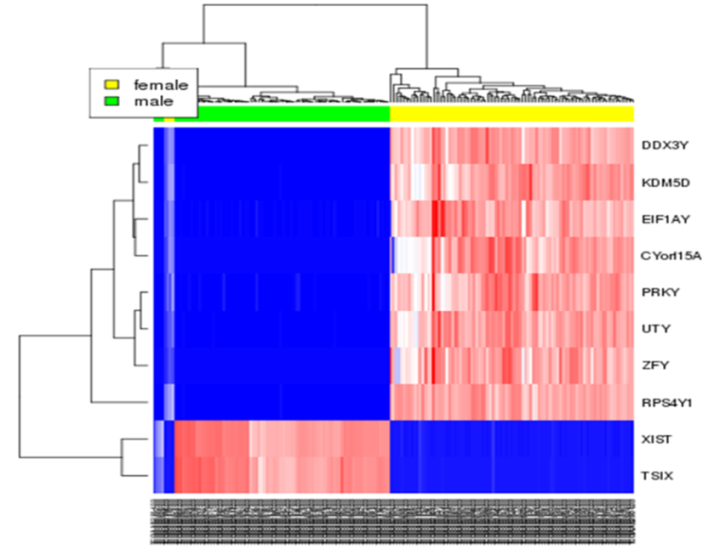
An array of genes, including DDX3Y and KDM5D, were highly expressed in males, whereas XIST and its antisense gene TSIX were expressed highly in females (Figure 1).

These eight male-predominant genes were expressed on the Y chromosome, whereas XIST and TSIX were expressed on the X chromosome.
3.3. Novel Genes Which Are Highly Expressed in AML Patients with Poor Cytogenetic RiskThe next objective was to identify which genes are highly expressed in patients with poor prognosis and to assess whether any of the reported genes would be included in this cohort. The IL7 gene came at the top of the highly expressed genes in AML (Table 3).
This overexpression was surprising, as the IL7 gene is a critical gene for lymphoid development, particularly T cells. None of the genes that were reported to be of high impact on the prognostic value, such as Fms-Like Tyrosine Kinase 3 (FLT3) (11), Nucleophosmin 1 (NPM1) or TET2 (3), were identified in this group. These genes were not expressed differentially in the favourable cytogenetic risk group either. Interestingly, six of the eight highest expressed genes in AML patients with poor prognosis were located on the Y chromosome.

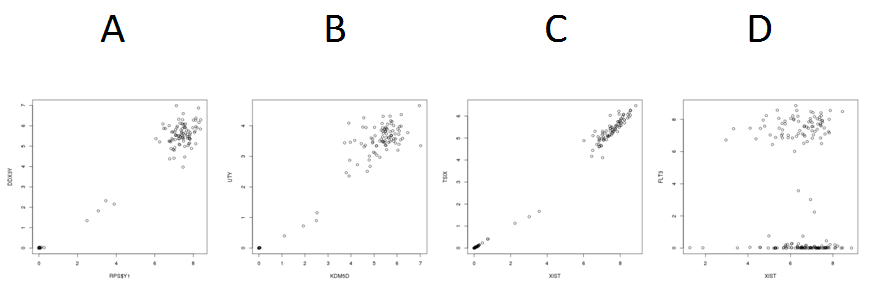
Next was to examine whether these male-abundant genes correlate with each other in AML patients and to see if they correlate with the previously reported significant genes. Male-abundant genes correlated highly with each other (P value < 2.2e-16) (Figure 2), as did XIST with its antisense gene TSIX. Interestingly, none of these genes correlated with the previously reported genes.
AML is a very complex disease in which many factors could contribute to the prognosis and overall survival of the disease. Apart from age, which is considered to be an independent prognostic factor in AML 7, several molecular abnormalities have been described as carrying a prognostic value 3. As far as the current study is concerned, gender has not been previously ascribed prognostic significance. In this cohort, however, gender was determined to carry prognostic value. Most of the patients with poor or unfavourable cytogenetic prognosis were males. Also, the majority of the deceased patients in this cohort were males, suggesting the male gender to be a poorer prognostic factor. These findings are in line with similar findings in different cohorts of larger size and at different time intervals 12, 13, 14. Interestingly, many of the highly expressed genes in patients with unfavourable cytogenetic profile did not correlate with genes, such as FLT3 and NPM1, that were previously associated with the unfavourable prognosis 15, 16.
Male abundance in AML, in particular in patients with lower overall survival and unfavourable prognosis, can be observed in previous studies 17. Yazarloo and colleagues found that the expression of several genes linked to testicular cancer was differentially expressed in male AML patients 18. These findings further support that the male gender carries a poorer prognosis than the female gender.
As gender was not considered to be a prognostic factor in any of these studies, nor was it linked to any cytogenetic or molecular features of AML, this study is the first of its kind in AML. The use of gender as an independent prognostic factor was previously determined in other haematological malignancies, such as acute lymphoblastic leukaemia and chronic myeloid leukaemia 19, 20. Furthermore, the male gender has also been determined as an independent predictor for worse survival and relapse in a large consecutive cohort of elderly with diffuse large B-cell lymphoma treated with rituximab plus cyclophosphamide, doxorubicin, vincristine, and prednisone 21. Yet, these studies could not determine the cellular or molecular differences giving rise to such prognostic difference between males and females.
The novel finding of the overexpression of the IL7 gene in this cohort of patients could be of functional significance. Wendelbo and colleagues found that patients with untreated AML suffer from a reduced systemic IL-7 22, which was corrected upon response to therapy. Taken together, IL-7 overexpression could be a physiological response to compensate for the lack of IL-7 or highlight a novel abnormality in AML in which IL-7 translation is potentially impaired.
Similar to this study, HOXA9 gene overexpression with its leukaemogenic potential was reported to be one of the most correlating factors to poor prognosis for human AML 23, 24. In this study, the HOXA9 gene was also the second-most expressed gene among patients who were classified with poor prognosis.
Limitations of this study include the following:
1-This study does not exhaust every possible molecular mechanism that might contradict these findings, such as DNA methylation or RNA sequencing.
2-The cohort in this study might not be representative, as many of the previously reported genes that had an impact on the prognosis and the overall survival were not of significance in this cohort.
4.1. ConclusionIn conclusion, the results of this study suggest that the male population is at higher risk of developing more severe forms of AML and, thus, carry a poorer prognosis compared to females. This was demonstrated in the higher male proportion with poor unfavourable prognosis as well as those who were deceased.
| [1] | Bullinger L, Döhner K, Döhner H. Genomics of Acute Myeloid Leukemia Diagnosis and Pathways. J Clin Oncol [Internet]. 2017 Mar 20; 35(9): 934-46. | ||
| In article | View Article PubMed | ||
| [2] | Medeiros BC, Othus M, Fang M, Roulston D, Appelbaum FR. Prognostic impact of monosomal karyotype in young adult and elderly acute myeloid leukemia: the Southwest Oncology Group (SWOG) experience. Blood. 2010 Sep 30; 116(13): 2224-8. | ||
| In article | View Article PubMed | ||
| [3] | Saultz J, Garzon R. Acute Myeloid Leukemia: A Concise Review. J Clin Med [Internet]. 2016 Mar 5; 5(3): 33. | ||
| In article | View Article PubMed | ||
| [4] | Vardiman JW, Thiele J, Arber DA, Brunning RD, Borowitz MJ, Porwit A, et al. The 2008 revision of the World Health Organization (WHO) classification of myeloid neoplasms and acute leukemia: rationale and important changes. Blood [Internet]. 2009 Jul 30; 114(5): 937-51. | ||
| In article | View Article PubMed | ||
| [5] | Dohner H, Estey EH, Amadori S, Appelbaum FR, Buchner T, Burnett AK, et al. Diagnosis and management of acute myeloid leukemia in adults: recommendations from an international expert panel, on behalf of the European LeukemiaNet. Blood [Internet]. 2010 Jan 21; 115(3): 453-74. | ||
| In article | View Article PubMed | ||
| [6] | Byrd JC. Pretreatment cytogenetic abnormalities are predictive of induction success, cumulative incidence of relapse, and overall survival in adult patients with de novo acute myeloid leukemia: results from Cancer and Leukemia Group B (CALGB 8461). Blood. 2002 Dec 15; 100(13): 4325-36. | ||
| In article | View Article PubMed | ||
| [7] | Mrózek K, Marcucci G, Nicolet D, Maharry KS, Becker H, Whitman SP, et al. Prognostic Significance of the European LeukemiaNet Standardized System for Reporting Cytogenetic and Molecular Alterations in Adults With Acute Myeloid Leukemia. J Clin Oncol. 2012 Dec 20; 30(36): 4515-23. | ||
| In article | View Article PubMed | ||
| [8] | Grossman RL, Heath AP, Ferretti V, Varmus HE, Lowy DR, Kibbe WA, et al. Toward a Shared Vision for Cancer Genomic Data. N Engl J Med. 2016 Sep 22; 375(12): 1109-12. | ||
| In article | View Article PubMed | ||
| [9] | Leukemia AM. Genomic and Epigenomic Landscapes of Adult De Novo Acute Myeloid Leukemia. N Engl J Med. 2013; 368(22): 2059-74. | ||
| In article | View Article PubMed | ||
| [10] | R Development Core Team. R: A language and environment for statistical computing. R Foundation for Statistical Computing. 2016. | ||
| In article | |||
| [11] | Kelly LM. FLT3 internal tandem duplication mutations associated with human acute myeloid leukemias induce myeloproliferative disease in a murine bone marrow transplant model. Blood. 2002 Jan 1; 99(1): 310-8. | ||
| In article | View Article PubMed | ||
| [12] | Acharya UH, Halpern AB, Wu Q (Vicky), Voutsinas JM, Walter RB, Yun S, et al. Impact of region of diagnosis, ethnicity, age, and gender on survival in acute myeloid leukemia (AML). J Drug Assess. 2018; 7(1): 51-3. | ||
| In article | View Article PubMed | ||
| [13] | Singh H, Asali S, Werner LL, DeAngelo DJ, Ballen KK, Amrein PC, et al. Outcome of older adults with cytogenetically normal AML (CN-AML) and FLT3 mutations. Leuk Res. 2011; 35(12): 1611-5. | ||
| In article | View Article PubMed | ||
| [14] | Tawfik B, Pardee TS, Isom S, Sliesoraitis S, Winter A, Lawrence J, et al. Comorbidity, age, and mortality among adults treated intensively for acute myeloid leukemia (AML). J Geriatr Oncol. 2016; 7(1): 24-31. | ||
| In article | View Article PubMed | ||
| [15] | Schnittger S, Schoch C, Kern W, Mecucci C, Tschulik C, Martelli MF, et al. Nucleophosmin gene mutations are predictors of favorable prognosis in acute myelogenous leukemia with a normal karyotype. Blood. 2005; 106(12):3733-9. | ||
| In article | View Article PubMed | ||
| [16] | Lin TL, Smith BD. Prognostically important molecular markers in cytogenetically normal acute myeloid leukemia. American Journal of the Medical Sciences. 2011. | ||
| In article | View Article PubMed | ||
| [17] | Patel JP, Gönen M, Figueroa ME, Fernandez H, Sun Z, Racevskis J, et al. Prognostic Relevance of Integrated Genetic Profiling in Acute Myeloid Leukemia. N Engl J Med. 2012 Mar 22; 366(12):1079-89. | ||
| In article | View Article PubMed | ||
| [18] | Yazarloo F, Shirkoohi R, Mobasheri MB, Emami A, Modarressi MH. Expression analysis of four testis-specific genes AURKC, OIP5, PIWIL2 and TAF7L in acute myeloid leukemia: a gender-dependent expression pattern. Med Oncol. 2013 Mar 6; 30(1):368. | ||
| In article | View Article PubMed | ||
| [19] | Chessells JM, Richards SM, Bailey CC, Lilleyman JS, Eden OB. Gender and treatment outcome in childhood lymphoblastic leukaemia: report from the MRC UKALL trials*. Br J Haematol. 1995 Feb; 89(2): 364-72. | ||
| In article | View Article PubMed | ||
| [20] | Lee JP, Birnstein E, Masiello D, Yang D, Yang AS. Gender and ethnic differences in chronic myelogenous leukemia prognosis and treatment response: a single-institution retrospective study. J Hematol Oncol. 2009; 2(1): 30. | ||
| In article | View Article PubMed | ||
| [21] | Eyre TA, Martinez‐Calle N, Hildyard C, Eyre DW, Plaschkes H, Griffith J, et al. Male gender is an independent predictor for worse survival and relapse in a large, consecutive cohort of elderly DLBCL patients treated with R‐ CHOP. Br J Haematol. 2019; 186(4):e94-e98. | ||
| In article | View Article | ||
| [22] | Wendelbo Ø, Glenjen N, Bruserud Ø. Interleukin-7 (IL-7) in Patients Receiving Intensive Chemotherapy for Acute Myelogenous Leukemia: Studies of Systemic IL-7 Levels and IL-7 Responsiveness of Circulating T Lymphocytes. J Interf Cytokine Res. 2002 Oct; 22(10): 1057-65. | ||
| In article | View Article PubMed | ||
| [23] | Golub TR, Slonim DK, Tamayo P, Huard C, Gaasenbeek M, Mesirov JP, et al. Molecular classification of cancer: Class discovery and class prediction by gene expression monitoring. Science (80). 1999; 286(5439): 531-7. | ||
| In article | View Article PubMed | ||
| [24] | Thorsteinsdottir U, Mamo A, Kroon E, Jerome L, Bijl J, Lawrence HJ, et al. Overexpression of the myeloid leukemia-associated Hoxa9 gene in bone marrow cells induces stem cell expansion. Blood. 2002; 99(1): 121-9. | ||
| In article | View Article PubMed | ||
Published with license by Science and Education Publishing, Copyright © 2020 Anwar A. Sayed
 This work is licensed under a Creative Commons Attribution 4.0 International License. To view a copy of this license, visit
http://creativecommons.org/licenses/by/4.0/
This work is licensed under a Creative Commons Attribution 4.0 International License. To view a copy of this license, visit
http://creativecommons.org/licenses/by/4.0/
| [1] | Bullinger L, Döhner K, Döhner H. Genomics of Acute Myeloid Leukemia Diagnosis and Pathways. J Clin Oncol [Internet]. 2017 Mar 20; 35(9): 934-46. | ||
| In article | View Article PubMed | ||
| [2] | Medeiros BC, Othus M, Fang M, Roulston D, Appelbaum FR. Prognostic impact of monosomal karyotype in young adult and elderly acute myeloid leukemia: the Southwest Oncology Group (SWOG) experience. Blood. 2010 Sep 30; 116(13): 2224-8. | ||
| In article | View Article PubMed | ||
| [3] | Saultz J, Garzon R. Acute Myeloid Leukemia: A Concise Review. J Clin Med [Internet]. 2016 Mar 5; 5(3): 33. | ||
| In article | View Article PubMed | ||
| [4] | Vardiman JW, Thiele J, Arber DA, Brunning RD, Borowitz MJ, Porwit A, et al. The 2008 revision of the World Health Organization (WHO) classification of myeloid neoplasms and acute leukemia: rationale and important changes. Blood [Internet]. 2009 Jul 30; 114(5): 937-51. | ||
| In article | View Article PubMed | ||
| [5] | Dohner H, Estey EH, Amadori S, Appelbaum FR, Buchner T, Burnett AK, et al. Diagnosis and management of acute myeloid leukemia in adults: recommendations from an international expert panel, on behalf of the European LeukemiaNet. Blood [Internet]. 2010 Jan 21; 115(3): 453-74. | ||
| In article | View Article PubMed | ||
| [6] | Byrd JC. Pretreatment cytogenetic abnormalities are predictive of induction success, cumulative incidence of relapse, and overall survival in adult patients with de novo acute myeloid leukemia: results from Cancer and Leukemia Group B (CALGB 8461). Blood. 2002 Dec 15; 100(13): 4325-36. | ||
| In article | View Article PubMed | ||
| [7] | Mrózek K, Marcucci G, Nicolet D, Maharry KS, Becker H, Whitman SP, et al. Prognostic Significance of the European LeukemiaNet Standardized System for Reporting Cytogenetic and Molecular Alterations in Adults With Acute Myeloid Leukemia. J Clin Oncol. 2012 Dec 20; 30(36): 4515-23. | ||
| In article | View Article PubMed | ||
| [8] | Grossman RL, Heath AP, Ferretti V, Varmus HE, Lowy DR, Kibbe WA, et al. Toward a Shared Vision for Cancer Genomic Data. N Engl J Med. 2016 Sep 22; 375(12): 1109-12. | ||
| In article | View Article PubMed | ||
| [9] | Leukemia AM. Genomic and Epigenomic Landscapes of Adult De Novo Acute Myeloid Leukemia. N Engl J Med. 2013; 368(22): 2059-74. | ||
| In article | View Article PubMed | ||
| [10] | R Development Core Team. R: A language and environment for statistical computing. R Foundation for Statistical Computing. 2016. | ||
| In article | |||
| [11] | Kelly LM. FLT3 internal tandem duplication mutations associated with human acute myeloid leukemias induce myeloproliferative disease in a murine bone marrow transplant model. Blood. 2002 Jan 1; 99(1): 310-8. | ||
| In article | View Article PubMed | ||
| [12] | Acharya UH, Halpern AB, Wu Q (Vicky), Voutsinas JM, Walter RB, Yun S, et al. Impact of region of diagnosis, ethnicity, age, and gender on survival in acute myeloid leukemia (AML). J Drug Assess. 2018; 7(1): 51-3. | ||
| In article | View Article PubMed | ||
| [13] | Singh H, Asali S, Werner LL, DeAngelo DJ, Ballen KK, Amrein PC, et al. Outcome of older adults with cytogenetically normal AML (CN-AML) and FLT3 mutations. Leuk Res. 2011; 35(12): 1611-5. | ||
| In article | View Article PubMed | ||
| [14] | Tawfik B, Pardee TS, Isom S, Sliesoraitis S, Winter A, Lawrence J, et al. Comorbidity, age, and mortality among adults treated intensively for acute myeloid leukemia (AML). J Geriatr Oncol. 2016; 7(1): 24-31. | ||
| In article | View Article PubMed | ||
| [15] | Schnittger S, Schoch C, Kern W, Mecucci C, Tschulik C, Martelli MF, et al. Nucleophosmin gene mutations are predictors of favorable prognosis in acute myelogenous leukemia with a normal karyotype. Blood. 2005; 106(12):3733-9. | ||
| In article | View Article PubMed | ||
| [16] | Lin TL, Smith BD. Prognostically important molecular markers in cytogenetically normal acute myeloid leukemia. American Journal of the Medical Sciences. 2011. | ||
| In article | View Article PubMed | ||
| [17] | Patel JP, Gönen M, Figueroa ME, Fernandez H, Sun Z, Racevskis J, et al. Prognostic Relevance of Integrated Genetic Profiling in Acute Myeloid Leukemia. N Engl J Med. 2012 Mar 22; 366(12):1079-89. | ||
| In article | View Article PubMed | ||
| [18] | Yazarloo F, Shirkoohi R, Mobasheri MB, Emami A, Modarressi MH. Expression analysis of four testis-specific genes AURKC, OIP5, PIWIL2 and TAF7L in acute myeloid leukemia: a gender-dependent expression pattern. Med Oncol. 2013 Mar 6; 30(1):368. | ||
| In article | View Article PubMed | ||
| [19] | Chessells JM, Richards SM, Bailey CC, Lilleyman JS, Eden OB. Gender and treatment outcome in childhood lymphoblastic leukaemia: report from the MRC UKALL trials*. Br J Haematol. 1995 Feb; 89(2): 364-72. | ||
| In article | View Article PubMed | ||
| [20] | Lee JP, Birnstein E, Masiello D, Yang D, Yang AS. Gender and ethnic differences in chronic myelogenous leukemia prognosis and treatment response: a single-institution retrospective study. J Hematol Oncol. 2009; 2(1): 30. | ||
| In article | View Article PubMed | ||
| [21] | Eyre TA, Martinez‐Calle N, Hildyard C, Eyre DW, Plaschkes H, Griffith J, et al. Male gender is an independent predictor for worse survival and relapse in a large, consecutive cohort of elderly DLBCL patients treated with R‐ CHOP. Br J Haematol. 2019; 186(4):e94-e98. | ||
| In article | View Article | ||
| [22] | Wendelbo Ø, Glenjen N, Bruserud Ø. Interleukin-7 (IL-7) in Patients Receiving Intensive Chemotherapy for Acute Myelogenous Leukemia: Studies of Systemic IL-7 Levels and IL-7 Responsiveness of Circulating T Lymphocytes. J Interf Cytokine Res. 2002 Oct; 22(10): 1057-65. | ||
| In article | View Article PubMed | ||
| [23] | Golub TR, Slonim DK, Tamayo P, Huard C, Gaasenbeek M, Mesirov JP, et al. Molecular classification of cancer: Class discovery and class prediction by gene expression monitoring. Science (80). 1999; 286(5439): 531-7. | ||
| In article | View Article PubMed | ||
| [24] | Thorsteinsdottir U, Mamo A, Kroon E, Jerome L, Bijl J, Lawrence HJ, et al. Overexpression of the myeloid leukemia-associated Hoxa9 gene in bone marrow cells induces stem cell expansion. Blood. 2002; 99(1): 121-9. | ||
| In article | View Article PubMed | ||