Architecture is in a constant process of change and innovation for the past few decades. The main driver of this is believed to be technology. The traditional paper-based process has evolved into a computer-aided design and now a days we are looking for even advanced method of design as well as construction practice. BIM have come to being due to this notion. The introduction of this method was a great revolution toward the whole disciplines in the construction industry. The adoption of new technologies or systems always requires the identification of potential barriers and key effective implementation strategies in order to ensure successful diffusion and implementation of the technologies. This paper is aimed at assessing the barriers that this method will encounter when it is going to be implemented. A phenomenological research methodology was used to asses lived perceptions of professionals in the Ethiopian construction industry.
The construction industry in Ethiopia plays a significant role in the countries social, economic and political endeavours. The GDP contribution of the industry has been raised to 5.6% and approaches to the sub-Saharan average (6%) 1. Meanwhile, the Gross Domestic Capital Formation (GDCF), which was about 60 percent in 1996/97, has reached nearly 75% in 2002/03.
The level of construction project management practice in terms of adapting general project management procedures, project management functions, tools & techniques to be unsatisfactory. Particularly, the level of practice in terms of safety, risk and time management was found to be very low. The amount of schedule slippage ranges between 61-80% and that of planed costs and other variables such as risk, quality, resources utilization and safety deviates in the range 21-40% from predetermined requirements or anticipated at the beginning of the project 2.
Despite its clear role, the construction sector in Ethiopia, like in other developing nations, faces many challenges in its practice. Some of these challenges are project overruns, poor quality, inappropriate project delivery systems, and a failure to cope with project requirements and the inability to adopt best practices 2. BIM might not solve all of the construction industry problems but it sure is the most efficient way of construction currently. Adopting such kind of technology is good progress towards solving the long stream of problems. In order to signify the impact of technology like BIM on construction industries, it is important to look into the importance of the construction industry in developing countries, its contribution to the overall economy and the existing gaps and challenges that may require more innovative solutions.
The BIM technology is relatively new to the whole world but its adoption across the world is spreading at a fast pace. Most developed countries, as well as some developing nations, are already in a way to advance the level of BIM in their construction industry. Any technology that needed to be applied in a context other than its development needs to pass through a certain stage to be fully accepted. Knowing the positive and negative parameters in its new destination usage area can save a lot of cost and time 3.
It is an exclusive truth that the emergence of BIM has significantly enhanced the overall construction practices of the companies that have adopted BIM in industrialized countries while the barriers of BIM implementation are still persistently inhibiting the adoption process 4. Understanding the barriers to its adoption is the most important step toward a successful usage of this technology. In order to find barriers and opportunities, it is important to apprehend the construction practice in Ethiopia.
The most important feature of BIM is that it is not generic. Issues found in Nigeria or elsewhere might not necessarily resemble with Ethiopian context. Many countries have studied their own respective adoption barriers towards BIM. Each of them has found distinct results and are moving towards the next step in the adoption process. It is of equal importance to study the situation in the Ethiopian context. This phenomenological study assess the possible barriers of BIM adoption in the construction industry specific to Ethiopia from the perspective of BIM aware professionals. Barriers discovered from other countries is also presented for comparison. Finally, themes were modelled and suggestions with possible recommendations for future purpose are set forth.
The conceptual framework that explains BIM maturity levels in terms of implementation was developed. It basically consists of stages and steps 5. The relevant BIM stages detailed by are summarized in Table below.
The main characteristics described in Table 1 is that, Stage 1 modelling is more concerned about fast tracking from the design to construction, in the stage 2 we see the need for collaboration overrules the fast-tracking notion. In the last stage the integration and collaboration with various disciplines enforces concurrent construction.
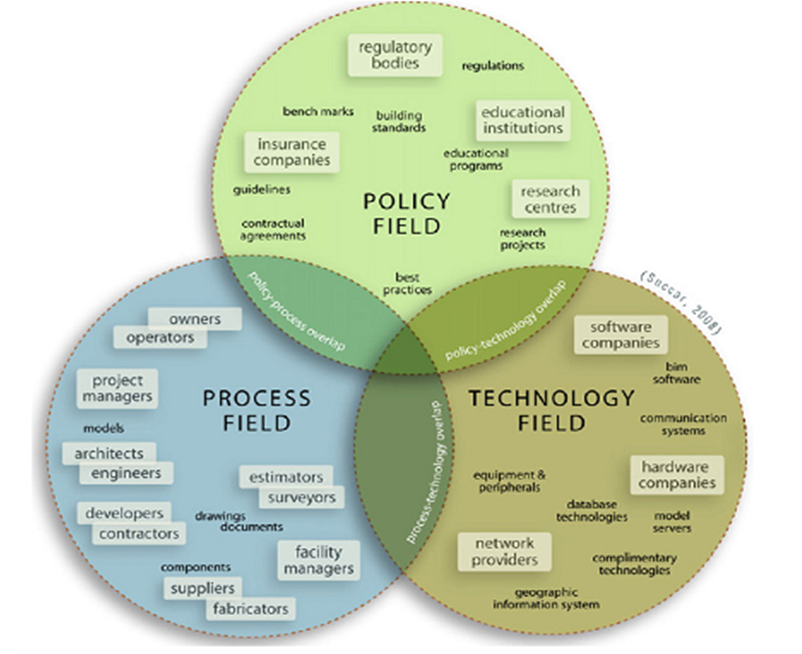
There are three fields or steps that needed to be taken in order to implement BIM. These steps are represented as a Venn diagram with technology, process and policy fields. This fields are the corner stone for the implementation of BIM. For instance, we see software, hardware and networking to be mentioned under technology field. In the policy field contractual and regulatory frameworks that need to be considered are mentioned. The same with process field, leadership and human resources are described as the main considerations 6.
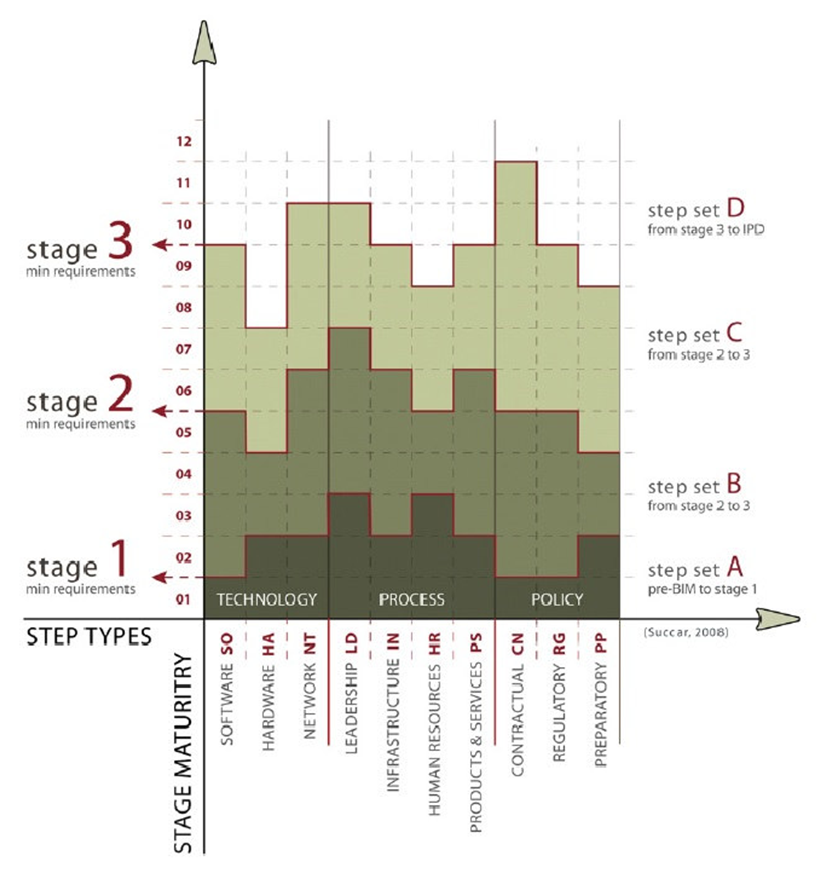
There is also a matrix which visualizes the conceptual framework of BIM maturity as a network of stages (on the vertical axis) and steps (on the horizontal axis). The matrix is shown Figure 2. This matrix representing also explain why a lot of developed nations have better maturity than developing nations. It is mainly due to the fact that there are higher levels of collaboration between disciplines and complexity of data models produced (Stages 2 and 3) as well as progressions made in the implementation steps e.g. with more advance BIM implementation policies. Figure 1 shows the need for more technology, process and policy requirements for step set A in contrast to step set B. Architects mostly use tools like to Revit and Archicad to produce models that can be shared with other AEC stakeholders who have compatible software. These models are however, to a large extent, used to extract 2D drawings for use by other AEC stakeholders 7.

Despite the fact that Ethiopia is developing country, the nation is known for its rich history of superb development attempts. Lalibela, Axum and other architectural heritage are just exemplary about the countries' technological and advancement powers. Fast forward to the 20th century in the year between 1930s and 1960s, exile temporary workers ruled the vast majority of the medium and little considerate and building ventures. In the 60s and 70s architects from various countries and cultural backgrounds like Germany, UK, Israel, USA, Austria, Greece, Finland, Bulgaria Italy, France, Yugoslavia, Russia, including architects from Ethiopia all added to the improvement of current engineering in the capital city-Addis Ababa. During the socialist era, there was a noteworthy lessening in the quantity of major common ventures in the nation because of the nationalization of private development organizations and the absence of worldwide agents. Afterward, after the adjustment in the administration in 1991, financed both locally and globally, the number of common development undertakings expanded 8.
The construction industry in Ethiopia contributes major share of the country’s GDP and also it is growing at a very fast pace. Between the years 2011 and 2018, the sector registered an average annual growth rate of about 25% 9. When the economy grew by 10.3 % in 2014/15, representing 56 % of industrial output, construction accounted for 8.5 % of GDP and 1.7 % to its growth. Within a decade, its share grew from 4% in 2009 to 9.5% of the GDP in 2018 excluding real-estate and related sectors 9.
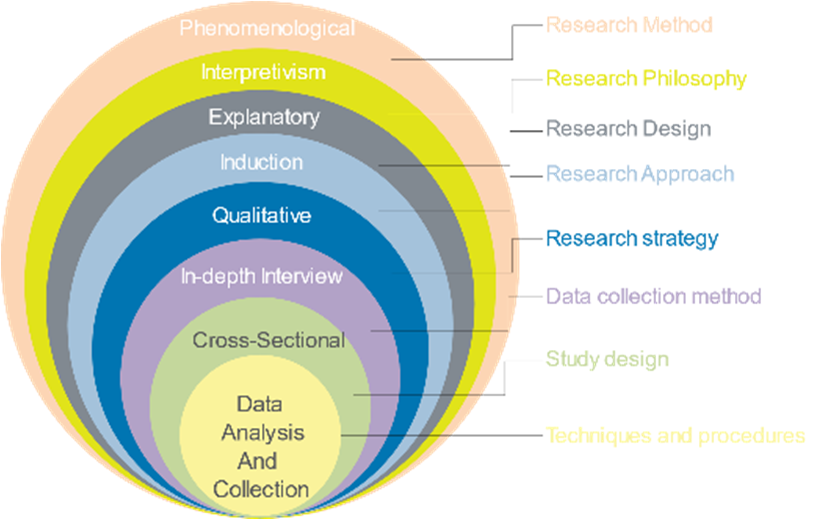
The research philosophy, research approach, methodological choice and research strategy suitable for this research were reviewed so that research objectives are met. A phenomenological research method used to investigate lived experiences and knowledge from participants. An interpretivism philosophy was used as this study is seeking experiences and beliefs. An explanatory research design is used in this research since past researches about BIM in the Ethiopian construction industry is very minimal, thus this study is aimed at adding to the body of knowledge of the subject matter. An inductive research approach is employed in this research since initial knowledge is very minimal and we are following the “Bottom-up” approach. The justification for the strategy choices was that the pilot study has shown that data collected through quantitative method leads to skeptical data. The “research onion” was employed for this research to present the methodological choices made for this study. The general representation of research method is summarized in Figure 3.

The selection of the study participants is very important to ensure the credibility of the results obtained. This was also the major challenge in the research. A combination of both probabilistic sampling and non-probabilistic sampling method was used to find potential participants. The process of finding potential participants commenced with two approaches then followed by a snowball sample.
Once the projects were identified the identification of studios that worked on the design of the projects was undertaken. This was done through research on the project information and network of individuals known in the industry. The second approach was finding published journals on BIM focused on the Ethiopian construction industry. Main researchers of the articles were interviewed to give their perceptions and knowledge on BIM. At the end of the interview, each participant was asked to identify anyone they thought could benefit the research process; a snowball sample. Exponential non-discriminative snowball sampling was followed as a result all recommendation was taken as a participant.

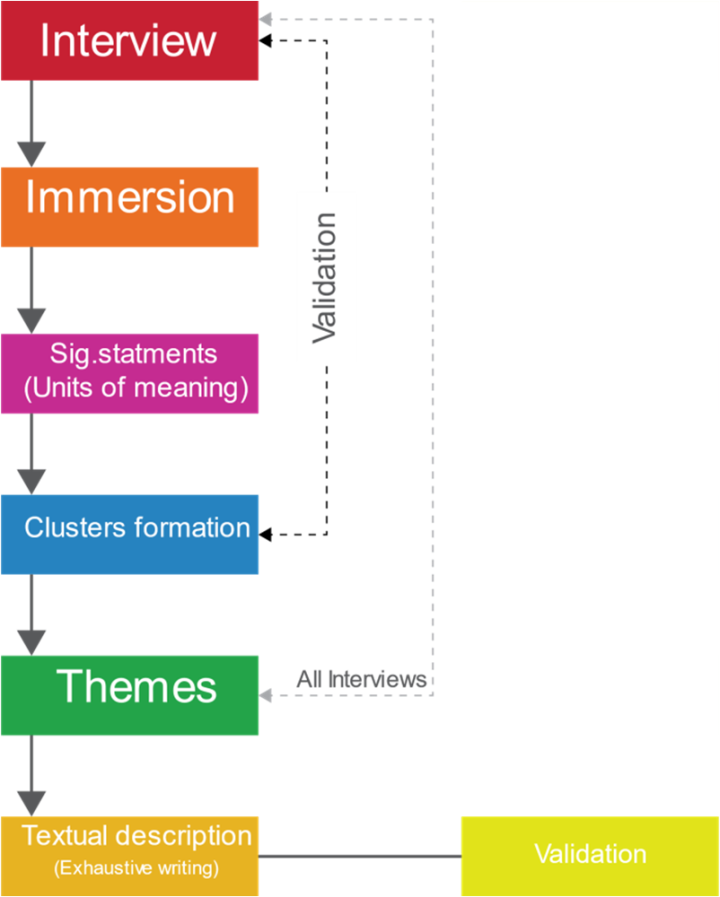
As described in previous chapters this study employs a phenomenological approach, as a result of the analysis also follows the same notion. Colazzi’s method of analysis is chosen for the research as it highlights conceptual patterns and describes the desired objective. The following steps are used for this research and are presented as follows:
Interviews are transcribed and are read thoroughly. This is intended to acquire the sense of each individual and their background and experiences.
Significant and frequently occurring statements are noted from the transcript. These issues are directly related to the phenomenon or the research question in the discussion.
Interpretive meanings are described for each significant statement. The research protocols are rechecked to ensure the original description is apparent in the interpretive meanings.
Clusters are formed from the interpretative meanings; this allows the formation of themes. Then validation is sought by checking for redundant themes and notes discrepancies.
The themes are then integrated into an exhaustive description.
A concise statement of the exhaustive description provides a fundamental statement of identification also referred to as the overall essence of the experience.
The reduced statement of the exhaustive description is presented to the study’s participants in order to verify the conclusions and the development of the essence statement. If discrepancies are noted, rework is done through significant statements, interpretive meanings, and themes in order to address the stated concerns.

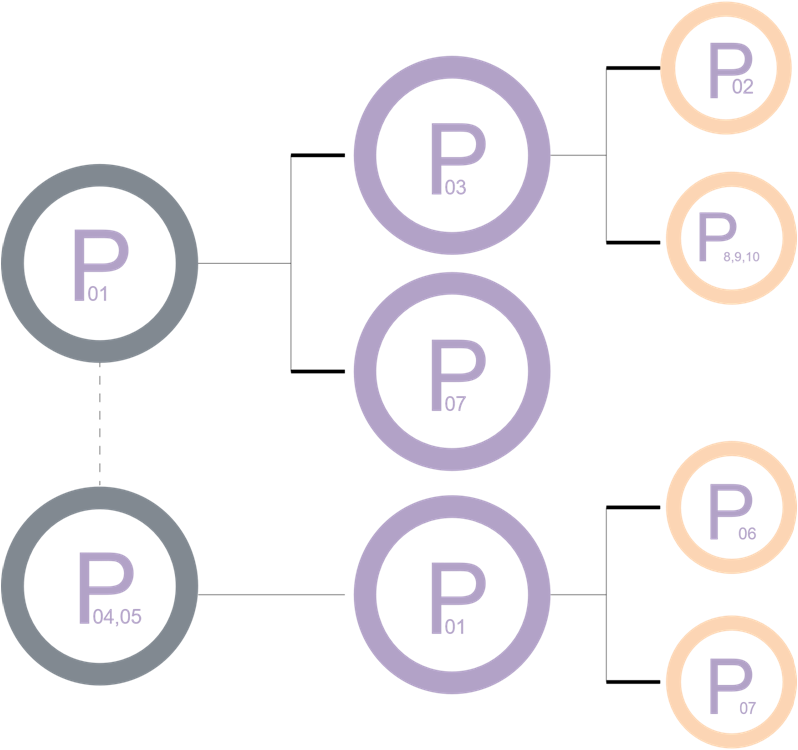
The process doesn’t follow a linear path rather it is more an iterative process. Transcripts are read over and over again to come up with meaningful senses. In some cases, the Nvivo tool was used to coin out repetitive terms coined by participants. These terms were used as an input for the theme descriptions. The figure below depicts the process graphically.
Qualitative inquiry allowed the opportunity to engage with these involved participants as the phenomenon surrounding how they experience and understand BIM was investigated. The participant's narrative was presented to make readers feel the essence of the participant's experience. The actual writing process contributed a lot to the analysis because of the additional time spent on the subject and discussion around it. In order to avoid personal identifications, participants’ names were assigned codes from P1 to P10 where the number indicates unique ID no given to the participant.
5.1. Participant’s NarrativeThe interview participants were presented with various questions all focusing to objective of assessing barriers of BIM implementation in Ethiopia, whilst mentioning other related issues. Each question narrative is presented in the following section.
This inquiry was expected to get some answers concerning the participants' point of view on impetuses persuading organizations or people to adopt BIM. Considering the most responses, there are apparently similar instances of considerations saw between all individuals believing that BIM develops a circumstance of composed collaboration and innovation. The participants' reactions to the question mainly relied upon the perspective of their experience and background.
Can you explain your background and explain your exposure to BIM?
This question was asked to draw an understanding of the participant's background. The snowball sampling has led to the discovery of many participants from different experiences and background. Each participant was asked about their profession and their years of experience as well as knowledge about both the construction industry and BIM. Two of the participants are currently working as BIM managers in the offices that they are employed. Four of the participants are from the academic background and have published articles on BIM. All of the academicians are from the same institute and two of them are Ph.D. holders, while one is MSc student for BIM global management course abroad. Three of the participants are from the government body called the Ethiopian construction project management institute hereafter known as ECPMI. The last four groups are from consulting firms and all are level I consulting firms.
Why adoption of BIM?
P01 described this question to be very legitimate and the most important question. This question is asked mostly by professionals who are already in the construction industry and who have followed a certain path. They will often pose the question as they have already a process that they have been using. The answer to this question according to P1 is that BIM is a system that has integration to a lot of work platform in the construction industry and every country has distinct construction culture. The core concept of BIM is the same but there are parameters that need to be altered as per the country’s character. For instance, every country has different project delivery principles and system, this factor alone can affect the entire process. As a result, there is no way towards direct importing of other countries' experience in other countries. This participant also justifies this by mentioning that there are even differences between European nations.
P02 describes this question by defining what BIM is and defined as a method of storing all the physical and functional characteristics of a building into one centralized platform often in 3D form. This centralization results in collaboration which later impacts the efficiency of the building. P05 has mentioned that the majority of cost and project time overrun are happening due to a lack of collaboration among professionals. There is a huge gap among communication and blame shifts in the construction industry and often problems are pushed to other professionals in the work line. For instance, if the block work has made a few cm shifts on the building will suggest that the plasterer will solve and the plasterer will direct the gypsum worker to handle it. As a result of this action, the problem will go until the end of the project without getting solved. P05 explained this with practical experience in mind.
According to P3, their organization didn't embrace BIM until 2005 e.c making them late adopters from the competition in the world, nevertheless they are pioneers in the local market. The reason for the adoption of BIM in their organization was mainly for client satisfaction and marketing demand. The responder mentioned that most of the clients come with three major demands shortproject time, limited budget and high-quality works. The firm believed that BIM can be an easy the solution to consider to meet the aforementioned demands.
Looking at the reaction from P4, the adoption of BIM spares a huge amount of time and cash during the construction. The participant further clarified that archives made using BIM is extremely helpful and can without much of a stretch be comprehended by customers and the group. The archiving issue was also raised by P07. The main research that they were engaged in was targeted on creating parametric Ethiopian models that can be used on one of the BIM tools. The models being present in such form will allow easy retrieval of local models into project parts. This research can be further seen as an opportunity for local products to be displayed in the international market. P07 perceives the adoption of BIM can be an opportunity for the local products to be presented to designers and contractors.
Though they are from different background one being from construction the other being from design P06 and P08 describe the need for adoption from the problems that they experienced in the construction industry practices. The later used to work on government housing projects and has experienced a lot of back and forth work during construction. This has taken an immense amount of time and pushed the project delivery time by years. The problems that are arising in the project are often understood after the actual building part is built. As a result, they believe the adoption of BIM can tackle these problems and allow stakeholders to take early actions.
According to P09, there exists a huge misunderstanding among building designers and contractors. They believe that a lot of people understand the 3D model than 2D drawings. The adoption of BIM will result in the representation of building data in 3D so whether we have literate or illiterate site workers communication will be easy. As a result of this, the quality of work will increase.
What is your opinion towards BIM adoption in Ethiopia?
This question was discussed with participants to get their insight into the adoption progress of BIM in Ethiopia. Most of them have encountered different scenarios in their experience in Ethiopia but they all share the same idea which is achievable and inevitable. The construction industry in Ethiopia despite all odds is growing fast and the need for high quality, efficient and on-time projects will be on huge demand. Each participant's opinion is stated in detail in the following sections. The participants have mentioned their responses from the following major perspectives
- Current issues
- Road to the adoption
- Change points
As mentioned earlier P03 is a BIM manager working in Ethiopia thus the view presented is very contextual and through long years of practical exposure. The key points raised by P06 include fragmented use, unconscious decisions, poor professionalism, and poor enforcing systems. The fragmented use since professionals involved in the business only consider the provision of their discipline and have no thought what so ever about the other disciplines. Therefore, they believe that the coordination even at the current practice very absent. The most intriguing issue raised by P09 which is similar to this context is, the enforcement mechanisms used by the government are very poor. The municipality takes preliminary drawings and final discipline drawings to approve the commencement of the construction. This creates a huge problem later on in the construction stage as the drawings produced are insufficient and lack the necessary information. If this is a prevalent culture then BIM shouldn’t even be under consideration.
P01 started the conversation saying that Ethiopia is not distant from other nations with regard to BIM adoption. Working in Germany this participant has experienced the construction industry in both countries. Germany, with all their capacity and infrastructure they is yet to be BIM mandate on the full scale. They plan to make the country BIM mandate by the year 2020 by mandating all the government projects to be done in BIM. Considering the country’s capacity Ethiopia should be proud that it is even considering it. This participant opinion towards the Ethiopian adoption is that it should be unique and as per our culture. The process should be well taught and organized so as to have a smooth transition.
The phenomena raised by P04 and P05 is almost similar, which is that the adoption of BIM is going to influence a lot of industries in the country. Foreign policy, trading system, project delivery method, bidding system, educational curriculums are among the aspects of the country that will be highly impacted due to the adoption of BIM. The government should be prepared as well as facilitate changes that are incurred due to BIM. They notice people often see BIM that is going to happen at just office level but the change is going to bring about a lot of change in the country.
P08 and P10 referred to the GTP 02 which mentions sustainable development as one of its goals. Though it going to end on this budget year their institute has worked on BIM under this legislation. This process can be smart decisions as it is very efficient and can give the country a great deal of profit. According to P02 Ethiopia needs to work on its infrastructure which are both soft and hard skills that are demanded by BIM. The knowledge necessary should also be developed by having the proper track.
According to P07, the majority of the industry professionals have stayed long enough in the industry and he is concerned that people might be very reluctant to the changes that BIM is going to bring about. These are a very prevalent phenomenon and are shared by the better half of the participants.
All the participants have mentioned about professionalism as the cornerstone for the collaboration ecosystem. These phenomena are often underestimated and professionals in Ethiopia are working in a distinct environment.
Who do you think should initiate the adoption of BIM?
A lot of countries have their pathways towards adoption but none of it is possible from a certain initiation. Different participants have mentioned different opinions regarding this question. The general categories are basically the three points discussed below.
- Government
- Education
- Industry.
Five of the total participants believe that the initiation should come from the government. They believe that the government can take measures in two ways this is enforcing and encouraging methods. The encouraging method is where the government applies actions that will better motivate people to engage in BIM. This can be by providing discount tools and a reward program for adoption. These are positive actions that the government can take in order to better attract the industry positively and allow adoption through understanding and self-motivation. They strongly believe that all powers are in the government to make all the vast amount of change BIM is going bring to the industry.
The enforcing mechanism that is proposed by the participants is a counteraction of the one mentioned earlier. This is the mechanism where the government will make government projects to be developed only by BIM. According to the participants, this will push the industry to involuntarily consideration of adoption of BIM in this system. They believe this way can create demand in the industry and people will force themselves into understanding the system. These two points are very opposing and highly debatable but are very crucial in the adoption journey.
P05 mentioned that if Ethiopia doesn’t join the world trade network then all foreign merchandises for BIM implementation are going to illegal. This includes the purchasing of software or work collaboration with professionals from abroad. P01 and P02 are also first-hand witnesses for government action towards BIM implementation in Germany and the UK respectively. All the actions in these two countries were made by the government. P01 describes that there was huge resistance from the public but the government used both enforcing and encouraging methods to inject it into the construction system. P02 mentions that the government main motivation towards the BIM implementation is that it had a motif to export 50% of its professionals into the world market by 2025. He believes that to initiate the adoption it is better to preach about its benefit and create BIM psychology to all stakeholders. This opinion is shared by both P09 and P10 as well.
P10 response to this question was not an opinion rather it is the task that they are already undertaking. Their institute is mandated by the government to impose modern sustainable methods to the construction industry. They took this mandate and are working towards BIM adoption in the industry. Their strategies mainly focus on the enforcement of BIM into the industry. He mentioned also to make Ethiopia BIM a mandated country for the year 2025 for projects approximately greater than five million.
The education perspective is the other side which is described by participants. They believe that BIM should be included in the current curriculum. This system, says P04 is not just a course that would be added in the curriculum rather it should be a practical journey where actual design discipline students (Sanitary, Electrical, Structural, and Mechanical) come together to work on a certain demo project. Otherwise, BIM lectures will not give any experience needed for the industry. These participants believe that students shouldn’t be learning something else in the classroom and join the industry with obsolete knowledge rather they should be equipped well in the school system.
The other group is the ones that believe it is a joint effort between the government and the education sector. The government has power over all actions in the country and education has to power over the upcoming generation. The students having all the necessary knowledge wouldn’t make that much of a difference if the industry is not ready for the knowledge capacity and vice versa. P03 and P06 describe this action method from their experience in Singapore and Spain respectively where the industry works in harmony with the university. The industry will send skilled professionals to share their experiences with students. These people update the students with the latest knowledge straight out of the actual scenario. This results in a levelled growth of knowledge of students with that of the industry.
P08 has a different opinion from others. She believes that if the government is dominion to this issue then people will be rushed into the system and this might lead to misconception. She mentions the case of Kaizen and BPR (Business process re-engineering) where people are no longer interested to listen to it whereas the government was taking different actions for its implementation. Therefore, she says that the government should be just the supporter but all efforts should be initiated from the public and professionals. They shall be engaged in it if only they believe and understand its application.
What do you think are the possible barriers to BIM adoption in Ethiopia?
The aim of this question was to seek the participants’ observation on critical barriers that have led to the adoption of BIM lag. As a developing country, it is clear that Ethiopia will face a lot of challenges when considering to adopt new technology. In business terms, it is inevitable to encounter resistance on investing in something doing the same job that has been done without it. However, this is not the only issue, there are also other barriers that are mentioned by the participants. They somehow presented a similar phenomenon but only the ones unique to the participants are mentioned here.
P06 mentions that the Ethiopian construction industry lack standards, even if they have a standard somewhere in the construction industry it isn’t usable by the enforcement bodies. A standard means meaningful communicable information that can be used by all professionals. He said every consulting office produces its own kind of drawing and have their own level of detail. As a result, some might start working with just preliminary drawings whereas the others will start with a more thorough drawing. He explained his experience in the office where senior professionals advised him to stop wasting time by detailing the construction drawing as there is no one referring to it.
As a BIM practicing office in Ethiopia, P03 has a more evident response to this question. He said that they produce to set of drawings, one for the municipality and one for construction. The level and details of the drawing they produce are not demanded by the municipality. He noticed that most firms are just targeted at passing the municipality screening. If the municipality level of understanding is just at the preliminary and 2D drawing understanding then BIM implementation is of no use for them. He believes since most of the buildings that are built in the city pass through this stage, then the introduction of BIM can come from these bureaus and disseminate to the system at least at level 01.
P01 also describes the major from practical experience. They mention being a chance to visit a government entity mandated to implement BIM and witnessed the level of understanding to be poor. In addition to this, the quality of the modeling was poor and lack standard guide. He shockingly describe the misunderstanding gap and afraid this can pose a great threat to the adoption of BIM in the industry. He has noticed a lot of people understand BIM as modeling software and they often assume their 3D modeling practice as the application of BIM.
As a senior lecturer in the industry P04 describes his practice in the Ethiopian government institutes. He mentioned his experiences as follows
“I have experience in Arbaminch University. I have seen that their experience is very limited. They are interested to know about it but they have no extra knowledge about it. As far as EIABC is concerned, I use to give lectures to students as a guest. There is a chair which is directly related to it which is called building graphics and informatics I know they give lectures to the students by inviting different people from abroad as well. I think they are doing what they can. I also have heard Masters Student take a certain course which is directly related to BIM. There is also a course in Bahirdar University at the postdoctoral level.”
He believes that there is a huge scarcity of the knowledge base about BIM. The adoption couldn’t move forward without having with proficient understanding about BIM. There should be a platform where local professionals will be able to learn from early adopters. In line with this notion, P05 mentions that he has noticed firms who have a relationship with foreign companies have better knowledge about BIM. In addition, firms who have an opportunity to work with clients or project teams from abroad have better understanding and movement towards BIM adoption.
Reluctant to change is among the phenomenon pointed out by P09. She describes this from her experience when first invited to attend a BIM training and when she tried to share with her colleagues in the firm.
“When I first heard about BIM I was interested to learn about it but as I started to work on the project, I assumed that the process is tedious and long. It was a very different and strict process to adhere to but once I got to see how it impacts the overall building performance, I continued to learn more. My part was scheduling which mostly has the load task at the end of the design, but due to my curiosity, I was learning how the professionals were designing and working. I have seen people who were well in the mid of the course but were resisting since they were upset by the strict and detail works that were demanded. I have experienced this in private consulting firms as well”.
The other resistance perspective that she mentioned is that BIM will create an organized and transparent system. She believes this will be a huge threat to corrupt government professionals. The effect of transparency can be among the threats for BIM implementation as the Ethiopian construction industry is known to corrupt.
The provision of a clear supply chain is the major barrier that P08 mentions. This barrier is also shared by participant P04, P05, P01, and P0. She describes the BIM system adoption will highly be halted by the current project delivery practice that Ethiopia has. She entails her opinion as follows:
“There needs to be a clear supply chain of the industry. There is still a problem knowing what the current market has in its bucket. The other thing is about the project delivery system. The introduction of IPD is of must as BIM is highly demanding for this system. There needs to be integrated when it comes to our country regulation, we are intended to specify materials as “equivalent” expression and no specific material is allowed to mention on Bid documents as it is believed it will facilitate corruption. The other is we have to customize (contextualize) our own way through BIM adoption otherwise BIM is going to face the same result as Kaizen and other similar failed systems.”
Technological" barriers are among the issues noted by P02. This can be all the demand that arises with the system and what is needed to fully implement BIM. For instance, most of the participants raised a lack of internet connection will result in unreliability and inefficiency. He mentions that BIM 360 demands at least an internet connection that is able to deliver 25Mbps connection for each machine on burst transfers at performance level. Nevertheless, the monthly rate for such speed is very expensive especially computing it for the machines in the office.
What measures would you anticipate to be taken in order to overcome the barriers?
The major objective of this question was to look for the participants' perception of basic actions that can be done to overcome the barriers and fasten the application. Like other questions they raised somehow similar phenomena, responses unique to the participants and recurring descriptions are mentioned in the following sections.
P05 strongly believes that the rate of corruption will be the biggest threat to its adoption. He believes that the adoption of BIM will bring about a transparent workflow which is very unfavourable to corruption. According to him actions first should be taken on minimizing corruption rate in order to even start taking steps toward BIM implementation otherwise he has a fear that corrupt professionals will take actions to halt its adoption. This opinion was also entailed by P08, she says there is a certain body that will lose their past benefits due to the implementation of BIM. In addition to that, she also shares the idea that these people once they know the implication of BIM they will find a way to slow down the process. As a result, the government shall take action on such matters way before BIM implementation.
The current construction system is from academia to industry says P03 and believes it is better if it is vice versa. He believes BIM is a very different system in the sense that there is a constant change with constant technological change. This is just part of the issues he recommends he also mentions that he has witnessed and experienced Singapore’s efforts made to overcome the barriers that were identified in the construction industry.
“It all started with the government, they believed that BIM is the future of their construction industry. They knew that the traditional process is coming to its end, therefore they started taking measures step by step. There are three issues when it comes to adoption this is demand, professionals, and system. They first started mandating government projects to be done by BIM. The government is always the biggest client in various contexts due to this sense they have created the demand. Next on they moved on to create professionals. They integrated short courses and invited top professionals from all over the world to share their experiences. In addition, they also sent their professionals abroad to get practical knowledge. This has gradually inclined the knowledge level through time. Lastly, the started creating the system, like digitizing the permit process and automation of the legal process. This whole process, in the end, made Singapore be among the pioneer country to adopt BIM.”
P01, on the other hand, believes for the successful implementation of BIM, we need a working and thorough road map. This Road map must be communicated with professionals from the industry and receive inputs from them since they are the ones that will be implementing BIM. The government when devising a roadmap should be aware of the possible changes that BIM demands its implementation. He mentions his experience in the government office which was mandated for BIM implementation where they didn’t have any road map when he was collecting data for his research. He recently has found that they developed a road map and he is very skeptical about it but he appreciated their effort.
Industry scale application of BIM can abolish all the mentioned barriers says P04. He strongly believes if firms act collaboratively due to the limited capacity of firms in the country. His response is entailed as follows
“The application should be in industry scale not at individual level. In some cases, it is exceptional and big firms like national consult or zias architects can try to adopt it by themselves since they have big firms and most professionals might be in the house. Having in house architects is very important as it allows the manipulation of the work process in a controlled environment. Therefore except for this company’s application should be made in industry level since most firms are small companies”.
The global trade organization participation of Ethiopia will also mandate the use of original copies of software. P06 believes that the full application of the system is only possible when we have full access to the authoring software. He mentions almost the entire industry uses pirated copy which has a lot of inefficiencies attached to it. This kind of actions can facilitate a fast adoption of the system and government should take actions in the matter.
P02 believes that a BIM task group should be created which will work towards the implementation of BIM. According to him the government ECPMI has too many tasks to handle under the issue of project management and might not give full attention to BIM. As a result of this, the government should consider establishing a specific task group acting towards BIM adoption.
The development of BIM models that can be utilized in the design can contribute to the localization of the BIM system says P07. He referred to his research as a step towards BIM adoption even though it is one among the many demand BIM as a system brings about. He believes that we shall see BIM other than a method to design-construction process rather like an opportunity creator for local products to gain international recognition. Therefore, actions should be not just on the barriers of BIM but also to the local unique advantage that BIM brings about.
The BIM system for the Ethiopian process must first start from tiny steps adoption where a clear working model can be practiced. P09 also mentions before moving to the whole BIM notion the country should consider clearing out its existing process. They assume if the system is clean adoption of BIM will be so much easier.
5.2. Significant StatementsNotable statements were coined from the interview transcripts and interview notes. These statements cover the entire topics including adoption strategy, issues, and barriers towards BIM implementation. Initial groupings of meaning through the context of the participant’s response were repeatedly reviewed. As a result, a total of 164 statements were identified from the entire interview conversation, 105 of these statements are about barriers the rest are about strategy action recommendations. These identifications have aided the cross-referencing for the overall meaning to develop clusters. The significant statements were combined and were inserted into Nvivo for word frequency analysis to determine the recurring terms. These terms formed the code clusters which later formed the themes.
5.2. Code ClustersThe significant statements found in the previous stage were used to develop the code clusters. The statements were grouped and merged as there were some statements with similar meanings with different expressions. These groupings were then organized into 10 coded clusters. The cluster analysis tool in Nvivo 12 was used to find these terms. Unnecessary and jargon words were omitted manually to point significant terms, this is textual terms words like “and “or “other”. The coded terms were again analyzed to find emerging terms. In the next stage, tree map analysis was used to find emerging themes. The following table represents the process result from Nvivo.
5.3. Themes EmergedAs mentioned in the previous section, the data have gone through various cycles of coding efforts. The resulting clusters have passed through a text search query to review where the texts have arrived in the research database. As a result, the analysis of the clusters led to the emergence of the core themes describing the phenomena under study. The four themes that evolved through the data relating to how participants experience and understand the barriers towards BIM adoption were Current practice: Workflow, Knowledge gaps: Education Requirements. Personal understandings: Perceptions & Resource: Infrastructure requirements.
Theme one: Current practice: Workflow
All participants described value associated with the current workflow in the construction industry that are huge barriers toward BIM adoption. Commentary and shared experiences regarding the workflow issues that the participants had and observed others having within their past gave light to emerging categories for defining this theme. The workflow theme refers to issues pertaining to the current construction practice from inception to construction building since the post-construction involvement of BIM is a very distant phenomenon.
Collaboration
These phenomena refer to the culture of working together and concurrently throughout the construction project. The major concept of BIM is the collaborative character of it. All the participants mentioned the poor level of collaboration in the current practices. They believe the BIM concept can create an arena for this ideal but important notion to come into life. The current level of collaboration in the AEC industry is what makes it be listed in the barrier department. The system comes with its own other demand but this collaborative ecosystem should be first worked out even without the introduction of BIM, as in like free practice.
Professionalism
Professionalism in its basic meaning means acting appropriately all the time, speak in a manner that is acceptable and careful. It is the proper attitude and conduct of a person or organization. When one is called a professional, it means that they have the correct education and background for their professional field. Professionalism has been mentioned by three of the participants. They believe this is often underestimated but the cornerstone for BIM adoption. Again, as the above component, this is a significant threat to the adoption of BIM. Professionals in the industry should have all the necessary knowledge to handle and manage to execute tasks in the construction project. They should contribute with their distinct knowledge and experience for the successful completion of projects.
Standard
The definition of project standard is among the initial stage of preparation for the BIM project. The standard derivation in the developed nation's experience is mostly from their previous 2D based work processes. The standards may include drawing visual standards, material standards, and communication standards. Currently, in the AEC industry, every firm generates different kinds of drawings some like to detail their works while the majority send out a preliminary drawing for construction. The standards in the construction industry are mostly a language medium between the designer and the contractor. If the designer doesn’t come up with understandable coherent drawing then we couldn’t even say construct as per standards.
Project Delivery
All of the participants have mentioned the need for the change of project delivery system however changes of such actions come with a lot of new systems. They believe that IPD (Integrated project delivery) is often used with BIM. The current emergence of BIM skills demands a room for a project delivery system with a better information management collaboration environment. The establishment of BIM requires a clear flow of information between suppliers and consultants. The current system in Ethiopia highly forbids the statement of directional words rather the term “similar” is used. Most of the participants believe that is due to an effort to abolish corruption during the purchasing of products. However, in the BIM system, every material should be indicated mentioning all the information about the information.
Corruption
One of the participants in this research has studied the corruption in the Ethiopian construction industry and suggests BIM as solution. His research was very important in highlighting the current level of corruption and the ways that BIM solves the problems. According to his research, BIM can be used as a tool to minimize corruption since one of the characters of BIM is that it is transparency.
Use case scenarios
The other issues mentioned by participants include short term planned projects, changing end-users and fragmented operations. Short term planned projects refer to projects that are not started with the end in mind. Often, we see a lot of building with half floors in use and half building in construction. This is a significant threat when it comes to BIM as the project site now has a new circumstance and this will create confusion in management. The other issue is changing end-users, a very common practice in the industry. A building designed for an apartment might be used for a school or other unrelated function. There is no proper mobilization of building utilities to these new functions and thinking about BIM might be a very distant topic in these circumstances. The last scenario is the fragmented operations which are the professionals may not proceed up until the project end. The reason might be from both the client-side and the professionals themselves. Much of the issues under this section are very unique to Ethiopia.
Theme Two: Knowledge gaps: Education Requirements
Understanding about BIM is among the major code clusters found in the analysis. The participants strongly recommend the raise in the overall understanding of BIM in the industry. These phenomena can also be understood as a driving factor, since having people with a proper understanding of BIM might gear the adoption of BIM.
Four of the participants entails the knowledge level to be very low in the industry, not only low it is often misunderstood. Most professionals in the industry that BIM is a software that can do all the works mentioned under the BIM system. P03 mentions that he has experienced a lot of people asking him to give BIM training and automatically asking him to install it for them soon. Even though the urge for the technology is appreciated the misunderstanding might be hard to reverse back.
P01 has been working as a BIM manager for more than 10 years in the industry and have a piece of more insightful information regarding BIM education and understanding. He entails his experience as follows with pleasantly occupied expression,
I see people around saying I graduated in BIM and mention that they have a certificate or diploma but it is very funny, there is nothing like that. BIM is not something you graduate from but rather something you have to experience or practice. You might say I have knowledge regarding the BIM system. The actual practice of a company has its own unique issues and the system is in constant update. The lesson you took one or two years ago might be obsolete now. The industry would like to see more of what you did out of the knowledge than just the certificate.
From this, we can notice that BIM is not something we just incorporate in the curriculum and move on but rather needs constant action towards improving the course works. The integration of the industry is also as important as giving the course. BIM knowledge needs special attention and consideration. The training given should be checked for being the latest information available in the industry. It also needs to be checked for being consistent with the current practice modality. The steel structure knowledge from the UK cannot be that useful for the industry that is entirely using reinforcement bars and concrete.
All of the participants have confirmed that there is a certain understanding of BIM but are very sceptical about the proper understanding of the system. Often misunderstanding of the system might result in developing a false perception and reluctance to the attainment of the proper knowledge.

The lack of knowledge phenomena mentioned by the participants also extends to the professionals working on the site. They mentioned that most of the site workers have the proper skill required by the construction industry. They noticed that they often start as a daily laborer and immediately upgrading to foreman while this skill is suggested to be held by professionals.
BIM not only requires professionals with its knowledge but also requires people with a sufficient understanding of the construction practice. This according to the participants poses a great barrier in the future of BIM implementation, as a result, the knowledge transfer should also extend deep.
Theme Three: Personal understandings: Perceptions
Perceptions of professionals are among the prevalent phenomena in most countries. The issues experienced in the local context is almost the same as in other countries. People perceive BIM in a lot of different ways some perceive it (positively) as the better way of doing things while others see it as (negatively) a threat to their current practice.
The positive ones whether they have the right or the wrong impressions are the ones that should be nurtured and shown the right way to it. The participants mentioned that they have encountered a lot of people with a novice knowledge being very positive and indulgent toward learning about it. P04 has mentioned his experience at Arbaminch where most graduate students don’t have any idea about while some of them assume it is a software but they were all generally interested to learn about it.
The negative perspective is the most pressing issue and the one that needs significant work to change. The negative view can take different forms and is described as follows
Generation Shift
As indicated by the interviewees, there is a typical thought in the development condition that some senior representatives have trouble to utilize PCs in their day by day schedules and assignments. This issue may be because of altogether different reasons, for example, being a preservationist at the top of the priority list, experiencing issues to learn new things, etc.
The participants mentioned that people with this direction of view are often older people or professionals who have been working in the industry for more than 5 years. This group of people is much immersed in the current practice and is very reluctant to such changes.
Discipline practice
P09 entails the situation where she was trying to share the experience in her local environment and finds out that people get interested in the beginning but fade up as they go through deeply. She says that as project manager
“I see Architects are the ones who are interested in pursuing more knowledge towards BIM than the other professional’s i.e. sanitary designers, Electrical, structural and Mechanical. They think it is to be a very tiring and long way to do it”. Some few other participants also share this opinion, this might be a big threat towards collaboration and future BIM managers.
Theme Four: Resource: Infrastructure requirements
All participants described some level of impact experienced in the scarcity of capable hardware. The infrastructure generally is categorized into three main categories the software, hardware and internet demand.
Hardware
A lot has been said about the software but the hardware is as important as well. The participants mentioned that most firms give high attention given to their architecture department towards high capacity computers. According to P09, she said the local market doesn’t have that much of supply for the pcs required if BIM becomes applied in full scale. Furthermore, she said the price along with the taxation becomes even higher. This is a huge threat to BIM as people will be discouraged and will revert back to an old system that demanded them with minimal capacity.
Software
Software is the fifth prevalent word from the interview transcript. The participants mentioned the very high cost associated with the most important BIM tools available. As a result, people are using pirated copies. The pirated copies are known to be very fragile and lack the full benefit that this software can demonstrate. P10 has stated that their institute is working to overcome this issue by collaborating with the tool for developing companies. They believe that this will abolish the current pirated software use prevalence. Having proper software will secure file stability and flexibility when using large document sizes.
Internet
Lack of stable internet connection in Ethiopia poses a significant problem when considering working in different locations. According to Autodesk, Revit Cloud Work-sharing requires three times (3X) the total disk space consumed by equivalent RVT files for all cloud work shared projects accessed by the user. As far as the connectivity is concerned the minimum status requires need 5Mbps, while the value and performance require a 10 and 25 Mbps speed on each machine respectively.
From the results we can see that Ethiopia’s construction needs to take major actions even before the consideration of BIM Adoption. BIM as a process needs a coherent workflow to function effectively otherwise the country is better off without adopting it. The changes that will be exercised along with BIM are significant to the other systems of the country as well. For instance the procurement system of the country needs to be updated in order to have a system for BIM functionality. The barriers presented by this research are mentioning both from current status and as well as from future perspective. The workflow related barriers pertains to the current status whereas the education is for future perspective. Having a proper educational platform will assure the sustainability of BIM as a process.
One of the questions in the interview guide was to review their suggestions regarding the measures required in order to facilitate the barriers mentioned. This people extensive knowledge about the subject matter makes the responses gather valid and the directions that they discuss probably would be the direction towards BIM adoption. This question is just intended to give a direction and it doesn’t stress or subjugate any circumstance. All of the participants explained what kind of actions will aid the adoption process. They brought up some methods of approaches from the experience and the information’s that they have:
• Creating a transparent workflow
• Having a strong collaboration between the industry and the academia
• Working through a feasible road map
• Holistic approach to adoption not discrete
• Creating Demand from the public
• Enhancing public awareness
Road map by its basic definition is set of direction to achieve a certain goal. The Road map in BIM is often considered to be the step towards BIM adoption. Most developed countries have a certain kind of Road map to gear their adoption. This kind of research are demanded by the road map preparing bodies to have a comprehensive knowledge about the industry. Referring the Table 2 we can see that years ranging from 3-10 years are required to actually take action towards BIM Adoption. For instance, in UK it took nine years between the original publishing of BS 1192 and the 2016 UK government mandate for BIM Level 02. Ethiopia has created its road map in the year 2018 but almost all these professionals interviewed were skeptical about it. The following table summarises all the major countries BIM adoption progress and their standardisation and policy initiative.
The nature of BIM is entirely having clear workflow and collaborative. Maintaining a clear workflow allows the ease of integration for BIM in the industry. One of the things that might be related to having non-transparent workflow is having paper-based system. This system by defaults create a void in the industry since communications are moderated by peoples. For instance, the building permit process is entirely paper based with lots of building errors emanate from. Therefore, clearing these systems by implementing better methodologies can be highly beneficial for the adoption of BIM.
The term holistic approach was coined by the participant and it is implying that BIM needs adoption should be approached in mass not just individually at office. This is often supported by associations and special societies. This kind of movement leads to a stronger foundation and can also aid efficient utilisation of resources.
The supply and demand association are very direct in its native character. When there is no demand there is no supply. This concept in BIM adoption terms, there should be a pull factor for professionals to consider adoption of BIM. In most cases government is the biggest client meaning if the government starts movement towards encouraging BIM adopters then this might foster BIM adoption.
First, I would like thank God for giving me the enthusiasm and the potential. Following, I want to heartily acknowledge my families. I also like to give my great appreciation to Dr Nebyou Yonas who is my advisor for his dedication, support and smart advises. Finally, Mr. Derge Alemu for his inspiration and for revealing problems about the Ethiopian construction industry.
| [1] | Causes of Contractor Cost Overrun in Construction Projects : The Caseof Ethiopian Construction Sector. Aregaw and Zewdu. 4, s.l. : Int. J. Bus. Econ. Res., 2015, Int. J. Bus. Econ. Res., Vol. 4, pp. 180-191. | ||
| In article | View Article | ||
| [2] | Assessment on Performance and Challenges of Ethiopian Construction Industry. Ayalew, t, Lafhaj, z and Dakhili, z. 11, s.l. : Journal of Architecture and Civil, 2016, Journal of Architecture and Civil Engineering, Vol. 2, pp. 01-11. | ||
| In article | |||
| [3] | BIM and basic challenges associated with its definitions, interpretations and expectations. Abbasnejad, Behzad and Hashem , Izadi Moud. 2013, International Journal of Engineering Research and Applications(IJERA). | ||
| In article | |||
| [4] | Building information modelling demystified: Does it make business sense to adopt BIM? Aranda-Mena, G, et al. 2009, International Journal of Managing Projects in Business, Vol. 2(3), p. 419. | ||
| In article | View Article | ||
| [5] | Building information modelling framework: A research and delivery foundation for industry stakeholders. Succar, B. 2009, Automation in Construction, Vol. 18, pp. 357-375. | ||
| In article | View Article | ||
| [6] | A review and outlook for a ‘Building Information Model’(BIM): A multi-standpoint framework for technological development. Cerovsek, T. 02, 2011, Advanced engineering informatics, Vol. 25, pp. 224-244. | ||
| In article | View Article | ||
| [7] | Chimhundu, Simbai. A study on the BIM adoption readiness and possible mandatory initiatives for successful implementation in South Africa. Johannesburg : s.n., 2015. | ||
| In article | |||
| [8] | Berhe, Asgedom Haile. MITIGATING RISKS OF CORRUPTION IN CONSTRUCTION:A THEORETICAL RATIONALE FOR BIM ADOPTION INETHIOPIA. Weimar : s.n., 2019. | ||
| In article | |||
| [9] | ECPMI. Proceedings of Conference on BIM Technology Inception and Worldwide Experience. Addis ababa : ECPMI, 2019. | ||
| In article | |||
| [10] | Psychological research as a phenomenologist views it.In: Valle, R. S. & King,. Colaizzi, P. Open University Press: New, 1978, Existential Phenomenological Alternatives for Psychology. | ||
| In article | |||
| [11] | Building Information Modeling (BIM): Trends, Benefits, Risks, and Challenges for the AEC Industry. Azhar, S. 3, s.l. : Leadership Manage. Eng.,, 2011, Leadership and Management in Engineering, Vol. 11, pp. 241-252. | ||
| In article | View Article | ||
Published with license by Science and Education Publishing, Copyright © 2020 Haleluya Getachew Belete and Nebyou Yonas Gabore
 This work is licensed under a Creative Commons Attribution 4.0 International License. To view a copy of this license, visit
http://creativecommons.org/licenses/by/4.0/
This work is licensed under a Creative Commons Attribution 4.0 International License. To view a copy of this license, visit
http://creativecommons.org/licenses/by/4.0/
| [1] | Causes of Contractor Cost Overrun in Construction Projects : The Caseof Ethiopian Construction Sector. Aregaw and Zewdu. 4, s.l. : Int. J. Bus. Econ. Res., 2015, Int. J. Bus. Econ. Res., Vol. 4, pp. 180-191. | ||
| In article | View Article | ||
| [2] | Assessment on Performance and Challenges of Ethiopian Construction Industry. Ayalew, t, Lafhaj, z and Dakhili, z. 11, s.l. : Journal of Architecture and Civil, 2016, Journal of Architecture and Civil Engineering, Vol. 2, pp. 01-11. | ||
| In article | |||
| [3] | BIM and basic challenges associated with its definitions, interpretations and expectations. Abbasnejad, Behzad and Hashem , Izadi Moud. 2013, International Journal of Engineering Research and Applications(IJERA). | ||
| In article | |||
| [4] | Building information modelling demystified: Does it make business sense to adopt BIM? Aranda-Mena, G, et al. 2009, International Journal of Managing Projects in Business, Vol. 2(3), p. 419. | ||
| In article | View Article | ||
| [5] | Building information modelling framework: A research and delivery foundation for industry stakeholders. Succar, B. 2009, Automation in Construction, Vol. 18, pp. 357-375. | ||
| In article | View Article | ||
| [6] | A review and outlook for a ‘Building Information Model’(BIM): A multi-standpoint framework for technological development. Cerovsek, T. 02, 2011, Advanced engineering informatics, Vol. 25, pp. 224-244. | ||
| In article | View Article | ||
| [7] | Chimhundu, Simbai. A study on the BIM adoption readiness and possible mandatory initiatives for successful implementation in South Africa. Johannesburg : s.n., 2015. | ||
| In article | |||
| [8] | Berhe, Asgedom Haile. MITIGATING RISKS OF CORRUPTION IN CONSTRUCTION:A THEORETICAL RATIONALE FOR BIM ADOPTION INETHIOPIA. Weimar : s.n., 2019. | ||
| In article | |||
| [9] | ECPMI. Proceedings of Conference on BIM Technology Inception and Worldwide Experience. Addis ababa : ECPMI, 2019. | ||
| In article | |||
| [10] | Psychological research as a phenomenologist views it.In: Valle, R. S. & King,. Colaizzi, P. Open University Press: New, 1978, Existential Phenomenological Alternatives for Psychology. | ||
| In article | |||
| [11] | Building Information Modeling (BIM): Trends, Benefits, Risks, and Challenges for the AEC Industry. Azhar, S. 3, s.l. : Leadership Manage. Eng.,, 2011, Leadership and Management in Engineering, Vol. 11, pp. 241-252. | ||
| In article | View Article | ||