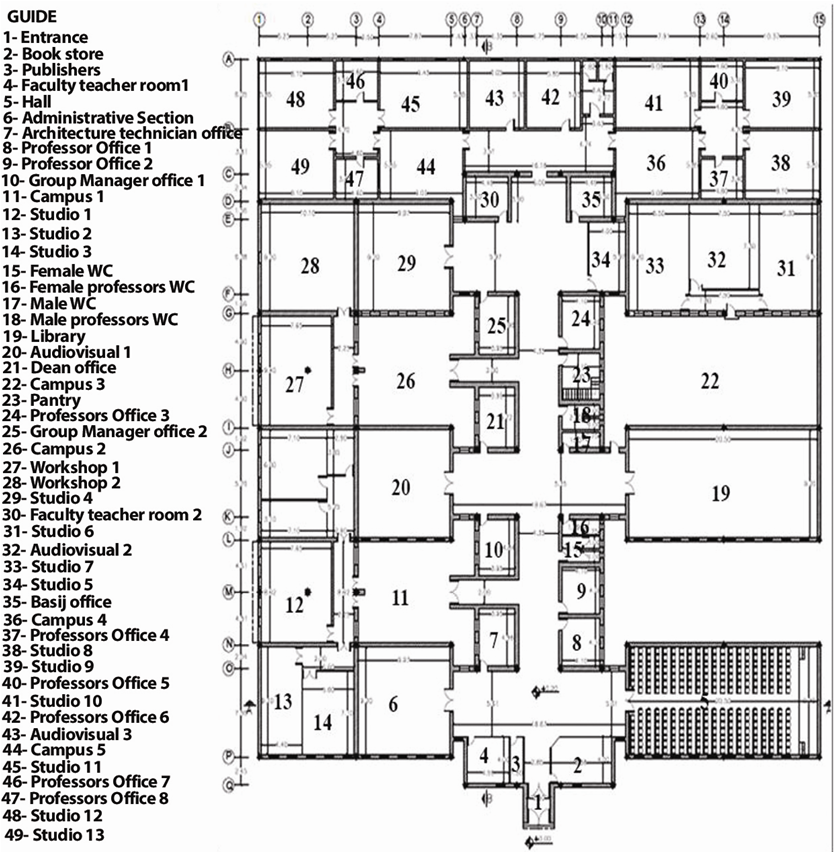
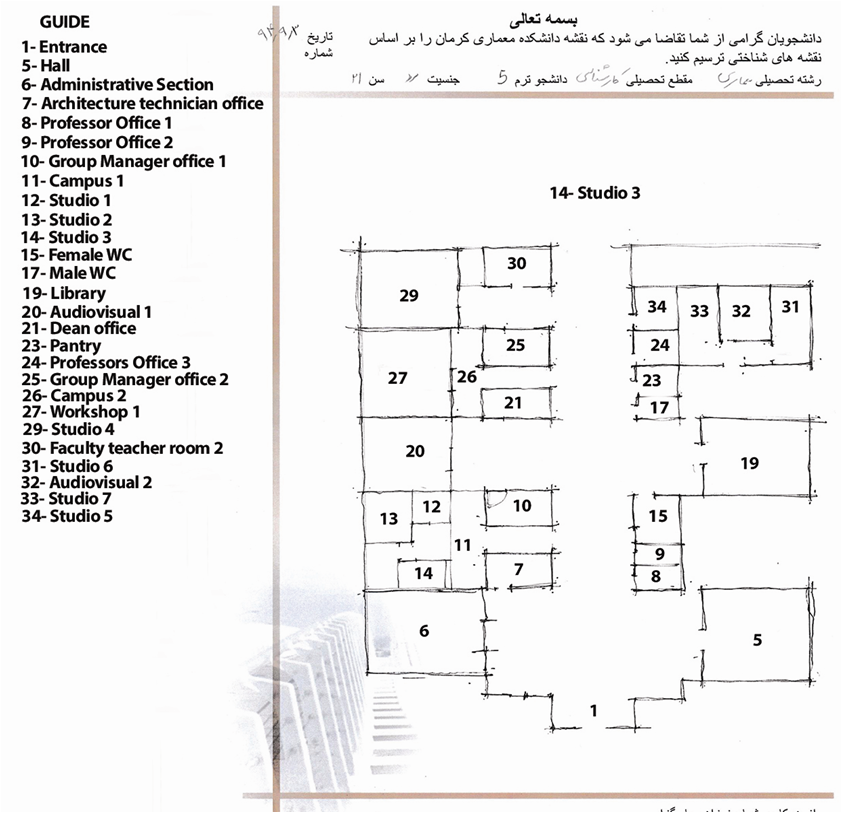
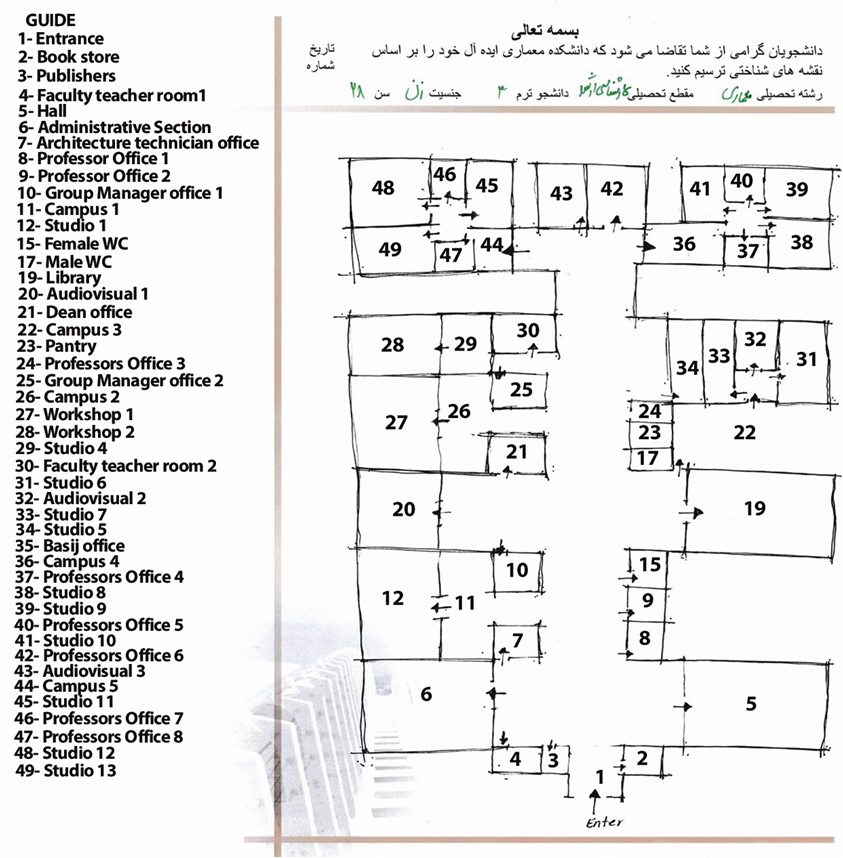
This post occupancy research is an attempt to analyze the design of an architecture school using a cognitive map tool. Fifty male and female architecture students purposively recruited from Kerman Islamic Azad University to participate in this study. Participants were asked to draw a sketch map depict all places they recall in their faculty and identify them with the names. Following the drawings, a series of interviews were conducted to understand the students’ rationales behind their drawings and to uncover navigational problems of spatial designs. Data were analyzed qualitatively with specific focus on the absence or presence of spaces and their sizes. The qualitative data was supplemented by quantitative data to have a better interpretation of meaning by looking at qualitative data from a quantitative angle. Results showed that the accuracy in drawings significantly increased the longer students spent time in the faculty and the more they got familiar with the places. The analysis of cognitive maps revealed that the absence or presence of some spaces in the sketch maps and their sizes corresponds to the functional importance of spaces, their locations, zoning, accessibility and their size in relation to their functions. Results suggest that men and women did not differ in the accuracy of their cognitive maps. However, for navigation, males used information about directions for navigation, whereas females employed a landmark-based strategy. Architect planners can take advantages of these findings to create distinctively and well used buildings. The results of the study has implication for those who are interested in navigational behaviours of the space users.
Much has been documented on the benefits of cognitive maps. A cognitive map is a mental spatial image of an environment (Allahyar, & Nazari, 2012. 1). Mental maps as mnemonic device help us: a) organize or store knowledge, b) to convey spatial information efficiently; and c) to practice a physical activity using symbols (Tuan, 1975. 2). Cognitive maps cannot be considered as “contextless entities” (Spencer et al, 1989, p.108. 3). they are “intricate, selective structures be incomplete (Downs & Stea, 1973. 4). Cognitive maps often depict pertinent and frequently visited places (Stephan et al., 2014. 5). However, they are gender sensitive, dynamic and can constantly change (Kara, 2013. 6). Cognitive maps have been widely used in urban planning and spatial cognition(e.g. Antes, McBride, & Collins, 1988 7; Tversky, 2003. 8). This tool can be potentially used by the architects to learn more about what the users of the spaces feel about them and whether the users face any navigational problems in the spaces. However, the applications of cognitive maps in architectural design have received minor consideration. The complex process of formation of cognitive representations of the environment has been overlooked as data gathered through the maps just analyzed quantitatively. Therefore, this qualitative study attempts to fill the gap left in the literature by examining the design of an architecture school using a cognitive map tool. Moreover, this study attempts to uncover navigational problems of the school spatial designs.
Cognitive maps as a mental representation of an environment can be very dissimilar to an actual place. The maps often depict only pertinent and frequently visited places in daily life (Stephan et al., 2014. 5). Differences between the cognitive maps and the real one may reflect what people consider more or less important (Tolman, 1948. 9). The accuracy of cognitive maps boost as a function of frequent visits (Stephan et al., 2014. 5). and navigation would facilitate when spatial knowledge about person to object relationship and knowledge of anchors (e.g. distinct area, landmark, path segment) develop (Allahyar, & Nazari, 2012. 1). Individual spatial abilities contribute to the development and characteristics of cognitive maps. Much exists on gender differences in spatial abilities. Gathering the data from different countries, Silverman and his associates examined gender differences in spatial ability. They found that gender differences persisted no matter which cultural or ethnical backgrounds the participants had. The results in literature have been far from conclusive (Silverman, and Peters, 2007. 10). In an experiment conducted by Moon and his colleagues, it was found that males did not significantly differ from females when recalling the number of places of narrative spaces. However, male could outperform females in locating places accurately in cognitive maps (Moon, & Ryu, 2016. 11). In another study conducted by Stephan and his colleagues, it was reported male participants sketched their home range more precisely compared to their female counterparts. The accuracy of female maps was associated with the residency length. In addition, the accuracy of cognitive maps was influenced by number of frequently visited places (Stephan et al., 2014. 5). Olaughlin and Brubaker did not find any differences between males and females in a mapping task (O’Laughlin, & Brubaker, 1998. 12).
Some studies highlighted sex differences in navigation strategies. Whereas males prefer to use directions and distances for navigation, females adopt a landmark-based strategy (Dabbs, Chang, Strong, &Milun, 1998; review Li, 2014 13).
This paper will draw upon two theories to examine cognitive map of students to see how they are different from each other and uncover navigational problems of spatial designs.
Vygotsky sociocultural theory (1978) 14: According to this theory (1978) truth is not a pre-existent entity that we can learn about it is through interaction and interpretation (Allahyar, & Nazari, 2012. 1). Cognitive maps represent variety of truth for human minds. Portugali argues that though Vygotskys’ theory is relevant to the study of cognitive maps as he emphasizes the environment. “Internalization in cognitive map is mental representation of the external environment; it is not set of objects, pattern, and spatial relations but their interactive mediated and mediating nature” (Portugali, 1996, p, 19. 15). The environment is filled with signs which are socially and culturally constructed.
Hunter-gatherer evolutionarily theory: This theory that was proposed by Silverman and Eals state that men and women over time evolved differently in terms of cognitive abilities to obtain food. Men are better at in hunting while women are better at gathering. This division of labor has resulted in sexually differentiated spatial abilities. Hunting means navigate unfamiliar regions while chasing one’s prey. This implies that to have a great ability in finding an efficient and direct route back to home with the prey. Similarly, the ability to recall objects and their locations, are important for gathering food. This implies that men and women are different in cognitive ability and navigation strategy (Silverman, & Eals, 1992. 16).
This research is a qualitative case study. Data were collected through sketch maps and interviews. Semi-structure interviews were conducted to understand the students’ rationales behind their drawings and to uncover navigational problems of spatial designs. Fifty volunteer male and female participants were recruited from the architecture school at Islamic Azad University of Kerman. One way cognitive maps can be studied is by asking an individual to decode his spatial images, in the form of a sketch map, on a piece of paper. Kerst and his associates (1987) 17 found that, notwithstanding the differences in peoples' drawing abilities, drawings still are an appropriate and reliable method to know about the mental representations of the environment.
Before carrying out this research, the consent from the board of schools was obtained.
Then participants received a consent form in which all participation details, its benefits and risk and purpose of the study was described in details. Participants were also informed that they had the possibility to withdraw from the participation without giving any certain reasons. Each participant was given an A4 white paper to depict all places recall in architecture faculty of Kerman Islamic Azad University. Time was given to all students for this task was equal. Additionally, we also collected -demographic data. For the sketch-map task, participants were instructed as follow: Please draw a map of the architecture faculty and include as much as you recall and identify each space with its name. We will compare your map with the original plan of the faculty. No need to be worried about your artistic ability since we are not measuring that.
To compare and assess accuracy of location of all those maps, certain criterion was needed. Our preliminary analysis of maps showed that some maps were more complete than the others as the covered more areas of the architecture schools. Some spaces were larger than the ones in the original plan.
The drawings were analyzed with specific focus on the absence or presence of spaces and their sizes. All of the sketch-maps were independently analyzed and by two coders (the first and the second author, her supervisor). The coders reached 96% of agreement. The obtained data analyzed through content analysis of the drawings and then coded by SPSS software. For analyzing the data in SPSS the spaces drawn by students coded by “1” which stands for yes and the spaces left undrawn coded by “2” which stands for no and then the coded data were tabulated.
Analyzing the data showed that cognitive maps were incomplete. Some places and even main details were missing. Distances between spaces were either overestimated or underestimated. Tolnam (1984) argues that differences between the cognitive maps and the real one may reflect what people consider more or less important. This is consistent with the definition of truth in Vygotsky sociocultural theory (Vygotsky, 1978. 14).
In describing their experience of the architecture faculty, almost all participants argued that familiarity is an important factor for recalling the environment. They highlighted that this correspond to a possible effect of frequency of use. For instance one of the participants said: I know these places since I go there quite often.
It seemed that there was a biased attention to locations that were frequently visited. Such a bias helped the participants to recall some spaces more accurately relative to those that were less frequently visited. For instance, one of the participant directly stated:
“The more you visit a place, the more you willing you will be to know about them”.
It seems that bias attention could be related to some experiences and actions undertaken in those locations. Another participant said: “I favour some locations over others because it reminds me of some good experience”.
Similarly, Holahan found that familiarity based on frequency of use can contribute to the accuracy of cognitive maps. In another study by Lloyd and Patton, it was found that uneven allocation of attentions to some locations can expedite learning those locations because of familiarity bias (Holahan, 1978. 18).
More than two third of the participants added that spending more time in the faculty, they would be able to recall places better and bias would disappear with sufficient experience and familiarity. All participants pointed out that building of high use were located main directions of the faculty.
Another factor that was highlighted by the participant was architectural legibility. According to the participants complexity of plan configuration, was one of the major culprit to fail in navigation. Illegible environments cannot be easily understood, and organized. “Our school plan looks too complicated to understand it well”.
Participants argued that more interaction with space, the better they could recall them. Some also added that they have relied on interactive landmarks and building characteristics for way-finding. Some of the landmarks and features were central yards, large windows toward central yards and campus, green spaces and grass around the building and natural brightness. The study identified cognitive difference in spatial abilities between the male and female participants. Male participants showed more tendencies towards distance, females seemed to be egocentric navigator. This result shows the effect of sex differences in cognitive function which has been highlighted by evolutionary- based theories.
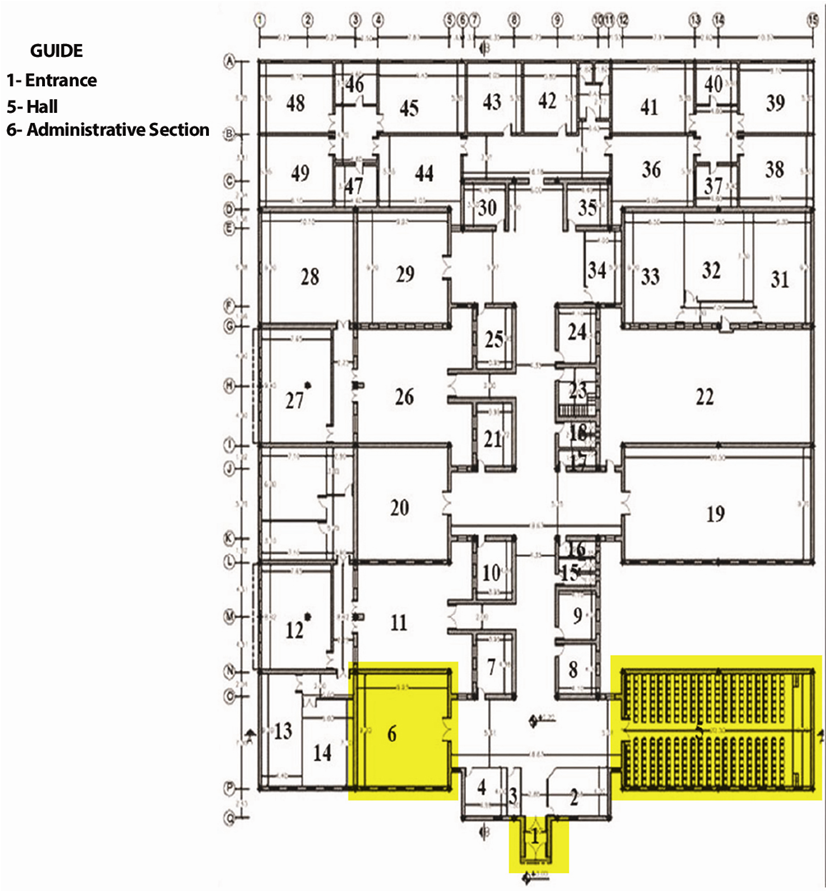
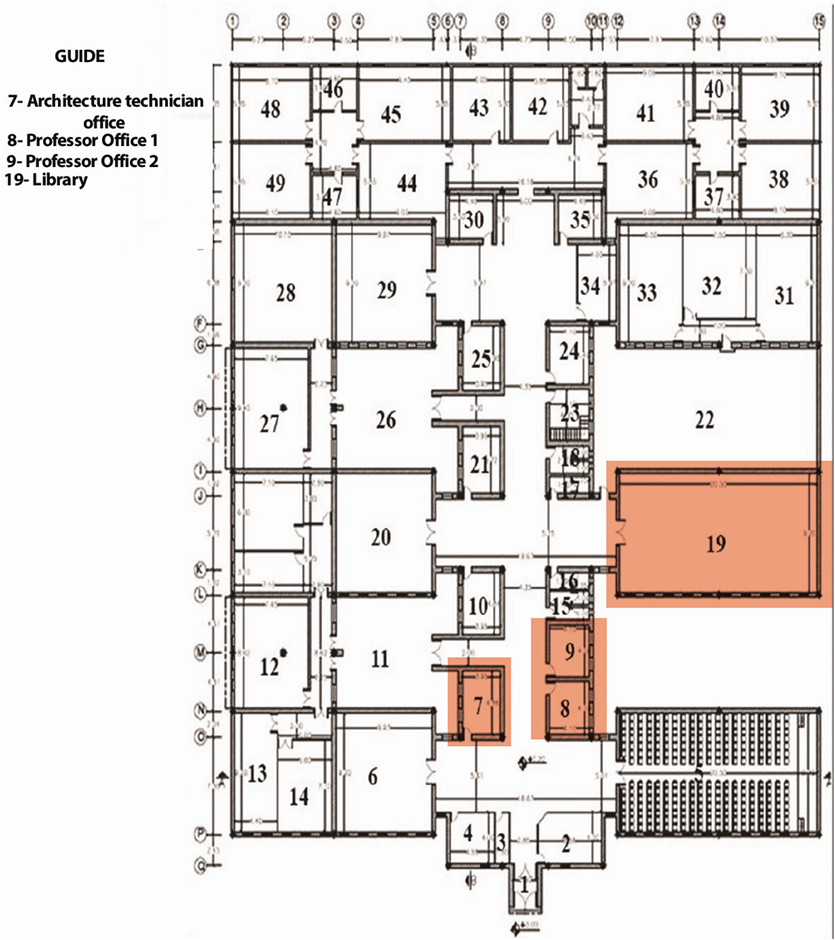
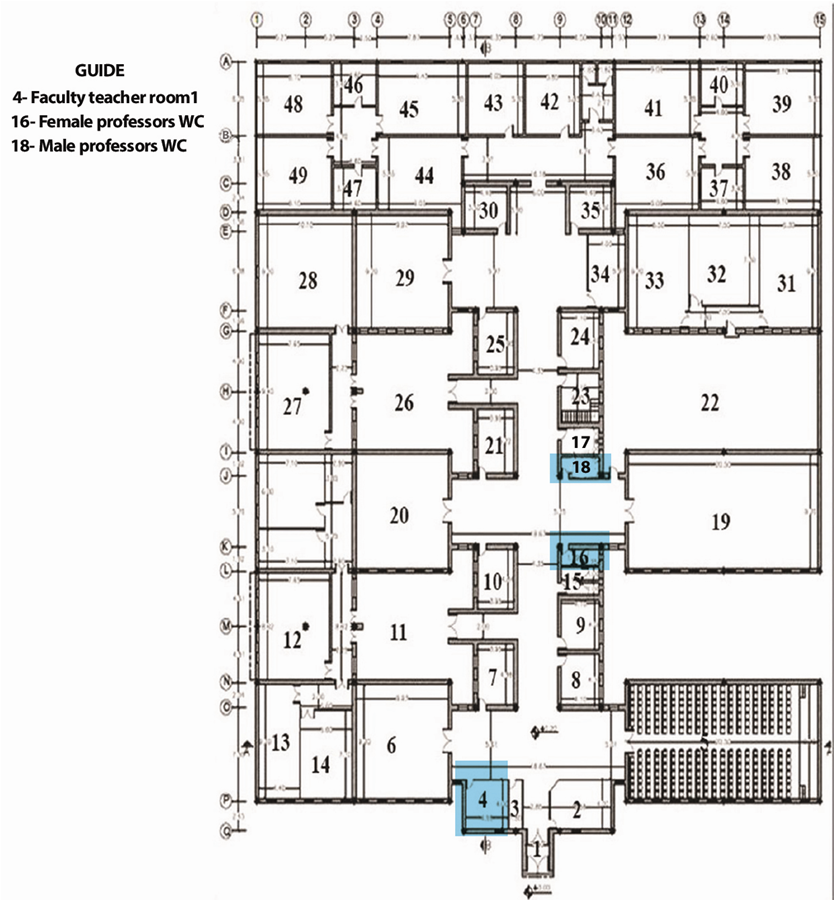
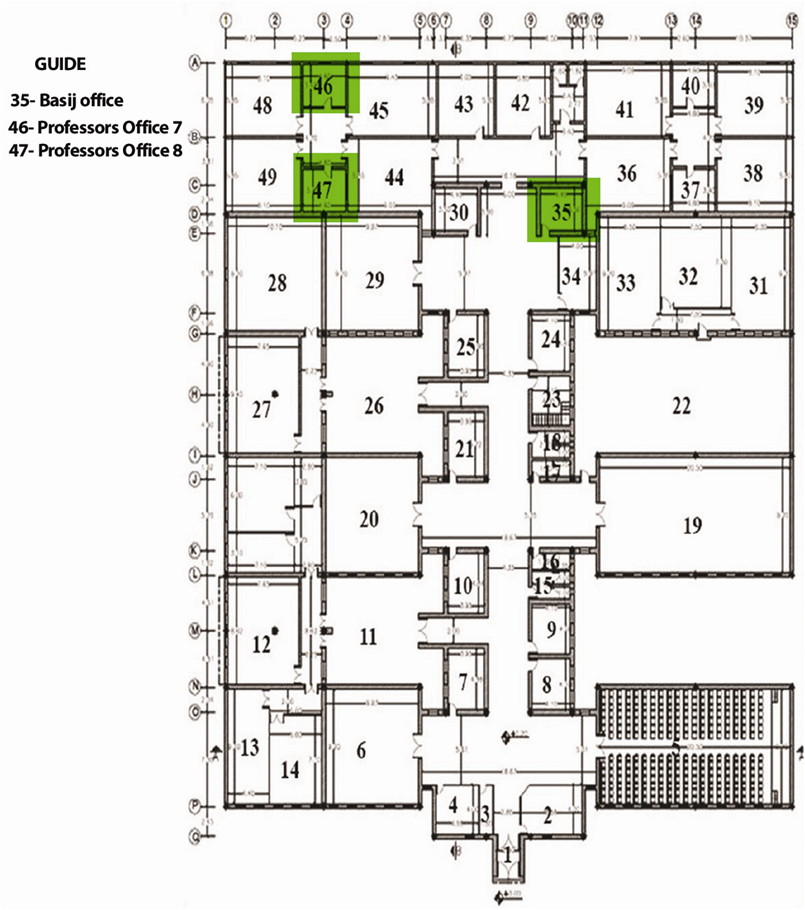
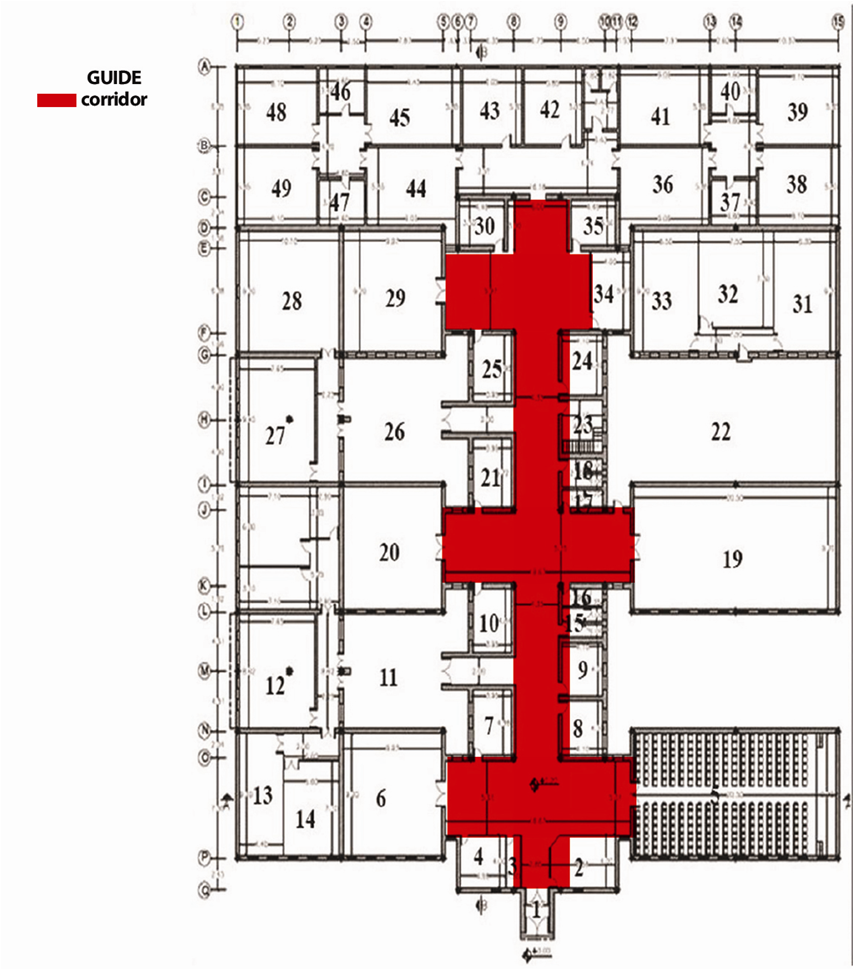
The spaces left undrawn by the students were professor offices, Basij office, professors WC, audiovisual 3, professor break room and workshops. The analysis of cognitive map revealed that some areas tended to be larger for all participants (see Table 1). These locations were halls, corridors, administrative section and library which were often used by students or located in main directions of the faculty (professors office 1 and 2) and were legible (library and audiovisual 1), the size and scale of spaces are in accordance with their application (e.g. corridors). Students also identified some of the spatial problems in architectural design of school and claimed that these problems made not only recalling the places but also inferring about the missing information more difficult. The problems were unzoning of spaces, spatial complexity and illegibility, inappropriate position of some places for example WCs, similarity of shapes and facades. They also added that the function of spaces need to be in congruence with the size (e.g. class size and number of attendants) since in some cases, lack of the space may minimize their visit to those spaces. The following spaces were considered as insufficient. Studio, lobby, fair, viva room and café or any places for social gathering.


The current study we examined the design of an architecture school using a cognitive map tool. We found that cognitive maps are flawed and biased representations of the environment. They are influenced by variety of factors such as salience of areas and locations, type of activity people carry out in environment, and their familiarity with the locations. People allocate asymmetrical attention to different locations and may favour some over others. This asymmetrical allocation of attention to and frequent interaction with the locations can facilitates learning and recalling those places. Interestingly all the participants reported trouble recalling the locations and failing in navigation. They associated their problem with zoning spaces, spatial complexity and illegibility, inappropriate position of some places, similarity of the shapes and facades. They also added that the function of spaces need to be in congruence with the size (e.g. class size and number of attendants) since in some cases, lack of the space may minimize their visit to those spaces. The following spaces were considered as insufficient. Studio, lobby, fair, viva room and café or any places for social gathering. In addition, men and women did not differ in the accuracy of their cognitive maps. However, females were found between them with regards to some object locations. Interestingly, for navigation, males used information about directions for navigation, whereas females employed a landmark-based strategy. The result of this study can lead architect planner to create distinctively and well used buildings and take a better use of navigational aids. The results of the study has implication for psychologist and policy makers who are interested in navigational behaviours of the space users Further study may assess some of the challenges that architect planners may face to respond to these sex differences in consumer strategies.
| [1] | Allahyar, N., and Nazari, A. (2012). Potentiality of Vygotsky's sociocultural theory in exploring the role of teacher perceptions, expectations and interaction strategies. WoPaLP, 6, 79-92. | ||
| In article | View Article | ||
| [2] | Tuan, Y.F. (1975). Images and mental maps. Annals of the Association of American Geographers, 65: 205-213. | ||
| In article | View Article | ||
| [3] | Spencer, C., Blades, M. & Morsley, K. (1989). The child in the physical environment, Chicester: Wiley. | ||
| In article | |||
| [4] | Downs, R. M., & Stea, D. (1973). Image and environment: Cognitive mapping and spatial behavior. Chicago: Aldine Pub. Co. | ||
| In article | View Article | ||
| [5] | Stephan, P., Jäschke, J. P. M., Oberzaucher, E., & Grammer, K. (October 01, 2014). Sex differences and similarities in urban home ranges and in the accuracy of cognitive maps. Evolutionary Psychology, 12, 4. | ||
| In article | View Article | ||
| [6] | Kara, B. (2013). Landscape Design and Cognitive Psychology. Procedia - Social and Behavioral Sciences, 82, 288-291. | ||
| In article | View Article | ||
| [7] | Antes, J.R., McBride, R.B., Collins, J.D. (1988). The effects of a new city traffic route on the cognitive maps of its residents, Environment and Behaviour, 20, 75-91. | ||
| In article | View Article | ||
| [8] | Tversky, B. (2003). Structures of Mental Spaces: How people think about space, Environment and Behaviour, 35, 66-80. | ||
| In article | View Article | ||
| [9] | Tolman, E. C. (1948). Cognitive maps in rats and men, Psychological Review, 55, 189-208. | ||
| In article | View Article PubMed | ||
| [10] | Silverman I., Choi J., and Peters M. (2007). The hunter-gatherer-theory of sex differences in spatial abilities: Data from 40 countries. Archives of Sexual Behavior, 36, 261-268. | ||
| In article | View Article PubMed | ||
| [11] | Moon, Y., Jo, H.,Kim.,J, & Ryu, J.(2016) Exploring gender differences in spatial orientation ability on representing cognitive map. International Journal of Psychology and Behavioral Sciences 2016, 6(2): 91-98. | ||
| In article | View Article | ||
| [12] | O’Laughlin, E. M., & Brubaker, B. S. (1998). Use of landmarks in cognitive mapping: Gender differences in self report versus performance. Personality and Individual Differences, 24, 595-601. | ||
| In article | View Article | ||
| [13] | Li, R. (2014). Why women see differently from the way men see? A review of sex differences in cognition and sports. Journal of Sport and Health Science, 3, 3, 155-162. | ||
| In article | View Article PubMed | ||
| [14] | Vygotsky, L. S. (1978). Mind in society: The development of higher psychological processes (M. Cole, V. John-Steiner, S. Scribner, & E. Souberman, Eds.). Cambridge, Mass.: Harvard University Press. | ||
| In article | View Article | ||
| [15] | Portugali, J. (1996). The construction of cognitive maps. Dordrecht: Kluwer Academic Publishers. | ||
| In article | View Article | ||
| [16] | Silverman, I. & Eals, M. (1992). Sex differences in spatial abilities: Evolutionary theory and data. The adapted mind: Evolutionary psychology and the generation of culture. J. M. Barkow, L. Cosmides and Tooby. New York, Oxford Univ. Press. | ||
| In article | View Article | ||
| [17] | Kerst S. M., Howard J. H., and Gugerty L. J. (1987). Judgment accuracy in pair-distance estimation and map sketching. Bulletin of the Psychonomic Society, 25, 185-188. | ||
| In article | View Article | ||
| [18] | Holahan C. J. (1978). Environment and behavior: A dynamic perspective. New York: Plenum Press. | ||
| In article | View Article | ||
 This work is licensed under a Creative Commons Attribution 4.0 International License. To view a copy of this license, visit
http://creativecommons.org/licenses/by/4.0/
This work is licensed under a Creative Commons Attribution 4.0 International License. To view a copy of this license, visit
http://creativecommons.org/licenses/by/4.0/
| [1] | Allahyar, N., and Nazari, A. (2012). Potentiality of Vygotsky's sociocultural theory in exploring the role of teacher perceptions, expectations and interaction strategies. WoPaLP, 6, 79-92. | ||
| In article | View Article | ||
| [2] | Tuan, Y.F. (1975). Images and mental maps. Annals of the Association of American Geographers, 65: 205-213. | ||
| In article | View Article | ||
| [3] | Spencer, C., Blades, M. & Morsley, K. (1989). The child in the physical environment, Chicester: Wiley. | ||
| In article | |||
| [4] | Downs, R. M., & Stea, D. (1973). Image and environment: Cognitive mapping and spatial behavior. Chicago: Aldine Pub. Co. | ||
| In article | View Article | ||
| [5] | Stephan, P., Jäschke, J. P. M., Oberzaucher, E., & Grammer, K. (October 01, 2014). Sex differences and similarities in urban home ranges and in the accuracy of cognitive maps. Evolutionary Psychology, 12, 4. | ||
| In article | View Article | ||
| [6] | Kara, B. (2013). Landscape Design and Cognitive Psychology. Procedia - Social and Behavioral Sciences, 82, 288-291. | ||
| In article | View Article | ||
| [7] | Antes, J.R., McBride, R.B., Collins, J.D. (1988). The effects of a new city traffic route on the cognitive maps of its residents, Environment and Behaviour, 20, 75-91. | ||
| In article | View Article | ||
| [8] | Tversky, B. (2003). Structures of Mental Spaces: How people think about space, Environment and Behaviour, 35, 66-80. | ||
| In article | View Article | ||
| [9] | Tolman, E. C. (1948). Cognitive maps in rats and men, Psychological Review, 55, 189-208. | ||
| In article | View Article PubMed | ||
| [10] | Silverman I., Choi J., and Peters M. (2007). The hunter-gatherer-theory of sex differences in spatial abilities: Data from 40 countries. Archives of Sexual Behavior, 36, 261-268. | ||
| In article | View Article PubMed | ||
| [11] | Moon, Y., Jo, H.,Kim.,J, & Ryu, J.(2016) Exploring gender differences in spatial orientation ability on representing cognitive map. International Journal of Psychology and Behavioral Sciences 2016, 6(2): 91-98. | ||
| In article | View Article | ||
| [12] | O’Laughlin, E. M., & Brubaker, B. S. (1998). Use of landmarks in cognitive mapping: Gender differences in self report versus performance. Personality and Individual Differences, 24, 595-601. | ||
| In article | View Article | ||
| [13] | Li, R. (2014). Why women see differently from the way men see? A review of sex differences in cognition and sports. Journal of Sport and Health Science, 3, 3, 155-162. | ||
| In article | View Article PubMed | ||
| [14] | Vygotsky, L. S. (1978). Mind in society: The development of higher psychological processes (M. Cole, V. John-Steiner, S. Scribner, & E. Souberman, Eds.). Cambridge, Mass.: Harvard University Press. | ||
| In article | View Article | ||
| [15] | Portugali, J. (1996). The construction of cognitive maps. Dordrecht: Kluwer Academic Publishers. | ||
| In article | View Article | ||
| [16] | Silverman, I. & Eals, M. (1992). Sex differences in spatial abilities: Evolutionary theory and data. The adapted mind: Evolutionary psychology and the generation of culture. J. M. Barkow, L. Cosmides and Tooby. New York, Oxford Univ. Press. | ||
| In article | View Article | ||
| [17] | Kerst S. M., Howard J. H., and Gugerty L. J. (1987). Judgment accuracy in pair-distance estimation and map sketching. Bulletin of the Psychonomic Society, 25, 185-188. | ||
| In article | View Article | ||
| [18] | Holahan C. J. (1978). Environment and behavior: A dynamic perspective. New York: Plenum Press. | ||
| In article | View Article | ||