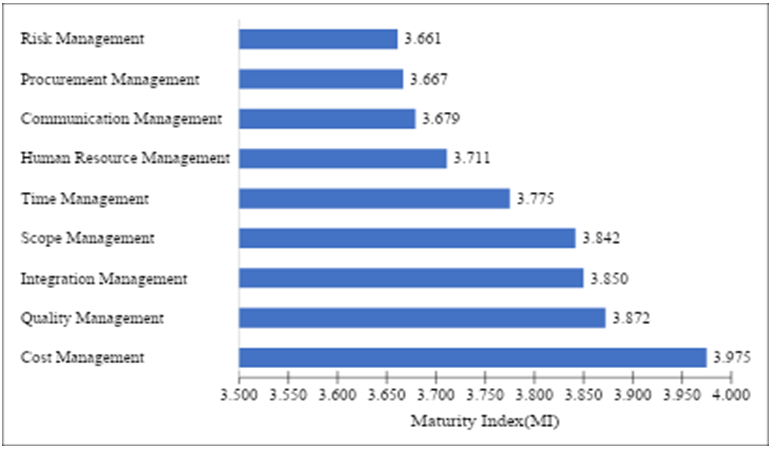
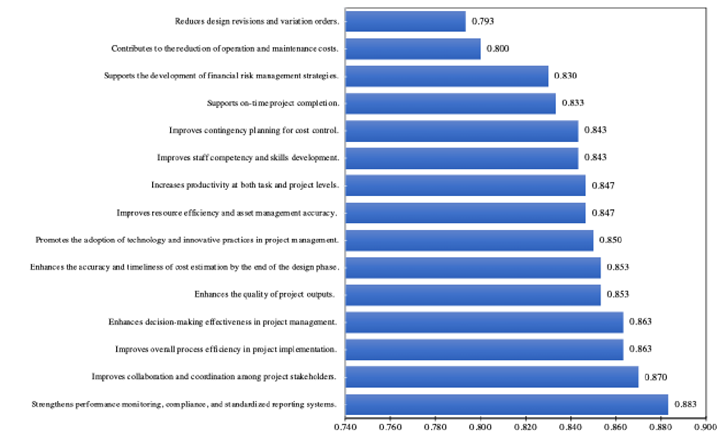
Benchmarking is a recognized mechanism for continuous improvement in construction project quality management. This study evaluates construction quality management maturity and benchmarking readiness in Cagayan de Oro City, Philippines. It measures maturity using the Project Management Maturity Model, assesses stakeholder perception through Key Performance Indicators, and ranks implementation barriers. A descriptive quantitative design was employed using a structured questionnaire administered to 60 construction professionals involved in government-supported projects. The instrument showed strong validity and reliability, with S-CVI values of 0.833–1.000, Cronbach’s alpha values of 0.796–0.960, KMO values of 0.888–0.905, and Bartlett’s Test results of p < 0.001. Maturity was analyzed using the Maturity Index and Weighted Index, while stakeholder perception was evaluated using the Relative Importance Index. Results showed generally high but uneven maturity, led by Cost Management (Mi = 3.975; Wi = 0.117) and Quality Management (Mi = 3.872; Wi = 0.114). Stakeholders perceived benchmarking positively, with RII values ranging from 0.793 to 0.883. FAHP ranked inadequate quality management training as the top barrier (GW = 0.220), followed by lack of quality team commitment (GW = 0.181) and lack of technical expertise (GW = 0.118). The study recommends institutionalizing benchmarking, strengthening competencies, improving digital capabilities, and reinforcing leadership commitment.
The local government of Cagayan de Oro City is committed to enhancing infrastructure to support community development and improve the quality of life for its residents. Each year, millions of pesos are allocated for infrastructure projects. The Philippine Statistics Authority (PSA) reported a GDP growth rate of 4.4% well below the government’s 5.5% to 6.5% target, as of the fourth quarter of 2025. This marked the softest growth since 2011, weighed down by a contraction in construction after flood control irregularities, with the construction industry as one of the main contributors, with a growth rate of 5%.
However, with the rising cost of service delivery and increasing expectations from government funding models, there is a pressing need to establish an effective framework to meet the growing demand for improved public services and infrastructure. While established quality management frameworks like Total Quality Management (TQM) have significantly transformed industries in developed countries, adapting these models to emerging markets poses unique challenges. In many cases, local councils prioritize regulatory compliance over performance, which often leads to issues in project planning and implementation such as budget overruns, quality defects, scheduling delays, and operational inefficiencies.
One powerful yet underutilized tool in this context is benchmarking, which enables organizations to assess their performance against industry standards and identify areas for improvement. Despite its potential, the practice has not been fully embraced within the local construction sector. To understand and advance quality practices, this study incorporates the Project Management Maturity Model (PMMM) and Key Performance Indicators (KPIs) as central evaluation tools. The PMMM provides a structured framework for assessing the maturity level of project management processes across key knowledge areas, helping determine how systematically quality practices are applied in local government construction projects.
Meanwhile, KPIs serve as quantifiable metrics such as cost predictability, defect rates, schedule adherence, and client satisfaction that allow for performance tracking and benchmarking comparisons. Together, these tools offer a data driven approach to identifying performance gaps, evaluating stakeholder perceptions, and crafting practical strategies to institutionalize benchmarking. This study seeks to investigate the barriers to fostering a quality culture through benchmarking for enhancing performance in the Cagayan de Oro City construction sector. By applying maturity modeling and performance indicators, the research aims to offer evidence-based solutions that support a more efficient, accountable, and quality-driven future for local infrastructure development.
Benchmarking is an established strategy for enhancing quality management by identifying best practices and promoting continuous improvement. In the construction sector, it allows firms to evaluate their performance against industry standards and adopt strategies that boost efficiency, reduce waste, and improve overall quality. Research shows that construction companies that implement benchmarking frameworks tend to achieve better project delivery, increased cost efficiency, and higher client satisfaction. However, successful benchmarking requires a supportive organizational culture, effective data collection mechanisms, and strong management commitment. Unfortunately, these elements are often lacking in many developing economies 1.
Despite its global adoption, benchmarking faces several limitations. A primary challenge is the lack of awareness and understanding of benchmarking principles among construction professionals. Many firms regard benchmarking as a complex and resource-intensive process that requires extensive data collection and analysis, which leads to reluctance in adopting it. Additionally, the absence of standardized performance metrics in the local construction industry makes it difficult to establish meaningful comparisons with industry leaders 2. Furthermore, the lack of technical expertise and limited access to training further impede the effective utilization of benchmarking tools 3.
Resistance to change within construction organizations poses a significant challenge. Many firms in Cagayan de Oro City operate under traditional management structures that prioritize cost and time over quality. As a result, the prevailing mindset among contractors and project managers often emphasizes immediate project completion rather than long term quality improvement. This resistance is further reinforced by the competitive nature of the industry, where firms are hesitant to share performance data due to concerns over confidentiality and maintaining a competitive edge 4. Without a collaborative approach to benchmarking, individual firms find it difficult to fully realize the benefits.
Financial constraints significantly hinder the implementation of benchmarking in the construction industry. Many small and medium-sized construction firms do not have the financial resources to invest in benchmarking initiatives, such as hiring consultants, adopting digital tools, or conducting thorough performance assessments 1. The costs related to data collection, training, and system upgrades often lead to these firms prioritize other operational expenses over benchmarking. Additionally, the absence of government incentives and regulatory support for benchmarking further discourages firms from investing in quality improvement measures 5.
The lack of regulatory enforcement and standardized quality management practices hinders the adoption of benchmarking. Although existing regulations focus on construction safety and compliance, they do not prioritize continuous improvement through benchmarking. In contrast to developed economies, where government agencies and industry associations actively promote benchmarking initiatives, the local construction sector lacks structured programs to encourage firms to implement best practices 6. This regulatory gap leads to inconsistencies in quality management approaches among different firms, making it challenging to establish a unified benchmarking framework.
Industry associations, academic institutions, and government agencies can play a key role in educating construction professionals about the benefits of benchmarking and offering practical guidance for its implementation 7. By fostering a culture of continuous learning, firms can build the expertise necessary to adopt and maintain effective benchmarking practices. Collaboration among construction firms is essential for effective benchmarking implementation. Establishing industry-wide benchmarking networks can facilitate data sharing, allow for performance comparisons, and promote the dissemination of best practices.
Financial support and policy interventions can effectively promote the adoption of benchmarking. Government initiatives, such as tax incentives, subsidies, and grants for companies that implement benchmarking, can help alleviate costs. Regulatory bodies can also require quality performance reporting and participation in benchmarking as part of construction licensing requirements 8. By incorporating benchmarking into regulatory frameworks, policymakers can establish quality management as a standard practice throughout the industry.
Benchmarking presents a valuable opportunity to improve the quality management of construction in Cagayan de Oro City. The purpose of this study is to assess the current project management maturity of the construction industry, particularly in the City of Cagayan de Oro, to evaluate the perception of stakeholders on benchmarking, and the barriers to adopting best practices.
1.1. ObjectivesThis study aims to evaluate the maturity level of benchmarking implementation in construction project quality management within the Cagayan de Oro City’s construction industry. The research will also evaluate stakeholders’ perception and identified key barriers to the adoption of benchmarking. Based on these findings, the study will analyze recommendations to overcome these barriers and enhance the integration of benchmarking, ultimately optimizing project outcomes and resource.
1. To measure the current maturity of construction project quality management using Maturity Index (MI) and Weighted Index (WI).
2. To evaluate stakeholders’ perception on implementing benchmarking of construction project quality management into their organizational practices using Relative Importance Index (RII).
3. To rank barriers to implementing benchmarking practices in construction industry of Cagayan de Oro City using fuzzy analytic hierarchy process (FAHP).
The construction industry is a vital engine of economic growth in the Philippines, serving as a major contributor to capital formation, employment generation, and national development. According to the Construction Industry Authority of the Philippines, the sector contributes approximately 33.9% to the country’s Gross Capital Formation (GCF), underscoring its substantial role in economic expansion. The industry also employs an average of 3.85 million workers, making it one of the country’s significant sources of jobs and economic activity (CIAP, 2018). As the government continues to pursue large-scale infrastructure expansion, through programs like “Build, Build, Build”, the efficient delivery of construction projects becomes increasingly important, particularly in terms of cost control, schedule performance, quality assurance, and public accountability 9.
Under the current administration, infrastructure development remains a central component of national economic policy. The government has increasingly relied on private capital through public-private partnerships (PPP) to finance infrastructure projects, compared with the previous administration’s greater dependence on foreign-assisted financing. Projects under the current administration were mainly focused on improving connectivity, contributing to a total of 194 priority construction and infrastructure projects, 45 of which were identified for private-sector funding through PPP arrangements. This national strategy reflects the administration’s commitment to improving infrastructure to support economic growth and reduce poverty before 2028 10. As the country continues to invest heavily in strategic infrastructure, improving construction project performance becomes essential to ensure that public and private investments translate into timely, cost-efficient, and high-quality project delivery.
Despite the construction industry’s significant contribution to national development, it continues to face longstanding structural and operational challenges. Globally, labor productivity growth in construction has averaged only 1% per year over the past two decades, which is substantially lower than productivity growth in many other industries. This weak performance has been associated with the highly fragmented nature of the industry, which often results in poor project management, insufficient design processes, limited coordination among stakeholders, and inadequate investment in skills development and innovation 77. These challenges are also evident in the Philippine construction sector, where firms continue to encounter barriers in adopting modern technologies and innovative project delivery practices.
In the Philippine context, one of the major issues affecting construction performance is the lack of clear frameworks, policies, and institutional programs that support the adoption of technology and process innovation. Reference 39 emphasized that this deficiency remains a key concern among construction companies in the country, limiting their ability to modernize practices and improve project outcomes. The same study identified a wide range of recurring project implementation issues, including variation orders, design changes, time overruns, cost overruns, lack of collaboration, poor communication, rework, quality-related deficiencies, safety issues, and construction waste. These recurring problems indicate that construction performance issues in the Philippines are not isolated incidents but rather systemic deficiencies that persist across multiple project types and institutional settings.
To synthesize the recurring implementation issues identified in the literature, Table 1 presents the commonly reported problems affecting construction project performance in the Philippine context, particularly those that may be addressed through benchmarking practices. Projects completed beyond their stipulated time and budget remain a chronic problem in public infrastructure implementation in the Philippines. Project implementation inefficiencies remain widespread in the public sector, as reflected in repeated audit observations and delayed infrastructure delivery. Specifically, the leading contributors to time overruns in public infrastructure projects were inaccurate budgeting, site or location conditions, suspension of work, delays in land acquisition and compensation, and variation orders, while the most influential contributors to cost overruns were inaccurate budgeting, variation orders, inadequate project planning, market conditions, and inadequate site investigations 67. These findings demonstrate that delayed and over-budget project delivery is not merely an isolated operational issue but a recurring systemic problem in Philippine public infrastructure implementation.
The Project Management Maturity Model (PMMM) is adopted in this study as the primary framework for assessing the maturity of project management practices within the local government construction sector. The PMMM provides a systematic and structured approach for evaluating organizational capabilities through progressive maturity levels, enabling institutions to measure the extent to which project management processes are defined, implemented, managed, and continuously improved 18. This framework remains widely used in benchmarking studies because it supports comparative analysis and identification of performance gaps across organizations.
Recent studies reinforce the continued relevance of maturity models in the construction sector. For instance, a review of project management maturity models highlights that such frameworks remain essential tools for evaluating organizational capability, improving performance, and supporting decision-making in project-based industries 19. Similarly, recent construction-focused research confirms that maturity models are practical tools for diagnosing deficiencies in project delivery and guiding improvement strategies 20.
In local government construction environments, project management practices often vary significantly in terms of standardization, implementation, and institutional support. These inconsistencies limit opportunities for performance optimization, knowledge transfer, and continuous improvement. Recent empirical studies in developing-country construction sectors show that maturity levels differ widely across organizations, with common gaps observed in risk management, quality control, and governance systems 21. This variability further justifies the need for a structured maturity assessment framework in this study.
To operationalize the PMMM framework, this study integrates it with the Knowledge Areas of the Project Management Institute PMBOK Guide Fourth Edition 22. The nine knowledge areas shown in Table 2 provide a comprehensive structure for evaluating core project functions. These domains remain widely recognized as fundamental components of project management capability across construction projects.
The measurement indicators, shown in Table 3, used in this study were adapted from the PMMM-based assessment framework developed by Reference 23, which operationalizes project management maturity through observable organizational practices across the PMBOK knowledge areas. Each indicator represents a measurable aspect of maturity, allowing respondents to evaluate the extent to which these practices are implemented within their organizations. These indicators were relevant to the study because they provided the basis for determining the current readiness of organizations to support benchmarking implementation. By measuring maturity across the PMBOK knowledge areas, the study was able to identify which project management practices were already established and which areas still required improvement before benchmarking could be effectively institutionalized.
Maturity within these knowledge areas is assessed using five progressive levels: Initial (Level 1), Structured (Level 2), Organizational Standards (Level 3), Managed (Level 4), and Optimizing (Level 5). These levels are cumulative in nature, meaning that higher levels indicate stronger institutionalization of processes 24. Recent research continues to support this staged progression, emphasizing that maturity evolves from basic compliance toward integrated, data-driven, and continuously improving systems 25. Likewise, studies on digital construction maturity highlight that organizations progress through structured stages as they adopt advanced technologies and management practices 26. To make the results easier to interpret, the Maturity Levels are grouped into three categories, as shown in Table 4. This classification provides a clearer basis for interpreting whether the assessed practices are still developing, moderately established, or already mature.
To quantitatively assess maturity, this study employs the Maturity Index (Mi), shown in Equation 1 and the Weight Index (Wi), shown in Equation 2.1. The Maturity Index represents the weighted average score of responses for each knowledge area, reflecting the overall level of maturity based on stakeholder assessments. This approach ensures that higher maturity levels contribute proportionally to the final score, capturing the degree of institutionalization of project management practices. The Weight Index, on the other hand, normalizes these maturity scores across all knowledge areas, enabling relative comparison and identification of areas that contribute most significantly to overall maturity 27.
 | (1) |
Where Mi is the maturity index for the ith knowledge area, fij is the frequency of responses at maturity level j for the ith knowledge area, j is the maturity level score (1 = Initial, 2 = Structured, 3 = Organizational Standards, 4 = Managed, 5 = Optimizing), L is the total number of maturity levels, and N is the total number of respondents.
 | (2) |
Where Wi is the weight index for the ith knowledge area, Mi is the computed maturity index, and ∑Mi is the summation of the mean ratings for the knowledge areas. Values closer to 1 indicate relatively higher maturity contribution and stronger institutionalization of practices within that knowledge area. This dual-index interpretation enhances the analytical strength of the study by combining absolute performance (Mi) and relative contribution (Wi). Recent literature supports this approach, emphasizing that maturity assessment should not only measure capability levels but also identify priority areas for improvement and strategic focus. Recent studies further emphasize that achieving higher maturity in construction organizations requires more than formal procedures. It depends on strong leadership, accountability, stakeholder engagement, and continuous improvement practices 28.
To ensure consistency in the assessment and interpretation of project management maturity, this study adopts the standardized five-level scale of the Project Management Maturity Model (PMMM), as presented in Table 5. These descriptions provide a standardized basis for respondents to assess the extent to which project management practices are implemented within their organizations. By anchoring each maturity level to clearly define organizational behaviors and process characteristics, the scale ensures consistent interpretation of responses and supports reliable comparison across knowledge areas 24 29. This scale also provides a clear basis for categorizing the maturity of existing practices from informal implementation to continuous improvement.
Key Performance Indicators (KPIs) are widely used in performance measurement and management, including in construction and local government settings. KPIs serve as quantifiable metrics that allow organizations to monitor progress toward strategic objectives, evaluate operational efficiency, and assess the effectiveness of project delivery 30. Within continuous improvement work, KPIs are commonly organized around core project outcomes, particularly cost management, schedule adherence, and quality control, often referred to as the iron triangle of project management, which remains a fundamental framework for evaluating project performance 22. At the same time, measurement systems can lose value when they become too crowded.
More recent studies continue to highlight the importance of these traditional indicators but also show that KPI frameworks in construction have gradually evolved. For instance, Reference 31 confirmed that cost, time, and quality remain the most frequently used indicators in benchmarking construction performance. However, newer research suggests that relying solely on these dimensions is no longer sufficient. There is now a stronger emphasis on process-related and operational indicators, such as coordination efficiency, information flow (e.g., RFI processing), and communication effectiveness. These types of indicators provide a clearer picture of how projects are actually managed on-site, not just the final outcomes.
In the context of public infrastructure, recent studies highlight the need for multi-dimensional KPI frameworks that extend beyond traditional technical and financial performance to include broader organizational and stakeholder-related outcomes 32, 33. This shift reflects the increasing complexity of construction projects, particularly in government settings where accountability, compliance, and public value are equally important. As a result, KPI-based benchmarking today is no longer limited to measuring outputs but also focuses on how processes are carried out and how decisions are made.
Despite their usefulness, KPIs must be carefully selected. Reference 34 emphasized that performance measurement systems should remain focused and manageable. They suggest limiting the number of indicators, usually between eight and twelve, to avoid unnecessary complexity. When too many KPIs are used, organizations may struggle to prioritize what really matters, which can weaken decision-making. This concern is also supported by Reference 35, who noted that overly complex measurement systems can reduce clarity and make implementation more difficult, especially in construction environments where data collection is already challenging.
In this study, ten (10) KPIs, presented in Table 6, fall within that recommended range. They were selected to cover both traditional performance dimensions such as cost, time, and quality, and emerging areas like innovation, data transparency, and human capital. This ensures that the framework captures the full scope of construction quality management, particularly in government projects, without overcomplicating the analysis.
While KPIs provide a strong foundation for benchmarking and continuous improvement, their application in practice is often challenged by real-world constraints, particularly in fragmented and resource-limited sectors such as construction and local government. Reference 36 emphasize that moving beyond basic compliance requires more than just measurement tools—it depends on sustained leadership commitment, capable personnel, and clearly defined accountability structures.
At the same time, Reference 36 caution that having too many performance indicators can be counterproductive. An excessive number of KPIs may dilute organizational focus, blur strategic priorities, and create confusion among those responsible for implementation. In many cases, issues such as inconsistent data collection, limited technological resources, and weak institutional support further reduce the effectiveness of KPI systems.
To address these challenges, collaborative mechanisms such as benchmarking networks or clubs have been introduced. These platforms allow organizations to share best practices, compare performance, and learn from one another in a non-competitive setting. Through such initiatives, knowledge gaps can be reduced, data-sharing practices can be improved, and overall capacity for performance measurement and improvement can be strengthened.
2.4. Validity and ReliabilityIn the context of construction quality management and benchmarking studies, the validity and reliability of the instrument are critical to ensure that the collected data accurately represent stakeholder perceptions, maturity levels, and priority judgments. In line with the quantitative methodology presented in Chapter 3, this study employed Content Validation, Construct Validation (KMO and Bartlett’s Test), and Reliability Testing (Cronbach’s Alpha) to establish the robustness of the dataset.
Recent methodological studies emphasize that combining expert-based validation and statistical testing strengthens the rigor of survey-based research, particularly in construction and project management contexts where indicators are multi-dimensional and interrelated 37, 38, 39.
Content validation was conducted through expert evaluation to ensure that the survey items are relevant, clear, and representative of benchmarking practices and construction quality management. This approach is widely supported in recent studies, which highlight that expert judgment remains the most appropriate method for validating context-specific constructs. To ensure reliable validation results, the study adopted an expert panel size consistent with recent recommendations shown in Table 7, where 6–10 experts are considered sufficient to achieve stable agreement while minimizing bias. 37, 40. This range ensures that the Content Validity Index (CVI) on scale produces dependable and defensible results.
The level of agreement among experts was quantified using the Content Validity Index (CVI). The interpretation thresholds for the Content Validity Index (CVI), shown in Table 8, were adopted from established methodological frameworks, particularly the foundational work of Polit and Beck, which has been widely applied and validated in recent studies on instrument development and validation 37, 41.
Construct validity was assessed using the Kaiser-Meyer-Olkin (KMO) Measure and Bartlett’s Test of Sphericity, which are widely applied in recent multivariate analysis studies 38, 39. These tests determine whether the dataset is suitable for factor analysis and whether the variables exhibit sufficient interrelationships. To guide interpretation, the following KMO thresholds in Table 9 were adopted.
Bartlett’s Test of Sphericity is a statistical procedure developed to test whether the correlation matrix is significantly different from an identity matrix 42. An identity matrix implies that the variables are not correlated, and therefore, unsuitable for factor analysis. Bartlett’s test evaluates the null hypothesis that the observed correlation matrix is an identity matrix. Similarly, Bartlett’s Test of Sphericity was interpreted using the following standard shown in Table 10. A significance level (p-value) less than 0.05 allows us to reject the null hypothesis and infer that the variables have statistically significant relationships.
In the context of benchmarking, especially for quality management in industries like construction, the KMO test validates whether performance indicators such as cost, time, quality compliance, or client satisfaction are statistically interrelated. This interrelatedness is crucial when attempting to reduce multiple benchmarking criteria into key performance dimensions or indices. Bartlett’s test helps confirm that the metrics being used such as site safety ratings, rework frequency, or material usage efficiency are sufficiently interrelated to produce meaningful, combined indicators. This is fundamental in deriving best practices or benchmark scores that can be generalized across projects or firms.
Reliability testing was conducted using Cronbach’s Alpha to evaluate the internal consistency of the survey instrument. This measure assesses the extent to which items within a construct are correlated and consistently measure the same concept. To standardize interpretation, the following thresholds were adopted as shown in Table 11 38.
Understanding issues that affect Cronbach’s Alpha is crucial when designing and evaluating survey instruments. One important factor is the number of items. Increasing the number of relevant and well aligned items generally improves Alpha, but adding too many similar items may artificially inflate it 43. Another consideration is unidimensionality, which assumes that all items measure a single construct. If items span multiple dimensions unknowingly, the Alpha can be misleading. This is why it is often recommended to conduct factor analysis alongside Cronbach’s Alpha to verify that item groupings are unidimensional 44.
2.5. Benchmarking of Construction Quality ManagementBenchmarking in construction quality management provides organizations with a structured approach to compare current practices against industry standards, identify performance gaps, and implement targeted improvements. In developing contexts such as Cagayan de Oro City, sustaining continuous improvement remains a significant challenge. Recent literature emphasizes that benchmarking extends beyond performance measurement, as it cultivates a quality-oriented culture across all stages of project delivery 45. To operationalize benchmarking, firms must adopt Key Performance Indicators (KPIs) that offer measurable insights into project outcomes, including efficiency, defect rates, safety compliance, and stakeholder satisfaction. Organizations that systematically monitor indicators such as rework rates, defect frequency, and schedule adherence demonstrate stronger quality management performance. However, the absence of structured KPI systems often leads to fragmented and inconsistent quality improvement efforts, particularly in resource-constrained environments 46.
A critical component of benchmarking is the implementation of structured Quality Management Systems (QMS) supported by clearly defined KPIs. Without a formalized system, organizations struggle to maintain consistency in quality standards across projects. Empirical findings indicate that firms relying on informal or ad hoc quality control mechanisms are more prone to inefficiencies, rework, and delays 47. The adoption of internationally recognized frameworks, such as ISO 9001, promotes a process-based approach to quality management and ensures alignment with best practices across the industry 48. In this context, KPIs such as defect density, material utilization efficiency, and subcontractor performance, serve as essential tools for evaluating system effectiveness. Nonetheless, many small and medium-sized enterprises face constraints related to financial capacity and technical expertise, limiting their ability to fully implement structured QMS frameworks 49.
Leadership commitment is another determining factor in the success of benchmarking initiatives. Effective implementation requires strong support from top management to foster accountability and ensure that quality objectives are aligned with measurable performance indicators. Studies have shown that organizations with leadership-driven quality cultures are more likely to institutionalize benchmarking practices and sustain continuous improvement efforts 50. Indicators such as training completion rates, audit compliance scores, and corrective action timelines reflect the extent to which leadership actively supports quality management.
Technological advancement further enhances benchmarking by enabling efficient data collection, real-time monitoring, and improved decision-making. Digital tools such as Building Information Modeling (BIM), automated inspection systems, and performance dashboards provide accurate and timely tracking of KPIs, thereby improving transparency and coordination among stakeholders 51. These systems allow organizations to monitor critical metrics such as inspection of pass rates, cost variance, and schedule performance. Despite these advantages, the adoption of digital technologies remains limited in many local construction contexts due to cost constraints and insufficient technical capacity 52. Addressing these limitations requires investment in digital infrastructure and targeted capacity-building initiatives to support data-driven benchmarking practices.
Collaboration and knowledge sharing are essential for establishing reliable and effective benchmarking systems. Participation in benchmarking networks enables organizations to exchange best practices, gain insights into industry performance, and adopt innovative approaches to quality management 53. However, collaboration is often hindered by competitive concerns and reluctance to share performance data among firms. This lack of transparency limits the development of standardized benchmarks and restricts opportunities for collective learning. Strengthening collaboration through industry associations and government-led initiatives can facilitate the standardization of KPIs and promote sector-wide improvements in quality performance.
Overall, benchmarking in construction quality management is a continuous process that requires sustained commitment, strategic investment, and industry collaboration. KPIs serve as the foundation for measuring performance and guiding improvement initiatives, enabling organizations to adopt best practices and enhance decision-making processes 35. However, the absence of structured systems and consistent KPI monitoring continues to hinder effective implementation, particularly in local government settings. To improve construction quality and achieve long-term competitiveness, organizations must institutionalize QMS frameworks, strengthen leadership engagement, leverage technological tools, and foster a culture of collaboration and continuous improvement.
2.6. Stakeholders’ Perception to Benchmarking ImplementationStakeholders’ perception plays a critical role in determining the acceptance, applicability, and long-term sustainability of benchmarking practices in construction quality management. In complex project environments, particularly within the public sector, stakeholders’ judgments influence decision-making, resource allocation, and the prioritization of improvement initiatives. Recent studies emphasize that benchmarking is not only a technical process but also a perception-driven practice, where its success depends on how stakeholders recognize its value in enhancing project performance 46, 52. As presented in Table 12, the selected indicators reflect key performance areas commonly associated with benchmarking outcomes in construction projects.
These indicators are grounded in contemporary research that highlights improvements in efficiency, cost control, coordination, and innovation. For instance, benchmarking practices have been shown to enhance resource efficiency and asset management by enabling organizations to compare operational performance against industry standards, thereby reducing inefficiencies and improving allocation strategies 52, 54. Similarly, the integration of benchmarking with digital tools contributes to faster and more accurate cost estimation during the design phase, supporting early-stage decision-making and minimizing budget deviations 46, 55.
Another critical dimension reflected in the indicators is the reduction of design-related inefficiencies, such as excessive requests for information (RFIs) and variation orders. Studies indicate that benchmarking, particularly when supported by data-driven systems, promotes design clarity and coordination, which in turn reduces rework and project delays 52, 56. Improved collaboration among institutions is also consistently reported, as benchmarking encourages transparency and shared performance metrics, fostering coordination between government agencies, contractors, and consultants 57.
From an operational perspective, benchmarking contributes to reduced operation and maintenance costs and improved project delivery timelines. Empirical findings suggest that organizations adopting benchmarking practices are better able to monitor lifecycle performance, leading to cost savings and more reliable scheduling outcomes 49. In addition, productivity gains at both task and project levels are frequently observed, as benchmarking enables the identification of best practices and performance gaps, which can then be addressed through targeted interventions 58.
Quality improvement remains one of the most significant perceived benefits of benchmarking. Recent studies demonstrate that benchmarking strengthens compliance with quality standards and promotes continuous improvement by aligning project processes with established benchmarks 50, 59. Moreover, benchmarking has been linked to increased technological adoption, particularly in the use of digital construction tools and data analytics, which further enhances decision-making and operational efficiency 52, 60.
Beyond operational improvements, benchmarking is also associated with broader organizational benefits, including increased innovation capacity and support for sustainable development initiatives. Research shows that organizations engaged in benchmarking are more likely to adopt innovative practices and accelerate sustainability transitions, as they are exposed to evolving industry standards and emerging technologies 61. In addition, the establishment of standardized reporting mechanisms and structured financial risk management strategies ensures greater accountability and consistency in project execution 32, 62.
Finally, the effectiveness of benchmarking systems in supporting decision-making processes is increasingly recognized. Studies indicate that integrated systems improve the quality of managerial decisions by providing timely and accurate performance data, thereby enhancing overall project outcomes 63. These findings collectively justify the inclusion of the selected indicators as measures of stakeholders’ perception, as they capture both the operational and strategic impacts of benchmarking implementation in construction projects. In this study, these indicators serve as the basis for assessing how stakeholders view the usefulness of benchmarking in improving construction project quality management. They also provide a structured foundation for interpreting perception results in relation to project efficiency, accountability, innovation, and continuous improvement.
The Likert scale is widely utilized in construction management research to quantify stakeholders’ perceptions, attitudes, and levels of agreement toward specific indicators. This method enables the systematic transformation of subjective judgments into quantifiable data suitable for statistical analysis 64. Recent studies affirm that Likert scales remain effective for capturing multi-dimensional constructs, particularly when assessing distinct indicators such as benchmarking outcomes. Rather than combining responses into a single index, individual items may be analyzed independently to reflect specific aspects of stakeholder perception. This approach is appropriate in construction research, where indicators represent diverse operational and managerial dimensions 65.
A five-point Likert scale is commonly adopted in engineering and construction studies because it balances measurement sensitivity with respondent convenience. It also provides a neutral midpoint, allowing respondents to express uncertainty when necessary. Empirical evidence suggests that such scales produce consistent and interpretable results when used in perception-based assessments 66. In this study, a five-point Likert scale is used to evaluate stakeholders’ perceptions of benchmarking implementation. The responses are assigned numerical values and analyzed using mean scores to determine the overall level of agreement for each indicator. The use of mean values and their corresponding verbal interpretations is supported by Reference 67, who emphasize that Likert-scale data can be meaningfully analyzed using descriptive statistics and categorized into qualitative interpretations. Furthermore, treating Likert-scale responses as interval data to justify the computation and interpretation of mean scores is supported by Reference 68. To ensure consistency in interpretation, equal interval ranges are established and assigned descriptive equivalents, a practice widely used in quantitative research to enhance clarity and comparability of results 69. Accordingly, the following scale in Table 13 is adopted.
In construction project management, stakeholder perception plays a critical role in evaluating the effectiveness and relevance of management practices such as benchmarking. Stakeholders provide valuable insights based on their direct involvement in project implementation. Understanding these perceptions is essential for identifying priority areas that influence project quality and performance 70, 71. Their perceptions regarding the contribution of benchmarking to construction quality management are measured using a five-point Likert scale, ranging from Strongly Disagree (1) to Strongly Agree (5).
To transform these subjective perceptions into measurable and comparable values, the Relative Importance Index (RII) is utilized. The RII is widely applied in construction research to analyze and rank stakeholder perceptions by quantifying the relative importance of variables based on respondents’ ratings 72. This method enables the prioritization of key indicators influencing construction quality management; the RII is calculated using Equation (3), where Wi is the weight assigned by each respondent (1 to 5), A is the highest weight on the scale (5), and N is the total number of respondents.
 | (3) |
The computed RII values range from 0 to 1. To ensure consistent and meaningful interpretation, this study adopts classification ranges that have been commonly used and validated in construction management literature, particularly in studies employing RII for ranking stakeholder perceptions 71, 73. The interpretation scale is presented in Table 14.
These threshold values are consistent with the classification approach proposed by Reference 73, which has been widely adopted in construction research and further applied in recent studies to interpret RII results. This categorization ensures that numerical outputs are translated into meaningful qualitative descriptions, facilitating clearer analysis and comparison across variables.
2.7. Barriers to Benchmarking Construction Quality ManagementBenchmarking in construction quality management is widely recognized as a critical mechanism for improving project performance and aligning industry practices with global standards. However, its implementation remains limited, particularly in developing contexts such as Cagayan de Oro City, where structural and organizational constraints persist. One of the primary barriers is the limited awareness and understanding of benchmarking practices among construction stakeholders. Recent studies confirm that insufficient knowledge and limited access to benchmarking frameworks significantly hinder adoption in developing construction sectors 52, 74. This implies that capacity-building initiatives and institutional support are necessary to improve awareness and promote benchmarking culture.
Another critical issue is the fragmented nature of data practices within the construction industry. Firms typically operate in isolation, with minimal data sharing and limited access to standardized performance indicators. Similar observations have been reported in international contexts, where organizations demonstrate reluctance to participate in benchmarking due to concerns over data confidentiality and competitive exposure 45, 75. In this study, statistical tools such as the Kaiser-Meyer-Olkin (KMO) measure and Bartlett’s Test of Sphericity are employed to evaluate sampling adequacy and determine whether the dataset is suitable for factor analysis 48. Low KMO values generally indicate weak interrelationships among variables, reflecting inconsistent practices and poor data integration across organizations. Furthermore, Cronbach’s Alpha is utilized to assess the internal consistency of the instrument, ensuring reliable measurement of perceived barriers 38. This implies that both statistical validation and industry standardization are essential to support meaningful benchmarking analysis.
Data confidentiality concerns further intensifying resistance to benchmarking implementation. Many construction firms are hesitant to disclose operational and performance-related information due to fears of competitive disadvantages and reputational risk. Empirical evidence suggests that transparency and trust are critical enablers of successful benchmarking systems, yet these elements are often lacking in fragmented construction environments 53, 59. As a result, collaborative benchmarking initiatives remain underdeveloped. To systematically evaluate these concerns, Pairwise Comparison is applied to rank barriers based on expert judgment, allowing the identification of the most critical constraints affecting implementation 76. This implies that structured decision-making tools are necessary to translate subjective perceptions into measurable priorities.
Financial constraints also play a significant role in limiting benchmarking adoption. Many firms operate under tight budget conditions, leading to a focus on cost minimization rather than investment in quality improvement systems. Studies have shown that organizations with low maturity in quality management often struggle to integrate benchmarking due to insufficient resources and lack of strategic direction 46, 47. Additionally, the absence of standardized quality metrics complicates performance comparison across projects and organizations 48. To address these limitations, Fuzzy Preference Relations (FPR) and Fuzzy Analytic Hierarchy Process (FAHP) are utilized to prioritize barriers and identify cost-effective interventions under conditions of uncertainty 52.
Table 15 presents the synthesized dimensions and corresponding critical success factors identified as key barriers to benchmarking construction quality management. These variables are grouped into five major dimensions: Quality, Human Capital, Technology, Stakeholder Satisfaction, and Economic-Political factors, each supported by recent literature. The table serves as the foundation for subsequent quantitative analysis, particularly in the application of Pairwise Comparison and FAHP methods, by organizing the variables into measurable and comparable constructs. This implies that the identified barriers are systematically derived and provide a valid basis for prioritization and decision-making. In relation to the study, these dimensions help establish the analytical framework for determining which barriers most significantly affect benchmarking implementation in the local construction industry. They also ensure that the succeeding FAHP analysis is grounded on literature-based variables rather than arbitrary or unsupported criteria.
The Pairwise Comparison method is a structured decision-making approach used to determine the relative importance of criteria by comparing them in pairs. Originally developed as part of the Analytic Hierarchy Process (AHP) by Reference 77, this method has been widely applied in construction management and benchmarking studies due to its ability to handle both qualitative and quantitative judgments. By simplifying complex decisions into binary comparisons, the method enables respondents to provide more consistent and focused evaluations of criteria of importance 77.
In the context of construction quality benchmarking, Pairwise Comparison is particularly useful when evaluating multidimensional performance indicators such as cost efficiency, timeliness, risk management, stakeholder satisfaction, and data transparency. These aspects are often difficult to measure directly; hence, expert judgment becomes essential. Studies have shown that pairwise-based evaluations improve decision clarity and reduce cognitive bias when dealing with multiple criteria 78, 79. This implies that structured comparison enhances the reliability of expert-based assessments.
Table 16 presents the Saaty scale used in the Pairwise Comparison method, defining the numerical values assigned to different levels of relative importance between criteria. The scale ranges from 1 to 9, where each value corresponds to a specific linguistic judgment, from equal importance to extreme importance. This standardized scale enables respondents to express their preferences consistently when comparing two criteria at a time, reducing ambiguity and improving the reliability of the resulting priority rankings. This implies that the use of a consistent evaluation scale strengthens the validity of the prioritization process.
The process involves constructing a preference matrix where respondents indicate the relative importance of one criterion over another using the Saaty scale. In construction applications, this method allows professionals such as engineers and project managers to systematically evaluate quality-related factors based on practical experience. This implies that expert-driven prioritization supports more targeted and effective decision-making in project management. The Pairwise Comparison method plays a valuable role in benchmarking because it helps decision makers identify priorities among performance indicators through a structured process of comparing indicators two at a time 77. This approach makes the decision more focused and allows for clearer comparative analysis. In the context of construction benchmarking, this method is especially helpful when evaluating essential areas of performance, where direct quantitative measurement may be difficult. By analyzing these indicators in pairs using input from a sample group of construction professionals, researchers can identify consistent trends in preferences and create a structured ranking that highlights which aspects of construction quality are considered most important across the industry 78.
The Fuzzy Analytic Hierarchy Process (FAHP) extends the classical AHP by incorporating fuzzy set theory to address uncertainty and ambiguity in expert judgments. In construction quality management, decision-making often involves subjective assessments expressed in linguistic terms rather than precise numerical values. FAHP addresses this limitation by representing pairwise comparisons using Triangular Fuzzy Numbers (TFNs), allowing a more realistic modeling of human judgment 80, 81. This makes FAHP suitable for this study because the prioritization of benchmarking barriers depends on expert judgment and professional experience rather than purely objective measurements.
Table 17 illustrates the Triangular Fuzzy Numbers (TFNs) used to convert linguistic judgments into fuzzy numerical values. Each level of importance in the Saaty scale is represented by a corresponding triangular fuzzy number, capturing the lower, middle, and upper bounds of expert judgment. This approach enables a more flexible interpretation of preferences and supports reciprocal comparisons through inverse TFNs. This implies that fuzzy representation improves the ability of the model to capture uncertainty in expert evaluations. In the context of the present study, the use of TFNs helped translate expert opinions on benchmarking barriers into comparable numerical values for FAHP analysis.
In this approach, the computation of fuzzy weights is performed using Buckley’s (1985) fuzzy geometric mean method. The average TFNs need to be converted into crisp numbers using equation 4 and will lead to crisp comparison matrix.
 | (4) |
The priority vector or normalized principal eigen vector w, showing normalized relative weights for criteria can be derived using equation 5. It is row averaged value of a column normalized matrix. The resulting priority vector represents the relative importance of each criterion, forming the basis for ranking barriers in benchmarking implementation. Recent studies confirm that FAHP improves decision accuracy in complex construction environments characterized by uncertainty and incomplete information 63, 74. This implies that incorporating fuzzy logic enhances the robustness of multi-criteria decision analysis.
 | (5) |
Finally, the resulting matrix shows the weighted sum criteria using equation 6. The priority weights of the criteria are obtained by solving the eigenvalue problem in equation 7, where w is the priority vector and is the maximum eigenvalue of the matrix. To obtain, add the elements in each column in the matrix and multiply the resulting vector by the priority vectors obtained.
 | (6) |
 | (7) |
A consistency check is conducted to verify the logical coherence of expert judgments. Table 18 presents the Random Index (RI) values used in calculating the Consistency Ratio (CR), which determines whether the pairwise comparisons are acceptable. Reference 77 introduced the Consistency Index (CI) and Consistency Ratio (CR) shown in equation 2.8 and 2.9. A CR value of 0.10 or below indicates acceptable consistency, ensuring that the judgments are reliable for further analysis.
This implies that consistency validation is critical in ensuring that the derived rankings are both mathematically sound and practically meaningful. In pairwise comparison, expert judgments may contain some degree of inconsistency because respondents compare several criteria based on professional experience and subjective assessment. To address this, the Consistency Index (CI) and Consistency Ratio (CR) are computed to determine whether the pairwise judgments are acceptable for further analysis. The Consistency Ratio (CR) allows a certain level of inconsistency in judgment, provided that it remains within the acceptable threshold. The Random Index (RI), which is used in computing the CR, is derived from random samples of randomly generated reciprocal matrices 82. Therefore, the consistency test results for both the dimension-level and sub-dimension matrices confirm that the judgments were sufficiently consistent for further multi-criteria analysis. This strengthens the reliability of the FAHP results because the final rankings are based on expert judgments that passed the required consistency validation.
 | (8) |
 | (9) |
This chapter presents the research methodology adopted in the study. It examines the maturity level of construction project quality management among key stakeholders involved in government construction project delivery in Cagayan de Oro City. It also identifies the barriers to the adoption of benchmarking within the local construction industry and evaluates stakeholders’ perceptions regarding its value and implementation.
Simultaneously, ten (10) Key Performance Indicators (KPIs) were identified from relevant literature to serve as measurable criteria for evaluating stakeholders’ perceptions of benchmarking implementation. These indicators provided a comprehensive basis for assessing perceived benefits, practical applicability, and the contribution of benchmarking to construction quality management. In parallel, key barriers to benchmarking adoption were also identified to capture the constraints affecting its implementation in the local construction context.
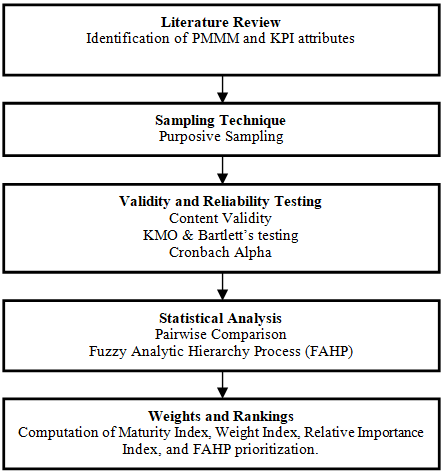
The overall research process is summarized in Figure 1, which presents a flow chart of the study. This schematic diagram illustrates the sequential progression of the research, from instrument development and data collection to data analysis and interpretation, thereby enhancing the clarity and transparency of the methodological framework.

To ensure the robustness and credibility of the findings, several analytical and statistical techniques were employed. Data validity and suitability for analysis were assessed using the Kaiser-Meyer-Olkin (KMO) Measure and Bartlett’s Test of Sphericity, while internal consistency was evaluated using Cronbach’s Alpha. The PMMM was utilized to determine the maturity level of construction quality management practices, while the Relative Importance Index (RII) was applied to analyze stakeholders’ perceptions of benchmarking implementation. Furthermore, the Fuzzy Analytic Hierarchy Process (FAHP) was used to prioritize and rank the identified barriers based on expert judgment, incorporating uncertainty and subjectivity in decision-making.
The integration of these methods ensured a comprehensive evaluation of both quantitative performance measures and qualitative expert insights. The results generated from this process served as the foundation for developing a context-specific framework aimed at enhancing benchmarking practices and strengthening construction quality management in public infrastructure projects.
3.1. Research ProcedureThe research procedure commenced with the development of a structured survey questionnaire derived from the Project Management Maturity Model (PMMM) framework and the selected Key Performance Indicators (KPIs). An initial validation was conducted to assess the clarity, relevance, and reliability of the instrument, followed by necessary revisions to refine its content and structure. The finalized questionnaire was subsequently subjected to expert validation by field specialists and reviewed by the thesis panel to ensure content adequacy, contextual relevance, and alignment with the study objectives prior to full deployment.
Following validation, the survey instrument was administered using purposive sampling to qualified construction professionals in Cagayan de Oro City. Data collection was conducted within the designated period through a combination of hard copy questionnaires and Google Forms. The use of hard copies facilitated direct engagement with respondents from institutions that preferred manual distribution, while Google Forms improved accessibility, streamlined response tracking, and increased participation rates. This mixed-mode approach ensured wider coverage of respondents and enhanced the efficiency and reliability of the data collection process. Upon retrieval, responses were carefully screened to ensure completeness and consistency, and the dataset was systematically cleaned to eliminate errors and invalid entries prior to analysis.
The validated dataset was then analyzed using appropriate statistical and analytical techniques, including descriptive statistics, validity and reliability testing, and multi-criteria decision-making methods. Each stage of the research procedure was systematically documented to ensure transparency, replicability, and adherence to established academic research standards.
Purposive sampling was employed in this study to ensure that respondents possess the necessary knowledge and experience relevant to the research objectives. This sampling method is appropriate for construction management studies where the focus was on obtaining informed professional judgment rather than achieving statistical generalization. According to Reference 83, purposive sampling enhances the rigor of research by selecting participants who were most capable of providing credible and meaningful data.
In this study, respondents were intentionally selected based on their direct involvement in government construction projects and their familiarity with project management and quality practices. Eligible participants included engineers, project managers, consultants, contractors, and other professionals engaged in planning, implementation, supervision, and evaluation of construction projects. To ensure the reliability of responses, only individuals with a minimum of five (5) years of professional experience in construction project implementation or quality management were included.
The use of purposive sampling was consistent with recent construction management studies that rely on expert-based selection of respondents. Studies such as Reference 84, and Reference 85 adopted similar approaches to ensure that participants possess the required technical competence and practical experience. This method was particularly suitable for this research, as it involved assessing project management maturity, evaluating stakeholder perceptions, and identifying barriers to benchmarking, all of which require informed and experience-based insights.
The sample size for this study was determined based on the objectives of the research, the analytical methods employed, and the availability of qualified respondents. A total of sixty-eight (68) responses were initially collected through purposive sampling. These responses were carefully screened based on completeness, consistency, and compliance with the established inclusion criteria. After data cleaning, sixty (60) valid responses were retained for the final analysis.
The screening process ensured that only respondents who met the required qualifications were included. Specifically, participants were required to have at least five (5) years of professional experience in construction project implementation or quality management and must be directly involved in government construction projects. Responses with missing data, inconsistent answers, or incomplete sections were excluded to maintain the integrity and reliability of the dataset.
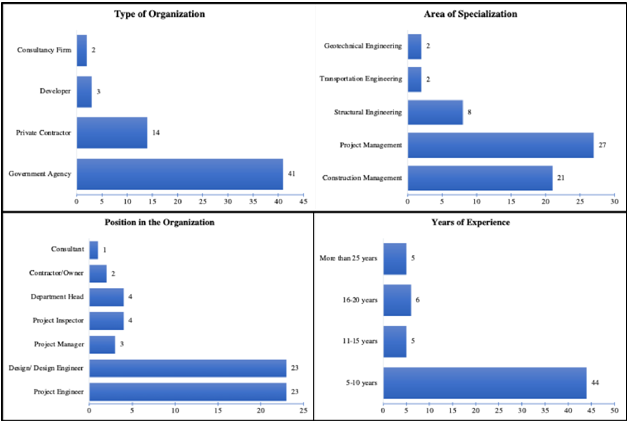
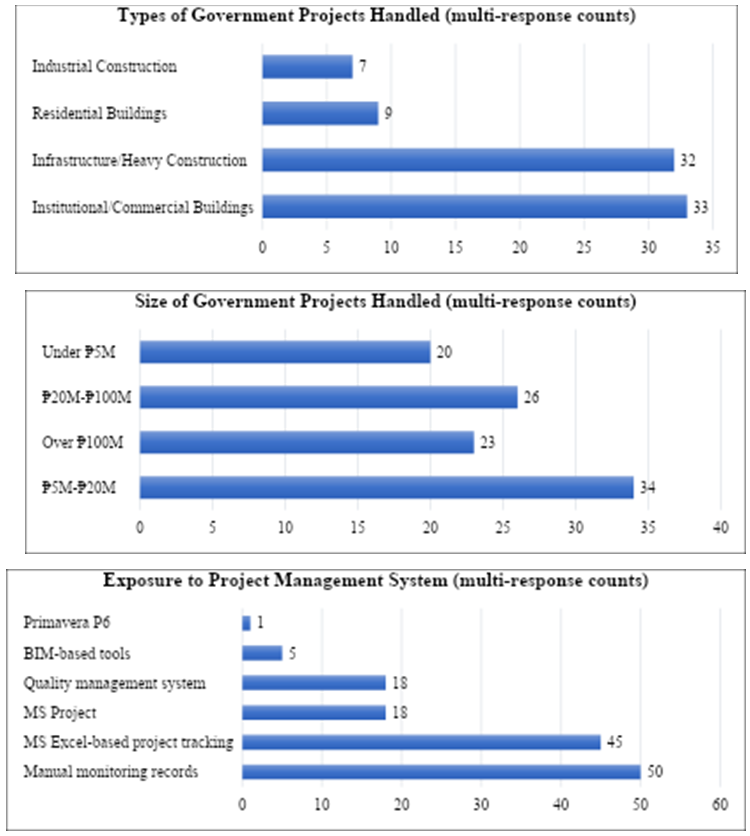
The final sample reflects a diverse group of professionals based on the demographic structure embedded in the survey instrument, including type of organization, area of specialization, position in the organization, and years of experience. This ensured that the dataset captured perspectives from different sectors of the construction industry, including government, private practice, and consultancy.
The experts involved in the content validity testing represented both the construction industry and academe, with balanced representation in terms of sex, educational attainment, and professional experience. This ensured that the instrument was reviewed from both academic and practical industry perspectives. Likewise, the respondents involved in the reliability testing phase were primarily from government agencies and had specialization in project management and construction management. Most held positions as project engineers and design engineers, with the majority having 5–10 years of professional experience, ensuring practical exposure to construction project implementation. To maintain the independence and validity of the final dataset, respondents involved in the pilot testing phase were excluded from the main survey.
For the main survey, most respondents came from government agencies, followed by private contractors. The majority specialized in project management and construction management, with notable representation from structural and transportation engineering. In terms of position, respondents were primarily project engineers and design engineers. Most had 5–10 years of experience, indicating a moderately experienced respondent group. In addition, the subset of sixteen (16) experts who participated in the Fuzzy Analytic Hierarchy Process (FAHP) pairwise comparison consisted of professionals from government agencies, private contractors, developers, and consultancy firms. Their positions ranged from project engineers to department heads and contractors, ensuring exposure to strategic decision-making. A significant portion of these experts also possessed more than 25 years of professional experience, providing a balanced mix of emerging and highly experienced practitioners.
The respondents were utilized across different phases of the research process. Six (6) experts were involved in the content validity testing of the questionnaire. The use of a small panel of subject-matter experts is consistent with recent methodological literature, which indicates that content validity assessment is typically conducted using approximately three (3) to ten (10) experts to evaluate clarity, relevance, and representativeness of measurement items 86. This range is considered sufficient to establish content validity when experts possess adequate domain knowledge and experience in the field.
Thirty (30) respondents were used for pilot testing to evaluate the reliability and internal consistency of the instrument. Recent methodological studies support that pilot testing for survey instruments commonly involves 20 to 30 respondents, which is adequate for assessing preliminary reliability measures such as Cronbach’s alpha and identifying problematic items prior to full-scale administration 87. This sample size is widely accepted in recent research as sufficient for evaluating internal consistency in early-stage instrument testing.
The use of sixty (60) respondents for the main analysis exceeds the commonly recommended range of 30 to 50 participants for purposive sampling in construction management research 21. This larger sample size improves the stability of computed indices, reduces the influence of outliers, and enhances the overall reliability of the findings, particularly for PMMM and RII, which rely on mean-based calculations.
For FAHP, the adequacy of the sample size was determined primarily by the expertise of the respondents rather than the total number of participants. Multi-Criteria Decision-Making (MCDM) methods were designed to capture informed judgments from qualified experts, and previous studies have demonstrated that reliable and stable results can be obtained even with relatively small expert groups, provided that the respondents possess sufficient domain knowledge. This was consistent with the principles of fuzzy decision-making, where the quality of judgments was prioritized over sample size 77. Empirical applications of FAHP and similar MCDM techniques also confirmed that expert panels ranging from approximately 10 to 20 respondents were commonly used and considered adequate for reliable pairwise comparison analysis 88. The use of sixteen (16) experts in this study was therefore considered sufficient to produce consistent and reliable pairwise comparisons, while also benefiting from a broader range of professional perspectives across relevant fields.
Overall, the final sample size was considered appropriate for the study. It supports reliable maturity assessment, accurate ranking of stakeholder perceptions, and robust prioritization of barriers. More importantly, the use of screened and qualified respondents ensures that the findings were grounded in professional expertise, thereby enhancing the validity and practical relevance of the research.
3.2. Research InstrumentsThe study used a structured survey questionnaire to assess project management maturity, organizational readiness for benchmarking, and identify and rank barriers to benchmarking implementation within the government construction sector in Cagayan de Oro City. The questionnaire consisted of four parts: (a) experts profile and criteria, (b) assessment of maturity of construction quality management practices, (c) stakeholders' perception on implementation of benchmarking, and (d) barriers to benchmarking adoption. The items were measured using three (3) different measurements for each section. The assessment of maturity was measured using the five stages of maturity level 21 for project management maturity model shown in Table 5. Each item on stakeholders' perception was measured using a 5-point Likert scale, ranging from strongly disagree (1) to strongly agree (5). This configuration includes two negative options, a neutral midpoint, and two positive options, providing a symmetrical range around the neutral point. Deciding the number of response options involves balancing the need for detailed data with the risk of respondent fatigue 66, whereas the barriers were rated using pairwise comparison of Saaty (2008).
The maturity assessment items were gathered from the study of Reference 23 which were developed to measure the organizations' Project management maturity against a number of key indicators. Indicators were arranged in a matrix structure, with maturity descriptors presented across increasing levels of practice development. Respondents rated each indicator using a five-point maturity scale ranging from ad hoc to optimized practice. Variables and indicators were derived from the review of related literature and examined by external construction experts to support content relevance.
For each indicator, a corresponding item was provided with five response options aligned with the maturity levels. Reponses were aggregated to determine maturity levels across knowledge areas. To evaluate stakeholder perception of benchmarking, a KPI-based set of items were included to collect performance dimensions relevant to construction quality culture and benchmarking readiness. The major constraints that hinder benchmarking adoption in government construction projects were organized across five broad areas: quality, human capital, technical, stakeholder satisfaction, and economic-political.
Content validation was conducted to ensure that the survey instrument adequately represents the constructs being measured in the study. A panel of six (6) field experts was engaged to evaluate the questionnaire in terms of clarity, relevance, and appropriateness of the items. The number of experts is considered sufficient, as studies recommend a minimum of five and not more than ten experts for content validation in survey research 89, 90. The experts were selected based on their professional experience in construction project management and their familiarity with benchmarking and quality management practices. Their feedback was used to refine the wording, structure, and content of the questionnaire prior to pilot testing. This process ensures that the instrument possesses adequate content validity and aligns with the objectives of the study.
The evaluation results were quantified using item-level content validity indices, where each item was assessed across the three criteria. Based on these ratings, items were classified according to their level of acceptability, either as “retain” or “retain with minor revision.” The feedback provided by the experts was systematically reviewed and incorporated to refine the wording, structure, and alignment of the questionnaire with the study objectives. This process ensured that the instrument achieved sufficient representativeness of the constructs being measured and minimized ambiguity prior to pilot testing. The detailed results of the content validation, including the experts’ ratings and corresponding revisions made to the questionnaire, are presented in the Appendices for reference. This documentation provides transparency in the validation process and supports the credibility of the research instrument.
The summary of the scale-level content validation, as presented in Table 19, indicates that all sections of the instrument achieved acceptable levels of validity. The PMMM, stakeholders’ perception, and barriers sections demonstrated very high validity scores, while the demographic section, although acceptable, required minor revisions. These results confirmed that the instrument was suitable for data collection and adequately represented the constructs of the study.
Overall, the content validation process ensured that the questionnaire was both comprehensive and contextually relevant to the construction industry in Cagayan de Oro City. The incorporation of expert feedback improved the clarity, structure, and alignment of the instrument with the research objectives. Content validation is a critical step in instrument development because it verifies whether the survey items adequately represent the intended constructs and are understandable to the target respondents. Moreover, establishing strong content validity prior to data collection enhances the accuracy of measurement, minimizes ambiguity, and increases the overall credibility and defensibility of the research findings. This established a strong foundation for the reliability and validity of subsequent data collection and analysis, thereby enhancing the credibility of the study findings.
Reliability Testing (Pilot Survey)
Following content validation, a pilot test involving thirty (30) respondents was conducted to assess the reliability of the survey instrument. These respondents were selected based on the same criteria as the main study participants but were not included in the final dataset. The reliability of the instrument was evaluated using Cronbach’s Alpha through IBM SPSS Statistics. This method measured the internal consistency of the items within each construct, ensuring that they reliably measure the same concept.
The results in Table 20 indicated that all constructs exhibit acceptable to excellent levels of internal consistency. According to Reference 38, Cronbach’s Alpha values above 0.70 indicated acceptable reliability, while values above 0.90 are considered excellent. The PMMM and stakeholders’ perception constructs demonstrated very high reliability, suggesting strong consistency among the items. The barriers construct, although slightly lower, remained within the acceptable range, which was typical for multidimensional variables.
Reliability testing is essential in quantitative research because it determines the extent to which an instrument consistently measures the intended constructs across different respondents and conditions. High Cronbach’s Alpha values indicate that the items within each construct are closely related and collectively provide stable and dependable measurements for statistical analysis. These findings confirmed that the questionnaire was reliable and suitable for use in the main survey.
Construct Validity (Pilot Survey)
After the administration of the revised and validated questionnaire, construct validity of the dataset was assessed using the Kaiser-Meyer-Olkin (KMO) Measure of Sampling Adequacy and Bartlett’s Test of Sphericity. Unlike content validity and pilot reliability testing, these tests were performed using the main survey dataset (n = 60) to evaluate whether the collected data was appropriate for statistical analysis.
The KMO test measured the adequacy of the sample and the degree of shared variance among variables. Values greater than 0.70 indicated acceptable sampling adequacy, while values above 0.80 were considered very good (Hair et al., 2019). Bartlett’s Test of Sphericity, on the other hand, determined whether the correlation matrix significantly differs from an identity matrix. A statistically significant result (p < 0.05) indicated that the variables were sufficiently correlated for multivariate analysis 91.
The results presented in Table 21 showed that all variables meet the required thresholds for sampling adequacy and exhibit statistically significant relationships. These findings confirmed that the dataset was suitable for further statistical analysis. According to Reference 92, acceptable KMO values and significant Bartlett’s Test results indicated that the data possess sufficient shared variance and are appropriate for techniques such as factor-based analysis, index computation, and multi-criteria decision-making. In the context of this study, the results validated the suitability of the dataset for the application of the Project Management Maturity Model (PMMM), Relative Importance Index (RII), and Fuzzy Analytic Hierarchy Process (FAHP). Construct validity assessment is important because it verifies whether the collected data adequately represent the theoretical constructs being measured and whether meaningful relationships exist among the variables. Furthermore, strong KMO values and significant Bartlett’s Test results enhance the credibility of subsequent statistical procedures by confirming that the dataset possesses sufficient intercorrelation structure for reliable quantitative analysis.
The collected data were systematically processed, organized, and analyzed using appropriate statistical and multi-criteria decision-making techniques to address the objectives of the study. The analysis followed a structured sequence, beginning with data preparation and screening, followed by computation of maturity levels, evaluation of stakeholder perception, and prioritization of barriers using FAHP. Prior to analysis, all responses from the main survey were encoded and consolidated in Microsoft Excel. Data cleaning was conducted to ensure completeness, consistency, and accuracy of responses. Only the validated dataset (n = 60) was used for subsequent computations.
The Project Management Maturity Model (PMMM) was utilized as the primary analytical framework for assessing the maturity of project management practices in relation to quality management and benchmarking implementation among government construction projects in Cagayan de Oro City. The model provided a structured approach for evaluating the extent to which project management processes were defined, implemented, monitored, and continuously improved within an organization. It was anchored on the nine (9) knowledge areas of the Project Management Body of Knowledge (PMBOK), thereby ensuring that the assessment covers all essential domains of project management.
To operationalize the PMMM framework, this study adopted the nine (9) knowledge areas of the Project Management Body of Knowledge (PMBOK), namely: project integration, scope, time, cost, quality, human resource, communication, risk, and procurement management. These domains, presented in Chapter 2, serve as the core dimensions for evaluating project management practices across government construction projects. The use of these knowledge areas ensured that the assessment was comprehensive and aligned with established project management standards.
The measurement indicators used in this study were adapted from the PMMM-based framework developed by Reference 23, as detailed in Table 3. Each indicator represented a specific and observable project management practice within a knowledge area, allowing respondents to evaluate the extent to which these practices were implemented in their respective organizations. The use of these validated indicators ensured that the measurement of maturity was grounded in established theoretical and practical constructs.
Responses were collected using the standardized five-level PMMM scale presented in Table 5. The scale consisted of Level 1 (Initial Process), Level 2 (Structured Process and Standards), Level 3 (Organizational Standards and Institutionalized Process), Level 4 (Managed Process), and Level 5 (Optimizing Process). These levels reflected a progressive degree of process maturity, where higher levels indicated stronger institutionalization, integration, and continuous improvement of project management practices. For purposes of quantitative analysis, responses were assigned numerical values ranging from 1 to 5 corresponding to the maturity levels.
The collected data were tabulated according to the frequency of responses for each maturity level per indicator, as presented in Table 22. The maturity level of each knowledge area was then determined using the Maturity Index (Mi), following the formulation presented in Chapter 2 (Equation 1). The Mi represented the weighted average score of responses, reflecting the overall maturity level based on stakeholder assessments.
Subsequently, the Weight Index (Wi) was computed using Equation 2 in Chapter 2 to determine the relative contribution of each knowledge area to the overall project management maturity. The normalization process ensured that the sum of all weights was equal to one, allowing for meaningful comparison and ranking across knowledge areas. The resulting Wi values were used to establish the relative importance and ranking of each domain in contributing to overall maturity. In addition to the numerical indices, the computed Mi values were interpreted using the maturity classification presented in Table 4, where maturity levels were grouped into three categories: Poor (Levels 1–2), Moderate (Level 3), and Mature (Levels 4–5). This classification provided a simplified and standardized basis for interpreting maturity levels and ensured consistency in the presentation of results across the study.
To measure these perceptions, a five-point Likert scale was employed, consistent with the scale presented in Table 11. The response categories include: 5 (Strongly Agree), 4 (Agree), 3 (Neutral), 2 (Disagree), and 1 (Strongly Disagree). This scale structure provided a balanced range of responses, allowing participants to express varying levels of agreement or disagreement, including neutrality. The use of a five-point scale ensured reliability and ease of response, while also maintaining sufficient sensitivity to capture variations in stakeholder perception.
A balanced scale ensured that respondents have an equal opportunity to express positive and negative sentiments, as well as neutrality, if applicable. This balance minimizes response bias and enhances the reliability of the data collected 66. Each response was collected as a category of choice, making the results suitable for frequency counting and comparison. Because categories were ordered, higher ratings indicated stronger agreement, but the data were interpreted primarily through distributions than assuming equal values.
The participants utilized a Likert rating scale to allocate scores for each indicators. This approach facilitated a quantitative assessment, offering insights that contributed context to the numerical ratings and pinpoint specific areas for enhancement. Results from respondents were compiled in Table 23, with each KPI summarized by the number of responses in each rating category. The resulting data proceeded to be analyzed using descriptive statistics to quantitatively comprehend its characteristics and quality. This method offer a means to efficiently summarize and interpret data. This involved calculating the arithmetic average of the ratings provided by the participants, presenting an overall measure of the extent of stakeholder perception through the ranking of the relative importance index (RII).
To quantify the extent of stakeholders’ perception, the Relative Importance Index (RII) was computed for each indicator using the formula presented in Equation 6. The RII method transforms ordinal Likert-scale responses into a normalized index ranging from 0 to 1, allowing for the comparison and ranking of indicators based on their relative importance. This approach was widely applied in construction research to prioritize factors influencing project performance and management practices.
In addition to the RII computation, mean scores were calculated for each indicator to provide an overall measure of the level of agreement among respondents. The interpretation of both mean values and RII results followed the classification scales presented in Chapter 2, specifically Table 12 for Likert scale interpretation and Table 13 for RII value interpretation. These standardized scales ensured consistency in the analysis and facilitated the translation of numerical results into meaningful qualitative descriptions.
The pairwise comparison method was utilized as a structured scale to capture expert judgments regarding the relative importance of the identified barriers. Respondents compared criteria in pairs using the Saaty scale, which consisted of values 1, 3, 5, 7, and 9 representing increasing levels of importance. These comparisons were performed within each hierarchical level, ensuring that only comparable criteria were evaluated against each other. Individual comparison matrices were constructed for each respondent and subsequently aggregated using the geometric mean method.
The use of pairwise comparison enabled the experts to systematically evaluate the relative influence of each barrier dimension and critical success factor based on professional experience and decision-making judgment. This approach was appropriate for FAHP because it simplified complex decision problems into manageable comparisons while allowing the incorporation of subjective expert evaluations. The aggregation of responses through the geometric mean method minimized the influence of extreme judgments and generated a collective representation of expert opinion suitable for fuzzy analysis.
Prior to the final FAHP computation, the consistency of the pairwise comparison judgments was evaluated to ensure the reliability and logical coherence of the expert responses. Consistency assessment was important because inconsistent judgments may affect the validity of the derived weights and rankings. The structured comparison process therefore enhanced the reliability, transparency, and analytical rigor of the multi-criteria decision-making procedure applied in the study.
The FAHP was applied to process the aggregated pairwise comparison matrices and compute the relative importance of barriers. Unlike conventional AHP, FAHP incorporated fuzzy set theory to address uncertainty and imprecision in expert judgment. This method allowed linguistic preferences to be represented using Triangular Fuzzy Numbers (TFNs), instead of single values. The use of TFNs enabled the representation of judgments as ranges defined by lower, middle, and upper bounds. This transformation enhanced the ability of the model to capture uncertainty inherent in decision-making. The FAHP therefore provided a more realistic and flexible framework for evaluating complex construction-related criteria.
The FAHP computation followed a structured sequence, where each stage corresponded to specific tables presented in this section. The process began with the transformation of aggregated pairwise comparison matrices into fuzzy matrices. Each subsequent step built upon the results of the previous stage to ensure logical progression of the analysis. The tables presented in this section represented intermediate and final outputs of the FAHP computation. Each table served a specific purpose in converting raw judgments into priority weights. This structured approach ensured traceability and clarity in the analytical process.
Fuzzy Transformation of Aggregated Pairwise Matrices
The first step involved transforming the aggregated crisp pairwise comparison matrices into fuzzy matrices using Triangular Fuzzy Numbers. Each value from the Saaty scale was converted into a corresponding fuzzy number defined by lower, middle, and upper bounds. The resulting matrices were presented in Tables 24, 25, 26, 27, 28, and 29. These matrices represented the fuzzy comparison values for both main dimensions and sub-criteria. Each cell in the matrix reflected a range of possible values rather than a single point estimate. This transformation allowed uncertainty in expert judgment to be incorporated into the analysis. The use of fuzzy representation enhanced the robustness of the decision-making model.
Conversion to Aggregated Crisp Comparison Matrix
The fuzzy matrices were subsequently converted into aggregated crisp comparison matrices to facilitate further computation. These matrices were presented in Tables 30, 31, 32, 33, 34, and 35. Each value in these tables represented a single numerical estimate derived from fuzzy values. The crisp matrices served as the basis for normalization and priority vector computation. This conversion ensured that the data can be processed using mathematical operations. It also simplified the interpretation of comparison values. This step bridges the transition from fuzzy representation to quantitative analysis. The defuzzification method applied in this study used the geometric mean approach, which calculated a single representative value for each triangular fuzzy number. The defuzzification formula was presented in Equation 8, allowing the fuzzy weights to be converted into crisp priority scores suitable for normalization and ranking.
Normalization and Priority Vector Computation
To facilitate ranking and further analysis, this process involved aggregating the fuzzy comparison values across each row of the matrix and normalizing them to obtain fuzzy weights. The mathematical formulation used to compute the normalized relative weights was defined in Equation 9, which involved normalizing the crisp matrices and computing the priority vector for each criterion. Each element in a column was divided by the column total to obtain normalized values. The average of each row was then calculated to derive the priority vector. These computations were presented in Tables 36, 37, 38, 39, 40 and 41. Additional calculations included the weighted sum vector and eigenvalue approximation. These values were used to assess the relative importance of each criterion. This step established the initial weights for all criteria in the hierarchy.
Consistency Validation
Consistency validation was conducted to ensure the reliability of the pairwise comparison judgments. The Consistency Ratio was computed prior to the FAHP analysis using the method discussed in Chapter 2. Only matrices that satisfied the acceptable threshold were used in the analysis. The fuzzy matrices were derived from these validated crisp matrices. As a result, the consistency of judgments were preserved throughout the FAHP process. This ensured that the computed weights were logically coherent. The validation step strengthened the credibility of the results.
Fuzzy Weight Computation and Defuzzification
The fuzzy geometric mean method was applied to compute fuzzy weights for each criterion. These weights were then converted into crisp values using the Center of Area (CoA) defuzzification method. The results were presented in Tables 42, 43, 44, 45, 46, and 47. Each table included fuzzy geometric mean values, fuzzy weights, defuzzified values, and normalized weights. The defuzzified values represented the final numerical weights for each criterion. These weights were normalized to ensure that their sum equals one. This step produced the final priority values used for ranking.
The fuzzy geometric mean method was selected because it effectively aggregates expert judgments while accounting for uncertainty and vagueness inherent in human decision-making. Through the use of triangular fuzzy numbers, the method captured the lower, middle, and upper bounds of expert preference, thereby providing a more flexible and realistic representation of subjective evaluations compared to conventional AHP approaches. The computation of fuzzy weights allowed the study to quantify the relative importance of each barrier dimension and critical success factor in a systematic and mathematically consistent manner.
The Center of Area (CoA) defuzzification technique was subsequently employed to transform the fuzzy values into single crisp values suitable for ranking and interpretation. Defuzzification was necessary because fuzzy values cannot be directly compared for prioritization purposes. The resulting normalized weights represented the proportional contribution of each criterion relative to the overall decision structure. Higher normalized weights indicated greater influence and priority of the corresponding barrier in affecting benchmarking implementation within construction project quality management.
Final Normalization and Ranking Basis
The final normalized weights obtained from the FAHP process were used as the basis for computing the global priority of each barrier. In this stage, the category weight (CW) represented the normalized weight of the main dimension, while the local weight (LW) represented the normalized weight of each critical success factor within its respective category. The global weight (GW) was computed by multiplying the category weight by the local weight, expressed as GW = CW × LW, consistent with hierarchical weighting procedures in multi-criteria decision-making 77, 80. This procedure allows the assessment of the stability of the ranking by observing how changes in input weights influence the computed global weights. The resulting global weights served as the basis for the final ranking of barriers and were used in the subsequent chapter for analysis and discussion.
The FAHP analysis concluded by validating the coherence of the fuzzy judgments through consistency verification inherited from the initial pairwise comparison stage. Since the fuzzy matrices were derived from consistency-validated crisp matrices, the resulting fuzzy priorities maintain logical reliability while offering improved representation of stakeholder uncertainty. Overall, the application of FAHP enhanced the strength of the multi-criteria decision-making process by integrating human judgment uncertainty into the prioritization of benchmarking barriers.
The survey questionnaire allowed both quantitative analysis and strategic interpretation, ultimately serving as a diagnostic and developmental tool for enhancing construction quality within the public sector. The questionnaire employed two measurement approaches based on the objectives of the study. Objective 1, which assessed the maturity of project management practices across the nine PMBOK® knowledge areas, used the five level Project Management Maturity Model adapted from Reference 18. The Likert scale specifically addressed Objectives 2, 3, and 4.
Objective 2 aimed to measure the perceived value of benchmarking, exploring whether respondents believed it contributed to improved efficiency, cost effectiveness, adherence to quality standards, and enhanced stakeholder satisfaction in project delivery. Objective 3 and 4 focused on the actual implementation of benchmarking practices, evaluating whether local councils systematically collect and compare data, apply insights gained from benchmarking, and engage in ongoing improvement efforts.
By using a five point Likert scale to gather responses across these objectives, the study captured a broad range of subjective perspectives, allowing for comparative analysis of attitudes and the extent to which benchmarking practices were embedded across different organizations. The combination of the Likert scale to assess individual perceptions and the Project Management Maturity Model (PMMM) to evaluate process maturity provided a well-rounded view of project management capabilities and challenges within the local government sector, supporting the development of targeted strategies for improvement.
To ensure analytical rigor and representativeness, data analysis was conducted using a stratified approach. The stratification allowed maturity levels to be analyzed within the organizational context of each agency, recognizing differences in mandate, project scale, governance structure, and operational capacity.
This chapter presented and examined the findings of the study based on responses from government stakeholders involved in construction projects in Cagayan de Oro City. The results were organized according to the research objectives and provided an overview of the current state of benchmarking in construction quality management within the local government sector. In doing so, it described the existing operational conditions and key constraints that influence current practices. The chapter began with the presentation of reliability and validity analyses to establish the adequacy and consistency of the survey instrument, as the subsequent analyses relied on stakeholder responses used to assess maturity levels, perception ratings, and priority judgments.
The succeeding sections presented the results of the Project Management Maturity Model (PMMM) assessment and the Likert-based stakeholders’ perception analysis, addressing the first and second research objectives. These findings were discussed at the overall level to present general trends and patterns in the data. The chapter concluded with the results of the Fuzzy Analytic Hierarchy Process (FAHP), which were used to identify and prioritize the key barriers to benchmarking implementation. These results served as the basis for the conclusions and recommendations presented in Chapter 5.
4.1. Demographic Profile of ExpertsFigure 2 presented the demographic profile of the experts in terms of organization type, area of specialization, position, and years of experience. These demographic criteria were important because the study relied on expert-based assessment to measure project management maturity, evaluate stakeholder perceptions of benchmarking, and identify key barriers to implementation. Therefore, the credibility of the results depended not only on the number of respondents but also on whether they possessed relevant professional exposure to construction project planning, implementation, quality management, and performance monitoring.
In terms of organization type, most respondents came from government agencies, comprising 41 out of 60 experts or 68.33%, followed by private contractors with 14 respondents. This distribution was relevant to the study because benchmarking was assessed within the context of government construction projects in Cagayan de Oro City. Since government agencies are directly responsible for project planning, procurement, monitoring, compliance, and quality assurance in public infrastructure delivery, their strong representation ensured that the findings reflected the actual institutional environment where benchmarking practices would most likely be implemented. The participation of private contractors also strengthened the results because contractors are directly involved in project execution and can provide practical insights into how government requirements, project controls, and quality standards are applied on site.
The respondents’ area of specialization further supported the reliability of the data. Most respondents were from project management and construction management, which are directly related to the study’s core variables. Project management specialists are familiar with planning, scheduling, budgeting, monitoring, and performance evaluation, while construction management practitioners are directly exposed to implementation issues, resource coordination, quality control, and field-level decision-making. Their participation was therefore important in assessing project management maturity using the PMMM framework because they could evaluate whether formal project management practices were actually applied in real construction settings. This also made their responses relevant to benchmarking because benchmarking requires knowledge of project performance, process comparison, and improvement practices.
The distribution of respondents by position also contributed to the validity of the findings. Project engineers and design engineers dominated the sample, with 23 respondents each. This was significant because these roles are directly involved in both technical and operational aspects of construction projects. Project engineers are commonly engaged in site implementation, progress monitoring, quality inspection, coordination, and reporting, while design engineers contribute to planning, technical documentation, design evaluation, and compliance with project requirements. Their combined perspectives allowed the study to capture both design-phase and construction-phase concerns, which is important because benchmarking in construction quality management should not be limited to one stage of the project cycle. Instead, it should consider how performance standards, quality expectations, cost control, and project outcomes are connected from planning to implementation.
Years of experience also played an important role in establishing the credibility of expert judgment. The majority of respondents belonged to the 5–10 years’ experience category, with 44 respondents. This level of experience suggested that the respondents had sufficient professional exposure to understand recurring issues in government construction projects while still being actively involved in current project management practices. Their responses were therefore useful in evaluating both established practices and present implementation gaps. This was especially important for the FAHP component of the study, where expert judgment was used to prioritize barriers. Respondents with practical experience were more capable of comparing barriers based on actual field exposure rather than purely theoretical understanding.

Figure 3 presented the types and sizes of government projects handled by the respondents, as well as their exposure to project management systems. These criteria were important because they described the operational environment in which project management maturity and benchmarking readiness were assessed. The results showed that respondents were mostly involved in institutional/commercial buildings and infrastructure/heavy construction projects, with 33 and 32 responses, respectively. This indicated that the respondents had experience in project types that usually require structured planning, coordination, technical documentation, quality control, and compliance monitoring. These types of projects are relevant to benchmarking because they involve measurable performance indicators such as cost efficiency, timeliness, quality compliance, productivity, risk management, and stakeholder coordination.
The project type distribution also implied that the respondents were not limited to simple or routine construction works. Institutional/commercial buildings and infrastructure/heavy construction projects often involve multiple stakeholders, higher technical requirements, and stricter government procedures. Because of this, respondents were likely exposed to project conditions where benchmarking could provide practical value. Benchmarking may help compare project delivery performance, identify recurring causes of delay, improve quality monitoring, and establish reference standards for future projects. Thus, the respondents’ project exposure strengthened the relevance of their assessments of maturity, perceived benchmarking benefits, and implementation barriers.
In terms of project size, the majority of respondents handled projects within the ₱5M–₱20M range, followed by projects worth ₱20M–₱100M and over ₱100M. This distribution was significant because project size affects the complexity of management practices. Projects with larger budgets usually require more formal documentation, stricter monitoring, stronger cost control, and greater accountability. The presence of respondents involved in medium to large-scale projects therefore supported the study’s objective of assessing maturity and benchmarking readiness in government construction projects. It also showed that the respondents had exposure to projects where performance measurement and comparison are necessary because financial, technical, and administrative risks become more significant as project scale increases.
The project size criterion also helped explain the importance of benchmarking in the local construction context. Since many respondents handled projects with substantial budgets, benchmarking can serve as a tool for improving accountability and decision-making. By comparing project performance across similar project types and sizes, agencies and project teams may identify which practices lead to better cost control, timely completion, quality compliance, and stakeholder satisfaction. Therefore, the project size profile contributes to the study by showing that benchmarking is not merely theoretical but applicable to the actual scale and complexity of projects handled by the respondents.

The project size criterion also helped explain the importance of benchmarking in the local construction context. Since many respondents handled projects with substantial budgets, benchmarking can serve as a tool for improving accountability and decision-making. By comparing project performance across similar project types and sizes, agencies and project teams may identify which practices lead to better cost control, timely completion, quality compliance, and stakeholder satisfaction. Therefore, the project size profile contributes to the study by showing that benchmarking is not merely theoretical but applicable to the actual scale and complexity of projects handled by the respondents.
However, the results on exposure to project management systems revealed an important gap. Most respondents relied on manual monitoring records and MS Excel-based project tracking, with 50 and 45 responses, respectively. In contrast, advanced tools such as BIM-based systems and Primavera P6 were minimally used. This finding is relevant because benchmarking depends heavily on reliable, consistent, and accessible project data. Manual records and spreadsheet-based tracking may be useful for basic monitoring, but they can also limit data integration, real-time analysis, standardization, and comparison across projects. This suggests that while respondents were involved in complex and financially significant projects, the technological systems used for project monitoring remained relatively basic.
This finding also connects directly with the later results of the study. The PMMM results showed high maturity overall, particularly in cost and quality-related areas, which suggests that basic project management processes are already practiced. However, the reliance on manual and Excel-based systems may explain why some knowledge areas, such as communication management, risk management, and procurement management, were relatively lower compared with cost and quality management. These areas often require integrated information flow, systematic tracking, and coordinated decision-making. Without stronger digital systems, project data may remain fragmented, making it difficult to use benchmarking as a continuous improvement tool.
Overall, the demographic and project characteristic results contributed to the study by confirming that the respondents were professionally qualified, technically involved, and exposed to relevant government construction projects. Their backgrounds strengthened the validity of the PMMM, RII, and FAHP results because their judgments were grounded in actual project experience. At the same time, the results revealed an important contradiction: respondents were involved in complex and high-value projects, but many still relied on basic monitoring tools. This indicates that the local construction sector may already have sufficient professional and project exposure to support benchmarking, but it still requires stronger data systems, standardized quality practices, and technical capacity to fully institutionalize benchmarking as a project quality management tool.
4.2. Project Management Maturity (PMMM) LevelFigure 4 presents the maturity index of the nine project management knowledge areas used in assessing the level of project management maturity among construction-related organizations in Cagayan de Oro City. The results showed that all knowledge areas obtained maturity index values within the High Maturity level, with scores ranging from 3.661 to 3.975. This indicates that project management practices were generally established, structured, and implemented across the respondent organizations. The overall pattern suggests that the organizations involved in the study were not operating at an informal or purely reactive level; rather, they had existing systems, procedures, and practices that guided project planning, execution, monitoring, and control.

The result contributes to the study by establishing the current maturity baseline of construction project quality management in Cagayan de Oro City. Since the study aims to examine the readiness and barriers to implementing benchmarking, the maturity profile provides an essential starting point. Benchmarking requires reliable project data, consistent processes, measurable performance indicators, and organizational discipline. Therefore, the finding that all knowledge areas reached a high maturity level suggests that the respondent organizations already possess a reasonable foundation for benchmarking implementation. However, the variation among the maturity scores also implies that benchmarking may not be equally easy to apply across all areas unless weaker domains are strengthened.
Table 48 provides a more detailed classification of the maturity results by showing the percentage of responses under the Poor, Medium, and Mature categories 48. Although all variables were interpreted as highly mature based on their maturity index, the distribution of responses showed that the level of maturity was experienced differently across organizations. Cost Management had the highest proportion of mature responses at 75.00%, followed by Integration Management at 68.33%, and Quality Management and Scope Management both at 66.67%. These results indicate that cost control, project coordination, quality planning, and scope definition were among the more consistently practiced areas.
The strong result for Cost Management is particularly relevant in the context of construction projects because cost is one of the most visible and closely monitored indicators of project performance. Proper budgeting, cost estimation, fund allocation, and expenditure monitoring are usually required in both public and private construction settings. In government projects, cost-related processes are also closely linked to accountability, audit requirements, and approved budgets. Therefore, the high maturity of cost management suggests that organizations were more capable of planning and controlling financial resources. This directly contributes to the study because cost efficiency is one of the important bases for benchmarking construction project performance.
The high maturity result for Quality Management is also significant because the study focuses on construction project quality management. With 66.67% of responses falling under the mature category, the result suggests that quality plans, quality assurance activities, and corrective actions were generally practiced. This means that quality-related processes were already present in the organizations assessed. However, the presence of 30.00% Medium responses also shows that quality management practices may not yet be fully consistent across all projects or agencies. This finding is important because benchmarking cannot be effectively implemented if quality standards and quality monitoring practices differ greatly from one project to another. Thus, the result supports the need for standardized quality indicators and more consistent quality documentation.
Integration Management ranked strongly in both the classification and maturity index results. Its mature response percentage of 68.33% indicates that many organizations had the capacity to develop and implement project management plans, coordinate project components, and conduct closure processes. This is relevant because integration management connects the different parts of a project into one coordinated system. In relation to benchmarking, integration management is important because performance comparison requires complete and connected information from cost, quality, time, procurement, risk, and communication systems. A mature integration process helps ensure that benchmarking will not be treated as an isolated activity but as part of overall project governance.
Scope Management also showed a high level of maturity, with 66.67% of responses under the mature category. This suggests that organizations were generally capable of defining project requirements, developing work breakdown structures, and identifying activities and resources. This finding contributes to the study because benchmarking construction quality requires a clear understanding of project scope. Without a well-defined scope, performance indicators such as cost efficiency, timeliness, productivity, and quality compliance may be difficult to compare accurately. The result therefore indicates that the organizations had a relatively strong basis for establishing comparable project parameters.
Time Management had 65.83% mature responses, showing that schedule preparation and monitoring were generally practiced. This result is important because delays are among the most common performance concerns in construction projects. A high maturity level in time management suggests that organizations were capable of preparing schedules, defining milestones, and monitoring progress against baseline plans. However, the presence of 28.33% Medium and 5.83% Poor responses implies that scheduling practices may still vary across projects. For benchmarking, this means that while schedule control exists, there may still be a need to improve consistency in schedule monitoring, delay tracking, and documentation of time-related performance.
The lower mature percentages in Human Resource Management, Communication Management, Procurement Management, and Risk Management indicate areas that may affect the successful implementation of benchmarking. Human Resource Management had 61.67% mature responses, but it also recorded 31.67% Medium responses. This suggests that staffing systems, team development, and project management competencies were present but not equally strong among all organizations. This is relevant because benchmarking is not only a technical process; it also depends on the competence of personnel who collect data, analyze performance, interpret results, and recommend improvements.
Communication Management had one of the lowest mature classifications at 55.42%, with a high 39.17% Medium response. This finding is important because communication is central to benchmarking. Benchmarking requires the regular sharing of project data, performance reports, lessons learned, and feedback among stakeholders. If communication systems are only moderately developed, benchmarking results may become fragmented, delayed, or poorly understood. Therefore, the relatively lower maturity in communication management suggests that organizations may need to strengthen reporting systems, stakeholder coordination, and information distribution before benchmarking can be fully institutionalized.
Procurement Management recorded 60.56% mature responses but had the highest poor classification at 11.11%. This result suggests that although procurement processes were generally standardized and implemented, some organizations still experienced weaknesses in early procurement planning, contract management, or consistency of procurement procedures. This is relevant to construction quality management because procurement decisions affect material quality, contractor performance, project cost, and schedule reliability. In benchmarking, procurement maturity is important because comparable performance cannot be achieved if procurement practices vary significantly across projects.
Risk Management had the lowest maturity index ranking and only 60.00% mature responses, with 32.78% Medium and 7.22% Poor. This finding is highly relevant because risk management reflects the organization’s ability to anticipate, respond to, and control uncertainties. The lower result suggests that risk identification may be practiced, but continuous risk monitoring and mitigation may not yet be fully embedded in project implementation. For benchmarking, this is a critical concern because risk-related data helps explain why some projects perform better or worse than others. Without mature risk management, benchmarking may identify performance gaps but fail to explain the causes behind those gaps.
The distribution in the result implied that some knowledge areas were still transitioning between Medium and High maturity, indicating that practices may be present but not yet fully institutionalized across all projects. Such variation is consistent with findings in construction maturity studies, where cost-related processes tend to mature faster due to regulatory and financial accountability requirements 27, 48.
Table 49 further summarizes the maturity index, interpretation, weight index, and ranking of the nine knowledge areas. The ranking confirms that Cost Management ranked first with an Mi of 3.975 and Wi of 0.117, followed by Quality Management with an Mi of 3.872 and Wi of 0.114. This indicates that the strongest maturity areas were those directly associated with measurable outputs, compliance, budget control, and quality requirements. This result implies that construction organizations in the study were more mature in areas where performance can be easily quantified and audited. This observation supports previous studies indicating that public sector construction projects often emphasize cost, quality, and scope control due to audit and regulatory pressures, while softer domains such as communication and risk management receive comparatively less attention 18.
The ranking of Quality Management as second is an important contribution to the study because it confirms that quality-related practices were already relatively strong among the respondents. Since the study examines benchmarking in relation to construction project quality management, this result suggests that quality management can serve as one of the strongest entry points for benchmarking implementation. Organizations may begin benchmarking through quality compliance, corrective action records, quality assurance practices, and project inspection outcomes because these are already practiced at a high maturity level.
The placement of Integration Management and Scope Management in the third and fourth ranks also supports the readiness of organizations for benchmarking. These areas provide structure, direction, and coordination in project implementation. Mature integration and scope management practices help ensure that project objectives, deliverables, responsibilities, and control mechanisms are properly defined. In the context of this study, these results suggest that benchmarking can be aligned with existing project management plans, work breakdown structures, and project control systems.
On the other hand, the lower rankings of Communication Management, Procurement Management, and Risk Management reveal potential limitations. Although they were still interpreted as highly mature, their relatively lower scores indicate that these areas were less developed compared with cost, quality, and integration management. This finding contributes to the study by identifying the areas where benchmarking implementation may encounter practical barriers. Benchmarking requires communication, procurement data, risk records, and cross-functional collaboration. Therefore, weaknesses in these areas may reduce the reliability, completeness, and usefulness of benchmarking results.
Table 50 provides a more specific analysis by presenting the maturity indicators under each knowledge area. The highest-rated indicator was “Project Costs are monitored and controlled throughout execution” with an Mi of 4.000, followed by “Project Costs are properly budgeted and planned” with an Mi of 3.950. These results confirm the strong maturity of cost management. They indicate that respondents perceived cost planning and cost control as consistently practiced in their organizations. This contributes to the study by showing that financial data may be one of the most reliable sources for benchmarking because cost-related processes are already well-established.
Another highly rated indicator was “Project activities and required resources are clearly defined” with an Mi of 3.933. This result supports the maturity of scope and planning processes. It shows that organizations were generally capable of identifying project activities and resource requirements before implementation. This is important because benchmarking depends on the comparability of projects. If activities and resources are clearly defined, it becomes easier to compare productivity, cost efficiency, time performance, and quality compliance across projects.
The indicator “Corrective actions are implemented to address quality issues” obtained an Mi of 3.917, which reflects strong maturity in responding to quality problems. This is significant because corrective action is a key part of continuous improvement. For benchmarking, the ability to document and implement corrective actions is important because it allows organizations to learn from performance gaps and apply improvements in future projects. This result suggests that the organizations already had mechanisms for addressing deficiencies, which can support the development of benchmarking-based improvement strategies.
However, the lower-rated indicators also provide important insights. “Project Risks are continuously monitored and controlled” obtained the lowest Mi of 3.583, while “Project Management competencies are demonstrated in practice” obtained an Mi of 3.600. These results suggest that while risk identification and project procedures exist, continuous monitoring, competency application, and proactive decision-making may not be equally strong. This is relevant because benchmarking requires not only data collection but also professional judgment, technical competence, and the ability to interpret performance differences. If competencies and risk monitoring are weaker, organizations may struggle to convert benchmarking results into effective management actions.
Similarly, the indicators related to communication, such as “Communication plans are developed to address stakeholder needs” and “Project information is effectively distributed to stakeholders,” both obtained an Mi of 3.633. Although still classified as high maturity, these scores were among the lower indicators. This suggests that communication processes may exist but may not yet be fully optimized. In benchmarking implementation, this is a critical issue because performance data must be shared, discussed, and understood by stakeholders. Weak communication may limit the usefulness of benchmarking, especially when results need to be translated into policy, training, or project-level improvements.
The lower score for contract management, with an Mi of 3.633, also highlights an area for improvement. Contracts influence quality requirements, work standards, accountability, and project delivery obligations. If contract management is not consistently mature from execution to closure, benchmarking may be affected because contract performance data may be incomplete or inconsistently documented. This result contributes to the study by showing that procurement and contract-related records should be strengthened to support reliable benchmarking.
Overall, the results from Figure 4.3 and Tables 4.3 to 4.5 indicated that project management maturity was generally high but unevenly distributed across knowledge areas and indicators. This contrast suggested that while operational systems were well-established, integrative, anticipatory, and human-centered processes require further development. This finding is consistent with recent studies emphasizing that maturity in construction organizations is often driven by execution efficiency rather than strategic capability, limiting continuous improvement and innovation 52, 59.
The contribution of these findings to the study is significant. First, the results establish that organizations in Cagayan de Oro City have an existing maturity foundation that can support benchmarking implementation. Second, the findings identify which areas are most ready for benchmarking, particularly cost and quality management. Third, the results reveal maturity gaps that may become barriers to benchmarking, especially in communication, risk management, procurement, and human resource competencies. Therefore, the maturity assessment does not only describe the current level of project management practice; it also explains the organizational readiness and limitations that affect the implementation of benchmarking for construction project quality management. This supports the broader direction of the study, which aims to measure maturity, assess stakeholder perceptions, and rank barriers to benchmarking implementation in the local construction industry.
4.3. Stakeholders’ Perception on Benchmarking ImplementationFigure 4.4 presents the Relative Importance Index values of the perceived benefits of benchmarking implementation. The results show that all indicators obtained high RII values ranging from 0.793 to 0.883, indicating that stakeholders generally had a strong positive perception of benchmarking as a useful tool for improving construction project performance. Since all indicators fell within a high contribution range, the findings suggest that respondents recognized benchmarking not merely as a documentation activity, but as a management approach that can support monitoring, coordination, efficiency, decision-making, quality improvement, and cost-related controls.
The highest-rated indicator was “Strengthens performance monitoring, compliance, and standardized reporting systems” with an RII of 0.883. This result is highly relevant to the study because benchmarking depends on the availability of measurable, comparable, and consistently reported performance data. In construction project quality management, performance monitoring and standardized reporting are essential because they allow organizations to track whether projects meet planned cost, time, quality, and compliance requirements. The high ranking of this indicator implies that stakeholders viewed benchmarking primarily as a mechanism for improving accountability and transparency. This is especially important in government-related construction projects, where documentation, compliance, and reporting are central to project evaluation and audit requirements.
This result contributes to the study by confirming that stakeholders see benchmarking as strongly aligned with existing control-oriented practices. Since the previous maturity results showed that organizations were already relatively mature in cost, quality, and integration management, the high perception of benchmarking in performance monitoring suggests that benchmarking can be introduced through existing reporting and compliance systems. In other words, benchmarking may be more acceptable to stakeholders when it is linked to processes they already recognize, such as monitoring reports, compliance checks, quality documentation, and standardized project evaluation.

The second-ranked indicator was “Improves collaboration and coordination among project stakeholders” with an RII of 0.870. This finding is significant because construction projects involve multiple actors, including clients, designers, engineers, contractors, suppliers, inspectors, and end-users. Benchmarking can improve collaboration by providing a common basis for comparing performance and identifying areas that require improvement. When stakeholders use shared indicators and standardized data, coordination becomes more objective and less dependent on informal communication. This result is relevant to the study because the successful implementation of benchmarking requires cooperation among agencies, project teams, and other construction stakeholders.
The high ranking of collaboration and coordination also addresses one of the weaker areas observed in the maturity assessment, where communication management ranked relatively lower compared with cost and quality management. This means that although communication systems may not be the strongest maturity area, stakeholders still recognize benchmarking as a possible way to improve coordination. Therefore, benchmarking may serve not only as a measurement tool but also as a coordination framework that helps align different stakeholders toward common project performance goals.
The third-ranked indicators were “Improves overall process efficiency in project implementation” and “Enhances decision-making effectiveness in project management,” both with an RII of 0.863. These results indicate that stakeholders believed benchmarking could improve how projects are implemented and managed. Process efficiency is important in construction because delays, rework, duplication of tasks, unclear workflows, and poor documentation can affect project outcomes. Benchmarking allows organizations to compare existing processes against better-performing practices, helping them identify inefficiencies and adopt improvements.
The result on decision-making is equally important because benchmarking provides evidence-based information that can guide project managers, engineers, and decision-makers. Instead of relying only on experience or routine procedures, benchmarking encourages the use of data, performance trends, and comparative results. This contributes directly to the study because one of the main purposes of benchmarking is to support continuous improvement through informed decisions. The high perception score suggests that stakeholders were aware that benchmarking can help management identify what works, what needs improvement, and where resources should be prioritized.
The fourth-ranked indicators were “Enhances the quality of project outputs” and “Enhances the accuracy and timeliness of cost estimation by the end of the design phase,” both with an RII of 0.853. These results are highly relevant because the study focuses on benchmarking in relation to construction project quality management. The high score for quality improvement suggests that stakeholders believed benchmarking can contribute to better project outputs by encouraging comparison with standards, best practices, and performance targets. This implies that benchmarking may help organizations identify quality gaps and implement corrective actions more systematically.
The high score for cost estimation accuracy also reflects the importance of reliable cost planning in construction projects. Accurate and timely cost estimation during the design phase helps reduce budget overruns, improves financial planning, and supports better project control. This finding connects strongly with the maturity result where cost management ranked highest among the knowledge areas. Together, these findings suggest that cost-related processes may be one of the strongest entry points for benchmarking implementation because stakeholders already recognize their importance and organizations already demonstrate high maturity in this area.
The fifth-ranked indicator was “Promotes the adoption of technology and innovative practices in project management” with an RII of 0.850. This result shows that stakeholders perceived benchmarking as a driver of innovation. By comparing current practices with better-performing organizations or standards, benchmarking can expose gaps in existing methods and encourage the adoption of digital tools, improved systems, and modern project management techniques. This is important because construction quality management increasingly depends on accurate data collection, digital documentation, scheduling tools, cost monitoring systems, and performance dashboards.
This finding contributes to the study by showing that benchmarking is not limited to traditional compliance monitoring. It also has the potential to support modernization and innovation in project management. However, since this indicator ranked only fifth, it suggests that stakeholders may still view technology adoption as a secondary benefit compared with more immediate outcomes such as monitoring, coordination, and efficiency. This implies that technology may need to be framed as a practical support system for benchmarking rather than as a separate innovation agenda.
The 6th to 7th ranked indicators show that stakeholders perceived benchmarking as highly useful in improving operational efficiency and organizational capability. The 6th-ranked indicators, improving resource efficiency and asset management accuracy and increasing productivity at both task and project levels both obtained an RII of 0.847, indicating that benchmarking can help organizations identify more efficient ways of using labor, materials, equipment, and project assets. The 7th-ranked indicators, improving staff competency and skills development and improving contingency planning for cost control, both with an RII of 0.843, suggest that benchmarking was also seen as a tool for learning, capability-building, and better financial preparedness. These findings imply that stakeholders recognized benchmarking not only as a reporting mechanism but also as a practical approach for improving work performance, developing personnel, and supporting more informed cost-control decisions.
The 8th to 10th ranked indicators reflect benefits that were still positively perceived but considered less immediate or more dependent on other project conditions. Supporting on-time project completion ranked 8th with an RII of 0.833, showing that benchmarking may help improve schedule performance, although timely completion is also affected by procurement, site conditions, contractor performance, and project changes. Supporting the development of financial risk management strategies ranked 9th with an RII of 0.830, indicating that benchmarking can support better risk-based financial planning through comparative cost and performance data. Meanwhile, reducing operation and maintenance costs ranked 10th with an RII of 0.800, suggesting that stakeholders recognized its long-term value, although this benefit may be less visible during project implementation. Overall, these rankings indicate that benchmarking was strongly valued for resource use, productivity, competency development, contingency planning, schedule support, financial risk management, and lifecycle cost efficiency, but these were viewed as secondary to the more immediate benefits of monitoring, compliance, coordination, and decision-making.
Table 51 supports these findings by showing the distribution of responses across the Likert scale categories. Most indicators received high combined scores under Strongly Agree and Agree, which confirms strong stakeholder acceptance of benchmarking benefits. The highest total score was observed for performance monitoring, compliance, and standardized reporting systems with a total weighted score of 265 out of 300, followed by collaboration and coordination with 261, and both process efficiency and decision-making effectiveness with 259. These results reinforce the interpretation that stakeholders most strongly associate benchmarking with measurable, visible, and management-oriented benefits.
At the same time, Table 51 also shows that some indicators received more neutral responses, particularly design revisions and variation orders, operation and maintenance costs, financial risk management strategies, and productivity-related outcomes. This suggests that while respondents generally believed in the value of benchmarking, they may have been less certain about benefits that are indirect, long-term, or dependent on other project management systems. This pattern is important because it shows that stakeholder perception is strongest when benchmarking is linked to immediate project control functions, but weaker when it is linked to lifecycle performance, risk strategy, or design-stage improvements.
Overall, Table 52 provides a prioritized view of the perceived benefits of benchmarking. The results indicate that stakeholders valued benchmarking most for monitoring, compliance, reporting, coordination, efficiency, and decision-making. These benefits are directly connected to the needs of construction project quality management because they support transparency, consistency, accountability, and systematic improvement. The high ranking of these indicators suggests that benchmarking can be positioned as a practical tool for strengthening existing project management systems rather than as an additional administrative burden.
The results indicate that stakeholders had a strong and positive perception of benchmarking implementation. However, the ranking pattern also reveals that benchmarking was perceived more strongly as a performance monitoring and management control tool than as a fully developed strategic improvement system. This means that in the current local construction context, stakeholders may be more ready to adopt benchmarking for reporting, compliance, coordination, and decision-making, while broader applications such as innovation, lifecycle cost reduction, risk strategy, and design improvement may require further orientation, training, and institutional support.
These findings contribute directly to the objectives of the study. First, they confirm that stakeholders recognize the relevance of benchmarking in improving construction project quality management. Second, they identify which benchmarking benefits are most valued by construction professionals, particularly those related to monitoring, compliance, coordination, efficiency, and decision-making. Third, they reveal areas where stakeholder understanding may still be developing, especially in relation to long-term cost reduction, financial risk management, and reduction of design revisions. Therefore, the results provide an important basis for recommending a benchmarking framework that begins with strong, visible, and accepted functions, then gradually expands toward strategic learning, innovation, and continuous improvement. This pattern suggested that benchmarking is currently understood more as a compliance and performance monitoring tool rather than as a comprehensive system for continuous improvement and long-term organizational development. This is consistent with studies indicating that benchmarking adoption in developing construction sectors often begins with control-oriented applications before evolving into strategic learning mechanisms 35, 93.
4.4. Identification of Key Barriers to Benchmarking ImplementationThis section presented the identification and prioritization of key barriers affecting the implementation of benchmarking practices in the construction industry of Cagayan de Oro City. The analysis utilized the Fuzzy Analytic Hierarchy Process (FAHP) to account for uncertainty and variability in expert judgments, as discussed in Chapter 2. The results were organized into three main components: (1) fuzzy pairwise comparison results, (2) consistency testing, and (3) final weights and rankings of barriers.
The fuzzy pairwise comparison results provided a structured quantification of expert judgments regarding the relative importance of barriers to benchmarking implementation. By integrating fuzzy logic into the Analytic Hierarchy Process, the study effectively captured the uncertainty and subjectivity inherent in human decision-making, which is particularly relevant in construction environments characterized by incomplete information and varying expert perspectives. This methodological approach enhances the robustness of the prioritization process and ensures that the resulting weights reflect realistic industry conditions rather than rigid deterministic values.
In the context of this study, the use of FAHP was consistent with recent construction management research, which emphasized the importance of handling ambiguity in expert-based evaluations 1, 3. This implied that the derived weights were not merely mathematical outputs but represent consensus-driven insights grounded in actual professional experience within the Cagayan de Oro construction sector.
Table 53 shows the transformed aggregated fuzzy pairwise comparison matrix for the five main barrier dimensions. Among the dimensions, Quality obtained the highest weight of 0.402, followed by Human Capital with 0.229, Economic-Political with 0.197, Technology with 0.123, and Stakeholder Satisfaction with 0.050. This result indicates that quality-related barriers were perceived as the most critical constraint to benchmarking implementation. Since benchmarking depends on the comparison of performance standards, quality indicators, and documented project outcomes, weak or inconsistent quality management practices can directly limit the ability of organizations to conduct meaningful benchmarking.
The dominance of the Quality dimension contributes significantly to the study because it confirms that benchmarking implementation is strongly dependent on the maturity of existing quality management systems. Even if organizations recognize the value of benchmarking, it cannot be implemented effectively without clear standards, quality monitoring procedures, documented corrective actions, and measurable performance indicators. This supports the overall direction of the study, which focuses on construction project quality management as the foundation for benchmarking. The result implies that before benchmarking can become a regular practice, organizations must strengthen the systems that define, measure, monitor, and improve project quality.
The second highest dimension was Human Capital with a weight of 0.229. This result shows that workforce capability, technical expertise, professional preparation, and training are also major barriers to benchmarking. Benchmarking is not only a system-based activity; it also requires personnel who can collect reliable data, interpret performance results, compare practices, and recommend improvements. Therefore, limited technical knowledge or insufficient training can reduce the effectiveness of benchmarking even when quality systems and tools are available. This finding contributes to the study by showing that benchmarking readiness is both organizational and human-centered.
The Economic-Political dimension ranked third with a weight of 0.197, indicating that external institutional support, policies, regulations, and funding also influence benchmarking implementation. This result is important because construction projects, especially those connected to the public sector, are strongly affected by government requirements, budget allocation, procurement rules, and regulatory frameworks. The ranking suggests that even if organizations are internally ready, benchmarking may still be difficult to sustain without enabling policies, sufficient funding, and institutional support from governing bodies.
The Technology dimension ranked fourth with a weight of 0.123. This indicates that technological barriers were recognized but were not considered as critical as quality, human capital, and economic-political factors. This finding implies that technology is a supporting mechanism rather than the primary barrier. Digital tools, data systems, and integrated platforms can improve benchmarking, but they cannot replace the need for clear quality standards, competent personnel, and institutional support. Therefore, technology should be viewed as an enabler of benchmarking rather than the starting point of implementation.
The lowest-ranked dimension was Stakeholder Satisfaction, with a weight of 0.050. This does not mean that stakeholder concerns are unimportant. Rather, it suggests that stakeholder-related issues were perceived as less critical compared with internal quality systems, human capacity, and institutional constraints. Stakeholder dissatisfaction may occur as a result of weak communication, poor project delivery, or inconsistent quality outcomes, but the FAHP results indicate that these are likely consequences of deeper organizational and system-level barriers. This contributes to the study by clarifying that the main obstacles to benchmarking are rooted more in systems, competencies, and governance than in stakeholder perception alone
Table 54 presents the FAHP results for barriers under the Quality dimension. Among the quality-related factors, the highest local weight was assigned to CSF3 with 0.423, followed by CSF1 with 0.326, and CSF2 with 0.251. This result suggests that the most influential quality-related barrier was the factor represented by CSF3, which carried the greatest relative importance within the quality dimension. In the final ranking table, this is reflected by the highest-ranked barrier, “Inadequate training and seminars on quality management,” with a global weight of 0.220. This indicates that the lack of continuous training and seminar exposure is the most critical barrier to benchmarking implementation.
This finding is highly relevant because benchmarking requires personnel to understand quality standards, performance indicators, measurement systems, and improvement methods. Without sufficient training, employees may treat benchmarking as an additional compliance task rather than as a continuous improvement process. The result implies that quality management training should be prioritized because it directly affects the ability of personnel to implement, interpret, and sustain benchmarking practices. It also suggests that strengthening technical capacity in quality management may produce the greatest improvement in benchmarking readiness.
The lower weights of CSF1 and CSF2 suggested that while these factors contributed to the problem, they are less critical than systemic deficiencies. Therefore, priority should be given to strengthening process standardization and quality control mechanisms. This implied that benchmarking cannot be effectively implemented without first institutionalizing quality management systems. This is consistent with Total Quality Management (TQM) principles, where structured processes and continuous monitoring are prerequisites for performance comparison and improvement 59.
Table 55 presents the FAHP results for the Human Capital dimension. The highest local weight was assigned to CSF4 with 0.391, followed by CSF5 with 0.357, and CSF6 with 0.252. In the final ranking, the major human capital barriers were “Lack of technical knowledge and expertise” and “Lack of professional preparation and qualifications.” These ranked third and fifth overall, with global weights of 0.118 and 0.111, respectively. This indicates that competency-related limitations were among the most critical barriers to benchmarking implementation.
The ranking of human capital barriers is important because benchmarking relies heavily on the ability of professionals to understand project data, compare performance, and translate findings into improvement actions. If personnel lack technical knowledge or professional preparation, benchmarking results may be misinterpreted or underutilized. This contributes to the study by emphasizing that benchmarking implementation should not focus only on frameworks and indicators, but also on capacity-building, professional development, and skills enhancement among project personnel. This implied that the lack of human capital development significantly limits the ability of organizations to adopt benchmarking practices, even when systems and tools were available. Studies emphasize that knowledge and competency gaps are among the most critical barriers to adopting advanced project management practices 29, 70.
Table 56 presents the results for the Technology dimension. The highest local weight was assigned to CSF8 with 0.420, followed by CSF9 with 0.327, and CSF7 with 0.252. In the final ranking, the technology-related barriers included “Data security issues” and “Weak integration of data systems,” which ranked seventh and eighth overall, with global weights of 0.067 and 0.056, respectively. These results indicate that technology-related concerns were relevant but secondary compared with quality, human capital, and institutional barriers.
The result is still significant because benchmarking requires accurate, accessible, and secure data. Weak integration of data systems can make it difficult to consolidate information from cost, schedule, quality, procurement, and risk management processes. Data security concerns may also discourage organizations from sharing project information or developing centralized benchmarking databases. Therefore, while technology was not the most dominant barrier, it remains an important support area. This implies that future benchmarking systems should include secure data management, standardized digital templates, and integrated reporting platforms. This implied that without adequate technological infrastructure, benchmarking processes become inefficient and difficult to sustain. However, technology alone is not sufficient, as it must be supported by organizational readiness and skilled personnel 52.This suggested that technological limitations, particularly in terms of system integration and functionality, were significant constraints. As highlighted in Chapter 2, benchmarking increasingly relies on digital tools for data collection and analysis.
Table 57 presents the results for Stakeholder Satisfaction barriers. The weights were relatively close, with CSF10 = 0.365, CSF12 = 0.323, and CSF11 = 0.312. This close distribution suggests that stakeholder-related barriers were interconnected and did not have one overwhelmingly dominant factor. In the final ranking, the stakeholder-related barriers were “Lack of management and leadership support” and “Lack of organizational communication,” which ranked ninth and tenth overall, with global weights of 0.026 and 0.024, respectively.
The close range of values suggested that stakeholder-related barriers were interconnected and collectively influenced benchmarking implementation. However, the relatively low overall weight of the stakeholder satisfaction dimension (Wi = 0.050) indicated that these factors were not perceived as primary constraints compared to quality management and human capital issues. This implies that stakeholder-related challenges were likely secondary effects of deeper organizational and systemic limitations rather than independent drivers of benchmarking failure.
Although these barriers ranked lower, their relevance should not be overlooked. Leadership support and communication are necessary for sustaining benchmarking practices. Management must provide direction, allocate resources, encourage participation, and ensure that benchmarking results are acted upon. Likewise, communication is needed to share performance results, coordinate among project participants, and build acceptance of benchmarking. Their lower ranking suggests that stakeholders viewed these barriers as less urgent compared with quality training, technical expertise, and government support, but they remain important for long-term implementation.
This finding is consistent with construction management literature, which emphasizes that stakeholder satisfaction is often an outcome of effective internal processes rather than a standalone determinant of project performance 93. In environments where project management systems, communication structures, and quality processes are not fully institutionalized, stakeholder dissatisfaction tends to emerge as a consequence rather than a root cause.
Furthermore, the relatively balanced weights among CSF10, CSF11, and CSF12 suggested that no single stakeholder-related issue dominates, indicating that these barriers operate collectively. This aligns with recent studies highlighting that stakeholder engagement challenges in construction projects are typically multifaceted, involving communication gaps, leadership limitations, and misalignment of expectations 35, 70.
Table 58 presents the results for the Economic-Political dimension. The highest local weight was assigned to CSF13 with 0.506, followed by CSF14 with 0.323, and CSF15 with 0.171. In the final ranking, the economic-political barriers were “Insufficient support from the government,” ranked fourth with a global weight of 0.116, and “Financial and budgetary limitations,” ranked sixth with a global weight of 0.080. This indicates that external support and funding conditions strongly influence benchmarking implementation.
The ranking of government support as the fourth overall barrier is particularly relevant in the context of Cagayan de Oro City’s construction industry, where public-sector projects and government-led infrastructure activities form an important part of the local construction environment. Benchmarking requires policy direction, standard guidelines, institutional encouragement, and possibly inter-agency coordination. Without government support in the form of policies, codes, regulations, or benchmarking requirements, organizations may lack motivation or authority to adopt benchmarking consistently. This contributes to the study by showing that benchmarking should not only be recommended at the organizational level but should also be supported by institutional mechanisms.
The significantly higher weight of CSF13 indicated that insufficient government support was the most critical external barrier. This aligned with the findings in Chapter 1, which emphasized the absence of structured benchmarking frameworks and policy incentives in the local context. This implied that benchmarking implementation was not solely dependent on organizational readiness but also requires strong institutional support. This finding is supported by studies highlighting that policy frameworks and government incentives are critical drivers of benchmarking adoption in public sector projects 1.
Table 59 presents the consistency ratios of the pairwise comparison results. All computed CR values were below the acceptable threshold of 0.10, with the dimensions obtaining a CR of 0.064, quality 0.016, human capital 0.062, technology 0.054, stakeholder satisfaction 0.031, and economic-political 0.074. These results indicate that the expert judgments were consistent and reliable. This is important because the validity of FAHP results depends on the logical consistency of the pairwise comparisons. Since all CR values passed the threshold, the resulting weights and rankings can be considered acceptable for interpretation and decision-making. The acceptable consistency values further imply that the experts’ evaluations were coherent across the different barrier dimensions and sub-factors. Thus, the succeeding prioritization of barriers can be treated as a dependable basis for identifying which constraints require the most immediate attention in benchmarking implementation.
The consistency results strengthen the credibility of the study because they show that the experts did not provide random or contradictory judgments. Instead, their comparisons followed a logical pattern, allowing the study to derive meaningful priority weights. This supports the reliability of the final barrier rankings and provides confidence that the identified priorities reflect expert consensus. All computed CR values were below the acceptable threshold of 0.10, indicating that the judgments were consistent and reliable. This implied that the pairwise comparisons were logically sound and that the resulting weights can be confidently used for further analysis and decision-making. The consistency of the results strengthens the credibility of the FAHP method applied in this study.
Table 60 presents the final weights and rankings of the key barriers. The top-ranked barrier was “Inadequate training and seminars on quality management” with a global weight of 0.220, followed by “Lack of commitment of the quality management team” with 0.181, and “Lack of technical knowledge and expertise” with 0.118. These top three barriers show that the most critical challenges were internal, quality-focused, and human-centered. This means that the success of benchmarking implementation depends heavily on strengthening the people and systems responsible for quality management.
The fourth-ranked barrier was “Insufficient support from the government” with a global weight of 0.116, followed by “Lack of professional preparation and qualifications” with 0.111, and “Financial and budgetary limitations” with 0.080. These results show that both internal competencies and external institutional support are necessary. Organizations may need trained personnel and committed quality teams, but they also need supportive policies, funding, and regulatory direction to sustain benchmarking.
The lower-ranked barriers were “Data security issues” at seventh, “Weak integration of data systems” at eighth, “Lack of management and leadership support” at ninth, and “Lack of organizational communication” at tenth. Although these barriers had lower global weights, they still contribute to the overall difficulty of benchmarking implementation. Technology and communication issues may become more important once organizations begin to institutionalize benchmarking systems and share performance data across projects.
Overall, the FAHP results indicate that benchmarking implementation in construction project quality management is primarily constrained by quality management capability, human capital readiness, and institutional support. The findings suggest that benchmarking should not begin with technology alone or with performance comparison alone. Instead, it should begin with strengthening quality management training, improving technical expertise, building commitment among quality management teams, and establishing government-supported policies and guidelines. These findings directly contribute to the study by identifying the most important barriers that must be addressed before benchmarking can be effectively adopted in the construction industry of Cagayan de Oro City.
The results of the maturity assessment, stakeholders’ perception, and FAHP barrier ranking collectively show that the construction organizations included in the study have a strong foundation for benchmarking implementation, but this readiness is not yet fully complete or evenly developed. The maturity assessment showed that all nine project management knowledge areas reached a High Maturity level, with Cost Management, Quality Management, Integration Management, Scope Management, and Time Management obtaining the highest maturity values. This implies that organizations already have established practices in planning, budgeting, quality control, project coordination, and schedule management. These areas are important because benchmarking requires organized processes, measurable project information, and consistent documentation. Therefore, the high maturity result suggests that benchmarking is not starting from zero; rather, it can be introduced by building on existing project management systems already practiced by the organizations.
The relationship among the three sets of results suggests that benchmarking implementation should follow a phased and capacity-based approach. Since Cost Management and Quality Management were among the most mature areas, and stakeholders also highly valued benchmarking for monitoring, compliance, cost estimation, and quality improvement, these areas can serve as the most practical starting points for benchmarking. Initial benchmarking activities may focus on project cost performance, quality compliance, corrective actions, standardized reporting, and project monitoring indicators. This would allow organizations to implement benchmarking in areas where they already have relatively strong systems and where stakeholders already see clear benefits.
At the same time, the FAHP results show that this implementation should not proceed without addressing the critical barriers. The dominance of quality and human capital barriers implies that training, technical competency, and commitment from quality management teams must be strengthened first. Without these, benchmarking may become only a reporting exercise rather than a tool for improvement. This means that capacity-building programs, quality management seminars, benchmarking orientation, and technical training should be treated as necessary preparations before full implementation. The maturity results show that systems are present, but the FAHP results show that people and organizational commitment must be strengthened to make those systems useful for benchmarking.
The role of government and institutional support also connects the three findings. The FAHP results ranked insufficient government support and financial and budgetary limitations as important barriers, while the stakeholder perception results showed that benchmarking was strongly associated with compliance and standardized reporting. This implies that benchmarking in the local construction industry may be more sustainable if supported by formal guidelines, standard indicators, policies, and reporting requirements. Since many construction projects are influenced by public-sector procedures, institutional support can help convert benchmarking from an optional practice into a recognized project management requirement. This would also help address inconsistencies in communication, procurement, and risk management identified in the maturity assessment.
The results also imply that technology should be introduced as a support mechanism, not as the first solution. Technology-related barriers ranked lower than quality, human capital, and economic-political barriers, but they remain relevant because benchmarking requires accurate, secure, and integrated project data. This connects with the stakeholder perception result where technology adoption ranked positively but not at the top. Therefore, digital tools, dashboards, databases, and integrated reporting systems should be introduced after basic quality standards, staff competencies, and institutional procedures are strengthened. Technology can improve benchmarking efficiency, but it cannot compensate for weak training, poor commitment, or unclear quality processes.
Overall, the three results support one main implication: Cagayan de Oro City’s construction industry has the basic maturity and stakeholder acceptance needed for benchmarking, but implementation will depend on strengthening human capability, quality management commitment, institutional support, and data systems. The maturity assessment shows the existing readiness of organizations, the stakeholder perception results show the perceived usefulness and acceptance of benchmarking, and the FAHP barrier ranking identifies the specific obstacles that must be addressed. Together, these findings provide a clear basis for recommending a benchmarking framework that begins with mature and accepted areas such as cost, quality, monitoring, and reporting, then gradually expands toward risk management, communication, technology integration, lifecycle cost analysis, and continuous improvement.
The motivation for this study was to assess the current state of benchmarking implementation in government construction projects in Cagayan de Oro City and to identify practical ways to improve construction quality management within the public sector. Given the increasing complexity of government construction projects and the need for accountability, efficiency, and continuous improvement, the assessment of project management maturity and benchmarking readiness was both timely and relevant.
This study contributed to the field of construction management by integrating the Project Management Maturity Model (PMMM), stakeholders’ perception analysis, and multi-criteria decision-making techniques. The application of pairwise comparison and the Fuzzy Analytic Hierarchy Process (FAHP) provided a structured and systematic approach to identifying key barriers and prioritizing interventions. Overall, the study established a clear relationship between project management maturity, stakeholder perception, and benchmarking implementation constraints.
5.1. ConclusionsThe assessment of benchmarking practices in government construction projects in Cagayan de Oro City provided a grounded contribution to construction quality management and public sector project delivery. By integrating PMMM results, stakeholder perception ratings, and FAHP prioritization, the study clarified the maturity level of project management practices, examined the perceived value of benchmarking, and identified the most critical barriers affecting its implementation. The key conclusions are summarized as follows:
a. The PMMM assessment indicated that government construction agencies operated at a high level of project management maturity, particularly in cost, quality, integration, and scope management. However, relatively lower maturity was observed in communication management, human resource management, and risk management. These results suggested that while control-oriented and compliance-driven processes were well established, integrative and adaptive functions were not yet fully institutionalized. This implies that although operational systems were effective, limitations in coordination, knowledge integration, and risk responsiveness may hinder the effective implementation of benchmarking.
b. The stakeholders’ perception analysis revealed that benchmarking was widely recognized as beneficial, particularly in improving performance monitoring, coordination, process efficiency, and decision-making. High levels of agreement were observed across all indicators. However, relatively lower ratings for indicators related to innovation, cost reduction, and risk management suggested that these benefits were perceived as indirect or long-term. This implies that benchmarking was primarily viewed as a performance monitoring and compliance tool rather than as a comprehensive strategy for continuous improvement and organizational development.
c. The FAHP results showed that the most critical barriers to benchmarking implementation were predominantly human-centered and organizational in nature, including inadequate training on quality management, lack of commitment of the quality management team, and lack of technical knowledge and expertise. Insufficient government support was also identified as a significant external constraint. These findings indicated that benchmarking implementation was not limited by awareness or perceived usefulness, but by gaps in organizational capacity and readiness. This implies that strengthening human capital and leadership commitment is essential for enabling effective benchmarking practices.
d. The results further indicated that technological and system-related barriers, such as weak data integration and limited digital infrastructure, contributed to the difficulty of implementing benchmarking practices. However, these factors were not the primary constraints but rather supporting limitations. This suggests that improvements in technology alone will not be sufficient unless accompanied by enhancements in organizational systems and human competencies.
e. The combined findings demonstrated that benchmarking implementation was influenced by a combination of organizational, human, technological, and institutional factors. These factors were interrelated and collectively affected by the ability of agencies to adopt benchmarking practices. This implies that benchmarking implementation requires a coordinated and system-wide approach rather than isolated interventions.
f. Overall, the study concluded that while government construction agencies demonstrated high project management maturity and a strong positive perception of benchmarking, its implementation remained limited due to human capital deficiencies, weak system integration, and insufficient institutional support. This highlights a gap between readiness in principle and readiness in practice, indicating the need for targeted and integrated improvements.
5.2. RecommendationsBased on the findings and conclusions of this study, the following recommendations are proposed for government agencies, policymakers, industry stakeholders, and future researchers to enhance the implementation of benchmarking in construction quality management within Cagayan de Oro City:
a. Government construction agencies should formally institutionalize benchmarking by integrating it into the entire project lifecycle, including planning, implementation, monitoring, and post-project evaluation. The results indicated moderate levels of project management maturity and inconsistent benchmarking application; thus, the adoption of standardized Key Performance Indicators (KPIs) is essential to ensure consistency, comparability, and reliability of performance data across projects. These KPIs should be applicable across both public and private sector projects to support industry-wide benchmarking.
b. Capacity-building initiatives should be prioritized to address gaps in technical knowledge, benchmarking awareness, and quality management competencies identified in the study. Structured training programs, seminars, and continuous professional development initiatives should be institutionalized for engineers, project managers, contractors, and other construction professionals. Emphasis should be placed on data analysis, KPI interpretation, and benchmarking methodologies to improve implementation effectiveness.
c. Leadership commitment should be reinforced by cultivating a quality-oriented and data-driven organizational culture across both government and private organizations. Management must actively support benchmarking initiatives through resource allocation, enforcement of accountability, and consistent implementation of quality management systems. The study identified weak leadership support as a major barrier; thus, top-level engagement is critical in driving organizational change and sustaining benchmarking practices.
d. Government agencies and industry stakeholders should increase investments in digital tools and infrastructure to support efficient data collection, integration, and real-time performance monitoring. The implementation of centralized project management systems, interoperable databases, and standardized reporting platforms is recommended to address technological barriers such as low digital maturity and fragmented data systems.
e. Formal collaboration mechanisms should be established among a broad range of stakeholders involved in construction project delivery, including government institutions, contractors, consultants, private developers, regulatory bodies, academic institutions, and local communities. These partnerships should focus on establishing structured platforms for data sharing, KPI harmonization, and exchange of best practices, such as benchmarking forums, collaborative networks, or benchmarking clubs. Expanding stakeholder participation directly addresses the study’s findings on limited transparency, weak coordination, and fragmented implementation practices.
f. Policymakers should develop enabling policies and regulatory frameworks that promote benchmarking adoption across the construction sector. This includes integrating benchmarking into performance evaluation systems, establishing incentives for compliance, and aligning benchmarking practices with national and local quality management standards. The study identified economic and political constraints as key barriers; therefore, strong policy support is necessary to institutionalize benchmarking practices and ensure their long-term sustainability.
g. To address the identified maturity gaps and barriers, a context-specific Benchmarking Implementation Framework is proposed. This framework follows a four-phase progressive model, ensuring systematic, scalable, and sustainable adoption across the construction industry:
i). Phase 1: Foundation (System and Policy Readiness)
• Establish standardized KPIs aligned with project objectives and national standards
• Institutionalize quality management procedures across organizations
• Develop formal policies and operational guidelines for benchmarking
• Secure leadership commitment and organizational support
ii). Phase 2: Capacity Development (Human Capital Strengthening)
• Conduct targeted training on benchmarking, quality management, and data analytics
• Enhance technical competencies of engineers, contractors, consultants, and project managers
• Promote internal and cross-organizational knowledge-sharing mechanisms
iii). Phase 3: System Integration (Technology and Data Enablement)
• Implement digital project management and monitoring systems
• Develop centralized and interoperable performance databases
• Standardize reporting formats and data collection procedures across organizations
iv). Phase 4: Benchmarking Implementation and Expansion
• Initiate internal benchmarking within individual organizations
• Expand to multi-stakeholder benchmarking, involving government, private sector, academe, and other industry participants
• Establish sector-wide benchmarking platforms or knowledge-sharing networks
• Continuously evaluate, validate, and refine performance using benchmarking results
• Conduct periodic reassessment of maturity levels to support continuous improvement
First, and foremost to God for His wisdom, strength, guidance, and countless blessings throughout the conduct and completion of this study. I would like to express my sincere gratitude to my family for their unwavering love, patience, and support throughout this research journey. I am deeply thankful to my adviser, Jonathan Calibara, for his expert guidance, constructive feedback, and constant encouragement, which greatly strengthened the quality of this work. I also extend my heartfelt appreciation to my panel members, Felrose Maravillas, Vera Karla Caingles, Israel Baguhin, and Genevieve Gabule, for their valuable insights, recommendations, and careful evaluation that helped refine this study. I am likewise grateful to all respondents and participating organizations from government agencies, private contractors, developers, and consultancy firms for their time and cooperation to share professional knowledge, experiences, and data essential to the completion of this research. Their participation and support greatly contributed to the success and credibility of this study. I also acknowledge the encouragement and assistance provided by my colleagues, friends, and mentors during the data gathering and writing stages of this research. My sincere appreciation is likewise extended to University of Science and Technology of Southern Philippines for providing the academic environment and institutional support that made this undertaking possible.
| [1] | Riaz, H., Iqbal Ahmad Khan, K., Ullah, F., Bilal Tahir, M., Alqurashi, M., & Badr Alsulami, T. (2022). Key factors for implementation of total quality management in construction Sector: A system dynamics approach. Ain Shams Engineering Journal. | ||
| In article | View Article | ||
| [2] | Sabone, M., & Addo-Tenkorang, R. (2016). Benchmarking performance measurement systems in Botswana’s construction sector. Journal of Construction Project Management and Innovation, 6(SI), 1489–1502. | ||
| In article | |||
| [3] | Budayan, C., & Okudan, O. (2022). Roadmap for the implementation of total quality management in ISO 9001-certified construction companies: Evidence from Turkey. Ain Shams Engineering Journal, 13(6), 101788. | ||
| In article | View Article | ||
| [4] | Sheoran, V., & Thakur, D. J. (2023). A study on evaluation of quality management systems in construction projects. International Journal of Membrane Science and Technology, 10(4), 2037–2048. | ||
| In article | View Article | ||
| [5] | Datta, S. D., Tayeh, B. A., Hakeem, I. Y., & Abu Aisheh, Y. I. (2023). Benefits and barriers of implementing building information modeling techniques for sustainable practices in the construction industry: A comprehensive review. Sustainability, 15(16), 12466. | ||
| In article | View Article | ||
| [6] | Alofi, K., & Younes, A. M. (2019). Total quality management implementation in the manufacturing sector in Saudi Arabia: A systematic review. Business and Management Research, 8(1), 41–52. | ||
| In article | View Article | ||
| [7] | Othman, I., Kineber, A. F., Oke, A. E., Zayed, T., & Buniya, M. K. (2021). Barriers of value management implementation for building projects in the Egyptian construction industry. Ain Shams Engineering Journal, 12(4), 21–30. | ||
| In article | View Article | ||
| [8] | Magtibay, R.K. (2025). Critical factors contributing to cost overruns in Philippine construction projects: A multi-stakeholder perspective. Business Fora: Business and Allied Industries International Journal. Vol. 5, No.1, 37 – 50. | ||
| In article | View Article | ||
| [9] | Siman, B.P. (2023). A critical analysis of the Philippine construction industry: Current trends, forecast, and business focus for engineering design firms. International Journal of Multidisciplinary Applied Business and Education Research 4(8):2691-2699. | ||
| In article | View Article | ||
| [10] | McKinsey & Company. (2017). Reinventing construction: A route to higher productivity. McKinsey Global Institute. https://www.mckinsey.com/industries/engineering-construction/ our-insights/ reinventing-construction-through-a-productivity-revolution. | ||
| In article | |||
| [11] | Dimaculangan, E.P. (2023). Issues and challenges in the Philippine construction industry: An opportunity for BIM adoption. Bitlis Eren University Journal of Science and Technology 13(2), 2023, 93-119. 10.17678/beuscitech.1279862 | ||
| In article | View Article | ||
| [12] | Layno, J. D. J., & Famadico, J. J. F. (2024). Cost and time overrun of public infrastructure project in the Philippines: Inhibiting factors and mitigating measures. International Journal of Multidisciplinary: Applied Business and Education Research, 5(12), 5360–5370. | ||
| In article | View Article | ||
| [13] | Camposano Jr, M.L., de la Cruz, A., & Bianes, J.R. (2025). Policy guidelines for managing variation orders in Philippine water and wastewater projects using analytical hierarchy process. Logistic and Operation Management Research (LOMR). | ||
| In article | View Article | ||
| [14] | Begay, B.C. (2024). Analysis of construction delays in public sector projects at apayao state college in the Philippines. Library Progress International44 (3), 22451-22463. | ||
| In article | |||
| [15] | Garcia, E. J. S., & Pilar, J. G. (2025). Factors causing the delays of construction projects in the City of Mati, Davao Oriental, Philippines. International Journal for Multidisciplinary Research, 7(3) | ||
| In article | View Article | ||
| [16] | Cabahug, R. R. (2014). A survey on the implementation of safety standards of on-going construction projects in Cagayan de Oro City, Philippines. Mindanao Journal of Science and Technology, 12, 12–24. | ||
| In article | |||
| [17] | Rimando, R. & Muhi, M. (2025). Sectoral occupational safety compliance of selected construction projects in the 4th district of Camarines Sur. Technologique A Global Journal on Technological Developments and Scientific Innovations. 5. 14-29. 10.62718/vmca.tech-gjtdsi.5.1.SC-0725-008. | ||
| In article | View Article | ||
| [18] | Crawford, A. (2015). Working in Partnership: The challenges of working across organizational boundaries, cultures and practices. Oxford University Press. Police Leadership - Rising to the Top (pp.71-94) | ||
| In article | View Article | ||
| [19] | Ruiz Lopez, J., Ortiz-Hernandez, J., Bonjour, E., Micaëlli, J.P. & Hernandez, Y. (2025). Systematic literature review of project management maturity models. Programming and Computer Software. 50. 771-785. 10.1134/S0361768824700750. | ||
| In article | View Article | ||
| [20] | Ibrahim, A. D., Abdulrahman, R. S., & Chindo, P. G. (2019). Assessment of risk management maturity of construction organizations in joint venture projects. Journal of Engineering, Project, and Production Management, 9(1), 20–28 | ||
| In article | |||
| [21] | Ackah, D., & Amponsah, R. (2024). Evaluating the Project Management Maturity in the Construction Industry of Developing Countries, Ghana in Perspective. Project Management Scientific Journal, 2024, 7(9): 01-15. | ||
| In article | View Article | ||
| [22] | Project Management. (2008) A guide to the project management book of knowledge (PMBOK). 4th Edition, Project Management Institute, Newtown Square. | ||
| In article | |||
| [23] | Koenig, N. (2015). Project management maturity in local government (Undergraduate thesis). University of Southern Queensland. | ||
| In article | |||
| [24] | Project Management Institute. (2013). A guide to the project management body of knowledge: PMBOK guide (5th ed.). Newtown Square, PA: Project Management Institute, Inc. | ||
| In article | View Article | ||
| [25] | Golabchi, H., Pereira, E., Lefsrud, L.M., & Mohamed, Y. (2025). Proposal of a safety maturity framework in construction: Implementing Leading Indicators for Proactive Safety Management. Journal of Safety and Sustainability. | ||
| In article | View Article | ||
| [26] | Jäkel, J.I., Fischerkeller, F., Oberhoff, T., & Klemt-Albert, K. (2024). Development of a maturity model for the digital transformation of companies in the context of construction industry 4.0. Journal of Information Technology in Construction. 29. 778-809. 10.36680/j.itcon.2024.034. | ||
| In article | View Article | ||
| [27] | Cooke-Davies, T.J. and Arzymanow, A. (2002). The maturity of project management in different industries: An investigation into variations between project management models. International Journal of Project Management 21 (2003), 471-478. | ||
| In article | View Article | ||
| [28] | Al-Marri, R., Abdalla, G., & Mahdi, E. (2025). Project management maturity in project-based organizations: frameworks, drivers, and the role of sustainability. Future Business Journal, 11. | ||
| In article | View Article | ||
| [29] | Kerzner, H. (2019). Using the project management maturity model: Strategic planning for project management. John Wiley & Sons, Inc. | ||
| In article | View Article PubMed | ||
| [30] | Cox, A., Lonsdale, C., Watson, G., & Qiao, H. (2003). Supplier relationship management: A framework for understanding managerial capacity and constraints. European Business Journal, 15(3), 135–145. | ||
| In article | View Article | ||
| [31] | Gurgun, A.P. and Koc, K. (2022) The role of contract incompleteness factors in project disputes: A hybrid fuzzy multi-criteria decision approach. Engineering, Construction and Architectural Management, 30, 3895-3926. | ||
| In article | View Article | ||
| [32] | Project Management Institute. (2021). A guide to the project management body of knowledge (PMBOK® Guide) (7th Ed.). Project Management Institute. | ||
| In article | |||
| [33] | Ofori, G., & Toor, S.-u.-R. (2021). Leadership in the construction industry: Developing authentic leaders in a dynamic world. Routledge. | ||
| In article | View Article | ||
| [34] | Kaplan, R.S. and Norton, D.P. (1996) Strategic Learning: The Balanced Scorecard. Strategy & Leadership, 24, 18-24. | ||
| In article | View Article | ||
| [35] | Costa, D. B., Formoso, C. T., Kagioglou, M., Alarcón, L. F., & Caldas, C. H. (2006). Benchmarking initiatives in the construction industry: Lessons learned and improvement opportunities. Journal of Management in Engineering, 22(4), 158–167. | ||
| In article | View Article | ||
| [36] | Kärnä, S., & Junnonen, J. M. (2016). Benchmarking construction industry, company and project performance by participants’ evaluation. Benchmarking: An International Journal, 23(7), 2092–2108. | ||
| In article | View Article | ||
| [37] | Almanasreh, E., Moles, R., & Chen, T.F. (2019). Evaluation of methods used for estimating content validity. Research in Social and Administrative Pharmacy, 15, 214–221. | ||
| In article | View Article PubMed | ||
| [38] | Hair, J. F., Black, W. C., Babin, B. J., & Anderson, R. E. (2019). Multivariate data analysis (8th Ed.). Cengage Learning. | ||
| In article | |||
| [39] | Shrestha, N. (2021). Factor analysis as a tool for survey analysis. American Journal of Applied Mathematics and Statistics, 9(1), 4-11. | ||
| In article | View Article | ||
| [40] | Zamanzadeh, V., Ghahramanian, A., Rassouli, M., Abbaszadeh, A., Alavi-Majd, H., & Nikanfar, A. (2015). Design and implementation content validity study: Development of an instrument for measuring patient-centered communication. Journal of caring sciences, 4 2, 165-78. | ||
| In article | View Article PubMed | ||
| [41] | Knebel MTG, da Costa BGG, Dos Santos PC, de Sousa ACFC, Silva KS. The conception, content validation, and test-retest reliability of the questionnaire for screen time of adolescents (QueST). J Pediatr (Rio J). 2022 Mar-Apr;98(2):175-182. | ||
| In article | View Article PubMed | ||
| [42] | Bartlett, M. S. (1954). A note on the multiplying factors for various chi square approximations. Journal of the Royal Statistical Society: Series B (Methodological), 16(2), 296–298. | ||
| In article | View Article | ||
| [43] | DeVellis, R. F. (2012). Scale development: Theory and applications (3rd Ed.). Sage Publications. | ||
| In article | |||
| [44] | Tavakol, M., & Dennick, R. (2011). Making sense of Cronbach’s alpha. International Journal of Medical Education, 2, 53–55. | ||
| In article | View Article PubMed | ||
| [45] | Garcia, C., Salvatierra Garrido, J.L., Campoverde, T., & Alarcon, L. (2023). Methodological proposal to assess management practices for incorporating benchmarking into the Chilean construction industry. Europub Journal of Multidisciplinary Research. 4. 33-49. 10.55033/ejmrv4n1-003. | ||
| In article | View Article | ||
| [46] | Al-Raqeb, H., Ghaffar, S. H., Haitherali, H., & Gopakumar, A. (2024). Overcoming barriers to implementing building information modelling in Kuwait’s Ministry of Public Works: A Framework for Sustainable Construction. Buildings, 14(1), 130. | ||
| In article | View Article | ||
| [47] | Pratama, F., Andhika, R. & Latief, Y. (2021). The framework of quality culture maturity in Indonesian construction company to reduce the construction failure rate. IOP Conference Series: Earth and Environmental Science. 794. 012027. 10.1088/1755-1315/794/1/012027. | ||
| In article | View Article | ||
| [48] | Karim, R. A., Latief, Y., & Zagloel, T. Y. (2022). Measuring and benchmarking the quality culture maturity of construction companies in Indonesia. IJE Transactions A: Basics, 35(10), 2027-2039. | ||
| In article | View Article | ||
| [49] | Gaur, S., & Tawalare, A. (2023). Development of a performance index model for evaluation of BIM-based stakeholder management using fuzzy synthetic evaluation. Buildings, 13(6), 1441. | ||
| In article | View Article | ||
| [50] | Ayalew, G. G., Admasu Alemneh, L., & Melkamu Ayalew, G. (2024). Exploring fuzzy AHP approaches for quality management control practices in public building construction projects. Cogent Engineering, 11(1). | ||
| In article | View Article | ||
| [51] | Bonilla, M., & Castillo, T. (2020). Benchmarking the construction industry: An adaptation of the world management survey methodology. In Proceedings of the 28th Annual Conference of the International Group for Lean Construction (pp. 217–228). | ||
| In article | View Article PubMed | ||
| [52] | Souza, C., Chinelli, C.K., Soares, C.A., & Longo, O.C. (2025). BIM as a tool for developing smart buildings in smart Cities: Potentialities and Challenges. Architecture. | ||
| In article | View Article | ||
| [53] | Albertin, M. R., Pontes, H. L., Aragão, D. P., Prata Junior, B. A., & Baltazar, M. C. (2021). A new flexible benchmarking monitoring system: A case study for the civil construction sector in Brazil. Espacios, 42(16), 50–60. | ||
| In article | View Article | ||
| [54] | Sacks, R., Eastman, C., Lee, G. and Teicholz, P. (2018) BIM Handbook, a guide to building information modeling for owners, managers, designers, engineers, and contractors, 3rd Edition, John Wiley & Sons Inc., New Jersey, Hoboken. | ||
| In article | View Article | ||
| [55] | Lu, Q., Won, J., & Cheng, J.C. (2016). A financial decision-making framework for construction projects based on 5D Building Information Modeling (BIM). International Journal of Project Management, 34, 3-21. | ||
| In article | View Article | ||
| [56] | Zhao, X., Wu, P., & Wang, X. (2021). Risk paths in BIM adoption in construction projects. Engineering, Construction and Architectural Management, 28(5), 1358–1376. | ||
| In article | |||
| [57] | Oraee, M., Hosseini, M. R., Edwards, D.J. & Papadonikolaki, E (2021) Collaboration in BIM-based construction networks: a qualitative model of influential factors. Engineering, Construction and Architectural Management, 29 (3). pp. 1194-1217. ISSN 0969-9988 | ||
| In article | View Article | ||
| [58] | Li, H., Lu, M., Hsu, S., Gray, M.R., & Huang, T. (2015). Proactive behavior-based safety management for construction safety improvement. Science & Engineering Faculty. | ||
| In article | View Article | ||
| [59] | Moradi, S., & Sormunen, P. (2023). Integrating lean construction with BIM and sustainability: a comparative study of challenges, enablers, techniques, and benefits. Construction Innovation. | ||
| In article | View Article | ||
| [60] | Pan, Y., & Zhang, L. (2021). Roles of artificial intelligence in construction engineering and management: A critical review and future trends. Automation in Construction, 122, 103517. | ||
| In article | View Article | ||
| [61] | Hossain, M. U., Ng, S. T., Antwi-Afari, P., & Amor, B. (2020). Circular economy and the construction industry: Existing trends, challenges and prospective framework for sustainable construction. Renewable and Sustainable Energy Reviews, 130, 109948. | ||
| In article | View Article | ||
| [62] | Alotaibi, A., & Gambatese, J. A. (2025). Challenges and benefits of using BIM technologies to improve construction safety: An exploratory case study. CIB World Building Congress Proceedings. | ||
| In article | View Article | ||
| [63] | Marzouk, M., & Sabbah, M. (2021). AHP–TOPSIS social sustainability approach for selecting suppliers in construction supply chains. Cleaner Environmental Systems, 2, 100034. | ||
| In article | View Article | ||
| [64] | Joshi, A., Kale, S., Chandel, S. and Pal, D. (2015) Likert Scale: Explored and Explained. British Journal of Applied Science & Technology, 7, 396-403. | ||
| In article | View Article | ||
| [65] | Taherdoost, H. (2022) Designing a questionnaire for a research paper: A comprehensive guide to design and develop an effective questionnaire. Asian journal of managerial science, 11, 8-16. | ||
| In article | View Article | ||
| [66] | Koo, M. and Yang, S.W. (2025). Likert-type scale. Encyclopedia 2025, 5, 18. | ||
| In article | View Article | ||
| [67] | Boone, H. N., Jr., & Boone, D. A. (2012). Analyzing Likert data. Journal of Extension, 50(2), Article 2TOT2. | ||
| In article | View Article | ||
| [68] | Norman, G. (2010). Likert scales, levels of measurement and the “laws” of statistics. Advances in Health Sciences Education, 15, 625–632. | ||
| In article | View Article PubMed | ||
| [69] | Creswell, J. W. (2014). Research design: Qualitative, quantitative, and mixed methods approaches (4th Ed.). SAGE Publications. | ||
| In article | |||
| [70] | Lakew, T., Admassu, K., & Maru, E. (2022). Framework on effective stakeholders’ management process related to project success in public building construction projects: The case of Gondar City, Ethiopia. International Journal of Advanced Research and Publications, 5(4). | ||
| In article | |||
| [71] | Jato-Espino, D. & Diaz-Sarachaga, J. M. (2020). Analysis of vulnerability assessment frameworks and methodologies in urban areas. Natural Hazards, 100, 437–457. | ||
| In article | View Article | ||
| [72] | Ofori, G., & Toor, S.-U.-R. (2021). Leadership in the Construction Industry: Developing Authentic Leaders in a Dynamic World (1st ed.). Routledge. | ||
| In article | View Article | ||
| [73] | Akadiri, O. P. (2011). Development of a multi-criteria approach for the selection of sustainable materials for building projects [Doctoral dissertation, University of Wolverhampton]. | ||
| In article | |||
| [74] | Alshibani, A., Aldossary, M. S., Hassanain, M. A., Hamida, H., Aldabbagh, H., & Ouis, D. (2024). Investigation of the driving power of the barriers affecting BIM adoption in construction management through ISM. Results in Engineering, 24, Article 102987. 7 | ||
| In article | View Article | ||
| [75] | Yap, J. B. H., Lam, C. G. Y., Skitmore, M., & Talebian, N. (2022). Barriers to the adoption of new safety technologies in construction: A developing country context. Journal of Civil Engineering and Management, 28(2), 120–133. | ||
| In article | View Article | ||
| [76] | Badihaveli, K. S., & Vyas, G. S. (2019). Benchmarking construction quality attributes for township projects. In Proceedings of the National Conference on Sustainable Infrastructure Development and Management. | ||
| In article | |||
| [77] | Saaty, T. L. (2008). Decision making with the analytic hierarchy process. International Journal of Services Sciences, 1(1), 83–98. | ||
| In article | View Article | ||
| [78] | Vaidya, O.S. and Kumar, S. (2006). Analytic hierarchy process: An overview of applications. European Journal of Operational Research, 169, 1-29. | ||
| In article | View Article | ||
| [79] | Zavadskas, E. K., & Turskis, Z. (2011). Multiple criteria decision making (MCDM) methods in economics: An overview. Technological and Economic Development of Economy, 17(2), 397–427. | ||
| In article | View Article | ||
| [80] | Buckley, J. J. (1985). Fuzzy hierarchical analysis. Fuzzy Sets and Systems, 17(3), 233–247. | ||
| In article | View Article | ||
| [81] | Kahraman, C., Cebeci, U., & Ulukan, Z. (2004). Multi‐criteria supplier selection using fuzzy AHP. Logistics Information Management, 16(6), 382-394. | ||
| In article | View Article | ||
| [82] | Dabous, S.A. & Alkass, S. (2008) Decision support method for multi‐criteria selection of bridge rehabilitation strategy, Construction Management and Economics, 26:8, 883-893 | ||
| In article | View Article | ||
| [83] | Campbell, S., Greenwood, M., Prior, S., Shearer, T., Walkem, K., Young, S., Bywaters, D., & Walker, K. (2020). Purposive Sampling: Complex or Simple? Research Case Examples. Journal of Research in Nursing, 25, 652-661. | ||
| In article | View Article PubMed | ||
| [84] | Jiao, Y.C., Chang, J., Liu, C. et al. (2023). Factors influencing the help-seeking behavior in patients with mild cognitive impairment: a qualitative study. BMC Health Serv Res 23, 1345. | ||
| In article | View Article PubMed | ||
| [85] | Al-Bahtiti, A. S., Tayeh, B. A., Baghdadi, A., Alaloul, W. S., & Abu Aisheh, Y. I. (2025). Drivers for adopting augmented reality and virtual reality technologies in the construction project management in Gaza City. Journal of Asian Architecture and Building Engineering, 1–18. | ||
| In article | View Article | ||
| [86] | Estremera, M. L., & Mendoza-Sarmiento, M. A. (2024). Content validity and reliability of questionnaires: Trends, prospects and innovation in the digital research epoch. ASEAN Innovative and Transformative Education Journal, 1(1), 1–10. | ||
| In article | |||
| [87] | Bujang MA, Omar ED, Foo DHP, Hon YK. Sample size determination for conducting a pilot study to assess reliability of a questionnaire. Restor Dent Endod. 2024 Jan 10;49(1):e3. | ||
| In article | View Article PubMed | ||
| [88] | Alqahtani, F. M., & Noman, M. A. (2024). An Integrated Fuzzy Delphi and Fuzzy AHP Model for Evaluating Factors Affecting Human Errors in Manual Assembly Processes. Systems, 12(11), 479. | ||
| In article | View Article | ||
| [89] | Vigor, A. V. E. (2023). Sentiments of 4th year architecture students in the use of computer aided design tools in improving their visual-spatial perception of design problems using Valence Aware Dictionary for Sentiment Reasoning (VADER): A computer-aided qualitative study. Science International (Lahore), 35(4), 329–331. | ||
| In article | |||
| [90] | Yusoff, M. S. B. (2019). ABC of content validation and content validity index calculation. Education in Medicine Journal, 11, 4954. | ||
| In article | View Article | ||
| [91] | Tabachnick, B. G., & Fidell, L. S. (2019). Using multivariate statistics (7th ed.). Pearson | ||
| In article | |||
| [92] | Kline, R. B. (2023). Principles and practice of structural equation modeling. Guilford Publications | ||
| In article | |||
| [93] | Kärnä, S., & Junnonen, J. M. (2016). Benchmarking construction industry, company and project performance by participants’ evaluation. Benchmarking, 23(7), 2092-2108. | ||
| In article | View Article | ||
| [94] | Pedron, J. M. O., Gonzales, D. R., Silva, D. L., Villaverde, B. S., Adina, E. M., Gacu, J. G., & Monjardin, C. E. F. (2025). A strategic AHP-based framework for mitigating delays in road construction projects in the Philippines. Future Transportation, 5(3), 80. | ||
| In article | View Article | ||
| [95] | Cabahug, R.R., Arquita, M.B., De La Torre, S.M.E., Valledor, M.S., & Olivares, S.M.D. (2018). Factors influencing the delay of road construction projects in Northern Mindanao, Philippines. Mindanao Journal of Science and Technology, 16(1), 187–197. | ||
| In article | |||
| [96] | Memon, Aftab & Abdul Rahman, Ismail & Jamil, Muhamad. (2014). Severity of variation order factors in affecting construction project performance. Journal of Basic and Applied Scientific Research. 4. 19-27. | ||
| In article | |||
| [97] | Mbugua, R. G., Karanja, S., & Oluchina, S. (2021). Barriers and facilitators to uptake of prostate cancer screening in a Kenyan rural community. Annals of African Surgery, 18(3), 130–136. | ||
| In article | View Article | ||
| [98] | Oppong, S.O., Amemasor, S.K., Ghansah, B., Benuwa, B., & Agbeko, M. (2025). The influence of digital professional development and professional learning communities in the relationship between school digital preparedness and digital instructional integration. PLOS One, 20. | ||
| In article | View Article PubMed | ||
| [99] | Abu Oda, M.M.A, Tayeh, B.A., Alhammadi, S.A., & Abu Aisheh, Y.I. (2022). Key indicators for evaluating the performance of construction companies from the perspective of owners and consultants. Results in Engineering, 15, 100596. | ||
| In article | View Article | ||
| [100] | Wawak, S., Ljevo, Z., & Vukomanović, M. (2020). Understanding the key quality factors in construction projects: A systematic literature review. Sustainability, 12(24), 10376. | ||
| In article | View Article | ||
| [101] | Zaid, O., Al-Dala’ien, R.N., Arbili, M.M., & Alashker, Y. (2025). Optimizing natural fiber content and types for enhanced strength and long-term durability in high-performance concrete. Cleaner Engineering and Technology. | ||
| In article | View Article | ||
| [102] | Ghansah, F. A., & Edwards, D. J. (2024). Digital technologies for quality assurance in the construction industry: Current trends and future research directions toward Industry 4.0. Buildings, 14(3), 844. | ||
| In article | View Article | ||
| [103] | Luo, H., Lin, L., Chen, K., Antwi-Afari, M. F., & Chen, L. (2022). Digital technology for quality management in construction: A review and future research directions. Developments in the Built Environment, 12. | ||
| In article | View Article | ||
| [104] | Shaawat, M., Abdallah, A., & Almohassen, A. S. (2024). Causes of miscommunication leading to project delays and low work quality in the construction industry of Saudi Arabia. Ain Shams Engineering Journal. 15. 102447. 10.1016/j.asej.2023.102447. | ||
| In article | View Article | ||
| [105] | Naji, K. K., & Gunduz, M. (2024). A systematic review of the digital transformation of the building construction industry. IEEE Access, 12, 31461–31483. | ||
| In article | View Article | ||
| [106] | Bigwanto, A., Widayati, N., Wibowo, M. A., & Sari, E. M. (2024). Key Performance Indicators (KPI) to Measure Effectiveness of Lean Construction in Indonesian Project. Sustainability, 16(15), 6461. | ||
| In article | View Article | ||
| [107] | Sumadireja, G. C., Dachyar, M., Farizal, F., Ma’aram, A., & Park, J. J. (2025). Identifying Key Assessment Factors for Human Capital Agility and Leadership Agility. Sustainability, 17(9), 3849. | ||
| In article | View Article | ||
| [108] | Volk, R., Stengel, J., & Schultmann, F. (2020). Building information modeling (BIM) for existing buildings—Literature review and future needs. Automation in Construction, 38, 109–127. | ||
| In article | View Article | ||
| [109] | Li, H., Lu, M., Hsu, S., Gray, M.R., & Huang, T. (2015). Proactive behavior-based safety management for construction safety improvement. Science & Engineering Faculty. | ||
| In article | View Article | ||
| [110] | Hoonakker, P., Carayon, P., & Loushine, T. (2010). Barriers and benefits of quality management in the construction industry: An empirical study. Total Quality Management & Business Excellence, 21(9), 953–969. | ||
| In article | View Article | ||
| [111] | Taroun, A. (2021). Towards a better modelling and assessment of construction risk: Insights from a literature review. Engineering, Construction and Architectural Management. | ||
| In article | |||
| [112] | Bakhshi, P., & Touran, A. (2014). An overview of budget contingency calculation methods in construction industry. Procedia Engineering, 85, 52-60. | ||
| In article | View Article | ||
| [113] | Maru, A., Jekale, W., & Asteray, B. (2024). Investigating the impact of lean construction principles on contractors’ project performance in Ethiopia using PLS-SEM. Journal of Project Management, 9(3), 227–238. | ||
| In article | View Article | ||
| [114] | Badec, K.P., Salam, P.A., & Dhakal, S. (2026). Stakeholder perceptions and policy implications of energy benchmarking in the Philippines. Energy for Sustainable Development. | ||
| In article | View Article | ||
Published with license by Science and Education Publishing, Copyright © 2026 Mary Kaye Paquibot and Jonathan B. Calibara
 This work is licensed under a Creative Commons Attribution 4.0 International License. To view a copy of this license, visit
http://creativecommons.org/licenses/by/4.0/
This work is licensed under a Creative Commons Attribution 4.0 International License. To view a copy of this license, visit
http://creativecommons.org/licenses/by/4.0/
| [1] | Riaz, H., Iqbal Ahmad Khan, K., Ullah, F., Bilal Tahir, M., Alqurashi, M., & Badr Alsulami, T. (2022). Key factors for implementation of total quality management in construction Sector: A system dynamics approach. Ain Shams Engineering Journal. | ||
| In article | View Article | ||
| [2] | Sabone, M., & Addo-Tenkorang, R. (2016). Benchmarking performance measurement systems in Botswana’s construction sector. Journal of Construction Project Management and Innovation, 6(SI), 1489–1502. | ||
| In article | |||
| [3] | Budayan, C., & Okudan, O. (2022). Roadmap for the implementation of total quality management in ISO 9001-certified construction companies: Evidence from Turkey. Ain Shams Engineering Journal, 13(6), 101788. | ||
| In article | View Article | ||
| [4] | Sheoran, V., & Thakur, D. J. (2023). A study on evaluation of quality management systems in construction projects. International Journal of Membrane Science and Technology, 10(4), 2037–2048. | ||
| In article | View Article | ||
| [5] | Datta, S. D., Tayeh, B. A., Hakeem, I. Y., & Abu Aisheh, Y. I. (2023). Benefits and barriers of implementing building information modeling techniques for sustainable practices in the construction industry: A comprehensive review. Sustainability, 15(16), 12466. | ||
| In article | View Article | ||
| [6] | Alofi, K., & Younes, A. M. (2019). Total quality management implementation in the manufacturing sector in Saudi Arabia: A systematic review. Business and Management Research, 8(1), 41–52. | ||
| In article | View Article | ||
| [7] | Othman, I., Kineber, A. F., Oke, A. E., Zayed, T., & Buniya, M. K. (2021). Barriers of value management implementation for building projects in the Egyptian construction industry. Ain Shams Engineering Journal, 12(4), 21–30. | ||
| In article | View Article | ||
| [8] | Magtibay, R.K. (2025). Critical factors contributing to cost overruns in Philippine construction projects: A multi-stakeholder perspective. Business Fora: Business and Allied Industries International Journal. Vol. 5, No.1, 37 – 50. | ||
| In article | View Article | ||
| [9] | Siman, B.P. (2023). A critical analysis of the Philippine construction industry: Current trends, forecast, and business focus for engineering design firms. International Journal of Multidisciplinary Applied Business and Education Research 4(8):2691-2699. | ||
| In article | View Article | ||
| [10] | McKinsey & Company. (2017). Reinventing construction: A route to higher productivity. McKinsey Global Institute. https://www.mckinsey.com/industries/engineering-construction/ our-insights/ reinventing-construction-through-a-productivity-revolution. | ||
| In article | |||
| [11] | Dimaculangan, E.P. (2023). Issues and challenges in the Philippine construction industry: An opportunity for BIM adoption. Bitlis Eren University Journal of Science and Technology 13(2), 2023, 93-119. 10.17678/beuscitech.1279862 | ||
| In article | View Article | ||
| [12] | Layno, J. D. J., & Famadico, J. J. F. (2024). Cost and time overrun of public infrastructure project in the Philippines: Inhibiting factors and mitigating measures. International Journal of Multidisciplinary: Applied Business and Education Research, 5(12), 5360–5370. | ||
| In article | View Article | ||
| [13] | Camposano Jr, M.L., de la Cruz, A., & Bianes, J.R. (2025). Policy guidelines for managing variation orders in Philippine water and wastewater projects using analytical hierarchy process. Logistic and Operation Management Research (LOMR). | ||
| In article | View Article | ||
| [14] | Begay, B.C. (2024). Analysis of construction delays in public sector projects at apayao state college in the Philippines. Library Progress International44 (3), 22451-22463. | ||
| In article | |||
| [15] | Garcia, E. J. S., & Pilar, J. G. (2025). Factors causing the delays of construction projects in the City of Mati, Davao Oriental, Philippines. International Journal for Multidisciplinary Research, 7(3) | ||
| In article | View Article | ||
| [16] | Cabahug, R. R. (2014). A survey on the implementation of safety standards of on-going construction projects in Cagayan de Oro City, Philippines. Mindanao Journal of Science and Technology, 12, 12–24. | ||
| In article | |||
| [17] | Rimando, R. & Muhi, M. (2025). Sectoral occupational safety compliance of selected construction projects in the 4th district of Camarines Sur. Technologique A Global Journal on Technological Developments and Scientific Innovations. 5. 14-29. 10.62718/vmca.tech-gjtdsi.5.1.SC-0725-008. | ||
| In article | View Article | ||
| [18] | Crawford, A. (2015). Working in Partnership: The challenges of working across organizational boundaries, cultures and practices. Oxford University Press. Police Leadership - Rising to the Top (pp.71-94) | ||
| In article | View Article | ||
| [19] | Ruiz Lopez, J., Ortiz-Hernandez, J., Bonjour, E., Micaëlli, J.P. & Hernandez, Y. (2025). Systematic literature review of project management maturity models. Programming and Computer Software. 50. 771-785. 10.1134/S0361768824700750. | ||
| In article | View Article | ||
| [20] | Ibrahim, A. D., Abdulrahman, R. S., & Chindo, P. G. (2019). Assessment of risk management maturity of construction organizations in joint venture projects. Journal of Engineering, Project, and Production Management, 9(1), 20–28 | ||
| In article | |||
| [21] | Ackah, D., & Amponsah, R. (2024). Evaluating the Project Management Maturity in the Construction Industry of Developing Countries, Ghana in Perspective. Project Management Scientific Journal, 2024, 7(9): 01-15. | ||
| In article | View Article | ||
| [22] | Project Management. (2008) A guide to the project management book of knowledge (PMBOK). 4th Edition, Project Management Institute, Newtown Square. | ||
| In article | |||
| [23] | Koenig, N. (2015). Project management maturity in local government (Undergraduate thesis). University of Southern Queensland. | ||
| In article | |||
| [24] | Project Management Institute. (2013). A guide to the project management body of knowledge: PMBOK guide (5th ed.). Newtown Square, PA: Project Management Institute, Inc. | ||
| In article | View Article | ||
| [25] | Golabchi, H., Pereira, E., Lefsrud, L.M., & Mohamed, Y. (2025). Proposal of a safety maturity framework in construction: Implementing Leading Indicators for Proactive Safety Management. Journal of Safety and Sustainability. | ||
| In article | View Article | ||
| [26] | Jäkel, J.I., Fischerkeller, F., Oberhoff, T., & Klemt-Albert, K. (2024). Development of a maturity model for the digital transformation of companies in the context of construction industry 4.0. Journal of Information Technology in Construction. 29. 778-809. 10.36680/j.itcon.2024.034. | ||
| In article | View Article | ||
| [27] | Cooke-Davies, T.J. and Arzymanow, A. (2002). The maturity of project management in different industries: An investigation into variations between project management models. International Journal of Project Management 21 (2003), 471-478. | ||
| In article | View Article | ||
| [28] | Al-Marri, R., Abdalla, G., & Mahdi, E. (2025). Project management maturity in project-based organizations: frameworks, drivers, and the role of sustainability. Future Business Journal, 11. | ||
| In article | View Article | ||
| [29] | Kerzner, H. (2019). Using the project management maturity model: Strategic planning for project management. John Wiley & Sons, Inc. | ||
| In article | View Article PubMed | ||
| [30] | Cox, A., Lonsdale, C., Watson, G., & Qiao, H. (2003). Supplier relationship management: A framework for understanding managerial capacity and constraints. European Business Journal, 15(3), 135–145. | ||
| In article | View Article | ||
| [31] | Gurgun, A.P. and Koc, K. (2022) The role of contract incompleteness factors in project disputes: A hybrid fuzzy multi-criteria decision approach. Engineering, Construction and Architectural Management, 30, 3895-3926. | ||
| In article | View Article | ||
| [32] | Project Management Institute. (2021). A guide to the project management body of knowledge (PMBOK® Guide) (7th Ed.). Project Management Institute. | ||
| In article | |||
| [33] | Ofori, G., & Toor, S.-u.-R. (2021). Leadership in the construction industry: Developing authentic leaders in a dynamic world. Routledge. | ||
| In article | View Article | ||
| [34] | Kaplan, R.S. and Norton, D.P. (1996) Strategic Learning: The Balanced Scorecard. Strategy & Leadership, 24, 18-24. | ||
| In article | View Article | ||
| [35] | Costa, D. B., Formoso, C. T., Kagioglou, M., Alarcón, L. F., & Caldas, C. H. (2006). Benchmarking initiatives in the construction industry: Lessons learned and improvement opportunities. Journal of Management in Engineering, 22(4), 158–167. | ||
| In article | View Article | ||
| [36] | Kärnä, S., & Junnonen, J. M. (2016). Benchmarking construction industry, company and project performance by participants’ evaluation. Benchmarking: An International Journal, 23(7), 2092–2108. | ||
| In article | View Article | ||
| [37] | Almanasreh, E., Moles, R., & Chen, T.F. (2019). Evaluation of methods used for estimating content validity. Research in Social and Administrative Pharmacy, 15, 214–221. | ||
| In article | View Article PubMed | ||
| [38] | Hair, J. F., Black, W. C., Babin, B. J., & Anderson, R. E. (2019). Multivariate data analysis (8th Ed.). Cengage Learning. | ||
| In article | |||
| [39] | Shrestha, N. (2021). Factor analysis as a tool for survey analysis. American Journal of Applied Mathematics and Statistics, 9(1), 4-11. | ||
| In article | View Article | ||
| [40] | Zamanzadeh, V., Ghahramanian, A., Rassouli, M., Abbaszadeh, A., Alavi-Majd, H., & Nikanfar, A. (2015). Design and implementation content validity study: Development of an instrument for measuring patient-centered communication. Journal of caring sciences, 4 2, 165-78. | ||
| In article | View Article PubMed | ||
| [41] | Knebel MTG, da Costa BGG, Dos Santos PC, de Sousa ACFC, Silva KS. The conception, content validation, and test-retest reliability of the questionnaire for screen time of adolescents (QueST). J Pediatr (Rio J). 2022 Mar-Apr;98(2):175-182. | ||
| In article | View Article PubMed | ||
| [42] | Bartlett, M. S. (1954). A note on the multiplying factors for various chi square approximations. Journal of the Royal Statistical Society: Series B (Methodological), 16(2), 296–298. | ||
| In article | View Article | ||
| [43] | DeVellis, R. F. (2012). Scale development: Theory and applications (3rd Ed.). Sage Publications. | ||
| In article | |||
| [44] | Tavakol, M., & Dennick, R. (2011). Making sense of Cronbach’s alpha. International Journal of Medical Education, 2, 53–55. | ||
| In article | View Article PubMed | ||
| [45] | Garcia, C., Salvatierra Garrido, J.L., Campoverde, T., & Alarcon, L. (2023). Methodological proposal to assess management practices for incorporating benchmarking into the Chilean construction industry. Europub Journal of Multidisciplinary Research. 4. 33-49. 10.55033/ejmrv4n1-003. | ||
| In article | View Article | ||
| [46] | Al-Raqeb, H., Ghaffar, S. H., Haitherali, H., & Gopakumar, A. (2024). Overcoming barriers to implementing building information modelling in Kuwait’s Ministry of Public Works: A Framework for Sustainable Construction. Buildings, 14(1), 130. | ||
| In article | View Article | ||
| [47] | Pratama, F., Andhika, R. & Latief, Y. (2021). The framework of quality culture maturity in Indonesian construction company to reduce the construction failure rate. IOP Conference Series: Earth and Environmental Science. 794. 012027. 10.1088/1755-1315/794/1/012027. | ||
| In article | View Article | ||
| [48] | Karim, R. A., Latief, Y., & Zagloel, T. Y. (2022). Measuring and benchmarking the quality culture maturity of construction companies in Indonesia. IJE Transactions A: Basics, 35(10), 2027-2039. | ||
| In article | View Article | ||
| [49] | Gaur, S., & Tawalare, A. (2023). Development of a performance index model for evaluation of BIM-based stakeholder management using fuzzy synthetic evaluation. Buildings, 13(6), 1441. | ||
| In article | View Article | ||
| [50] | Ayalew, G. G., Admasu Alemneh, L., & Melkamu Ayalew, G. (2024). Exploring fuzzy AHP approaches for quality management control practices in public building construction projects. Cogent Engineering, 11(1). | ||
| In article | View Article | ||
| [51] | Bonilla, M., & Castillo, T. (2020). Benchmarking the construction industry: An adaptation of the world management survey methodology. In Proceedings of the 28th Annual Conference of the International Group for Lean Construction (pp. 217–228). | ||
| In article | View Article PubMed | ||
| [52] | Souza, C., Chinelli, C.K., Soares, C.A., & Longo, O.C. (2025). BIM as a tool for developing smart buildings in smart Cities: Potentialities and Challenges. Architecture. | ||
| In article | View Article | ||
| [53] | Albertin, M. R., Pontes, H. L., Aragão, D. P., Prata Junior, B. A., & Baltazar, M. C. (2021). A new flexible benchmarking monitoring system: A case study for the civil construction sector in Brazil. Espacios, 42(16), 50–60. | ||
| In article | View Article | ||
| [54] | Sacks, R., Eastman, C., Lee, G. and Teicholz, P. (2018) BIM Handbook, a guide to building information modeling for owners, managers, designers, engineers, and contractors, 3rd Edition, John Wiley & Sons Inc., New Jersey, Hoboken. | ||
| In article | View Article | ||
| [55] | Lu, Q., Won, J., & Cheng, J.C. (2016). A financial decision-making framework for construction projects based on 5D Building Information Modeling (BIM). International Journal of Project Management, 34, 3-21. | ||
| In article | View Article | ||
| [56] | Zhao, X., Wu, P., & Wang, X. (2021). Risk paths in BIM adoption in construction projects. Engineering, Construction and Architectural Management, 28(5), 1358–1376. | ||
| In article | |||
| [57] | Oraee, M., Hosseini, M. R., Edwards, D.J. & Papadonikolaki, E (2021) Collaboration in BIM-based construction networks: a qualitative model of influential factors. Engineering, Construction and Architectural Management, 29 (3). pp. 1194-1217. ISSN 0969-9988 | ||
| In article | View Article | ||
| [58] | Li, H., Lu, M., Hsu, S., Gray, M.R., & Huang, T. (2015). Proactive behavior-based safety management for construction safety improvement. Science & Engineering Faculty. | ||
| In article | View Article | ||
| [59] | Moradi, S., & Sormunen, P. (2023). Integrating lean construction with BIM and sustainability: a comparative study of challenges, enablers, techniques, and benefits. Construction Innovation. | ||
| In article | View Article | ||
| [60] | Pan, Y., & Zhang, L. (2021). Roles of artificial intelligence in construction engineering and management: A critical review and future trends. Automation in Construction, 122, 103517. | ||
| In article | View Article | ||
| [61] | Hossain, M. U., Ng, S. T., Antwi-Afari, P., & Amor, B. (2020). Circular economy and the construction industry: Existing trends, challenges and prospective framework for sustainable construction. Renewable and Sustainable Energy Reviews, 130, 109948. | ||
| In article | View Article | ||
| [62] | Alotaibi, A., & Gambatese, J. A. (2025). Challenges and benefits of using BIM technologies to improve construction safety: An exploratory case study. CIB World Building Congress Proceedings. | ||
| In article | View Article | ||
| [63] | Marzouk, M., & Sabbah, M. (2021). AHP–TOPSIS social sustainability approach for selecting suppliers in construction supply chains. Cleaner Environmental Systems, 2, 100034. | ||
| In article | View Article | ||
| [64] | Joshi, A., Kale, S., Chandel, S. and Pal, D. (2015) Likert Scale: Explored and Explained. British Journal of Applied Science & Technology, 7, 396-403. | ||
| In article | View Article | ||
| [65] | Taherdoost, H. (2022) Designing a questionnaire for a research paper: A comprehensive guide to design and develop an effective questionnaire. Asian journal of managerial science, 11, 8-16. | ||
| In article | View Article | ||
| [66] | Koo, M. and Yang, S.W. (2025). Likert-type scale. Encyclopedia 2025, 5, 18. | ||
| In article | View Article | ||
| [67] | Boone, H. N., Jr., & Boone, D. A. (2012). Analyzing Likert data. Journal of Extension, 50(2), Article 2TOT2. | ||
| In article | View Article | ||
| [68] | Norman, G. (2010). Likert scales, levels of measurement and the “laws” of statistics. Advances in Health Sciences Education, 15, 625–632. | ||
| In article | View Article PubMed | ||
| [69] | Creswell, J. W. (2014). Research design: Qualitative, quantitative, and mixed methods approaches (4th Ed.). SAGE Publications. | ||
| In article | |||
| [70] | Lakew, T., Admassu, K., & Maru, E. (2022). Framework on effective stakeholders’ management process related to project success in public building construction projects: The case of Gondar City, Ethiopia. International Journal of Advanced Research and Publications, 5(4). | ||
| In article | |||
| [71] | Jato-Espino, D. & Diaz-Sarachaga, J. M. (2020). Analysis of vulnerability assessment frameworks and methodologies in urban areas. Natural Hazards, 100, 437–457. | ||
| In article | View Article | ||
| [72] | Ofori, G., & Toor, S.-U.-R. (2021). Leadership in the Construction Industry: Developing Authentic Leaders in a Dynamic World (1st ed.). Routledge. | ||
| In article | View Article | ||
| [73] | Akadiri, O. P. (2011). Development of a multi-criteria approach for the selection of sustainable materials for building projects [Doctoral dissertation, University of Wolverhampton]. | ||
| In article | |||
| [74] | Alshibani, A., Aldossary, M. S., Hassanain, M. A., Hamida, H., Aldabbagh, H., & Ouis, D. (2024). Investigation of the driving power of the barriers affecting BIM adoption in construction management through ISM. Results in Engineering, 24, Article 102987. 7 | ||
| In article | View Article | ||
| [75] | Yap, J. B. H., Lam, C. G. Y., Skitmore, M., & Talebian, N. (2022). Barriers to the adoption of new safety technologies in construction: A developing country context. Journal of Civil Engineering and Management, 28(2), 120–133. | ||
| In article | View Article | ||
| [76] | Badihaveli, K. S., & Vyas, G. S. (2019). Benchmarking construction quality attributes for township projects. In Proceedings of the National Conference on Sustainable Infrastructure Development and Management. | ||
| In article | |||
| [77] | Saaty, T. L. (2008). Decision making with the analytic hierarchy process. International Journal of Services Sciences, 1(1), 83–98. | ||
| In article | View Article | ||
| [78] | Vaidya, O.S. and Kumar, S. (2006). Analytic hierarchy process: An overview of applications. European Journal of Operational Research, 169, 1-29. | ||
| In article | View Article | ||
| [79] | Zavadskas, E. K., & Turskis, Z. (2011). Multiple criteria decision making (MCDM) methods in economics: An overview. Technological and Economic Development of Economy, 17(2), 397–427. | ||
| In article | View Article | ||
| [80] | Buckley, J. J. (1985). Fuzzy hierarchical analysis. Fuzzy Sets and Systems, 17(3), 233–247. | ||
| In article | View Article | ||
| [81] | Kahraman, C., Cebeci, U., & Ulukan, Z. (2004). Multi‐criteria supplier selection using fuzzy AHP. Logistics Information Management, 16(6), 382-394. | ||
| In article | View Article | ||
| [82] | Dabous, S.A. & Alkass, S. (2008) Decision support method for multi‐criteria selection of bridge rehabilitation strategy, Construction Management and Economics, 26:8, 883-893 | ||
| In article | View Article | ||
| [83] | Campbell, S., Greenwood, M., Prior, S., Shearer, T., Walkem, K., Young, S., Bywaters, D., & Walker, K. (2020). Purposive Sampling: Complex or Simple? Research Case Examples. Journal of Research in Nursing, 25, 652-661. | ||
| In article | View Article PubMed | ||
| [84] | Jiao, Y.C., Chang, J., Liu, C. et al. (2023). Factors influencing the help-seeking behavior in patients with mild cognitive impairment: a qualitative study. BMC Health Serv Res 23, 1345. | ||
| In article | View Article PubMed | ||
| [85] | Al-Bahtiti, A. S., Tayeh, B. A., Baghdadi, A., Alaloul, W. S., & Abu Aisheh, Y. I. (2025). Drivers for adopting augmented reality and virtual reality technologies in the construction project management in Gaza City. Journal of Asian Architecture and Building Engineering, 1–18. | ||
| In article | View Article | ||
| [86] | Estremera, M. L., & Mendoza-Sarmiento, M. A. (2024). Content validity and reliability of questionnaires: Trends, prospects and innovation in the digital research epoch. ASEAN Innovative and Transformative Education Journal, 1(1), 1–10. | ||
| In article | |||
| [87] | Bujang MA, Omar ED, Foo DHP, Hon YK. Sample size determination for conducting a pilot study to assess reliability of a questionnaire. Restor Dent Endod. 2024 Jan 10;49(1):e3. | ||
| In article | View Article PubMed | ||
| [88] | Alqahtani, F. M., & Noman, M. A. (2024). An Integrated Fuzzy Delphi and Fuzzy AHP Model for Evaluating Factors Affecting Human Errors in Manual Assembly Processes. Systems, 12(11), 479. | ||
| In article | View Article | ||
| [89] | Vigor, A. V. E. (2023). Sentiments of 4th year architecture students in the use of computer aided design tools in improving their visual-spatial perception of design problems using Valence Aware Dictionary for Sentiment Reasoning (VADER): A computer-aided qualitative study. Science International (Lahore), 35(4), 329–331. | ||
| In article | |||
| [90] | Yusoff, M. S. B. (2019). ABC of content validation and content validity index calculation. Education in Medicine Journal, 11, 4954. | ||
| In article | View Article | ||
| [91] | Tabachnick, B. G., & Fidell, L. S. (2019). Using multivariate statistics (7th ed.). Pearson | ||
| In article | |||
| [92] | Kline, R. B. (2023). Principles and practice of structural equation modeling. Guilford Publications | ||
| In article | |||
| [93] | Kärnä, S., & Junnonen, J. M. (2016). Benchmarking construction industry, company and project performance by participants’ evaluation. Benchmarking, 23(7), 2092-2108. | ||
| In article | View Article | ||
| [94] | Pedron, J. M. O., Gonzales, D. R., Silva, D. L., Villaverde, B. S., Adina, E. M., Gacu, J. G., & Monjardin, C. E. F. (2025). A strategic AHP-based framework for mitigating delays in road construction projects in the Philippines. Future Transportation, 5(3), 80. | ||
| In article | View Article | ||
| [95] | Cabahug, R.R., Arquita, M.B., De La Torre, S.M.E., Valledor, M.S., & Olivares, S.M.D. (2018). Factors influencing the delay of road construction projects in Northern Mindanao, Philippines. Mindanao Journal of Science and Technology, 16(1), 187–197. | ||
| In article | |||
| [96] | Memon, Aftab & Abdul Rahman, Ismail & Jamil, Muhamad. (2014). Severity of variation order factors in affecting construction project performance. Journal of Basic and Applied Scientific Research. 4. 19-27. | ||
| In article | |||
| [97] | Mbugua, R. G., Karanja, S., & Oluchina, S. (2021). Barriers and facilitators to uptake of prostate cancer screening in a Kenyan rural community. Annals of African Surgery, 18(3), 130–136. | ||
| In article | View Article | ||
| [98] | Oppong, S.O., Amemasor, S.K., Ghansah, B., Benuwa, B., & Agbeko, M. (2025). The influence of digital professional development and professional learning communities in the relationship between school digital preparedness and digital instructional integration. PLOS One, 20. | ||
| In article | View Article PubMed | ||
| [99] | Abu Oda, M.M.A, Tayeh, B.A., Alhammadi, S.A., & Abu Aisheh, Y.I. (2022). Key indicators for evaluating the performance of construction companies from the perspective of owners and consultants. Results in Engineering, 15, 100596. | ||
| In article | View Article | ||
| [100] | Wawak, S., Ljevo, Z., & Vukomanović, M. (2020). Understanding the key quality factors in construction projects: A systematic literature review. Sustainability, 12(24), 10376. | ||
| In article | View Article | ||
| [101] | Zaid, O., Al-Dala’ien, R.N., Arbili, M.M., & Alashker, Y. (2025). Optimizing natural fiber content and types for enhanced strength and long-term durability in high-performance concrete. Cleaner Engineering and Technology. | ||
| In article | View Article | ||
| [102] | Ghansah, F. A., & Edwards, D. J. (2024). Digital technologies for quality assurance in the construction industry: Current trends and future research directions toward Industry 4.0. Buildings, 14(3), 844. | ||
| In article | View Article | ||
| [103] | Luo, H., Lin, L., Chen, K., Antwi-Afari, M. F., & Chen, L. (2022). Digital technology for quality management in construction: A review and future research directions. Developments in the Built Environment, 12. | ||
| In article | View Article | ||
| [104] | Shaawat, M., Abdallah, A., & Almohassen, A. S. (2024). Causes of miscommunication leading to project delays and low work quality in the construction industry of Saudi Arabia. Ain Shams Engineering Journal. 15. 102447. 10.1016/j.asej.2023.102447. | ||
| In article | View Article | ||
| [105] | Naji, K. K., & Gunduz, M. (2024). A systematic review of the digital transformation of the building construction industry. IEEE Access, 12, 31461–31483. | ||
| In article | View Article | ||
| [106] | Bigwanto, A., Widayati, N., Wibowo, M. A., & Sari, E. M. (2024). Key Performance Indicators (KPI) to Measure Effectiveness of Lean Construction in Indonesian Project. Sustainability, 16(15), 6461. | ||
| In article | View Article | ||
| [107] | Sumadireja, G. C., Dachyar, M., Farizal, F., Ma’aram, A., & Park, J. J. (2025). Identifying Key Assessment Factors for Human Capital Agility and Leadership Agility. Sustainability, 17(9), 3849. | ||
| In article | View Article | ||
| [108] | Volk, R., Stengel, J., & Schultmann, F. (2020). Building information modeling (BIM) for existing buildings—Literature review and future needs. Automation in Construction, 38, 109–127. | ||
| In article | View Article | ||
| [109] | Li, H., Lu, M., Hsu, S., Gray, M.R., & Huang, T. (2015). Proactive behavior-based safety management for construction safety improvement. Science & Engineering Faculty. | ||
| In article | View Article | ||
| [110] | Hoonakker, P., Carayon, P., & Loushine, T. (2010). Barriers and benefits of quality management in the construction industry: An empirical study. Total Quality Management & Business Excellence, 21(9), 953–969. | ||
| In article | View Article | ||
| [111] | Taroun, A. (2021). Towards a better modelling and assessment of construction risk: Insights from a literature review. Engineering, Construction and Architectural Management. | ||
| In article | |||
| [112] | Bakhshi, P., & Touran, A. (2014). An overview of budget contingency calculation methods in construction industry. Procedia Engineering, 85, 52-60. | ||
| In article | View Article | ||
| [113] | Maru, A., Jekale, W., & Asteray, B. (2024). Investigating the impact of lean construction principles on contractors’ project performance in Ethiopia using PLS-SEM. Journal of Project Management, 9(3), 227–238. | ||
| In article | View Article | ||
| [114] | Badec, K.P., Salam, P.A., & Dhakal, S. (2026). Stakeholder perceptions and policy implications of energy benchmarking in the Philippines. Energy for Sustainable Development. | ||
| In article | View Article | ||