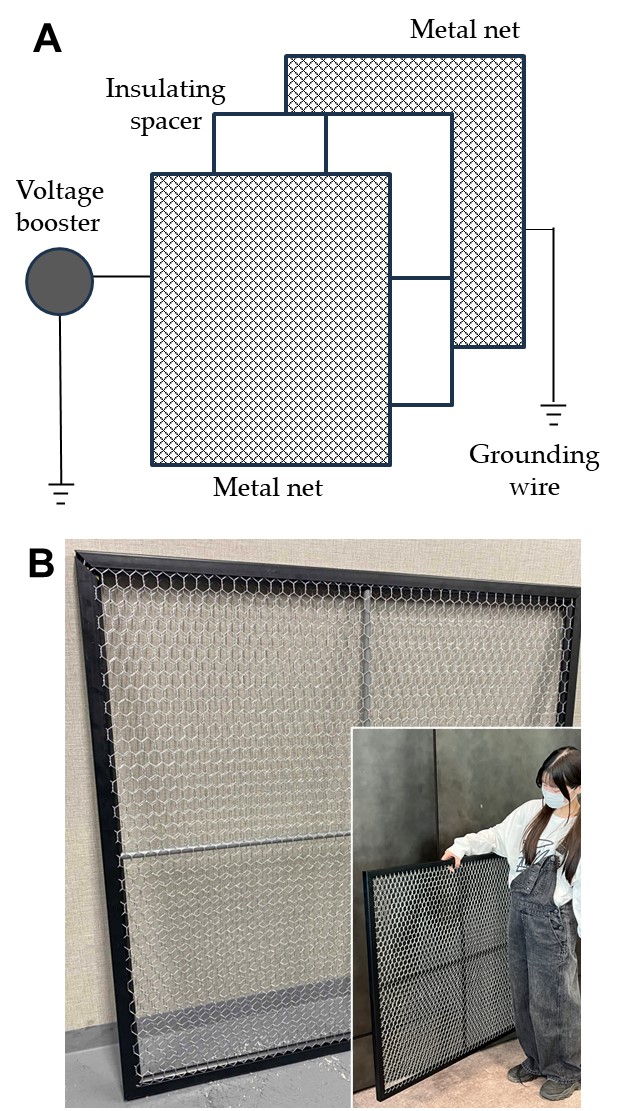
The present study introduces an innovative device that enables the safe, unmanned control of kudzu vines climbing along roadside fences. The device consists of two identical galvanized iron nets arranged in parallel at a specified interval, separated by plastic spacers and secured within a plastic frame. One of the metal nets is connected to a pulse-charging positive voltage booster, while the other is grounded. This type of voltage booster is commonly used in electric fences to repel wild animals from crop fields, ensuring safe operation. The positive charge on the metal net connected to the voltage booster induces a negative charge on the grounded net through electrostatic induction. These opposite charges create an electric field in the space between the two nets. Kudzu vines creeping along the ground receive electric sparks from the pulse-charged net when they enter this electric field. These sparks are strong enough to destroy the apical meristem (growing tip) of the vine, thereby preventing further growth. Thanks to its simple structure, the device is easy to construct, cost-effective, and suitable for long-term use with minimal maintenance. The plastic spacers and frames, produced using metal molds, allow for rapid assembly and mass production of the components. This facilitates widespread deployment along roadside fences, especially on expressways across the country, where the kudzu invasion has become a serious social issue.
Kudzu (Pueraria montana var. lobata) is a vine plant in the legume family that grows in sunny mountainous areas and produces reddish-purple flowers in early autumn 1. It has vigorous fertility, with vines growing up to nearly 10 meters from late summer to autumn 2. Its large, three-lobed leaves can cover entire areas. Due to its strong vitality, kudzu is an invasive species that causes significant damage to ecosystems 1. It smothers other plants and kills understory vegetation, thereby destroying habitats for birds and other animals. Kudzu can also interfere with aquatic plant growth and reduce biodiversity when it grows near water sources. Additionally, it hampers the growth of crops and fruit trees, causing harm to agriculture and forestry.
Kudzu can become entangled in roads, fences, power lines, and other structures, causing damage to the landscape 3. It can also block forest roads and boardwalks, rendering them unusable. When kudzu grows along forest roads and embankments, it can hinder access and make disaster response more difficult. Additionally, there is a risk that strong winds may cause trees entangled with kudzu to fall, further spreading the damage. Removing kudzu requires a tremendous amount of time, money, and effort 4, 5.
The Research Association of Electric Field Screen Supporters (RAEFSS) 6, to which the authors belong, has been focusing on developing weed control methods using electrostatic techniques 7. Among the various research topics, the development of physical methods to manage kudzu invasion has been a high-priority issue across many related fields. In particular, kudzu entanglement in roadside fences has become a serious problem for companies responsible for operating and maintaining expressways. Given the vast highway network in Japan, with fences installed along most sections, the effort and cost required for kudzu control are enormous. In terms of control methods, herbicides are avoided due to environmental concerns 4, 5. As a result, manual removal using mowers has been the primary approach. However, Japan's recent labor shortages have made it increasingly difficult to effectively manage the kudzu problem.
In developing a new electrostatic device to control kudzu, one of the highway management companies, NEXCO West Japan, made a request to our research association that included the following six requirements: 1) The existing roadside fences should be usable without modification. 2) The structure of the electrostatic device should be simple and cost-effective to manufacture. 3) The newly developed device should be easy to attach to the fences. 4) The device attached to the fence should be easy to maintain. 5) The device must be safe to touch while in operation. 6) Kudzu weeding should be automated. Fulfilling all of these requirements has been a major challenge for the RAEFSS. Fortunately, however, the knowledge and experience accumulated through research on electrostatic devices for weed control have made it possible to overcome these difficulties [8-12] 8.
Electrostatics is a branch of science that deals with phenomena caused by stationary electric charges. In this study, we focus on sparks—high-voltage discharge events—generated by static electricity. The first step in the electric discharge phenomenon is to impart an electric charge to a conductor. To charge the target conductor, a voltage booster is used—an apparatus that increases the initial voltage to the desired level. Using the enhanced voltage, a negative voltage booster draws negative charges from the ground and supplies them to the conductor connected to it, resulting in negative electrification of the conductor. Conversely, a positive voltage booster removes free electrons from the conductor and transfers them to the ground, leaving a net positive charge on the conductor (positive electrification). The electric charge on the conductor creates an electric field in the surrounding space. When a second, grounded conductor enters this electric field, discharge-mediated sparks are generated toward it 13. This spark exposure imposes a strong impact on the conductor with an additional electric current-induced Joule heating 8. If the second conductor is a weed, it can be eradicated by this spark exposure treatment 7. In fact, several researchers have attempted to control various weed species using this electrostatic principle 8, 11, 14, 15, 16, 17, 18, 19. Although attempts to control weeds using electrostatic techniques have revolutionized weeding methods, all previous studies have focused on controlling weeds on flat, cultivated land. Moreover, the equipment used was very expensive and structurally complex, making it difficult to promote the widespread adoption of these techniques. As a result, these methods were entirely unsuitable for the present purpose.
There are two types of voltage boosters: the continuous-charging type, which charges continuously, and the pulse-charging type, which charges at regular intervals for very short durations. Of the two, the pulse-charging type has been used to power electric fences installed to prevent the entry of wild animals into crop fields, and it poses no safety concerns 20. Matsuda et al. 9, 10, 12 also confirmed the safe use of pulse-charging voltage boosters for weed control purposes. More importantly, they demonstrated that the spark discharge generated by the pulse-charged metal wire attached to a fence was effective in destroying the growing points of kudzu vines creeping along the fence 9. The results of this research formed the basis for the present approach. However, the problem with this method was that the kudzu vines that had stopped growing remained attached to the fence. To address this issue, it was necessary to prevent the elongation of the kudzu vines before they came into contact with the charged metal net.
The device proposed in the present study consists of a pair of pulse-charged and grounded metal nets arranged in parallel at a specified interval. The concept of pairing two identical metal nets was established in our previous work for its structural simplicity and ease of low-cost construction 10, 12. As expected, a metal net composed of two layers can be easily attached to the fence simply by hooking it in place. Currently, all commercially available voltage boosters are of the positive-charging type; therefore, in this study, a positive-charging booster was also used to charge the metal net. The metal net connected to a positive voltage booster is positively charged, and this positive charge induces a negative charge on the grounded metal net through electrostatic induction 21. A key point to be clarified in this study is the optimization of the interval between these oppositely charged nets (pole distance), as this space serves as the site where invading vines are exposed to sparks.
The main focus of the present approach is to destroy the growing point at the tip of the vine, thereby completely suppressing its subsequent elongation. The previous work 9 revealed that the growing point was subjected to spark irradiation from the charged metal wine when the vine tip entered the electric field between the charged and grounded wires attached to the fence at regular intervals, and again when the vine touched the grounded wine. These results suggest that a spark discharge-mediated electric current flows along the vine between the tip and the point where it contacts the grounded wire 9. The duration and extent of electric current flow along the kudzu vine depend on the conductivity of the vine body. Matsuda et al. 9 reported that pulse charging at 10 kV enabled electric current to reach a position 8–15 mm away from the vine tip.
The concept of kudzu control envisioned in this study involves a kudzu vine crawling along the ground and passing through the first metal net—specifically, when the tip of the vine enters the electric field between the two nets—at which point it is exposed to sparks emitted from the charged metal net. If the distance between the two nets increases, the timing of when the vine is exposed to sparks is delayed, resulting in a longer portion of the vine entering the electric field. If the vine becomes too long, electrical conductivity may be compromised, preventing current from flowing through it and, consequently, inhibiting spark generation. In the present study, we aim to determine the optimal spacing between the pulse-charged and grounded metal nets to effectively destroy the growing point of kudzu vines through spark irradiation. Based on the results obtained, we propose a double-netted unit (DNU) for controlling kudzu vines that can be safely attached to existing fences, with the goal of putting it to practical use.
We randomly selected 500 kudzu vines growing on the Faculty of Agriculture campus at Kindai University (Nara, Japan). Metal nets with varying mesh sizes (1–5 cm in diameter) were placed vertically 5 cm in front of each vine. We then observed whether each vine passed through the mesh or climbed up the net. A total of 100 vines were tested for each mesh size (1, 2, 3, 4, and 5 cm). Based on these observations, we determined the minimum mesh size through which all vines were able to pass.

Figure 1A shows the structure of the DNU. The device consists of two identical metal nets (galvanized iron mesh) measuring 90 cm × 90 cm with a mesh size of 1-5 cm in diameter (Asahi Wire Netting, Osaka, Japan). The nets were arranged in parallel at a fixed distance, separated by polyvinyl chloride rods (5-20 mm in diameter) used as insulating spacers. The net and spacer components were secured within a polyvinyl chloride frame. One of the metal nets was connected to a pulse-charging type positive voltage booster (S500-10WS: pulse interval: 1 second; output voltage: 10 kV) (Mirai-no-Agri Co., Ltd Sapporo, Japan), while the other metal net was connected to a grounding wire. Figure 1B shows a photograph of the fully assembled DNU. This DNU can be purchased from the Towaron Trading Corp. in Sakai City, Osaka Prefecture, Japan.
2.3. Optimization of Pole Distance for Enhanced Sparking EfficiencyA charged conductor produces an electric field in the surrounding space and can generate discharge-mediated sparks when a second, grounded conductor reaches the edge of this electric field 22. This edge represents the maximum distance at which the charged conductor can emit a spark to the second conductor—referred to as the sparking distance. The sparking distance can be measured by gradually moving a grounded, pointed metal probe toward the charged conductor. When the tip of the probe reaches the boundary of the electric field, a spark is emitted from the charged conductor. The distance from the charged conductor to the tip of the probe at the moment of discharge is defined as the sparking distance. Using this method, the sparking distance of the pulse-charged metal net was determined.
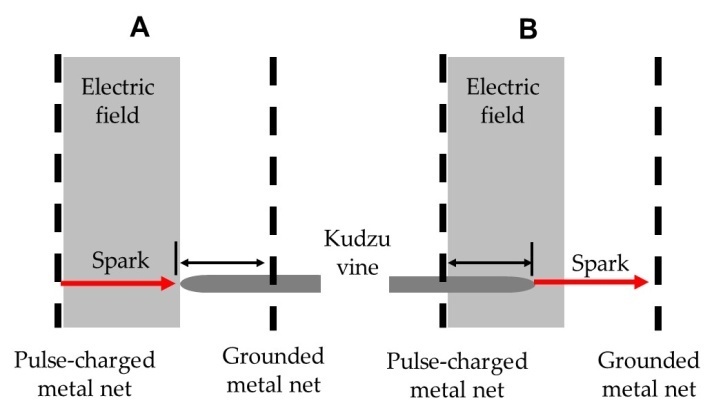
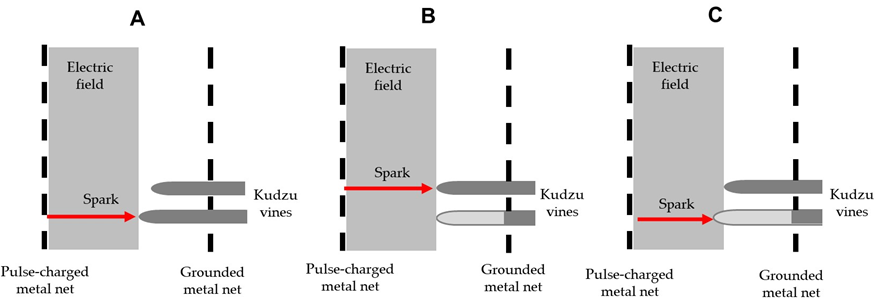
The DNU generates an electric field in the space between two metal nets, and a spark is triggered when a kudzu vine enters this space. However, the mode of spark generation differs depending on which metal net the vine contacts first. Figure 2A and 2B illustrate situations in which the vine enters the DNU's electric field from the grounded and charged metal nets, respectively. In both cases, the vine makes contact with the corresponding metal net. When the vine enters from the grounded metal net side and its tip reaches the electric field of the charged metal net—i.e., the spark distance—a spark is generated from the charged metal net toward the vine (Figure 2A). On the other hand, when the vine enters from the charged metal net side, a spark is generated from the tip of the vine toward the grounded metal net. This occurs when the distance from the tip of the vine to the grounded net matches the sparking distance of the charged metal net (Figure 2B). Based on these observations, the optimal distance between the two metal nets was investigated. In this experiment, the distances between the metal nets of the DNU were set to 5, 10, 15, 20, 23, 24 and 25 mm. Vigorous kudzu vines growing on the campus were cut at a position 50 cm from the tip. The excised vines were gradually inserted into the interior through a metal net, and then the DNU was switched on to investigate the insertion depth at which sparks were generated. For each net distance, 20 vines were used for insertion form the charged metal net or the grounded metal net.

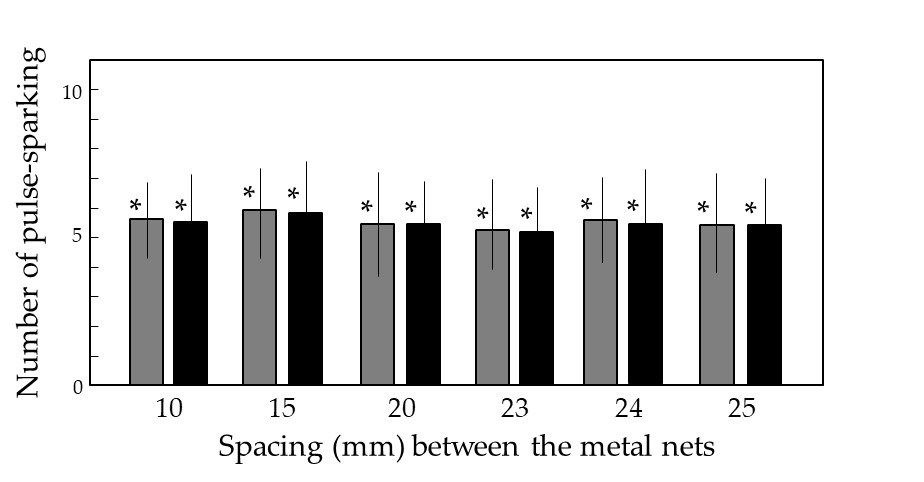
Previous studies 9, 10 have reported that pulsed sparking stops autonomously. In the present study, we investigated whether the duration of sparking varies under different spacing conditions. Since sparking is accompanied by a small explosive sound (referred to as the "sparking sound"), the number of sound occurrences can be recorded to estimate the duration of pulsed sparking 8. In this study, for each spacing condition, the vine was inserted from either the charged or grounded metal net to a position 5 mm away from the opposite metal net, after which the voltage booster was activated. The sound generated by the sparking was measured in decibels using a sound-level meter (Sato Tech, Kanagawa, Japan). The sound profile was recorded using a spectrum analyzer integrated into the sound-level meter. For each net distance, 20 vines were used for insertion form the charged metal net or the grounded metal net. The experiment was repeated five times to allow for statistical analysis of the data.
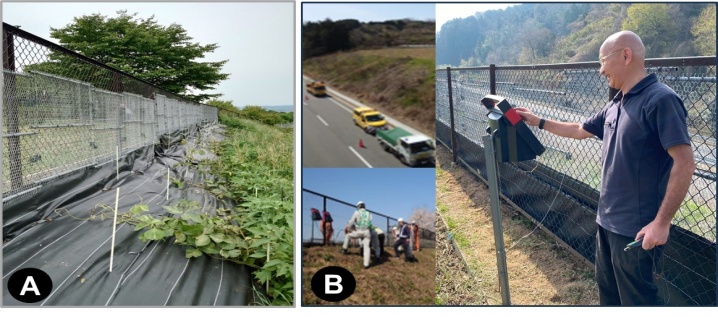
2.4. Practical Application of DNUs to roadside FencesFor field testing, we installed DNUs on the roadside fences along the motorway within the university campus, as well as on the fences along the NEXCO West Japan Expressway surrounding the campus. As shown in Figure 3, at each experimental site, several DNUs were attached in a horizontal row on the fences. As a control, we selected adjacent fences without DNUs and marked plots of the same size as the DNUs on their surfaces to determine the number of kudzu vines growing there. To evaluate the effectiveness of the DNUs in controlling kudzu vines, we rated each DNU on a 5-point scale at the end of the experiment. A score of 0 indicated no vines climbing on the DNU, while scores of 1 to 4 corresponded to 1–5, 6–10, 11–20, and more than 20 vines growing on the DNU, respectively. The DNUs were then evaluated based on the average scores obtained. The experiments were conducted over a six-month period from May to October each year— the peak growing season for kudzu vines— and were carried out over three years (2022 to 2024).

All experiments were repeated five times, and all data are presented as mean and standard deviation. Tukey’s test was performed using EZR software (ver. 1.54; Jichi Medical University, Saitama, Japan) 23 to detect differences among the various conditions. A p-value < 0.05 was considered significant.
The electric spark exposure of kudzu vines was effective in destroying the growing point at their tip, which regulates subsequent elongation 9. The success of this approach depends on the creation of an electric field that the vines will inevitably enter. The concept of creating an electric field between two metal nets was initially proposed as a soil cover to control weed seedlings emerging from arable land 10. In the electric field properly generated between the pulse-charged and grounded metal nets, seedlings can be zapped by pulsed sparks at a theoretical frequency of 60 arcs per minute, i.e., 86,400 arcs per day 10. This promising method is expected to be applicable for controlling kudzu vines climbing along fences if the paired metal nets are set vertically.
Proper spacing between the pulse-charged and grounded metal nets was the primary requirement to direct sparks preferentially toward the vines entering the electric field. The major factors affecting spark discharge production are the voltage applied to the conductors and the distance between the opposite poles at each voltage 22. In the present study, a fixed voltage (10 kV) was used for charging; therefore, the remaining variable was the distance between the two metal nets. A prerequisite for this approach was understanding the extent of the electric field produced by the charged conductor, since sparks are generated when a grounded conductor comes into contact with this field. This information is useful for removing grounded conductors near the charged conductor or for placing the charged conductor away from neighboring grounded conductors; in our case, the non-insulated metallic fence presents a significant example. The present measurements showed that the pulsed metal net creates an electric field extending approximately 5 mm in circumference, leading us to adopt a pole distance longer than 5 mm as a precaution.
Table 1 highlights the relationship between pole distance and the length of vines inserted during spark formation. It presents the spark generation rate for each metal net into which kudzu vines were inserted, as well as for each insertion length. In both cases, the results were completely identical. When the vines were inserted from the grounded metal net side, no arcing occurred until the tip of the vine reached the boundary of the electric field (i.e., a position 5 mm from the charged metal net), regardless of the net spacing. The results obtained in the experiments with 20 mm, 23 mm, and 25 mm spacing were particularly important for estimating the conductivity of the kudzu vine used in this study. In these configurations, the vine tip had to be inserted at least 15 mm, 18 mm, and 19 mm, respectively, for it to reach the electric field. In the 20 mm and 23 mm spacing conditions, all vines that met this requirement generated sparks. However, in the 25 mm spacing condition, no sparks were observed, even though the inserted vines reached the electric field. These results suggest that, under the applied voltage of 10 kV, electrical current can flow through the kudzu vine up to a maximum length of approximately 18 mm. When the vines were inserted from the charged metal net side, a spark was generated from the tip of the vine toward the grounded metal net. This is different from the case where it is inserted from the grounded net side. However, in both cases, an electric current flows through the vine, which actually affects its growth.
Continuous irradiation with pulsed sparks destroys the growth and vascular tissues at the irradiated site and evaporates body water through the generation of Joule heat 8, 9. Since the plant's vascular system is damaged, it cannot replenish the water lost through evaporation. As a result, the irradiated tissue becomes increasingly dry with continued exposure. The drying of the tissue reduces its electrical conductivity, which eventually prevents current from flowing through the tissue and stops further spark generation 9, 10. In the present experiment as well, spark generation ceased autonomously after repeated exposure to pulsed sparks under various spacing conditions of the DNU. Figure 4 shows the duration required for arcing to stop under each spacing condition. The results indicate that there was no significant difference in spark duration among the tested spacing conditions.

The results in Table 1 show that a spacing between 10 mm and 23 mm allows for the construction of the DNU capable of suppressing the invasion of kudzu vines. When considering the practical application of the DNU, it is necessary to address not only the functional aspects identified in this study, but also potential issues that may arise under normal operating conditions. The primary concern is that the metal nets used exhibit a certain degree of elasticity. This means that, for example, when a force is applied to the surface of the metal net, it may deform inward, reducing the distance between the nets. In tests where force was applied manually, the net was pushed inward by as much as 13–14 mm. In such cases, if the spacing between the metal nets is 5 mm or less, a pulsed spark is likely to occur at that location. To prevent problems even in the event of such an unexpected situation, a spacing of 20 mm is recommended for the practical version of the DNU.
Since the DNU is operated outdoors for extended periods, the issue of rusting metal parts cannot be ignored, especially when installed in rainy or coastal areas. When rust occurs, metal becomes brittle and its strength decreases, increasing the risk of parts falling off or breaking, and thereby raising safety concerns. Rust also causes the surface of iron components to discolor and lose their luster, which negatively affects the device's appearance. As rust progresses, it becomes more difficult to remove and often requires measures such as polishing and repainting. This leads to increased costs and maintenance efforts, placing a financial burden on users. To minimize rusting of the DNU’s metal nets, iron nets coated with tin and zinc have been used.
The DNU proposed in this study consists of two metal nets, a spacer placed between them, and a frame to hold everything together. The spacer and the frame, which is attached to the top, bottom, left, and right sides of the DNU, are made by pouring polyvinyl chloride resin into mechanical molds. The assembly of these components is extremely simple and straightforward. The resulting DNU is highly weather-resistant. Moreover, since it can be washed with water, it is very easy to maintain and manage.
3.3. Assessment of the Ability of the DNU to Deal with Continuously Invading Kudzu VinesThe most basic feature of the DNU is that spark irradiation is always limited to a single target. This means that even if multiple vines enter the electric field, only one vine is irradiated with a spark at any given time. However, in practice, all invading vines are successfully exterminated. Therefore, it is important to propose a possible mechanism to explain this effective extermination. A straightforward explanation can be provided for the case in which the vines enter the electric field from the grounded metal net (Figure 5).
The first condition for target selection is that the vine closest to the charged metal net is the one exposed to the spark, even when multiple vines coexist in the space between the nets (Figure 5A). As a second condition, if two vines are at the same distance from the charged metal net, the vine with higher conductivity is selected as the target. This situation occurs when the first vine is already being irradiated with sparks, and a second vine grows to the same position. As the first vine gradually dries due to the irradiation and its conductivity decreases, the fresh vine—whose conductivity remains high—becomes the new target (Figure 5B). A third case may occur as an extension of the second. In this scenario, spark irradiation shifts from the first vine to the second, and then the first vine continues to grow. Since the first vine is now closest to the charged metal net, it can again become the target of spark irradiation (Figure 5C).
In summary, the charged metal net appears to have the ability to instantly recognize both the distance and conductivity of potential targets, and to discharge toward the one closest to it. By fully utilizing this mechanism, even continuous invasion by kudzu vines into the electric field can be effectively controlled.

The final stage of the study involves attaching the DNU to an existing roadside fence to control kudzu vines that climb up the structure. To achieve this, it is important to understand the factors that may negatively affect the performance of the DNU when installed on the fence. According to our preliminary research, roadside fence netting is typically made of iron wire coated with a synthetic resin such as vinyl chloride, which provides high corrosion resistance and durability. These fences are electrostatically grounded because their metal posts are embedded in the soil. Although vinyl chloride is an insulating material, in many areas the resin coating has deteriorated and peeled off over time. If such exposed metal parts are located near the charged metal net of the DNU, they may become targets for spark discharge. To prevent such risks, there are restrictions on how the DNU can be attached to the fence. The optimal method is to position the grounded metal net side of the DNU facing the fence. This ensures a sufficient distance between the charged metal net and the fence, thereby eliminating the risk of spark generation.
The voltage booster used in this study was originally developed for an electric fence. This device was available for our purposes without any modifications. The voltage booster can charge up to 1,000 meters of metal wire without a voltage drop, theoretically allowing it to connect up to 1000 DNUs. In this study, we attached 15 to 30 DNUs to the roadside fence, depending on the size of the fence at each experimental site. The voltage booster for the electric fence is powered by a storage battery charged by a solar panel. Using this system for our device offers additional advantages such as eliminating the need to install new electric cables and avoiding electricity costs during operation, as part of the DNU's efforts to control kudzu vines.
In the field test conducted over the three-year plan, the first two years focused on ensuring the stable operation of the DNU—specifically, whether the device functioned normally throughout the half-year testing periods. In the final year, the effectiveness of the DNU in controlling kudzu was evaluated. Various weather conditions might adversely affect the normal operation of the DNU. Among these, particular attention was given to the impact of a prolonged rainy season, extreme midsummer temperatures approaching 50°C, and damage caused by typhoon storms. During the two-year experimental period, the DNU was exposed to harsh environmental conditions on multiple occasions, but fortunately, it was able to complete the tests without any damage. Its weather-resistant characteristics can be attributed to its simple structure. In fact, the DNU consists only of two galvanized metal nets, a plastic spacer, and a frame—components that are relatively resistant to climatic factors.
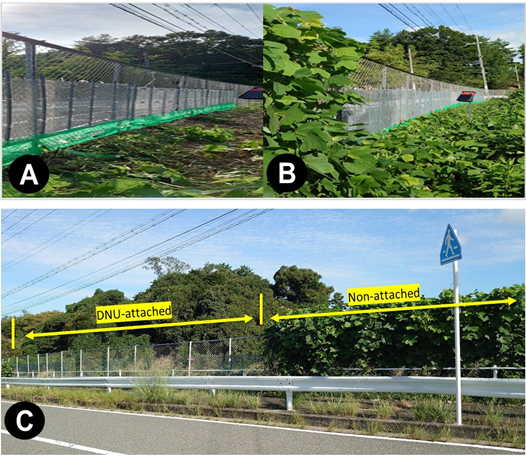
The results of the kudzu control test conducted in the final year of the three-year plan are presented here. The test was initiated simultaneously in six areas and monitored kudzu vine growth over a six-month period. The effect of the DNU on inhibiting vine growth was assessed at the end of the experiment. A portion of the results is shown in Figure 6.

As shown in Figures 6B and 6C, vigorous growth of kudzu vines was observed at all experimental sites, with more than 20 vines climbing up the fences and completely covering their surfaces with large leaves. In fact, all untreated fences at these sites were classified as Grade 4, indicating the highest level of vine growth (Table 2). These results suggest that the selected test sites were well-suited for evaluating the DNU's effectiveness in controlling kudzu vines. At the same time, these two photographs clearly demonstrate the device's strong inhibitory effect, showing that it effectively suppressed vine growth near the fences, which were ranked as Grade 0 (Table 2).
The DNU's ability to prevent kudzu vines from becoming entangled in the grounded metal net is highly beneficial for the maintenance and management of the equipment. In practical terms, removing vines that have already become entangled is labor-intensive, making this a serious issue, especially considering the large scale of the installed fencing.
To produce achievements that truly contribute to society, it is essential to accurately identify the problems that need to be addressed, develop a rational research strategy based on flexible thinking, and carry it through to completion. The main theme of this research was the control of kudzu entangled in roadside fences, utilizing concepts and techniques from electrostatic engineering to their fullest extent. Due to the vigorous growth potential of kudzu, its widespread proliferation in the environment has become a persistent social problem that is difficult to control. To develop a technology that can reliably address this issue, it was necessary to meet six key requirements for proposing a practically applicable device: ease of construction, low production cost, ease of application and maintenance, safe operation, low energy consumption, and high functionality. The first three requirements were fulfilled by the simple structure of the proposed apparatus. The remaining three were achieved through a deep understanding of how to design an appropriate electrostatic system and which electrostatic principles should be applied. This social contribution was clearly the result of collaboration between university researchers, who provided academic expertise in electrostatics and weed ecology, and company engineers, who contributed strong technical skills to develop reliable products.
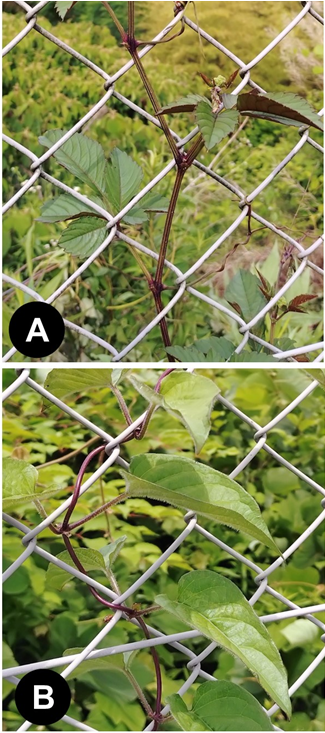
The results of this study have provided a clear objective for the control of kudzu that creeps along the ground and approaches fences. However, when broadening the scope to include weeds that become entangled in fences, other species besides kudzu must also be addressed. Among these, typical vine weeds include bush killer (Cayratia japonica (Thunb.) Gagnep.) (Figure 7A) 25 and skunk vine (Paederia scandens (Lour.) Merr.) (Figure 7B) 26, which are occasionally observed on the university campus.

If these weeds emerge from the ground directly beneath the fence, they will wrap around it as they grow (Figure 7A, B). In particular, if they emerge on the side of the fence without the DNU, they cannot be controlled, as the electrostatic effect does not reach that area at all. To address this issue, we are planning to revise the conventional 90 cm × 90 cm standard and develop a new DNU with dimensions of 90 cm × 10 cm. When installed horizontally to cover the ground at the base of the fence, this new type can serve as a soil cover to control weeds emerging from the ground. If the soil-cover DNU is connected to the upright DNU on the opposite side of the fence, the new DNU will not require a separate voltage boost. In this configuration, weed seedlings emerging from the ground were exposed to sparks as they passed through the grounded net and entered the electric field of the upper charged metal net 10, 12.
With a single voltage booster and a suitable conductor, electrostatic engineering experiments can be easily conducted. Typical conductors include various metals, which are highly conductive and therefore serve as cost-effective materials for this purpose. A voltage booster is a device that either supplies electric charge to a conductive material or removes free electrons from it, using the high voltage it generates. Since metals allow charge to move freely, they can be easily charged simply by connecting them to a voltage booster. Based on this fundamental principle, even readers without a background in electrostatics can replicate the device introduced in this study—or modify it to suit their own objectives—using inexpensive, readily available materials. From this perspective, we believe the findings of this study have the potential for significant social impact across a wide range of fields.
This work was supported by a 2025 research promotion grant from the General Incorporated Foundation Vertex Green Foundation. We would like to express our deepest gratitude to Kindai University for recommending our electrostatic weed control device and for deciding to exhibit it at Expo 2025 Osaka, Kansai, Japan. The weed control device developed in this research has been submitted to the Japan Patent Office as a new invention (Patent Application No. 2204-29724) and is currently under review.
| [1] | Forseth, I.N., Innis, A.F. “Kudzu (Pueraria montana): History, physiology, and ecology combine to make a major ecosystem threat” Critical Reviews in Plant Sciences, 23. 401–413. 2004. | ||
| In article | View Article | ||
| [2] | Tsugawa, H., Sasek, T.W., Takahashi, T., Nishikawa, K. “Demographic characteristics of overwintering stems and root systems which constitute a network in natural kudzu (Pueraria lobata Ohwi) stands” Japanese Journal of Grassland Science, 38. 80–89. 1992. | ||
| In article | |||
| [3] | Carter, G.A., Teramura, A.H. “Vine photosynthesis and relationships to climbing mechanics in a forest understory” American Journal of Botany, 75. 1011–1018. 1988. | ||
| In article | View Article | ||
| [4] | Weaver, M.A., Boyette, C.D., Hoagland, R.E. “Management of kudzu by the bioherbicide, Myrothecium verrucaria, herbicides and integrated control programmes” Biocontrol Science and Technology, 26. 136–140. 2016. | ||
| In article | View Article | ||
| [5] | Miller, J.H., The Vine to Love or Hate Kudzu, Suntop Press, Kodak, 1996, 137-149. | ||
| In article | |||
| [6] | Research Association of Electric Field Screen Supporters. http://www.electric-field-screen.org/info.html. Accessed: May 28, 2025 | ||
| In article | |||
| [7] | Toyoda, H. “Electrostatic techniques for physically managing pathogens, insect pests, and weeds in field and greenhouse cropping systems” Agronomy, 13. 2855. 2023. | ||
| In article | View Article | ||
| [8] | Matsuda, Y., Shimizu, K., Sonoda, T., Takikawa, Y. “Use of electric discharge for simultaneous control of weeds and houseflies emerging from soil” Insects, 11. 861. 2020. | ||
| In article | View Article PubMed | ||
| [9] | Matsuda, Y., Takikawa, Y., Kakutani, K., Nonomura, T., Okada, K., Kusakari, S., Toyoda, H. “Use of pulsed arc discharge exposure to impede expansion of the invasive vine Pueraria montana” Agriculture, 10. 600. 2020. | ||
| In article | View Article | ||
| [10] | Matsuda, Y., Takikawa, Y., Shimizu, K., Kusakari, S., Toyoda, H. “Use of a pair of pulse-charged grounded metal nets as an electrostatic soil cover for eradicating weed seedlings” Agronomy, 13. 1115. 2023. | ||
| In article | View Article | ||
| [11] | Matsuda, Y., Kakutani, K., Toyoda, H. “Unattended electric weeder (UEW): A novel approach to control floor weeds in orchard nurseries” Agronomy, 13. 1954. 2023. | ||
| In article | View Article | ||
| [12] | Matsuda, Y., Kakutani, K., Toyoda, H. “A simple electrostatic apparatus for controlling weeds on slopes without causing soil erosion” American Journal of Civil Engineering and Architecture, 12. 1-7. 2024 | ||
| In article | View Article | ||
| [13] | Toyoda, H., Kusakari, S., Matsuda, Y., Kakutani, K., Xu, L., Nonomura, T., Takikawa, Y., An illustrated manual of electric field screens: their structures and functions, RAEFSS Publishing Department, Nara, 75-85. | ||
| In article | |||
| [14] | Wilson, R.G., Anderson, F.N. “Control of three weed species in sugar beets (Betavulgaris) with an electrical discharge system” Weed Science, 29, 93–97. 1981. | ||
| In article | View Article | ||
| [15] | Diprose, M.F., Benson, F.A. “Electrical methods of killing plants” Journal of Agricultural Engineering Research, 30. 197–209. 1984. | ||
| In article | View Article | ||
| [16] | Nagura, A., Tenma, T., Sakaguchi, Y., Yamano, N., Mizuno, A. “Destruction of weeds by pulsed high voltage discharges” Journal of The Institute of Electrostatics Japan, 16. 59–66. 1992. | ||
| In article | |||
| [17] | Mizuno, A. “Destruction of weeds by high voltage discharge” Journal of Plasma and Fusion Research, 75. 666–671. 1999. | ||
| In article | View Article | ||
| [18] | Minoda, A. “A basic study on weeding method by using high voltage” Japan Journal of Industrial and Applied Engineering, 9. 21–24. 2021. | ||
| In article | View Article | ||
| [19] | Lati, R.N., Rosenfeld, L., David, I.B., Bechar, A. “Power on! Lowenergy electrophysical treatment is an effective new weed control approach” Pest Management Science, 77. 4138–4147. 2021. | ||
| In article | View Article PubMed | ||
| [20] | Burke, M., Odell, M., Bouwer, H., Murdoch, A. “Electric fences and accidental death” Forensic Science, Medicine and Pathology, 13. 196–208. 2017. | ||
| In article | View Article PubMed | ||
| [21] | Griffith, W.T. The Physics of Everyday Phenomena, a Conceptual Introduction to Physics, McGraw-Hill, New York, 2004, 232–252. | ||
| In article | |||
| [22] | Kaiser, K.L. Electrostatic Discharge, Taylor & Francis, New York, 2006, 214-224. | ||
| In article | |||
| [23] | Kanda, Y. “Investigation of the freely available easy-to-use software ‘EZR’ for medical statistics” Bone Marrow Transplantation, 48. 452–458. 2013. | ||
| In article | View Article PubMed | ||
| [24] | Jonassen, N. Electrostatics, Kluwer Academic Publishers, Boston, 2002, 24–30. | ||
| In article | View Article PubMed | ||
| [25] | Nakai, T., Yano, S. “Vines avoid coiling around neighbouring plants infested by polyphagous mites” Science Reports, 9. 6589. 2019. | ||
| In article | View Article PubMed | ||
| [26] | Chen, M., Cai, M., Xiang, P., Qin, Z., Peng, C., Li, S. “Thermal adaptation of photosynthetic physiology of the invasive vine Ipomoea cairica (L.) enhances its advantage over native Paederia scandens (Lour.) Merr. in South China” Tree Physiology, 43. 575-586. 2023. | ||
| In article | View Article PubMed | ||
Published with license by Science and Education Publishing, Copyright © 2025 Yoshinori Matsuda, Norihiko Kajimura, Maou Hirai, Kazutaka Fujimoto and Hideyoshi Toyoda
 This work is licensed under a Creative Commons Attribution 4.0 International License. To view a copy of this license, visit
http://creativecommons.org/licenses/by/4.0/
This work is licensed under a Creative Commons Attribution 4.0 International License. To view a copy of this license, visit
http://creativecommons.org/licenses/by/4.0/
| [1] | Forseth, I.N., Innis, A.F. “Kudzu (Pueraria montana): History, physiology, and ecology combine to make a major ecosystem threat” Critical Reviews in Plant Sciences, 23. 401–413. 2004. | ||
| In article | View Article | ||
| [2] | Tsugawa, H., Sasek, T.W., Takahashi, T., Nishikawa, K. “Demographic characteristics of overwintering stems and root systems which constitute a network in natural kudzu (Pueraria lobata Ohwi) stands” Japanese Journal of Grassland Science, 38. 80–89. 1992. | ||
| In article | |||
| [3] | Carter, G.A., Teramura, A.H. “Vine photosynthesis and relationships to climbing mechanics in a forest understory” American Journal of Botany, 75. 1011–1018. 1988. | ||
| In article | View Article | ||
| [4] | Weaver, M.A., Boyette, C.D., Hoagland, R.E. “Management of kudzu by the bioherbicide, Myrothecium verrucaria, herbicides and integrated control programmes” Biocontrol Science and Technology, 26. 136–140. 2016. | ||
| In article | View Article | ||
| [5] | Miller, J.H., The Vine to Love or Hate Kudzu, Suntop Press, Kodak, 1996, 137-149. | ||
| In article | |||
| [6] | Research Association of Electric Field Screen Supporters. http://www.electric-field-screen.org/info.html. Accessed: May 28, 2025 | ||
| In article | |||
| [7] | Toyoda, H. “Electrostatic techniques for physically managing pathogens, insect pests, and weeds in field and greenhouse cropping systems” Agronomy, 13. 2855. 2023. | ||
| In article | View Article | ||
| [8] | Matsuda, Y., Shimizu, K., Sonoda, T., Takikawa, Y. “Use of electric discharge for simultaneous control of weeds and houseflies emerging from soil” Insects, 11. 861. 2020. | ||
| In article | View Article PubMed | ||
| [9] | Matsuda, Y., Takikawa, Y., Kakutani, K., Nonomura, T., Okada, K., Kusakari, S., Toyoda, H. “Use of pulsed arc discharge exposure to impede expansion of the invasive vine Pueraria montana” Agriculture, 10. 600. 2020. | ||
| In article | View Article | ||
| [10] | Matsuda, Y., Takikawa, Y., Shimizu, K., Kusakari, S., Toyoda, H. “Use of a pair of pulse-charged grounded metal nets as an electrostatic soil cover for eradicating weed seedlings” Agronomy, 13. 1115. 2023. | ||
| In article | View Article | ||
| [11] | Matsuda, Y., Kakutani, K., Toyoda, H. “Unattended electric weeder (UEW): A novel approach to control floor weeds in orchard nurseries” Agronomy, 13. 1954. 2023. | ||
| In article | View Article | ||
| [12] | Matsuda, Y., Kakutani, K., Toyoda, H. “A simple electrostatic apparatus for controlling weeds on slopes without causing soil erosion” American Journal of Civil Engineering and Architecture, 12. 1-7. 2024 | ||
| In article | View Article | ||
| [13] | Toyoda, H., Kusakari, S., Matsuda, Y., Kakutani, K., Xu, L., Nonomura, T., Takikawa, Y., An illustrated manual of electric field screens: their structures and functions, RAEFSS Publishing Department, Nara, 75-85. | ||
| In article | |||
| [14] | Wilson, R.G., Anderson, F.N. “Control of three weed species in sugar beets (Betavulgaris) with an electrical discharge system” Weed Science, 29, 93–97. 1981. | ||
| In article | View Article | ||
| [15] | Diprose, M.F., Benson, F.A. “Electrical methods of killing plants” Journal of Agricultural Engineering Research, 30. 197–209. 1984. | ||
| In article | View Article | ||
| [16] | Nagura, A., Tenma, T., Sakaguchi, Y., Yamano, N., Mizuno, A. “Destruction of weeds by pulsed high voltage discharges” Journal of The Institute of Electrostatics Japan, 16. 59–66. 1992. | ||
| In article | |||
| [17] | Mizuno, A. “Destruction of weeds by high voltage discharge” Journal of Plasma and Fusion Research, 75. 666–671. 1999. | ||
| In article | View Article | ||
| [18] | Minoda, A. “A basic study on weeding method by using high voltage” Japan Journal of Industrial and Applied Engineering, 9. 21–24. 2021. | ||
| In article | View Article | ||
| [19] | Lati, R.N., Rosenfeld, L., David, I.B., Bechar, A. “Power on! Lowenergy electrophysical treatment is an effective new weed control approach” Pest Management Science, 77. 4138–4147. 2021. | ||
| In article | View Article PubMed | ||
| [20] | Burke, M., Odell, M., Bouwer, H., Murdoch, A. “Electric fences and accidental death” Forensic Science, Medicine and Pathology, 13. 196–208. 2017. | ||
| In article | View Article PubMed | ||
| [21] | Griffith, W.T. The Physics of Everyday Phenomena, a Conceptual Introduction to Physics, McGraw-Hill, New York, 2004, 232–252. | ||
| In article | |||
| [22] | Kaiser, K.L. Electrostatic Discharge, Taylor & Francis, New York, 2006, 214-224. | ||
| In article | |||
| [23] | Kanda, Y. “Investigation of the freely available easy-to-use software ‘EZR’ for medical statistics” Bone Marrow Transplantation, 48. 452–458. 2013. | ||
| In article | View Article PubMed | ||
| [24] | Jonassen, N. Electrostatics, Kluwer Academic Publishers, Boston, 2002, 24–30. | ||
| In article | View Article PubMed | ||
| [25] | Nakai, T., Yano, S. “Vines avoid coiling around neighbouring plants infested by polyphagous mites” Science Reports, 9. 6589. 2019. | ||
| In article | View Article PubMed | ||
| [26] | Chen, M., Cai, M., Xiang, P., Qin, Z., Peng, C., Li, S. “Thermal adaptation of photosynthetic physiology of the invasive vine Ipomoea cairica (L.) enhances its advantage over native Paederia scandens (Lour.) Merr. in South China” Tree Physiology, 43. 575-586. 2023. | ||
| In article | View Article PubMed | ||