This work evaluates the effect of adding limestone (corrector) to lateritic gravelly on the granulometric fractions of the mixtures in the process of modifying the mechanical properties. The lateritic gravelly - limestone couple does not obey the law of mixtures. The optimal mixture is obtained by adding 30 % by weight of the corrector to obtain a mixture with unmeasurable clay, silt (4.25 %) and sand (19.47 %) contents. The results obtained show that from 15-30% by weight of the corrector, the compressive strength, elastic modulus, CBR and maximum dry density increase and the use properties are improved. From 30-40% by weight of the corrector with sand fraction SF (19.47-21.09%) in the mixture, the mechanical properties decrease. The addition of the corrector (15-40%) decreases the clay (5.18-1.68%) and silt (14.09-0.67) fractions, while the sand fraction (12.93-21.09%) increases by 63.11%. The increase of the sand fraction by 50.58% decreases the plasticity index by 77.16%. For a sand fraction SF (50.58-63.11%), the plasticity index is not measurable and the sand equivalent SE (32.5-35%) of the mixture increases by 7.69%. Increasing the sand fraction causes the compaction curves (Proctor) to flatten and the optimum moisture content to decrease. There is a negative correlation between compressive strength and strain at failure. Mixes containing 15-25% and 30-40% of the corrector can be used as a base layer for T1 < (5.105) and T1-T2 (5.105 - 1.5.106) traffic respectively, in terms of the cumulative number of passes of a 13T equivalent axle.
The socio-economic importance of a road for developing countries is well established. Indeed, roads provide 80% of freight transport between cities and states and often remain the only access road to rural areas 1. However, the construction of a road requires the use of good quality materials in the pavement body to ensure its estimated average life of 15 years 2. Materials must meet current standards to be used in the different layers of the pavement 2, 3. The proximity of the sources of materials for pavement construction reduces the transport distance, the intervention time and the nuisance associated with supply 2, 3. This proximity of materials also solves the problem of increasing the safety of road users and residents 4, 5. However, the scarcity of suitable road materials in some parts of sub-Saharan Africa has led to the use of non-conventional local materials such as lateritic gravelly in pavement construction 4, 6, 7, 8. Due to their abundance, lateritic gravelly are the most commonly used local materials for pavement construction 9, 10. Indeed, some studies show that lateritic gravelly, although poorly graded, have proven to be good for pavement construction 4, 11.
The absence of rocky materials that can be used directly without preparation in the base layer of a pavement led to the search for less costly and technically acceptable alternatives through the mechanical stabilization of two materials. Three departments of the Congo have large deposits of limestone, used exclusively for the production of cement. The shortage of rock materials in these departments can be compensated for by the use of limestone (recycled or natural) in pavement layers. This can be an asset, if preceded by the necessary geotechnical studies 6, 7, 8. However, crushing limestone is a difficult task and public works companies often decline the offer for several reasons. Limestone is an abrasive material that causes excessive wear and tear on the crusher hammers, resulting in time-consuming replacement of the hammers and additional expense for the company 3. Limestone is too hard a material, and crushing it often produces angular grains and a small amount of sand. It is not easy to use in pavement layers. However, the compactness of lateritic gravelly after compaction may not be high, unless its gradation is restored by adding a corrective material with a good gradation 3, 4. Limestone can be an alternative solution, if it is used as a corrective material to reduce fines and improve the granulometry of lateritic gravelly 4. All this will lead to a reduction in the cost of producing (0/31.5) limestone and its quantity in pavement construction. The intrinsic characteristics of the gravels obtained after crushing such as hardness, resistance to wear by friction and resistance to polishing are linked to the nature of the source rock and cannot be improved by the technician 3. The experiments carried out show that the compaction capacity of a rocky material is conditioned by the shape of its granulometric curve, the absence of segregation and the compactness of the compacted material. Then, the sub base layer of a pavement is stable, if the contacts between grains are numerous. The more compact the material, the less risk there is of grain displacement causing the pavement layers to settle when cars pass. Indeed, the materials of the base layer can undergo a strong attrition under the traffic if, the shearing resistance is then entirely supported by the friction of the grains between them 3. Consequently, the construction of the body of the pavement and the wearing course requires the use of only fairly compact aggregates, excluding flat aggregates 3. Indeed, the latter do not make it possible to produce a very compact bituminous concrete and, moreover, in road engineering, they cannot be used because they lead to excessively slippery wearing courses 3. However, to improve the behavior of lateritic gravelly used in road engineering, several techniques and materials have been tested in the literature: chemical stabilization with different binders, mechanical stabilization by adding crushed rock, etc. 2, 4, 12, 13, 14, 15, 16, 17.
Despite the variety of studies, the subject remains open and is not exhausted. It will always be important to carry out the necessary geotechnical tests for mixtures 18. Indeed, the experiments carried out on aggregates of various granularities do not lead to identical conclusions, depending on whether one is interested in compaction, resistance to repeated car loads, attrition, etc. The behavior of the mixture depends not only on its granularity but also on the mineralogy of the lateritic gravelly 4. To our knowledge, the improvement of lateritic gravelly properties by the addition of limestone has not yet been reported. By adopting mechanical tests (CBR index, compressive strength, static modulus, strain at failure) as a means of assessing the quality of the mixture, we have attempted to highlight, from the lateritic gravelly-limestone mixture, the role of grading, plasticity index, sand equivalent, optimum moisture content and compaction conditions. This work investigates the effects of the particle size fractions of the mixtures on the changes in the mechanical characteristics of the material, determines the related traffic and statistical properties of the mixtures.
The lateritic gravelly and limestone samples were collected from the locality of Tsiaki and its surroundings, according to the respective geographical coordinates S04°10'34.1'' - E013°28'40.4'' and E013°54'18.9'' – 04°14'56.2''. In the following, lateritic gravelly will be designated by the two letters LG and limestone by LS.
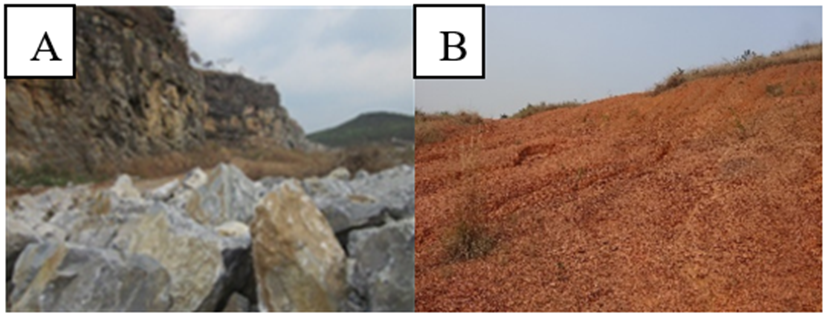
Figure 1(A) shows the deposition of grey-black limestone, an overly hard material with a good skeleton. After crushing, the limestone sometimes produces some fines and grains that do not meet the standard. Lateritic gravelly are yellow in color, composed of pebbles and covered by a gangue.
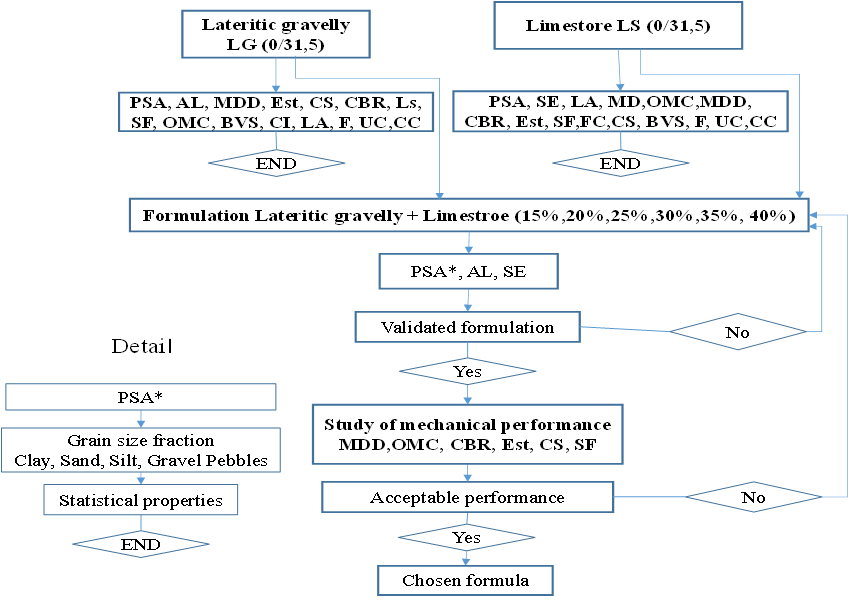
The lateritic gravelly is transported to the laboratory and sampled with the 40 mm sieve, to obtain a particle size of 0/31.5 mm. The granulometry of 0/31.5 of the limestone is obtained after crushing. The pair of lateritic gravelly (main material) and limestone (corrective material) is used in proportions of (15%, 20%, 25%, 30%, 35%, 40%). The mixture of the two materials was obtained by stirring the chosen proportions until a homogeneous mixture was obtained. In the following, the lateritic gravel samples will be designated by the letters (LG) and the limestone by (LS). The tests on the LG - LS mixture is carried out according to the diagram in Figure 2.
The Origin Pro 2019b software was used in the process of implementing the relationships between the intrinsic properties of the lateritic gravelly and limestone. The mathematical model selected is the one with the highest coefficient of determination R2 and the lowest Chi - sqr (χ²) – allows to test the independence between two random variables. Minitab 17 software was used to determine the statistical properties of the particle size fractions of the mixtures.


The percentage distribution of solid grains according to their dimensions is represented by the grain size. For particle separation, two types of tests were performed by: sieving for grains of the size ɸ > 80 μm according to NF P94-056 19 and the sedimentation for the grains of diameter ɸ ≤ 80 μm according to NF P94-057 20. The grain size fraction is deduced from the recommendations of grain size nomograms, considering clays as particles < 0.002 mm, silts 0.002-0.06 mm, sands 0.06-2 mm, grave 2-20 mm, Pebbles 20-200 mm. The grain sizes corresponding to D10, D30, D60 by weight of sieve are deduced from the granulometric curves. The Cu uniformity and Cc curvature coefficients made it possible to characterize the grain size of the lateritic gravelly and defined according to the formulas below:
 | (1) |
 | (2) |
Dx - is the grain size corresponding to x % by weight of sieve.
The Atterberg limits are determined by the Casagrande method, in accordance with NF P 94-051 21. The plasticity index characterizes the extent of the water content range in which soils behave plastically. The limits of liquidity (LL) and plasticity (PL) are determined on the fraction of soil (mortar) passing a 0.40 mm sieve. The plasticity index (PI) is expressed by the following relationship:
 | (3) |
The measurement of methylene blue adsorption capacity of a soil consists of measuring the quantity of methylene blue adsorbed by the 0/5 mm fraction of material suspended in water. This test makes it possible to characterize the clay content (or cleanliness) of a soil. It is a quantity that is directly linked to the specific surface of soil and reflects the overall quantity and quality (activity) of the clay fraction. The methylene blue value of a soil (BVS) is determined by the standard NF P 94-068 22.
Modified Proctor test used to determine optimum moisture content OMC (%) for which compaction leads to a maximum dry density MDD (T/m3). Maximum dry density is not a direct indication mechanical strength soil. However, material that nevertheless has pores, more interactions there are between particles, better cohesion soil. Mineralogy and formation medium influence water content soil. Optimum moisture content and maximum dry density were measured using modified Proctor test, according NF P 94-093 23.
The sand equivalent test is used to characterize the type of soil to be analyzed in accordance with standard NF P 18-598 24. The purpose of this test is to evaluate the relative proportion of fine elements contained in the soil and allows instantaneous control of the constancy of certain qualities of materials used in road construction. LG - LS (0/31.5) 15%, 20%, 25%, 30%, 35%, 40% mixtures are cured at an average ambient temperature of 25˚C, after a curing time of one hour.
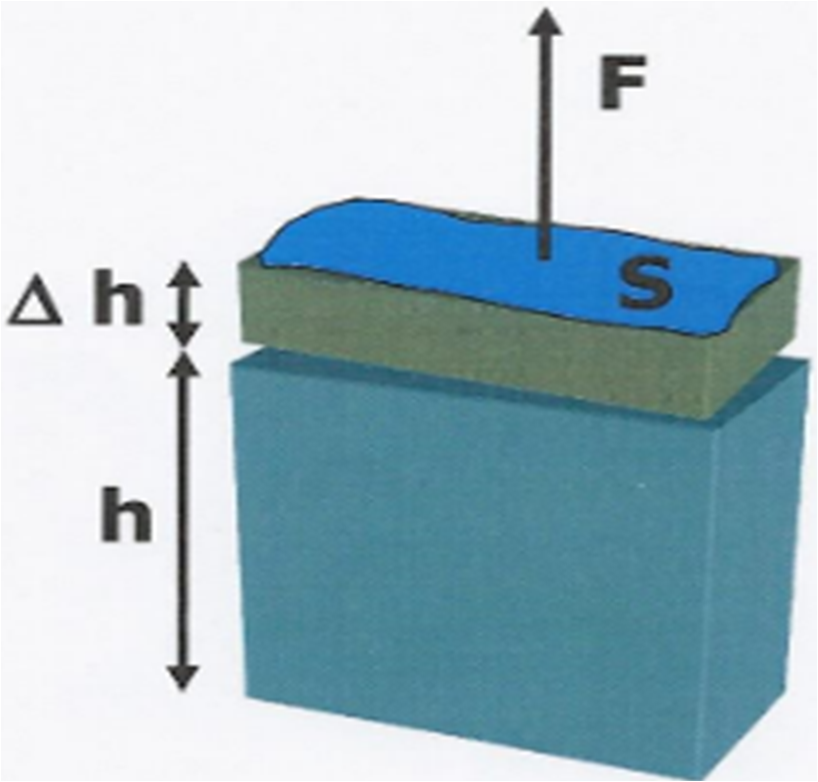
For each mixture, three cylindrical samples 10 x 20 cm are made at the optimum moisture content of the modified Proctor test. The compressive strength was determined according to the standard NF P98-230-2 25. The static modulus was obtained from the ratio between the compressive strength and the strain at failure of the material according to the following scheme:

Figure 3 shows the device for determining the mechanical properties of LG, LS and mixtures.
 | (4) |
 | (5) |
 | (6) |
CS – compressive strength, F – compression force, S – contact surface, SF - strain at failure; EST – static modulus.

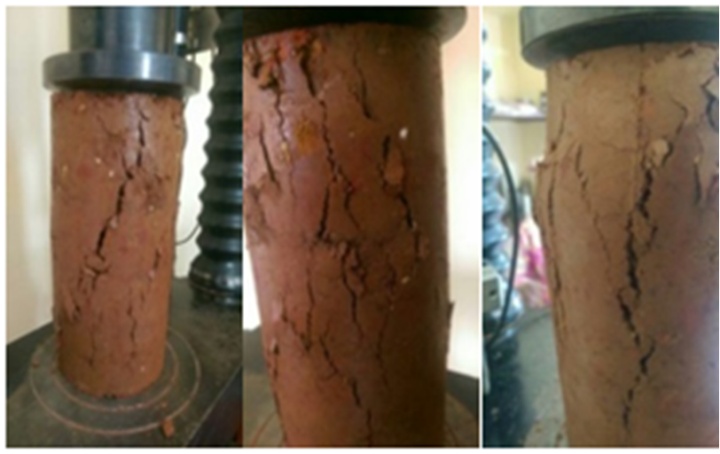
Figure 4 shows the multi-purpose universal press used to crush specimens 10 cm in diameter and 20 cm high.
The California Bearing Ratio (CBR) test is used for the mechanical characterization and compaction of materials in pavement layers. It measures the shear strength of the material and makes it possible to calculate the bearing capacity of the material, by estimating its resistance to punching. It gives the essential parameters for the geotechnical tests prior to construction and is defined according to the standard NF P 94-078 26.
The fragmentation test, i.e., the impact resistance of rocks and aggregates with regard to hardness, resistance to wear by friction and resistance to polishing. The hardness is intended to assess the resistance of the aggregate to fragmentation under the action of traffic. The Los Angeles test procedure is based on the standard NF P18-573 27.
The micro-Deval test is used to determine the wear resistance of an aggregate sample. This resistance to wear for certain rocks is not the same in dry conditions or in the presence of water. The test is defined according to the standard NF EN 1097-1 28. The flattening coefficient is one of the tests used to characterize the more or less massive shape of the aggregates. Grains of a gravel that approximate the sphere or cube are best. Those that come in needles, in platelets are to be discarded. The test is defined according to the standard NF EN 933-3 29.
Scanning electron microscopy (SEM) is performed with the Phillips XL30 EM device. It gives information on the relief of the sample, the morphology of the grains and their arrangement in the material. Depending on the physical and chemical properties of the grains, lateritic gravel is classified by three classification systems, AASHTO T88-70 30, standard NF P 11 300 18 and USCS 31: (1) classification for gravelly soils, where more than 50% of the elements by weight are greater than 80 μm and (2) classification for fine soils, where more than 50% of the elements by weight are less than 80 μm.
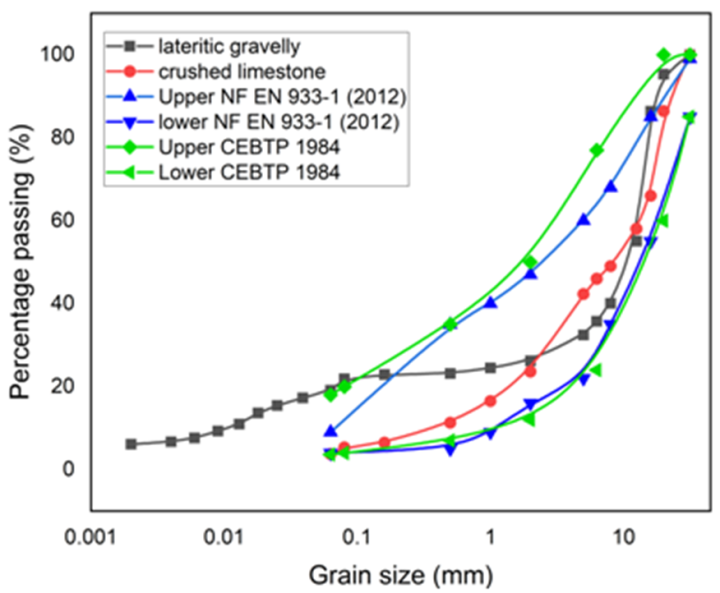
Figure 5 represents the grain sizes of LG (0/31.5), LS (0/31.5) and the normative spindles prescribed for the rocky materials of the base layer by the standard NF EN 13285 32 and the technical document CEBTP 1984 2.

Figure 5 shows the representation of lateritic gravelly and limestone according to the European standard NF EN933-1 (2012) and the CEBTP technical document (1984).
The characteristics of lateritic gravelly as the main material and limestone as a corrective material suitable for mechanical treatment are contained in Table 1.
The work consisted in finding the percentage of the corrective material (LS 0/31.5) to be added to the main material (LG 0/31.5) so that the grading curve of the mixture integrates the spindles 2, 27. Both materials meet the requirements for mechanical stabilization.
The lateritic gravelly (0/31.5) has a CBR index (68%), higher than those of lateritic gravelly (0/31.5) studied in the Democratic Republic of Congo, Ivory Coast and Niger 4, 10. The limestone LS (0/31.5) has a non-measurable plasticity index and its sand equivalent SE (74%) is higher than 40%, which is the lower limit of crushed materials that can be used as a base layer for T3- T4 traffic (1.5.106-4.106) 2.
3.2. Petrography and Mineralogy of Lateritic Gravelly
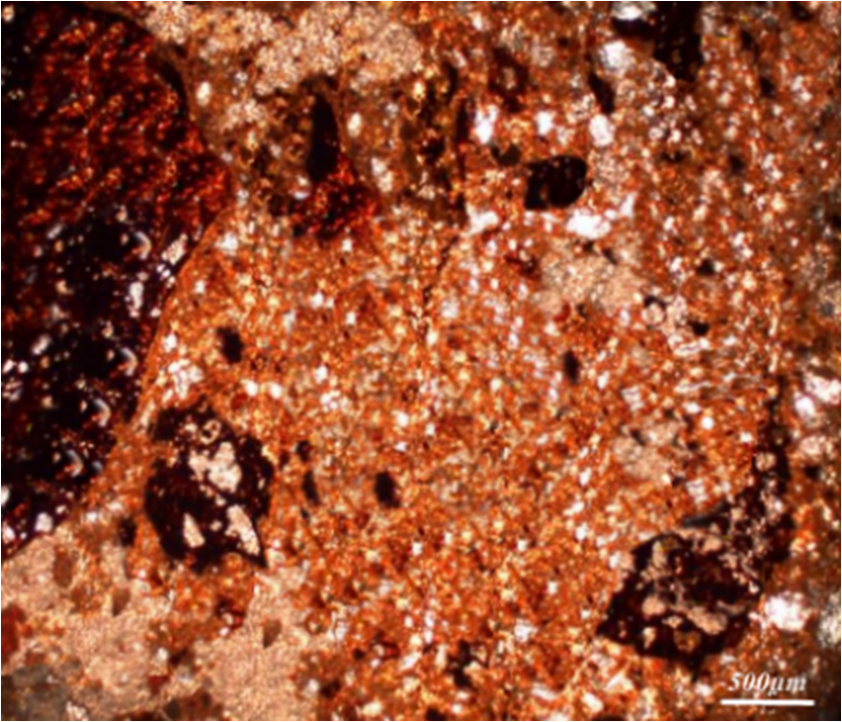
The amorphous resin appears grey-beige. The different minerals appear in ochre, white, orange and yellow-orange colors. It can be seen that the texture of these samples is characterized by zones of isolated concentration of iron oxides generally in an aggregate of quartz grains. The whole is immersed in a mainly kaolinic matrix. Quartz grains and pisolite concretions are also found embedded in the kaolinic matrix but with a relatively low density compared to the cementing zones. The petrographic study carried out on all the samples in the study area revealed minerals such as quartz, kaolinite and iron oxides. Depending on the combination and arrangement of the elements, three types of texture can be distinguished:
• Isolated ferruginous attack texture: it is characterized by ferritic zones dense in silica.
These zones are isolated and sporadically spread in the kaolinic matrix poor in iron oxides. The cracked quartz grains are also embedded in the kaolin matrix.
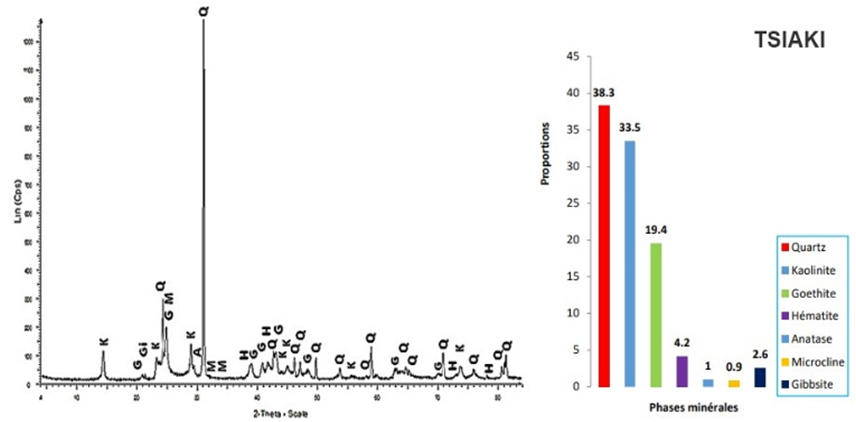
From Figure 7, quartz and kaolinite contents are lower in this sample, respectively 38.3% and 33.5%. On the other hand, iron oxides are present in large quantities with a content of 19.4 % for goethite and 4.2 % for hematite. A small amount of aluminum oxides (%gibbsite = 2.6%) was also found in this sample.

Anatase and microcline are present in trace amounts (1 and 0.9%). XRD analysis of the lateritic sample powders revealed minerals such as quartz, kaolinite, goethite, hematite, anatase and microcline. Hydrated aluminum oxides (gibbsite Al (OH)3) were found. Indeed, after identification of the mineral phases, they were quantified by the Riedvelt method.
The analyzed sample shows a predominance of silica and alumina contents which classifies the LG (0/31.5) among the aluminosilicates of the phyllosilicate family. Silica and alumina would respectively indicate the presence of quartz and clay minerals as a crystalline phase. These two crystalline phases have a refractory character and reinforce the mechanical strength of the finished material. The SiO2/Al2O3 ratio (2.85), being higher than 2, means that the LG (0/31.5) is less permeable to water and therefore less porous. The low K2O content means that the LG (0/31.5) is poor in illite.
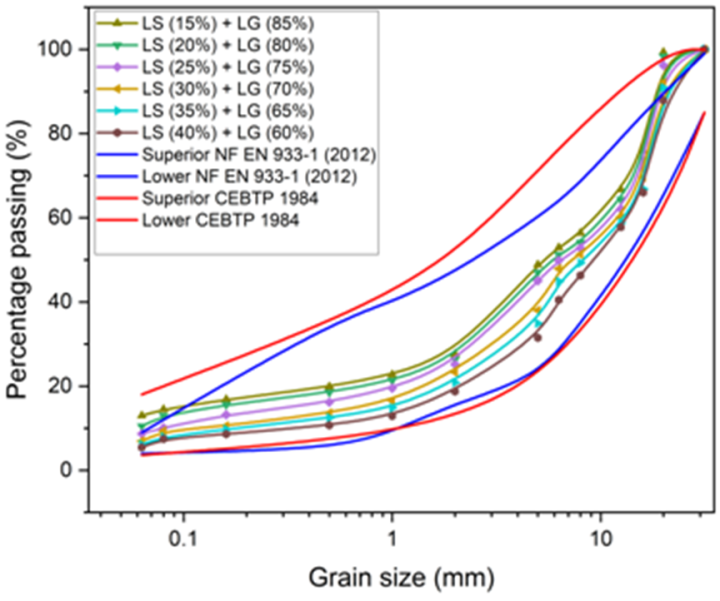
3.3. Characterization of Mixtures LG – LS (0/31.5)Figure 8 shows the particle size distribution of LG-LS (0/31.5) mixtures. The LS (0/31.5) was used in the mixtures in proportions of 15%, 20%, 25%, 30%, 35%, 40%.
Figure 8 shows the distribution of grains in the mixes after addition of LS (15-40%) according to the NF EN 933-1 (2012) spindle and the CEBTP (1984) technical document.
The particle size curves for mixtures of 15%-20% LS (0/31.5) include only the CEBTP 1984 spindle 2 and for mixtures of 25-40%, the curves include both spindles 2, 32.

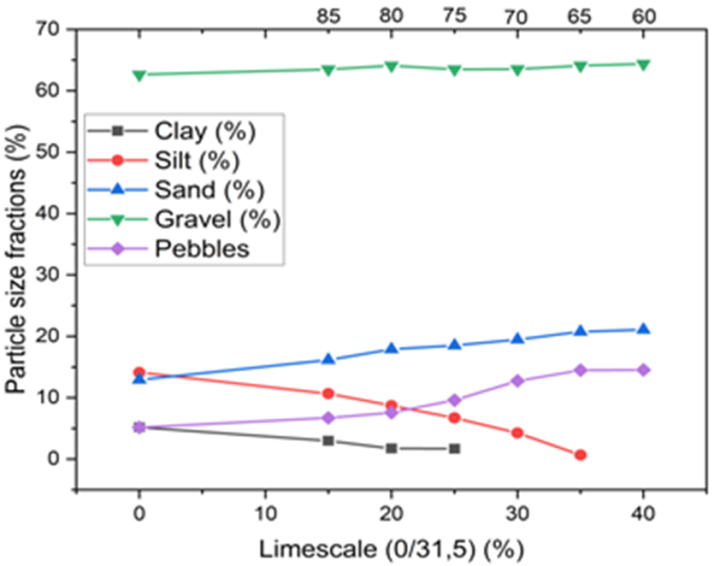
The particle size fractions of the mixtures are shown in Figure 9.

According to Figure 9, sand, gravel and pebbles fractions increase while clay and silt fractions decrease after the addition of LS (0/31.5).
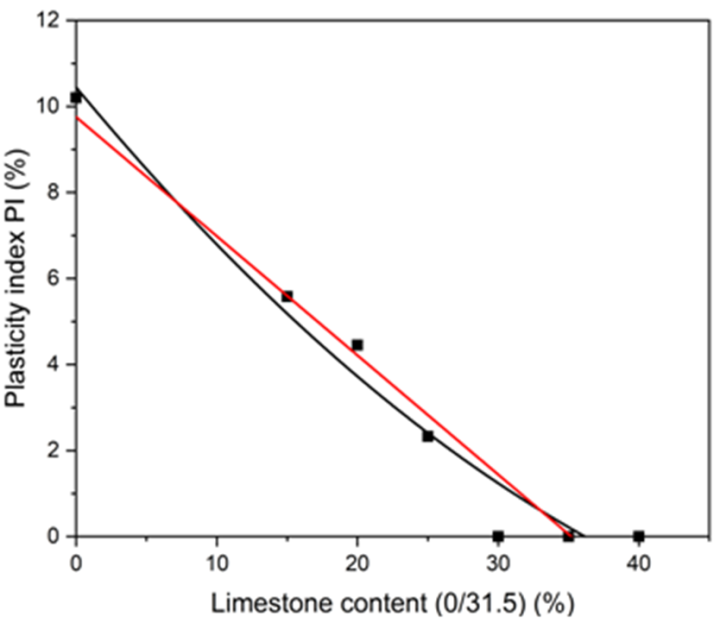
Figure 10 shows the evolution of the plasticity index as a function of the crushed sand content. In fact, this figure answers the question of whether the couple LG – LS (0/31.5) obeys the law of mixtures.
According to Figure 10, the plasticity index (PI) of the mixture is not really proportional to the lateritic gravelly content LG (0/31.5) of the mixture. Indeed, PI is of the form:
 | (7) |
PI - plasticity index of the mixture and αc - lateritic gravelly fines content (0/31.5) of the mixture.
Moreover, it can be said that the plasticity index does not obey the law of mixtures, contrary to the clay content of the mixture. In other words, the plasticity index is not proportional to the clay content of the mixture. Indeed, the clay content of the mixture ( ) as a function of the crushed sand content of the mixture is given by the following relationship:
 | (8) |
 - clay content of the mixture,
  - clay content of the lateritic gravelly,
  - plasticity of the mixture.

According to Figure 10, the addition of LS (0-25%) to lateritic gravelly decreases the PI (10.2-2.33) by 77.16% and the PI is not measurable after the addition of LS (30-40%).
The addition of LS (15-25%) decreases the PI (5.58-2.33%) by 58.24% and remains below 6%, the maximum allowed for rock materials for the base layer 2.

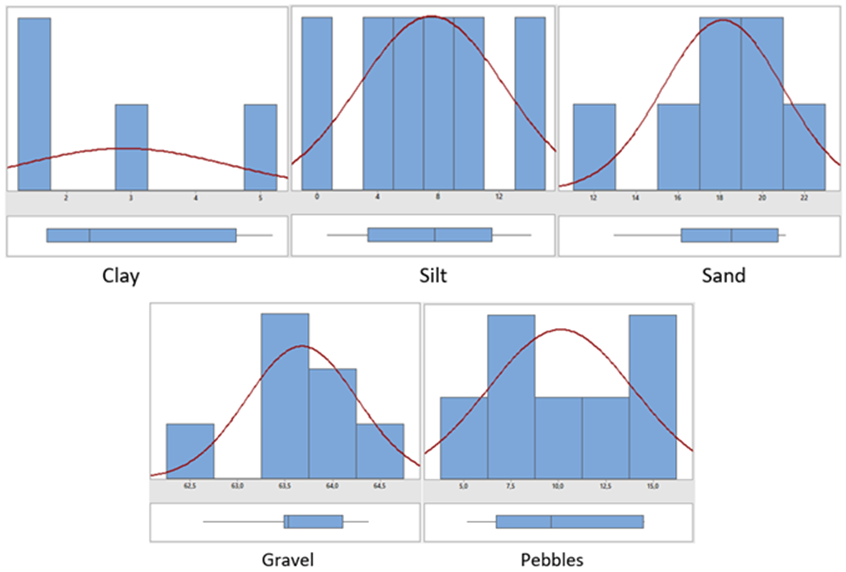
From Figure 11, the 95% confidence intervals for the particle size fractions are as follows: clay has a mean (0.2777-5.5023), median (1.68-5.18) and standard deviation (0.93-6.121). Silt has a mean (2.536-12.504), median (1.949-12.869) and standard deviation (2.965-11.648).
Sand has a mean (15.483-20.743), median (15.291-20.833) and standard deviation (1.833-6.262). Gravel has a mean (63.14-64.215), median (63.263-64.182) and standard deviation of (0.375-1.280). Pebbles have a mean (6.562-13.663), median (6.297-14.493) and standard deviation of (2.474-8.454).
The statistical properties of particle size fractions extracted from Figure 11 are shown in Table 4.
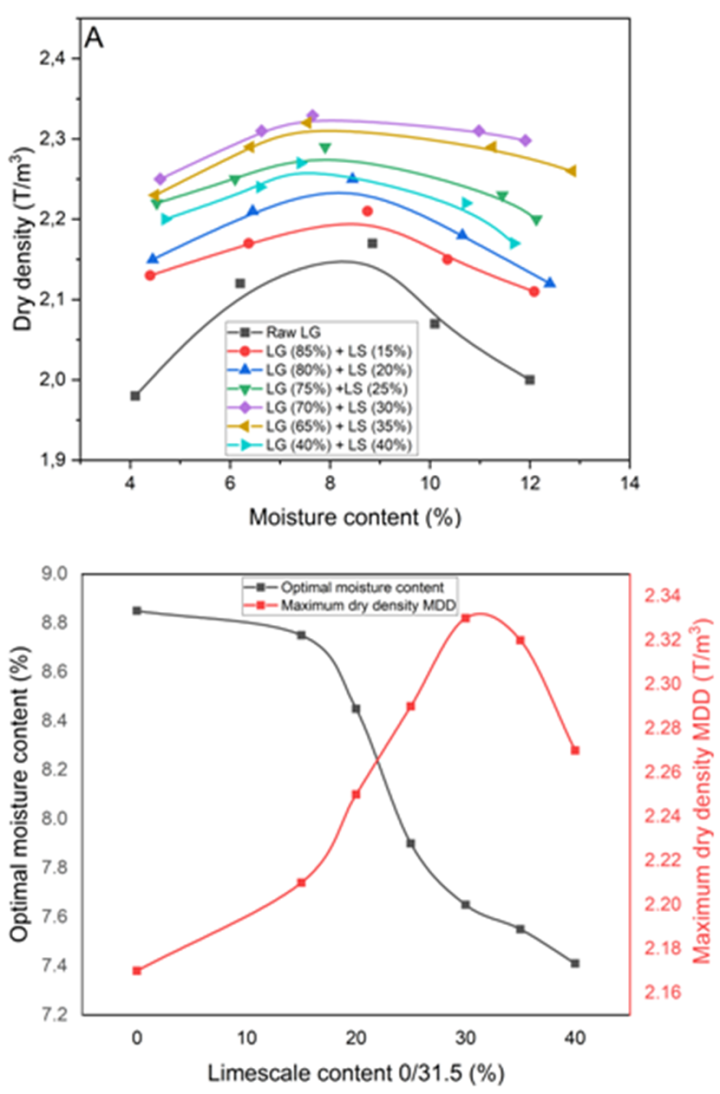
Several correlations were developed to understand the behavior of the resulting mixtures. Figure 12 (A), shows the evolution of the dry density as a function of the moisture content, after addition of LS (15-40%) and Figure 12 shows the correlation between maximum dry density and optimum moisture content.
Even if the Proctor test allows above all to determine the optimal moisture content (OMC) allowing to have a maximum dry density MDD of the material; and that the maximum dry density is not a direct indication of the mechanical strength of the material. It remains that for the same material, the less there are pores (defects), the more there are interactions between these different particles and in principle the more there is cohesion. Figure 12 shows that the maximum dry density (2.33 T/m3) is obtained with the addition of 30% limestone.
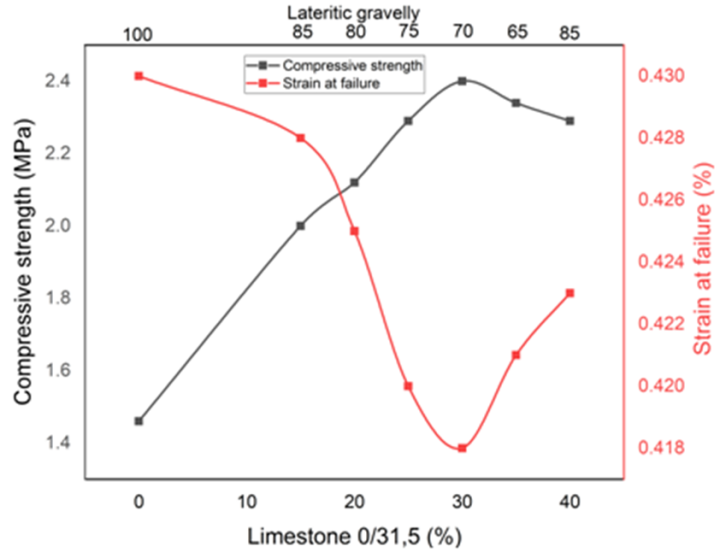
The addition of LS (15-30%) increases the DDM (2.17-2.29 T/m3) by 5.53% and for SL (35-40%) decreases the DDM (2.32-2.27 T/m3) by 2.16%. According to Figure 12, the addition of LS (15-25%) decreases the plasticity of the material and the optimal moisture content of the material. Figure 13 shows the correlation between the compressive strength and strain at failure of the mixes as a function of the addition of limestone.


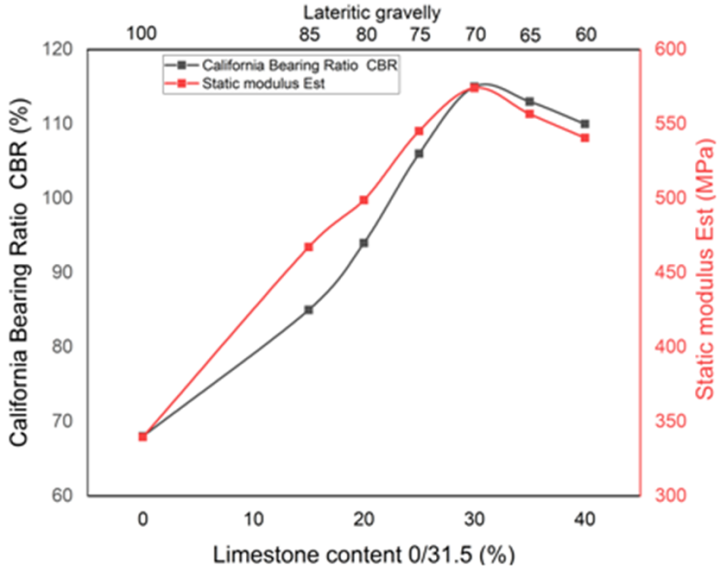
Figure 13 shows the negative correlation between compressive strength and strain at failure. If the pavement base layer is undersized (thin) in relation to the expected traffic, the pavement structure will operate with an imposed deformation. Figure 14 shows the correlation between the static modulus and the lift index CBR as a function of the addition of the limestone (0/315).

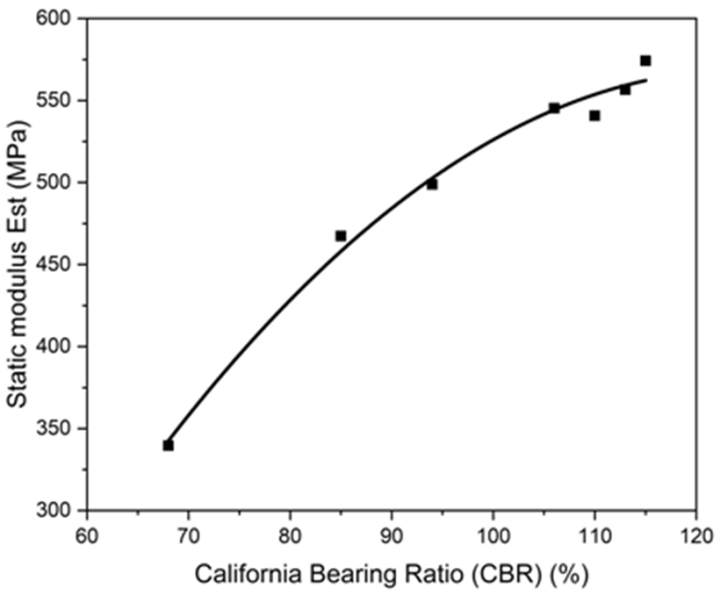
Figure 14 shows that there is a correlation between the static modulus of the material and its CBR value as a function of limestone addition, as illustrated in Figure 15.

The relationship between the static modulus and the California Bearing Ratio is a polynomial fit:
 | (9) |
 |
 |
 |
 |
On the other hand, for mixing LG - LS (0/31.5), the static modulus of the material can be adopted by the relationship 2:
 | (10) |
The average of the coefficient K (5), retained by the central laboratory for bridges and roads (LCPC-France) for the CBR index > 10, K (5) and for the CBR index < 10, K (10) 2. The static modulus is obtained by the relation (5):
 | (11) |
and the CBR (%), is defined after laboratory tests. The average K coefficient can be determined by the following relationship:
 | (12) |
 | (13) |
The results obtained are contained in Table 5.
The average coefficient is K (5.1), for a CBR (68-115%) > 10 2.

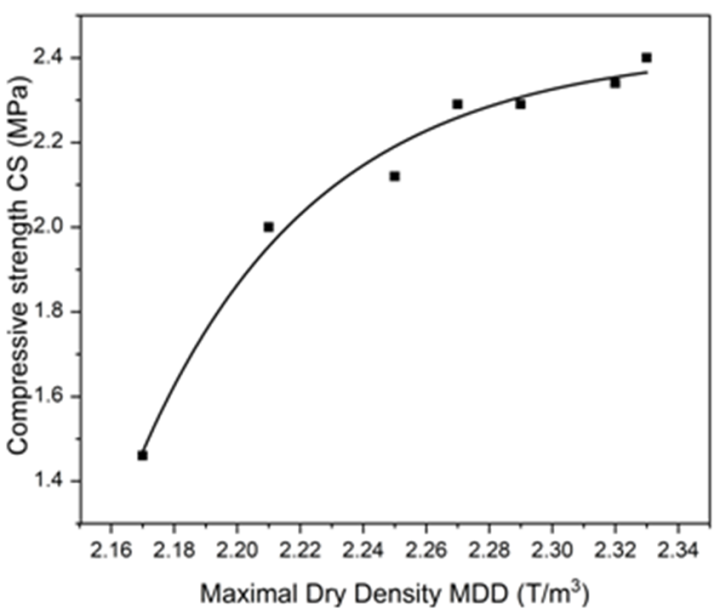
According to Figure 16, the correlation obtained allows to define the compressive strength of a mixture of granular materials in the preliminary study phase.
The relationship between compressive strength and maximum dry density is a fit to the logistic model of the form:
 |
 |
 |
 |
 |
 |
CS (MPa) – compressive strength, MDD (T/m3) – maximum dry density, R2 - coefficient of determination, Chi - Sqr (χ²) – allows to test the independence between two random variables.
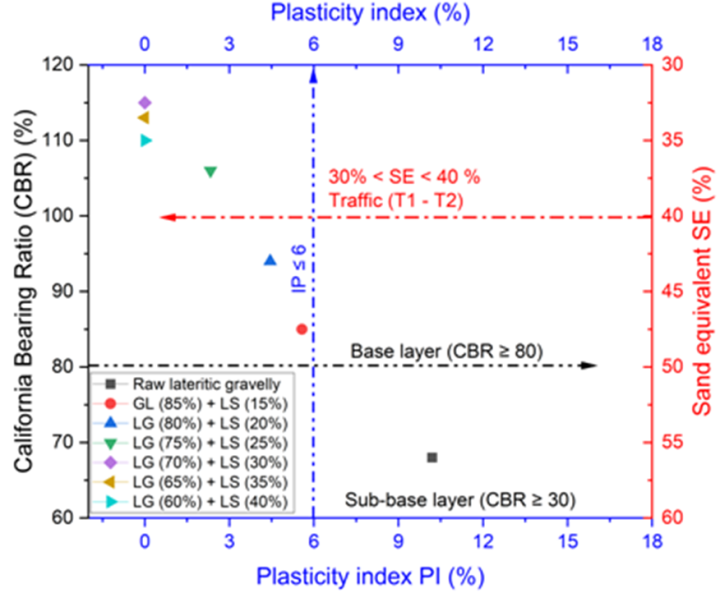
3.5. Uses of Mixtures in Pavement LayersFigure 16 shows the bearing capacity of lateritic gravel and LG - LS (0/31.5) mixtures and indicates their use in pavement layers.

According to Figure 17, the raw LG has a CBR index (68%), higher than the minimum of 35% 2, its plasticity index PI (10.2%) is lower than the maximum of 20% 2. Lateritic gravelly can be used in the sub-base layer of pavements with T1-T2 (5.105 - 1.5.106) traffic, for the cumulative number of passages of an axle equivalent to 13T 2. Mixtures with LS (15-25%) have indices CBR (85-106%), above the minimum of 80% 2 and plasticity indices PI (5.58-2.33%), below the maximum of 6% 2. These mixes are recommended for the base layer of pavements that can withstand T1 < 5.105 traffic (in cumulative axle loads equivalent to 13T) 2. For mixtures with LS (30-40%), the CBR (115-110%) and sand equivalent SE (32.5-35%) are respectively higher than 80% and 30-40%. These mixes are recommended for the base layer of T1-T2 pavements 2.
3.6. DiscussionIn Figure 5, the grading curve of the lateritic gravelly LG (0/31.5) presents a similar aspect to those observed for other lateritic gravelly. Indeed, without being identical, the grading curve is generally inscribed in the spindle for the coarse elements and flares for the fine elements 4, 10. To allow the grain size curve of the LG (0/31.5) to integrate the CEBTP 1984 and NF EN 933-1 2, 32 spindles, the LG (0/31.5) was amended with a LS (0/31.5) less rich in fines in order to reduce the percentage of grains of size 0.063-0.2 mm. The grain size curve of the LG (0/31.5) is outside the upper normative ranges of CEBTP 1984 and NF EN 933-1 2, 32 for grains smaller than 0.1 mm and 0.2 mm respectively. The washed grading curve LS (0/31.5) is well within the two spindles for 0.08-31.5 mm grains. For grain sizes of 0.06-0.08 mm, the grading curve is outside the lower spindles (NF EN 933-1) 32 and at the lower limit of the CEBTP 1984 spindles 2.
According to Figure 5, the CEBTP 1984 classification 2 divides the LG (0/31.5) into three groups defined on the basis of geotechnical parameters. Unfortunately, none of these classifications place the LG (0/31.5) in any particular group. Some geotechnical parameters place LG in group 1, 2 or 3. According to the specifications of standard NF P11-300 18, LG (0/31.5) is classified as B6, containing fine clayey 32 of class A-2-4 31 like most of the lateritic gravelly studied 4, 17.
According to Table 1, the grain size distribution of the LG (0/31.5) is composed of the fractions clay, silt, sand, gravel and pebbles. The grain distribution has a uniformity coefficient Cu > 10 and a curvature coefficient Cc > 3, i.e., the grading curve is poorly calibrated. Figures 5, 8-9 show that the addition of LS (15-25%) decreases the clay fraction (1.98-1.68%) by 15.15% and that the clay fraction is not measurable for LS (30-40%). The addition of LS (15-35%) decreases the silt fraction (10.67-0.67%) by 93.72% and for LS (40%) the silt fraction is not measurable. For LS (15-40%), the sandy fraction (16.15-21.09%) increases by 30.59%. The decrease of the clay and silt fraction causes the decrease of the cohesion, plasticity index (Figure 10) and the optimum moisture content (Figure 12) of the material. For LS (15-30%), CBR, compressive strength and static modulus improve 2, 4, 5, 33. When LS (35-40%) and the sand fraction (20.74-21.09%), the mechanical properties decrease 2, 4, 5, 33.
Figure 11 and Table 4 show that the Alpha significance level of 0.05 and the Anderson-Darling normality test with A2 (0.12-0.39) and p-value (0.19-0.98) show that the resting pulse data does not follow a normal distribution.
In the Figure 12, the addition of LS (30-40%) does not measure the plasticity of the material and the sand equivalent SE (32.5-35%) increases by 10.77%. The increase in sand content leads to a flattening of the dry density curves.
Figure 13 shows that there is a strong negative correlation between compressive strength and strain at failure, which will be manifested in the settlement of the pavement body materials. Indeed, the addition of LS (15-30%) decreases the strain at failure and the compressive strength increases. Above 30% limestone, the strain at failure increases and the compressive strength decreases. It is therefore necessary to design the different layers of the pavement according to the traffic to avoid settlement or punching of the pavement structure materials.
According to Figure 14, the relationship between the static modulus and the California Bearing Ratio is a polynomial fit. However, the average coefficient K (5.1) is obtained for Est (339.53-574.24 MPa) with CBR values (68-115%) higher than 10% 2. The relationship between compressive strength and maximum dry density is a fit to the logistic model (Figure 16).
According to Figure 17, the mixes with LS (15-25%) have a CBR (85-106%) higher than the minimum 80%. The plasticity index PI (2.33-5.58%) Figure 10, is lower than the maximum of 6% 2, which is the allowed limit for the plasticity of rock materials in the base layer for T1-T2 traffic (5.105-1.5.106) 2. Mixtures with LS (30-40%) have a CBR (110-115%) higher than the minimum of 80% and a sand equivalent SE (32.5-35%) higher than the minimum of 30%, but lower than the maximum of 40%, for use as a base layer for T1-T2 traffic 2. According to Table 3, for mixtures of LS (15 - 40%), the static modulus Est (467.29 - 540.64 MPa) and the compressive strength CS (2 – 2.29 MPa) can be used in the base layer of pavements 2, 17. Lateritic gravelly has a static modulus Est (339.53MPa) and a compressive strength Rc (1.46 MPa), which recommends it as a sub-base layer with T1-T3 traffic (5.105- 4.106) 2.
The LG (0/31.5) is a cohesive, moderately plastic material PI (10.2%) with a spread out and poorly graded particle size. The LG (0/31.5) is composed of clay (5.18%), silt (14.09%), sand (6.93%), gravel (68.64%) and pebbles (5.16%). The LS (0/31.5) has a spread and well graded particle size, composed of sand (24.54%), gravel (58.61%) and pebbles (16.85%). The lateritic gravel contains clay fines classified as B6 and A-2-4. The LG (0/31.5) has a Los Angeles coefficient LA (33). Thanks to its Los Angeles LA (18) and Micro Deval DM (6.25) coefficients, the LS (0/31.5) can support T4-T5 (4.106-2.107) traffic as a base layer, in terms of cumulative number of passages of an axle equivalent of 13T. The mixture of LG (0/31.5) as the main material and LS (0/31.5) as the corrective material does not obey the law of mixtures. LS (0/31.5) has a sand equivalent SE (74%), i.e., LS (0/31.5) sand can be used in the production of quality concrete. The mechanical characteristics and plasticity index of LG (0/31.5) are respectively CBR (68%), Est (339.53 MPa), CS (1.46 MPa) and PI (10.2%). In other words, LG (0/31.5) can be used as a sub-base layer material for T2-T3 traffic (5.105 - 4.106). LS (0/31.5) has a CBR value (98%) that should be discarded because of the reduced number of contacts between the grains and the risk of grain displacement during the passage of automobiles. The lack of a solid cohesion of the material was observed during compaction of LS (0/31.5) in the laboratory. LG-LS mixtures (15%, 20%, and 25%, 30%, 35%, 40%) have their optimum at 30%. For mixtures with LS (15-30%), the CBR (85-106%), Est (467.29-545.24MPa), CS (2-2.29 MPa), MDD (2.25-2.33 T/m3) increase, the optimum moisture content and plasticity index decrease. The mixture LS (30%) is recommended for the traffic base layer T2-T3 (5.105 - 4.106). For mixtures with LS (30-40%), the CBR (110-115%), Est (540.64-574.24 MPa), CS (2.4-2.29 MPa), MDD (2.33-2.27 T/m3) decrease when the sand fraction is in the range 20.74-21.09%. These mixes are recommended for the base layer for traffic T1-T2 (5.105-1.5.106). The optimum moisture content continues to decrease, the plasticity index becomes unmeasurable and the SE sand equivalent (32.5-35%) increases. In effect, the addition of LS (15-40%), decreases the clay and silt fractions and the sand fraction increases. The increase of the sand fraction (20.74-21.09%) causes the flattening of the dry density curves (Proctor). The correlation of mixtures between the static modulus Est (339.53 - 574.24 MPa) and the CBR index (68-115%) has an average coefficient K (5.1). There is a negative correlation between compressive strength and strain at failure, due to the fact that the base layer is thin and rests on a deformable substrate.
The authors declare that they have no known competing financial interests or personal relationships that could have appeared to influence the work reported in this article.
| [1] | Lombard J., O. Ninot. (2010). . BAGF, Geographies. Bulletin of the Association of French Geographers, 2010 - persee.fr. | ||
| In article | |||
| [2] | C.E.B.T.P (1984): Practical guide to pavement design for tropical countries, French Ministry of Cooperation. | ||
| In article | |||
| [3] | Georges Jeuffroy, “Design and Construction of Pavements - Volume II”. Materials, equipment, techniques for carrying out the work. E. Eyrolles 1985. | ||
| In article | |||
| [4] | Louis Ahouet, Raymond Gentil Elenga, Stévyna Bouyila, Mondésir Ngoulou, Eric Kengue (2019). Improvement of the geotechnical properties of lateritic gravel by adding crushed alluvial gravel 0/31,5. Revue RAMRes – Applied and Engineering Sciences. V 3(1), pp. 1-6. http://publication.lecames.org. | ||
| In article | |||
| [5] | Raymond G. Elenga, Louis Ahouet, Mondésir Ngoulou, Stévina Bouyila, Guy F. Dirras, Eric Kengué (2019). Improvement of an Alluvial Gravel Geotechnical Properties with a Clayey Soil for the Road Construction. Research Journal of Applied Sciences, Engineering and Technology 16(4): 135-139. | ||
| In article | View Article | ||
| [6] | A.A.A. Molenaara. Durable and Sustainable Road Constructions for Developing Countries. Procedia Engineering 54 (2013) 69-81. The 2 nd International Conference on Rehabilitation and Maintenance in Civil Engineering. | ||
| In article | View Article | ||
| [7] | G. Cocks, Keeley, R., Leek, C., Foley, P., Bond, T., Crey, A., Paige-Green, P., Emery, S., Clayton, R., Iness, Mc D., Les Marchant. The use of naturally occurring materials for pavements in western australia. Austalian Geomechanics, 30, 1, 2015. | ||
| In article | |||
| [8] | Weinert, H. H. The natural road construction materials of South Africa. Academica, Pretoria, Cape Town, 1980. . | ||
| In article | |||
| [9] | Nwaiwu, C.M.O., Alkali, I.B.K. & Ahmed, U.A. Properties of Ironstone Lateritic Gravels in Relation to Gravel Road Pavement Construction. Geotech Geol Eng 24, 283-298 (2006). | ||
| In article | View Article | ||
| [10] | Zolfeghari Fara, S.Y., Kassimb, K. A., Eisazadehb, A., Kharib, M. An Evaluation of the Tropical Soils Subjected Physicochemical Stabilization for Remote Rural Roads. Procedia Engineering 54, 2013. | ||
| In article | View Article | ||
| [11] | M Fall (1993). Identification and mechanical characterization of lateritic gravels from Senegal: Application to roads. | ||
| In article | |||
| [12] | Quadri1, H. A., Adeyemi1, O. A., Olafusi, O. S. (2012). Investigation of the geotechnical engineering properties of laterite as a subgrade and base material for road constructions in Nigeria, Civil and Environmental Research, 2, Vol.8, 2012. | ||
| In article | |||
| [13] | Onana, V. L., Ngo’o Ze, A., Medjo Eko, R., Ntouala, R. F. D., Nanga Bineli, M. T., Ngono Owoudou, B., Ekodeck, G. E. (2017). Geological identification, geotechnical and mechanical characterization of charnockite-derived lateritic gravels from Southern Cameroon for road construction purposes,Transportation Geotechnics, 10, 2017. | ||
| In article | View Article | ||
| [14] | Marie Thérèse Marame Mbengue, Abdou Lawane Gana, Adamah Messan, Anne Pantet (2022). Geotechnical and Mechanical Characterization of Lateritic Soil Improved with Crushed Granite. | ||
| In article | |||
| [15] | Ndiaye Massamba, Magnan Jean-Pierre, Cissé Lamine (2022). Lithostabilization studies of laterite with dolerite from Mansadala (South-East of Senegal) for use in pavement base courses. ESJ Natural/Life/Medical Sciences. | ||
| In article | |||
| [16] | Souley Issiakou M., Saiyouri N., Anguy Y., Gaborieau C., Fabre R. (2015). Study of lateritic materials used in road construction in Niger: improvement method. 33rd Meeting of AUGC, ISABTP/UPPA, Anglet, 27 - 29 May 2015. | ||
| In article | |||
| [17] | NF P 11-300 (1992) French Standard. Construction of Earthworks - Classification of Materials for Use in the Construction of Embankments and Subgrades of Road Infrastructure. | ||
| In article | |||
| [18] | Chrétien, M., Fabre, R., Denis, A. and Marache, A. (2007) Search for Optimal Geotechnical Identification Parameters for a Classification of Soils Susceptible to Shrink-Swell. French Journal of Geotechnics, No. 120-121, 91-106. | ||
| In article | View Article | ||
| [19] | NF P 94-056 (1996) French Standard. Soils: Recognition and Tests. Granulometric Analysis. Method by Dry Sieving after Washing, French Standards Association, 5-15. | ||
| In article | |||
| [20] | NF P94-057 (1992) French Standard. Soils: Recognition and Tests. Granulometric Analysis. Sedimentation Method, French Standards Association, 4-17. | ||
| In article | |||
| [21] | NF P94-051 (1993) French Standard. Soils: Recognition and Tests. Determination of Atterberg Limits. Limit of Liquidity at the Cup-Limit of Plasticity at the Roller. French Standards Association, 4-14. | ||
| In article | |||
| [22] | NF P94-068 (1998) French Standard. Soils: Investigation and Testng—Measuring of the Methylene Blue Adsorption Capacity of a Rocky Soil. Determination of the Methylene Blue of a Soil by Means of the Strain Test, October 1998. | ||
| In article | |||
| [23] | NF P 94-093 (2014) French Standard. Soils: reconnaissance and testing - Determining the compaction references of a material - Normal Proctor test - Modified Proctor test. | ||
| In article | |||
| [24] | NF P 18-598 (1991) French Standard. The sand equivalent (SE) is a test that measures the cleanliness of sand. It is intended for use on plastic soils where the plasticity index measurement is not very accurate. | ||
| In article | |||
| [25] | NF P98-230-2 (1993) French Standard. Pavement testing - Preparation of hydraulically bound or unbound materials - Part 2: Manufacture of sand or fine soil specimens by static compression. | ||
| In article | |||
| [26] | NF P 94-078 (1997) French Standard: Soils: Reconnaissance and tests - CBR index after immersion - Immediate CBR index - Immediate bearing index - Measurement on compacted sample in the CBR mould. | ||
| In article | |||
| [27] | P18-573 (1990) French Standard: Aggregates - Los Angeles test. Coefficient expressed as a percentage that characterizes the resistance to fragmentation of an aggregate. | ||
| In article | |||
| [28] | NF EN 1097-1 (2004) European Standard: Tests for determining the mechanical and physical properties of aggregates - Part 1: Determination of wear resistance (micro-Deval). | ||
| In article | |||
| [29] | NF EN 933-3 (1997) European Standard: Test to determine the geometric characteristics of aggregates. Part 3. Determination of aggregate shapes. Flattening coefficient. | ||
| In article | |||
| [30] | AASHTO T88-70. The American Association of State Highway and Transportation Officials system is used worldwide for road construction. | ||
| In article | |||
| [31] | Unified Soil Classification System (USCS). This system is applicable to projects such as dams, foundations and runways. The basic principle of this system is to classify coarse-grained soils according to their grain size and fine-grained soils according to their plasticity. | ||
| In article | |||
| [32] | NF EN 933-1 (2012). Tests for determining the geometric properties of aggregates - Part 1: Determination of grain size - Sieve size analysis. | ||
| In article | |||
| [33] | Marie Thérèse Marame Mbengue, Abdou Lawane Gana, Adamah Messan, Anne Pantet. Geotechnical and Mechanical Characterization of Lateritic Soil Improved with Crushed Granite. Civil Engineering Journal, Vol. 8, No. 05, May, 2022. | ||
| In article | View Article | ||
Published with license by Science and Education Publishing, Copyright © 2023 Sorel Gael Dzaba Dzoualou, Louis Ahouet, Sylvain Ndinga Okina and Mang Egrik P. W. O. Nkembo
 This work is licensed under a Creative Commons Attribution 4.0 International License. To view a copy of this license, visit
http://creativecommons.org/licenses/by/4.0/
This work is licensed under a Creative Commons Attribution 4.0 International License. To view a copy of this license, visit
http://creativecommons.org/licenses/by/4.0/
| [1] | Lombard J., O. Ninot. (2010). . BAGF, Geographies. Bulletin of the Association of French Geographers, 2010 - persee.fr. | ||
| In article | |||
| [2] | C.E.B.T.P (1984): Practical guide to pavement design for tropical countries, French Ministry of Cooperation. | ||
| In article | |||
| [3] | Georges Jeuffroy, “Design and Construction of Pavements - Volume II”. Materials, equipment, techniques for carrying out the work. E. Eyrolles 1985. | ||
| In article | |||
| [4] | Louis Ahouet, Raymond Gentil Elenga, Stévyna Bouyila, Mondésir Ngoulou, Eric Kengue (2019). Improvement of the geotechnical properties of lateritic gravel by adding crushed alluvial gravel 0/31,5. Revue RAMRes – Applied and Engineering Sciences. V 3(1), pp. 1-6. http://publication.lecames.org. | ||
| In article | |||
| [5] | Raymond G. Elenga, Louis Ahouet, Mondésir Ngoulou, Stévina Bouyila, Guy F. Dirras, Eric Kengué (2019). Improvement of an Alluvial Gravel Geotechnical Properties with a Clayey Soil for the Road Construction. Research Journal of Applied Sciences, Engineering and Technology 16(4): 135-139. | ||
| In article | View Article | ||
| [6] | A.A.A. Molenaara. Durable and Sustainable Road Constructions for Developing Countries. Procedia Engineering 54 (2013) 69-81. The 2 nd International Conference on Rehabilitation and Maintenance in Civil Engineering. | ||
| In article | View Article | ||
| [7] | G. Cocks, Keeley, R., Leek, C., Foley, P., Bond, T., Crey, A., Paige-Green, P., Emery, S., Clayton, R., Iness, Mc D., Les Marchant. The use of naturally occurring materials for pavements in western australia. Austalian Geomechanics, 30, 1, 2015. | ||
| In article | |||
| [8] | Weinert, H. H. The natural road construction materials of South Africa. Academica, Pretoria, Cape Town, 1980. . | ||
| In article | |||
| [9] | Nwaiwu, C.M.O., Alkali, I.B.K. & Ahmed, U.A. Properties of Ironstone Lateritic Gravels in Relation to Gravel Road Pavement Construction. Geotech Geol Eng 24, 283-298 (2006). | ||
| In article | View Article | ||
| [10] | Zolfeghari Fara, S.Y., Kassimb, K. A., Eisazadehb, A., Kharib, M. An Evaluation of the Tropical Soils Subjected Physicochemical Stabilization for Remote Rural Roads. Procedia Engineering 54, 2013. | ||
| In article | View Article | ||
| [11] | M Fall (1993). Identification and mechanical characterization of lateritic gravels from Senegal: Application to roads. | ||
| In article | |||
| [12] | Quadri1, H. A., Adeyemi1, O. A., Olafusi, O. S. (2012). Investigation of the geotechnical engineering properties of laterite as a subgrade and base material for road constructions in Nigeria, Civil and Environmental Research, 2, Vol.8, 2012. | ||
| In article | |||
| [13] | Onana, V. L., Ngo’o Ze, A., Medjo Eko, R., Ntouala, R. F. D., Nanga Bineli, M. T., Ngono Owoudou, B., Ekodeck, G. E. (2017). Geological identification, geotechnical and mechanical characterization of charnockite-derived lateritic gravels from Southern Cameroon for road construction purposes,Transportation Geotechnics, 10, 2017. | ||
| In article | View Article | ||
| [14] | Marie Thérèse Marame Mbengue, Abdou Lawane Gana, Adamah Messan, Anne Pantet (2022). Geotechnical and Mechanical Characterization of Lateritic Soil Improved with Crushed Granite. | ||
| In article | |||
| [15] | Ndiaye Massamba, Magnan Jean-Pierre, Cissé Lamine (2022). Lithostabilization studies of laterite with dolerite from Mansadala (South-East of Senegal) for use in pavement base courses. ESJ Natural/Life/Medical Sciences. | ||
| In article | |||
| [16] | Souley Issiakou M., Saiyouri N., Anguy Y., Gaborieau C., Fabre R. (2015). Study of lateritic materials used in road construction in Niger: improvement method. 33rd Meeting of AUGC, ISABTP/UPPA, Anglet, 27 - 29 May 2015. | ||
| In article | |||
| [17] | NF P 11-300 (1992) French Standard. Construction of Earthworks - Classification of Materials for Use in the Construction of Embankments and Subgrades of Road Infrastructure. | ||
| In article | |||
| [18] | Chrétien, M., Fabre, R., Denis, A. and Marache, A. (2007) Search for Optimal Geotechnical Identification Parameters for a Classification of Soils Susceptible to Shrink-Swell. French Journal of Geotechnics, No. 120-121, 91-106. | ||
| In article | View Article | ||
| [19] | NF P 94-056 (1996) French Standard. Soils: Recognition and Tests. Granulometric Analysis. Method by Dry Sieving after Washing, French Standards Association, 5-15. | ||
| In article | |||
| [20] | NF P94-057 (1992) French Standard. Soils: Recognition and Tests. Granulometric Analysis. Sedimentation Method, French Standards Association, 4-17. | ||
| In article | |||
| [21] | NF P94-051 (1993) French Standard. Soils: Recognition and Tests. Determination of Atterberg Limits. Limit of Liquidity at the Cup-Limit of Plasticity at the Roller. French Standards Association, 4-14. | ||
| In article | |||
| [22] | NF P94-068 (1998) French Standard. Soils: Investigation and Testng—Measuring of the Methylene Blue Adsorption Capacity of a Rocky Soil. Determination of the Methylene Blue of a Soil by Means of the Strain Test, October 1998. | ||
| In article | |||
| [23] | NF P 94-093 (2014) French Standard. Soils: reconnaissance and testing - Determining the compaction references of a material - Normal Proctor test - Modified Proctor test. | ||
| In article | |||
| [24] | NF P 18-598 (1991) French Standard. The sand equivalent (SE) is a test that measures the cleanliness of sand. It is intended for use on plastic soils where the plasticity index measurement is not very accurate. | ||
| In article | |||
| [25] | NF P98-230-2 (1993) French Standard. Pavement testing - Preparation of hydraulically bound or unbound materials - Part 2: Manufacture of sand or fine soil specimens by static compression. | ||
| In article | |||
| [26] | NF P 94-078 (1997) French Standard: Soils: Reconnaissance and tests - CBR index after immersion - Immediate CBR index - Immediate bearing index - Measurement on compacted sample in the CBR mould. | ||
| In article | |||
| [27] | P18-573 (1990) French Standard: Aggregates - Los Angeles test. Coefficient expressed as a percentage that characterizes the resistance to fragmentation of an aggregate. | ||
| In article | |||
| [28] | NF EN 1097-1 (2004) European Standard: Tests for determining the mechanical and physical properties of aggregates - Part 1: Determination of wear resistance (micro-Deval). | ||
| In article | |||
| [29] | NF EN 933-3 (1997) European Standard: Test to determine the geometric characteristics of aggregates. Part 3. Determination of aggregate shapes. Flattening coefficient. | ||
| In article | |||
| [30] | AASHTO T88-70. The American Association of State Highway and Transportation Officials system is used worldwide for road construction. | ||
| In article | |||
| [31] | Unified Soil Classification System (USCS). This system is applicable to projects such as dams, foundations and runways. The basic principle of this system is to classify coarse-grained soils according to their grain size and fine-grained soils according to their plasticity. | ||
| In article | |||
| [32] | NF EN 933-1 (2012). Tests for determining the geometric properties of aggregates - Part 1: Determination of grain size - Sieve size analysis. | ||
| In article | |||
| [33] | Marie Thérèse Marame Mbengue, Abdou Lawane Gana, Adamah Messan, Anne Pantet. Geotechnical and Mechanical Characterization of Lateritic Soil Improved with Crushed Granite. Civil Engineering Journal, Vol. 8, No. 05, May, 2022. | ||
| In article | View Article | ||