Fire outbreaks in market places are frequently occurring in Nigeria; they have different negative effects such as the destruction of valuable goods, properties and the loss of lives of people. Thus, market environments in the Federal Capital Territory of Nigeria were studied with the aim of determining the passive fire readiness, in order to provide improved design guidelines for Nigerian market design against fire outbreaks. Descriptive survey method was used for this research. There are 1,430 total number of sales points in the study area. Out of the total number of sales points, 287 sales points were studied by the use of systematic sampling method at every 5th interval. Data were obtained from the core stakeholders such as the Federal Fire Service of Nigeria, National Association of Nigerian Traders and the managing company of the market through interviews. They were also obtained from the direct observation schedule, and from the sales people in the market via focus group discussions. Contents analysis technique was used to analyze the data; the result of the data analysis was accepted via normality test. In the presence of other findings is inadequate fire exit gates in the market. Among other guidelines is that all markets must have adequate number of fire exit gates and these should be determined by the architects with respect to the size of markets in terms of the number of available facilities and expected human population.
In the Federal Capital Territory (FCT) of Nigeria, just like in any other city of Nigeria, there are many markets and the large population of FCT has led to the establishment of different markets in the territory 1. As more markets were established in Nigeria, different problems arose from their establishments and these include fire outbreaks, bomb blasts, stealing, fraud, human congestions, quarrels and disputes, inadequate supply of water and electricity, inadequate toilet facilities, dilapidated market structures, substandard buildings, the activities of hawkers and open space traders that do not conform with the standard market operations 2, 3, 4. Among these problems, fire outbreaks in particular have led to the destruction of substantial goods, properties and lives of many people on regular basis 2, 3. Therefore, passive fire readiness of Nigerian markets is a very crucial issue, and it is thus the focus of this study.
Passive fire readiness in this context refers to the passive fire prevention and protection measures in the market. It is a means whereby fire may be prevented as much as possible through design and use of appropriate materials 5. This includes the provision of areas or places of refuge, fire escape doors and stairs, and fire drills to educate occupants on fire protection devices and means of escape 6, 7. Properties and lives of people can be saved by being prepared before fire strikes 8. When looking at new building developments, fire safety is often a consideration which seems to be taken for granted, particularly where markets are concerned 9. There is a necessity for fire safety in the design of buildings 10. Optimum fire prevention and protection are enhanced with the incorporation of fire safety from the stages of design to the stages of completion of markets which in turn curtails the risks from fire.
According to the 24, the design for fire safety or fire prevention and protection should address the dead-end corridor limitations, evacuation, means of egress and material specification in public buildings of which markets are included. To enhance fire safety, the buildings or facilities shall be accessible by the firefighting apparatus via avenue of a better access road for the fire apparatus with approved driving surfaces such as concrete, tar and asphalt being able to support the imposed firefighting apparatus load 21, 22, 23. Thus, it became crucial that fire safety is incorporated into the design of markets, especially in Nigeria to ensure passive fire readiness, so as to save human lives, properties and goods from being destroyed in the markets.
The aim of this research is to determine the passive fire readiness in the environments of Garki model market of the Federal Capital Territory (FCT), in order to provide improved guidelines for Nigerian market design against fire outbreaks. The objectives of this research are: to evaluate the passive fire readiness in the environments of Garki model market with regards to the opinions of the core stakeholders in the FCT of Nigeria; to compare the passive fire readiness in the market environments with the established minimum standards for fire safety design; to ascertain the passive fire prevention measures via observations in the environments of Garki model market. The scope of this research is all the buildings and their environments in Garki model market of the FCT of Nigeria. FCT is located in the central part of Nigeria 11. The location of Garki model market is along Mustajad Street (off Karaye Street and Samuel Ladoke Akintola Boulevard); it is situated in the centre of Abuja Municipal Area Council of the FCT of Nigeria 12.
Descriptive survey method was used for this research. Quantitative and qualitative data were generated. Data were obtained from the core stakeholders in the Federal Capital Territory (FCT) of Nigeria such as the Federal Fire Service of Nigeria (FFSN), National Association of Nigerian Traders (NANT), managing company of Garki model market (Abuja Markets Management Limited) and the sales people in Garki model market. There are 1,430 sales points in Garki model market 13. By using systematic sampling method at every 5th interval, 287 sales points were selected out of the total number of the sales points for this research. The three research instruments that were employed for the data collection are: interviews, focus group discussion and direct observation schedules. Focus group discussion was employed to get the opinions of five sales people in the market regarding passive fire readiness. The staff of the FFSN, NANT and the managing company of Garki model market were interviewed, while direct observation schedule was employed to assess the passive fire readiness in the market.
Contents analysis technique was used to analyze the data as a result of the quantitative and qualitative nature of this research with their outcome statistics from different categories of respondents. Tables were used to present the data collected from the observation exercises. Owing to the simplicity of the statistical tool of this research in terms of the use of non-parametric measures for the contents analysis, the result of data analysis was accepted by employing visual method of normality test. It was also accepted due to the normal and appropriate comparisons of the research data within the themes and sub-themes.
Passive fire readiness was determined with respect to the site plan, floor plans, doors and windows, roof members and other fire control measures in Garki model market.
3.1. Passive Fire Readiness with Regards to the Site PlanThe problems associated with the site plan, number of their observations, and common locations in Garki model market are shown in Table 1. The problems are common in both formal and informal section of the market.
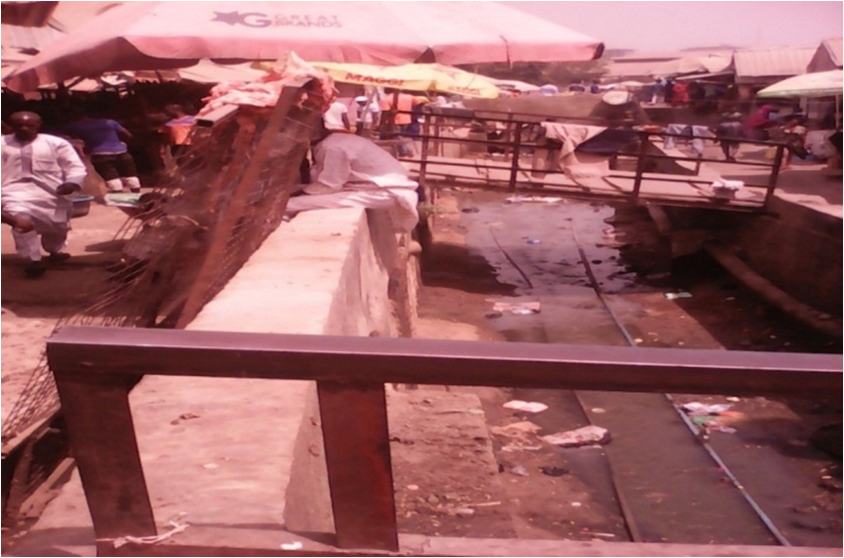
Buildings should be approachable for the firefighting vehicles in case of fire outbreaks 14, 15. However, a canal of three metres wide was constructed in Garki model market and it divided the market into formal (lock-up shops) and informal (open stalls) sections. There are no bridges that can allow the firefighting vehicles to move from the formal section to the informal section to fight fire in case of fire outbreak. Apart from the gates at the formal section, there is no any other gate to lead people or firefighting vehicles to the informal section of the market. Plate I shows a canal in Garki model market. In addition, the discussion with the staff of the managing company of Garki model market showed that there is no first aid centre in the market where people that may become victims of the fire outbreaks can receive immediate medical treatments before they can be transferred to the hospital.

From the interview questions administered to the Federal Fire Service of Nigeria (FFSN), the Fire Service is averagely satisfied with the design of Garki model market with respect to the fire exit gates because of the available number of the fire exit gates and the absence of fire exit signs to direct people to them. Only two exit gates were observed in the market. The first exit gate is for both pedestrian and vehicular exits which is 4.5 metres wide in the formal section of the market; this is wide enough to allow many people to pass through it at the same time when there are fire outbreaks. The second exit gate is locked up with a pad lock and it is only for pedestrian exits which is two metres wide in the formal section of the market; this is not wide enough to allow many people to pass through it at the same time when there are fire outbreaks. Contrary to this immediate statement, the minimum overall width of the gate opening shall be 6.0 metres for fire safety purpose 16. Similarly, the exit gates shall have a clear opening of not less than 7.2 metres for a dual traffic direction 17. Thus, the design of Garki model market is considered unsatisfactory with respect to the fire exit gates in relation to the size of the market in terms of the numbers of facilities (1,430 sales points). Plate II shows a pedestrian exit gate in Garki model market.

The problems associated with floor plans, number of their observations, and common locations in Garki model market are shown in Table 2. The problems are common in the southern part of the formal section of the market.
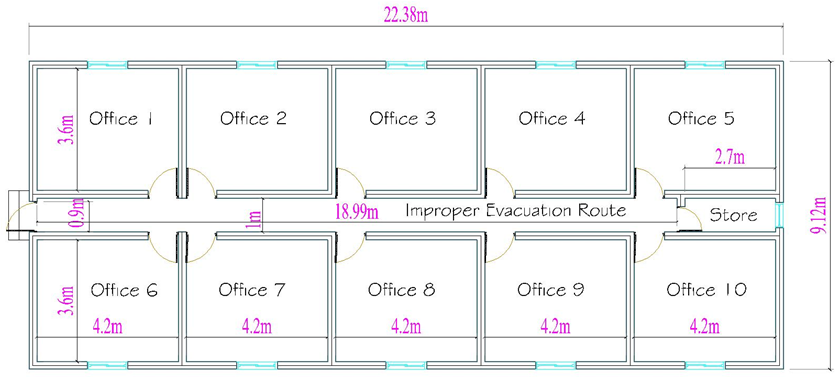
It was observed that smoke vents were not incorporated into the floor design of all the buildings in Garki model market; these can lead to the death of people due to suffocation during fire outbreaks. Figure 1 shows a poor conceptual floor plan of the administrative building of the market without smoke vents. Moreover, the design of the evacuation routes was not properly considered in the administrative building in the southern part of the market. A long primary evacuation route of 1.0 metre wide was incorporated into the design of the administrative building without incorporating secondary evacuation routes in case of fire outbreak that may start from the entrance of the primary evacuation route of the building. In this case, if there is any severe fire outbreak at the entrance of the primary evacuation route, all the people in the administrative building will be trapped by fire at the same time. Figure 1 also shows a poor conceptual floor plan of the administrative building of the market with an improper primary evacuation route of 1.0 metre wide.
In addition, the width of primary evacuation route of the administrative building of the market cannot allow two people who are at the risk of fire to escape conveniently at the same time. This is because, according to 14, a minimum width of 1.3 metres to 1.4 metres of a corridor is needed to allow two people to pass one another unhindered in a building. Similarly, 18 states that all the corridors should have an unobstructed width of at least 1.2 metres wide, and it is the minimum width for fire escape.

The problems associated with the design of doors and windows, number of their observations, and common locations in Garki model market are shown in Table 3. The problems are common in the administrative building of the market.
It was observed that an external door of 0.9 metre wide was incorporated into the design of the administrative building of Garki model market at the entrance of the primary evacuation route in the southern part of the market. This width of the external door is not wide enough for two people who are at the risk of fire to conveniently escape through it at the same time 14, 19. Apart from the entrance door, the primary evacuation route of the administrative building of the market has no window opening or any other opening for natural lighting to aid proper escape of people in case of fire outbreak. In addition, Figure 1 shows a poor conceptual floor plan of the administrative building of the market without window opening and adequate width of external door at the primary evacuation route.
3.3. Passive Fire Readiness with Regards to the Design of Roof Members
It was noticed that all the roofs of buildings in the whole Garki model market were absolutely not designed against fires. The distance that exits in between buildings or between the boundary and building is obviously a crucial factor to consider as it is the severity of fire outbreaks that are ascertained via the fire loads of buildings 14, 20. However, the roof eaves of 10 open stall buildings in the informal section of the market are very close and almost touching each other. These can lead to easy spread of fire when there is fire outbreak. Plate IV shows the closeness of the roofs in Garki model market.
3.4. Passive Fire Readiness with Regards to other Fire Control MeasuresThe interview questions administered to the managing company of Garki model market showed that the training of the sales people on how to use fire protection devices is every five to eleven months and the sales people were able to operate them during the training but the discussion with the staff of the managing company of the market revealed that most sales people hardly respond to calls for drills, and this is a challenge for them. The discussion with the sales people showed that the venue for the training on fire prevention and protection measures is at the open area in the southern part of the market. In view of these training intervals for the sales people in Garki model market, they are considered adequate.
Nigerian market environments are prone to fire outbreaks due to improper design against them. For this reason, this research was aimed to determine the passive fire readiness in Garki model market, in order to provide improved guidelines for Nigerian market design against fire outbreaks. The results of the research showed that there is presence of canal that divided the market into two sections without bridges to allow firefighting vehicles to pass through them, and there is no first aid centre for fire victims. Other results of the research are: lack of fire exit signs, inadequate number of fire exit gates, insufficient width of fire exit gate, lack of smoke vents in buildings, inadequate width of evacuation route and insufficient width of the external door for the primary evacuation route of the administrative building, lack of window or any other opening for natural lighting to aid proper escape of people in case of fire outbreak in the primary evacuation route of the administrative building.
In addition, the majority of roof eaves in the informal section of the market are very close and almost touching each other, and these can lead to easy spread of fire when there is fire outbreak; sales people do not respond to calls for drills on how to use fire protection devices in the market. Therefore, the following guidelines are recommended for the design of Nigerian markets against fire outbreaks:
Guidelines for the Design of Nigerian Markets against Fire Outbreaks
i. There should be bridges at specified intervals on the canals in markets to allow accessibilities of the firefighting vehicles.
ii. Markets must have first aid centres where victims of fire outbreaks can receive immediate medical treatments before they can be transferred to hospitals.
iii. Markets must have external signage stands (stand-alone type of external signs for fire exits) to be positioned on the sites (outside the market buildings) at different locations to direct people to the fire exit gates, so that when there are fire outbreaks, people who are at the risk of fires can easily escape.
iv. All markets must have adequate number of fire exit gates and these should be determined by the architects with respect to the size of markets in terms of the number of available facilities and expected human population. At most, in every 100 metres of the length of market fences, a fire exit gate should be established.
v. All the fire exit gates of markets must be wide enough (at least six metres) at any proper location to allow adequate evacuation of masses including the disabled people who are at the risk of fires that may need help at the same time.
vi. Floor plans of market buildings should indicate the locations of smoke vents along all the escape routes at appropriate intervals (between the intervals of four to ten metres), in order to reduce suffocation as a result of the smoke from fires.
vii. The locations of the smoke vents in the market buildings should start from four metres (at least) from the starting points of the fire escape routes, in order to reduce suffocation as a result of smoke from fires.
viii. The administrative buildings of markets, or other buildings with a low human population in markets should have a minimum width of 1.2 metres for the evacuation routes, in order to allow two people who are at the risk of fire to escape properly.
ix. The external doors (fire escape doors) of market buildings at the primary evacuation route should have a minimum width of 1.8 metres, in order to allow three people who are at the risk of fires to escape conveniently at the same time.
x. The evacuation routes in market buildings must have window openings for natural lighting where there are no provision for other openings apart from the external entrance doors, in order to aid proper escape of people via adequate natural lighting, if the windows are opened during the fire outbreaks.
xi. The spaces between market buildings must be at least eight metres to reduce the spread of fires from one market building to another market building.
xii. The management authorities of markets in Nigeria should enforce the mandatory training of fire consciousness and preparedness for all the sales people in markets, since most sale people are not responding to calls for training on how to use fire protection devices.
The rates of combustion of the building materials per time were not considered in this research, in order to know the rate of burning of the market per time in relations to the human interventions, and this is a gap in knowledge. Therefore, it is recommended that in subsequent research of this type, this gap should be filled.
| [1] | Federal capital development authority of Nigeria, The department of urban and regional planning. Builders of Abuja, 2016. Available: http://fcda.gov.ng/index.php?option=com_content&view=article&id=30&Itemid=66. | ||
| In article | |||
| [2] | Federal fire service of Nigeria, Market fires killed 600 in 15 months. The controller general (Joseph Anebi), federal fire service of Nigeria, 2016. Available: http://punchng.com/market-fire-killed-600-in-15-months-cg/. | ||
| In article | |||
| [3] | National association of Nigerian traders, NANT’s analysis of markets in Nigeria that have been gutted by fire since 2010 to 2016. The report of press statement of the president of the national association of Nigerian traders (NANT) during the media briefing on the government’s passivity over the menace of incessant market fire incidents tormenting Nigerian traders. A trader advocacy series, NANT/Trade PAS/-0250, 2016. | ||
| In article | |||
| [4] | Olayinka, A, Challenges of traditional markets administration in Yagba communities, north-central Nigeria, 1900-2010. Research on humanities and social sciences, 4 (22), ISSN (Paper): 2224-5766, ISSN (Online): 2225-0484, 2016. | ||
| In article | |||
| [5] | Fire safety programme index, Fire safety manual. A manual of the Florida Atlatnic university, 2013. Available: https://www.fau.edu/facilities/ehs/info/Fire-Safety-Manaul.pdf. | ||
| In article | |||
| [6] | National fire protection association, Emergency evacuation planning guide for people with disabilities. A guide for fire emergency, 2016. Available: https://www.nfpa.org/-/media/Files/Public-Education/By-topic/Disabilities/EvacuationGuidePDF.ashx?la=en. | ||
| In article | |||
| [7] | Norman, E.G, A decision model for recommending which building occupants should move where during fire emergencies. Fire safety journal, 80 (1), 20-29, 2016. | ||
| In article | View Article | ||
| [8] | Seattle Government, Seattle fire department. Annual report of United States of America, 2016. Available: www.seattle.gov/fire. | ||
| In article | |||
| [9] | Muiruri, G. & Mulinge, C, Health and safety management on construction projects sites in Kenya: A case study of construction projects in Nairobi county. A paper presented at international federation of surveyors (FIG) congress, Kuala Lumpur, Malaysia, 16th-21th June, 2014. Available: http://www.fig.net/resources/proceedings/fig_proceedings/fig2014/papers/ts07k/ TS07K_muiruri_mulinge_6847.pdf. | ||
| In article | |||
| [10] | Whole building design guide, Fire protection. A programme of the national institute of building sciences. An authoritative source of innovative solutions for the built environment, 2017. Available: https://www.wbdg.org/design-objectives/secure-safe/fire-protection. | ||
| In article | |||
| [11] | Nnodim, N.J, Centre for performing arts, Abuja: A study of the methods for improving accessibility and increasing participation of people with disabilities. An unpublished master degree thesis. Department of architecture, university of Nigeria, Nsukka, Enugu State, Nigeria, 2011. | ||
| In article | |||
| [12] | Satellite google map data, Garki model market. A map showing the location of Garki Model Market in the federal capital territory of Nigeria, 2016. Available: https://www.google.com/maps/@9.0220938,7.4905048,452m/data=!3m1!1e3. | ||
| In article | |||
| [13] | Abuja markets management limited, Our facilities. A report of facilities of Abuja markets management limited, 2016. Available: http://www.abujamarketsmanagement.com/our-facilities/. | ||
| In article | |||
| [14] | Neufert, E. & Neufert, P, Architects' data. An architecture book, ISBN-10: 0632037768, ISBN-13: 978-0632037766, Third Edition, 12th September, 2000, Pp. 72-76, 126-130, & 137. Oxford Brookes University: Wiley-Blackwell. | ||
| In article | |||
| [15] | World health organisation, Building security and fire protection. A technical supplement to world health organisation (WHO) technical report series, No. 961, 2014. World health organization, Appia, Geneva, Switzerland: WHO press. | ||
| In article | |||
| [16] | Northwest fire district, Manual vehicle and pedestrian gates. Chapter seven of the general guidelines for manual gates. Northwest fire district, Tucson, 2017. Available: https://northwestfire.org/wp-content/uploads/2017/03/Ch-7-Manual-Pedestrian-Gates.pdf. | ||
| In article | |||
| [17] | City of vista fire department, Access gates. A guideline for the access gates, 2012. Prevention bureau, Vista. Available: http://www.cityofvista.com/home/showdocument?id=754. | ||
| In article | |||
| [18] | Scottish government policy on building standards, Scottish building standards. Access within buildings in section 4.2 of the 2017 building standards technical handbooks of the Scottish government, 2017. Available: http://www.gov.scot/resource/buildingstandards/2017NonDomestic/chunks/ch05s03.html. | ||
| In article | |||
| [19] | International code council, Minimum bedroom door size. Forum on the existing building codes, 2013. Available: https://www.iccsafe.org/forum/existing-building-codes/minimum-bedroom-door-size/. | ||
| In article | |||
| [20] | Building regulations, Fire safety. Technical guidance document B, volume 2. Environment, community and local government, government of Ireland, Western Europe, 2016. | ||
| In article | |||
| [21] | California fire code, Standards for fire department vehicle access for use by all jurisdictions, cities and county, within the limits of Santa Clara County. A California vehicle code, 2009. Available: http://www.unidocs.org/fire/un-096.pdf. | ||
| In article | |||
| [22] | International code council, Appendix D: fire apparatus access roads. Oregon fire code, 2007. Available: https://www2.iccsafe.org/states/oregon/07_fire/07_PDFs/Appendix%20D_ Fire%20Apparatus%20Access%20Roads.pdf. | ||
| In article | |||
| [23] | Metropolitan fire brigade, Planning guidelines for emergency vehicle access and minimum water supplies within the metropolitan fire district. Fire safety guideline, number: GL-27 prepared by metropolitan fire safety advisory group, 2014. Available: http://www.mfb.vic.gov.au/media/docs/GL-27%20v4a%2003.2011-3e42cd76 -7c05-462b-bdf3-e127b68592d4-0.pdf. | ||
| In article | |||
| [24] | Nigerian society of engineers, Managing disasters in public buildings. A report of an umbrella organisation for the engineering profession in Nigeria, 2016. Available: http://www.nse.org.ng/pic_uploaded/resources/SAFETY_IN%20_PUBLIC_BUILDING.pdf. | ||
| In article | |||
Published with license by Science and Education Publishing, Copyright © 2023 Odaudu Ugbede Sunday and Abdullahi Aminu Lawan
 This work is licensed under a Creative Commons Attribution 4.0 International License. To view a copy of this license, visit
http://creativecommons.org/licenses/by/4.0/
This work is licensed under a Creative Commons Attribution 4.0 International License. To view a copy of this license, visit
http://creativecommons.org/licenses/by/4.0/
| [1] | Federal capital development authority of Nigeria, The department of urban and regional planning. Builders of Abuja, 2016. Available: http://fcda.gov.ng/index.php?option=com_content&view=article&id=30&Itemid=66. | ||
| In article | |||
| [2] | Federal fire service of Nigeria, Market fires killed 600 in 15 months. The controller general (Joseph Anebi), federal fire service of Nigeria, 2016. Available: http://punchng.com/market-fire-killed-600-in-15-months-cg/. | ||
| In article | |||
| [3] | National association of Nigerian traders, NANT’s analysis of markets in Nigeria that have been gutted by fire since 2010 to 2016. The report of press statement of the president of the national association of Nigerian traders (NANT) during the media briefing on the government’s passivity over the menace of incessant market fire incidents tormenting Nigerian traders. A trader advocacy series, NANT/Trade PAS/-0250, 2016. | ||
| In article | |||
| [4] | Olayinka, A, Challenges of traditional markets administration in Yagba communities, north-central Nigeria, 1900-2010. Research on humanities and social sciences, 4 (22), ISSN (Paper): 2224-5766, ISSN (Online): 2225-0484, 2016. | ||
| In article | |||
| [5] | Fire safety programme index, Fire safety manual. A manual of the Florida Atlatnic university, 2013. Available: https://www.fau.edu/facilities/ehs/info/Fire-Safety-Manaul.pdf. | ||
| In article | |||
| [6] | National fire protection association, Emergency evacuation planning guide for people with disabilities. A guide for fire emergency, 2016. Available: https://www.nfpa.org/-/media/Files/Public-Education/By-topic/Disabilities/EvacuationGuidePDF.ashx?la=en. | ||
| In article | |||
| [7] | Norman, E.G, A decision model for recommending which building occupants should move where during fire emergencies. Fire safety journal, 80 (1), 20-29, 2016. | ||
| In article | View Article | ||
| [8] | Seattle Government, Seattle fire department. Annual report of United States of America, 2016. Available: www.seattle.gov/fire. | ||
| In article | |||
| [9] | Muiruri, G. & Mulinge, C, Health and safety management on construction projects sites in Kenya: A case study of construction projects in Nairobi county. A paper presented at international federation of surveyors (FIG) congress, Kuala Lumpur, Malaysia, 16th-21th June, 2014. Available: http://www.fig.net/resources/proceedings/fig_proceedings/fig2014/papers/ts07k/ TS07K_muiruri_mulinge_6847.pdf. | ||
| In article | |||
| [10] | Whole building design guide, Fire protection. A programme of the national institute of building sciences. An authoritative source of innovative solutions for the built environment, 2017. Available: https://www.wbdg.org/design-objectives/secure-safe/fire-protection. | ||
| In article | |||
| [11] | Nnodim, N.J, Centre for performing arts, Abuja: A study of the methods for improving accessibility and increasing participation of people with disabilities. An unpublished master degree thesis. Department of architecture, university of Nigeria, Nsukka, Enugu State, Nigeria, 2011. | ||
| In article | |||
| [12] | Satellite google map data, Garki model market. A map showing the location of Garki Model Market in the federal capital territory of Nigeria, 2016. Available: https://www.google.com/maps/@9.0220938,7.4905048,452m/data=!3m1!1e3. | ||
| In article | |||
| [13] | Abuja markets management limited, Our facilities. A report of facilities of Abuja markets management limited, 2016. Available: http://www.abujamarketsmanagement.com/our-facilities/. | ||
| In article | |||
| [14] | Neufert, E. & Neufert, P, Architects' data. An architecture book, ISBN-10: 0632037768, ISBN-13: 978-0632037766, Third Edition, 12th September, 2000, Pp. 72-76, 126-130, & 137. Oxford Brookes University: Wiley-Blackwell. | ||
| In article | |||
| [15] | World health organisation, Building security and fire protection. A technical supplement to world health organisation (WHO) technical report series, No. 961, 2014. World health organization, Appia, Geneva, Switzerland: WHO press. | ||
| In article | |||
| [16] | Northwest fire district, Manual vehicle and pedestrian gates. Chapter seven of the general guidelines for manual gates. Northwest fire district, Tucson, 2017. Available: https://northwestfire.org/wp-content/uploads/2017/03/Ch-7-Manual-Pedestrian-Gates.pdf. | ||
| In article | |||
| [17] | City of vista fire department, Access gates. A guideline for the access gates, 2012. Prevention bureau, Vista. Available: http://www.cityofvista.com/home/showdocument?id=754. | ||
| In article | |||
| [18] | Scottish government policy on building standards, Scottish building standards. Access within buildings in section 4.2 of the 2017 building standards technical handbooks of the Scottish government, 2017. Available: http://www.gov.scot/resource/buildingstandards/2017NonDomestic/chunks/ch05s03.html. | ||
| In article | |||
| [19] | International code council, Minimum bedroom door size. Forum on the existing building codes, 2013. Available: https://www.iccsafe.org/forum/existing-building-codes/minimum-bedroom-door-size/. | ||
| In article | |||
| [20] | Building regulations, Fire safety. Technical guidance document B, volume 2. Environment, community and local government, government of Ireland, Western Europe, 2016. | ||
| In article | |||
| [21] | California fire code, Standards for fire department vehicle access for use by all jurisdictions, cities and county, within the limits of Santa Clara County. A California vehicle code, 2009. Available: http://www.unidocs.org/fire/un-096.pdf. | ||
| In article | |||
| [22] | International code council, Appendix D: fire apparatus access roads. Oregon fire code, 2007. Available: https://www2.iccsafe.org/states/oregon/07_fire/07_PDFs/Appendix%20D_ Fire%20Apparatus%20Access%20Roads.pdf. | ||
| In article | |||
| [23] | Metropolitan fire brigade, Planning guidelines for emergency vehicle access and minimum water supplies within the metropolitan fire district. Fire safety guideline, number: GL-27 prepared by metropolitan fire safety advisory group, 2014. Available: http://www.mfb.vic.gov.au/media/docs/GL-27%20v4a%2003.2011-3e42cd76 -7c05-462b-bdf3-e127b68592d4-0.pdf. | ||
| In article | |||
| [24] | Nigerian society of engineers, Managing disasters in public buildings. A report of an umbrella organisation for the engineering profession in Nigeria, 2016. Available: http://www.nse.org.ng/pic_uploaded/resources/SAFETY_IN%20_PUBLIC_BUILDING.pdf. | ||
| In article | |||