This paper investigates the effect of different sizes and locations of the buoy on the dynamic response of the floating platform. The full-scale of the OC4-DeepCwind semi-submersible floating offshore wind turbine (FOWT) platform was analyzed using the boundary element method (BEM) in ANSYS-AQWA software, considering regular wave conditions. Platform motions and mooring line tension in the surge, heave, and pitch are presented and discussed in time and frequency domains. Validation was carried out by comparison of the platform motion RAO (response amplitude operator) and fairlead tension RAO magnitudes in the surge, heave, and pitch between numerical and experimental data under seven sea states' regular waves. Four different buoy diameters and its locations (B1, B2, B3, and B4) have been considered. The results show that increasing the buoy size leads to an increase in surge motion, while the amplitude of semi-submersible decreases in heave motion. Also, in the pitch motion, it is reduced for B1 and B2, while an increase was found for B3 and B4. In addition, increasing the distance of buoy from the platform leads to an increase in the surge motion response while it is reduced for that of the heave response.
To minimize floating offshore structure motions, mooring line systems have been used that provide the necessary restoring force against environmental loadings. As the water depth increased, the weight of the mooring line consisting of chains or cables became too heavy, and the vertical forces from the mooring line on the floating platform increased. In the catenary mooring system, part of the mooring line is rested on the seabed ground. When the catenary mooring system gets lifted by the excursion or vessel motion the restoring force is generated. The buoys are used in the suspended portion of the mooring system to effectively reduce the hydrodynamic response of platform and mooring lines tension 1.
In recent years, the effect of buoys on the mooring line system and floating platform response has been investigated by many researchers. Yuan et al. proposed a hybrid mooring system with several clump weights and buoys to optimize the position and volume of the buoys based on the mooring line tension. In their work, Morrison's equation was used to calculate the hydrodynamic loads 1. Brommundt et al. developed a numerical tool to optimize the catenary mooring system of a semisubmersible wind turbine platform with two different depths (75 m and 330 m). mooring line length, angle, and horizontal distance between the anchor and fairlead were investigated 2. Fitzgerald and Bergdahl used a buoy-attached mooring line for a wave energy converter at a water depth of 50 m, indicating that the buoy may reduce cable weight, induce mooring loads, and affect floater motion. For offshore applications, hybrid mooring concepts such as clump weight and buoy have been developed 3. Effect of buoys on the dynamics response of mooring lines and platform motion have been investigated by Qiao et al. numerically 4. Mavrakos and Chatjigeorgiou used the frequency and time domains to examine the mooring line motion and tension, including different buoy sizes and locations in deep water 5. Mavrakos et al. 6 studied the benefit of attaching buoys to the mooring line and confirmed that the reduction of the mooring line dynamic could be achieved when the size, number, and location of the buoys are chosen correctly. Benassai et al. compared the motion control performance of the catenary mooring and the tension line mooring systems for the Dutch tri-floater wind turbine at the water depth between 50m and 200m to minimize the mooring line weight. Both operational and extreme load cases are considered, the weight of chain cable and steel wire rope are compared for different water depths 7. Mooring configurations of a floating point absorber consisting of catenary chain with and without additional clump weight or buoy were compared by Vicente et al 8. The results showed that the maximum horizontal motion and the energy absorption power are less sensitive to different arrangements of the buoys and clump weights than average and maximum mooring line tension. Ghafari and Dardel investigated the effect of diameter and number of buoys on the response of the Amirkabir semisubmersible drilling platform using the BEM. The results showed that increasing the number of buoys decreases the amplitude of the surge motion while increasing the heave and pitch motions 9. In particular, the semi-submersible, the spar, and the tension leg platform are different types of substructures that are widely used for the wind turbine or hybrid wind-wave concepts 10, 11.
The purpose of this paper is to investigate the hydrodynamic response of the DeepCwind semi-submersible floating offshore wind turbine (FOWT) platform consisting of three mooring lines that are divided into two segments with an intermediate buoy. Simulations were carried out using ANSYS AQWA software under the regular airy wave conditions. Fairlead tension and platform motions in three directions (surge, heave, and pitch) are presented and discussed.
Governing equations, including potential flow theory, have been used, and three-dimensional radiation/diffraction theory has been utilized to estimate the wave force acting on the rigid floating platform. The potential flow expression includes the first-order incident wave potential, the corresponding diffracted wave potential, and the radiation wave potential due to the j-th motion with unit motion amplitude 12. The hydrodynamic loads, the motion responses, and mooring forces responses are obtained using the three-dimensional radiation/diffraction theory and the Morison element theory.
The fluid flow field that surrounds the floating object is defined using Laplace equation as the governing equation. A boundary integration method is used to calculate the fluid velocity potential function with boundary conditions 9. The Morison element models the mooring line as a chain under the effect of various external factors include external hydrodynamic, structural, and inertia loadings. Considering the hydrodynamics interaction among M floating body and using frequency-dependent coefficients, the linear equation of motion is expressed as follow:
 | (1) |
In Eq. (1),  is a 6M×6M structure mass matrix,
  and
and  are the 6M×6M hydrodynamic added mass and damping matrices which consist of hydrodynamics interaction coupling components between M structures,
  is combined hydrostatic stiffness matrix.
  is the total forces and moments, subscripts j and k correspond to the motion modes, and the subscripts m, n refer to the m-th and n-th structure. By defining an integral convolution form, the equation of motion can be described as 13.
 | (2) |
where R is the velocity impulse function matrix and F(t) is the total force, which includes the mooring force, and first- and second-order wave force. For the hydrodynamics analyses, second-order wave force must be considered as one of the important loads in potential-based BEM to calculate the hydrodynamic drift force on the floating body 14, 15. The significance of second-order wave force on the floating wind platform has been demonstrated computationally as well as experimentally 16. Refer to 17 for additional information on mooring force equations.
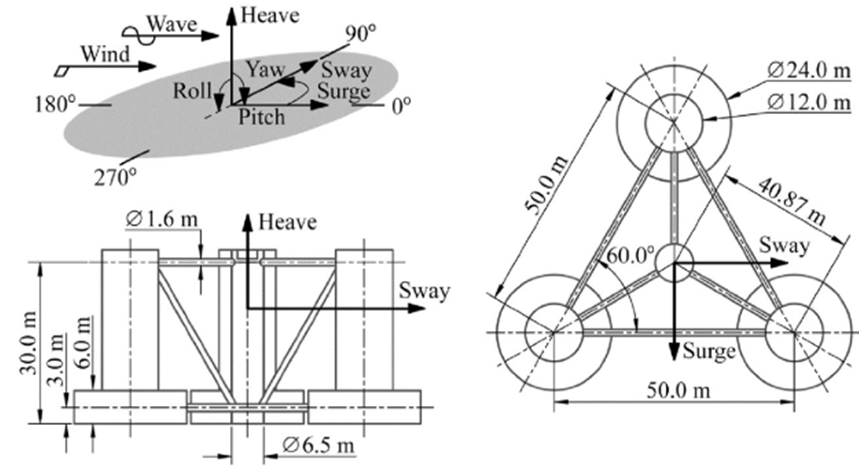
DeepCwind characteristics
The present result is compared to experimental data from the DeepCwind semi-submersible floating platform, which was used in studies by Coulling et al. 18. The DeepCwind semi-submersible floating platform model has been tested at the Maritime Research Institute Netherlands' offshore wind/wave basin by the University of Maine DeepCwind program 18. It should be mentioned that the experimental model for the DeepCwind semi-submersible floating platform was evaluated in 1:50 scale model experiments. Table 1 shows the characteristic of the DeepCwind semi-submersible floating platform.

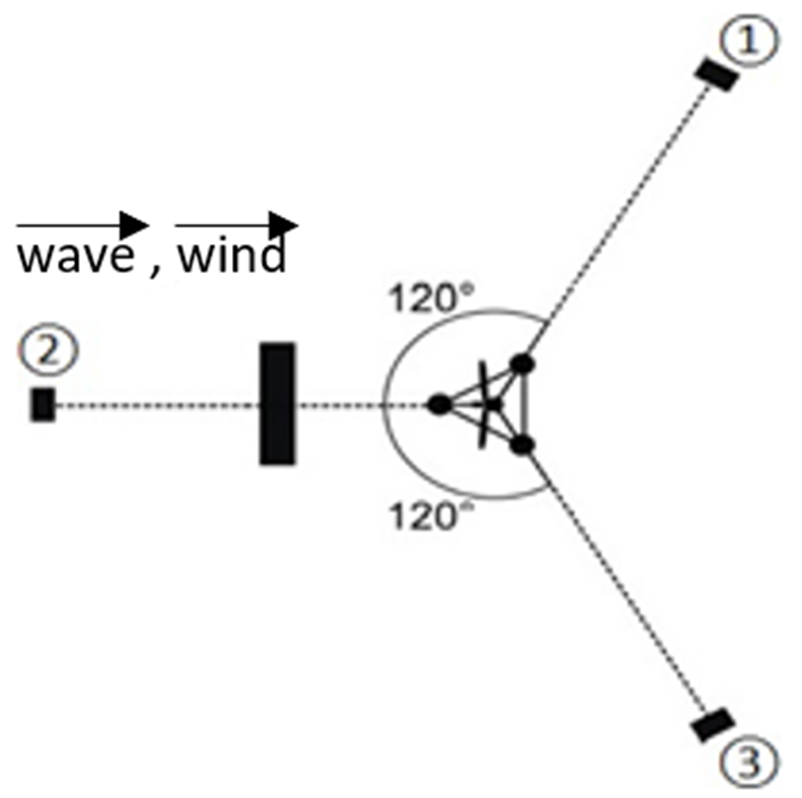
Figure 2 shows the platform orientation and mooring line configuration. Mooring line properties are listed in Table 2.
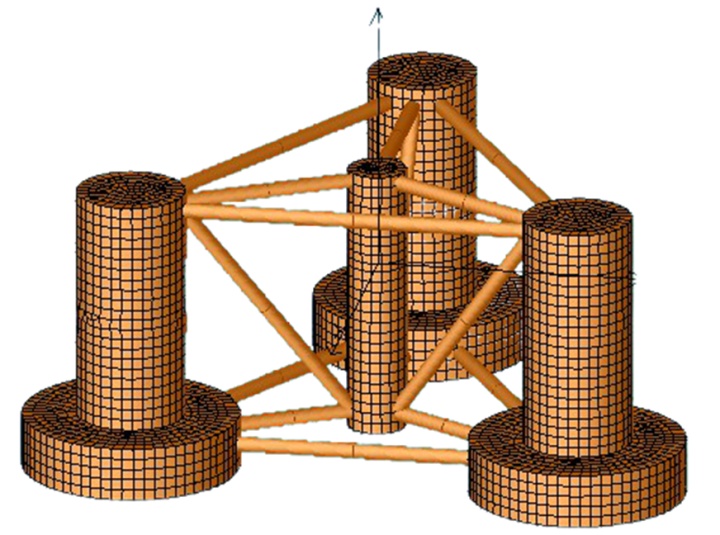
The validation is divided into two main steps: (1) the platform response amplitude operator (RAO) (2) and fairlead tension RAO under seven regular wave environmental. The present numerical result is obtained from potential theory using the BEM method and compared to the experimental data by Coulling et al 18. Based on the convergence analysis results, a maximum element size of 1.8m was obtained, including 7800 panel and 5400 diffracting panel that show in Figure 3.

Seven different regular waves were considered, and the platform response was investigated to validate the numerical results of the RAO response motions and mooring line tension. Table 3 shows the selected sea states for regular waves defined by period (T) and wave amplitude (A).
Table 4 compares the platform motion RAO in the surge, heave, and pitch between numerical and experimental data under seven sea states' regular waves. The root mean squared error (RMSE) for the DeepCwind semi-submersible floating platform shows relatively good agreement between numerical results and measurement data for all three motions.
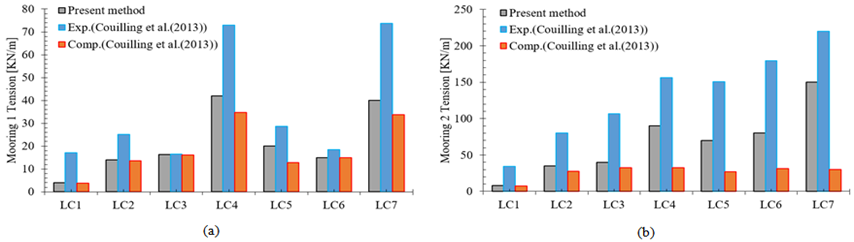
Figure 4 shows a comparison of fairlead tension RAO magnitudes between the present numerical results and experimental data for different case studies. It can be seen that the numerical results are in reasonably good agreement with the experimental data. At amplitude wave height and period, mooring line 1 experiences more tension. It should be noted that similar results were obtained due to the symmetry between mooring lines 1 and 3, hence in the present study, only the results of mooring lines 1 are given. It can be observed that the DeepCwind test data and the numerical simulation results are in relatively good agreement.

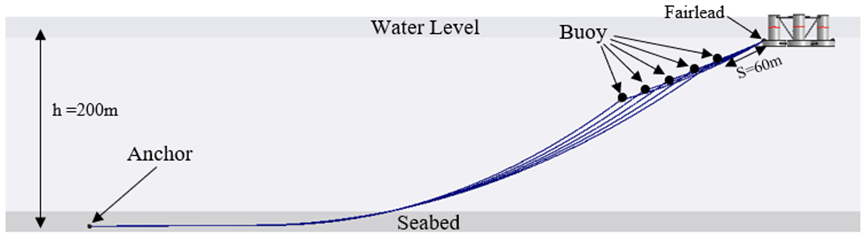
The effect of the buoy diameter for different distances from fairlead on platform response and mooring lines tension have been investigated in this section. The numerical simulation was carried out for the regular wave with amplitude 5 meters and period of 12 seconds. Table 5 summarizes the bouy size and distances from fairlead where S is the distance between the fairlead and the buoy. Effect of buoy location on mooring line configurations in one of the mooring line is shown in Figure 5.

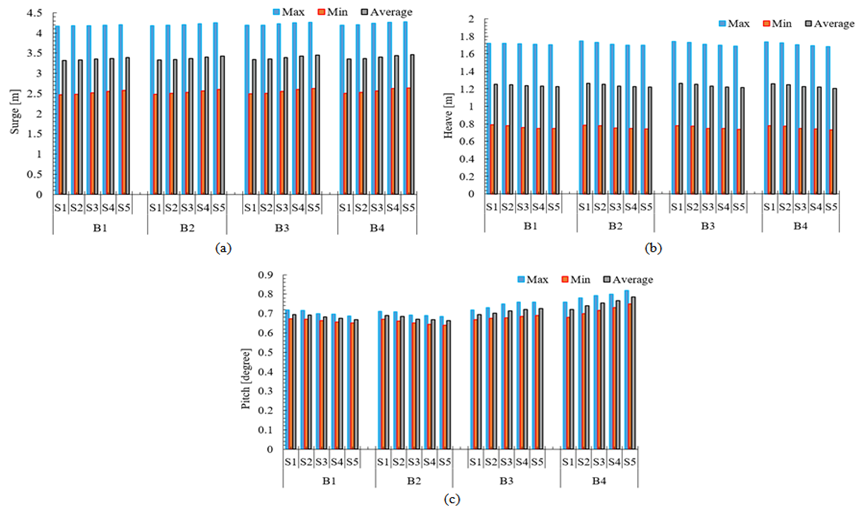
The effects of buoy size and location on the global responses of a semi-submersible platform are obtained in time domain analyses with 2000 seconds duration and then the statistical study of maximum, minimum, and average of the numerical results for surge, heave and pitch motion are shown in Figure 6.

As shown in Figure 6, increasing the buoy size leads to increasing the average, maximum, and minimum surge motion, while in heave motion, the semi-submersible amplitude decreases less as the buoy size increases. Also, in pitch motion, it was first observed that the increased size of the buoy for B1 and B2 from the platform could reduce the amplitude of the platform. Then, with the increased size of buoy for B3 and B4, the amplitude of the average, maximum, and minimum surge motion increased. In addition to, with increasing the distance of buoy from the platform, the average, maximum, and minimum of surge motion are increased, while it is reduced for that of the heave response. In pitch motion, increasing distance for B1 and B2 reduced the amplitude of oscillations, while its vice versa for B3, B4.
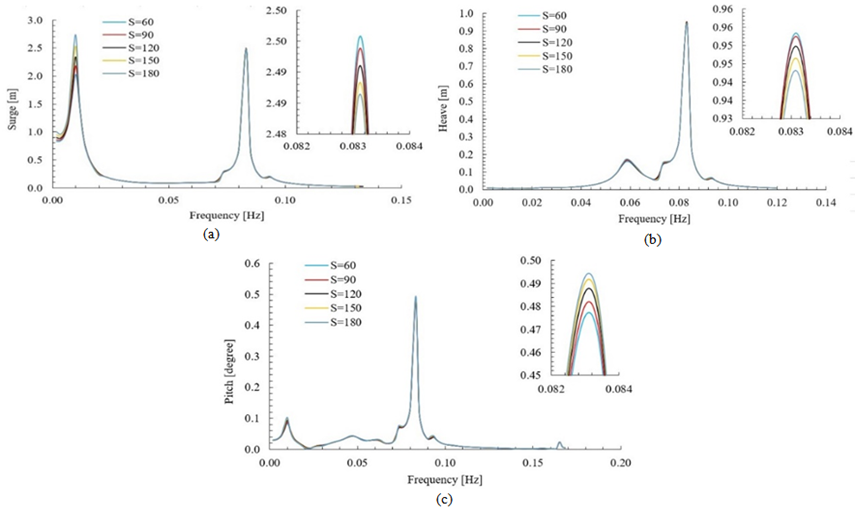
The frequency response of platform in the surge, heave, and pitch motions considering one buoy size (B2) under different distance from the platform shows in Figure 7.

As shown in Figure 7, the surge and heave motion frequency responses have two resonant frequencies: the low frequency (LF) and the resonant wave frequency (WF). Both responses decrease as the buoy distance from the platform increases. In addition, the resonant LF and WF response amplitude for heave motion decreases. In pitch motion, increasing the distance between the buoy and the platform increases the amplitude of the platforms' resonant WF and LF. Table 6 shows the LF and WF values of platform response for buoy B2 for the surge, heave, and pitch motions.
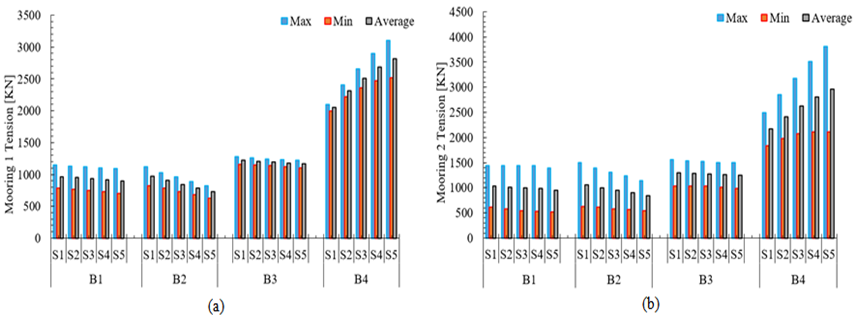
The tension force of the mooring lines is shown in Figure 8. It was first observed that the increasing distance of buoy types B1, B2 from the platform could reduce the average tension force, maximum, and minimum mooring lines 1, 2. Then, with the increased distance of the buoy types B3, B4 from the platform, the tension force amplitude of the mooring lines increased.

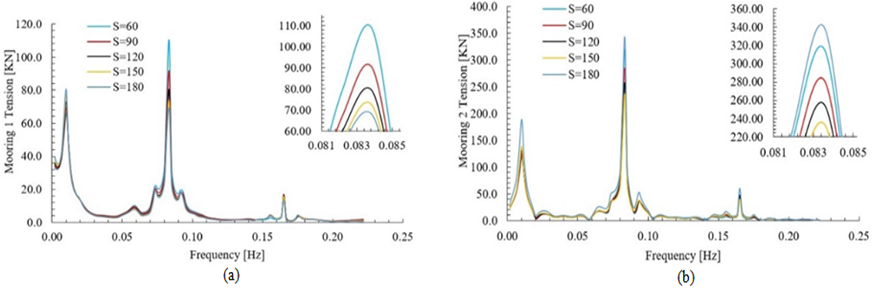
The tension force of the mooring line for buoy type B2 is shown in Figure 9. It can also be observed that there are two resonant frequencies for mooring tension; the low resonant frequency occurs in the 105s period and the wave frequency in the 12.5s period. With increasing distance from the platform, the amplitude of the LF oscillation increases, but the amplitude of the WF oscillation decreases.
The effects of buoy size and location on mooring line tension and platform responses were investigated for surge, heave, and pitch motion of the DeepCwind semi-submersible floating platform in regular wave conditions. BEM method was used to simulate hydrodynamics responses of the platform in both frequency and time domains.
• Increasing the buoy size leads to an increase in the surge motion, while in the heave motion, the amplitude of semi-submersible decreases. Also in the pitch motion, it is reduced for B1 and B2 while an increase was found for B3 and B4.
• With increasing the distance of buoy from the platform, the surge motion response is increased while it is reduced for that of the heave response. In pitch motion, increasing distance for B1 and B2 case studies reduced the amplitude of oscillations while its vice versa for B3, B4.
• Increasing buoy distance decreased the mooring tension force for B1 and B2, while its increased for B3 and B4.
• In the surge and heave motions, the amplitudes of LF and WF decrease as the buoy distance increases while it is increased for that of pitch motion.
• In the case of B2, the amplitude of the mooring tension in the LF increases, but for WF it's vice versa.
| [1] | Qiao D, Yan J, Ou J. Effects of mooring line with buoys system on the global responses of a semi-submersible platform. Brodogradnja: Teorija i praksa brodogradnje i pomorske tehnike. 2014 Mar 25; 65(1): 79-95. | ||
| In article | |||
| [2] | Brommundt M, Krause L, Merz K, Muskulus M. Mooring system optimization for floating wind turbines using frequency domain analysis. Energy Procedia. 2012 Jan 1; 24: 289-96. | ||
| In article | View Article | ||
| [3] | Fitzgerald J, Bergdahl L. Including moorings in the assessment of a generic offshore wave energy converter: A frequency domain approach. Marine Structures. 2008 Jan 1; 21(1): 23-46. | ||
| In article | View Article | ||
| [4] | Qiao D, Ou J. Global responses analysis of a semi-submersible platform with different mooring models in South China Sea. Ships and Offshore Structures. 2013 Oct 1; 8(5): 441-56. | ||
| In article | View Article | ||
| [5] | Mavrakos SA, Chatjigeorgiou J. Dynamic behaviour of deep water mooring lines with submerged buoys. Computers & structures. 1997 Jul 1; 64(1-4): 819-35. | ||
| In article | View Article | ||
| [6] | Mavrakos SA, Papazoglou VJ, Triantafyllou MS, Brando P. Experimental and numerical study on the effect of buoys on deep water mooring dynamics. InThe First International Offshore and Polar Engineering Conference 1991 Aug 11. OnePetro. | ||
| In article | |||
| [7] | Benassai G, Campanile A, Piscopo V, Scamardella A. Mooring control of semi-submersible structures for wind turbines. Procedia Engineering. 2014 Jan 1; 70: 132-41. | ||
| In article | View Article | ||
| [8] | Vicente PC, Falcão AF, Justino PJ. Slack-chain mooring configuration analysis of a floating wave energy converter. InProceedings of the 26th International Workshop on Water Waves and Floating Bodies, Athens, Greece 2011 Apr (Vol. 17). | ||
| In article | View Article | ||
| [9] | Ghafari H, Dardel M. Parametric study of catenary mooring system on the dynamic response of the semi-submersible platform. Ocean Engineering. 2018 Apr 1; 153: 319-32. | ||
| In article | View Article | ||
| [10] | Ghafari HR, Ghassemi H, He G. Numerical study of the Wavestar wave energy converter with multi-point-absorber around DeepCwind semisubmersible floating platform. Ocean Engineering. 2021 Jul 15; 232: 109177. | ||
| In article | View Article | ||
| [11] | Ghafari HR, Neisi A, Ghassemi H, Iranmanesh M. Power production of the hybrid Wavestar point absorber mounted around the Hywind spar platform and its dynamic response. Journal of Renewable and Sustainable Energy. 2021 May 15; 13(3): 033308. | ||
| In article | View Article | ||
| [12] | Barltrop N. Floating Structures: a guide for design and analysis. 1998 Jun 1. | ||
| In article | |||
| [13] | Cummins WE, Iiuhl W, Uinm A. The impulse response function and ship motions. | ||
| In article | |||
| [14] | Motallebi M, Ghafari H, Ghassemi H, Shokouhian M. Calculating the second-order hydrodynamic force on fixed and floating tandem cylinders. Zeszyty Naukowe Akademii Morskiej w Szczecinie. 2020. | ||
| In article | |||
| [15] | Ghafari H, Motallebi M, Ghassemi H. Potential-based boundary element method to calculate the hydrodynamic drift force on the floating cylinder. Journal of Applied Mathematics and Computational Mechanics. 2020; 19(4). | ||
| In article | View Article | ||
| [16] | Li J, Jiang Y, Tang Y, Qu X, Zhai J. Effects of Second-Order Difference-Frequency Wave Forces on Floating Wind Turbine Under Survival Condition. Transactions of Tianjin University. 2017 Mar; 23(2): 130-7. | ||
| In article | View Article | ||
| [17] | Ghafari HR, Ketabdari MJ, Ghassemi H, Homayoun E. Numerical study on the hydrodynamic interaction between two floating platforms in Caspian Sea environmental conditions. Ocean Engineering. 2019 Sep 15; 188: 106273. | ||
| In article | View Article | ||
| [18] | Coulling AJ, Goupee AJ, Robertson AN, Jonkman JM, Dagher HJ. Validation of a FAST semi-submersible floating wind turbine numerical model with DeepCwind test data. Journal of Renewable and Sustainable Energy. 2013 Mar 26; 5(2): 023116. | ||
| In article | View Article | ||
Published with license by Science and Education Publishing, Copyright © 2022 Arman Aghaei Ganjgani, Hamid Reza Ghafari, Hassan Ghassemi and Mahmoud Ghiasi
 This work is licensed under a Creative Commons Attribution 4.0 International License. To view a copy of this license, visit
http://creativecommons.org/licenses/by/4.0/
This work is licensed under a Creative Commons Attribution 4.0 International License. To view a copy of this license, visit
http://creativecommons.org/licenses/by/4.0/
| [1] | Qiao D, Yan J, Ou J. Effects of mooring line with buoys system on the global responses of a semi-submersible platform. Brodogradnja: Teorija i praksa brodogradnje i pomorske tehnike. 2014 Mar 25; 65(1): 79-95. | ||
| In article | |||
| [2] | Brommundt M, Krause L, Merz K, Muskulus M. Mooring system optimization for floating wind turbines using frequency domain analysis. Energy Procedia. 2012 Jan 1; 24: 289-96. | ||
| In article | View Article | ||
| [3] | Fitzgerald J, Bergdahl L. Including moorings in the assessment of a generic offshore wave energy converter: A frequency domain approach. Marine Structures. 2008 Jan 1; 21(1): 23-46. | ||
| In article | View Article | ||
| [4] | Qiao D, Ou J. Global responses analysis of a semi-submersible platform with different mooring models in South China Sea. Ships and Offshore Structures. 2013 Oct 1; 8(5): 441-56. | ||
| In article | View Article | ||
| [5] | Mavrakos SA, Chatjigeorgiou J. Dynamic behaviour of deep water mooring lines with submerged buoys. Computers & structures. 1997 Jul 1; 64(1-4): 819-35. | ||
| In article | View Article | ||
| [6] | Mavrakos SA, Papazoglou VJ, Triantafyllou MS, Brando P. Experimental and numerical study on the effect of buoys on deep water mooring dynamics. InThe First International Offshore and Polar Engineering Conference 1991 Aug 11. OnePetro. | ||
| In article | |||
| [7] | Benassai G, Campanile A, Piscopo V, Scamardella A. Mooring control of semi-submersible structures for wind turbines. Procedia Engineering. 2014 Jan 1; 70: 132-41. | ||
| In article | View Article | ||
| [8] | Vicente PC, Falcão AF, Justino PJ. Slack-chain mooring configuration analysis of a floating wave energy converter. InProceedings of the 26th International Workshop on Water Waves and Floating Bodies, Athens, Greece 2011 Apr (Vol. 17). | ||
| In article | View Article | ||
| [9] | Ghafari H, Dardel M. Parametric study of catenary mooring system on the dynamic response of the semi-submersible platform. Ocean Engineering. 2018 Apr 1; 153: 319-32. | ||
| In article | View Article | ||
| [10] | Ghafari HR, Ghassemi H, He G. Numerical study of the Wavestar wave energy converter with multi-point-absorber around DeepCwind semisubmersible floating platform. Ocean Engineering. 2021 Jul 15; 232: 109177. | ||
| In article | View Article | ||
| [11] | Ghafari HR, Neisi A, Ghassemi H, Iranmanesh M. Power production of the hybrid Wavestar point absorber mounted around the Hywind spar platform and its dynamic response. Journal of Renewable and Sustainable Energy. 2021 May 15; 13(3): 033308. | ||
| In article | View Article | ||
| [12] | Barltrop N. Floating Structures: a guide for design and analysis. 1998 Jun 1. | ||
| In article | |||
| [13] | Cummins WE, Iiuhl W, Uinm A. The impulse response function and ship motions. | ||
| In article | |||
| [14] | Motallebi M, Ghafari H, Ghassemi H, Shokouhian M. Calculating the second-order hydrodynamic force on fixed and floating tandem cylinders. Zeszyty Naukowe Akademii Morskiej w Szczecinie. 2020. | ||
| In article | |||
| [15] | Ghafari H, Motallebi M, Ghassemi H. Potential-based boundary element method to calculate the hydrodynamic drift force on the floating cylinder. Journal of Applied Mathematics and Computational Mechanics. 2020; 19(4). | ||
| In article | View Article | ||
| [16] | Li J, Jiang Y, Tang Y, Qu X, Zhai J. Effects of Second-Order Difference-Frequency Wave Forces on Floating Wind Turbine Under Survival Condition. Transactions of Tianjin University. 2017 Mar; 23(2): 130-7. | ||
| In article | View Article | ||
| [17] | Ghafari HR, Ketabdari MJ, Ghassemi H, Homayoun E. Numerical study on the hydrodynamic interaction between two floating platforms in Caspian Sea environmental conditions. Ocean Engineering. 2019 Sep 15; 188: 106273. | ||
| In article | View Article | ||
| [18] | Coulling AJ, Goupee AJ, Robertson AN, Jonkman JM, Dagher HJ. Validation of a FAST semi-submersible floating wind turbine numerical model with DeepCwind test data. Journal of Renewable and Sustainable Energy. 2013 Mar 26; 5(2): 023116. | ||
| In article | View Article | ||