Developing compound probability distributions is very important in the field of probability and statistics because there are different datasets from different fields with different features. These features range from high skewness, peakedness (kurtosis), bimodality, highly dispersed, and so on. Existing distributions might not easily fit well to these emerging data of interest. So, there is a need to develop more robust and flexible distributions that are positively skewed, negatively skewed, and bathup shape, to handle some of these features in the emerging data of interest. This paper, therefore, proposed a new four-parameter distribution called the Normal-Power{logistic} distribution. The proposed distribution was characterized by its density, distribution, survival, hazard, cumulative hazard, reversed hazard, and quantile functions. Properties such as the r-th moment, heavy tail property, stochastic ordering, mean inactive time were obtained. A useful transformation of the proposed distribution to normal distribution was shown to help generate its quantiles. The method of Maximum Likelihood Estimation (MLE) was used to estimate the model parameters. A simulation study was carried out to test the consistency of the maximum likelihood parameter estimates. The result of the simulation shows that the biases reduce as the sample size increases for different parameter values. The importance of the new distribution was proved empirically using a real-life dataset of gauge lengths of 10mm. The proposed distribution was compared with five other competing distributions, and the results show that the proposed Normal-Power{logistic} distribution (NPLD) performed favourably than the other five distributions using the AIC, CAIC, BIC, HQIC criteria.
In the field of statistics and probability, the power function distribution is unimodal, skewed, and peaked depending on the shape parameter value 1, 2. In literature, many known probability distributions such as exponential, Weibull, gamma, and lognormal are used for modeling lifetime data and widely applied in a variety of studies because of their advantages in different situations 3, especially using them as baseline distribution in the T-R{Y} family 4, 5, 6. The power function despite its flexibility as a lifetime distribution that arises in several scientific fields has not been considered in this regard 7.
The power function distribution is a special model that can be formed or related to the uniform, Weibull, Kumaraswamy distributions. The power function distribution is considered one of the simplest and handy lifetime distributions. It is a special case of the beta distribution and one may sight the importance of the distribution in statistical tests such as the likelihood ratio test. The simplicity and usefulness of the power function distribution compelled the researchers to explore its further extensions, generalizations, and applications in different areas of science 8. It is the inverse of Pareto distribution 9. Estimation of the power parameters has been done by various authors, for instance; 10, 11 proposed the two-parameter power function distribution as a simple alternative to the exponential distribution when it comes to modeling failure data related to mortality rate and component failures. The Weibull power function distribution was suggested by 12. 13 studied the properties of the Odd Lomax-Exponential distribution. 1 proposed the modified power function distribution.
The probability density function (pdf) and cumulative distribution function (cdf) of two-parameter power function distribution with scale parameter λ and shape parameter k are, respectively, given as
 |
and
 |
The normal distribution is another lifetime distribution with its various advantages. Many authors have worked on the normal distribution and it has huge applications in various fields. Also, many authors have developed and studied convoluted distributions with normal distribution parameters (µ and σ). These authors include but are not limited to Exponentiated-Normal proposed and studied by 14, Beta-Normal distribution by 15, Gamma-Normal (GN) distribution by 16, Kumaraswamy-Normal distribution by 17, Weibull-Normal by 18, Exponentiated-Generalized-Normal (EGN) distribution by 19, Weibull-Normal{log-logistics} distribution by 20, Lomax-Cauchy {Uniform} by 21, Rayleigh Cauchy distribution by 22 and Weibull-Inverse Rayleigh distribution: Classical/ Bayesian approach by 23.
Many classical distributions have been extensively used for modeling real data in many areas. However, in many situations; there is a clear need for extended forms of these distributions to improve the flexibility and goodness of fit of these distributions. For that reason, generated families of continuous distributions are developed by introducing one or more additional shape parameter(s) to the baseline distribution or by combining two or more distributions to produced new ones. 24 described such new distributions as convoluted distributions.
In this paper, the aim is to develop a novel univariate continuous probability distribution called the normal-power function {logistic} distribution {NPLD}. It is derived from the T-Power function {Y} family proposed and studied by 7. The distribution has four parameters, two from the normal distribution and the other two from the power function distribution. The scope covers different characterizations of the NPLD are to be established such as its density, distribution, survival, hazard, cumulative hazard, reversed hazard, and quantile function. To achieve this aim, different properties of the proposed distribution such as the r-th moment, heavy tail property, stochastic ordering, mean inactive time are to be obtained. The relationship between the proposed distribution and normal distribution is to be established. Thus, the proposed distribution can be positively skewed, negatively skewed, symmetric, and has a bathtub shape. The method of Maximum Likelihood Estimation (MLE) is used to estimate the model parameters. The importance of the new distribution will be proved empirically using a real-life dataset of gauge lengths of 10mm and compared with other convoluted distributions with normal distribution parameters (µ and σ). The proposed distribution will be very useful in engineering, medicine, and all filed of life. It is expected to perform well when normal distribution fails to fit the data of interest.
The rest of the paper contains the following sections. The formation of the pdf and cdf of the NPLD is performed in Section 2. Some statistical properties of NPLD distribution are provided in Section 3. Estimation of parameters, simulation study, and application to real data are presented in Section 4. The article ends with concluding remarks in section 5.
Ekum et al. 7 defined the cdf and pdf of T-Power {logistic} family as
 | (1) |
and
 | (2) |
respectively, where T can follow any probability distribution that has the same support with the logistic distribution. The quantile function of the logistic distribution is used, which is the log of the odd function of the power function distribution.
In this research, let T follow normal distribution with parameters μ and σ, i.e. T~N(μ, σ). This proposed distribution is called the Normal-Power Function Distribution.
Let T∈(-∞, ∞) be any random variable. Here, T follows the normal distribution with cdf and pdf given by
 | (3) |
and
 | (4) |
respectively.
By substituting equation (3) into (1) we have
 | (5) |
where
 |
is called the error function.
So, equation (5) is the cdf of the proposed normal-power function {logistic} distribution (NPLD) and the corresponding pdf is derived by substituting (4) into (2) and we have
 | (6) |

Equation (6) can be written as
 |


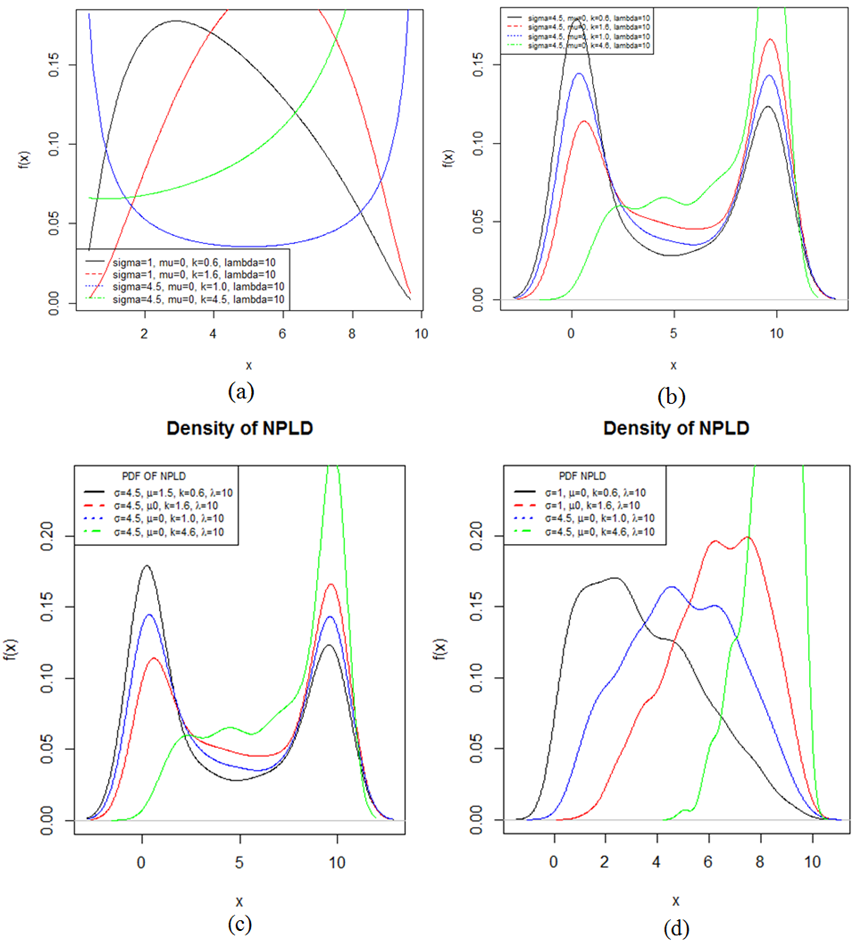
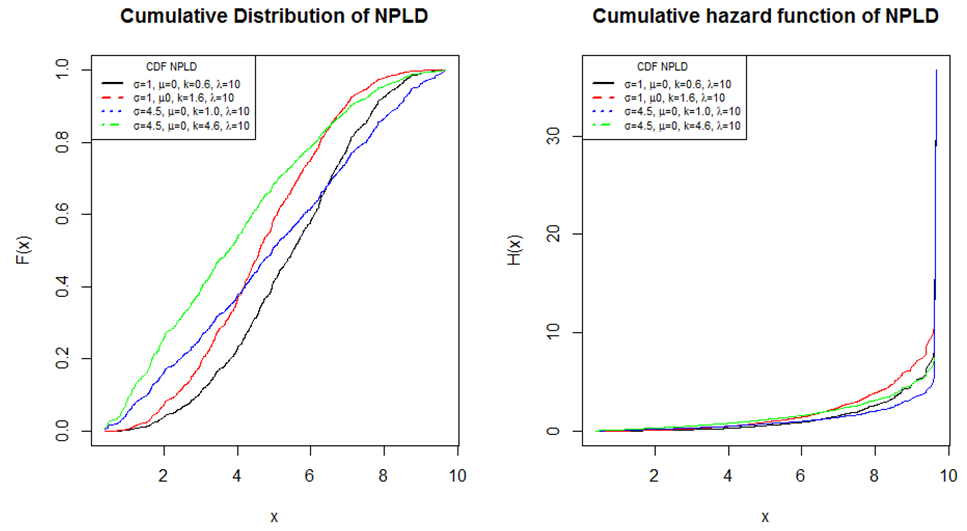
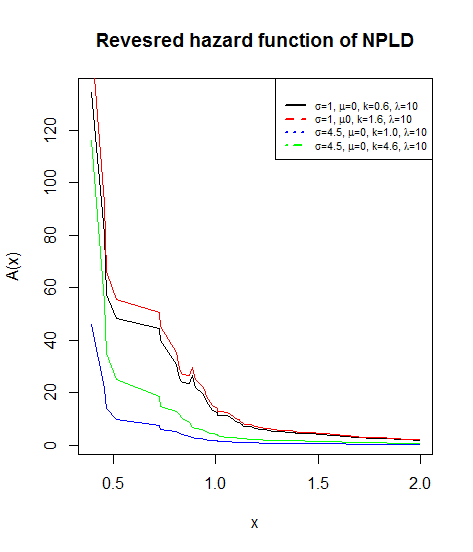
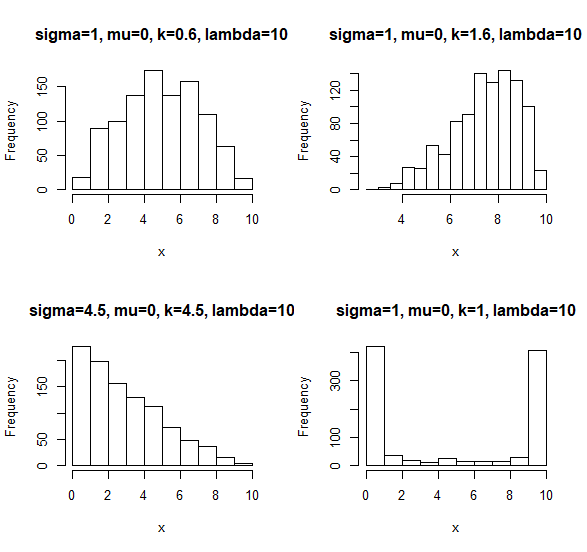
The NPLD is a novel four-parameter distribution. Parameters λ and σ are scale parameters, k is a shape parameter, while μ is a location parameter. The pdf plots in Figure 1 show that NPLD can be positively skewed, negatively skewed, symmetric (see also the histogram in Figure 4), and can have a bath up shape, depending on the parameter values. The cdf plots in Figure 2 shows that for increasing values of x, the cdfs increase as well, increasing from zero and flattened at lambda since lambda is an upper bound. Figure 2 shows the cumulative hazard plots, which rise from zero slowly and asymptotic to the vertical axis at lambda. The reversed hazard decreases with increasing values of x and it is asymptotic to both axes. The reversed hazard plot is adjusted to display on x values less than 2 for clearer curves.
2.1. Properties of NPLDThis section considered some major properties of the new proposed distribution.
The survival, hazard, cumulative hazard, and the reversed hazard functions are given in equations (7 – 10) respectively.
 | (7) |
 | (8) |
 | (9) |
 | (10) |
Lemma 1. If X follows the NPLD with parameters μ, σ, k, λ then random variable  follows the normal distribution with parameters μ and σ.
Proof.
Let
 | (11) |
Differentiating equation (11) with respect to x gives
 |
 |
 |
 |
Therefore, the pdf of random variable Y is given by
 | (12) |
Equation (12) completes the proof.
2.3. Quantile Function of NPLDThe quantile function of NPLD is given by
 | (13) |
where  is the quantile function of the normal distribution with parameters μ and σ. Note that
  is used to generate random variate that is normally distributed with mean μ and variance σ2. This can be achieved by using R codes [T = qnorm(p, mean = μ, sd = σ)], where p is vector of probabilities. It can be a sequence of numbers between 0 and 1 or uniformly distributed random values between 0 and 1. We can have in R as p = runif(n), where n is the number of observations to be generated.

The quantile function of a normal distribution is given by
 | (14) |
Substitute equation (14) into (13) to have the quantile function of NPLD given by
 | (15) |
The quantile function in (15) can be applied by using the quantile function in (13).
2.3. The r-th MomentConsider a random variable  . The r-th moment of the random variable
  is defined as
 | (16) |
where  is the pdf of the NPLD defined in equation (6). Substituting equation (6) into (16) and using integration by parts, we obtained the r-th moment of the NPLD as
 |
 | (17) |
Thus, equation (17) is the r-th moment of GPLD.
2.4. The Heavy-tail PropertySupposing  is a continuous random variable with a probability density function
 . Then, by definition,
  is said to be heavy-tailed if and only if
 | (18) |
To examine the heavy-tail property of NPLD, substitute equation (6) into (18) to obtain
 |
Using the infinity property
 |
Thus,
 |
Therefore,  is not a heavy-tailed function. This can be seen from the pdf plots in Figure 1.
The comparative study of the behavior of a continuous random variable can be investigated using stochastic ordering 25, 26.
Supposing 
 and
and  be continuous random variables.
  is said to be smaller than
  in the 25, if the following conditions hold.
 |
i. Stochastic order  if
if  for all
ii. Hazard rate order  if
if  for all
iii. Mean residual life order  if
if  for all
iv. Likelihood ratio order  if
if  decreases in
Theorem 1: Let  and
and  ~ NPLD with
  and
and  respectively. If
 |
then . Hence
 ,
,  and
and .
.
Proof
The NPLD will be ordered based on the strongest likelihood ratio order.
 | (19) |
 | (20) |
Thus, for and
and  ,
,
 |
for  and
and  ,
,
 |
and if  and
and 
 |
Hence,  ,
,  and
and .
.
The mean inactivity time function of a random variable  with a known pdf and cdf is defined as
 | (21) |
where  is the time,
  the probability function of the NPLD. From the above definition, we obtain the mean inactive function of the NPLD as
 |
 |
Thus,
 | (22) |
In this section, we derived the maximum likelihood parameter estimates, carried out simulation studies to test the consistency of the parameters, and applied the distribution to two real datasets.
4.1. Maximum Likelihood EstimationFrom the pdf in (6), we derived the likelihood function as
 |
Take the log of the likelihood function to have the log-likelihood given by
 | (23) |
Each of the parameters of the distribution can be estimated by differentiating the  with respect to each parameter, and equating the result to zero.
 | (24) |
 | (25) |
 | (26) |
 | (27) |
From equation (24), we have
 |
From equation (25), we have
 |
Parameter k is not in closed form, thus, Newton Rapson numerical method is used to estimate the parameter of k., developed by R package (maxLik or optim) (R Development Core Team 2009) 27.
The parameter λ cannot be estimated using maximum likelihood because it is an upper bound of the distribution. So, λ can be estimated directly from data as
 |
where  is the standard error of
  Max(xi) is the maximum of x and
  is the arithmetic mean of x.
In this subsection, we present the simulation study for the NPLD to investigate its flexible behavior and consistency of the parameter estimates. We examined the “mean estimates (ME), variance, biases, and root mean square errors (RMSEs)” of the MLEs. Below are the procedures used to perform the simulation studies:
1. Uniform distribution is used to generate n quantiles, p.
2. The quantile function defined in equation (15) is used to generate NPLD random variates.
3. The sample sizes are drawn as  , and
, and
4. The parameters values are set as  ,
,  , and
, and  .
.
Table 1 to Table 3 show that the maximum likelihood parameter estimates are consistent. The biases, variances, and RMSEs reduce as the sample size increases. This shows that the parameters are consistent.
4.3. Real Application of NPLDIn this subsection, NPLD is applied to two datasets, one in the engineering field and the other in the medical field. This will enable us to see the usefulness of the data in various fields of study.
Application 1
In this first application, we make use of the data set of gauge lengths of 10mm from Kundu and Raqab 28. This data set consists of 63 observations:
1.901, 2.132, 2.203, 2.228, 2.257,2.350, 2.361, 2.396, 2.397, 2.445, 2.454, 2.474, 2.518, 2.522, 2.525, 2.532, 2.575, 2.614,2.616, 2.618, 2.624, 2.659, 2.675, 2.738, 2.740, 2.856, 2.917, 2.928, 2.937, 2.937, 2.977,2.996, 3.030, 3.125, 3.139, 3.145, 3.220, 3.223, 3.235, 3.243, 3.264, 3.272, 3.294, 3.332,3.346, 3.377, 3.408, 3.435, 3.493, 3.501, 3.537, 3.554, 3.562, 3.628, 3.852, 3.871, 3.886,3.971, 4.024, 4.027, 4.225, 4.395, 5.020.
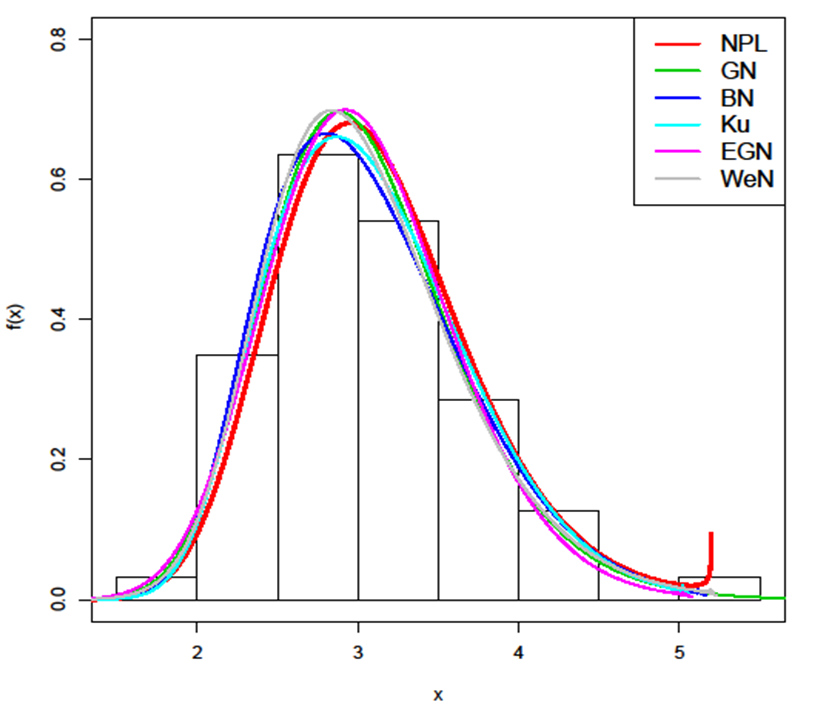
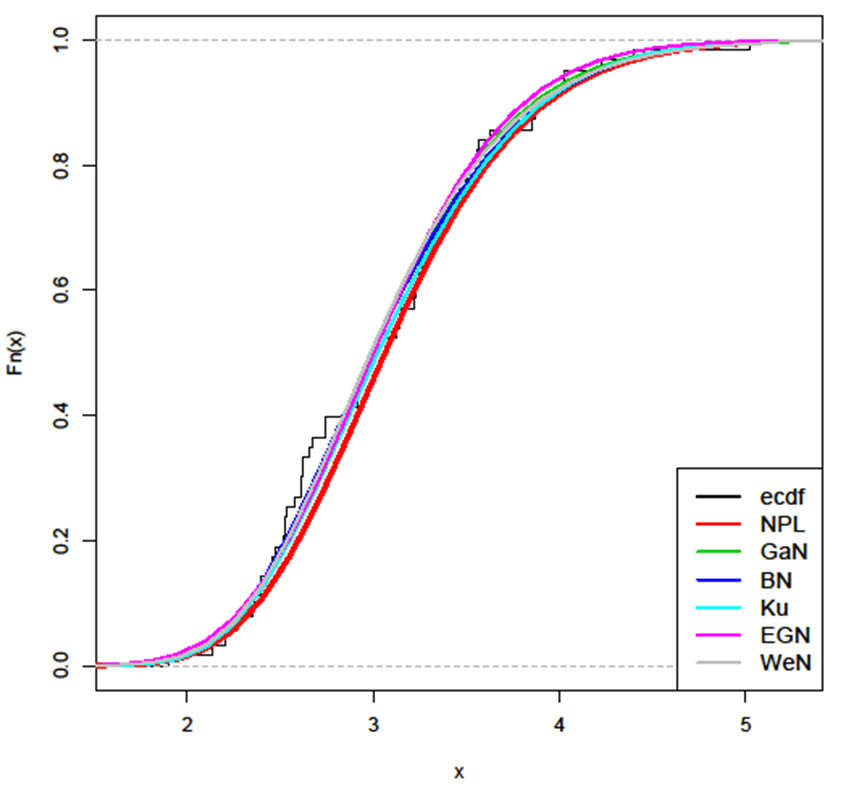
The gauge lengths of 10mm data are fitted by using the NPLD, the Beta-Normal (BN) distribution defined and studied by 15 Kumaraswamy-Normal by 17. Exponentiated Generalized-Normal (EGN) distribution by 19, Weibull-Normal (WN) distribution by 20, and Gamma-Normal (GN) distribution by 14. The data is skewed to the right (skewness = 0.6328 and kurtosis = 3.2863). The results from the six distributions are presented in Table 4. The Log-Likelihood (LogL), Akaike Information Criterion (AIC), Consistent Akaike Information Criterion (CAIC), Bayesian Information Criterion (BIC), Hannan Quinn Information Criterion (HQIC), Cramer-von Mises statistic (W), Anderson-Darling statistic (A), the Kolmogorov-Smirnov (KS) goodness of fit statistic with its corresponding p-value are reported in Table 4. From Table 4, all six distributions provide an adequate fit to the data set using W, A, KS statistics, and p-value.
Table 4 shows that the NPLD performed best when compared with the other five distributions based on the model selection criteria using AIC, CAIC, BIC, and HQIC. This is because the smaller the values of the selection criteria, the better the model.


Figure 5 displayed the histogram of the gauge length data with the density curve of NPLD and the other five competing distributions. The NPLD appears to fit the data most and gives an account of the gap to the right of the histogram and rise to take care of the dispersed or extreme value. Figure 6 displayed the cumulative distribution of the data with the six distributions fitted on it. The NPLD shows almost a perfect fit.
Application 2
In this second application, we used Crude Mortality Rate (CMR) from Bradley 29. The data set consists of 65 observations and it is given thus:
2.01, 6.32, 3.52, 2.15, 5.42, 2.04, 2.77, 2.26, 1.95, 1.00, 2.45, 0.74, 0.98, 1.27, 2.77, 3.68, 1.1, 1.09, 1.60, 0.57, 3.33, 0.91, 7.14, 2.08, 3.85, 1.99, 7.76, 2.52, 1.57, 4.67, 4.22, 1.92, 1.59, 4.08, 2.02, 0.84, 6.85, 2.18, 2.04, 1.05, 2.91, 1.37, 2.43, 2.28, 3.74, 1.30, 1.59, 1.83, 3.85, 6.30, 4.83, 0.50, 3.40, 2.33, 4.25, 3.49, 2.12, 0.83, 0.54, 3.23, 4.50, 0.71, 0.48, 2.30, 7.73
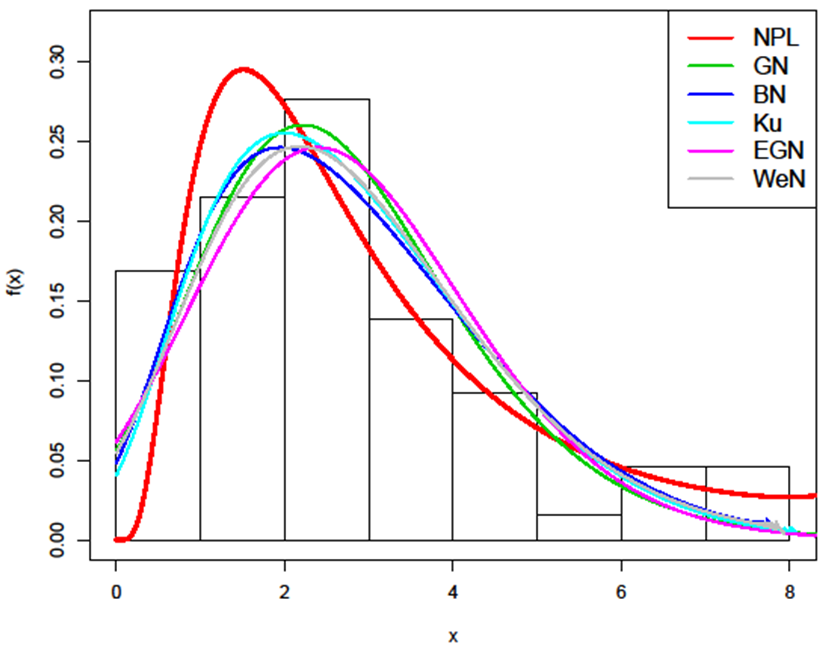
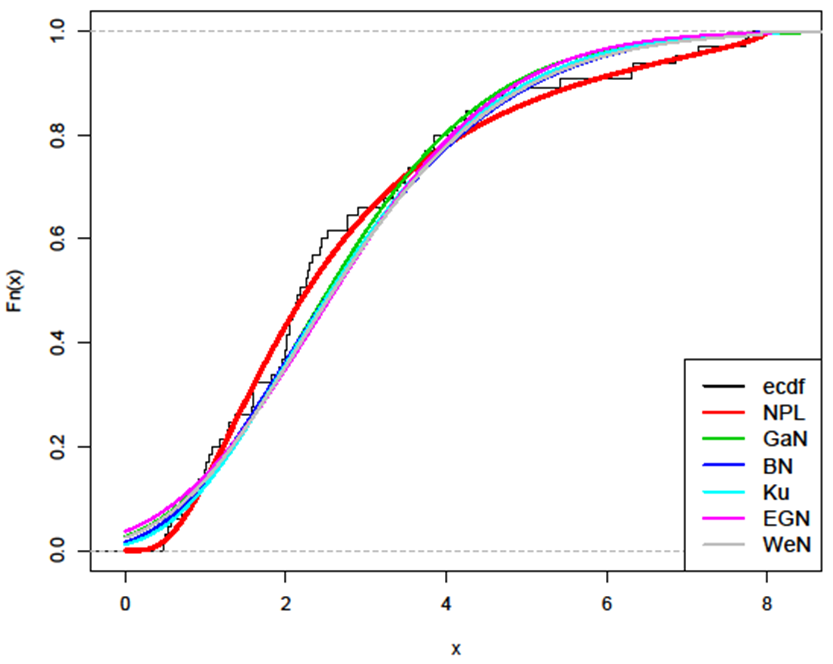
The second data is also fitted by using the same set of distributions. The data is positively skewed (skewness = 1.1235 and kurtosis = 3.6889). The results from the six distributions are presented in Table 5 using the same set of criteria.
From Table 5, all six distributions provide an adequate fit to the data using the KS p-value, but NPLD has the best fit. Table 5 shows that the NPLD performed best when compared with the other five distributions based on the model selection criteria used.
Figure 7 displayed the histogram of the CMR data with the density curve of NPLD and the other five competing distributions. The NPLD appears to fit the data most showing the positive skewness on the histogram and rise to take care of the dispersed or extreme values. Figure 8 displayed the cumulative distribution of the CMR data with the six distributions fitted on it. The NPLD performed better on the curve.

A new generalization of the power function distribution is defined and studied. The Normal-Power function {log-logistic} distribution (NPLD) can be unimodal or bimodal, positively skewed, negatively skewed, symmetric, or bath up. Its pdf, cdf, survival function, hazard function, cumulative hazard function, and reversed hazard function are used to characterize the distribution. The quantile function is derived and displayed. With useful transformation, the four parameters GPLD reduces to the normal distribution with two parameters. The NPLD is not a heavy-tail function, its r-th moment and the mean inactive function exists. The method of maximum likelihood estimation was used to estimate the parameters of GPLD. The distribution is applied to two datasets, a gauge length of 10mm and a crude mortality rate. The analysis shows that the NPLD is capable of providing adequate fit to the two datasets that are about symmetric or skewed to the right, with little peakedness, and it is found to perform well in fitting the two datasets and compared favourably than other five convoluted distributions with normal distribution parameters. It is recommended that NPLD should be used to fit gauge length, crude mortality rate, and any similar data that slightly deviate from normal and cannot be fitted by the normal distribution. The deviation from normality can be handled by the shape parameter. It should be used in the generalized linear regression model whenever the ordinary linear regression model fails.
The authors declare that they have no competing interests.
All Authors drafted the manuscript together. All authors read and approved the final manuscript.
| [1] | Okorie, I.E., Akpanta, A.C., Ohakwe, J. and Chikezie, D.C. The modified Power function distribution. Cogent Mathematics, 4: 2017, 1319592. | ||
| In article | View Article | ||
| [2] | Ekum, M.I., Adeleke, I.A. and Akarawak, E.E.. Lambda Upper Bound Distribution: Some Properties and Applications. Benin Journal of Statistics, 3: 2020a, 12-40. | ||
| In article | |||
| [3] | De Pascoa, M.A.R., Ortega, E.M.M. and Cordeiro, G.M. The Kumaraswamy generalized gamma distribution with application in survival analysis. Statistical Methodology, 8, 2011, 411-433. | ||
| In article | View Article | ||
| [4] | Aljarrah, M.A., Lee, C., Famoye, F. On generating T-X family of distributions using quantile functions, Journal of Statistical Distributions and Applications, 1(2), 2014. | ||
| In article | View Article | ||
| [5] | Alzaatreh, A., Lee, C., Famoye, F. A new method for generating families of continuous distributions, METRON 71, 2013, 63-79. | ||
| In article | View Article | ||
| [6] | Alzaatreh, A., Famoye, F. and Lee, C. The gamma-normal distribution: Properties and application. Computational Statistics & Data Analysis, 69, 2014a, 67-80. | ||
| In article | View Article | ||
| [7] | Ekum, M. I., Adamu, M. O., Adeleke, I. A., Akarawak, E. E. and Arowolo, O. T. Class of Generalized Power Function Distributions: Properties and Applications. 2020b. | ||
| In article | View Article | ||
| [8] | Arshad, M. A., Iqbal, M. Z., and Ahmadm M. Exponentiated Power Function Distribution: Properties and Applications. Journal of Statistical Theory and Applications, 19 (2), 2020, 297-313. | ||
| In article | View Article | ||
| [9] | Dallas, A.C. Characterization of Pareto and power function distribution. Annals of Mathematical Statistics, 28, 1976, 491-497. | ||
| In article | View Article | ||
| [10] | Zaka, A., and Akhter, A.S. Methods for estimating the parameters of power function distribution. Pakistan Journal of Statistics and Operations Research 9, 2013, 213-224. | ||
| In article | View Article | ||
| [11] | Meniconi, M., and Barry, D.M. The power function distribution: A useful and simple distribution to assess electrical component reliability. Microelectronics Reliability, 36: 1996, 1207-1212. | ||
| In article | View Article | ||
| [12] | Tahir, M. H., Zubair, M., Cordeiro, G. M., Alzaatreh, A., and Mansoor, M. The Weibull-power Cauchy distribution Model, properties and applications. Hacettepe Journal of Mathematics and Statistics, 46 (4), 2016. | ||
| In article | View Article | ||
| [13] | Ogunsanya, A. S., Sanni, O.O. M., and Yahya, W. B. Exploring Some Properties of Odd Lomax-Exponential Distribution. Annals of Statistical Theory and Applications (ASTA) 1: 2019, 21-30. | ||
| In article | |||
| [14] | Gupta, R. C., Gupta, P. L., and Gupta, R. D. Modeling failure time data by Lehmann alternatives. Communications in Statistics - Theory and Methods 27, 1998, 887-904. | ||
| In article | View Article | ||
| [15] | Eugene, N., Lee, C., and Famoye, F. Beta-Normal distribution and its applications, Communications in Statistics - Theory and Methods, 31(4), 2002, 497-512. | ||
| In article | View Article | ||
| [16] | Zografos, K., and Balakrishnan, N. On families of beta- and generalized gamma-generated distributions and associated inference. Stat. Methodol. 6: 2009, 344-362. | ||
| In article | View Article | ||
| [17] | Cordeiro, G. M., and de Castro, M. A new family of generalized distributions. J. Stat. Comput. Simul. 81: 2011, 883-898. | ||
| In article | View Article | ||
| [18] | Alzaatreh, A., Lee, C., Famoye, F. T-normal family of distributions: a new approach to generalize the normal distribution. Journal of Statistical Distributions and Applications. 1(16), 2014b, 1-18. | ||
| In article | View Article | ||
| [19] | Cordeiro, G. M., Ortega, E. M. M., and da Cunha, D. C. C. The Exponentiated Generalized Class of Distributions. Journal of Data Science 11, 2013, 1-27. | ||
| In article | View Article | ||
| [20] | Famoye, F., Akarawak, E., and Ekum, M. Weibull-Normal distribution and its Applications. Journal of Statistical Theory and Applications. Vol. 17(4), December 2018, 719-727. | ||
| In article | View Article | ||
| [21] | Amalare, A. A., Ogunsanya, A. S. Ekum, M. I. and Owolabi, T. Lomax-Cauchy {Uniform} Distribution: Properties and Application to Exceedances of Flood Peaks of Wheaton River, Benin Journal of Statistics, 3, 2020, 66-81. | ||
| In article | |||
| [22] | Ogunsanya, A. S., Akarawak, E. E., and Ekum, M. I. On some properties of Rayleigh-Cauchy distribution”, Journal of Statistics and Management Systems: 2021a. | ||
| In article | View Article | ||
| [23] | Ogunsanya, A.S., Yahya, W. B., Adegoke, T. M., Iluno, C., Aderele, O. R. and Ekum M. I. A New Three-Parameter Weibull Inverse Rayleigh Distribution: Theoretical Development and Applications. Mathematics and Statistics, 9(3), 2021b, 249-272. | ||
| In article | View Article | ||
| [24] | Akarawak, E. E. E., Adeleke, I. A. and Okafor, R. O. (2013). The Weibull-Rayleigh Distribution and its Properties”. Journal of Engineering Research, 18(1): 56-67. | ||
| In article | |||
| [25] | Shaked, M., and Shantikumar, J. G. (1994). Stochastic Orders and Their Applications, Academic Press, New York. | ||
| In article | |||
| [26] | Yu, Y. 2009. Stochastic Ordering of Exponential Family Distributions and Their Mixtures. Department of Statistics, University of California, Irvine, CA 92697, USA. | ||
| In article | |||
| [27] | R Development Core Team R- A Language and Environment for Statistical Computing (R Foundation for Statistical Computing, Austria, Vienna, 2009). | ||
| In article | |||
| [28] | D. Kundu and M. Z. Raqab, (2005). Generalized Rayleigh Distribution: Different Methods of Estimation. Computational Statistics and Data Analysis, 49(1), 187-200. | ||
| In article | View Article | ||
| [29] | Bradley, E. H, Webster, T. R., Baker, D., Schlesinger, M., Inouye, S. K., Barth, M. C, Lapane, K. L, Lipson, D., Stone, R., and Koren M. J. (2004). Translating research into practice: speeding the adoption of innovative health care programs. Issue Brief (Commonwealth Fund). 724: 1-12. | ||
| In article | |||
Published with license by Science and Education Publishing, Copyright © 2021 Matthew Iwada Ekum, Obalowu Job, Jimoh Taylor, Asimi Amalare, Mundher Abdullah Khaleel and Adeyinka Solomon Ogunsanya
 This work is licensed under a Creative Commons Attribution 4.0 International License. To view a copy of this license, visit
http://creativecommons.org/licenses/by/4.0/
This work is licensed under a Creative Commons Attribution 4.0 International License. To view a copy of this license, visit
http://creativecommons.org/licenses/by/4.0/
| [1] | Okorie, I.E., Akpanta, A.C., Ohakwe, J. and Chikezie, D.C. The modified Power function distribution. Cogent Mathematics, 4: 2017, 1319592. | ||
| In article | View Article | ||
| [2] | Ekum, M.I., Adeleke, I.A. and Akarawak, E.E.. Lambda Upper Bound Distribution: Some Properties and Applications. Benin Journal of Statistics, 3: 2020a, 12-40. | ||
| In article | |||
| [3] | De Pascoa, M.A.R., Ortega, E.M.M. and Cordeiro, G.M. The Kumaraswamy generalized gamma distribution with application in survival analysis. Statistical Methodology, 8, 2011, 411-433. | ||
| In article | View Article | ||
| [4] | Aljarrah, M.A., Lee, C., Famoye, F. On generating T-X family of distributions using quantile functions, Journal of Statistical Distributions and Applications, 1(2), 2014. | ||
| In article | View Article | ||
| [5] | Alzaatreh, A., Lee, C., Famoye, F. A new method for generating families of continuous distributions, METRON 71, 2013, 63-79. | ||
| In article | View Article | ||
| [6] | Alzaatreh, A., Famoye, F. and Lee, C. The gamma-normal distribution: Properties and application. Computational Statistics & Data Analysis, 69, 2014a, 67-80. | ||
| In article | View Article | ||
| [7] | Ekum, M. I., Adamu, M. O., Adeleke, I. A., Akarawak, E. E. and Arowolo, O. T. Class of Generalized Power Function Distributions: Properties and Applications. 2020b. | ||
| In article | View Article | ||
| [8] | Arshad, M. A., Iqbal, M. Z., and Ahmadm M. Exponentiated Power Function Distribution: Properties and Applications. Journal of Statistical Theory and Applications, 19 (2), 2020, 297-313. | ||
| In article | View Article | ||
| [9] | Dallas, A.C. Characterization of Pareto and power function distribution. Annals of Mathematical Statistics, 28, 1976, 491-497. | ||
| In article | View Article | ||
| [10] | Zaka, A., and Akhter, A.S. Methods for estimating the parameters of power function distribution. Pakistan Journal of Statistics and Operations Research 9, 2013, 213-224. | ||
| In article | View Article | ||
| [11] | Meniconi, M., and Barry, D.M. The power function distribution: A useful and simple distribution to assess electrical component reliability. Microelectronics Reliability, 36: 1996, 1207-1212. | ||
| In article | View Article | ||
| [12] | Tahir, M. H., Zubair, M., Cordeiro, G. M., Alzaatreh, A., and Mansoor, M. The Weibull-power Cauchy distribution Model, properties and applications. Hacettepe Journal of Mathematics and Statistics, 46 (4), 2016. | ||
| In article | View Article | ||
| [13] | Ogunsanya, A. S., Sanni, O.O. M., and Yahya, W. B. Exploring Some Properties of Odd Lomax-Exponential Distribution. Annals of Statistical Theory and Applications (ASTA) 1: 2019, 21-30. | ||
| In article | |||
| [14] | Gupta, R. C., Gupta, P. L., and Gupta, R. D. Modeling failure time data by Lehmann alternatives. Communications in Statistics - Theory and Methods 27, 1998, 887-904. | ||
| In article | View Article | ||
| [15] | Eugene, N., Lee, C., and Famoye, F. Beta-Normal distribution and its applications, Communications in Statistics - Theory and Methods, 31(4), 2002, 497-512. | ||
| In article | View Article | ||
| [16] | Zografos, K., and Balakrishnan, N. On families of beta- and generalized gamma-generated distributions and associated inference. Stat. Methodol. 6: 2009, 344-362. | ||
| In article | View Article | ||
| [17] | Cordeiro, G. M., and de Castro, M. A new family of generalized distributions. J. Stat. Comput. Simul. 81: 2011, 883-898. | ||
| In article | View Article | ||
| [18] | Alzaatreh, A., Lee, C., Famoye, F. T-normal family of distributions: a new approach to generalize the normal distribution. Journal of Statistical Distributions and Applications. 1(16), 2014b, 1-18. | ||
| In article | View Article | ||
| [19] | Cordeiro, G. M., Ortega, E. M. M., and da Cunha, D. C. C. The Exponentiated Generalized Class of Distributions. Journal of Data Science 11, 2013, 1-27. | ||
| In article | View Article | ||
| [20] | Famoye, F., Akarawak, E., and Ekum, M. Weibull-Normal distribution and its Applications. Journal of Statistical Theory and Applications. Vol. 17(4), December 2018, 719-727. | ||
| In article | View Article | ||
| [21] | Amalare, A. A., Ogunsanya, A. S. Ekum, M. I. and Owolabi, T. Lomax-Cauchy {Uniform} Distribution: Properties and Application to Exceedances of Flood Peaks of Wheaton River, Benin Journal of Statistics, 3, 2020, 66-81. | ||
| In article | |||
| [22] | Ogunsanya, A. S., Akarawak, E. E., and Ekum, M. I. On some properties of Rayleigh-Cauchy distribution”, Journal of Statistics and Management Systems: 2021a. | ||
| In article | View Article | ||
| [23] | Ogunsanya, A.S., Yahya, W. B., Adegoke, T. M., Iluno, C., Aderele, O. R. and Ekum M. I. A New Three-Parameter Weibull Inverse Rayleigh Distribution: Theoretical Development and Applications. Mathematics and Statistics, 9(3), 2021b, 249-272. | ||
| In article | View Article | ||
| [24] | Akarawak, E. E. E., Adeleke, I. A. and Okafor, R. O. (2013). The Weibull-Rayleigh Distribution and its Properties”. Journal of Engineering Research, 18(1): 56-67. | ||
| In article | |||
| [25] | Shaked, M., and Shantikumar, J. G. (1994). Stochastic Orders and Their Applications, Academic Press, New York. | ||
| In article | |||
| [26] | Yu, Y. 2009. Stochastic Ordering of Exponential Family Distributions and Their Mixtures. Department of Statistics, University of California, Irvine, CA 92697, USA. | ||
| In article | |||
| [27] | R Development Core Team R- A Language and Environment for Statistical Computing (R Foundation for Statistical Computing, Austria, Vienna, 2009). | ||
| In article | |||
| [28] | D. Kundu and M. Z. Raqab, (2005). Generalized Rayleigh Distribution: Different Methods of Estimation. Computational Statistics and Data Analysis, 49(1), 187-200. | ||
| In article | View Article | ||
| [29] | Bradley, E. H, Webster, T. R., Baker, D., Schlesinger, M., Inouye, S. K., Barth, M. C, Lapane, K. L, Lipson, D., Stone, R., and Koren M. J. (2004). Translating research into practice: speeding the adoption of innovative health care programs. Issue Brief (Commonwealth Fund). 724: 1-12. | ||
| In article | |||