In this paper, we propose a new class of Gumbel generated distributions called Gumbel-Marshall-Olkin family of distributions. The new family of distributions is represented as linear mixture of exponentiated-G distribution. Some of the sub-models are presented. We derived some characterizations such as the quantile, moments, moment generating function, entropy and order statistics of the proposed family of distributions. The estimation of the unknown parameters of the new class of distribution is through the maximum likelihood. The consistency of the MLEs of the sub-model is assessed by means of simulation. Furthermore, we derive the bivariate density function of the new class of distributions. Two real life data sets are used to illustrate the potential usefulness of the sub-models of the proposed class of distributions. The results of the applications clearly indicate that the sub-models of the proposed class of distribution provided better fit among the other competing models.
In recent years, there have been growing interests in developing families of statistical distributions by extending already existing distributions through the addition of one or more parameters. The primary focus is to generate more flexible distributions that will provide better fits to many practical situations where ordinarily the classical distributions would not have provided adequate fits. 1 proposed a method of generating new family of distributions for any baseline distribution with cumulative density function (cdf)  and define the corresponding cdf
  as
as
 | (1) |
where  and
and  is the survival function of the baseline distribution with vector of parameters
  . For
. For ,
,  .
.
In the literatures, there are many other families of distributions such are exponentaited-G by 2, beta–G by 3, transmuted-G by 4, gamma-G 5, Kumaraswamy-G by Cordeiro and de Castro (2011) 6, McDonald-G by 7.
Furthermore, 8 proposed a method of generating families of continuous distribution called the transformed-transformer (T-X) with the cdf of a class of continuous distributions for any given baseline distribution defined as
 |
and the corresponding probability density function (pdf) is given by
 |
where  satisfies the following conditions:
  ,
,  is differentiable and monotonically non-decreasing,
  as
as  and
and  as
as  .
.
9 proposed Gumbel-G family of distributions following 8. However, in this paper, we propose a new wider class of continuous distributions which generalizes the Gumbel-G family of distributions by taking
 |
and
 |
Here,  is the cdf of eq. (1).
The new wider class of continuous distributions is called Gumbel Marshall Olkin family of distributions (GMO-G) having cdf and pdf are respectively given by
 | (2) |
and
 | (3) |
where  ,
,  is the vector of parameters of the GMO-G. For
  in eqs. (2) and (3), GMO-G reduces to the cdf and pdf of Gumbel-G of 9, which is a special case of the newly proposed family of distributions..
The hazard rate function (hrf) and survival function (s.f) of GMO-G are respectively given by
 |
and
 |
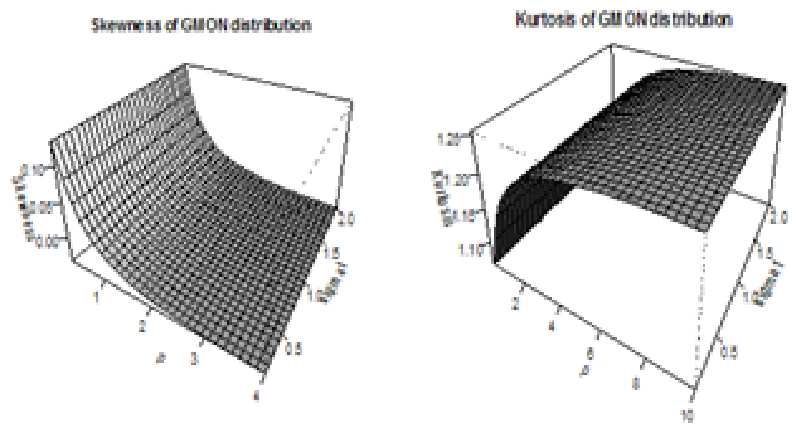
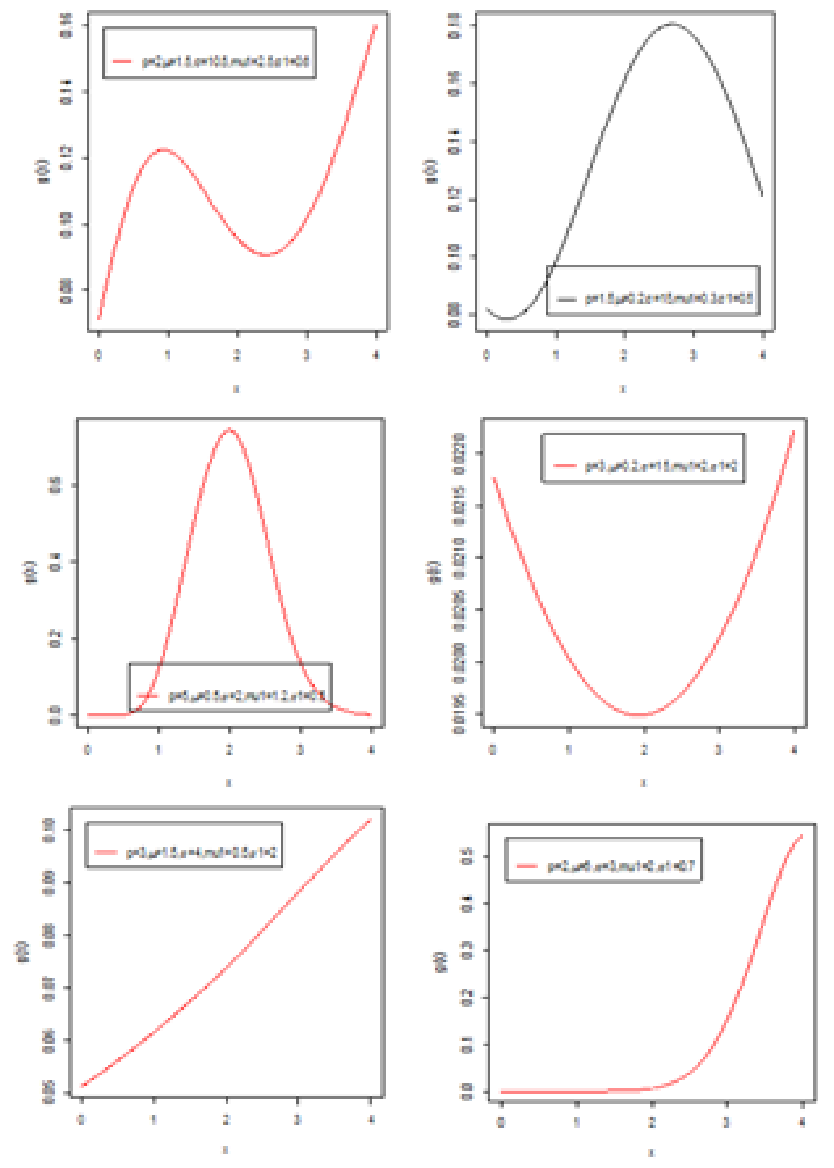
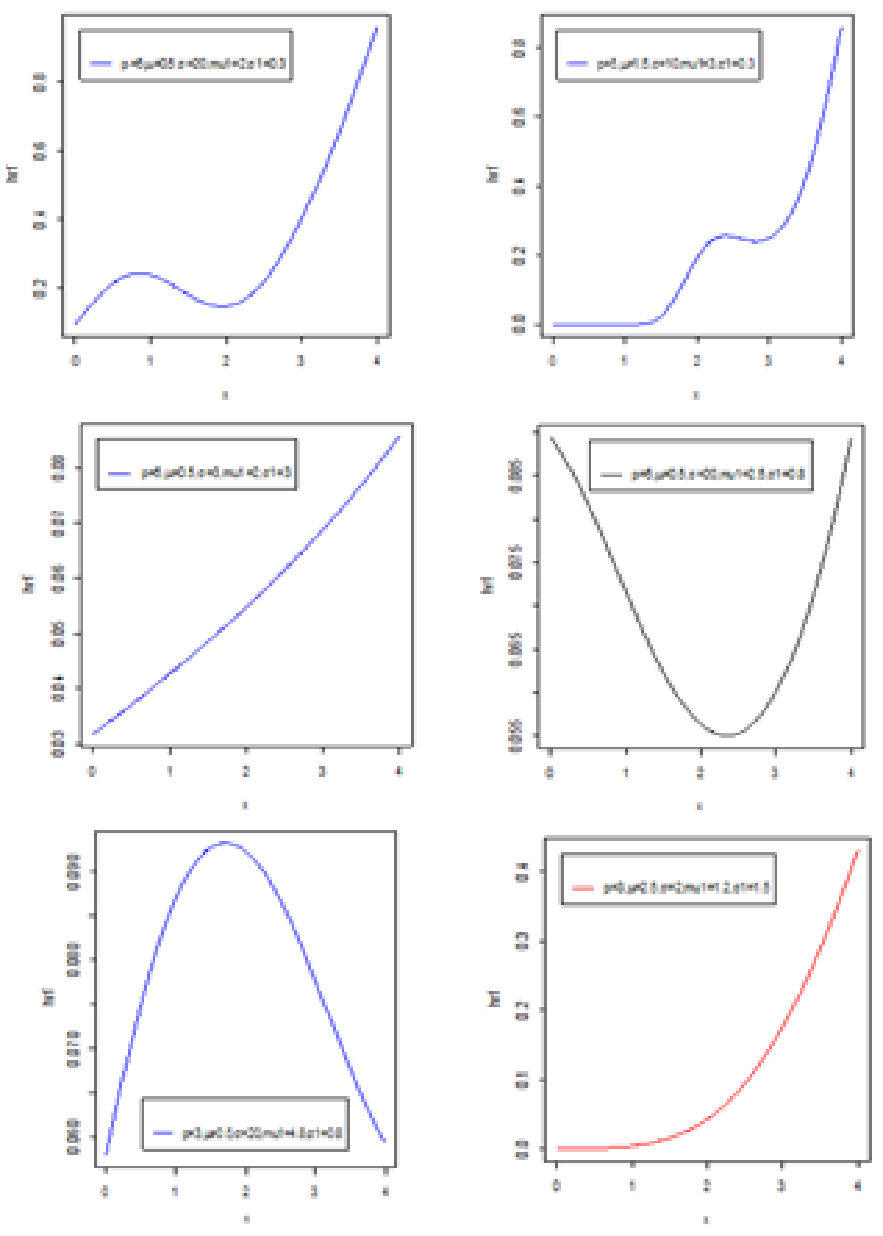
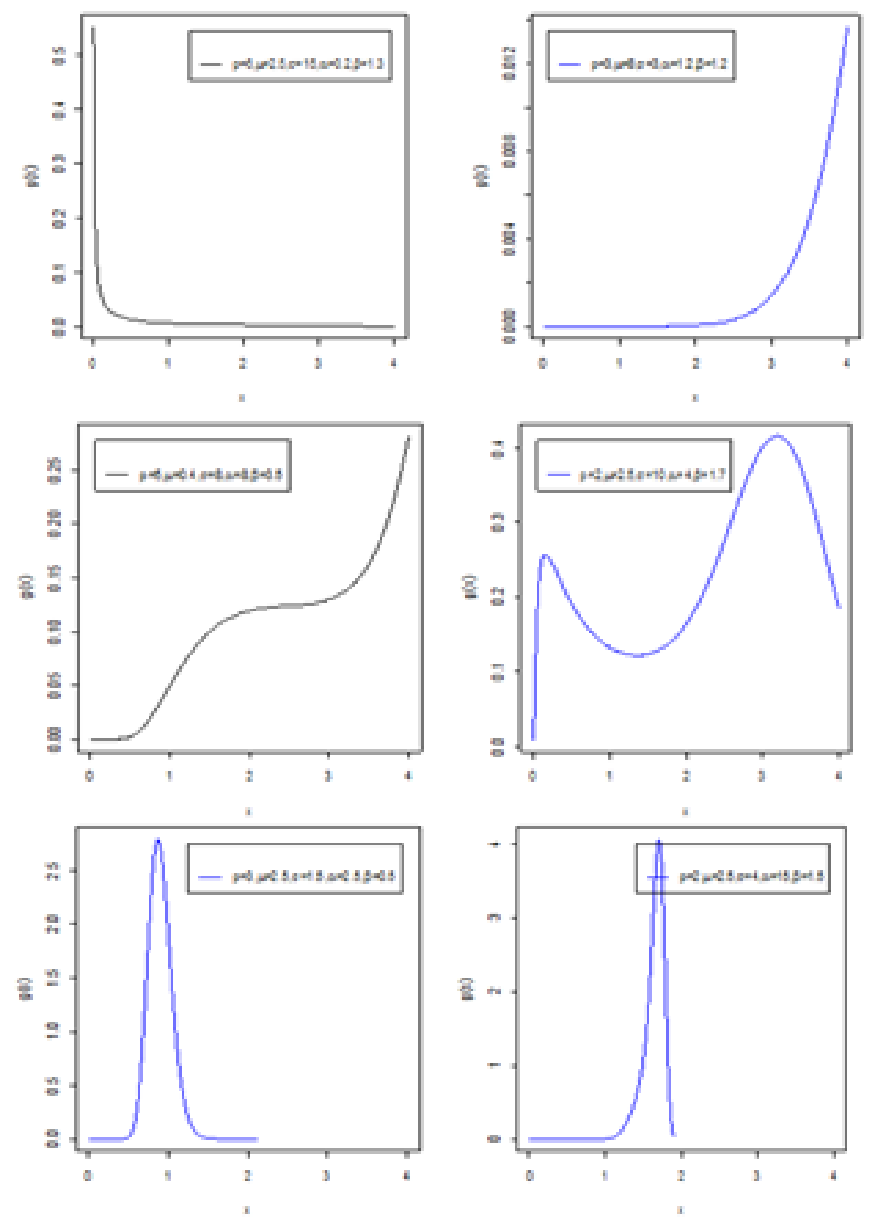
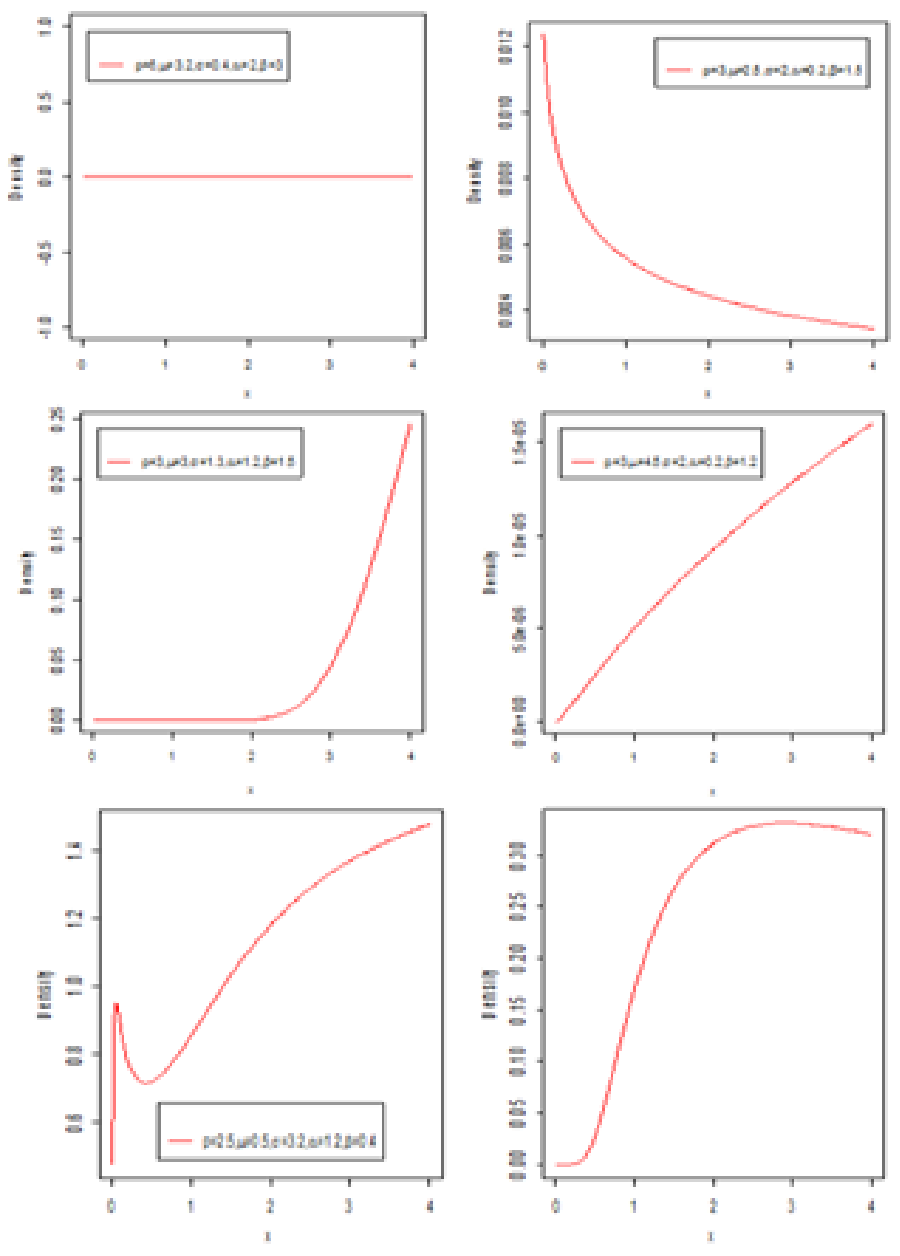
The main motivations behind this paper are to generate more flexible distributions having bimodal, bathtub, symmetric, monotone increasing, increasing-decreasing-increasing, J and reverse-J shapes; hazard rates of constant, J, reverse-J, monotone increasing, increasing-decreasing-increasing shapes as shown in Figure 2, Figure 3, Figure 4 and Figure 5; construct heavy-tailed distributions which are not longer-tailed for modeling real-life data as shown in figure1; and generate models that will provide better fit even when compared with models having the same baseline distribution.
The remaining part of the paper is organized as follows. The linear representation of the distribution and density functions of the new class of distributions are presented in section 2. In section 3, we presented some special models of the proposed new family of distributions. The quantile function is presented in section 4. In section 5, the shapes of density and hazard rate functions are discussed. We derived the moments including the ordinary, incomplete and generating function in section 6. The Entropy and the distribution of the order statistics are presented in sections 7 and 8. In section 9, we presented the method of estimation of the unknown parameters of the new family of distributions. Simulation studies on the consistency of the MLEs are presented in section 10. Bivariate extension of the proposed family of distribution is presented in section 11. Finally in section 12, we provided the concluding remarks.
Considering some useful series expansion
 |
and
 |
Using the series expansion above, equation (2) can re-written as mixture of exponentiated-G (exp-G) cumulative function given by
 | (4) |
where
 |
Here  is the cdf of Exp-G of power parameter
 . See 2, 10, 11, 12.
Some mathematical properties of Gumbel Marshall Olkin –G family of distributions can be derived from those properties of the EXP-G distribution. See 11, 12, 13.
Differentiating eq. (4), eq. (3) can be re-written as
 | (5) |
Here,  is the density function of Exp-G with power parameter
In this section, we consider two of the special models of GMO-G. However, equation (3) will be most tractable when the cdf and pdf of the baseline distribution have simply analytic expression.
3.1. GMO-Normal (GMO-N) DistributionSuppose  and
and  denotes the cdf and pdf of standard normal distribution where
 ;
;  ,
,  , then the pdf of GMO-N distribution is given by
 |
Here, is the parameter vector of GMO-N distribution. Figure 2 shows some possible shapes which are not limited to bathtub, symmetric, J-shape and monotone increasing shapes for some selected parameter values. Figure 3 also shows some possible shapes of the hazard rate function for some selected parameter values. These shapes indicate the flexibility of GMO-N and its potential to model real-life data.
A random variable with
 |
and
 |
where  and
and  are the shape and scale parameters is said to follow Weibull distribution. By substituting
  and
and  in equation (3), the pdf of GMO-W is defined as
 |
The plots of the pdf and hrf of GMO-W distribution for selected parameter values are shown in Figure 4 and Figure 5 respectively. Shapes such as bimodal, j and reverse-J, symmetric and left-skewed are for the density function while constant, S-shape, monotone increasing, increasing-decreasing-increasing shapes are for hazard rate function.
The quantile function (qf) of GMO-G family is obtained by inverting equation (1.2) and it is given by
 | (6) |
Here, and
and is the qf of the baseline distribution.
The effect of the parameters GMO-G on skewness and kurtosis are determined by its quantile measures using the Bowley’s skewness and Moor’s kurtosis measures. These measures are respectively given by
and
 |
However, these measures are less sensitive to outliers and they do exist for distribution with moments. We considered the effect of parameters  and
and  on the skewness and kurtosis of GMO-Normal. The plots are presented in Figure 1. Both measures equal zero for the normal distribution.

Proposition 1: If  follows Gumbel distribution, then for any baseline distribution with cdf
  the qf can be expressed as
 | (7) |
where  is the qf of Marshall Olkin and
  the qf of the transformed distribution.
PROOF
 and
and  are obtained by inverting (1) and cdf of
  and are respectively given by
 |
and
 |
Substituting  and
and  in (7) and simplifying, (6) is obtained.
The shapes of the density and hazard rate function of GMO-G can be described analytically. The critical points of the GMO-G density function are the roots of the equation below
 | (8) |
By equation (8), there may be more than one root. Suppose  is a root of (8), then
 , and
, and  correspond to the local maximum, local minimum, and point of reflection respectively. Here
  is given by
 |
Figure 2 and Figure 4 show the graphical pdf plots of two GMO-G sub-models (GMO-N and GMO-W) for selected parameter values indicating different shapes.
Furthermore, the shape of the GMO-G hazard rate function can be described analytically. The critical points of the GMO-G hazard rate function are the roots of the eq. (9).
 | (9) |
There may be more than one root of equation (9). Thus, if  is a root of (9), then
 ,
, , and
, and  correspond to the local maximum, local minimum, and point of reflection respectively. Here
  is given by


Figure 3 and Figure 5 show the graphical hrf plots of two GMO-G sub-models (GMO-N and GMO-W) for selected parameter values indicating different shapes.
In this section, we obtained some moments associated with GMO-G family of distribution.
6.1. Ordinary MomentSuppose is a random variable from GMO-G distribution, then the
  moment about the origin can be expressed by two formulas.
Firstly, let a random variable having pdf
 with power parameter
 , then the
  moment of
  is given by
 |
Secondly,
 |
where
 |
The incomplete moment plays important role in determining measures of inequality such as Lorenz, Bonferroni and Gini measures of inequality 14. For a random variable having GMO-G density function, the  incomplete moment is given by
 |
The moment generating function (mgf)  of a random variable X having GMO-G defined as can be obtained firstly by
 |
where is the mgf of Y~Expm+1-G distribution.
Secondly, can be obtained by
 |
where  ,
, and
and are as defined in equation (6).
The measure of uncertainty of a random variable is through entropy. The Renyi and Shannon entropies are the two popular entropies. However, the Renyi entropy is a generalization of Shannon entropy. For a random variable  with pdf
  , according to 15, the Renyi entropy is defined as
 |
However, suppose X~GMO-G, the Renyi entropy is given by
Let be a random sample from a population having pdf
  and
and  the order statistics. The pdf
  of the
  order statistics is given by
 |
 |
Following 16, the pdf of  ordered statistics of sample of size n from GMO-G population is given by
 (10)
(10)
 |
We consider the maximum likelihood method for the estimation of unknown parameters of GMO-G distribution. For a random sample  of size
  from eq. (2), the log-likelihood function is given by
 |
The score functions for the parameters of the distribution are given by
 |
 |
 |
The MLEs say,  of
of  can be obtained as the solution to the non-linear equations

 and
and  Iterative techniques such as a Newton-Raphson type algorithm can be employed to evaluate
  Here, the optim function in R statistical software is used to obtain the numerical solution. Taking the minus expectation of the partial derivative of the score function with respect to the parameters of the distribution, we obtain the Fisher’s information matrix
  ;
;  , where
  is the number of parameters of the baseline distribution. However, under general regularity conditions,
  is asymptotically multivariate normal distributed
  . By
. By  the asymptotic confidence interval for the parameters of the distribution appropriately constructed.
In this section, we assess the performance of the MLEs of GMO-Normal distribution, a sub model of GMO-G through simulation studies of different starting parameter values 


 and
and 


 Simulated samples data of sizes n=50, 100, 150 generated by inverting the GMO-N distribution function given by
 |
where is the distribution function of normal distribution with
 and
and The MLEs, say
  =
= ,
, ,
, ,
,  ,
, are determined and the process is repeated for N=1000 times. We obtain the average estimates (Mean value), average baises and the mean square error (MSE) given respectively by
 |
 |
and
 |
The results of the simulations for the three different starting parameter values are respectively shown in Table 1, Table 2, and Table 3. The values in the tables indicate that as the sample size increases the mean values tend to starting parameter values and the MSE decreases which conforms to the first order asymptotic theory.
Let X and Y be two random variables from GMO-G family of distribution, the bivariate cdf is given by
 | (11) |
By taking the partial derivative of (11) with respect to  and
and , the bivariate pdf of GMO-G is given by
 |
where
 |
and
 |
The marginal distributions are respectively given by
 |
and
The conditional density functions are respectively given by
 |
and
 |
and
 |
In this section, we considered the applications of two sub models of GMO-G (GMO-Weibull and GMO-Lomax) to real life data sets to show the potentials of the new class of distributions. Comparison with other models having the same baseline distribution is made based on goodness-of-statistics Cramer Von Mises (W*), Anderson Darling, Koromogrov-Smirnov, Akaike Information Criterion, and Bayesian Information Criterion. The model with the least value of goodness-of-fit statistics provides the best fit 17.
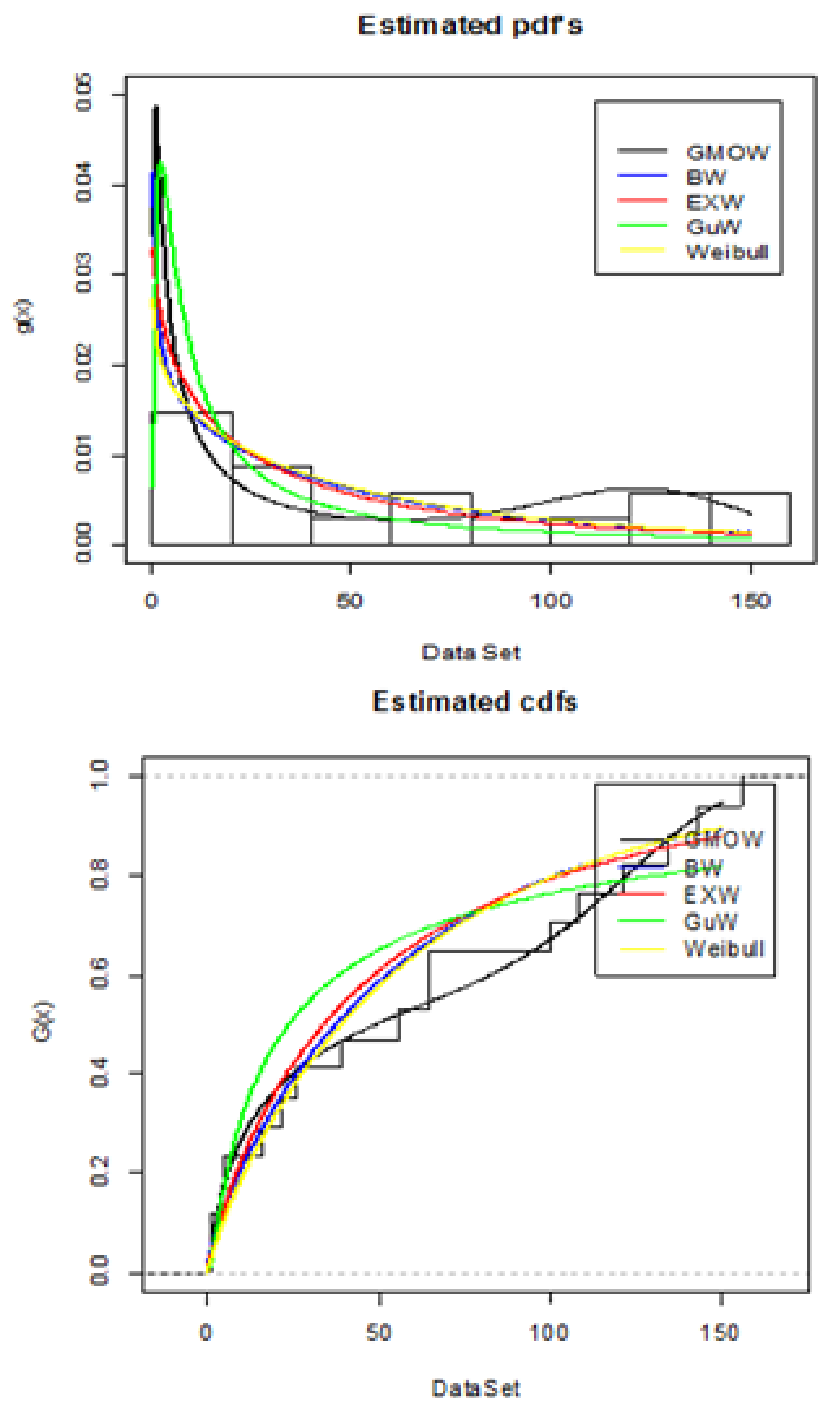
First data set: The first real data set is on the observed survival times (weeks) for AG positive reported by 18. The data set is as follow: 65, 156, 100, 134, 16, 108, 121, 4, 39, 143, 56, 26, 22, 1, 1, 5, 65. The GMO-Weibull, Exponentiated-Weibull(ExpW) due to 2, Beta-Weibull (BW) due to 19, Gumbel-Weibull(GuW) due to 9, logistic-Weibull(LW) and Weibull distribution are fitted to the data set.
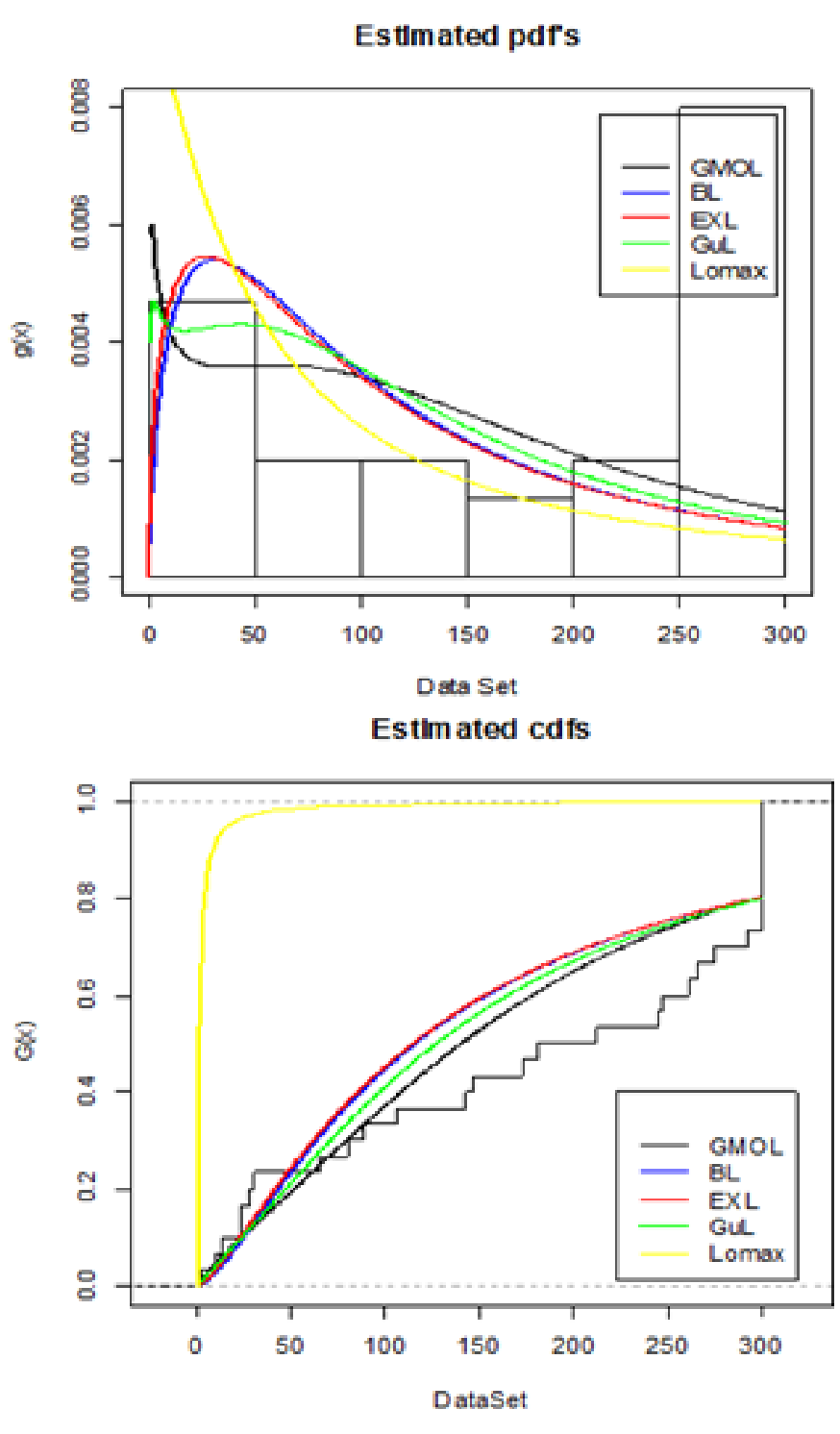
Second data set: The second real data set refers to 30 devices failure times reported by Meeker and Escobar 20 and Tahir et al. 21. The data set are as follow: 275,13, 147, 23, 181, 30, 65, 10, 300, 173, 106, 300, 300, 212, 300, 300, 300, 2, 261, 293, 88,247, 28, 143, 300, 23, 300, 80, 245, 266. The GMO-Lomax, Beta-Lomax (BL) due to 22, Gumbel-Lomax(GuL) due to 23, Exponentiated-Lomax(ExpL) due to 24, logistic-Lomax (LL) due to 25 and Lomax distribution are fitted to the data set.
The results of the two applications to the real data sets are shown in Table 4, Table 5 and Table 6, Table 7 for first and second data set respectively. The parameter estimates with standard errors in parenthesis are shown in Table 4 and Table 6 while the goodness-of-fit statistics are contained in Table 5 and Table 7 for the first and second data set respectively. The plots of the estimated pdfs and empirical cdf with cdfs of some of the competing models in the first and second application are shown respectively in Figure 6 and Figure 7. The plots in Figure 6 and Figure 7 indicate that the sub models of the newly proposed class of distributions provide better fits among the competing models in agreement with the Table 5 and Table 7.

We proposed a new class of Gumbel generated family of distributions called Gumbel-Marshall Olkin-G family of distribution which has Gumbel-G as a special model. The cdf and pdf of the new class of distributions are represented as linear combination of exponentiated-G family of distribution. Some sub models of the new class of distributions are presented and several continuous distributions can be obtained for any baseline distribution. Furthermore, some statistical properties such as the quantile function. Ordinary and incomplete moments, generating function, entropy, and density function of the order statistics are derived. The unknown parameters of the new family of distributions are estimated through maximum likelihood method. The consistency of the MLEs is considered using GMO-N by means of simulations studies. We further derived the bivariate extension of the new class of distributions. Finally, the potentials of the new class of the distributions are illustrated by means of comparing the GMO-W and GMO-Lomax distributions with other competing distributions in two real life data sets. The goodness-of-statistics indicate that the two sub models of the new class of distributions provide the best fit among other competing models.
| [1] | Marshall A.W. and Olkin I. (1997). A new method for adding a parameter to a family of distribution with application to exponential and Weibull families. Biometrika, 84(3): 641-652. | ||
| In article | View Article | ||
| [2] | Mudholkar G.S., Srivastava D.K. and Freimer M. (1995). The exponentiated Weibull family: A reanalysis of the bus Motor-failure data, Technometrics, 37(4) 436-445. | ||
| In article | View Article | ||
| [3] | Eugene N., Lee C. and Famoye F., (2002). Beta-Normal distribution and its applications. Commun. Statis-theory meth., 31(4):497-512. | ||
| In article | View Article | ||
| [4] | Shaw, W. T. and Buckley, I. R. C. (2007). The alchemy of probability distributions: beyond Gram-Charlier expansions and a skew-kurtotic-normal distribution from a rank transmutation map. Research report. | ||
| In article | |||
| [5] | Zografos, K. and Balakrishnan, N. (2009). On families of beta and generalized gamma-generated distributions and associated inference, Statistical Methodology 6:344-362. | ||
| In article | View Article | ||
| [6] | Cordeiro G. M and De Castro M. (2011). A new family of generalized distributions. Journal of statistical computation and simulation, 81(7): 883-898. | ||
| In article | View Article | ||
| [7] | Alexander C., Cordeiro G.M., Ortega E.M.M and Sarabia J.M. (2012). Generalized beta generated distributions. Computational statistics and data analysis, 56:1880-1897. | ||
| In article | View Article | ||
| [8] | Alzaatreh, A., Lee C. Famoye F. (2013). A new method for generating families of continuous distributions. Metron, 71: 63-79. | ||
| In article | View Article | ||
| [9] | Al-Aqtash R., Lee C. and Famoye F. (2014). Gumbel-Weibull distribution: Properties and application. Journal of Modern applied statistical methods, 13(2)201-225. | ||
| In article | View Article | ||
| [10] | Gupta R. D. and Kundu D. (2001). Exponentiated exponential family: An alternative to gamma and Weibull distributions. Biometrika Journal, 43(1):117-130. | ||
| In article | View Article | ||
| [11] | Cordeiro G. M., Ortega E.M.M., and Da Cunha D.C.C. (2013). The Exponentiated generalized class of distributions. Journal of data science, 11: 1-27. | ||
| In article | |||
| [12] | Nadarajah S. and Kotz S. (2006). The exponentiated type distributions. Acta Appl. Math., 92:97-111. | ||
| In article | View Article | ||
| [13] | Cordeiro G.M., Alizadeh M., Ozel G., Hosseini B., Ortega E.M.M., and Altun E. (2016). The generalized odd log-logistic family of distributions:properties, regression models and applications, Journal of statistical computation and simulation. | ||
| In article | View Article | ||
| [14] | Butler R. J. and McDonald J.B. (1989). Using Incomplete moments to measure inequality. Journal of Econometrics, 42: 109-119. | ||
| In article | View Article | ||
| [15] | Rényi, A. (1961). On Measures of Entropy and Information. Proceedings of the Fourth Berkeley Symposium on Mathematical Statistics and Probability, Volume 1: Contributions to the Theory of Statistics, 547-561, University of California Press, Berkeley, Calif. | ||
| In article | |||
| [16] | Nadarajah S., Cordeiro G.M., and Ortega E.M.M. (2015). The Zografos-Balakrishnan-G family of distributions: Mathematical properties and applications. Comm. Stat. Theory Methods, 44: 186-215. | ||
| In article | View Article | ||
| [17] | Chen, G. and Balakrishnan, N., (1995). A General Purpose Approximate Goodness-of-Fit Test. Journal of Quality Technology, 27:2, 154-161. | ||
| In article | View Article | ||
| [18] | Feigl P, Zelen M (1965) .Estimation of exponential probabilities with concomitant information. Biometrics, 21:826-838. | ||
| In article | View Article PubMed | ||
| [19] | Lee C.., Famoye, F., and Olumolade, O. (2007). Beta-Weibull Distribution: Some Properties and Applications to Censored Data. Journal of Modern Applied Statistical Methods, 6(1): 173-186. | ||
| In article | View Article | ||
| [20] | Meeker W. Q. and Escobar L.A., (1998). Statistical methods for reliability data. Wiley New York. | ||
| In article | |||
| [21] | Tahir ,M. H., Alizadeh, M., Mansoor, M., Cordeiro, G. M., and Zubair, M. (2016). The Weibull-power function distribution with applications. Hacettepe Journal of Mathematics and Statistics, 45(1): 245-265. | ||
| In article | View Article | ||
| [22] | Rajab, M., Aleem, M., Nawaz, T. and Daniyal M. (2013). On Five Parameter Beta Lomax Distribution. Journal of Statistics, 20: 102-118. | ||
| In article | |||
| [23] | Tahir, M.H., Hussain, A.M., Cordeiro, G.M., Hamedani, G.G., Mansoor, M. and Zubair, M. (2015). The Gumbel-Lomax Distribution: Properties and Applications. Journal of Statistical Theory and Applications, 15 (1): 61-79. | ||
| In article | View Article | ||
| [24] | El-Bassiouny, A.H., Abdo, N. F., and Shahen, H.S., (2015). Exponential Lomax Distribution. International Journal of Computer Applications, 121(13): 24-29. | ||
| In article | View Article | ||
| [25] | Zubair, M., Cordeiro, G. M., Tahir, M. H., Mahmood, M., Mansoor, M. (2017). A Study of Logistic-Lomax Distribution and Its Applications. Journal of Probability and Statistical Science, 15(1): 29-46. | ||
| In article | |||
Published with license by Science and Education Publishing, Copyright © 2020 Elebe E. Nwezza, Chinonyerem V. Ogbuehi, Uchenna U. Uwadi and C.O. Omekara
 This work is licensed under a Creative Commons Attribution 4.0 International License. To view a copy of this license, visit
http://creativecommons.org/licenses/by/4.0/
This work is licensed under a Creative Commons Attribution 4.0 International License. To view a copy of this license, visit
http://creativecommons.org/licenses/by/4.0/
| [1] | Marshall A.W. and Olkin I. (1997). A new method for adding a parameter to a family of distribution with application to exponential and Weibull families. Biometrika, 84(3): 641-652. | ||
| In article | View Article | ||
| [2] | Mudholkar G.S., Srivastava D.K. and Freimer M. (1995). The exponentiated Weibull family: A reanalysis of the bus Motor-failure data, Technometrics, 37(4) 436-445. | ||
| In article | View Article | ||
| [3] | Eugene N., Lee C. and Famoye F., (2002). Beta-Normal distribution and its applications. Commun. Statis-theory meth., 31(4):497-512. | ||
| In article | View Article | ||
| [4] | Shaw, W. T. and Buckley, I. R. C. (2007). The alchemy of probability distributions: beyond Gram-Charlier expansions and a skew-kurtotic-normal distribution from a rank transmutation map. Research report. | ||
| In article | |||
| [5] | Zografos, K. and Balakrishnan, N. (2009). On families of beta and generalized gamma-generated distributions and associated inference, Statistical Methodology 6:344-362. | ||
| In article | View Article | ||
| [6] | Cordeiro G. M and De Castro M. (2011). A new family of generalized distributions. Journal of statistical computation and simulation, 81(7): 883-898. | ||
| In article | View Article | ||
| [7] | Alexander C., Cordeiro G.M., Ortega E.M.M and Sarabia J.M. (2012). Generalized beta generated distributions. Computational statistics and data analysis, 56:1880-1897. | ||
| In article | View Article | ||
| [8] | Alzaatreh, A., Lee C. Famoye F. (2013). A new method for generating families of continuous distributions. Metron, 71: 63-79. | ||
| In article | View Article | ||
| [9] | Al-Aqtash R., Lee C. and Famoye F. (2014). Gumbel-Weibull distribution: Properties and application. Journal of Modern applied statistical methods, 13(2)201-225. | ||
| In article | View Article | ||
| [10] | Gupta R. D. and Kundu D. (2001). Exponentiated exponential family: An alternative to gamma and Weibull distributions. Biometrika Journal, 43(1):117-130. | ||
| In article | View Article | ||
| [11] | Cordeiro G. M., Ortega E.M.M., and Da Cunha D.C.C. (2013). The Exponentiated generalized class of distributions. Journal of data science, 11: 1-27. | ||
| In article | |||
| [12] | Nadarajah S. and Kotz S. (2006). The exponentiated type distributions. Acta Appl. Math., 92:97-111. | ||
| In article | View Article | ||
| [13] | Cordeiro G.M., Alizadeh M., Ozel G., Hosseini B., Ortega E.M.M., and Altun E. (2016). The generalized odd log-logistic family of distributions:properties, regression models and applications, Journal of statistical computation and simulation. | ||
| In article | View Article | ||
| [14] | Butler R. J. and McDonald J.B. (1989). Using Incomplete moments to measure inequality. Journal of Econometrics, 42: 109-119. | ||
| In article | View Article | ||
| [15] | Rényi, A. (1961). On Measures of Entropy and Information. Proceedings of the Fourth Berkeley Symposium on Mathematical Statistics and Probability, Volume 1: Contributions to the Theory of Statistics, 547-561, University of California Press, Berkeley, Calif. | ||
| In article | |||
| [16] | Nadarajah S., Cordeiro G.M., and Ortega E.M.M. (2015). The Zografos-Balakrishnan-G family of distributions: Mathematical properties and applications. Comm. Stat. Theory Methods, 44: 186-215. | ||
| In article | View Article | ||
| [17] | Chen, G. and Balakrishnan, N., (1995). A General Purpose Approximate Goodness-of-Fit Test. Journal of Quality Technology, 27:2, 154-161. | ||
| In article | View Article | ||
| [18] | Feigl P, Zelen M (1965) .Estimation of exponential probabilities with concomitant information. Biometrics, 21:826-838. | ||
| In article | View Article PubMed | ||
| [19] | Lee C.., Famoye, F., and Olumolade, O. (2007). Beta-Weibull Distribution: Some Properties and Applications to Censored Data. Journal of Modern Applied Statistical Methods, 6(1): 173-186. | ||
| In article | View Article | ||
| [20] | Meeker W. Q. and Escobar L.A., (1998). Statistical methods for reliability data. Wiley New York. | ||
| In article | |||
| [21] | Tahir ,M. H., Alizadeh, M., Mansoor, M., Cordeiro, G. M., and Zubair, M. (2016). The Weibull-power function distribution with applications. Hacettepe Journal of Mathematics and Statistics, 45(1): 245-265. | ||
| In article | View Article | ||
| [22] | Rajab, M., Aleem, M., Nawaz, T. and Daniyal M. (2013). On Five Parameter Beta Lomax Distribution. Journal of Statistics, 20: 102-118. | ||
| In article | |||
| [23] | Tahir, M.H., Hussain, A.M., Cordeiro, G.M., Hamedani, G.G., Mansoor, M. and Zubair, M. (2015). The Gumbel-Lomax Distribution: Properties and Applications. Journal of Statistical Theory and Applications, 15 (1): 61-79. | ||
| In article | View Article | ||
| [24] | El-Bassiouny, A.H., Abdo, N. F., and Shahen, H.S., (2015). Exponential Lomax Distribution. International Journal of Computer Applications, 121(13): 24-29. | ||
| In article | View Article | ||
| [25] | Zubair, M., Cordeiro, G. M., Tahir, M. H., Mahmood, M., Mansoor, M. (2017). A Study of Logistic-Lomax Distribution and Its Applications. Journal of Probability and Statistical Science, 15(1): 29-46. | ||
| In article | |||








 of the first data set)



 of the second data set)
