Similar to Fibonacci sequence and Lucas sequences that are recursively defined we define an integer sequence using the Euler totient function ϕ and study some of its properties. We also verify that the sequence we have defined has some properties similar to Fibonacci sequence, but even then it is not a Lucas sequence.
There have been various attempts in the recent literature to study properties related to integer sequences similar to Fibonacci sequence which is defined recursively by F0 = 1, F1 = 1 and Fn = Fn-1 +Fn-2 for n> 1. Fibonacci sequence has many interesting properties like even being consisting of very large terms after a few number of initial terms, the ratio of consecutive terms converges to a finite number. Another interesting property of Fibonacci sequence is that it has no perfect numbers in it (See 1). A larger class of sequences is defined generalizing the Fibonacci sequence called Lucas sequences. They also share some of the important properties of Fibonacci sequences. In this article, we define an integer sequence via the arithmetical function. Euler ϕ function and try to obtain some properties of this sequence contrasting with the Fibonacci sequence
In what following, ϕ will denote the Euler totient function. Therefore, ϕ (n) is the number of positive integers < n that are co prime to n, n 1. By
1. By  (n), we mean the number of divisors of n.
  (n) will denote the sum of divisors of n including n itself. n is said to be perfect if
  (n) = 2n. Some examples for perfect numbers are 6 and 28.
Now we state a classical result on convergence of real numbers called as the Stolz-Cesaro theorem:
Theorem 2.1. [ 3, Chapter 3, Theorem 1.2.2]
Let  be a sequence of real numbers and
  a strictly monotone and divergent sequence. Then
 |
 |
Implies
 |
The Fibonacci sequence, as we mentioned above in the introduction is defined recursively as F0 = 1, F1 = 1 and Fn = Fn-1 + Fn-2 for n  2. For a fixed pair of integers (p, q), Lucas sequence is defined as choosing l0, l1 arbitrary, and defining ln = pln-1 – qln-2. If we let p = 1 and q = -1, it becomes the definition of the Fibonacci sequence.
It is known that Fibonacci sequence or Lucas sequence do not contain any perfect numbers 1.
We now state a lemma which we are going to use frequently.
Lemma 3.1. The ϕ function satisfies the following bounds:
(1) 
(2) 
(3) 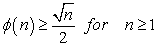
Proof. The statement (1) is obvious. To see (2) note that for every 2n, half of the number of numbers below or equal to that are even and so they are not co-prime to 2n. Hence a maximum of n of them only can be co-prime to 2n. Hence statement (2) follows. The claim in (3) has been established by J. Browkin while trying to see the weaker result 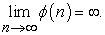 This proof can be found, for example in [ 4, Chapter 6, Theorem 4].
We now define a sequence  recursively as follows. Take
  . Define
  Some initial values of
  are 1, 2, 3,5, 7, 11, 13, 19, 23, 29, 33 . . . This sequence is clearly a monotone increasing sequence and goes to
  with n. Let us call it as the phi-sequence. This sequence is in fact called as the totient summatory function in the literature. We now show
  can be restricted above by some polynomial in n. We summarize our claims in the next two propositions.
Proposition 3.2. 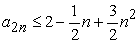 for every n.
Proof. By definition  . We now split this over even and odd indices. Thus
 |
If k is even, then by lemma (3.1),  and if k odd (or in fact for any k),
  . Then
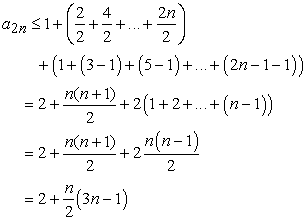 |
which is what we claimed.
Proposition 3.3. 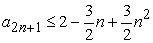 for every n.
Proof. Note that  . Now use the bound obtained in the above proposition to conclude.
Fibonacci sequence is monotonically increasing to  with n. One of the key properties of Fibonacci sequence is that the ratio of consecutive terms converges to the number
  = 1.6180339887 …. Though the terms are increasing by large leaps, the ratio of terms
 surprisingly approaches a finite number. In the next result, we show that the sequence we defined above has the same property. That is, the limit of ratio of terms
  converges to a finite number.
Theorem 3.4. The sequence of ratios  converges to 1 as
  .
.
Proof. Since  we have
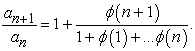 |
By (1) and (3) in lemma (3.1),
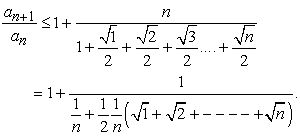 |
Write xn =√1 +√2+…+√n and yn= n .Then
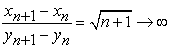 |
 |
by theorem (2.1), we have  Thus
Thus  is bounded above by a sequence which converges to 1. Also, since
  by definition, it is bounded below by the constant sequence (1). Hence by squeeze theorem for real number sequences,
  also converges to 1.
We now prove that the sequence we have defined is not a Lucas sequence.
Theorem 3.5. There do not exist integers r, s such that  which works for every n. In other words no tail of the ϕ sequence is Lucas.
Proof. On the contrary, suppose such r, s exists. Then since 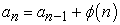 we get
 |
Now the  . Since
 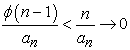 as can be seen in the proof of theorem (3.4). So as
  we get
  . Since r, s fixed integers, r - s = 1. Thus
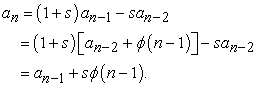 |
Therefore 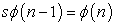 . Note that s is positive by this equation. If we let n - 1 to be a prime, then
 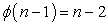 . Since n is even,
  If we take
  this means that
  , which is not true for n > 4. So such an s cannot exist. The infinitude of primes proves our claim.
We have already seen that Lucas sequences do not contain perfect numbers. Though we are unable to state such a result for our phi-sequence, we have experimental evidence to believe that such a statement holds for our sequence as well. We have tested it for all terms up to 106 (with the support of SageMath software) and could not locate a single perfect number. So we state it as a conjecture and leave it for future studies:
Conjecture 3.6. The  sequence does not contain any perfect numbers.
There are many other questions one may find interesting with these type of sequences. For example, the set 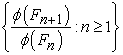 is dense in the set of all positive numbers (see 2). Such a similar result can be discussed for our phi-sequence also. Further, we believe that similar properties may hold if we modify our sequence replacing the phi-function with
  or
or  . We plan to discuss these sequences in a sequel to this article.
| [1] | Florian Luca. Perfect fbonacci and lucas numbers. Rendiconti del Circolo Matematico di Palermo, 49(2):313-318, 2000. | ||
| In article | View Article | ||
| [2] | Florian Luca, V Janitzio Mejia Huguet, Av San Pablo, and Florin Nicolae. On the euler function of fbonacci numbers. Journal of Integer Sequences, 12(2):3, 2009. | ||
| In article | |||
| [3] | Marian Muresan. A concrete approach to classical analysis, volume 14. Springer, 2009. | ||
| In article | View Article | ||
| [4] | Waclaw Sierpinski. Elementary Theory of Numbers: Second English Edition (edited by A. Schinzel), volume 31. Elsevier, 1988. | ||
| In article | |||
Published with license by Science and Education Publishing, Copyright © 2019 Binu K P, Vinod S and K Vishnu Namboothiri
 This work is licensed under a Creative Commons Attribution 4.0 International License. To view a copy of this license, visit
http://creativecommons.org/licenses/by/4.0/
This work is licensed under a Creative Commons Attribution 4.0 International License. To view a copy of this license, visit
http://creativecommons.org/licenses/by/4.0/
| [1] | Florian Luca. Perfect fbonacci and lucas numbers. Rendiconti del Circolo Matematico di Palermo, 49(2):313-318, 2000. | ||
| In article | View Article | ||
| [2] | Florian Luca, V Janitzio Mejia Huguet, Av San Pablo, and Florin Nicolae. On the euler function of fbonacci numbers. Journal of Integer Sequences, 12(2):3, 2009. | ||
| In article | |||
| [3] | Marian Muresan. A concrete approach to classical analysis, volume 14. Springer, 2009. | ||
| In article | View Article | ||
| [4] | Waclaw Sierpinski. Elementary Theory of Numbers: Second English Edition (edited by A. Schinzel), volume 31. Elsevier, 1988. | ||
| In article | |||


