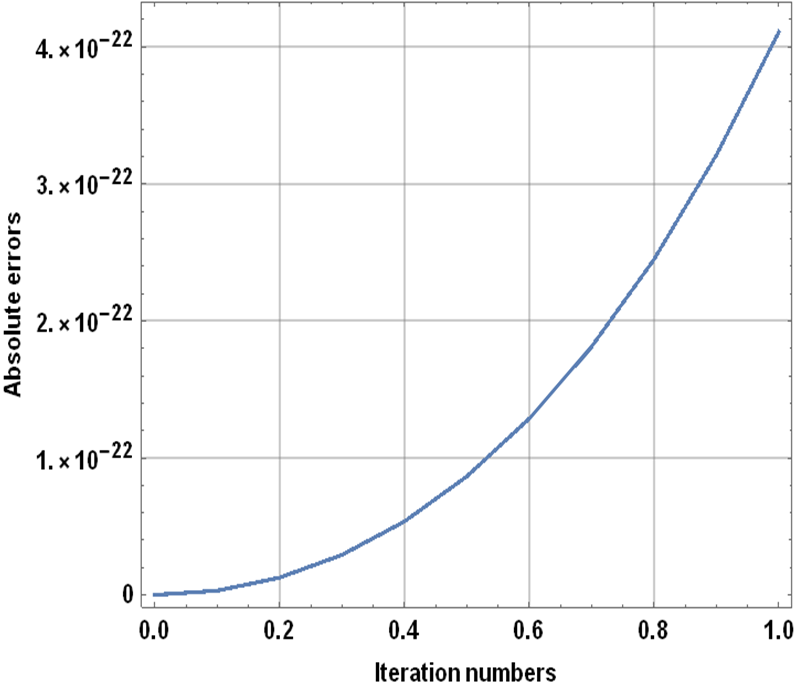
The solution of Differential Equations is an important topic for deliberation among scientists. However, until today, nothing is known on a single-step block method of p-stable for solving third-order Differential Equations (IVPs) whose accuracy is ninth order. This paper focuses on the derivation, analysis, and implementation of the one-step implicit hybrid block method with seven off-step points for direct solution of general third-order ordinary differential equations' initial value problems (IVPs). For the solution of IVPs, the power series functions were utilized as the basis function. To determine the unknown parameters, an approximate solution from the basis function was interpolated at chosen off-grid points. The third derivative of the estimated solution was collocated at all grid and off-grid points to produce a system of linear equations. Consistency, zero stability, convergence, and absolute stability were all evaluated on the method. The numerical results achieved through implementation are quite close to the theoretical solutions and compare well to other novel methods in the literature.
This research considers a third-order Ordinary Differential Equations (ODEs) of the form
 | (1) |
where  is a given real-valued function that is continuous within the integration interval. The study of thin-film flow, fluid dynamics and mechanics, entry-flow phenomena, hydrodynamics, the constant flow of water in a long rectangular tank, and other problems of the kind Eq. (1) arises. The conventional way of obtaining a numerical solution of Eq. (1) is by reduction to an equivalent system of first-order ODEs of the form
 | (2) |
This method is extensively discussed in the works of Refs. 1, 2, 3, and many others. Despite its enormous success, this approach is not without drawbacks. Computer programs associated with method implementation are frequently complicated, particularly subroutines to supply the starting values for the methods, resulting in longer computer time and requiring more computational work Refs. 4, 5, 6. Direct techniques were devised to overcome the disadvantages. The works in this category are implemented in predictor-corrector Refs. 7, 8, 9 or block mode (Refs. 10, 11, 12, 13, 14), and their stability domain was thoroughly investigated. This work adopted an approach based on collocation and interpolation of power series approximate solution to derive a one-step hybrid scheme with seven off-step points for the direct solution of general third-order ODEs.
The series solution techniques appraised by Refs. 15, 16, 17, 18 for obtaining the unknown function of differential equations was adopted as the research methodology. The basis function is considered as an approximate solution of Eq. (1) which is a power series representation of the form
 | (3) |
The third derivative of Eq. (3) gives
 | (4) |
Equating Eq. (4) to Eq. (1) yields the differential system
 | (5) |
Where the's are the parameters to be determined  and
and  denote the number of collocation and interpolation points respectively. Collocating Eq. (5) at the mesh points
  and interpolating Eq. (3) at
  yields a system of equations
 | (6) |
 | (7) |
By putting these systems of equations in matrix form and then solved to obtain the values of parameters,  which when substituted in Eq. (4), yields, after some simplification, a hybrid linear method with continuous coefficients of the form
 | (8) |
Where the coefficients  and
and are given as
 |
 |
 |
 |
 |
 |
 |
 |
 |
 |
 |
 | (9) |
where . Evaluating Eq. (9) at
  yields the discrete one-step formulas
 | (10a) |
 | (10b) |
 | (10c) |
 | (10d) |
 | (10e) |
 | (10f) |
By combining the schemes Eq. (10), the first, second derivatives of the schemes and write in block form, using the definition of implicit block method in Eq. (9) to obtain the block formula describe as follows:
 | (11) |
 is the power of the derivative of the continuous method and
  is the order of the problem to solve:
  . This equation is solved, and values for


 and
and 
 are obtained as follows:
 |
 |
 |
 |
 |
 |
 |
 | (12) |
 |
 |
 |
 |
 |
 |
 |
 | (13) |
 |
 |
 |
 |
 |
 |
 |
 | (14) |
In this section, the analysis of the basic properties of the method was carried out as follows.
3.1. Order and Error Constant of the MethodThe formula in Eq. (10f) in a conventional linear multistep method can be expressed as:
 | (15) |
Following Ref. 1, the local truncation error associated with Eq. (15) was defined by the difference operator
 | (16) |
where  is assumed to have continuous derivatives of a sufficiently high order. Therefore expanding (10f) in Taylor series about the point
  to obtain the expression
 | (17) |
The term  is called the error constant and implies that the local truncation error is given by:
 | (18) |
since  see Ref. 19; then the method has ordered
 with error constant
According to Ref. 2 a block method is zero stable provided the roots  of the first characteristic polynomial
  specified as
 | (19) |
satisfies  and for those roots with
  the multiplicity must not exceed 2. By definition (3.2) block Eq. (11) is zero stable since the roots of the characteristic polynomial satisfy
  and the root
  has multiplicity not exceeding the order of the differential equation. Moreover, as
  where
where  is the order of the differential equation, for the block method,
  and
and 
 |
Implies that
 |
Hence, the method is Zero stable.
3.3. Consistency of the MethodFrom Eq. (10f), the first and second characteristics polynomials of the method are given by
 |
 |
This implies that the method presented in this report is consistent since it satisfies the following conditions:
i) The order of the method is  which is obvious.
ii) For the method 

 and
and  thus
thus
iii) If  and
and
 |
it follows from here that  shows that the condition (iii) is satisfied as well
iv) Note that
 |
 |
 |
For the principal root is observed that the last condition above is satisfied. Hence the method is consistent.
3.4. Convergence of the MethodAccording to Ref. 20, the necessary and sufficient condition for a numerical method to be convergent is to be consistent and Zero stable. Thus since it has been successfully shown from the above condition, it could be seen that method is convergent.
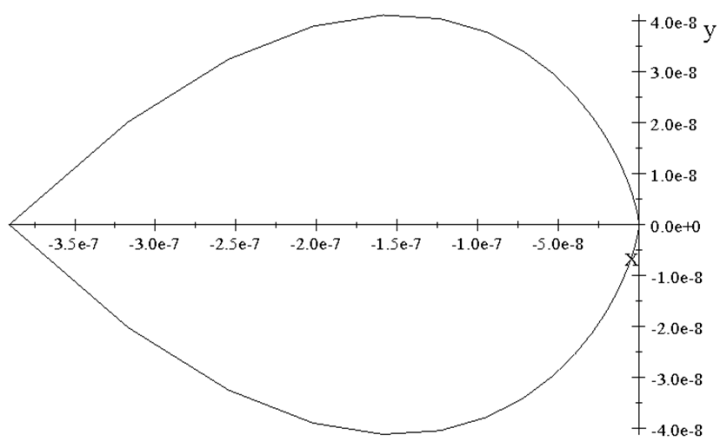
3.5. Region of Absolute Stability of the Method.The boundary locus method was adopted by considering the stability polynomial written in general form:
 | (20) |
 and
and  is assumed constant. The stability polynomial of the formula (10f) becomes:
 | (21) |
where,
 |
and
 |
From Eq. (20),
 | (22) |
Substituting  and
and  into Eq. (21), evaluate, and equate the imaginary part to zero leads to
 | (23) |
The method was utilized to solve specific initial value problems of third-order ordinary differential equations to verify its accuracy, workability, and applicability. The following notations are used to represent the current findings:
XVAL: Value of the independent variable where a numerical value is taken.
ERC: Exact result at XVAL
NRC: Numerical result at XVAL
ERR: Error in proposed method at XVAL
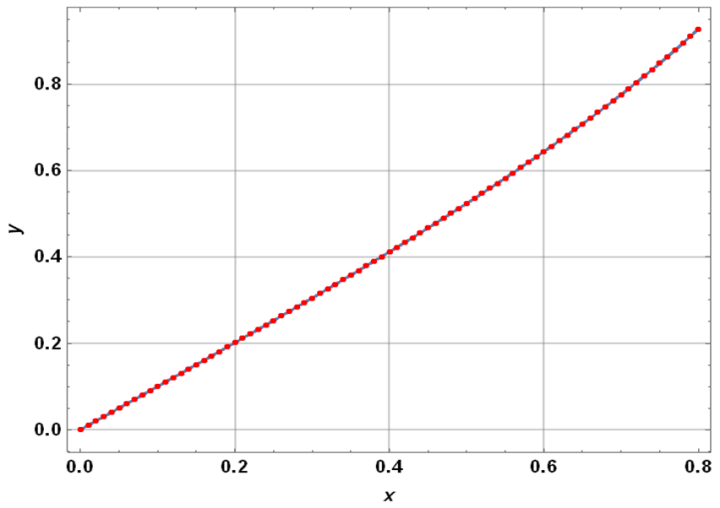
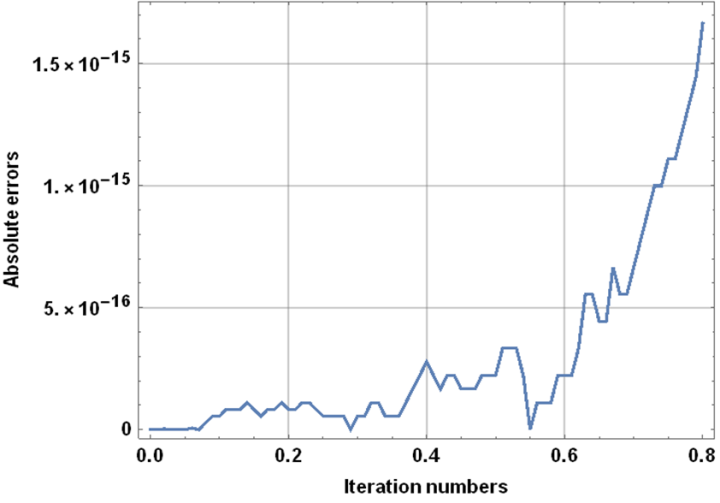
4.1. Problem 1Consider a non linear third order ODE problem:
 |
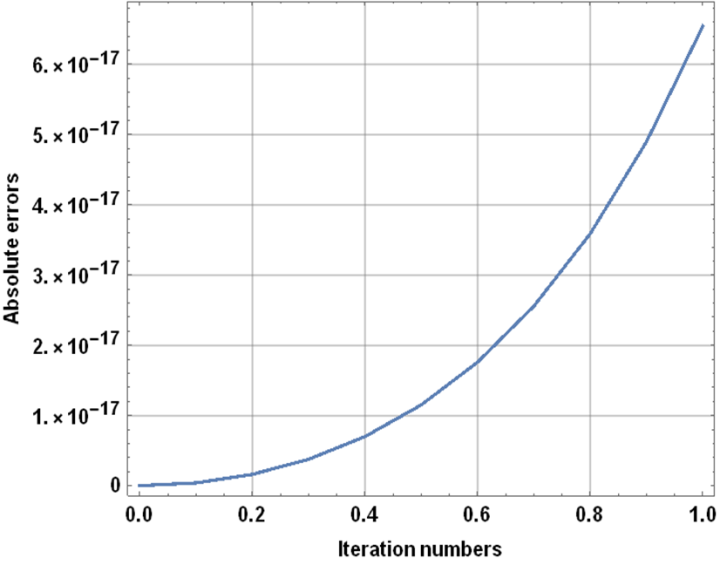
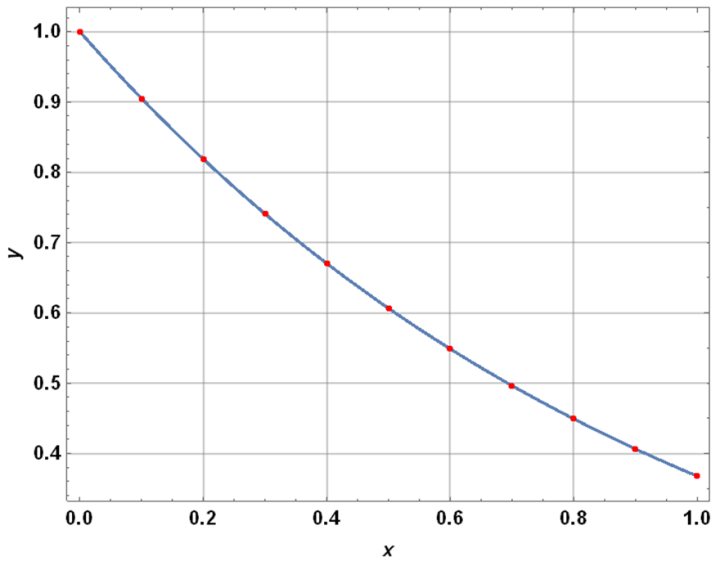
whose exact solution is given by  . The method was used to solve the problem, and the results were compared with Ref. 21 as shown in Table 1.


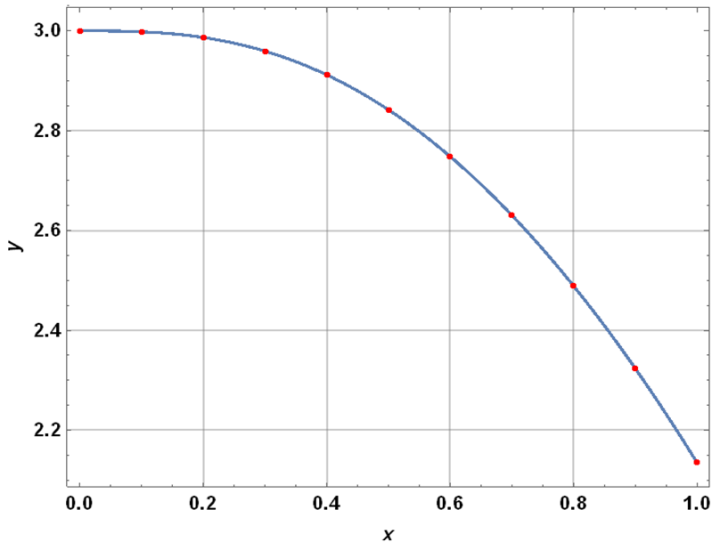
Consider the linear problem:
 |
Exact solution: 
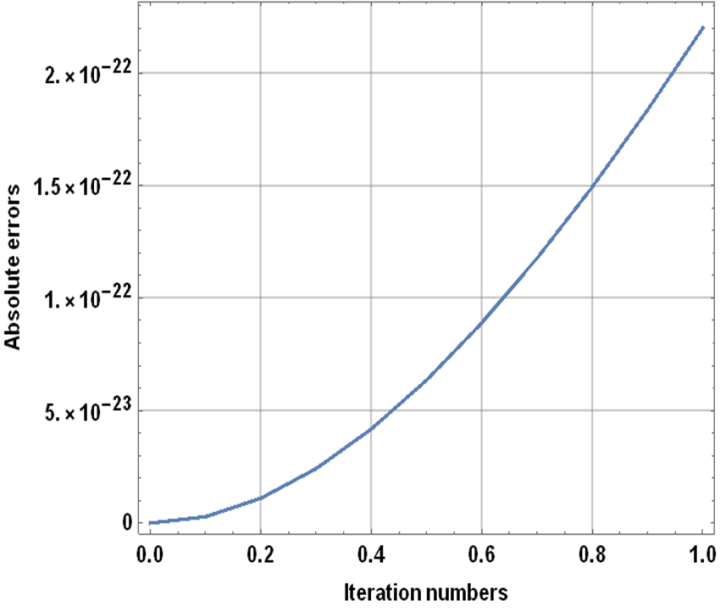
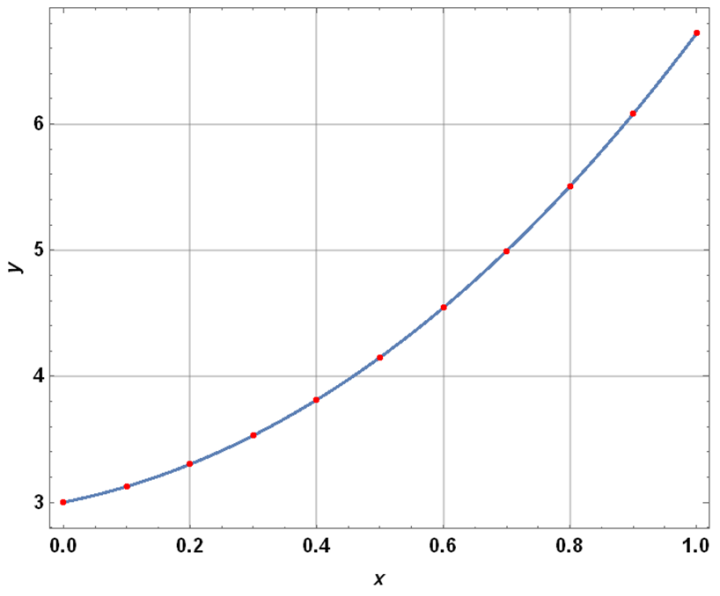
The proposed method was applied to this example and the results obtained are compared with that of Ref. 21 in Table 2. The result is as shown in Table 2.


Consider the problem:
 |
Exact solution:  . The proposed method was applied to this example and the results obtained are compared with that of Ref. 6 in Table 3.


Consider the problem:
 |
Exact solution:  The proposed method was applied to this example and the results obtained are compared with that of Ref. 6 in Table 4.

This work developed a one-step collocation approach with seven off-steps to directly solve initial value problems of general third-order ODEs. A step size with seven off-step locations is chosen for improved technique performance within the stability interval. In fact, when the new approach's results were compared to the block method proposed by Allogmany and Ismail 20, the new method was more accurate.
The authors declare no competing interests.
Conceptualization, Methodology, Validation, Formal analysis, Writing-original, Draft Preparation, Writing-review and Editing, and Revision, Dr. M. K. Duromola
The author would make the associated data available upon a reasonable request.
| [1] | Lambert J.D. (1973). Computational methods in ODEs, John Wiley & Sons, New York. | ||
| In article | |||
| [2] | Fatunla, S. O (1991). Block method for Second Order IVPs. International Journal of Computer Mathematics, 41(9); 55-63. | ||
| In article | View Article | ||
| [3] | Brugnano, L., & Trigiante, D. (1998). Solving differential equations by multistep initial and boundary value methods. CRC Press. | ||
| In article | |||
| [4] | Jator, S. N. (2007). A SIXTH ORDER LINEAR MULTISTEP METHOD FOR. International journal of pure and applied Mathematics, 40(4), 457-472. | ||
| In article | |||
| [5] | Olabode, B. T. (2013). Block multistep method for the direct solution of third order of ordinary differential equations. FUTA Journal of Research in sciences, 2(2013), 194-200. | ||
| In article | |||
| [6] | Awoyemi, D., Kayode, S. & Adoghe, L. (2014). A five-step P-stable method for the numerical integration of third order ordinary differential equations. Am. J. Comput. Math. 2014, 4, 119-126. | ||
| In article | View Article | ||
| [7] | Kayode S. J. (2008). “A Zero stable Method for Direct Solution of Fourth Order Ordin3ary Differential Equation”, American Journal of Applied Sciences, Vol. 5 (11): 1461-1466. | ||
| In article | View Article | ||
| [8] | Bolarinwa Bolaji (2015). Fully implicit Block-Predictor Corrector method for the Numerical Integration of y’’’=f (x, y, y’, y’’) y(a) =η1, y’(a) =η2, y’’(a) =η3, Journal of Scientific Research and Reports 6(2):165 - 171. | ||
| In article | View Article | ||
| [9] | Kayode, S.J. & Obarhua, F.O. (2017). Symmetric 2-Step 4-Point Hybrid Method for the Solution of General Third Order Differential Equations. Journal of Applied and Computational Mathematics. 6, 348. | ||
| In article | |||
| [10] | Ademiluyi, R.A., Duromola, M.K. & Bolarinwa Bolaji. (2014). Modified block method for the direct solution of initial value problems of fourth order Ordinary differential equations. Australian Journal of Basic and Applied Sciences, 8(10) July 2014; 389-394. | ||
| In article | |||
| [11] | Kayode S.J, Duromola M. K and Bolarinwa Bolaji. (2014). Direct solution of initial value problems of fourth order ordinary differential equations using modified implicit hybrid block method. Journal of Scientific Research and Reports.3 (21); 2792-2800. | ||
| In article | View Article | ||
| [12] | Lee, L.Y., Fudziah, I. & Norazak, S. (2014). An Accurate Block Hybrid Collocation Method for Third Order Ordinary Differential Equations. Journal of Applied Mathematics.2014 (2014), Article ID 549597, 9 pages. | ||
| In article | View Article | ||
| [13] | Olabode, B.T., & Momoh, A. L. (2016). Continuous hybrid multistep methods with legendre basis function for direct treatment of second order stiff ODEs. American Journal of Computational and Applied Mathematics, 6(2), 38-49. | ||
| In article | |||
| [14] | M. K. Duromola, A. L. Momoh. (2019). Hybrid Numerical Method with Block Extension for Direct Solution of Third Order Ordinary Differential Equations American Journal of Computational Mathematics, 2019, 9, 68-80. | ||
| In article | View Article | ||
| [15] | Das, P., Rana, S., & Ramos, H. (2020). A perturbation-based approach for solving fractional-order Volterra–Fredholm integro differential equations and its convergence analysis. International Journal of Computer Mathematics, 97(10), 1994-2014. | ||
| In article | View Article | ||
| [16] | Das, P., & Rana, S. (2021). Theoretical prospects of fractional order weakly singular Volterra Integro differential equations and their approximations with convergence analysis. Mathematical Methods in the Applied Sciences, 44(11), 9419-9440. | ||
| In article | View Article | ||
| [17] | Shakti, D., Mohapatra, J., Das, P., & Vigo-Aguiar, J. (2022). A moving mesh refinement based optimal accurate uniformly convergent computational method for a parabolic system of boundary layer originated reaction–diffusion problems with arbitrary small diffusion terms. Journal of Computational and Applied Mathematics, 404, 113167. | ||
| In article | View Article | ||
| [18] | Das, P., Rana, S., & Ramos, H. (2019). Homotopy perturbation method for solving Caputo‐type fractional‐order Volterra-Fredholm integro‐differential equations. Computational and Mathematical Methods, 1(5), e1047. | ||
| In article | View Article | ||
| [19] | Badmus A.M. and Yahaya Y.A. (2014). New Algorithm of Obtaining Order and Error Constants of Third Order Linear Multistep Method. Asian Journal of Fuzzy and Applied Mathematics;2(6), ISSN: 2321-564X. | ||
| In article | |||
| [20] | Henrici P. (1962). Discrete Variable Methods in Ordinary Differential Equations. John Wiley & Sons, New York | ||
| In article | |||
| [21] | Allogmany, R. & Ismail, F. (2020): Implicit Three-Point Block Numerical Algorithm for Solving Third Order Initial Value Problem Directly with Applications. Mathematics, 8(10), p.1771. | ||
| In article | View Article | ||
Published with license by Science and Education Publishing, Copyright © 2022 Duromola M.K.
 This work is licensed under a Creative Commons Attribution 4.0 International License. To view a copy of this license, visit
http://creativecommons.org/licenses/by/4.0/
This work is licensed under a Creative Commons Attribution 4.0 International License. To view a copy of this license, visit
http://creativecommons.org/licenses/by/4.0/
| [1] | Lambert J.D. (1973). Computational methods in ODEs, John Wiley & Sons, New York. | ||
| In article | |||
| [2] | Fatunla, S. O (1991). Block method for Second Order IVPs. International Journal of Computer Mathematics, 41(9); 55-63. | ||
| In article | View Article | ||
| [3] | Brugnano, L., & Trigiante, D. (1998). Solving differential equations by multistep initial and boundary value methods. CRC Press. | ||
| In article | |||
| [4] | Jator, S. N. (2007). A SIXTH ORDER LINEAR MULTISTEP METHOD FOR. International journal of pure and applied Mathematics, 40(4), 457-472. | ||
| In article | |||
| [5] | Olabode, B. T. (2013). Block multistep method for the direct solution of third order of ordinary differential equations. FUTA Journal of Research in sciences, 2(2013), 194-200. | ||
| In article | |||
| [6] | Awoyemi, D., Kayode, S. & Adoghe, L. (2014). A five-step P-stable method for the numerical integration of third order ordinary differential equations. Am. J. Comput. Math. 2014, 4, 119-126. | ||
| In article | View Article | ||
| [7] | Kayode S. J. (2008). “A Zero stable Method for Direct Solution of Fourth Order Ordin3ary Differential Equation”, American Journal of Applied Sciences, Vol. 5 (11): 1461-1466. | ||
| In article | View Article | ||
| [8] | Bolarinwa Bolaji (2015). Fully implicit Block-Predictor Corrector method for the Numerical Integration of y’’’=f (x, y, y’, y’’) y(a) =η1, y’(a) =η2, y’’(a) =η3, Journal of Scientific Research and Reports 6(2):165 - 171. | ||
| In article | View Article | ||
| [9] | Kayode, S.J. & Obarhua, F.O. (2017). Symmetric 2-Step 4-Point Hybrid Method for the Solution of General Third Order Differential Equations. Journal of Applied and Computational Mathematics. 6, 348. | ||
| In article | |||
| [10] | Ademiluyi, R.A., Duromola, M.K. & Bolarinwa Bolaji. (2014). Modified block method for the direct solution of initial value problems of fourth order Ordinary differential equations. Australian Journal of Basic and Applied Sciences, 8(10) July 2014; 389-394. | ||
| In article | |||
| [11] | Kayode S.J, Duromola M. K and Bolarinwa Bolaji. (2014). Direct solution of initial value problems of fourth order ordinary differential equations using modified implicit hybrid block method. Journal of Scientific Research and Reports.3 (21); 2792-2800. | ||
| In article | View Article | ||
| [12] | Lee, L.Y., Fudziah, I. & Norazak, S. (2014). An Accurate Block Hybrid Collocation Method for Third Order Ordinary Differential Equations. Journal of Applied Mathematics.2014 (2014), Article ID 549597, 9 pages. | ||
| In article | View Article | ||
| [13] | Olabode, B.T., & Momoh, A. L. (2016). Continuous hybrid multistep methods with legendre basis function for direct treatment of second order stiff ODEs. American Journal of Computational and Applied Mathematics, 6(2), 38-49. | ||
| In article | |||
| [14] | M. K. Duromola, A. L. Momoh. (2019). Hybrid Numerical Method with Block Extension for Direct Solution of Third Order Ordinary Differential Equations American Journal of Computational Mathematics, 2019, 9, 68-80. | ||
| In article | View Article | ||
| [15] | Das, P., Rana, S., & Ramos, H. (2020). A perturbation-based approach for solving fractional-order Volterra–Fredholm integro differential equations and its convergence analysis. International Journal of Computer Mathematics, 97(10), 1994-2014. | ||
| In article | View Article | ||
| [16] | Das, P., & Rana, S. (2021). Theoretical prospects of fractional order weakly singular Volterra Integro differential equations and their approximations with convergence analysis. Mathematical Methods in the Applied Sciences, 44(11), 9419-9440. | ||
| In article | View Article | ||
| [17] | Shakti, D., Mohapatra, J., Das, P., & Vigo-Aguiar, J. (2022). A moving mesh refinement based optimal accurate uniformly convergent computational method for a parabolic system of boundary layer originated reaction–diffusion problems with arbitrary small diffusion terms. Journal of Computational and Applied Mathematics, 404, 113167. | ||
| In article | View Article | ||
| [18] | Das, P., Rana, S., & Ramos, H. (2019). Homotopy perturbation method for solving Caputo‐type fractional‐order Volterra-Fredholm integro‐differential equations. Computational and Mathematical Methods, 1(5), e1047. | ||
| In article | View Article | ||
| [19] | Badmus A.M. and Yahaya Y.A. (2014). New Algorithm of Obtaining Order and Error Constants of Third Order Linear Multistep Method. Asian Journal of Fuzzy and Applied Mathematics;2(6), ISSN: 2321-564X. | ||
| In article | |||
| [20] | Henrici P. (1962). Discrete Variable Methods in Ordinary Differential Equations. John Wiley & Sons, New York | ||
| In article | |||
| [21] | Allogmany, R. & Ismail, F. (2020): Implicit Three-Point Block Numerical Algorithm for Solving Third Order Initial Value Problem Directly with Applications. Mathematics, 8(10), p.1771. | ||
| In article | View Article | ||