Oxyfluorfen widely using in paddy field and unknowingly polluting the soil. The present study soil microorganism’s carbon and nitrogen transformation test was conducted in loamy sand soil, the experiment conducted as per Organization for Economic Co-operation and Development (OECD) Guideline 216 and 217. The application of oxyfluorfen 23.5% EC applied dose rates T0-Control, T1-100 g a.i/ha (active ingredient/hectare) and T2-1000g a.i/ha soil dry weight. The test concentrations were one and ten times the recommended field application rate. After application of the soil boxes were incubated at 20°C in dark conditions. The soil samples were collected at 0 (within the 6 hours), 7, 14, and 28 days after imposing the treatment. Carbon transformation (short-term respiration) was determined by amended the glucose to soil samples. Short-term respiration was calculated based on oxygen consumption (BOD) during the experiment. Soil nitrification was determined by measuring the NO3- contents of aqueous soil extracts using calibrated ion-sensitive electrodes and the Orion expandable ion analyzer. The deviation in respiration rates and nitrification compared to controls after applying the test item after 28 days 2.8 % and 7.0 % for the; -3.12% and -7.18% for the respiration rates and nitrification respectively T1 and T2 test concentrations. There was no significant variation between the treatment and control samples.
Oxyfluorfen selective pre and post emergence herbicide used to controlling weed in the agriculture field, but oxyfluorfen widely using in agriculture without precise knowledge. This is the one of reason contaminate the soil, ground-level water and the effects on soil enzymes, impact on soil biochemical process and recycling of nutrients 1, 2, 3. Nowadays, pesticides are widely used in preventing and controlling the diseases and pests of crop, but at the same time pesticide residues have brought serious harm to human’s health and the environment. The herbicides applied to the soil at recommended dose rate rarely had a detrimental effect on microbial populations or their microbial activities under laboratory as well as field conditions. Microorganisms are one of the important parameters for plant growth in the ecosystem; it can be related to microbial activity and soil health. The microbial population or microbial activity in some cases recovered after 1-5 weeks, after using the glyphosate the microbial growth same level maintained up to 14 days after the 14th day did not impact the microbial growth, then enhanced microbial activity. These changes confirm that pesticides applied at recommended doses and intervals are rarely deleterious to the beneficial microorganisms and their activities. Most of the studies were focused on a single application or two application studies followed the recommended field dose rate and 2X recommend dose rate only for a short period, the effect of the herbicides on soil which may provide a realistic evaluation of the soil microorganism 4. Oxyfluorafen residues found in rice crops (grain, straw) and soil detected a low amount of residues detected in paddy different substrates (Grain, straw and Soil) using different dose rates T1 and T2 240 and 500 g a.i/ha 5. The carbon, nitrogen (soil microorganisms), and phosphorous levels depend on the using concentration of the pesticides and fertilizers and irrigation of the crops of a certain field 6, 7, 8, 9. Investigated effect of various man-made activities on soil biotic organics, water retention capacity, Porosity, cation exchange capacity and soil organic carbon levels more beneficial 10. Oxyfluorfen herbicide of the biphenyl - ether group using a wide range of fruit trees, vegetables, field crops, and non-crop areas for weed control. Mainly using in India paddy crop, ground nut and sugarcane. Oxyfluorfen is classified as a potentially carcinogenic ingredient.
The microbial population or microbial activity was recovered after some time when significant changes were observed. The Carbon: Nitrogen ratios (microorganisms) are a very key role in soil quality, but the Carbon: Nitrogen ratios depend on the many factors (Soil texture, soil moisture and soil usages) 8. Soil other parameters organic carbon (SOC), Total Nitrogen (TN) residue levels depend on the intercropping of the lands, depth of soil, and tillage of the cops 11, 12. Effects on the soil microorganism’s pre-treatment and post-treatment effect of the Linuron (Avalon–50wp) in soil and soil half-life also involving key role 13. Soil microorganisms ratio depends upon the giving the Carbon and phosphorus sources 14. Soil microbial mineralization and immobilizations were a key role in soil fertility 15. The oxyfluorfen have a low run of potential property in the soil, so it has low-risk contamination of the water sources and adjacent water sources- N 16. The oxyfluorfen soil persistence study conducted in different dosages and compound degrades based on carbon content, group of microbial content and type of the soil 17. The effect of oxyfluorfen 23.5% EC soil microflora study conducted under the laboratory condition that measured carbon and nitrogen and respiration following an application of the sample to loamy sand soil.
The Loamy sand soil samples were collected from the IIBAT agricultural field, Padappai, Chennai, with a sampling depth of 0-20 cm. The Geographical location Latitude 12.8866 and Longitude 80.0216. No pesticides were used in the sampled soil for the last four years. No organic or mineral fertilizer was applied in the sampled soil for the last two years. The soil was sieved with a 2mm sieve. The soil was pre-incubated (before the experiment) in air ventilation plastic boxes stored in at 20°C dark conditions and adjusted 50% of maximum water holding capacity (WHC), The soil stored according to OECD 216 & 217 test guidelines.
2.2. Soil PreparationBefore the experiment initiation, the required amount of water was used for the adjustment of the moisture content (approximately 50% WHCmax) of the soil. The lucerne meal (0.5% soil dry weight) was added to the soil for nitrogen transformation. Nitrogen transformation is based on the soil microflora capacity to metabolize organic material (lucerne meal) and convert the organic nitrogen to nitrate (nitrification). Changes in the soil’s nitrogen level (nitrate content) and the rate of nitrate formation were used to assess the potential effects of oxyfluorfen 23.5% EC on nitrogen transformation. A 4 g of glucose /kg dry soil weight was added into the soil for a shot-term respiration rate (carbon transformation).
2.3. Oxyfluorfen Stock Solution PreparationThe oxyfluorfen stock solution was prepared by weighing the test item accurately 416.22 mg into a 50 mL volumetric flask. Then it was dissolved with deionized water, diluted and made up to the mark with deionized water. The concentration of this stock solution was 1956.21 mg L-1, the concentration of stock solution conformed by a validated HPLC(Agilent model1290) method.
2.4. Treatment With Oxyfluorfen 23.5% ECThe test concentrations used in this study were based on recommended field dose, 1 and 10 times the recommended application rate of oxyfluorfen 23.5% EC, equivalent to 100 g of oxyfluorfen a.i./ha and 1000 g of oxyfluorfen a.i./ha., respectively. According to the guidance provided by OECD 216/217, the test concentrations should be derived from a single application rate and a multiple, not more than 5-10 times the single application rate 18, 19, 20. After the application of the test item concentration in the soil is confirmed by a validated method.
T0 - Untreated Control (Water spray)
T1 - Oxyfluorfen 23.5% EC @0.27 mg/kg dry soil (100 g a.i/ha)
T2 - Oxyfluorfen 23.5% EC @2.7 mg/kg dry soil (1000 g a.i/ha)
Accurately 2376.89g moist (dry soil weight 2010.85 g (84.6%)) soil was weighed into two different plastic boxes(one box for short term respiration, one box for nitrification test), About 10.02 g (ratio to 5 g/kg (0.5%) of dry soil weight) of Lucerne meal was added into one box for Nitrogen transformation study. Then the soil was transferred into 9 boxes for different occasions, each box contains about 260g of soil weight including that of the perforated plastic lid. In each box, the weight was recorded including that of the perforated plastic lid. All boxes were kept in an incubator at 20 ± 2°C in the dark and once in a week, the moisture was adjusted based on the initial weight by adding water.
Accurately 2375.36g moist (soil dry weight 2005.55 g (84.6%)) soil was weighed into two plastic boxes(one box for nitrogen transformation and another box carbon transformation), about 10.02 g of Lucerne meal was added to the one box for Nitrogen transformation study. Accurately 0.032 mL (32 µl) of stock solution transferred into the soil to achieve the T1dose (0.27 mg/kg) rate to each box. Then the soil was transferred into 9 boxes from each box for different occasions, each box contains about 260g of soil weight. Then the weight was recorded at each box, including that of the perforated plastic lid. All boxes were kept in an incubator at 20 ± 2°C in the dark and once in a week, the moisture was adjusted based on the initial weight by adding water.
Accurately 2376.36g moist (soil dry weight 2010.40 g (84.6%)) soil was weighed into two plastic boxes(one box for nitrogen transformation and another box carbon transformation), about 10.01 g of Lucerne meal was added to the one box for Nitrogen transformation study. Accurately 0.32 mL(320 µl) of stock solution transferred into the soil to achieve the T2dose (2.7 mg/kg) rate to each box. Then the soil was transferred into 9 boxes from each box for different occasions, each box contains about 260g of soil weight. Then the weight was recorded at each box, including that of the perforated plastic lid. All boxes were kept in an incubator at 20 ± 2°C in the dark and once in a week, the moisture was adjusted based on the initial weight by adding water.
2.5. Soil Sample AnalysisThe samples were occasionally collected from each box following parameters were determined:
Dry weight, pH, Nitrate content, Short-term (Carbon) respiration. Prior starting the experiment soil results and methods presented in Table 1).
The NO3-content was measured using calibrated ion-sensitive electrodes and the Orion expandable ion-analyzer 21. The calibration solutions were prepared using sodium nitrate solutions (0.0001 molar, 0.001 molar, 0.005 molar, 0.01 molar, 0.1 molar). The assay accuracy was conducted accurately 1.5mL of 0.01 molar sodium nitrate solution fortified into 50 g of control soil, then extracted and measured the concentration of nitrate content in the soil.
Each application three replicates were used for the estimation of nitrogen turnover.
The limit of quantification (LOQ) for nitrate was calculated based on the dry substance of the sample of all sampling dates by spiking the known concentration into the soil.
The soil sample was collected within 6 hours (0th Day), 7th Day, 14th day and 28 days after imposing the treatment. The collected soil samples (control and treated) were extracted and analyzed using an expandable ion-analyzer determined by measuring the NO3- contents of aqueous soil extracts.
The extraction procedure for Nitrogen: Twenty grams of soil weighed into glass bottles from each treatment was brought up to a final volume of 200 mL with 0.1% alum solution (Aluminum-potassium-sulfate, AlK (SO4)2 12 H2O). The samples were vigorously shaken for approximately 30 minutes. The aqueous supernatant was filtered through Whatman 41mm filter paper and a fifty mL aliquot was used for the nitrate measurements using the NO3- selective electrode. The ion electrode was calibrated with a freshly prepared standard solution. The concentrations of NO3- in the soil were expressed as mg NO3- per kg soil dry weight. For all the test samples, the contents of NO3- were determined and calculated in the respective treatments. Deviations from treatment and control were reported based on the comparison of nitrate content between treatment and controls.
Nitrate:
 |
NO3¯-N = Content of NO3¯ -N in soil [mg /kg dry weight]
c = Content of NO3¯ in solution [mg / 100 M1]
 |
Soil DW = Soil dry weight (%)
Rate of formation of nitrate (mg nitrate / kg soil dry weight /day):
 |
Where =0, 7, 14 and 28 days
 |
Before the soil sample analysis BOD meter (Lovibond) was calibrated with BOD CM Test Tablet (2418328), as per the COA certified value of the tablet 324 mg L-1, the instrument a showed value of 320 mg L-1. The soil sample was collected within 6 hours (0th Day), 7th Day, 14th day and 28 days. On each occasion approximately 20 g of soil samples were collected in three replicates from the representative boxes. Then added 4 mL volume of glucose solution (4 mL of a solution of 12.5 g glucose/50 mL deionized water i.e. end concentration 3.2 g of glucose/kg soil dry weight.) was added into each box and mixed thoroughly. The amount of glucose to give the highest respiration rates was determined in a pre-test.
The glucose amended soil samples were incubated at 20 ± 2°C. The oxygen consumption was measured up to 24 consecutive hours using the BOD meter [21], and the carbon dioxide release was calculated. The linear part of the respiration curve after 2 hours and up to 14 hours was used for the calculation of the respiration rate.
The O2 consumption was calculated by regression analysis of the linear part of the respiration curve over 12 hours and the curves are presented in Figure 2. For calculation of produced CO2 a correction was made using the transformation factor 1.375 (O2 → CO2). The results of the respiration test are reported as produced carbon dioxide (mg CO2/kg soil dry weight per hour).
Variation of Replicate Samples (Co-efficient variation CV):
 |
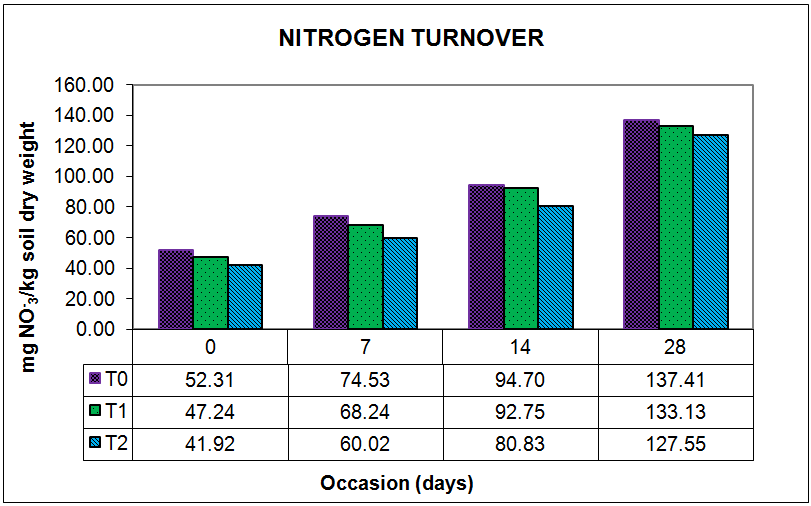
Nitrogen Turn Over: The test item oxyfluorfen 23.5% EC was applied in a loamy sand soil, the dose rates (T0-Control, T1- 0.27 mg oxyfluorfen/kg, T2- 2.7 mg oxyfluorfen/kg) soil dry weight, then incubated for 28 days at 20°C. The Limit of Quantification (LOQ) of Nitrate to each occasion wise calculated and results presented in Table 2.
A summary of the nitrate formation rate in soil treated with 0.27mg oxyfluorfen/kg soil dry weight and 2.7 mg oxyfluorfen/kg soil dry weight. Results are presented in Tables 3 and 5 (Figure 1).
After 28 days the nitrate content determined and compared with the control deviation was 3.12 % and 7.18 % for the T1 and T2 test concentrations respectively. The soil nitrate content deviation was not statistically significant for both concentrations.
The rate of nitrate content determined at 0th-day soil differed from controls by -9.68 % and -19.86 % for 0.27 mg oxyfluorfen/kg soil dry weight (T1 dose) and 2.7 mg oxyfluorfen/kg soil dry weight (T2 dose). The rate of nitrate content determined at 7th day soil differed from controls by -8.44 % and -9.48 % for 0.27 mg oxyfluorfen/kg soil dry weight and 2.7 mg oxyfluorfen/kg soil dry weight. The rate of nitrate formation 14th day after application of the test item to soil differed from controls by -2.07 % and -14.65 % for the T1 and T2 test concentrations respectively. The difference between treatment and controls was statistically no significant for both concentrations. After 28 days, deviations between treatments and control did not exceed 25%.
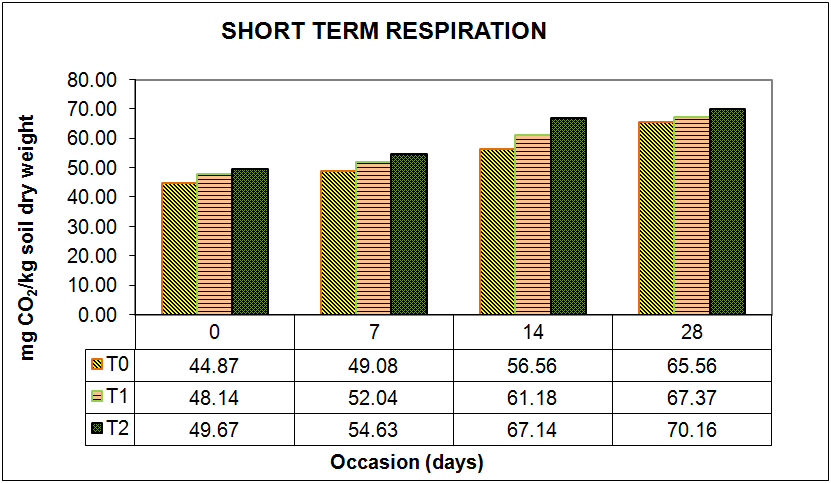
Short-Term Respiration (Carbon Turnover): The test item oxyfluorfen 23.5% EC was applied in a loamy sand soil, the dose rates (T0-Control, T1- 0.27mg oxyfluorfen /kg, T2- 2.7 mg oxyfluorfen /kg) soil dry weight, then incubated for 28days at 20°C. The soil carbon content, deviation from the control, determined on day 28th after application of the test item treated groups compared to control was 2.77 % and 7.02 % for 0.27mg and 2.7 mg oxyfluorfen/kg soil dry weight, respectively.
The rate of Short-Term Respiration (Carbon Turnover) 7th day after application of the test item to soil differed from controls by 6.02% and 11.32 % for 0.27 mg oxyfluorfen/kg soil dry weight and 2.7 mg oxyfluorfen/kg soil dry weight. The rate of nitrate formation on the 14th day after application of the test item to soil differed from controls by 8.16 % and 18.70 % for 0.27 mg oxyfluorfen/kg soil dry weight and 2.7 mg oxyfluorfen/kg soil dry weight. The difference between treatment and controls was statistically no significant for both concentrations. After 28 days, deviations between treatments and control did not exceed 25%.
The test item at soil concentrations of 0.27mg oxyfluorfen/kg soil dry weight and 2.7 mg oxyfluorfen/kg soil dry weight had no long term influence on the short-term, substrate-induced respiration. The difference in soil respiration between the treated and control soils was below the 25% value at the end of the 28th day given by the OECD 217 guideline. At the end of the 28th day study, deviations in respiration rates compared to controls after applying the test item to soil were 2.6% and 6.6% for the test concentrations of 0.27 mg oxyfluorfen/kg soil dry weight and 2.7 mg oxyfluorfen/kg soil dry weight, respectively, (Table 4, Figure 2). The respiration rates in treated soil were statistically no significantly occurred from control. Numerical data obtained during the conduct of the study was subjected to the calculation of group mean, standard deviation and was reported.
3.1. Statistical AnalysisStatistical analysis was performed using IBM SPSS Statistics version 26, 2019. Data was analyzed for normality using the Shapiro-Wilk test and homogeneity using Levene's test. Normally distributed and homogeneous data was analyzed using One way ANOVA followed by Dunnett test for post hoc comparison. For normally distributed but heterogeneous data, the Dunnett’s T3 method was used and presented.

The soil microflora adequate data not available on the oxyfluorfen herbicide, the test item is applied in loamy sand soil at 100g a.i/ha and 1000g a.i/ha dose rate. The difference in soil respiration rates and microbial nitrification in both parameters between treated and control soil was clearly below the 25% trigger value given by the OECD 216, 217 19 guidelines throughout the test. At the end of the experiment 28 day values deviations in respiration rates compared to controls 2.8 and 7.0 % for the test concentrations of 0.27mg and 2.7 mg oxyfluorfen/kg soil dry weight. At the same time microbial nitrification at 28th day 3.12 and 7.18 % deviation from the control for the test concentrations 0.27mg and 2.7 mg oxyfluorfen/kg soil dry weight. Up to 14 days soil respiration and microbial nitrification both parameters slightly affected, then after the test item did not impact on the microbial growth. The soil microbial effect was no significant occurred after 28 days of incubation for carbon and nitrogen. There is no long-term impact on the soil, so we can follow the dose rate in agriculture fields.
The authors thank to the Director, Test facility management, IIBAT, for supporting the facilities to conduct the research.
| [1] | Brian A. Schumacher. “United States Environmental Protection Agency, Environmental Sciences Division National Exposure Research Laboratory”. April-2020. | ||
| In article | |||
| [2] | Jackson, M.L. “Soil chemical analysis”. Prentice Hall of India Private Limited, New Delhi. 1973. | ||
| In article | |||
| [3] | Sireesha A, Rao P.C, Ramalaxmi C.S, Swapna G. “Effect of pendimethalin and oxyfluorfen on soil enzyme activity”. Journal of Crop and Weed 8 (1), 124-128. 2012. | ||
| In article | |||
| [4] | Fawole O. B. Aluko M. and Olowonihi T. E. “Effects of a Carbendazim-Mancozeb fungicidal mixture on soil microbial populations and some enzyme activities in soil”. Agrosearch 10, 65-74. 2008 & 2009. | ||
| In article | View Article | ||
| [5] | Sondhia S. “Persistence of oxyfluorfen in soil and detection of its residues in rice crop”. Toxicological & Environmental Chemistry 91(3), 425-433. 2008. | ||
| In article | View Article | ||
| [6] | Alavaisha E, Manzoni S, Lindborg R. “Different agricultural practices affect soil carbon, nitrogen and phosphorous in Kilombero-Tanzania”, Journal of Environmental Management. 234, 159-166.2019. | ||
| In article | View Article PubMed | ||
| [7] | Gary Roberts, Alison Penwell, Fabrice Peurou, Alan Sharpe. (2010). The effect of soil moisture content on nitrogen transformation using OECD test. Applied Soil Ecology 46, 478-482. | ||
| In article | View Article | ||
| [8] | Yilai Lou, Minggang Xu, Xianni Chen, Xinhua He, Kai Zhao: Stratification of soil organic C, N and C:N ratio as affected by conservation tillage in two maize fields of China. Catena, 95, 124-130. 2012. | ||
| In article | View Article | ||
| [9] | Yilai Lou, Minggang Xu, Xianni Chen, Xinhua He, Kai Zhao. “Stratification of soil organic C, N and C:N ratio as affected by conservation tillage in two maize fields of China”. Catena 95, 124-130. 2012. | ||
| In article | View Article | ||
| [10] | Satya Sundar Bhattacharya, Ki-Hyun Kim, Subhasish Das, Minori Uchimiya, Byong Hun Jeon, Eilhann Kwon, Jan E. Szulejko. “A review on the role of organic inputs in maintaining the soil carbon pool of the terrestrial ecosystem”. Journal of Environmental Management. 167, 214-227. 2016. | ||
| In article | View Article PubMed | ||
| [11] | Jian-Fu Xue, Chao Pu, Sheng-Li Liu, Zhong-Du Chen, Fu Chen, Xiao-Ping Xiao, Rattan Lal, Hai-Lin Zhang. “Effects of tillage systems on soil organic carbon and total nitrogen in a double paddy cropping system in Southern China”. Soil & Tillage Research. 153, 161-168. 2015. | ||
| In article | View Article | ||
| [12] | Wen-Feng Cong, Ellis Hoffland, Long LI, Johan six, jian-hao Sun, Xing-Guo Bao, Fu-suo Zhang and Wopke Vander Werf. “Intercropping enhances soil carbon and nitrogen”. Global Change Biology. 21(4), 1715-1726. 2014. | ||
| In article | View Article PubMed | ||
| [13] | Mukherjee P, Alam S, Sardar D, Pahari A, Roy S, Chowdhury A. “Persistence and Dissipation of Linuron (Afalon–50wp) in Pea Cropped Soil and Its Effect on Soil Microorganisms”, Environmental. Contamination and Toxicology. 76, 407-414. 2006. | ||
| In article | View Article PubMed | ||
| [14] | Christine Heuck, Alfons Weig, Marie Spohn. “Soil microbial biomass C:N: P stoichiometry and microbial use of organic phosphorus”, Soil Biology & Biochemistry. 85, 119-129. 2015. | ||
| In article | View Article | ||
| [15] | Asya Dragoeva, Vanya Koleva, Nurzhihan Hasanova and Stoicho Slanev. “Cytotoxic and Genotoxic effects of Diphenyl-ether Herbicide GOAL (Oxyfluorfen) using the Allium cepa test”. Research Journal of Mutagenesis. 2, 1-9. 2012. | ||
| In article | View Article | ||
| [16] | Mantzos N, Karakitsou A, Hela D, Patakioutas G, Leneti E, Konstantinou I. “Persistence of oxyfluorfen in soil, runoff water, sediment and plants of a sunflower cultivation”. Science of the Total Environment. 472, 767-777. 2014. | ||
| In article | View Article PubMed | ||
| [17] | Janaki P, Chinnusamy C and Jaya Kumar B. “Persistence of oxyfluorfen in acid soil and tea leaves”. Indian Journal of Weed Science 46(2), 200-202. 2014. | ||
| In article | |||
| [18] | Brian A. Schumacher NCEA-C- 1282 EMASC-001. United States Environmental Protection Agency, Environmental Sciences Division National Exposure Research Laboratory. April 2002. | ||
| In article | |||
| [19] | OECD-Guideline for the Testing of Chemicals, Soil Microorganisms: Nitrogen Transformation Test, Guideline 216, 2000, dated 21 January 2000. | ||
| In article | |||
| [20] | OECD-Guideline for the Testing of Chemicals, Soil Microorganisms: Carbon Transformation Test, Guideline 217, 2000, dated 21 January 2000. | ||
| In article | |||
| [21] | Nageswara Rao Tentu a, Parvatamma Botsa b, Manohara Naidu Tentu c, Karri Apparao “Soil microorganisms nitrogen transformation test for abamectin 3.6 g/L EC (w/v) in loamy sand soil”. Acta Ecologica Sinica. 37, 115-119. 2017. | ||
| In article | View Article | ||
| [22] | SETAC Guideline - Procedures for Assessing the Environmental Fate and Ecotoxicity of Pesticides, Soil Micro-organisms, page 40-42. March 1995. | ||
| In article | |||
Published with license by Science and Education Publishing, Copyright © 2021 A. V. Rama Subbaiah and Atmakuru Ramesh
 This work is licensed under a Creative Commons Attribution 4.0 International License. To view a copy of this license, visit
http://creativecommons.org/licenses/by/4.0/
This work is licensed under a Creative Commons Attribution 4.0 International License. To view a copy of this license, visit
http://creativecommons.org/licenses/by/4.0/
| [1] | Brian A. Schumacher. “United States Environmental Protection Agency, Environmental Sciences Division National Exposure Research Laboratory”. April-2020. | ||
| In article | |||
| [2] | Jackson, M.L. “Soil chemical analysis”. Prentice Hall of India Private Limited, New Delhi. 1973. | ||
| In article | |||
| [3] | Sireesha A, Rao P.C, Ramalaxmi C.S, Swapna G. “Effect of pendimethalin and oxyfluorfen on soil enzyme activity”. Journal of Crop and Weed 8 (1), 124-128. 2012. | ||
| In article | |||
| [4] | Fawole O. B. Aluko M. and Olowonihi T. E. “Effects of a Carbendazim-Mancozeb fungicidal mixture on soil microbial populations and some enzyme activities in soil”. Agrosearch 10, 65-74. 2008 & 2009. | ||
| In article | View Article | ||
| [5] | Sondhia S. “Persistence of oxyfluorfen in soil and detection of its residues in rice crop”. Toxicological & Environmental Chemistry 91(3), 425-433. 2008. | ||
| In article | View Article | ||
| [6] | Alavaisha E, Manzoni S, Lindborg R. “Different agricultural practices affect soil carbon, nitrogen and phosphorous in Kilombero-Tanzania”, Journal of Environmental Management. 234, 159-166.2019. | ||
| In article | View Article PubMed | ||
| [7] | Gary Roberts, Alison Penwell, Fabrice Peurou, Alan Sharpe. (2010). The effect of soil moisture content on nitrogen transformation using OECD test. Applied Soil Ecology 46, 478-482. | ||
| In article | View Article | ||
| [8] | Yilai Lou, Minggang Xu, Xianni Chen, Xinhua He, Kai Zhao: Stratification of soil organic C, N and C:N ratio as affected by conservation tillage in two maize fields of China. Catena, 95, 124-130. 2012. | ||
| In article | View Article | ||
| [9] | Yilai Lou, Minggang Xu, Xianni Chen, Xinhua He, Kai Zhao. “Stratification of soil organic C, N and C:N ratio as affected by conservation tillage in two maize fields of China”. Catena 95, 124-130. 2012. | ||
| In article | View Article | ||
| [10] | Satya Sundar Bhattacharya, Ki-Hyun Kim, Subhasish Das, Minori Uchimiya, Byong Hun Jeon, Eilhann Kwon, Jan E. Szulejko. “A review on the role of organic inputs in maintaining the soil carbon pool of the terrestrial ecosystem”. Journal of Environmental Management. 167, 214-227. 2016. | ||
| In article | View Article PubMed | ||
| [11] | Jian-Fu Xue, Chao Pu, Sheng-Li Liu, Zhong-Du Chen, Fu Chen, Xiao-Ping Xiao, Rattan Lal, Hai-Lin Zhang. “Effects of tillage systems on soil organic carbon and total nitrogen in a double paddy cropping system in Southern China”. Soil & Tillage Research. 153, 161-168. 2015. | ||
| In article | View Article | ||
| [12] | Wen-Feng Cong, Ellis Hoffland, Long LI, Johan six, jian-hao Sun, Xing-Guo Bao, Fu-suo Zhang and Wopke Vander Werf. “Intercropping enhances soil carbon and nitrogen”. Global Change Biology. 21(4), 1715-1726. 2014. | ||
| In article | View Article PubMed | ||
| [13] | Mukherjee P, Alam S, Sardar D, Pahari A, Roy S, Chowdhury A. “Persistence and Dissipation of Linuron (Afalon–50wp) in Pea Cropped Soil and Its Effect on Soil Microorganisms”, Environmental. Contamination and Toxicology. 76, 407-414. 2006. | ||
| In article | View Article PubMed | ||
| [14] | Christine Heuck, Alfons Weig, Marie Spohn. “Soil microbial biomass C:N: P stoichiometry and microbial use of organic phosphorus”, Soil Biology & Biochemistry. 85, 119-129. 2015. | ||
| In article | View Article | ||
| [15] | Asya Dragoeva, Vanya Koleva, Nurzhihan Hasanova and Stoicho Slanev. “Cytotoxic and Genotoxic effects of Diphenyl-ether Herbicide GOAL (Oxyfluorfen) using the Allium cepa test”. Research Journal of Mutagenesis. 2, 1-9. 2012. | ||
| In article | View Article | ||
| [16] | Mantzos N, Karakitsou A, Hela D, Patakioutas G, Leneti E, Konstantinou I. “Persistence of oxyfluorfen in soil, runoff water, sediment and plants of a sunflower cultivation”. Science of the Total Environment. 472, 767-777. 2014. | ||
| In article | View Article PubMed | ||
| [17] | Janaki P, Chinnusamy C and Jaya Kumar B. “Persistence of oxyfluorfen in acid soil and tea leaves”. Indian Journal of Weed Science 46(2), 200-202. 2014. | ||
| In article | |||
| [18] | Brian A. Schumacher NCEA-C- 1282 EMASC-001. United States Environmental Protection Agency, Environmental Sciences Division National Exposure Research Laboratory. April 2002. | ||
| In article | |||
| [19] | OECD-Guideline for the Testing of Chemicals, Soil Microorganisms: Nitrogen Transformation Test, Guideline 216, 2000, dated 21 January 2000. | ||
| In article | |||
| [20] | OECD-Guideline for the Testing of Chemicals, Soil Microorganisms: Carbon Transformation Test, Guideline 217, 2000, dated 21 January 2000. | ||
| In article | |||
| [21] | Nageswara Rao Tentu a, Parvatamma Botsa b, Manohara Naidu Tentu c, Karri Apparao “Soil microorganisms nitrogen transformation test for abamectin 3.6 g/L EC (w/v) in loamy sand soil”. Acta Ecologica Sinica. 37, 115-119. 2017. | ||
| In article | View Article | ||
| [22] | SETAC Guideline - Procedures for Assessing the Environmental Fate and Ecotoxicity of Pesticides, Soil Micro-organisms, page 40-42. March 1995. | ||
| In article | |||