Textile industries make use of large quantities of azo dyes for various ranges of processing, which are recalcitrant in nature and resistant to degradation. The present study examined on screening of adaptive bacterial species from textile effluent polluted soil and its efficacy to decolourize commonly used textile azo dyes. Azo dye degrading adaptive species have been selected by the use of nutrient agar medium supplemented with azo dye with 100 ppm. A Bacterial isolate SKB16 was chosen and experimented to decolourize Reactive Yellow and Reactive Red F3B dyes. The optimization of decolorization conditions which includes pH, temperature and dye concentration were studied. The adaptive species SKB16 showed maximum decolourization of Reactive yellow and Reactive red F3B in 100 ppm concentration at pH 7, temperature 37°C at 98 hrs of incubation. Biotransformation of the azo dyes were assessed by characterizing the metabolites formed after degradation through Fourier transform infrared spectroscopy (FT-IR) and High-performance liquid chromatography (HPLC). FT-IR and HPLC analysis of dye degraded metabolites by the bacterial isolate SKB16 proved that the decolourization process was due to degradation .This study illustrates that potential of the newly isolate adaptive strain of Enterobacter sps SKB16 to be employed for the treatment of textile dye containing effluents.
Worldwide technological revolution, logistic growth and up gradation, constitutes and reciprocate between environment and communal well-being. Especially, Textile industry is the great source of economy and also consume large quantities of water and dyes resulting in generation of huge of volumes of wastewater/ effluent which are highly toxic containing inorganic and recalcitrant compounds. 1, 2. Among the diverse groups of textile dyes, azo (above 60%) dyes grouped as the largest class 3, 4. The azo dyes in textile effluents in liaison with adjacent soil and aquatic system 5, cause detrimental environment challenges 6.
Azo dyes chromophoric (-N=N-) organization is a versatile class due to its complex aromatic structure, as a result they are highly stable and resistant to microbial attack 6. Dye concentration in textile effluent may vary from 2% to 50% 7. The azo dye containing textile effluent hinders the activity of aquatic ecosystems, even minimum concentration of dye in water changes its colour, oxygen deficiency which also influence the photosynthesis process 8. Further, the dyes and their degraded metabolites composed of aromatic amines are highly toxic and persists in the environment 9, which causes detrimental changes to humans and animals, viz. mutagenesis carcinogenesis, teratogenesis, 10. Therefore, removal of these dyes from textile effluents has become a huge problem nowadays. Recently, the treatment of azo dye containing effluent was carried out by physical, chemical and biological techniques. Oxidation, coagulation, sonication, ion exchange, membrane filtration, electro chemical oxidation and fenton process all these techniques are not efficient due to several constraints such as expensive and laborious 11. To overcome these constraints an eco-friendly technique has to be developed to mitigate the textile effluent pollution 12, 13. Bioremediation is seen as an environmental efficient technology, 14 and has been adopted to degrade dyes, its effectiveness relies on adaption and action of the microorganism. Many microorganisms such as bacteria, fungi and algae, involved in dye degradation have been reported 5, 15. Among those, bacteria proved to be promising candidate which possess short generation time, generate less sludge and can grow in cheaper source. Compared to fungal degradation, bacterial degradation are highly preferred as the previous one as long incubation period, unstable at high temperature limit its usage in dye decolourization 16. Fungal degradation is also limited due to bacterial contamination and precarious management in textile effluent treatment plants 17. Diverse groups of aerobe, anaerobe and facultative anaerobe decolorize and degrade different textile azo dyes have been reported 8.
Bacillus cohnii LAP 217 18, Enterococcus faecalis and Klebsiella varircola, Enterobacter aerogenes 19, Pseudomonas aeruginosa GB30 20 are reported as potential bacterial species for the biotransformation of reactive azo dyes to non-toxic forms. Also Direct red 81 and disperse orange by Shewanella putrefaciens 5, reactive red 120 and Reactive yellow 84 by Pseudomonas guariconesis was reported to be effectively degraded by respective bacterial species under under optimized culture conditions 21. Few reports also suggest that Klebsiella sps from activated sludge samples could effectively degrade two groups of dyes, namely Reactive orange 16 (monoazo) and Reactive Green 19 (di-azo) dyes 22. Apart from pure culture, bacterial consortium could also degrade toxic contaminants and wastes more efficiently than the individual strains 23. Concordant communication of microbes or enzymes of mixed cultures attribute higher efficiency of decolourization 24, 25. Bacterial consortium comprising Achromobacter xylosoxidans strain APZ, K. pneumoniae strain AHM, and B. mannanilyticus strain was employed involved in textile effluent treatment 26 There are reports on the Biotransformation of 16 azo dyes monitored by bacterial consortia Aeromonas sps, Pseudomonas sps, R.globerulus 11. Better decolorizing ability of consortia depends on conditions in which azo dyes are degraded and strains generally metabolize the dyes under aerobic condition. Various reports suggest that bacteria can transform azo dyes in aerobic stage. Inspite of that microaerophilic conditions were performed due to its ease of operation and low cost 11. Further, the biotransformation of textile azo dyes relies to a greater extent on microbes which degrade azo dyes. Hence, it is decisive to develop a competent micro flora containing plentiful and manifold species of bacteria capable of metabolizing azo dyes.
In the present findings, adaptive species capable of decolorizing and degrading azo dyes was successfully isolated from textile effluent polluted soil through standard microbiological procedures. The bioremediation efficacy of the isolates were checked for their ability to decolorize Reactive yellow and Reactive Red azo dyes which are commonly used in textile industry. Furthermore, the promising strain was identified through 16s rDNA sequencing and the metabolites produced by the novel isolate was subjected to FT-IR and HPLC analysis to propose the degradative pathway.
The commonly used textile azo dyes (Reactive Yellow and Reactive Red F3B) used in the present investigation is shown in Table 1 and were procured from R.K dyeing industry, Salem, Tamilnadu, India. Media was procured from Himedia Pvt Ltd., Mumbai and other chemicals were of the highest purity and of analytical grade from Merck, India). The soil samples for isolation of adapted bacterial strain was aseptically collected from dumping grounds of the same textile dyeing industry and were transported to the laboratory immediately.
2.2. Isolation, Identification and Screening of Dye Degrading BacteriaThe soil sample was serially diluted following standard procedures. Stock cultures were maintained on nutrient agar slants and they were used for screening of dye decolourization ability. Abiotic controls were also maintained. The genomic DNA isolation were performed by Roche DNA extraction kit, Germany and the amplification of DNA was carried out using Eubac primers .16S rDNA analysis was performed by ABI Prism 377 automatic sequencer (Applied Bio systems, CA, USA). It was then analyzed by NCBI using Basic Local Alignment Search Tool and submitted to Gen bank 36
The screening experiments were carried out with individual strains (pure culture) in nutrient broth medium incorporated with the chosen dye Reactive Yellow and Reactive Red F3B Aseptically 5 ml of log phase culture was inoculated in a 250 ml Erlenmeyer flask which contained sterile nutrient broth with chosen dye at concentration of 100 ppm. Further the flasks were incubated under shaking condition at 120 rpm for 24hrs, subsequent at static condition up to 96hrs 27. After complete decolourization 100 ml of the sample were aspirated aseptically and centrifuged in cooling centrifuge at 10000 rpm for 10 min (5408R, Eppendorf). The supernatant were collected and subjected to analysis using UV-visible spectrophotometer at corresponding wavelength of native dye. Percentage of decolourization were calculated as given below: 19.
 |
Assessment of physic-chemical parameters pH requirement on decolourization of Reactive Yellow and Reactive Red F3B by the chosen isolates was examined. Influences of different pH (5, 6, 7, 8 and 9) were studied in Nutrient broth medium amended with 100 ppm dye concentration. 0.1N sodium hydroxide /0.1 N hydrochloric acid was used to adjust the pH. The chosen strain was inoculated in mid log phase and then incubated at 37°C until maximum decolourization is observed.
2.4. Extraction of Metabolites for AnalysisHPLC and FT-IR analysis was performed to evaluate the metabolites produced during decolourization of the dyes by chosen isolate. Decolourized sample was centrifuged at 10,000 rpm for 20 min and the metabolites produced were extracted thrice using equal volume of ethyl acetate. It was then dried over anhydrous Na2SO4 and evaporated to dryness in rotary evaporator which is then dissolved in HPLC grade methanol 28, 29.
HPLC analysis was performed on (Shimadzu LC 40102010 system) C18 column, with HPLC grade methanol as a mobile phase at flow rate 1 mL/min 29. FT-IR analysis of the control dye and its biodegraded product was analyzed to determine the functional group of degraded products. Functional group analysis of control dye and its biodegraded product was studied through Perkin Elmer agilent carry 600 series in the mid region of 400-4000 cm-1 with 16 scan speed. FT-IR spectrophotometer 29.
Owing to different morphological and cultural characters, twenty two bacterial strains were isolated and designated as SKB 1 to SKB 22. On basis of best maximum decolorizing percentage during preliminary screening the bacterial isolate SKB16 was subjected to molecular identification through 16s rDNA analysis and was identified as Enterobacter species. It is a Gram negative, rod shaped, facultative anaerobe, with rapid growth. The sequences of the identified autochthonous isolate Enterobacter species SKB16 was submitted to Genbank under accession MN658825.
The isolate SKB16 possess high decolourization efficiency against azo group containing Reactive Yellow and Reactive Red F3B individually in nutrient broth at pH 7 in 37°C incubation at both shaking and followed by static conditions. Decolourization potential of the isolate is shown in the (Table 2). Decolourization percentage was observed after 96 hrs of incubation and a maximum of 92 % was achieved for Reactive Yellow. Similar results were observed and reported by many researchers 11, 18, 19, 20. Previous reports on decolourization of dye infers in contrast that decolourization may be affected by nutrient supplements at non shaking condition and dye degradation takes place only during active phase of bacteria 30, 31. Whereas here it is observed that the rate of decolorization increased upon incubation at static conditions
Decolorization percentage greatly depends on pH, the percentage decolourization of two dyes at different pH by isolated adaptive species Enterobacter sps SKB16 is shown in Figure 1

The degradation percentage is fully influenced by the pH of the growth medium. It is observed that the increase and decrease in pH from neutral significantly affect decolorization efficiency of both the dyes. pH 7 was fond to be optimal for decolorization by the novel isolate Enterobacter sps SKB16. Several reports reveal that neutral pH was optimal for colour removal by different bacterial species 32. Similar kind of observations was recorded in degradation of Direct Blue dye by Enterobacter sps 19, crystal violet by C. davisae 33 and Congo red by Bacillus sp 34. It is inferred that the pH of the media plays critical role in the permeability of the azo dyes in to the bacterial system, which facilitates the rate of decolourization. It can be concluded that the dye degradation was effectively achieved by Enterobacter sp SKB16 under microaerophilic condition at pH 7 31.
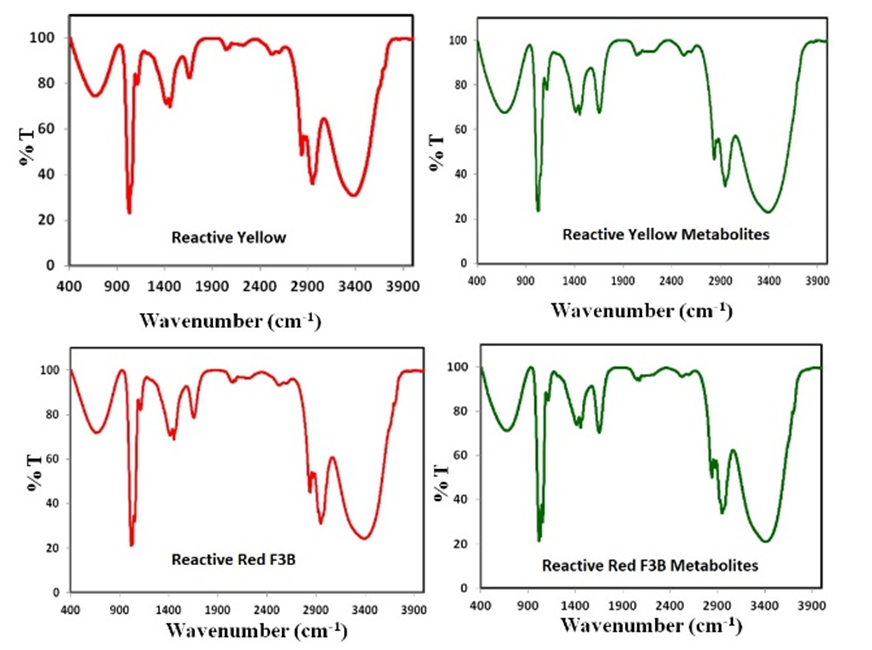
3.2. Biodegradation AnalysisThere exists a little peak difference between FT-IR spectra of parent dyes and their decolorized products (Figure 2), which proves to be one of the analytical techniques to indicate the biological transformation of complex dyes 37 (Reactive Yellow and reactive Red F3B) into simpler products.

The Fourier transform IR spectra of the parent dyes show peaks between 3300 and 3400 cm-1 representing N-H stretching of secondary amides. The peaks in the range of 2940 and 2960 cm-1 represent C-H stretching vibrations. The peak at 1657 cm-1corresponds to azo group of the dye (N=N stretching vibration). The peak at 1030 cm-1 corresponds to S=O stretching vibration of sulfoxides group present in both dyes. The peak at 658 cm-1 corresponds to C-Cl stretching vibration of monocholrinated halogen group exist in Reactive Yellow dye (Figure 2). The FT-IR spectra of biodegraded products by Enterobacter sps SKB16 are shown in (Figure 2), and most of the vibrations resembles with parent dyes. It may be due to the formed degradation products are also have the same functional groups as parent dyes. Although azo group have undergone reductive cleavage by Enterobacter sps SKB16, the degradation products also show trace of azo peaks 35, may be due to trace of non-degraded parent dyes present in the final products.


The biodegradation of Reactive Yellow and Reactive Red F3B by Enterobacter sps SKB16 was further confirmed by HPLC elution profile of control and degraded products (Figure 3 and Figure 4). The elution profile of parent azo dye Reactive Yellow showed major peaks at 2.611, 3.136, 3.604, 3.853, 4.765 and 5.344 retention time, whereas the degraded products showed a major peak at retention time of 3.185 min (Figure 3). Drastic shift in the major peak of parent and degraded dye confirms the dye degradation into various metabolites. The HPLC analysis of Reactive Red F3B showed major peaks at 2.669, 3.092, 3.686, 4.846, 5.407, 7.839 and 9.482 min, whereas the metabolite produced after degradation displayed reduction peaks at 1.846, 2.388, 3.226, 3.617, 4.862 and 5.428 min, indicates biotransformation of the dye by Enterobacter sps SKB16 (Figure 4). HPLC analysis of biodegraded metabolites showing major differences in the peak 38, indicate Reactive Yellow and Reactive Red F3B was metabolized by Enterobacter sps SKB16.
Textile industry wastewater containing toxic azo dyes are great barriers to sustainable environmental. growth; The challenging task is the removal of those dyes from the textile effluent and the present study focused on the isolation of potential azo dye degrading autochthonous bacterial species. The results reveal that the isolate Enterobacter SKB16 has significantly decolorized both the chosen azo dyes and has exhibited its potential to be exploited in the primary treatment of textile industry effluents. Future study is aimed to investigate the on the enzyme activity, elucidate dye degradative pathways and metabolite toxicity which will truly reflect the potential of the strain to be exploited in real time treatment of textile industry effluent.
The authors gratefully acknowledge University Grants Commission, New Delhi for funding the research [F.NO-43/134/2014 (SR)].
| [1] | Roy, M., Sen, P. and Pal, P., “An integrated green management model to improve environmental performance of textile industry towards sustainability”. Journal of Cleaner Production, 271, p.122656. 2020. | ||
| In article | View Article | ||
| [2] | Shanmugam, S., Ulaganathan, P., Sivasubramanian, S., Esakkimuthu, S., Krishnaswamy, S. and Subramaniam, S., “Trichoderma asperellum laccase mediated crystal violet degradation–Optimization of experimental conditions and characterization”. Journal of environmental chemical engineering, 5(1), pp.222-231, 2017 | ||
| In article | View Article | ||
| [3] | Ayed, L., Mahdhi, A., Cheref, A., Bakhrouf, A., “Decolorization and degradation of azo dye Methyl Red by an isolated Sphingomonas paucimobilis: Bio toxicity and metabolites characterization”. Desalination. 274(1), 272-277, 2011 | ||
| In article | View Article | ||
| [4] | Bhattacharya S, Gupta AB, Gupta A, Pandey A. “Introduction to water remediation: importance and methods. In”. Water remediation .Singapore: Springer.3-8, 2018. | ||
| In article | View Article | ||
| [5] | Ali, H., “Biodegradation of Synthetic Dyes—A Review”. Water, Air, Soil Pollution 213, 251-273. 2010 | ||
| In article | View Article | ||
| [6] | Dave, H., Ledwani, L. and Nema, S.K., “Nonthermal plasma: a promising green technology to improve environmental performance of textile industries. In “The Impact and Prospects of Green Chemistry for Textile Technology (pp. 199-249). Wood head publishing. 2019 | ||
| In article | View Article | ||
| [7] | Oliveira, T.P., Marques, G.N., Castro, M.A.M., Costa, R.C.V., Rangel, J.H.G., Rodrigues, S.F., dos Santos, C.C. and Oliveira, M.M., “Synthesis and photo catalytic investigation of ZnFe2O4 in the degradation of organic dyes under visible light”. Journal of Materials Research and Technology. 2020. | ||
| In article | View Article | ||
| [8] | Zabłocka-Godlewska, E., Przystaś, W., & Grabińska-Sota, E., “Possibilities of Obtaining from Highly Polluted Environments: New Bacterial Strains with a Significant Decolorization Potential of Different Synthetic Dyes”. Water, Air, & Soil Pollution, 229(6). 2018. | ||
| In article | View Article PubMed | ||
| [9] | Kurade, M., Waghmode, T.R., Jadhav, M.U., Jeon, B.H., Govindwar, S.P., “Bacterial–yeast consortium as an effective biocatalyst for biodegradation of sulphonated azo dye Reactive Red 198”. RSC Adv. 5(29), 23046-23056. 2015. | ||
| In article | View Article | ||
| [10] | Chung, K.T., Chen, S.C., Wong, T.Y., Li, Y.S., Wei, C.I., Chou, M.-W., “Mutagenic studies of benxidine and its analogues: structure activity relationships”. Toxicology. Science. 56(2), 351-356. 2000. | ||
| In article | View Article PubMed | ||
| [11] | Saratale, R.G., Saratale, G.D., Chang, J.S., Govindwar, S.P., “Bacterial Decolorization and degradation of azo dyes: A review”. J. Taiwan Inst. Chem. Eng., 42(1), 138-157. 2011. | ||
| In article | View Article | ||
| [12] | S. Saroj, S. Dubey, P. Agarwal, R. Prasad, R.P. Singh., “Evaluation of the efficacy of a fungal consortium for degradation of azo dye and simulated textile dye effluents, Sustain”. Water Resource. Management. 1 233-243. 2015. | ||
| In article | View Article | ||
| [13] | E. Forgacs, T. Cserhati, G. Oros, “Removal of synthetic dyes from wastewaters: a review”, Environ. Int. 30 953-971. 2004. | ||
| In article | View Article PubMed | ||
| [14] | Butani, N., Jobanputra, J., Bhatiya, P., Pater, R., “Recent biological technologies for textile effluent treatment”. Int. Res. J. Biol. Sci. 2(6), 77-82. 2013. | ||
| In article | |||
| [15] | Srinivasan, A., & Viraraghavan, T., “Decolorization of dye wastewater by biosorbents: a review”. Journal of Environmental Management, 91, 1915-1929. 2010. | ||
| In article | View Article PubMed | ||
| [16] | Taguchi T, Ebihara K, Yanagisaki C. “Decolorization of recalcitrant dyes by a multicopper oxidase produced by Iodidimonas sp. Q-1 with iodide as a novel inorganic natural redox mediator”. Scientific Reports 8: 6717. 2018. | ||
| In article | View Article PubMed | ||
| [17] | Robinson, T., McMullan, G., Marchant, R. and Nigam, P., “Remediation of dyes in textile effluent: a critical review on current treatment technologies with a proposed alternative”. Bioresource technology, 77(3), pp.247-255. 2001. | ||
| In article | View Article | ||
| [18] | Mishra, S. and Maiti, A., “Applicability of enzymes produced from different biotic species for biodegradation of textile dyes”. Clean Technologies and Environmental Policy, 21(4), pp.763-781. 2019. | ||
| In article | View Article | ||
| [19] | Sudha, M., Bakiyaraj, G., Saranya, A., Sivakumar, N., & Selvakumar, G. “Prospective assessment of the Enterobacter aerogenes PP002 in Decolorization and degradation of azo dyes DB 71 and DG 28”. Journal of Environmental Chemical Engineering, 6(1), 95-109. 2018. | ||
| In article | View Article | ||
| [20] | S. Saroj, S. Dubey, P. Agarwal, R. Prasad, R.P. Singh, “Evaluation of the efficacy of a fungal consortium for degradation of azo dye and simulated textile dye effluents”, Sustain Water Resource Management. 1 233-243, 2015. | ||
| In article | View Article | ||
| [21] | Mishra, Saurabh, Jagdeep Kumar Nayak, and Abhijit Maiti. "Bacteria-mediated bio-degradation of reactive azo dyes coupled with bio-energy generation from model wastewater." Clean Technologies and Environmental Policy: 1-17. 2020. | ||
| In article | View Article | ||
| [22] | Meerbergen, K., Willems, K.A., Dewil, R., Van Impe, J., Appels, L., Lievens, B., “Isolation and screening of bacterial isolates from wastewater treatment plants to decolorize azo dyes”. Journal of Bioscience Bioengineering. 125, 448-456. 2018. | ||
| In article | View Article PubMed | ||
| [23] | Kolekar, Y.M., Nemade, H.N., Markad, V.L., Adav, S.S., Patole, M.S., Kodam, K.M., “Decolorization and biodegradation of azo dye, reactive blue 59 by aerobic granules”. Bioresource Technology. 104(1), 818-822. 2012. | ||
| In article | View Article PubMed | ||
| [24] | Fang, Z., Yong, Y.-C., Zhang, J., Du, G.-C., Chen, J., “Keratinolytic protease: a green biocatalyst for leather industry”. Applied Microbiology, Biotechnology. 101(21), 7771-7779. 2017. | ||
| In article | View Article PubMed | ||
| [25] | Barathi, S., Aruljothi, K.N., Karthik, C. and Padikasan, I.A., “Optimization for enhanced ecofriendly decolorization and detoxification of Reactive Blue160 textile dye by Bacillus subtilis.” Biotechnology Reports, 28, p.e00522. 2020. | ||
| In article | View Article PubMed | ||
| [26] | Kumar MA, Vigneshwaran ME, Priya M., “Concocted bacterial consortium for the detoxification and mineralization of azoic-cum-sulfonic textile mill effluent”. Journal of Water Process Engineering 16C:199-205. 2017. | ||
| In article | View Article | ||
| [27] | Kalyani, D.C., Telke, A.A., Dhanve, R.S., Jadhav, J.P., 2009. “Eco friendly biodegradation and detoxification of Reactive Red 2 textile dye by newly isolated Pseudomonas sp. SUK1”. Journal of Hazardous Material 163, 735-743. | ||
| In article | View Article PubMed | ||
| [28] | Parshetti, G.K., Telke, A.A., Kalyani, D.C. and Govindwar, S.P., “Decolorization and detoxification of sulfonated azo dye methyl orange by Kocuria rosea MTCC 1532”. Journal of Hazardous Materials, 176(1-3), pp.503-509. 2010. | ||
| In article | View Article PubMed | ||
| [29] | Srinivasan, S., Sadasivam, S.K., “Exploring bacterial systems for docking and aerobic 452 microaerophilic biodegradation of textile azo dye”. Journal of Water Process Engineering. 22, 180-191. 453. 2018. | ||
| In article | View Article | ||
| [30] | Bharagava, R.N., Mani, S., Mulla, S.I. and Saratale, G.D., “Degradation and decolourization potential of an ligninolytic enzyme producing Aeromonas hydrophila for crystal violet dye and its phytotoxicity evaluation”. Ecotoxicology and environmental safety, 156, pp.166-175. 2018. | ||
| In article | View Article PubMed | ||
| [31] | K.C. Chen, W.T. Huang, J.Y. Wu, J.Y. Houng, “Microbial decolourization of azo dyes by Proteus mirabilis”, J. Ind. Microbiol. Biotechnology. 23 (1999) 686-690. 2017. | ||
| In article | View Article PubMed | ||
| [32] | Verma, A.K., Nath, D., Bhunia, P. and Dash, R.R., “Application of ultra-sonication and hybrid bioreactor for treatment of synthetic textile wastewater”. Journal of Hazardous, Toxic, and Radioactive Waste, 21(2), p.04016018. 2017. | ||
| In article | View Article | ||
| [33] | Cao, X., Wang, H., Zhang, S., Nishimura, O., & Li, X. “Azo dye degradation pathway and bacterial community structure in biofilm electrode reactors”. Chemosphere, 208, 219-225. 2018 | ||
| In article | View Article PubMed | ||
| [34] | K.P. Gopinath, S. Murugesan, J. Abraham, K. Muthukumar, “Bacillus mutant for improved biodegradation of Congo red: random mutagenesis approach”, Bioresource Technology. 100 (2009) 6295-6300.2005. | ||
| In article | View Article PubMed | ||
| [35] | Krishnamoorthy, R., Jose, P.A., Ranjith, M., Anandham, R., Suganya, K., Prabhakaran, J., Thiyageshwari, S., Johnson, J., Gopal, N.O. and Kumutha, K., 2018. “Decolourisation and degradation of azo dyes by mixed fungal culture consisted of Dichotomomyces cejpii MRCH 1-2 and Phoma tropica MRCH 1-3.” Journal of environmental chemical engineering, 6(1), pp.588-595. | ||
| In article | View Article | ||
| [36] | Thanavel, M., Bankole, P.O., Kadam, S., Govindwar, S.P. and Sadasivam, S.K., “Desulfonation of the textile azo dye Acid Fast Yellow MR by newly isolated Aeromonas hydrophila SK16”. Water Resources and Industry, 22, p.100116. 2019. | ||
| In article | View Article | ||
| [37] | Kafilzadeh F, Sahragard P, Jamali H., “Isolation and identification of hydrocarbons degrading bacteria in soil around Shiraz Refinery”. African Journal of Microbiological Research 4(19): 3084-308. 2011 | ||
| In article | View Article | ||
| [38] | Kumar, S.S., Muruganandham, T., Kathiravan, V., Ravikumar, R. and Jabbir, M.M, “Rapid decolourization of Disperse Red F3B by Enterococcus faecalis and its Phytotoxic Evaluation”. Int. J. Curr. Microbiol. App. Sci, 2(10), pp.52-67. 2013. | ||
| In article | |||
Published with license by Science and Education Publishing, Copyright © 2021 Sheela Thangaraj, Baby Jooju and Senthil Kumar Sadasivam
 This work is licensed under a Creative Commons Attribution 4.0 International License. To view a copy of this license, visit
http://creativecommons.org/licenses/by/4.0/
This work is licensed under a Creative Commons Attribution 4.0 International License. To view a copy of this license, visit
http://creativecommons.org/licenses/by/4.0/
| [1] | Roy, M., Sen, P. and Pal, P., “An integrated green management model to improve environmental performance of textile industry towards sustainability”. Journal of Cleaner Production, 271, p.122656. 2020. | ||
| In article | View Article | ||
| [2] | Shanmugam, S., Ulaganathan, P., Sivasubramanian, S., Esakkimuthu, S., Krishnaswamy, S. and Subramaniam, S., “Trichoderma asperellum laccase mediated crystal violet degradation–Optimization of experimental conditions and characterization”. Journal of environmental chemical engineering, 5(1), pp.222-231, 2017 | ||
| In article | View Article | ||
| [3] | Ayed, L., Mahdhi, A., Cheref, A., Bakhrouf, A., “Decolorization and degradation of azo dye Methyl Red by an isolated Sphingomonas paucimobilis: Bio toxicity and metabolites characterization”. Desalination. 274(1), 272-277, 2011 | ||
| In article | View Article | ||
| [4] | Bhattacharya S, Gupta AB, Gupta A, Pandey A. “Introduction to water remediation: importance and methods. In”. Water remediation .Singapore: Springer.3-8, 2018. | ||
| In article | View Article | ||
| [5] | Ali, H., “Biodegradation of Synthetic Dyes—A Review”. Water, Air, Soil Pollution 213, 251-273. 2010 | ||
| In article | View Article | ||
| [6] | Dave, H., Ledwani, L. and Nema, S.K., “Nonthermal plasma: a promising green technology to improve environmental performance of textile industries. In “The Impact and Prospects of Green Chemistry for Textile Technology (pp. 199-249). Wood head publishing. 2019 | ||
| In article | View Article | ||
| [7] | Oliveira, T.P., Marques, G.N., Castro, M.A.M., Costa, R.C.V., Rangel, J.H.G., Rodrigues, S.F., dos Santos, C.C. and Oliveira, M.M., “Synthesis and photo catalytic investigation of ZnFe2O4 in the degradation of organic dyes under visible light”. Journal of Materials Research and Technology. 2020. | ||
| In article | View Article | ||
| [8] | Zabłocka-Godlewska, E., Przystaś, W., & Grabińska-Sota, E., “Possibilities of Obtaining from Highly Polluted Environments: New Bacterial Strains with a Significant Decolorization Potential of Different Synthetic Dyes”. Water, Air, & Soil Pollution, 229(6). 2018. | ||
| In article | View Article PubMed | ||
| [9] | Kurade, M., Waghmode, T.R., Jadhav, M.U., Jeon, B.H., Govindwar, S.P., “Bacterial–yeast consortium as an effective biocatalyst for biodegradation of sulphonated azo dye Reactive Red 198”. RSC Adv. 5(29), 23046-23056. 2015. | ||
| In article | View Article | ||
| [10] | Chung, K.T., Chen, S.C., Wong, T.Y., Li, Y.S., Wei, C.I., Chou, M.-W., “Mutagenic studies of benxidine and its analogues: structure activity relationships”. Toxicology. Science. 56(2), 351-356. 2000. | ||
| In article | View Article PubMed | ||
| [11] | Saratale, R.G., Saratale, G.D., Chang, J.S., Govindwar, S.P., “Bacterial Decolorization and degradation of azo dyes: A review”. J. Taiwan Inst. Chem. Eng., 42(1), 138-157. 2011. | ||
| In article | View Article | ||
| [12] | S. Saroj, S. Dubey, P. Agarwal, R. Prasad, R.P. Singh., “Evaluation of the efficacy of a fungal consortium for degradation of azo dye and simulated textile dye effluents, Sustain”. Water Resource. Management. 1 233-243. 2015. | ||
| In article | View Article | ||
| [13] | E. Forgacs, T. Cserhati, G. Oros, “Removal of synthetic dyes from wastewaters: a review”, Environ. Int. 30 953-971. 2004. | ||
| In article | View Article PubMed | ||
| [14] | Butani, N., Jobanputra, J., Bhatiya, P., Pater, R., “Recent biological technologies for textile effluent treatment”. Int. Res. J. Biol. Sci. 2(6), 77-82. 2013. | ||
| In article | |||
| [15] | Srinivasan, A., & Viraraghavan, T., “Decolorization of dye wastewater by biosorbents: a review”. Journal of Environmental Management, 91, 1915-1929. 2010. | ||
| In article | View Article PubMed | ||
| [16] | Taguchi T, Ebihara K, Yanagisaki C. “Decolorization of recalcitrant dyes by a multicopper oxidase produced by Iodidimonas sp. Q-1 with iodide as a novel inorganic natural redox mediator”. Scientific Reports 8: 6717. 2018. | ||
| In article | View Article PubMed | ||
| [17] | Robinson, T., McMullan, G., Marchant, R. and Nigam, P., “Remediation of dyes in textile effluent: a critical review on current treatment technologies with a proposed alternative”. Bioresource technology, 77(3), pp.247-255. 2001. | ||
| In article | View Article | ||
| [18] | Mishra, S. and Maiti, A., “Applicability of enzymes produced from different biotic species for biodegradation of textile dyes”. Clean Technologies and Environmental Policy, 21(4), pp.763-781. 2019. | ||
| In article | View Article | ||
| [19] | Sudha, M., Bakiyaraj, G., Saranya, A., Sivakumar, N., & Selvakumar, G. “Prospective assessment of the Enterobacter aerogenes PP002 in Decolorization and degradation of azo dyes DB 71 and DG 28”. Journal of Environmental Chemical Engineering, 6(1), 95-109. 2018. | ||
| In article | View Article | ||
| [20] | S. Saroj, S. Dubey, P. Agarwal, R. Prasad, R.P. Singh, “Evaluation of the efficacy of a fungal consortium for degradation of azo dye and simulated textile dye effluents”, Sustain Water Resource Management. 1 233-243, 2015. | ||
| In article | View Article | ||
| [21] | Mishra, Saurabh, Jagdeep Kumar Nayak, and Abhijit Maiti. "Bacteria-mediated bio-degradation of reactive azo dyes coupled with bio-energy generation from model wastewater." Clean Technologies and Environmental Policy: 1-17. 2020. | ||
| In article | View Article | ||
| [22] | Meerbergen, K., Willems, K.A., Dewil, R., Van Impe, J., Appels, L., Lievens, B., “Isolation and screening of bacterial isolates from wastewater treatment plants to decolorize azo dyes”. Journal of Bioscience Bioengineering. 125, 448-456. 2018. | ||
| In article | View Article PubMed | ||
| [23] | Kolekar, Y.M., Nemade, H.N., Markad, V.L., Adav, S.S., Patole, M.S., Kodam, K.M., “Decolorization and biodegradation of azo dye, reactive blue 59 by aerobic granules”. Bioresource Technology. 104(1), 818-822. 2012. | ||
| In article | View Article PubMed | ||
| [24] | Fang, Z., Yong, Y.-C., Zhang, J., Du, G.-C., Chen, J., “Keratinolytic protease: a green biocatalyst for leather industry”. Applied Microbiology, Biotechnology. 101(21), 7771-7779. 2017. | ||
| In article | View Article PubMed | ||
| [25] | Barathi, S., Aruljothi, K.N., Karthik, C. and Padikasan, I.A., “Optimization for enhanced ecofriendly decolorization and detoxification of Reactive Blue160 textile dye by Bacillus subtilis.” Biotechnology Reports, 28, p.e00522. 2020. | ||
| In article | View Article PubMed | ||
| [26] | Kumar MA, Vigneshwaran ME, Priya M., “Concocted bacterial consortium for the detoxification and mineralization of azoic-cum-sulfonic textile mill effluent”. Journal of Water Process Engineering 16C:199-205. 2017. | ||
| In article | View Article | ||
| [27] | Kalyani, D.C., Telke, A.A., Dhanve, R.S., Jadhav, J.P., 2009. “Eco friendly biodegradation and detoxification of Reactive Red 2 textile dye by newly isolated Pseudomonas sp. SUK1”. Journal of Hazardous Material 163, 735-743. | ||
| In article | View Article PubMed | ||
| [28] | Parshetti, G.K., Telke, A.A., Kalyani, D.C. and Govindwar, S.P., “Decolorization and detoxification of sulfonated azo dye methyl orange by Kocuria rosea MTCC 1532”. Journal of Hazardous Materials, 176(1-3), pp.503-509. 2010. | ||
| In article | View Article PubMed | ||
| [29] | Srinivasan, S., Sadasivam, S.K., “Exploring bacterial systems for docking and aerobic 452 microaerophilic biodegradation of textile azo dye”. Journal of Water Process Engineering. 22, 180-191. 453. 2018. | ||
| In article | View Article | ||
| [30] | Bharagava, R.N., Mani, S., Mulla, S.I. and Saratale, G.D., “Degradation and decolourization potential of an ligninolytic enzyme producing Aeromonas hydrophila for crystal violet dye and its phytotoxicity evaluation”. Ecotoxicology and environmental safety, 156, pp.166-175. 2018. | ||
| In article | View Article PubMed | ||
| [31] | K.C. Chen, W.T. Huang, J.Y. Wu, J.Y. Houng, “Microbial decolourization of azo dyes by Proteus mirabilis”, J. Ind. Microbiol. Biotechnology. 23 (1999) 686-690. 2017. | ||
| In article | View Article PubMed | ||
| [32] | Verma, A.K., Nath, D., Bhunia, P. and Dash, R.R., “Application of ultra-sonication and hybrid bioreactor for treatment of synthetic textile wastewater”. Journal of Hazardous, Toxic, and Radioactive Waste, 21(2), p.04016018. 2017. | ||
| In article | View Article | ||
| [33] | Cao, X., Wang, H., Zhang, S., Nishimura, O., & Li, X. “Azo dye degradation pathway and bacterial community structure in biofilm electrode reactors”. Chemosphere, 208, 219-225. 2018 | ||
| In article | View Article PubMed | ||
| [34] | K.P. Gopinath, S. Murugesan, J. Abraham, K. Muthukumar, “Bacillus mutant for improved biodegradation of Congo red: random mutagenesis approach”, Bioresource Technology. 100 (2009) 6295-6300.2005. | ||
| In article | View Article PubMed | ||
| [35] | Krishnamoorthy, R., Jose, P.A., Ranjith, M., Anandham, R., Suganya, K., Prabhakaran, J., Thiyageshwari, S., Johnson, J., Gopal, N.O. and Kumutha, K., 2018. “Decolourisation and degradation of azo dyes by mixed fungal culture consisted of Dichotomomyces cejpii MRCH 1-2 and Phoma tropica MRCH 1-3.” Journal of environmental chemical engineering, 6(1), pp.588-595. | ||
| In article | View Article | ||
| [36] | Thanavel, M., Bankole, P.O., Kadam, S., Govindwar, S.P. and Sadasivam, S.K., “Desulfonation of the textile azo dye Acid Fast Yellow MR by newly isolated Aeromonas hydrophila SK16”. Water Resources and Industry, 22, p.100116. 2019. | ||
| In article | View Article | ||
| [37] | Kafilzadeh F, Sahragard P, Jamali H., “Isolation and identification of hydrocarbons degrading bacteria in soil around Shiraz Refinery”. African Journal of Microbiological Research 4(19): 3084-308. 2011 | ||
| In article | View Article | ||
| [38] | Kumar, S.S., Muruganandham, T., Kathiravan, V., Ravikumar, R. and Jabbir, M.M, “Rapid decolourization of Disperse Red F3B by Enterococcus faecalis and its Phytotoxic Evaluation”. Int. J. Curr. Microbiol. App. Sci, 2(10), pp.52-67. 2013. | ||
| In article | |||