The study was undertaken to assess the physico-chemical conditions and record the zooplankton community at Sangave pond in Uttara Kannada district. A total of 34 zooplankton species were recorded. Cladocera was the dominating group in the pond with 14 species and highest abundance of 2302 individuals. Macrothrix goeldi was the most abundant species in this group represented with 228 individuals. Rotifera was represented with 10 species and 1776 individuals. Only three species of ostracods were recorded during 18 months study period. Dominance value of Ostracod was highest with 0.366 followed by Copepod with 0.1468 Rotifers with 0.1144 and the least dominance of 0.07314 was shown by Cladocera. Evenness was highest for Cladocers followed by Copepoda, Rotifera and least evenness value was of group Ostracoda Though the water body is located in the protected area the presence of eutrophic species like Brachinous calyciflorus, Lecane luna and fluctuations in the electric conductivity indicate that, there is a need for regular monitoring to conserve the water body from further deterioration.
Aquatic ecosystems are the most productive ecosystems in the biosphere and play a significant role in the ecological sustainability. Water constitute an essential component on the biosphere that is needed to meet the crucial needs and sustain life on earth, such as water for drinking and agricultural activities, fish production, supporting biodiversity, energy production, recreation, transport, climate stabilizers and pollutant sink. Due to increase in human population growth there is intolerable strains on the water resources 1. The freshwater sources of the world are experiencing markedly accelerating rates of qualitative and quantitative degradation because of population growth and technological advancement 2. Discharges of domestic, industrial and agricultural wastes have increased the various chemicals that enter the water which alter their physico-chemical characteristics. Phosphorus and nitrogen contents from the domestic sewage and fertilizers that leach out from agricultural lands accelerate the process of eutrophication of water bodies 3. In addition, natural processes like dust storms, run-off and weathering of minerals are slow processes in causing eutrophication. In the past when communities were sparsely populated, water was capable of self revival and restoration by metabolizing the pollutants, but with the increased anthropogenic activities its self-purification capacity has diminished leading to severe water pollution problems 4. Eutrophication of water cause great changes in the structure of zooplankton communities. Due to algal blooming many species disappear as a consequence of release of algal toxins or the clogging of filter-feeding apparatus 5. There is a growing concern about the changes in the aquatic environment accompanying anthropogenic pollution and there is a need for monitoring of the surface waters and protect the organisms inhibiting them. The zooplankton community, which closely related to all other components of the biota, is not only act as a sensitive indicator of the aquatic environment but also helps the ecologist in monitoring of water bodies 6. Their community structure is shaped primarily by the physical and chemical environment. However, the dominant forces that affect these communities are biological interactions, predation and inter and intra specific competition for food resources 7. Since zooplankton community structure and composition are affected by eutrophication, these communities have the potential value as indicators of changing trophic condition 8. Uttara Kannada district is located in the western part of India and it is a part of central Western Ghats. It is covered with 80% of forest 9 and harbors two important protected areas viz Dandeli wildlife sanctuary and Anashi National park together forming the Kali Tiger Reserve (KTR). It is designated as the ecologically sensitive district in Karnataka 10. The Hydrobiological studies of the Uttar Kannada district are mainly concerned with the water quality 11, 12, 13, phytoplankton and zooplankton composition 14, 15, 16, river pollution 17, and Limno chemistry 18. The studies on water bodies in protected areas particularly in the core and buffer zones of Kali tiger reserve are limited 16. Hence the present work is undertaken to study the zooplankton community and hydrobiology of Sangave pond located in the sensitive zone.
Study area is located near Sangave village in Supa taluka of Uttara Kannada district of Karnatak state, India. It is situated 20km away from sub-district headquarter Joida. Geographically the pond is situated at 15º 12' 17.8" N and 74º 34' 03.5" E.
2.2. Sample Collection and AnalysisWater samples were collected during the early hours of the day between 6:00 and 9:00 hours on monthly basis from July 2017 to December 2018. Water quality parameters like air and water temperature, pH, conductivity, TDS were measured at the sampling site through Eutech PCS Tester 35 probe. A Systronics Nephlo-turbido meter was used to determine turbidity. Chemical parameters like dissolved oxygen (DO), free CO2, chloride, alkalinity, hardness, phosphate, nitrate were analysed in the laboratory using standard methods 19 For qualitative and quantitative studies of zooplankton, 100 litters of water was sieved through plankton net made of nylon bolting cloth (68µm mesh size). Samples were fixed in 4% formaldehyde and 2 ml glycerine was added to avoid brittling. Sedgwick Rafter counting cell was used for quantitative analysis of zooplanktons. Organisms were identified to the greatest possible taxonomic level (Genus/species), using an Olympus CH 20i optical microscope and a specialized bibliography [20-35] 20.
Pearson correlation was used to study the interrelation between water quality variables using SPSS software (IBM) version 21. The data were analyzed with a software program Past, which generates diversity indices with the help of zooplankton abundance count.
Fifteen physico-chemical parameters were estimated from the study area to observe the monthly variations for a period of 18 months (Table 1). Minimum air temperature of 16°C was recorded during November 2018 and maximum of 24°C was observed in April and May, 2018. Water temperature was minimum during November 2017 and maximum of 24°C was observed during several months. pH ranged between 6.1 and 9.6. Minimum value was recorded during May, 2018 and Maximum in September, 2018. Electrical conductivity (EC) was minimum (148 µS/cm) in August, 2017 and a maximum of 255 µS/cm was observed in April, 2018. TDS was minimum with 88.7 ppm in December, 2017 and maximum of 179 ppm was recorded in May, 2018. Dissolved oxygen ranged between 6.8 mg/l to 12.4 mg/lit. Its maximum value was observed during December, 2018 and minimum in June, 2018. Free carbon dioxide was minimum (3.3 mg/l) in July, 2018 and maximum of 11 mg/l was observed during April, 2018. Total Alkalinity ranged between 12 and 97mg/l with its minimum value in January, 2018 and maximum in February, 2018. Total hardness was minimum in November, 2018 (41mg/l) and maximum of 74mg/l was observed during February, 2018. Chloride levels varied from 6mg/l to 82mg/l. A minimum value was recorded in December, 2018 and maximum during June, 2018. Phosphate levels ranged between 0.01 mg/l and 0.05 mg/l. Nitrate values were fluctuating between 0.01mg/l to o.1 mg/l during the study period. A minimum value of 8mg/l of sulphate was recorded in December (8mg/l) and maximum of 39mg/l was observed in May, 2018. BOD ranged between 1 mg/l and 2.4 mg/l with its minimum value during July, 2017 and maximum in May, July and August, 2018. Turbidity value was minimum (25mg/l) in September and December, 2018 and maximum of 350mg/l was recorded in August, 2018.
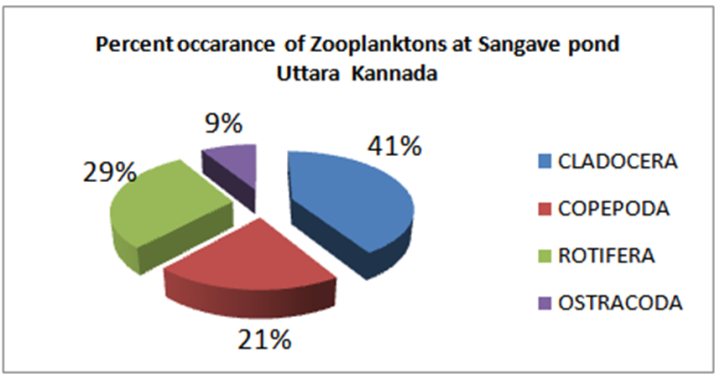
A total of 34 zooplankton species were recorded during the present study. Cladocera was represented with 41% (Figure 1) of the total zooplanktons with 14 species The abundance was highest in August, 2018 with 246 individuals and minimum of 23 individuals were recorded in March, 2018 (Table 2). Macrothrix goeldi was the most abundant species in this group represented with 228 individuals. Seven species of Copepoda comprising 21% of total zooplanktons were recorded during the study period. Their abundance was minimum with 9 individuals recorded in July, 2017 and maximum abundance of 166 individuals were observed in May, 2018. Tropocyclops parsinus was the most abundant species in this group with a total of 265 individuals observed during the entire study period. Rotifera was the second highest group after cladocerans constituting 29% of the total zooplanktons with 10 species. Minimum abundance of 28 individuals of rotifers were observed in July, 2017 and maximum abundance with 319 individuals were observed in February, 2018.

Brachionus caudatus of this group was the most abundant species amongst all the zooplankton species observed represented with 339 individuals. Only three species of ostracodes were recorded in the present study representing 9% of the total zooplanktons. Hemicypris fossulata was the most abundant species in this group with 69 individuals. Maximum abundance of ostracodes was observed during March and April, 2018.
Estimation of physicochemical parameters and their monthly variations not only help in determining the water quality but also gives information on the status, productivity and sustainability of the water body. During the present study, monthly variations and the correlations between the physico-chemical parameters is investigated (Table 3). Temperature is an essential component in an aquatic ecosystem that controls and regulates the biotic and other abiotic factors. Monthly fluctuations in air and water temperature were observed during the study period. It was higher during April and May months which fall under summer season. This may be due to long day length and angle of incidence of solar rays 36. Air temperature showed positive correlation with water temperature, alkalinity, chloride, sulphate and BOD and it was negatively correlated with pH and DO. Positive correlation of temperature with BOD and negative correlation with DO was also reported from Lake Prashar, Himachal Pradesh, India 37. pH affects the aquatic biota since many of their metabolic activities are pH sensitive.
High values of pH are due to very high concentration of bicarbonate in the lakes 38. In the present study the water was almost alkaline throughout the study period with highest value during post monsoon months. Similar observation was reported by earlier workers 39, 40. In the present study pH was positively correlated with phosphates and turbidity and it was significantly negatively correlated with carbon dioxide, alkalinity, nitrates and sulphates. EC is a good indicator of overall water quality. Natural waters generally possess low EC however, contaminants increase its level in water body 41, 42. The conductivity values more than 200 µmhos are considered as eutrophic. In the present study, highest EC of 255 µS/cm was observed in April, 2018. Concentration of TDS from natural sources can vary depending on the solubility of minerals in different geological regions. In the present study TDS was positively correlated with BOD, It was maximum during May, 2018 while minimum in December 2018. Similar observations were made at Attiveri reservoir 43. Dissolved oxygen (DO) is an important parameters that determine the water quality and abundance of zooplankters 44. DO showed positive correlation with nitrates and significant negative correlation with hardness, chlorides and turbidity. Carbon dioxide in water is due to decomposition of organic matter dissolution of carbonates and bicarbonates and respiration of aquatic organisms 45. In the present study CO2 was positively correlated with alkalinity and significantly negatively correlated with phosphates and turbidity. Total alkalinity values were high during pre-monsoon months may be the result of organic decomposition that release bicarbonate ions causing increase in alkalinity 46. Alkalinity values were positively correlated with sulphates and negatively correlated with phosphates. The total hardness values were high during June, to August 2018. Rain leaches out much of the mineral ions in the soil replacing them with hydrogen ions leading to increased hardness 47. Total hardness in the present work was positively correlated with chlorides, phosphates and turbidity and negatively correlated with nitrates. Chloride levels were high during September, 2017 and low during December. Its values were positively correlated with sulphates and negatively correlated with nitrates. Phosphates are chemical compounds that contain phosphorous. It is a key nutrient that both plants and animals use for growth and development. Excess of phosphate in aquatic system leads to algal blooming and may result in eutrophication. In the present study it varied from 0.01 to 0.05 mg/l. Its values are positively correlated with turbidity. Low levels of nitrates may occur naturally in water due to low solubility 48, but excess nitrates get in to water as a result of runoff of fertilizers and pollution due to animal waste and sewage. In the present study nitrate level ranged from 0.01 to 0.1 mg/l and its values were negatively correlated with turbidity. Sulphate levels in the present study were highest during summer months and it is positively correlated with BOD. Biological Oxygen Demand in the water body varied from 1.0 to 2.4 Maximum values were observed during May, July and August 2018 and the highest value of BOD in the month of May was also reported at Saralasagar reservoir 49. During Monsoon due to heavy rains mixing of water with suspended particulate matter creates high turbulence leading to increased turbidity. In the present study also high turbidity was observed during the rainy months of June, July and August months when there were good rains. Similar observations were reported at Saralasagar reservoir 49. Zooplanktons are the essential components of aquatic system and play key role in regulating the ecosystem and as secondary consumers they act as intermediate link between phytoplankton and fish. As they are strongly affected by the changes in the aquatic environment they may be used as indicators of change in water quality 50. In the present study Cladocerans dominated the zooplanktons with highest species richness and maximum abundance. They are the important source of food for fishes and play a major role in food chain and energy transfer 51, 52. Their abundance was maximum during June, July, August and September 2018 and minimum in summer months (March and April, 2018). Similar observations were made in earlier studies 53, 54. Rotifers were the second most dominant group represented with 10 species and 1176 individuals. Rotifer abundance generally increase during summer 55, 56, 57, 58. In the present study also maximum abundance of rotifers were observed during summer months and minimum during monsoon (July 2017). Copepoda was represented with seven species. There abundance was minimum during rainy months of July, August and September and maximum during summer months of April and May. Ostracod abundance was highest in summer months March and April 2018. Similar observations was made at a freshwater pond Shibnagar, Agartala, Tripura 59.
Diversity indices in the present study indicates that the population of Ostracod dominates with a dominance value of 0.366 followed by Copepod with 0.1468 Rotifers with 0.1144 and the least dominance of 0.07314 was shown by Cladocera. (Table 4)
According to Simpson-1D: Cladocera with highest species richness and abundance exhibited highest diversity (0.9269) followed by Rotifera (0.8856), Copepoda (0.8532) and least was Ostracoda (0.634). Evenness was highest for Cladocers followed by Copepoda, Rotifera and least evenness value was of group Ostracoda.
In the present study zooplankton community was represented with 34 species belonging to four groups Viz Cladocera, Copepoda, Rotifera and Ostracoda. Cladocera was the leading group with highest number of 14 species and abundance of 2302 individuals. Rotifera was the second dominating group with 10 species and 1776 individuals. Brachinus caudatus a rotifer was the most abundant species represented with a total of 339 individuals. Ostracoda had minimum of three species and a total of 163 individuals. Though the water body is located in the protected area the presence of eutrophic species like Brachinous calyciflorus Lecane luna and fluctuations in the electric conductivity indicate that, there is a need for the conservation. The study provide a base line data on the present status of the water body which can be used as a tool to formulate the conservative strategy to protect the water body from further deterioration.
Authors thank Manjunath Hosamani and Basavaraj S.K for the help in preparation of manuscript. NR thank Principal, B.N Degree College Dandeli for the support and encouragement.
| [1] | Jones, J. Gwynfryn, Freshwater ecosystem-structure and response, Ecotoxicology & Environmental Safety, 50. 107-113. 2001. | ||
| In article | View Article PubMed | ||
| [2] | Wetzel, G.R., Limnology Lake and River ecosystems III edition, Academic press, A Harcourt science and technology company, California, USA. pp 1006. 2003 | ||
| In article | |||
| [3] | Rao, V. N. R., Mohan, R., Hariprasad, V. and Ramasubramanian, R, Sewage pollution in the high altitude Ootylake, Udhagamandalam-cause and concern. Poll Res. 13(2). 133-150. 1994. | ||
| In article | |||
| [4] | Kumar, Arvind and Chandan Bohra. Impact of human activities on the limnology of two religious ponds of Basukinath Dham, Dumka, Bihar. Environ and Ecol. 16(4). 809-812.1998 | ||
| In article | |||
| [5] | Sampaio, E.V., Rocha, O., Matsumura-Tundisi, T. and Tundisi, J.G. Composition and abundance of zooplankton in the limnetic zone of seven reservoirs of the Paranapanema River, Brazil. Braz.J.Biol. 62(3). 525-545. 2002. | ||
| In article | View Article PubMed | ||
| [6] | Vandysh, O. I., Zooplankton as an indicator of the state of lake ecosystems polluted with mining wastewater in the Kola Peninsula. Russian. J Ecol. 35(2), 110-116. 2004. | ||
| In article | View Article | ||
| [7] | Neves, I.F., O. Rocha, K.F. Roche and A.A. Pinto., Zooplankton community structure of two marginal lakes of the River Cuiaba (Mato Grasso, Brazil) with analysis of rotifera and cladocera diversity. Braz. J. Biol. 63(3), 329-343.2003. | ||
| In article | View Article PubMed | ||
| [8] | Blancher, C. Eldon., Zooplankton-trophic relationships in some north and central Florida lakes.Hydrobiologia. 109, 251-263. 1984. | ||
| In article | View Article | ||
| [9] | Nayak, M.R., B.M. Ratnakar., Environment issues in Uttara Kannada need for preservation of Environment. Indian Journal of Applied Research 5(3) 493-494, 2015. | ||
| In article | |||
| [10] | Ramchandra, T.V., Vegetation Status in Uttara Kannada District. Mapana Journal of Sciences, 6(1): 1-26. 2007. | ||
| In article | View Article | ||
| [11] | Birasal, M. R., Nadkarni, V. B., Krishnamurthy S. R. and S. G. Bharati., The physico-chemical status of the Kali River after the closure of the Supa dam - A preliminary report. J. Freshwater Biol., 3(4), 251-257.1991. | ||
| In article | |||
| [12] | Hegde G.R and Bhat, D.M., Post monsoon water qualities of lentic ecosystems in Uttar Kannada district, Karnataka state.In: Irfan A.Khan (eds), Frontiers in plant science, The book syndicate publ. Hyderabad, pp: 1-6. 1995. | ||
| In article | |||
| [13] | Ghosh, N. C. and McBean, E. A., Water quality modeling of the Kali River, India.Wat.Air. Soil Poll. 102(1-2), 91-103. 1998. | ||
| In article | View Article | ||
| [14] | Isaacs, S. W. and Hegde, G. R., Freshwater algae of Uttara Kannada district, Karnataka State.Phykos. 25. 102-107. 1986. | ||
| In article | |||
| [15] | Birasal, N. R., Nadkarni V. B. and B. Y. M. Gouder.(1989). Ecology of zooplankton of Supa reservoir of Kali river during the filling phase (Western Ghats, Karnataka). J. Freshwater Biol., 1(1), 15-23. 1989. | ||
| In article | |||
| [16] | Revankar, Nayana., Kadadevaru, G. G., Basavaraj S.K., Zooplankton diversity and Physico-Chemical conditions in Bommanahalli Reservoir Of Uttara Kannada District Karnataka India. Int J Eco & Env.Sci. 3(3). 65-71. 2021. | ||
| In article | |||
| [17] | Krishnamurthy S. R., and Bharati, S. G., Studies on the metal pollution of the river Kali, around Dandeli, (North Kanara District), Karnataka India. Polln Res, 13(3), 249-252.1994 | ||
| In article | |||
| [18] | Vasanthkumar. B., Vijaykumar, K., Sedamkar E.B, (2014). Limno-chemistry of some lentic water bodies of Karwar, Uttara Kannada District, Karnataka. LAKE (1-8), 2014. | ||
| In article | |||
| [19] | Standard methods for the examination of water and wastewater, APHA-AWWA-WPCF, 15th Edition, 1980. | ||
| In article | |||
| [20] | Edmondson, W. T. Freshwater Biology (2nd ed.). New York, USA: John Wiley & sons, 1959. | ||
| In article | |||
| [21] | Dhanapathi, M. V. S. S. S. Rotifers from Andhra Pradesh, India - I. Hydrobiologia. 45. 357-372. 1974 | ||
| In article | View Article | ||
| [22] | Dhanapathi, M. V. S. S. S. Rotifers from Andhra Pradesh, India - III. Hydrobiologia, 48. 9-16. 1976. | ||
| In article | View Article | ||
| [23] | Dumont, H. J., & Van De Velde, I. Report on a collection of Cladocera and Copepodafrom Nepal. Hydrobiologia, 53, 55-65. 1977. | ||
| In article | View Article | ||
| [24] | Dumont, H. J., Biogeography of Rotifers. Hydrobiologia, 104, 19-30. 1983. | ||
| In article | View Article | ||
| [25] | Sharma, B. K., Rotifers from West Bengal III. Further studies on the Euratatoria. Hydrobiologia, 64(3), 239-250. 1979. | ||
| In article | View Article | ||
| [26] | Sharma, B. K., Contributions to the rotifer fauna of Orissa, India. Hydrobiologia, 70. 225-233. 1980. | ||
| In article | View Article | ||
| [27] | Sharma, B. K., The Indian species of the genus Brachionus (Euratatoria: Monogonanta). Hydrobiologia, 104, 31-9. 1983. | ||
| In article | View Article | ||
| [28] | Sharma, B. K., Indian Brachinidae (Euratatoria: Monogonanta) and their distribution. Hydrobiologia, 144, 269-275. 1987. | ||
| In article | View Article | ||
| [29] | Sharma, B. K., & Michael, R. G. Synopsis of taxonomic studies on the Indian Rotatoria. Hydrobiologia, 73, 229-236. 1980. | ||
| In article | View Article | ||
| [30] | Sharma, B. K., & Michael, R. G. Review of taxonomic studies on freshwater Cladocera from India with remarks on biogeography. Hydrobiologia, 145, 29-33. 1987. | ||
| In article | View Article | ||
| [31] | Rajapaska, R & Fernando, C. H., The Cladocera of Srilanka (Ceylon) with remarks on some species. Hydrobiologia, 1982, 94, 49-69. | ||
| In article | View Article | ||
| [32] | Patil, C. S and Gouder, B. Y. M., Freshwater fauna of Dharwad (India) I: Rotifera. Journal Karnatak University Science, 27, 93-114. 1982 | ||
| In article | |||
| [33] | Patil, C. S. and Gouder, B. Y. M. Freshwater fauna of Dharwad (India) II: Cladocera. Journal Karnatak University Science, 27, 115-126. 1982 | ||
| In article | |||
| [34] | Patil, C. S. and Gouder, B. Y. M. Freshwater copepods of Dharwad (Karnataka state, India). Journal Karnatak University Science, 27, 130-141. 1982 | ||
| In article | |||
| [35] | Patil, C. S and Gouder, B. Y. M. Freshwater invertebrates of Dharwad, Prasaranga. Dharwad: Karnatak University, 1989. | ||
| In article | |||
| [36] | Fernandes, A and Pai, I.K.. Zooplankton diversity and limnological parameters in river Sal, Goa: Journal of Bioresources. 5(2) 24-32. 2018. | ||
| In article | |||
| [37] | Ramesh C. Sharma and Rama Kumari., Seasonal variation in zooplankton community and environmental variables of sacred Lake Prashar Himachal Pradesh, Indai. Int. Jour. of Fisheries and Aquatic Studies. 6(2), 207-213. 2018. | ||
| In article | |||
| [38] | Wetzel, R. G. Limnology. W. B. Saunders Co., Philadelphia, London, and Toronto, xii + pp 743. 1975. | ||
| In article | |||
| [39] | Saxena, S.B., Adoni, A.D., Diurnal variation in Sagar lake, Sagar (India) 1. Studies in deep water areas. Hydrobiol. 43, 435-443. 1973. | ||
| In article | View Article | ||
| [40] | Vass, K. K., Raina, H. S., Zutshi, D. P. and Khan, M. A., Hydrobiological studies on River Jhelum. Geobios, 4, 238-242. 1977. | ||
| In article | |||
| [41] | Goel, P.K and Ttivedi, R.K.,Studies on limnology of a few freshwater bodies in south Western Maharastra. Ind. J. Envron. Prot. 5, 19-25, 1986. | ||
| In article | |||
| [42] | Kadam, S.D., Environmental study of lake Rankala Jayanti nala and lake Kotitirtha from Kolhapur city. Environment and Ecology, 8(1) 92-95. 1990. | ||
| In article | |||
| [43] | Kudri, V.A., Kadadevaru, G.G. and Kanamadi, R.D., Characterization of selected lentic habitats of Dharwad, Haveri and Uttara Kannada Districts of Karnataka state, India. Environmental Monitoring and Assessment 120, 387-405. 2006. | ||
| In article | View Article PubMed | ||
| [44] | Park, G.S., Marshall, H.G., The Trophic contributions of Rotifers in tidal freshwater and estuarine habitats, Estuarine, Coastal and Shelf Science, 51, 729-742. 2000. | ||
| In article | View Article | ||
| [45] | Sakhare, V.B. Reservoir fisheries and Limnology. Narendra Publishing House, New Delhi, India 2007. | ||
| In article | |||
| [46] | Chandan Sarkar and Saha N.M., Seasonal Variation of Water Quality Parameters and their Impact on Fish Biodiversity Indices of Hasadanga Beel: A Case Study. Current World environment 16(1) 07-17. 2021. | ||
| In article | View Article | ||
| [47] | Bastaraud, A., Jambou, R., Mahazosaotra, J., Rakotondramanga, J-M., Ravaonindrina, N. and Perthame, E., The impact of rainfall on drinking water quality in Antananarivo, Madagascar. PLoS ONE 15(6) 1-18. 2020.. | ||
| In article | View Article PubMed | ||
| [48] | Chavan A.W., Dhamani. A.A and Murkute V.B., Seasonal variation in physico-chemical parameters of river Wainganga near Brahmaputri, District Chanrapur, International Interdisciplinary Res. J. (1), 28-35. 2012. | ||
| In article | |||
| [49] | Sreenivas Reddy., K. Satya Parameshwar Water Quality Studies of Saralasagar Reservoir with reference to Physico-Chemical Parameters, Indian Joural of Sci. Tech. 9(29) 1-18.2016. | ||
| In article | View Article | ||
| [50] | Shashank, K.R and Raghunandan, K.S. A checklist of Zooplankton recorded at Melukote ponds, PandavapuraTaluk, Karnataka. Int J. fisheries and Aquatic studies. 8(3) 268-272. 2020. | ||
| In article | |||
| [51] | Watkar AM, Barbate MP. Studies on Zooplankton Diversity of River Kolar, Saoner, Dist. Nagpur, Maharashtra. Journal of Life Sciences and Technologies. 1(1): 26-28. 2013. | ||
| In article | View Article | ||
| [52] | Rajashekhar M., Vijaykumar K., Parveen Z. Zooplankton diversity of three freshwater lakes with relation to trophic status, Gulbarga district, North-East Karnataka, South India. International journal of systems Biology. 1(2):32-37. 2009. | ||
| In article | |||
| [53] | Kiran, B.R., Puttaiah, E.T., Kamath, D., Diversity and seasonal fluctuation of zooplankton in fish pond of Bhadra fish farm, Karnataka. Zoos’ Print Journal.. 22(12), 2935–2936. 2007 | ||
| In article | View Article | ||
| [54] | Shivashankar, P., Venkataramana, G.V., Zooplankton diversity and their seasonal variations of Bhadra Reservoir. International Research Journal of Environment Sciences 2(5). 87-91. 2013. | ||
| In article | |||
| [55] | Nogueira M, Gomes., Zooplankton composition, dominance and abundance as indicators of environmental compartmentalization in Jurumirim Reservoir(Parana panema River). Hydrobiologia. 455. 1-18.2001. | ||
| In article | View Article | ||
| [56] | Ramirez G.P., Nandini, S., Sarma, S., Valderrama, R., Cuesta E, and Hurtado I,. Seasonal variations of zooplankton abundance in the freshwater reservoir Vallede Bravo (Mexico). Hydrobiologia. 467, 99-108.2002. | ||
| In article | View Article | ||
| [57] | Manickam N., Bhavan, P.S., Santhanam, P., Muralisankar, T. and Srinivasan, V., Seasonal Variations of Zooplankton Diversity in a Perennial Reservoir at Thoppaiyar. Austin Journal of Aquaculture and Marine Biology. 1(1): 1-7. 2014. | ||
| In article | |||
| [58] | Neelgund, H..D and Kadadevaru, G.G., A study on seasonal variationin Zooplankton abundance in Kadasgatti Minor irrigation Tank of Bailhongal Taluk, Belagavi District, Karnataka, INDIA. Ind J. Sci and Tech 14(27), 2238-2249. 2021. | ||
| In article | View Article | ||
| [59] | Chakrabarti Saumen., A Comparative Study on the Occurrence, Density and Seasonal Variations of Phytoplankton and Zooplankton in a Perennial Pond Ecosystem of Tripura, India. Applied Ecology and Environmental Sciences, 9(8), 761-768. 2021. | ||
| In article | View Article | ||
Published with license by Science and Education Publishing, Copyright © 2021 Nayana Revankar and Girish G. Kadadevaru
 This work is licensed under a Creative Commons Attribution 4.0 International License. To view a copy of this license, visit
http://creativecommons.org/licenses/by/4.0/
This work is licensed under a Creative Commons Attribution 4.0 International License. To view a copy of this license, visit
http://creativecommons.org/licenses/by/4.0/
| [1] | Jones, J. Gwynfryn, Freshwater ecosystem-structure and response, Ecotoxicology & Environmental Safety, 50. 107-113. 2001. | ||
| In article | View Article PubMed | ||
| [2] | Wetzel, G.R., Limnology Lake and River ecosystems III edition, Academic press, A Harcourt science and technology company, California, USA. pp 1006. 2003 | ||
| In article | |||
| [3] | Rao, V. N. R., Mohan, R., Hariprasad, V. and Ramasubramanian, R, Sewage pollution in the high altitude Ootylake, Udhagamandalam-cause and concern. Poll Res. 13(2). 133-150. 1994. | ||
| In article | |||
| [4] | Kumar, Arvind and Chandan Bohra. Impact of human activities on the limnology of two religious ponds of Basukinath Dham, Dumka, Bihar. Environ and Ecol. 16(4). 809-812.1998 | ||
| In article | |||
| [5] | Sampaio, E.V., Rocha, O., Matsumura-Tundisi, T. and Tundisi, J.G. Composition and abundance of zooplankton in the limnetic zone of seven reservoirs of the Paranapanema River, Brazil. Braz.J.Biol. 62(3). 525-545. 2002. | ||
| In article | View Article PubMed | ||
| [6] | Vandysh, O. I., Zooplankton as an indicator of the state of lake ecosystems polluted with mining wastewater in the Kola Peninsula. Russian. J Ecol. 35(2), 110-116. 2004. | ||
| In article | View Article | ||
| [7] | Neves, I.F., O. Rocha, K.F. Roche and A.A. Pinto., Zooplankton community structure of two marginal lakes of the River Cuiaba (Mato Grasso, Brazil) with analysis of rotifera and cladocera diversity. Braz. J. Biol. 63(3), 329-343.2003. | ||
| In article | View Article PubMed | ||
| [8] | Blancher, C. Eldon., Zooplankton-trophic relationships in some north and central Florida lakes.Hydrobiologia. 109, 251-263. 1984. | ||
| In article | View Article | ||
| [9] | Nayak, M.R., B.M. Ratnakar., Environment issues in Uttara Kannada need for preservation of Environment. Indian Journal of Applied Research 5(3) 493-494, 2015. | ||
| In article | |||
| [10] | Ramchandra, T.V., Vegetation Status in Uttara Kannada District. Mapana Journal of Sciences, 6(1): 1-26. 2007. | ||
| In article | View Article | ||
| [11] | Birasal, M. R., Nadkarni, V. B., Krishnamurthy S. R. and S. G. Bharati., The physico-chemical status of the Kali River after the closure of the Supa dam - A preliminary report. J. Freshwater Biol., 3(4), 251-257.1991. | ||
| In article | |||
| [12] | Hegde G.R and Bhat, D.M., Post monsoon water qualities of lentic ecosystems in Uttar Kannada district, Karnataka state.In: Irfan A.Khan (eds), Frontiers in plant science, The book syndicate publ. Hyderabad, pp: 1-6. 1995. | ||
| In article | |||
| [13] | Ghosh, N. C. and McBean, E. A., Water quality modeling of the Kali River, India.Wat.Air. Soil Poll. 102(1-2), 91-103. 1998. | ||
| In article | View Article | ||
| [14] | Isaacs, S. W. and Hegde, G. R., Freshwater algae of Uttara Kannada district, Karnataka State.Phykos. 25. 102-107. 1986. | ||
| In article | |||
| [15] | Birasal, N. R., Nadkarni V. B. and B. Y. M. Gouder.(1989). Ecology of zooplankton of Supa reservoir of Kali river during the filling phase (Western Ghats, Karnataka). J. Freshwater Biol., 1(1), 15-23. 1989. | ||
| In article | |||
| [16] | Revankar, Nayana., Kadadevaru, G. G., Basavaraj S.K., Zooplankton diversity and Physico-Chemical conditions in Bommanahalli Reservoir Of Uttara Kannada District Karnataka India. Int J Eco & Env.Sci. 3(3). 65-71. 2021. | ||
| In article | |||
| [17] | Krishnamurthy S. R., and Bharati, S. G., Studies on the metal pollution of the river Kali, around Dandeli, (North Kanara District), Karnataka India. Polln Res, 13(3), 249-252.1994 | ||
| In article | |||
| [18] | Vasanthkumar. B., Vijaykumar, K., Sedamkar E.B, (2014). Limno-chemistry of some lentic water bodies of Karwar, Uttara Kannada District, Karnataka. LAKE (1-8), 2014. | ||
| In article | |||
| [19] | Standard methods for the examination of water and wastewater, APHA-AWWA-WPCF, 15th Edition, 1980. | ||
| In article | |||
| [20] | Edmondson, W. T. Freshwater Biology (2nd ed.). New York, USA: John Wiley & sons, 1959. | ||
| In article | |||
| [21] | Dhanapathi, M. V. S. S. S. Rotifers from Andhra Pradesh, India - I. Hydrobiologia. 45. 357-372. 1974 | ||
| In article | View Article | ||
| [22] | Dhanapathi, M. V. S. S. S. Rotifers from Andhra Pradesh, India - III. Hydrobiologia, 48. 9-16. 1976. | ||
| In article | View Article | ||
| [23] | Dumont, H. J., & Van De Velde, I. Report on a collection of Cladocera and Copepodafrom Nepal. Hydrobiologia, 53, 55-65. 1977. | ||
| In article | View Article | ||
| [24] | Dumont, H. J., Biogeography of Rotifers. Hydrobiologia, 104, 19-30. 1983. | ||
| In article | View Article | ||
| [25] | Sharma, B. K., Rotifers from West Bengal III. Further studies on the Euratatoria. Hydrobiologia, 64(3), 239-250. 1979. | ||
| In article | View Article | ||
| [26] | Sharma, B. K., Contributions to the rotifer fauna of Orissa, India. Hydrobiologia, 70. 225-233. 1980. | ||
| In article | View Article | ||
| [27] | Sharma, B. K., The Indian species of the genus Brachionus (Euratatoria: Monogonanta). Hydrobiologia, 104, 31-9. 1983. | ||
| In article | View Article | ||
| [28] | Sharma, B. K., Indian Brachinidae (Euratatoria: Monogonanta) and their distribution. Hydrobiologia, 144, 269-275. 1987. | ||
| In article | View Article | ||
| [29] | Sharma, B. K., & Michael, R. G. Synopsis of taxonomic studies on the Indian Rotatoria. Hydrobiologia, 73, 229-236. 1980. | ||
| In article | View Article | ||
| [30] | Sharma, B. K., & Michael, R. G. Review of taxonomic studies on freshwater Cladocera from India with remarks on biogeography. Hydrobiologia, 145, 29-33. 1987. | ||
| In article | View Article | ||
| [31] | Rajapaska, R & Fernando, C. H., The Cladocera of Srilanka (Ceylon) with remarks on some species. Hydrobiologia, 1982, 94, 49-69. | ||
| In article | View Article | ||
| [32] | Patil, C. S and Gouder, B. Y. M., Freshwater fauna of Dharwad (India) I: Rotifera. Journal Karnatak University Science, 27, 93-114. 1982 | ||
| In article | |||
| [33] | Patil, C. S. and Gouder, B. Y. M. Freshwater fauna of Dharwad (India) II: Cladocera. Journal Karnatak University Science, 27, 115-126. 1982 | ||
| In article | |||
| [34] | Patil, C. S. and Gouder, B. Y. M. Freshwater copepods of Dharwad (Karnataka state, India). Journal Karnatak University Science, 27, 130-141. 1982 | ||
| In article | |||
| [35] | Patil, C. S and Gouder, B. Y. M. Freshwater invertebrates of Dharwad, Prasaranga. Dharwad: Karnatak University, 1989. | ||
| In article | |||
| [36] | Fernandes, A and Pai, I.K.. Zooplankton diversity and limnological parameters in river Sal, Goa: Journal of Bioresources. 5(2) 24-32. 2018. | ||
| In article | |||
| [37] | Ramesh C. Sharma and Rama Kumari., Seasonal variation in zooplankton community and environmental variables of sacred Lake Prashar Himachal Pradesh, Indai. Int. Jour. of Fisheries and Aquatic Studies. 6(2), 207-213. 2018. | ||
| In article | |||
| [38] | Wetzel, R. G. Limnology. W. B. Saunders Co., Philadelphia, London, and Toronto, xii + pp 743. 1975. | ||
| In article | |||
| [39] | Saxena, S.B., Adoni, A.D., Diurnal variation in Sagar lake, Sagar (India) 1. Studies in deep water areas. Hydrobiol. 43, 435-443. 1973. | ||
| In article | View Article | ||
| [40] | Vass, K. K., Raina, H. S., Zutshi, D. P. and Khan, M. A., Hydrobiological studies on River Jhelum. Geobios, 4, 238-242. 1977. | ||
| In article | |||
| [41] | Goel, P.K and Ttivedi, R.K.,Studies on limnology of a few freshwater bodies in south Western Maharastra. Ind. J. Envron. Prot. 5, 19-25, 1986. | ||
| In article | |||
| [42] | Kadam, S.D., Environmental study of lake Rankala Jayanti nala and lake Kotitirtha from Kolhapur city. Environment and Ecology, 8(1) 92-95. 1990. | ||
| In article | |||
| [43] | Kudri, V.A., Kadadevaru, G.G. and Kanamadi, R.D., Characterization of selected lentic habitats of Dharwad, Haveri and Uttara Kannada Districts of Karnataka state, India. Environmental Monitoring and Assessment 120, 387-405. 2006. | ||
| In article | View Article PubMed | ||
| [44] | Park, G.S., Marshall, H.G., The Trophic contributions of Rotifers in tidal freshwater and estuarine habitats, Estuarine, Coastal and Shelf Science, 51, 729-742. 2000. | ||
| In article | View Article | ||
| [45] | Sakhare, V.B. Reservoir fisheries and Limnology. Narendra Publishing House, New Delhi, India 2007. | ||
| In article | |||
| [46] | Chandan Sarkar and Saha N.M., Seasonal Variation of Water Quality Parameters and their Impact on Fish Biodiversity Indices of Hasadanga Beel: A Case Study. Current World environment 16(1) 07-17. 2021. | ||
| In article | View Article | ||
| [47] | Bastaraud, A., Jambou, R., Mahazosaotra, J., Rakotondramanga, J-M., Ravaonindrina, N. and Perthame, E., The impact of rainfall on drinking water quality in Antananarivo, Madagascar. PLoS ONE 15(6) 1-18. 2020.. | ||
| In article | View Article PubMed | ||
| [48] | Chavan A.W., Dhamani. A.A and Murkute V.B., Seasonal variation in physico-chemical parameters of river Wainganga near Brahmaputri, District Chanrapur, International Interdisciplinary Res. J. (1), 28-35. 2012. | ||
| In article | |||
| [49] | Sreenivas Reddy., K. Satya Parameshwar Water Quality Studies of Saralasagar Reservoir with reference to Physico-Chemical Parameters, Indian Joural of Sci. Tech. 9(29) 1-18.2016. | ||
| In article | View Article | ||
| [50] | Shashank, K.R and Raghunandan, K.S. A checklist of Zooplankton recorded at Melukote ponds, PandavapuraTaluk, Karnataka. Int J. fisheries and Aquatic studies. 8(3) 268-272. 2020. | ||
| In article | |||
| [51] | Watkar AM, Barbate MP. Studies on Zooplankton Diversity of River Kolar, Saoner, Dist. Nagpur, Maharashtra. Journal of Life Sciences and Technologies. 1(1): 26-28. 2013. | ||
| In article | View Article | ||
| [52] | Rajashekhar M., Vijaykumar K., Parveen Z. Zooplankton diversity of three freshwater lakes with relation to trophic status, Gulbarga district, North-East Karnataka, South India. International journal of systems Biology. 1(2):32-37. 2009. | ||
| In article | |||
| [53] | Kiran, B.R., Puttaiah, E.T., Kamath, D., Diversity and seasonal fluctuation of zooplankton in fish pond of Bhadra fish farm, Karnataka. Zoos’ Print Journal.. 22(12), 2935–2936. 2007 | ||
| In article | View Article | ||
| [54] | Shivashankar, P., Venkataramana, G.V., Zooplankton diversity and their seasonal variations of Bhadra Reservoir. International Research Journal of Environment Sciences 2(5). 87-91. 2013. | ||
| In article | |||
| [55] | Nogueira M, Gomes., Zooplankton composition, dominance and abundance as indicators of environmental compartmentalization in Jurumirim Reservoir(Parana panema River). Hydrobiologia. 455. 1-18.2001. | ||
| In article | View Article | ||
| [56] | Ramirez G.P., Nandini, S., Sarma, S., Valderrama, R., Cuesta E, and Hurtado I,. Seasonal variations of zooplankton abundance in the freshwater reservoir Vallede Bravo (Mexico). Hydrobiologia. 467, 99-108.2002. | ||
| In article | View Article | ||
| [57] | Manickam N., Bhavan, P.S., Santhanam, P., Muralisankar, T. and Srinivasan, V., Seasonal Variations of Zooplankton Diversity in a Perennial Reservoir at Thoppaiyar. Austin Journal of Aquaculture and Marine Biology. 1(1): 1-7. 2014. | ||
| In article | |||
| [58] | Neelgund, H..D and Kadadevaru, G.G., A study on seasonal variationin Zooplankton abundance in Kadasgatti Minor irrigation Tank of Bailhongal Taluk, Belagavi District, Karnataka, INDIA. Ind J. Sci and Tech 14(27), 2238-2249. 2021. | ||
| In article | View Article | ||
| [59] | Chakrabarti Saumen., A Comparative Study on the Occurrence, Density and Seasonal Variations of Phytoplankton and Zooplankton in a Perennial Pond Ecosystem of Tripura, India. Applied Ecology and Environmental Sciences, 9(8), 761-768. 2021. | ||
| In article | View Article | ||