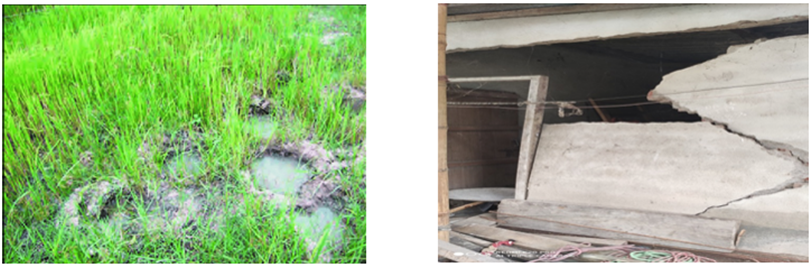
Man-elephant conflict is not a new topic in today’s world as it becomes a universal problem due to its frequent occurrence in many parts of the world. The damages and destructions caused by wild elephants is real and significant danger to human life as well as their properties. Most of the elephants often venture into villages during night time in the search of food, water and living space. The herd of wild elephants always trigger panic among the local people of Boraligaon village of Nagaon district (Assam) during harvesting season which have remained unaddressed for the people of Assam due to lack of proper communication. Thus, this paper is an attempt to assess the nature of man elephant conflict with its impact in the study area of Boraligaon village. Keeping this in mind, it has been tried to highlight the key issues using primary information as well as secondary collected from various sources. The continuing man-elephant conflict during winter season has taken a serious turn in the study region damaging most of the paddy fields in the time of harvesting which is an outcome of habitat loss and food and water shortage of wild elephants. This conflict may be a never-ending process, but its risk can be lowered down by adopting some scientific and systematic initiatives as well as their proper monitoring in timely.
Man elephant conflict is a serious concern in most of the world’s countries and becomes a universal problem. ‘Each year, man-elephant conflict results in approximately 100 to more than 500 human deaths and damage to 10,000-15,000 houses and 8-10 million hectares of crops, while over 200 elephants die due to human-related activities including poaching for ivory or meat, poisoning, cattle-borne diseases, electrocution and collision with trains’ 1. In simple words, man-elephant conflict refers to the interactions between humans and elephants that often resulting in detrimental impacts for both species. But now question is that why does this conflict occur again and again? What are the main reasons behind this conflict? Basically, national parks, wildlife sanctuaries, safari parks, protected areas are the actual habitat and ideal environmental conditions for elephants which are now very close to or adjoining human settlements in most parts of the world. As a result, whenever this beautiful creature of nature comes into contact with landscapes dominated by human in search of living space and food they pose a great threat to human beings and their properties. ‘But now varieties of management strategies have been developed and are practiced at different scales for preventing and mitigating man-elephant conflict.’ 2.
According to the 2017 census by Project Elephant, India has the largest number of wild Asian elephants, estimated at 29,964 representing about 60 per cent of the species’ global population as India is the home of around 30 notified Elephant Reserves by covering an area of about 69,582.80 km2. But rapidly expansion of human settlements and agricultural fields has resulted in widespread loss of elephant habitat which is progressively forced them to closer contact with people, sparking more frequent and severe human-elephant conflicts over space, resulting in most dangerous effects ranging from crop raiding to reciprocal loss of life. In India, over 500 people and 100 elephants die every year due to conflict with each other, while properties worth millions are damaged 3. ‘Such conflicts affect not only the population of elephant but broaden environment impacts on ecosystem equilibrium and biodiversity conservation also’ 4. As a great threat to biodiversity conservation, the management of this conflict is must by adopting a wide variety of prevention and mitigation approaches.
Conflict between man and elephant is not a new topic for Assam as this greenery land of Northeast India is one of the most important strongholds for the survival of the Asian elephants. According to Synchronized Elephant Population Estimation India 2017, in Assam, elephants are distributed in 36 forest divisions by covering an area of about 15,050 km2 in which elephant density is estimated about 0.38 elephants/km2 by the Assam Forest Department. The elephant population in Assam has increased from 5,246 in 2002 to 5,719 in 2017 by representing around 20% of India’s total wild elephant population and 10-15% of the global Asian elephant population, but now their lives are at risk due to alarming rate of conflict between elephants and people. ‘This conflict has become an annual occurrence which results not only in loss of crops, but also destruction of properties and loss of human lives, and in turn, retaliation against elephants. As a result of the severity of this conflict, most of the people have taken to poisoning and electrocuting elephants in desperate attempts to protect their lives and livelihoods’ 6. Among the Northeastern states, Assam recorded the maximum number of elephant and human life losses during the period of 2014-2019 in which 128 elephants and 332 persons lost their lives as against no deaths of elephants and human beings were recorded in the states of Manipur and Mizoram during the last five years 7. Mushrooming of human population lead illegal and unplanned developmental activities along the elephant corridors, forests and natural habitats which in turn obstructing the free movements of elephants in their habitats and corridors, resulting in come closer to the human settlements in search of food, water and living space.
Most of the conflicts occur in small forest pockets, reserved forests, elephant habitats and corridors. In Assam the districts of Sonitpur, Udalguri, Baksa, Golaghat, Nagaon, Goalpara and Karbi Anglong are the focal points from where most of the conflict related cases have been reported. But within Assam, there are some such kinds of remote areas mainly villages by surrounding some small forest pockets where man-elephant conflicts seem to have spiraled out of control and but yet to come on limelight. Boraligaon is such a medium size village of Nagaon district where man-elephant conflict becomes an annual phenomenon during the harvesting season. Thus, this report is an attempt to study about the nature of man elephant conflict in the area of Boraligaon village with the major causes and its impact on the socio-economic life of the villagers.
The main objective of this report is as follows
• To assess the nature of man elephant conflict with its impact in the study area.
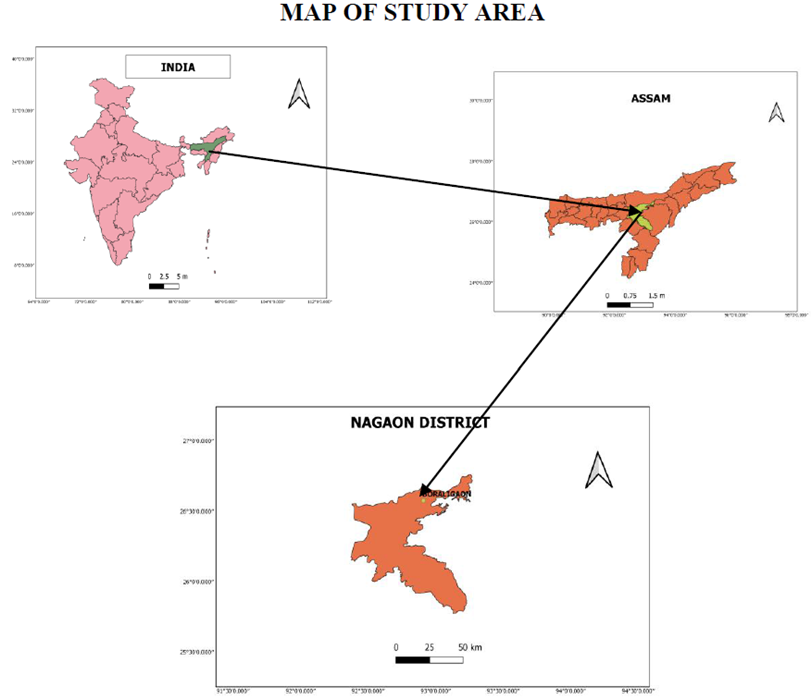
As shown in the Figure 1 Boraligaon village is situated 5 km away from Kaliabor Block and 40 km away from Nagaon district of Assam. This medium size village of Kaliabor circle is bounded to the north by the mighty river Brahmaputra, to the south by Bagser Reserve Forest, to the east by the Kaziranga National park and to the west by Kolong River. Its total geographical area is about 96.85 hectares. The latitudinal extension is 26°31'23.74" N and longitudinal extension is 92°57´13.55" E. With 171 families the total population of Boraligaon village is 879 out of which 440 are males and 439 are females (according to Census, 2011). Along with the tropical vegetation deciduous forest and shrubs are also found in the study region.
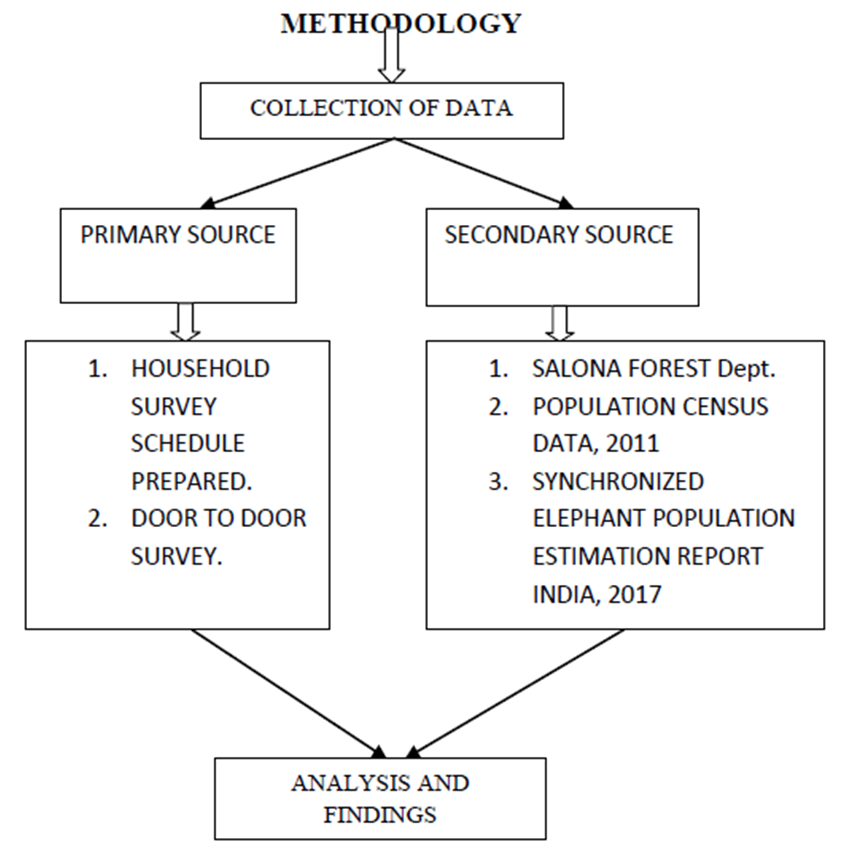
The data necessary for this study have been obtained from both primary and secondary sources. For the purpose of collecting primary data out of 171 a total of 51 households have been randomly selected as sample households in the study area. A relevant household survey schedule has also been prepared for the collection of data from the sample households. To attain the objective of the study, data of last five years (2015-2019) related with man-elephant conflict including number of elephants death, human deaths, amount of crop damaged are collected from Office of the Forest Department Northern Range, Salona, Nagaon, Assam. In case of secondary sources along with Population Census data of 2011 and Synchronized Elephant Population Estimation Report India 2017, various published newspapers’ reports including The Sentinel, The Economic Times, journals, magazines and books are consulted to draw the conclusion.
The data collected through door to door survey and from the Office of the Forest Department Northern Range, Salona are tabulated and analyzed. The results of the analysis are graphically presented by cartogram including bar diagram.
The village Boraligaon is occupied by most of the people of Adivasi community of Assam, constituting about 17.01% of the total population in the study area as per 2011 Census. Though some of the villagers’ main occupation is agriculture but most of them are engaged in agriculture and nearby Tea Estates including Sakmuthi, Hatigaon, Kellyden, Amluckie etc. as a labourer and daily wage earner. During harvesting season, man-elephant conflict is on the rise for which villagers spend sleepless nights in the threat of jumbo. A large herd of wild elephants’ entry in to the paddy field during winter season become a hazardous phenomenon in this region, resulting in damage to crop yields, destruction of the houses and even a death in the family. They usually come from neighbouring Burhapahar hill and Bagser Reserve Forest in search of food and water. Now, the continuing man-elephant conflict during winter has taken a serious turn in the study region damaging most of the paddy fields in the time of harvesting.
5.2. Causes of Man-elephant Conflict in the Study AreaIt is obvious that mushrooming of human population, continuous destruction of green cover in order to meet the demands of needs, scarcity of food, water and living space in the forests and blockage of elephant corridors due to various anthropogenic developmental activities are main driving forces for triggering man-elephant conflict in most of the regions. For this purpose, the following reasons are mainly responsible behind the conflict in the study area:
• During rainy season deadly monsoon floods have ravaged Assam’s national parks, wildlife sanctuaries, reserve forests and protected areas in which highlands serve as a refuge for the wildlife that migrates from the jungles. So, in the race of living space competition they move towards highlands instead of plain areas. As the study region is a plain terrain, elephants frequently visit its paddy fields during harvesting season in search of food and if they are not find anything there or human tries to drive away them, they start to create panic situation in the human habitats.
• Besides, Elephants often come to the village site’s water bodies including ponds, beels in search of water as most of the existing elephant habitats’ water sources dry up during winter season.
• Along with banana trees, elephant apples and grasses, elephants are very fond of homemade rice beer. The villagers of Boraligaon are prepared this liquid at their homes. As rice beer is a common thing in the Adivasi community of Assam, without which no socio-cultural functions can be performed at all. Now, some villagers make country liquor for commercial purposes in the study area. Thus, the smell of this homemade rice beer invites the elephants in to the human habitats; consequently, they demolish the houses in search of this liquor.
• The Boraligaon village is enclosed by forest cover on its two sides which has been gradually being cleared for various purposes including settlements, forest products and most importantly establishment of small tea gardens by the villagers. By encroaching the forest covers growing of tea gardens contribute a lot towards fuelling the conflict between man and elephant.
• Moreover, following various unscientific methods to drive away elephants is one of the major causes of increasing man-elephant conflict in the area of Boraligaon. When a herd of elephants comes to the agricultural fields and neighbouring water bodies, villagers feel threatened and adopt various unscientific methods including throwing of stones and firecrackers, shouting from different places, beating drums, firing and bursting firecrackers etc. to scare away them resulting in conflict between the two.
5.3. Impact of Man-elephant Conflict in the Study AreaThe total number of incidences that took place during conflict between man and elephant in the study region since 2015 is highlighted in the Table 1.
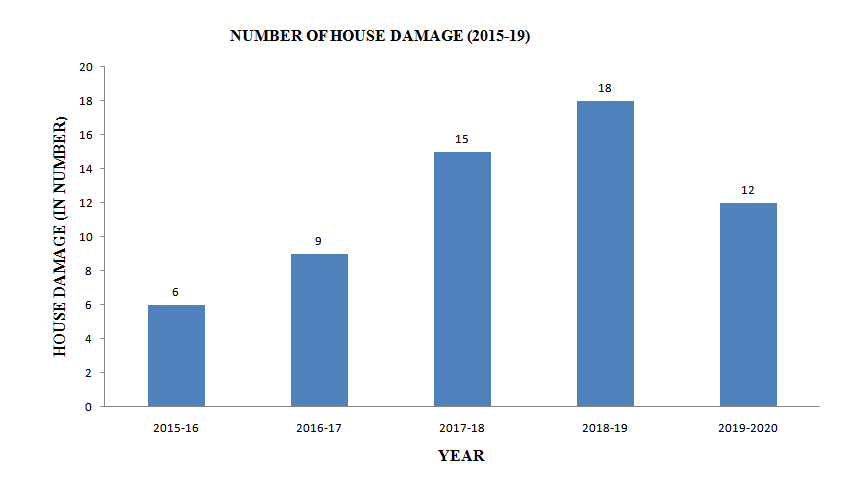
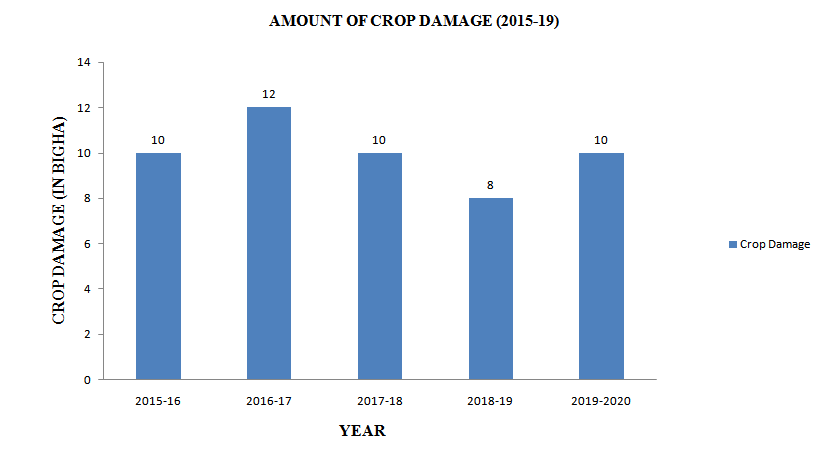
From the Figure 3 and Figure 4 it is cleared that, the intensity of man-elephant conflict is increasing day by day, resulting in 60 houses and 50 bighas of crop field were damaged during last five years. Though no elephant deaths occurred in the conflict during the period of 2015-19, but a total of 4 villagers were injured out of which 1 lost his lives.


If the Office of the Forest Department Northern Range, Salona will take the following measures in proper and systematic way then it is possible to minimize the conflict to some extent in the study area in near future.
• Electrocution in the boundary of Paddy field and household.
• Formation of Anti-Depredation Squad Committee.
• Organizing various awareness programme.
• Distribution of crackers, torch lights, diesel and kerosene oil etc. among the villagers to chase
According to sources, the officials of the Salona Forest dept. have been trying to push back the herd through blank fire but they have failed so far. According to sources, the forest officials are relentlessly trying, but due to lack of sufficient man-power and equipment they are unable to provide security to the villagers from wild elephants.
However, as shown in the Table 2 the Office of the Forest Department Northern Range, Salona has been providing the following aids among the victims in the study area.
The man-elephant conflict is going to be a never-ending process due to the rapidly loss of elephants’ habitat as well as increasing anthropogenic developmental activities across the elephants’ corridors. Though in such conditions no formula is going to work properly but protection measures need to be strengthened strictly. The Office of the Forest Department Northern Range, Salona has already taken some initiatives for minimizing the risk of conflict in the study region but due to lack of proper awareness programme and implementation, all of the efforts go in vain. As a result of which the villagers have been gradually losing their resources one by one by spending sleepless nights during harvesting period.
Author wants to thank Bharati Biswas, a resident of Boraligaon, for assistance with data gathering and household survey that greatly improved the manuscript.
| [1] | Kar A. and et al. (2016). Indian Journal of Research. Loss Due to Man Elephant Conflict in Assam: A Peliminary Study. Volume 5. Issue 2. pp. 188-190. | ||
| In article | |||
| [2] | Shaffer L. Jen and et al. (2019). Frontiers in Ecology and Evolution: Conservation and Restoration Ecology. Human-Elephant Conflict: A Review of Current Management Strategies and Future Directions. | ||
| In article | View Article | ||
| [3] | 500 people, 100 elephants die due to man-animal conflict: Govt. data, 11th August, 2020. www.newindianexpress.com | ||
| In article | |||
| [4] | Bhattacharya Anindita and et al. (2017). An International journal of Environment and Bio-diversity. People perception on human-elephant conflict around Laokhowa Wildlife Sanctuary of Assam, India. Volume-8. No. 4. pp. 555-559. | ||
| In article | |||
| [5] | Elephants killed 761 in Assam since 2010 https://www.deccanherald.com/national/elephant-kills-761-assam-2010-717176.html. | ||
| In article | |||
| [6] | Zimmermann Alexandra and et al. (2009). Community-Based Human-Elephant Conflict Management in Assam. pp.- 34-40. | ||
| In article | |||
| [7] | Northeast Man-Animal Conflict. Centre Says Over 300 People, 149 Elephants Killed Since 2014: A Report published in https://thewire.in/environment/northeast-elephant-deaths-assam. | ||
| In article | |||
| [8] | Bhattacharjee Sujayita (2012). International Journal of Scientific and Research Publications. The Scenario of Man-Elephant Conflict in Hoollongapar Gibbon Wildlife Sanctuary of Assam, India. Volume 2. Issue 8. pp. 1-3. | ||
| In article | |||
| [9] | Borah Jimmy and et al. (2005). ZOOS’ PRINT. Man-Elephant Conflict Problem: A Case Study. Volume XX. Number 7. pp. 22-24. | ||
| In article | |||
| [10] | Human-elephant Conflict Escalates at Numaligarh-Morangi Area in Golaghat. www.sentinelassam.com 2019-09-18. | ||
| In article | |||
| [11] | Man-Elephant Conflict: Locals Spend Sleepless Night in Samuguri. www.sentinelassam.com 2019-09-12. | ||
| In article | |||
| [12] | Messmer Terry A. (2009). Human-Wildlife Conflicts 3(1). Human-Wildlife Conflicts: Emerging Challenges and Opportunities. pp. 10-17. | ||
| In article | |||
| [13] | Deka Kaushik (2018). A report published in India Today, August 14, 2018. Dwindling forest area, poaching endanger elephants in Assam. | ||
| In article | |||
| [14] | Choudhury Krishnakhi (2018). International Research Journal of Social Sciences. Impact of Liquor in Tribal Community- Boko, Assam. Volume- 7(3). pp. 39-45. | ||
| In article | |||
| [15] | Man-Elephant Conflict: Forest Degradation, Unplanned Mining of Natural Resources to Blame https://www.sentinelassam.com/top- headlines/man-elephant-conflict-forest-degradation-unplanned- mining-of-natural-resources-to-blame/#. | ||
| In article | |||
| [16] | Choudhury Dr. Anwaruddin. Green Heritage: A Nature Activist Group for the Conservation of Nature and Wildlife in North-East India. Human-wildlife conflict in Assam: From bad to worse. | ||
| In article | |||
Published with license by Science and Education Publishing, Copyright © 2021 Niha Dutta
 This work is licensed under a Creative Commons Attribution 4.0 International License. To view a copy of this license, visit
http://creativecommons.org/licenses/by/4.0/
This work is licensed under a Creative Commons Attribution 4.0 International License. To view a copy of this license, visit
http://creativecommons.org/licenses/by/4.0/
| [1] | Kar A. and et al. (2016). Indian Journal of Research. Loss Due to Man Elephant Conflict in Assam: A Peliminary Study. Volume 5. Issue 2. pp. 188-190. | ||
| In article | |||
| [2] | Shaffer L. Jen and et al. (2019). Frontiers in Ecology and Evolution: Conservation and Restoration Ecology. Human-Elephant Conflict: A Review of Current Management Strategies and Future Directions. | ||
| In article | View Article | ||
| [3] | 500 people, 100 elephants die due to man-animal conflict: Govt. data, 11th August, 2020. www.newindianexpress.com | ||
| In article | |||
| [4] | Bhattacharya Anindita and et al. (2017). An International journal of Environment and Bio-diversity. People perception on human-elephant conflict around Laokhowa Wildlife Sanctuary of Assam, India. Volume-8. No. 4. pp. 555-559. | ||
| In article | |||
| [5] | Elephants killed 761 in Assam since 2010 https://www.deccanherald.com/national/elephant-kills-761-assam-2010-717176.html. | ||
| In article | |||
| [6] | Zimmermann Alexandra and et al. (2009). Community-Based Human-Elephant Conflict Management in Assam. pp.- 34-40. | ||
| In article | |||
| [7] | Northeast Man-Animal Conflict. Centre Says Over 300 People, 149 Elephants Killed Since 2014: A Report published in https://thewire.in/environment/northeast-elephant-deaths-assam. | ||
| In article | |||
| [8] | Bhattacharjee Sujayita (2012). International Journal of Scientific and Research Publications. The Scenario of Man-Elephant Conflict in Hoollongapar Gibbon Wildlife Sanctuary of Assam, India. Volume 2. Issue 8. pp. 1-3. | ||
| In article | |||
| [9] | Borah Jimmy and et al. (2005). ZOOS’ PRINT. Man-Elephant Conflict Problem: A Case Study. Volume XX. Number 7. pp. 22-24. | ||
| In article | |||
| [10] | Human-elephant Conflict Escalates at Numaligarh-Morangi Area in Golaghat. www.sentinelassam.com 2019-09-18. | ||
| In article | |||
| [11] | Man-Elephant Conflict: Locals Spend Sleepless Night in Samuguri. www.sentinelassam.com 2019-09-12. | ||
| In article | |||
| [12] | Messmer Terry A. (2009). Human-Wildlife Conflicts 3(1). Human-Wildlife Conflicts: Emerging Challenges and Opportunities. pp. 10-17. | ||
| In article | |||
| [13] | Deka Kaushik (2018). A report published in India Today, August 14, 2018. Dwindling forest area, poaching endanger elephants in Assam. | ||
| In article | |||
| [14] | Choudhury Krishnakhi (2018). International Research Journal of Social Sciences. Impact of Liquor in Tribal Community- Boko, Assam. Volume- 7(3). pp. 39-45. | ||
| In article | |||
| [15] | Man-Elephant Conflict: Forest Degradation, Unplanned Mining of Natural Resources to Blame https://www.sentinelassam.com/top- headlines/man-elephant-conflict-forest-degradation-unplanned- mining-of-natural-resources-to-blame/#. | ||
| In article | |||
| [16] | Choudhury Dr. Anwaruddin. Green Heritage: A Nature Activist Group for the Conservation of Nature and Wildlife in North-East India. Human-wildlife conflict in Assam: From bad to worse. | ||
| In article | |||