Road networks is a key ingredient to economic Growth and development. The present research, study and detect the changes in land use and land cover at a micro level. In this study, the dynamic change of land use and land cover has been studied by using a GIS based technique Landsat imagery captured before road widening (2011) and road widening (2018). Road widening has led to the drastic change of land use and land cover at Nongpoh by the introduction of new land use class and change in the area of land use pattern.
Widening of roads and construction of new roads are no doubt a blessing to the society. Several studies have found that greater land-use change takes place in proximity to the highway where, built-up land expansion that covered farmland, forest and water bodies was a major component of land-use change in the highway-effect zone.
Road widening in any areas especially in a town will not be possible without demolition of structures, land acquisition, loss of agricultural land, etc. which in turn changes the land use and land cover. The NH 40 at Nongpoh town is the best area to study the recent changes in land use and land cover in the state of Meghalaya due to the recent widening of the road.
The major objective of this research is to assess and detect the extent of land use and land cover change due to road widening.
For assessing and detecting the land use and land cover change due to road widening, the highway-effect zone was extended over 1 km width and 5 km length. A GIS technique has been used for mapping the changes of land before the highway expansion (2011),) and after the expansion (2018). In order to achieve this objective, digitization of the changes has been carried out by using Google Earth Imagery or Landsat satellite images and save it in .kmz file, which later input it in Arc GIS software 10.3 version for final mapping and assessing.
The land use land cover mapping has been carried through visual interpretation or on screen interpretation. Though it really takes time but this is the best way to get accurate land use and land cover categories for a small area. The land use land cover category has been adopted from NESAC and MBDA land use land cover classes.
The data that I have used in this research is basically data collected from Landsat satellite imagery of before road widening (2011) and after road widening (2018). Collection of data and ground truthing by using GPS instrument has also been used.
Nongpoh town is located in the northern part of Ri Bhoi district Meghalaya. It is an area dominated by the Shillong group of rocks granite intrusive rocks. It is located at an area extending from 25° 15’00” N to 25° 54’ 45” N latitude and from 91° 50’ 30” E to 91° 53’ 15” E Longitude.
The Widening of the highway at Nongpoh has led to the drastic changes in the land use and land cover. The study has been analyzed by taking in to consideration two respective years i.e. before the road widening 2011 and after the road widening in the year 2018.
7.1. Land Use Land Cover at Nongpoh before Road WideningThe land use and land cover patterns of any area will not change or will slightly change without any interference by human. Nongpoh as an underdeveloped headquarter of the district has several requirements to upgrade itself especially in terms of roads. The NH 40 which passed through Nongpoh town prior to 2011 was very narrow. The narrow road in the mountainous areas like Meghalaya controls the population size to increase from the migration perspective which then controls the land use and land cover change of an area.


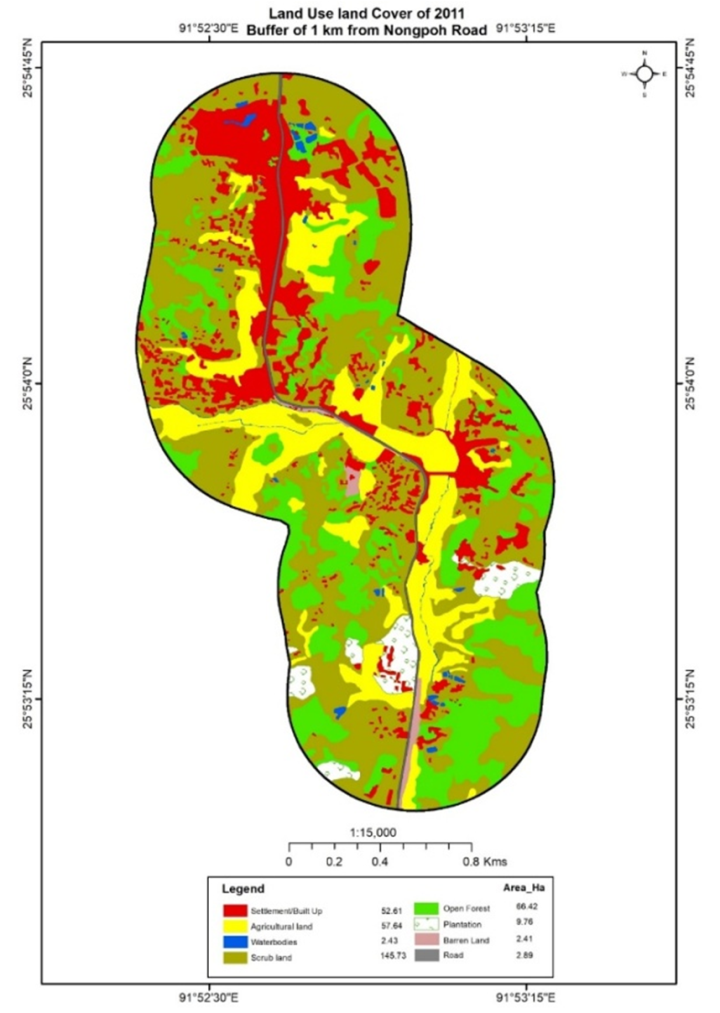
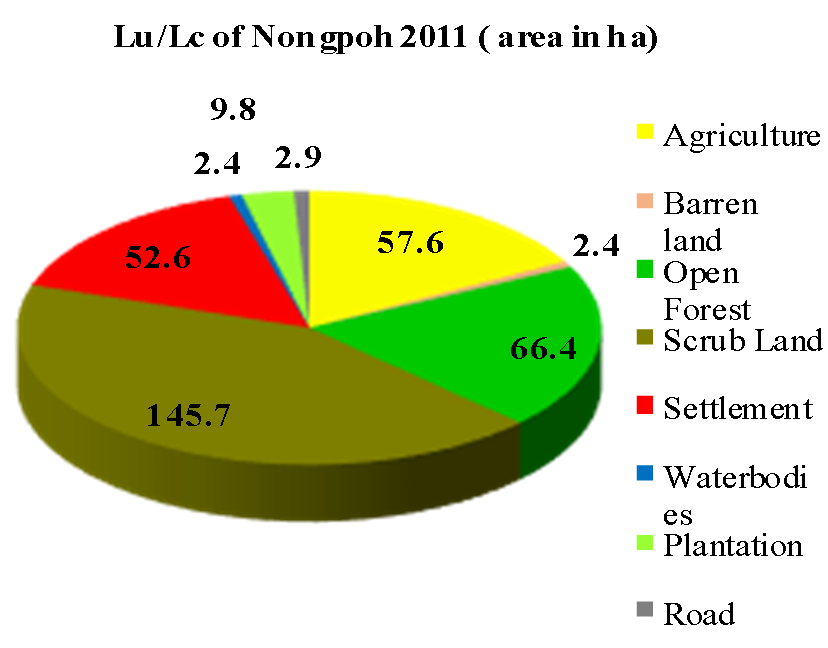
The figures and table given above shows the land use and land cover of Nongpoh town before the bypass construction i, e during the year 2011. A buffer of 1km and a total area of land was 340 ha. The highest occupied land cover was Scrub land (145.7), Open forest (66.4ha), followed by agricultural land (57.6ha), settlements (52.6ha), plantation occupied about 9.8 ha. The least occupied land use and land cover was road 2.9ha, water bodies and barren land of only 2.4 ha each.
Most of the land was covered with scrub in almost all part of the study area and used by agriculture almost all along the road and spread towards the east and the west of the highway. Apart from these two, open forest also dominates most of the area of land which has been found scattered throughout the study area. As a town, the areas are also well distributed by human settlements which can be seen all along the highway and highly concentrated at the main center found in the northern part of the study area. Plantation of pineapples can also be seen in the southern part of the main town far from population centers. Ponds and lakes including fish ponds have been detected in the southern part of the study area with a less area coverage, Barren land with a less area coverage can also be seen in the southern part along the highway. This is mainly because of the disposal of waste and debris from the highway construction sites.
7.2. Land Use and Land Cover of Nongpoh after Road WideningThe widening of the road has led to huge fragmentation of the natural as well as the cultural landscapes which has modified the land use patterns and will also continue modifying in the years to come. A center of attraction in terms of population, markets, administration, etc will probably led to the drastic changes in the land use and land cover in a particular area.
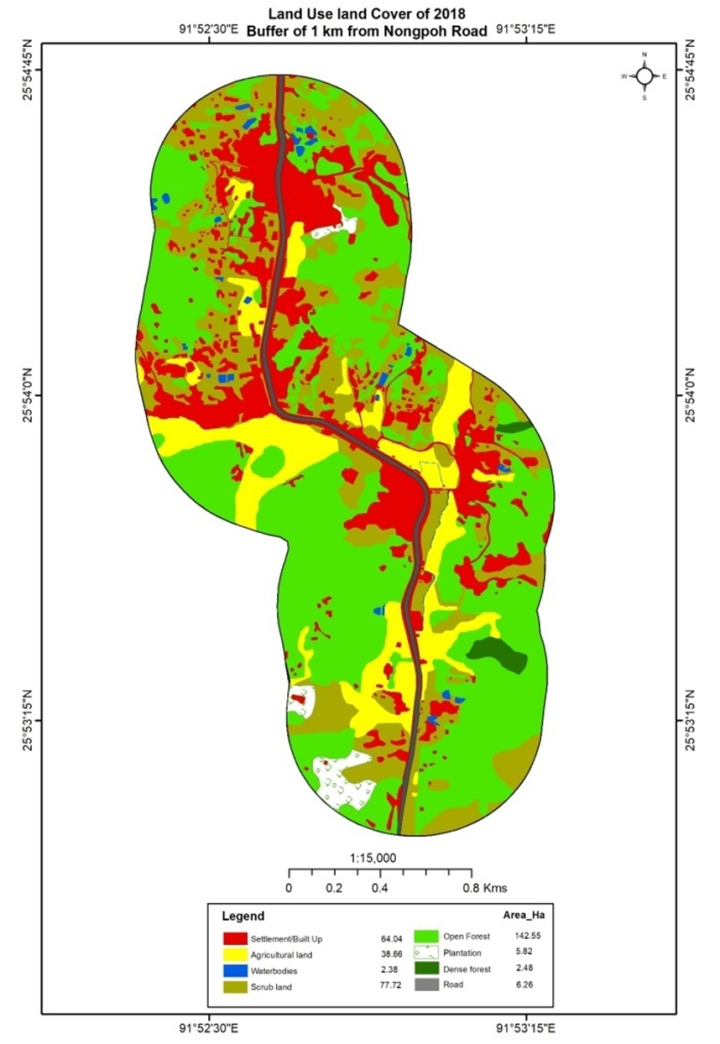
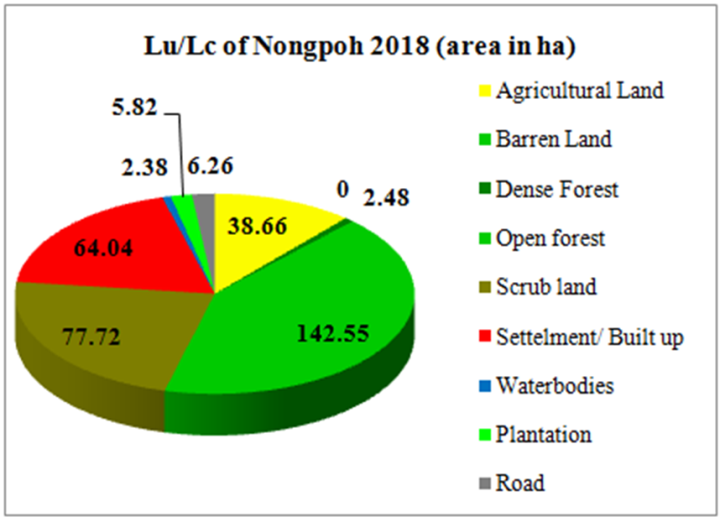
The map and the figure given above shows the land use and land cover of Nongpoh after the widening the highway i,e during the year 2018. A buffer of 1km and a total area of 340 ha was studied. The highest occupied land cover was open forest (142.5 ha), followed by Scrub land (77.7 ha), settlements (64.0 ha), agriculture (38.7ha). The least occupied land use and land cover is plantation (5.8 ha) and dense forest (2.4 ha), water bodies of (2.3 ha), Road (6.2 ha) and barren land (0.0 ha) respectively.


In the year 2018 just after the highway widening it was found that most of the land use and land cover changes gradually. Most of the land was covered with open forests and scrub land. This is because Nongpoh as a headquarter of the District has population who are least engaged in the primary sector of economy which can be justify by the percentage of agricultural land which is of only 38.7 ha which are found scattered away from the residential areas and away from the road, most of the people engaged in the secondary and the tertiary sector, leaving behind most of the land to be occupied with forest and scrub. As a town, the areas are also well distributed by human settlements which occupied about 64.0 ha of land and can be seen all along the highway and away from the highway highly concentrated at the main center found in the northern part of the study area. Settlements increases gradually in terms of area size because of migration from the surrounding areas and other states into the main town just after the widening of the highway. It was found that new buildings and structures have been constructed not only along the highway but also away from the highway. Plantation of pineapples can also be seen in the southern part of the main town far from population centers. Ponds and lakes including fish ponds have been detected in the southern part of the study area with a less area coverage, Barren land disappeared in the year 2018, for road and human settlements occupied its area.
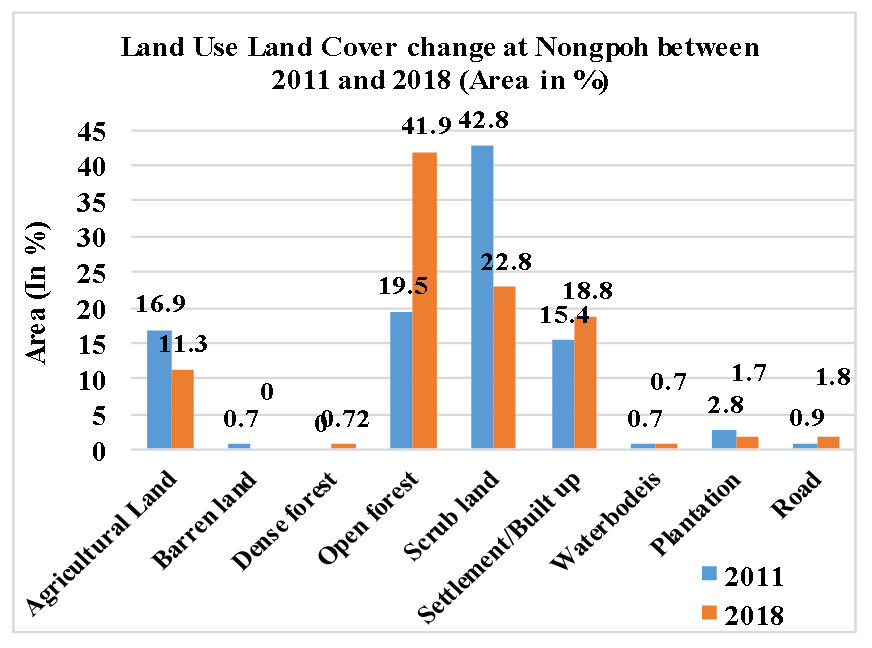
7.3. Change Detection: Comparative StudyThe comparative study has been made by determining the percentage of change and assessing it as follows:

Widening of the highway at Nongpoh town has really modified the land use and land cover in an around the town. There has been a drastic change in terms of agriculture when compared 2011 and 2018. There has been a loss of -5.6 % of agricultural land. Agricultural field has been replaced by settlement and roads. In terms of settlements, It was found that it increase by 3.4%. This is mainly because of migration from the neighboring villages and from other districts of the states mainly for livelihood. It was also found that barren land disappeared for these has been covered by vegetation and occupied by human settlements and roads. Open forest occupied its highest percentage of 22.4% Scrub land has reduced to 20% which is a result of road acquisition and occupied by human settlements.
Land-use land-cover has been extensively modified by the widening of the highway and. Landscape are supposed to be changed and compromise with development. Development is in a continuous process in the study area of Nongpoh which will continue to re-modify the land-use and land-cover in the years to come. Development along with education will change the land use and land cover pattern in a sustainable manner.
Glory be to God who had given me physical and mental strength to complete this paper. First of all I am deeply grateful and would like to express my thankful heart to Prof H.J. Syiemlieh of the Department of Geography North Eastern Hill University, for his help, professionalism, valuable guidance throughout this reviewed paper, for without whom this paper will not be fruitful. I would also like to express my gratitude to my mother who had really inspired me in whatever I do. This paper is dedicated to my father (L). W.B. Kharryngki.
| [1] | Arjun Poudel (2014). ‘Mitigation of road construction induced land degradation effects on livelihoods: A case of rural access programme Nepal’. | ||
| In article | |||
| [2] | Atlas, 2016, Meghalaya Basin Development authority. | ||
| In article | |||
| [3] | Bhakta .G.P, (1995) Geography of Meghalaya, Shillong; Bimal Bawri, India. | ||
| In article | |||
| [4] | Erickson, D.L. 1995. Rural land use and land cover change. Land Use Policy. 12 (3). | ||
| In article | View Article | ||
| [5] | Joseph A. Di Pietro, in Landscape Evolution in the United States, (2013). | ||
| In article | |||
| [6] | Karis L.Day (2001). “Assessing the Impact of highway development on Land Use/Land cover change In Appalachian Ohio” | ||
| In article | |||
| [7] | Kijowska. J, Kijowski, A. (2013), Landscape Changes Caused by the Construction of the Poznan Western Ring road - Selected Problems. Institute of Physical Geography and Environmental Planning, Department of Integrated Geography. pp 153 - 154. | ||
| In article | |||
| [8] | Manju Mohan1, et,al (2011). “Dynamics of Urbanization and Its Impact on Land-Use/Land-Cover: A Case Study of Megacity Delhi “.Journal of Environmental Protection, 2011 | ||
| In article | View Article | ||
| [9] | Morimoto Akinori (2015). “Transportation and Land use” | ||
| In article | |||
| [10] | Skinner, R.E. 2002. “Highway Research for the 21st Century.” Issues in Science and Technology 19:31-35. | ||
| In article | |||
| [11] | Whitelegg. J. (1994). ‘Transport and land take’ A report for CPRE, Eco Logica Ltd. White Cross Lancaster. | ||
| In article | |||
Published with license by Science and Education Publishing, Copyright © 2020 Preciouswell Nongsiej and H.J. Syiemlieh
 This work is licensed under a Creative Commons Attribution 4.0 International License. To view a copy of this license, visit
http://creativecommons.org/licenses/by/4.0/
This work is licensed under a Creative Commons Attribution 4.0 International License. To view a copy of this license, visit
http://creativecommons.org/licenses/by/4.0/
| [1] | Arjun Poudel (2014). ‘Mitigation of road construction induced land degradation effects on livelihoods: A case of rural access programme Nepal’. | ||
| In article | |||
| [2] | Atlas, 2016, Meghalaya Basin Development authority. | ||
| In article | |||
| [3] | Bhakta .G.P, (1995) Geography of Meghalaya, Shillong; Bimal Bawri, India. | ||
| In article | |||
| [4] | Erickson, D.L. 1995. Rural land use and land cover change. Land Use Policy. 12 (3). | ||
| In article | View Article | ||
| [5] | Joseph A. Di Pietro, in Landscape Evolution in the United States, (2013). | ||
| In article | |||
| [6] | Karis L.Day (2001). “Assessing the Impact of highway development on Land Use/Land cover change In Appalachian Ohio” | ||
| In article | |||
| [7] | Kijowska. J, Kijowski, A. (2013), Landscape Changes Caused by the Construction of the Poznan Western Ring road - Selected Problems. Institute of Physical Geography and Environmental Planning, Department of Integrated Geography. pp 153 - 154. | ||
| In article | |||
| [8] | Manju Mohan1, et,al (2011). “Dynamics of Urbanization and Its Impact on Land-Use/Land-Cover: A Case Study of Megacity Delhi “.Journal of Environmental Protection, 2011 | ||
| In article | View Article | ||
| [9] | Morimoto Akinori (2015). “Transportation and Land use” | ||
| In article | |||
| [10] | Skinner, R.E. 2002. “Highway Research for the 21st Century.” Issues in Science and Technology 19:31-35. | ||
| In article | |||
| [11] | Whitelegg. J. (1994). ‘Transport and land take’ A report for CPRE, Eco Logica Ltd. White Cross Lancaster. | ||
| In article | |||