Understanding the spatial and temporal variation of precipitation is important to identify its driving potential of extreme events that impact on the socio-economic conditions at national and provincial scales. This study presents the spatial and temporal variation of precipitation and the related extreme events in provincial scale using 143 rain-gauge stations across Nepal during 2001–2016. The results show the provincial differences in the precipitation distribution, with the highest precipitation in Province 4 (Bagmati) and lowest in Province 6 (Karnali). The precipitation is in decreasing trend at the national and provincial scale, expect for Province 6. The spatial distribution of precipitation shows the wettest (Lumle) and driest (Manang and Mustang) areas of the country located within the same Province 4. The seasonal cycle reveals the longer period of monsoon in Provinces 1 and 4; meanwhile, a shorter monsoon period was observed in Provinces 6 and 7 (Farwestern). Heavy (R10mm) and extreme precipitation (R25mm) events were higher in those provinces with a more extended monsoon period and vice-versa. The result further shows that the number of Consecutive Dry Day (CCD) spells in all the provinces was higher than the number of Consecutive Wet Day (CWD) spells. The time-series of extreme events (R10mm, R25mm, CDD and CWD) show an inter-annual variation in seven provinces during 2001-2016. The spatial variation of the number of wet and dry spells was reversed for the provinces lying in the eastern and western parts of the country. This study helps to update and upgrade our understanding of precipitation variability and related extremities over different provinces of Nepal, which can further assist the provincial government in disaster management.
Precipitation is a fundamental component of the water cycle. The spatial and temporal distribution of precipitation has important implications in the climate system because the changes in precipitation amount and frequency lead to regional as well as global impacts 1, 2, 3. Nepal is a mountainous country in South Asia and is influenced by South Asian Monsoon. Precipitation in Nepal varies spatially due to orography, wind exposure, and direction of the mountain range at the local scale 4, 5. Spatial and temporal changes in precipitation intensity and frequency often lead to extreme events, such as drought, flood, landslides, and debris flow 6, 7. Moreover, variations in precipitation over the country impact the agricultural system and affect the socio-economic development. The mountainous region of the country is an important source of freshwater and susceptible to environmental changes, ultimately affecting the environmental services it provides 8, 9, 10. Thus, the precipitation studies are essential to understand the water source vulnerability, rainfall induced hazards, predict the impact of these events, and identify vulnerable areas in the face of increased climate variability 11, 12. Summer monsoon (June–September) is the primary source of annual precipitation (~80%) in the country, while other seasons (October–May) contribute about 20% in the total precipitation. Both summer and winter monsoons have a significant impact on the agriculture sector of Nepal 13. Raingauge stations provide precise measurement of precipitation on the ground surface.
Many studies have been conducted in Nepal for studying the spatial and temporal variation of precipitation 2, 5, 14, 15 and related extreme events for different time-periods and regions 4, 7, 12, 16, 17, 18, 19, 20. An analysis of summer monsoon precipitation of Nepal using 168 stations between 1956 to 1975, revealed summer monsoon rainfall accounts for 80 to 90% of total annual rainfall across the country 15. Reference 5 analyzed the nature of the precipitation regime across the country based on the shape and magnitude of long-term mean precipitation from 1965 to 1995. A recent study analyzed the changing precipitation over the east-west division of Nepal from 1951 to 2007 and found that mean precipitation has decreased in the western region of Nepal 13. Besides, it has highlighted that increasing extreme precipitation may lead to severe flash floods in Nepal. Analysis of precipitation extremes across the country shows the increasing trend of heavy precipitation events at many of the stations analyzed 12. The spatial distribution of high-intensity precipitation extreme is different from annual and monsoonal distribution 7. The study 7 had also mentioned that lowlands and mountainous areas are exposed to high-intensity precipitation extremes with a higher probability of floods and landslides in these regions. The peak annual and 1-day extreme precipitation occurred between mid-elevation (2,000 and 3,500 m) and lower elevation (<2000 m) areas in the southern foot-hills, respectively with its highest intensity in a central region of the country 4. A basin level study reported the decrease in average annual precipitation over the Koshi basin from 1997 to 2016 at the rate of -20mm/year; meanwhile, extreme events were found to be increasing 21. On the contrary, the precipitation indices showed an increase in precipitation with weaker statistical significance in the same study area from 1975 to 2010 22.
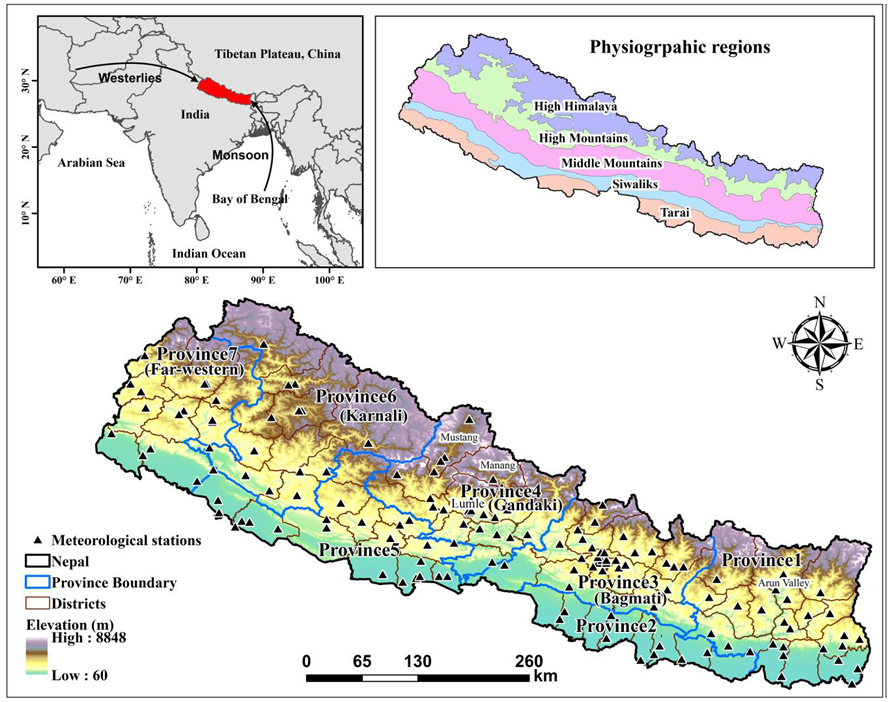
The aforementioned studies over Nepal analyzed the spatial and temporal precipitation, and extremities either focusing on river basin, topographic zones, different regions (western, central and eastern) or previous administrative zones. Recently, the country has been divided into seven different provinces, and each of these provinces differs in topography and climatology (Figure 1 and Table 1). Thus, we aim to analyze the spatial and temporal distribution of precipitation at both national and provincial scales using 143 observed station data during 2001–2016. Moreover, this study has analyzed the spatial and temporal variations of high-intensity related extreme precipitation events over seven different provinces of Nepal. Precipitation evaluation at each province will help to understand the precipitation patterns, trend, as well as the frequency of extreme events. Therefore, understanding the spatial and temporal extreme precipitation events over different provinces is vital for disaster preparedness, decision-makers, and climate scientists, including hydrologists, agriculturalists, emergency managers, and industrialists.
The study area, Nepal extends 885 km east-west and 145–248 km north-south encompassing a land area of 147,181 km2 in the southern slope of the central Himalayas and the northern part of Indo-Gangetic plains. Within a small latitudinal extent, elevation ranges from ~60 m above sea level (asl) in southern lowland (Kechanakal) to Mt. Everest with 8848 m asl in the northern Himalaya. The terrain of the country is dominated by high snow-capped mountain ranges (Himalayas) and hills 5, 17. The country is geographically divided into Tarai (lowland), Siwaliks, Middle Mountains, High Mountains, and High Himalaya from south to north with increasing altitude. Such a steep gradient within a short distance, changes in mountain slopes and landscapes create a heterogeneous distribution of precipitation across the country, which is fundamentally controlled by the summer monsoon system. Four climatological seasons associated with synoptic weather patterns are pre-monsoon (March-May), summer monsoon (JuneSeptember), postmonsoon (OctoberNovember) and winter season (DecemberFebruary) 15.
In 2015, seven provinces were established in the country; the provincial governments are now responsible for the formulation of plans and policies regarding water resource management and disaster risk management (Figure 1; Table 1). The moisture transfer from the Bay of Bengal enters from Province 1 with a modal onset date of 10 June. Among the seven provinces, Province 2 is the smallest covering the eastern lowland areas of the country, whereas province 6 is the largest (Table 1). Provinces 3, 4, 6 and 7 are named as Bagmati, Gandaki, Karnali, and Far-western, respectively while remaining are yet to be named. Hereafter, we have used the Provinces' number for convenience. The summer monsoon enters from the east (Province 1) and advances westwards (Province 6 and 7) while winter precipitation brought by westerlies start from the west (Province 7) and advances eastwards. The influence of these two systems governs the heterogenous climatology of the country.

Daily precipitation time-series data obtained from 326 stations during 2001–2016 were collected from the Department of Hydrology and Meteorology, Government of Nepal (DHM). However, all 326 stations do not feature regular datasets, and therefore, quality control was conducted to discard those stations with a large number of missing datasets. Thus, only those stations were selected which had recorded a minimum of 25 days of daily precipitation in all months during the study period. Additionally, the homogeneity test was performed to test the fluctuations in data series using the RHtest software package. After the quality control, 143 stations were found to be suitable for the current study concerning data availability, and homogeneity with optimum spatial coverage across the country. The selected station ranges from ~60 m to 3870 m elevation. However, rain gauge stations in high elevation areas were sparse due to a remote, rugged topography. The number of stations and annual precipitation varied according to provinces; with the highest number of stations (30) in Province 4 and lowest (10) in Province 2 (Figure 1; Table 1).
2.3. MethodsThe station datasets were separated for different provinces using their geographical locations (Figure 1; Table 1). The mean monthly precipitation datasets were obtained by averaging the daily precipitation at each station during the study period to characterize seasonal behavior over the annual cycle. The kriging linear interpolation method was used to demonstrate the spatial distribution of mean precipitation (mm/day) at national and provincial scales. For provincial scales, only those stations were selected to perform kriging interpolation which belongs to their respective provinces.
Meanwhile, all stations were used for the national scale. The kriging interpolation method is recognized as the most distinctive interpolation method to interpolate the meteorological datasets 24, 25. This method is based on the regionalized variable theory which assumes the statistical surface to be interpolated has a certain degree of continuity, which is also an advanced and sophisticated geostatistical procedure that generates and estimates surface from a scattered set of points 26. In general, kriging forms weights form surrounding measured values to predict values at unmeasured locations 27. For the study of the annual cycle, mean monthly datasets were averaged for each province and additionally averaged for each season (Figure 4 and Table 2).
High intensity related extreme events were computed at each station using daily datasets, R10mm and R25mm days indicators; these indices characterize the magnitude of very intense precipitation events that are responsible for flash floods and landslides. R10mm and R25mm, referred to as heavy and extreme precipitation events are the total number of days in the year when precipitation was ≥10 and < 25mm and, ≥25 mm, respectively. Consecutive dry days (CDD) and consecutive wet days (CWD) describe the 5 consecutive dry and wet days, respectively. For dry and wet days, <1 and ≥1 mm threshold were used, respectively. These indices are an indicator of dryness and wetness, which highlights the importance in the agriculture sectors. 28. Both of these indices were visualized and compared for each station across the country and different provinces. These indices are recommended by the Expert Team on Climate Change Detection, Monitoring and Indices (ETCCDMI), jointly established by the World Meteorological Organization (WMO) Commission for Climatology and the Research Programme on Climate Variability and Predictability 29.
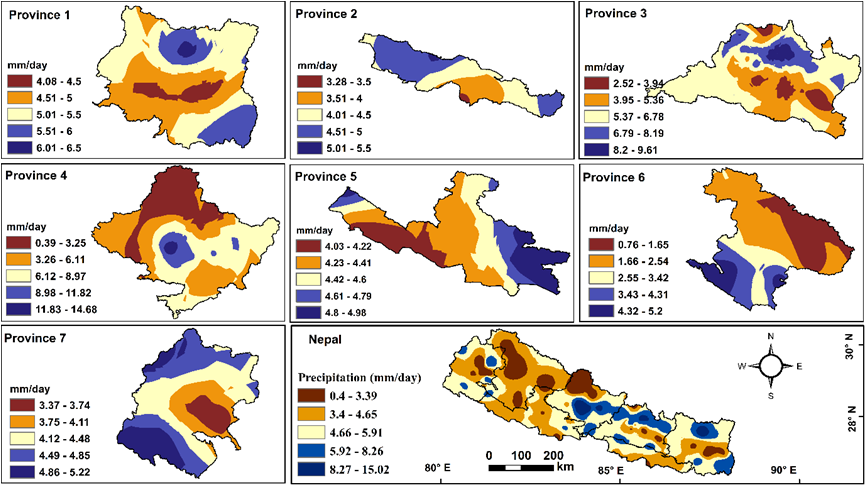
The annual precipitation ranged from 4 to 6.5 mm/day in Province 1 during the study period. Meanwhile, the high rainfall in the range of 5.51–6.5 mm/day occurred in the middle North (Arun Valley region) and South East region of the Province 1. The smallest province, i.e. Province 2, shows the east-west distribution of precipitation in the range of 4.5–5.5 mm/day with a lower amount detected in the middle part of the Province (Figure 2). Similarly, in Province 3, high precipitating areas are located in the high mountains with a range of 6.79–9.61 mm/day. The central and eastern part in the mid-elevation areas of Province 3 (Ramechhap and Kavre districts) receive the lowest precipitation of 2.52–3.42 mm/day. In Province 4, Lumle area in the Kaski region receives the highest amount of rainfall in the range of 11.83–14.68 mm/day, whereas the lowest precipitation occurs in the trans-Himalaya districts: Manang and Mustang (Figure 1) with precipitation of 0.39–3.25 mm/day. However, the annual precipitation in most areas of Province 3 ranged between 0.39 and 8.97 mm/day. The high value of precipitation is observed in the eastern part with decreasing rates towards the western part in the Province 5.
The distribution of the precipitation is low in the high elevation area (0.76-3.42 mm/day), whereas higher in the lower area (3.43–5.2 mm/day) of Province 6. In Province 7, annual precipitation ranged from 3.37 to 5.22 mm/day. The areas with rainfall above 4mm/day are the areas of the upper reaches and lower reaches of Province 7. The spatial distribution of annual precipitation analyzed using all the stations across Nepal shows the regional differences in the precipitation distribution and amount (Figure 2). The regional annual precipitation is higher in the Central region as compared to the Eastern and Western regions of the country during the study period. Comparatively, precipitation is lowest in the northwestern part of the country.
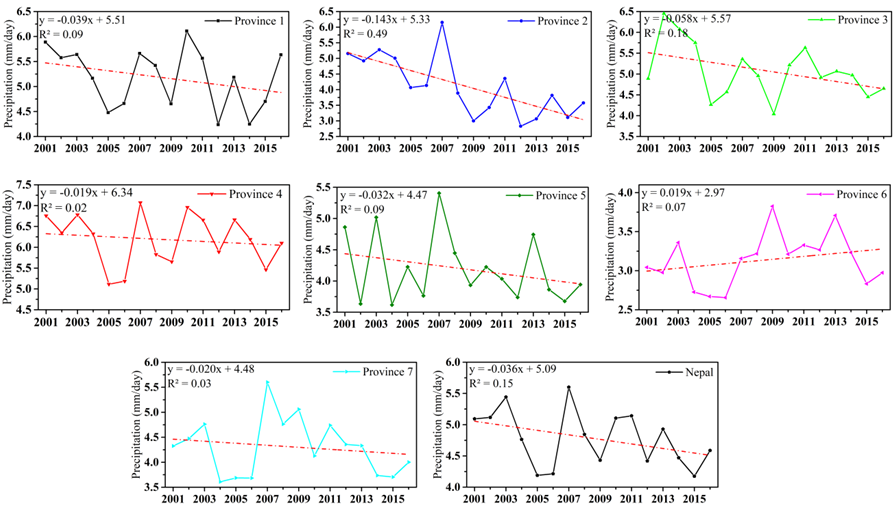
During the study period, all the provinces display a similar pattern of annual precipitation trend, i.e. downward trend except for Province 6 (Figure 3). Province 6, which lies in Western Nepal, has an increasing trend with 0.019 mm/day (R2=0.07). In contrast, Province 2 in Eastern Nepal displayed a higher decreasing trend of precipitation (slope=-0.143 mm/day, R2=0.49), followed by Province 3 (slope=-0.058 mm/day, R2=0.18). Provinces 4 and 7 have almost similar temporal annual trends at a 95% confidence interval (p<0.05); however, the inter-annual precipitation amount is different in both provinces. The result shows that the provinces located in Eastern Nepal have a higher decreasing rate of annual precipitation trends than Western Nepal during 2001–2016. The national precipitation trend is decreasing at the rate of 0.036 mm/day (R2=0.145), as it represents the average trends of all the seven provinces.


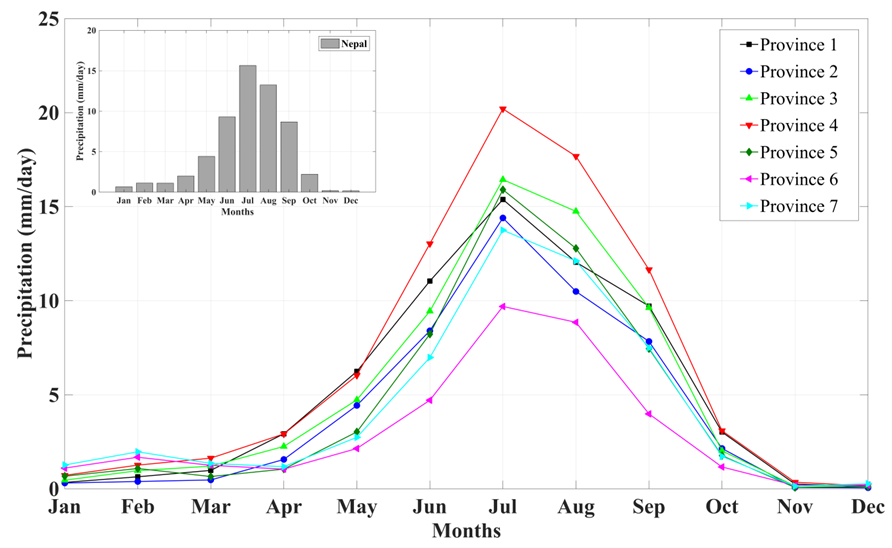
The seasonal cycle of precipitation shows peak during the summer monsoon (June to September), which is also detected in all seven provinces (Figure 4). During this season, precipitation starts to increases from June obtaining peak in July and decreases gradually in August and September. The seasonal cycle shows a longer period of monsoon in Provinces 1 and 4; meanwhile, a shorter monsoon period was observed in Provinces 6 and 7 (Figure 4). Among seven provinces, the mean precipitation in the winter was heavier in the Province 7 (1.62 mm/day) and lowest in Province 2 (0.25 mm/day). Due to the summer monsoon influences, precipitation was found to be drier in Province 6 (6.81 mm/day) and heavier in Province 4 (Table 2). Post-monsoon rainfall in all the provinces ranged between 0.6–1.8 mm/day. As the monsoon starts from the eastern part of Nepal, the pre-monsoon rainfall was found to be higher in the Province 1 as compared to other provinces, except for Province 4. The winter precipitation in Nepal is influenced by westerlies, and consequently, the Far-western Province (Province 7) of Nepal gets higher precipitation. The winter precipitation gradually decreases as westerlies become weak from west to east of the country with the lowest precipitation in Provinces 1 and 2 (Table 2).

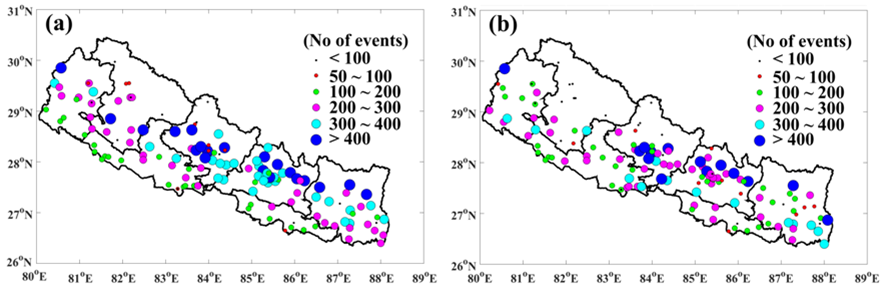
The frequency of total extreme precipitation events of R10mm (precipitation ≥10 and < 25 mm/day) and R25mm (precipitation ≥25 mm/day) at each station over the different Provinces are shown in Figure 5. There are about 100–300 R10mm events in most of the stations (Figure 5a). Provinces 1, 3, and 4 show a higher number of heavy (R10mm) and extreme events (R25mm) in the hilly regions (mid-elevation areas). Further, the result reveals that these events are higher in the northern part than the southern part of the country. The total frequency of heavy precipitation events is higher than the frequency of extreme events across the country (Figure 5a and Figure 5b). It can be noted that Provinces 1, 3 and 4 have a higher occurrence of R25mm events with a maximum of 200–400 events during the study period (Figure 5b). The frequency of these events (R10mm and R25mm) is low in Province 2, followed by Provinces 5, 6 and 7, respectively. The spatial distribution of R25mm events in different provinces shows 100–300 number of events on an average (Figure 5b). Among all provinces, the frequency of extreme events is higher (total events >400) in Province 3 and 4 (Figure 5b). It can be concluded that the frequency of total R10mm and R25mm events have varied over different Provinces. However, both the indices revealed that Provinces 1, 3 and 4 should be taken into higher priority as they have chances to be affected by flood, landslide, and soil erosion. The frequency of heavy and extreme events is higher in the eastern region than the western region of Nepal (Figure 5).


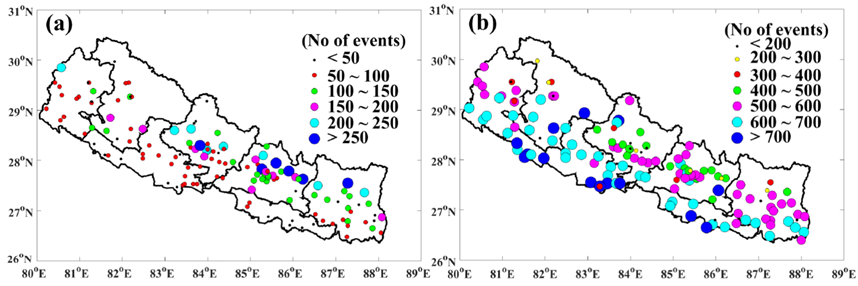
Province wise CWD and CDD spell reveals a heterogeneous spatial distribution (Figure 6). On average, CWD and CDD of each Province are 50–150 and 400–700, respectively. A higher count of CWD spell was found in Provinces 3, 4 and 1 (higher than 150) meanwhile, most of the stations at Province 2, 5, 7 and 8 show the small count (less than 100) (Figure 5a). The lowland Provinces, i.e., Province 2, and Province 5 have higher CDD spells (above 600) whereas, high elevation areas of Provinces 6 and 4 have relatively lower CDD spells (Figure 6b). The result shows that the number of CDD spells was higher as compared to the number of CWD spells.
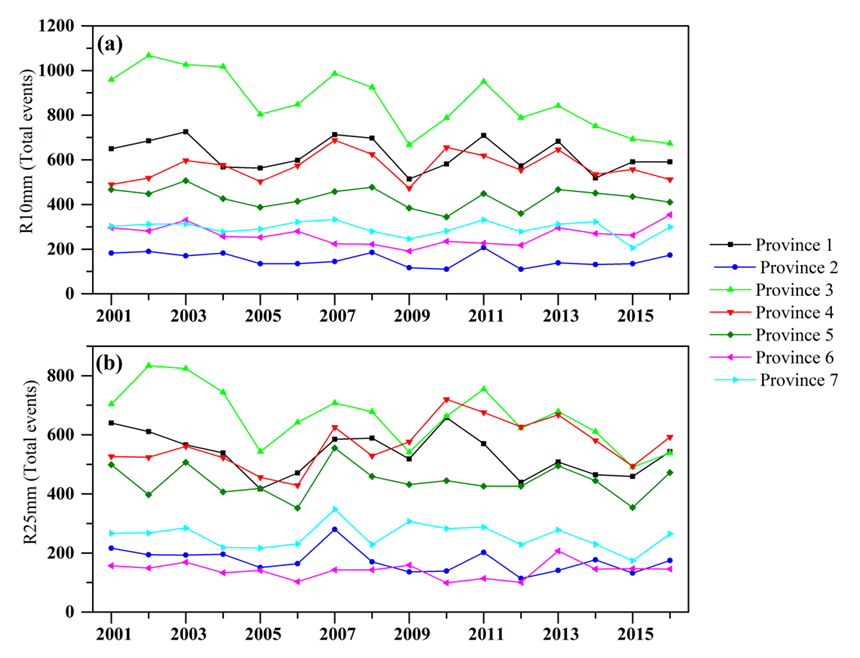
3.4. Temporal Distribution of Extreme Precipitation EventsThe precipitation amount is higher, especially during the summer monsoon season at most of the stations over the country (Figure 4 and Table 2). Figure 7 shows the interannual time-series of heavy and extreme precipitation events in each province during the study period. In Province 3, heavy precipitation events are more than 700; meanwhile, remaining provinces had less than 700 events (Figure 7a). It was noted that only Province 2 had few events of the heavy precipitation during the study period (Figure 7a). The temporal time series of R10mm shows the minimum number of events mainly during 2005, 2009 and 2012 in many of the provinces. Whereas, the years 2003, 2007, 2008, and 2011 shows maximum R10mm events in all provinces.
For extreme precipitation events, all the provinces have higher than 100 events (Figure 7b). Provinces (1, 3, 4, and 5) with higher precipitation and lower precipitation (Provinces 2, 6, and 7) have a similar temporal distribution of heavy and extreme precipitation during the study period. In Province 3, the highest number of both heavy and extreme precipitation events were observed, whereas the lowest number of same events were observed in Province 2 and 6, respectively during the study period (Figure 7b). The highest number of both events (heavy and extreme) was recorded in 2002 in Province 3 (Figure 7). The reduction of extreme precipitation events was found in the years: 2005, 2009, 2012 and 2015 in most of the provinces (Figure 7b).
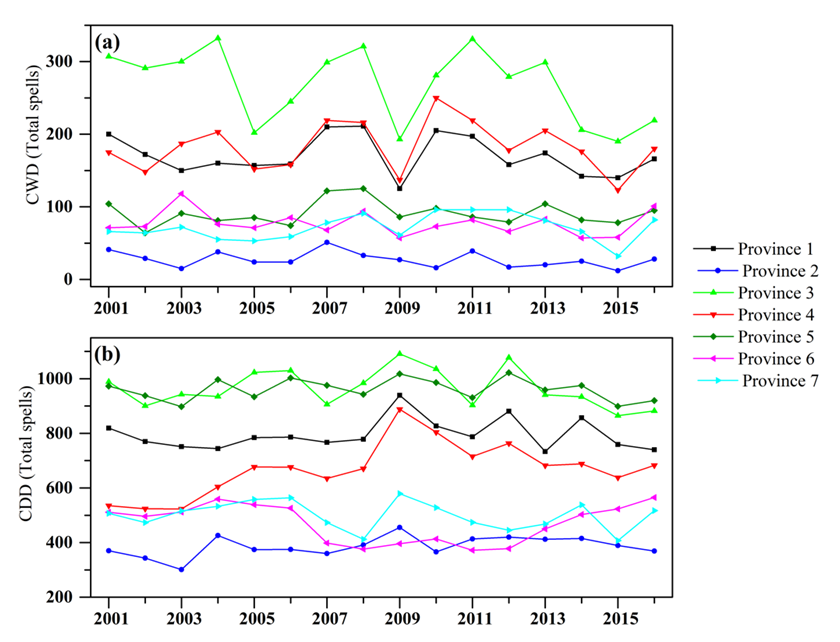
The analysis of both CDD and CWD indices show a similar pattern of temporal variation (increased and decreased of both spells) of these events in all provinces (Figure 8). The results revealed that CDD spells were higher in number than CWD spells. The higher fluctuation of CWD spells was mainly observed in Provinces 3, 4 and 1. The remaining provinces show a similar pattern of the temporal variation. The years 2005, 2009 and 2015 have fewer CWD spells in Provinces 1, 3, and 4. Meanwhile, Provinces (3, 4, and 1) lying in the eastern part of the country has a higher number of wet spells than Provinces (5, 6, and 7) in the western part of the country, except Province 2 with lowest CWD (Figure 8a). However, the same years with the lowest number of CWD spells (2005, 2009 and 2015) shows the opposite pattern for CDD, i.e., high CDD spells. The higher numbers of CWD spell is shown in Province 3 suggesting that this province is the wettest among the other provinces during the study period. Meanwhile, the lowest CWD and CDD spells are found in Province 2 indicating it as the driest province among the others. During the study period, the maximum CDD events are observed in 2009 in most of the Provinces (Figure 8b), indicating that 2009 was a dry year in Nepal. The results show that there are frequent occurrences of the wet (flood) and dry (drought) spells in all the provinces during the study period.


After the initiation of federal governance system from 2015, the country is divided into seven provinces (Figure 1). This study, for the first time, analyzed the spatial and temporal distribution of precipitation over seven different provinces of Nepal during 2001–2016. The average area covered by a single station in Provinces 1, 2, 3, 4, 5, 6, and 7 is ~1036.2, 966.1, 676.7, 896, 928.7, 1865.6, and 1302.6 km2, respectively. The density, distribution, and locations of rain gauge networks in seven Provinces are different while rain gauge stations in the hilly regions are usually located at the river valley (Figure 1), this may not represent the actual spatial distribution of precipitation across the country.
Spatial distribution of precipitation shows the wettest (Lumle) and driest (Manang) areas of the country located in the same Province 4 which is primarily controlled by topographic barriers including localized leeward (rain shadow) and windward side of the mountains 4, 7. East-west progression of the summer monsoon and distribution of mountain ranges results in the heterogeneous distribution of rainfall with the lower precipitation in the higher mountains of Provinces 4, 6 and 7 and higher in the mid-elevation areas of the Provinces 4, 3 and 1.
All the provinces and the national scale shows the decreasing trend of the annual precipitation except Province 6. Furthermore, the results also indicate that the provinces lying in the Eastern region has a higher decreasing trend than Western region. The high number of CDD spell supports this result as reported in the Province 2 of the Eastern region. Reference 13 showed the east-west division of the annual precipitation trends over Nepal. However, our result based on recent time-scale (2001–2016) opposes their finding of decreasing precipitation trend in Western Nepal and an increasing trend in Eastern Nepal during 1951–2007. The significantly increased rainfall extremes are observed over India during boreal summer especially after 1980 30, 31, while an apparent monsoon revival has also observed in the Indian regions during 2000–2014 due to land-ocean temperature gradient resulting increased trend of precipitation 32, 33. Meanwhile, variations in aerosol loading, surface cooling through large-scale circulation and moisture feedbacks may affect rainfall over the Asian monsoon and adjacent regions 34, 35, 36. This might have affected the annual precipitation distribution over Nepal, especially in the Province 5.
The annual cycle of precipitation shows the difference in seasonal precipitation amount in different provinces. The short monsoonal period in Provinces 6, 7 and 2 and relatively longer monsoonal period in Provinces 4, 1, 3, and 5 reveals that the monsoon is stronger in eastern provinces and weaker in the western provinces of the country. In contrast, winter precipitation (westerly weather) is more pronounced in western hills (Provinces 6 and 7). These phenomena are very similar to earlier studies as they show that the monsoon activity decreases from east to west of the country 2, 5.
Spatial distribution of extreme precipitation suggests that heavy and extreme precipitation is more intense in mid-elevation areas of Provinces 1, 3 and 4 suggesting there is an increasing possibility of landslides and floods in these provinces directly affecting the lowland areas. Though Province 2 was found drier among others, the high occurrence of floods in this Province is due to higher extreme precipitation in Province 1 and 3 because the rivers in Province 2 share their catchments with the upper Provinces 1 and 3. On the other hand, the extreme events in Province 1 were found in Arun Valley (Figure 5) which may be due to heavy cloud burst in the Valley as moisture transfer from the Bay of Bengal enters through the southern part of Province 1 towards the mountains 12, 37. Previously, Reference 7 evaluated the spatial distribution of extreme precipitation across the country; however, the present study evaluates the interannual variation of precipitation and its extremities based on the total stations at respective provinces. The spatial and temporal distribution of precipitation and its extremities at the provincial scale will be helpful in flood and drought studies and hazard minimization 38, 39, finally benefiting decision-makers in Provincial Government.
Our study presents the spatial and temporal analysis of the precipitation and its extremities at the provincial scale during 2001–2016 from the 143 rain gauge stations across the country. The spatial distribution of annual precipitation showed the highest and lowest precipitation (mm/day) in Province 4 and Province 6, respectively, during the study period. The precipitation trend is decreasing at the rate of 0.036 mm/day (R2=0.07) at a national scale, while provinces located in Eastern Nepal has a higher decreasing precipitation trend than Western Nepal. The seasonal cycle of precipitation showed a peak during the summer monsoon (June to September) in all provinces, which generally starts to increase from June obtaining a peak in July and then decreases gradually in August and September. Furthermore, the seasonal cycle of precipitation shows a longer period of monsoon in Provinces 1 and 4; meanwhile, a shorter monsoon period was observed in Provinces 6 and 7. About 100–400 heavy (R10mm) and 50–300 extreme (R25mm) events were observed in most of the stations across the country. Spatially, the extreme events also vary at provincial scales across the country. Provinces (1, 3, and 4) with longer monsoon period have higher R10mm and R25mm events as compared to other Provinces (6 and 7) with a relatively shorter monsoon period. CWD also follows a similar spatial variation in all the provinces. However, Province 2 and Province 5, located at low elevation, has higher CDD spells (above 600) as compared to Province 6 located at a higher elevation. The results show that the number of CDD spells was higher than the number of CWD spells in all the provinces. The temporal time-series of extreme events (R10mm, R25mm, CDD, and CWD) show an inter-annual variation during 2001–2016. Furthermore, in all provinces, lower extreme events (R10mm, R25mm, and CWD) were observed in 2005, 2009, 2012 and 2015, respectively. Concurrently, these years were also found to have the highest number of CDD. The spatial variation of the number of wet and dry spells was a contrast for the provinces lying in the eastern and western parts of the country. Moreover, the spatial and temporal distribution of precipitation and extreme events differs in all the provinces. Therefore, this study on the spatial and temporal variability of precipitation over different provinces is essential for assisting decision-makers and climate scientists. This kind of study has significant implications for conducting further research at local, regional, and global scales where similar types of topography exist.
Shankar Sharma, Nitesh Khadka and Kalpana Hamal equally contributed to the work with help from others.
The first author is supported by the University of Chinese Academy of Sciences Scholarship. The Department of Hydrology and Meteorology, Government of Nepal, is acknowledged for providing the observed precipitation datasets. This study was jointly supported by the National Natural Science Foundation of China (41871280 and 41471286), the Second Tibetan Plateau Scientific Expedition and Research Program (STEP) (2019QZKK0206), and the 13th five-year Informatization Plan of Chinese Academy of Sciences (XXH13505-06).
| [1] | Smalley, M. and T. L’Ecuyer, A global assessment of the spatial distribution of precipitation occurrence. Journal of Applied Meteorology and Climatology, 2015. 54(11): p. 2179-2197. | ||
| In article | View Article | ||
| [2] | Duncan, J.M., E.M. Biggs, J. Dash, and P.M. Atkinson, Spatio-temporal trends in precipitation and their implications for water resources management in climate-sensitive Nepal. Applied Geography, 2013. 43: p. 138-146. | ||
| In article | View Article | ||
| [3] | Turner, A.G. and H. Annamalai, Climate change and the South Asian summer monsoon. Nature Climate Change, 2012. 2(8): p. 587. | ||
| In article | View Article | ||
| [4] | Talchabhadel, R., R. Karki, B.R. Thapa, M. Maharjan, and B. Parajuli, Spatio‐temporal variability of extreme precipitation in Nepal. International Journal of Climatology, 2018. 38(11): p. 4296-4313. | ||
| In article | View Article | ||
| [5] | Kansakar, S.R., D.M. Hannah, J. Gerrard, and G. Rees, Spatial pattern in the precipitation regime of Nepal. International Journal of Climatology: A Journal of the Royal Meteorological Society, 2004. 24(13): p. 1645-1659. | ||
| In article | View Article | ||
| [6] | Chalise, S. and N. Khanal, Recent extreme weather events in the Nepal Himalayas. The extremes of the extremes: extraordinary floods, 2002. 271: p. 141-146. | ||
| In article | |||
| [7] | Karki, R., U. Schickhoff, T. Scholten, and J. Böhner, Rising precipitation extremes across Nepal. Climate, 2017. 5(1): p. 4. | ||
| In article | View Article | ||
| [8] | Shrestha, A.B., C.P. Wake, J.E. Dibb, and P.A. Mayewski, Precipitation fluctuations in the Nepal Himalaya and its vicinity and relationship with some large scale climatological parameters. International Journal of Climatology: A Journal of the Royal Meteorological Society, 2000. 20(3): p. 317-327. | ||
| In article | View Article | ||
| [9] | Shrestha, A.B. and R. Aryal, Climate change in Nepal and its impact on Himalayan glaciers. Regional Environmental Change, 2011. 11(1): p. 65-77. | ||
| In article | View Article | ||
| [10] | Shrestha, B., Q. Ye, and N. Khadka, Assessment of Ecosystem Services Value Based on Land Use and Land Cover Changes in the Transboundary Karnali River Basin, Central Himalayas. Sustainability, 2019. 11(11): p. 3183. | ||
| In article | View Article | ||
| [11] | Pereira, P., M. Oliva, and E. Baltrenaite, Modelling extreme precipitation in hazardous mountainous areas. Contribution to landscape planning and environmental management. Journal of Environmental Engineering and Landscape Management, 2010. 18(4): p. 329-342. | ||
| In article | View Article | ||
| [12] | Baidya, S.K., M.L. Shrestha, and M.M. Sheikh, Trends in daily climatic extremes of temperature and precipitation in Nepal. Journal of Hydrology and Meteorology, 2008. 5(1): p. 38-51. | ||
| In article | |||
| [13] | Pokharel, B., S.Y.S. Wang, J. Meyer, S. Marahatta, B. Nepal, Y. Chikamoto, and R. Gillies, The east–west division of changing precipitation in Nepal. International Journal of Climatology, 2019. | ||
| In article | View Article | ||
| [14] | Karki, R., R. Talchabhadel, J. Aalto, and S.K. Baidya, New climatic classification of Nepal. Theoretical and applied climatology, 2016. 125(3-4): p. 799-808. | ||
| In article | View Article | ||
| [15] | Nayava, J.L., Rainfall in Nepal. Himalayan Review, 1980. 12: p. 1-18. | ||
| In article | |||
| [16] | Kumar, A., R.A. Houze Jr, K.L. Rasmussen, and C. Peters-Lidard, Simulation of a flash flooding storm at the steep edge of the Himalayas. Journal of Hydrometeorology, 2014. 15(1): p. 212-228. | ||
| In article | View Article | ||
| [17] | Duncan, J.M. and E.M. Biggs, Assessing the accuracy and applied use of satellite-derived precipitation estimates over Nepal. Applied Geography, 2012. 34: p. 626-638. | ||
| In article | View Article | ||
| [18] | Bookhagen, B., Appearance of extreme monsoonal rainfall events and their impact on erosion in the Himalaya. Geomatics, Natural Hazards and Risk, 2010. 1(1): p. 37-50. | ||
| In article | View Article | ||
| [19] | Dahal, R.K. and S. Hasegawa, Representative rainfall thresholds for landslides in the Nepal Himalaya. Geomorphology, 2008. 100(3-4): p. 429-443. | ||
| In article | View Article | ||
| [20] | Klein Tank, A., T. Peterson, D. Quadir, S. Dorji, X. Zou, H. Tang, K. Santhosh, U. Joshi, A. Jaswal, and R. Kolli, Changes in daily temperature and precipitation extremes in central and south Asia. Journal of Geophysical Research: Atmospheres, 2006. 111(D16). | ||
| In article | View Article | ||
| [21] | Subba, S., Y. Ma, and W. Ma, Spatial and temporal analysis of precipitation extremities of Eastern Nepal in the last two decades (1997–2016). Journal of Geophysical Research: Atmospheres, 2019. | ||
| In article | View Article | ||
| [22] | Shrestha, A.B., S.R. Bajracharya, A.R. Sharma, C. Duo, and A. Kulkarni, Observed trends and changes in daily temperature and precipitation extremes over the Koshi river basin 1975–2010. International Journal of Climatology, 2017. 37(2): p. 1066-1083. | ||
| In article | View Article | ||
| [23] | Baniya, B., Q. Tang, Y. Pokhrel, and X. Xu, Vegetation dynamics and ecosystem service values changes at national and provincial scales in Nepal from 2000 to 2017. Environmental Development, 2019. 32: p. 100464. | ||
| In article | View Article | ||
| [24] | Aumond, P., A. Can, V. Mallet, B. De Coensel, C. Ribeiro, D. Botteldooren, and C. Lavandier, Kriging-based spatial interpolation from measurements for sound level mapping in urban areas. The Journal of the Acoustical Society of America, 2018. 143(5): p. 2847-2857. | ||
| In article | View Article PubMed | ||
| [25] | Lam, N.S.-N., Spatial interpolation methods: a review. The American Cartographer, 1983. 10(2): p. 129-150. | ||
| In article | View Article | ||
| [26] | Caruso, C. and F. Quarta, Interpolation methods comparison. Computers & Mathematics with Applications, 1998. 35(12): p. 109-126. | ||
| In article | View Article | ||
| [27] | Apaydin, H., F.K. Sonmez, and Y.E. Yildirim, Spatial interpolation techniques for climate data in the GAP region in Turkey. Climate Research, 2004. 28(1): p. 31-40. | ||
| In article | View Article | ||
| [28] | Casanueva Vicente, A., C. Rodríguez Puebla, M.D. Frías Domínguez, and N. González Reviriego, Variability of extreme precipitation over Europe and its relationships with teleconnection patterns. 2014. | ||
| In article | View Article | ||
| [29] | Data, C., Guidelines on analysis of extremes in a changing climate in support of informed decisions for adaptation. World Meteorological Organization, 2009. | ||
| In article | |||
| [30] | Mukherjee, S., S. Aadhar, D. Stone, and V. Mishra, Increase in extreme precipitation events under anthropogenic warming in India. Weather and climate extremes, 2018. 20: p. 45-53. | ||
| In article | View Article | ||
| [31] | Nikumbh, A.C., A. Chakraborty, and G. Bhat, Recent spatial aggregation tendency of rainfall extremes over India. Scientific reports, 2019. 9(1): p. 1-7. | ||
| In article | View Article PubMed | ||
| [32] | Jin, Q. and C. Wang, A revival of Indian summer monsoon rainfall since 2002. Nature Climate Change, 2017. 7(8): p. 587-594. | ||
| In article | View Article | ||
| [33] | Devika, M.V. and P.A. Pillai, Recent changes in the trend, prominent modes, and the interannual variability of Indian summer monsoon rainfall centered on the early twenty-first century. Theoretical and Applied Climatology, 2019. 139(1-2): p. 815-824. | ||
| In article | View Article | ||
| [34] | George, J., L. Harenduprakash, and M. Mohan, Multi year changes of Aerosol Optical Depth in the monsoon region of the Indian Ocean since 1986 as seen in the AVHRR and TOMS data. Ann Geophys, 2008. 26: p. 7-11. | ||
| In article | View Article | ||
| [35] | Nakajima, T., S.C. Yoon, V. Ramanathan, G.Y. Shi, T. Takemura, A. Higurashi, T. Takamura, K. Aoki, B.J. Sohn, and S.W. Kim, Overview of the Atmospheric Brown Cloud East Asian Regional Experiment 2005 and a study of the aerosol direct radiative forcing in east Asia. Journal of Geophysical Research: Atmospheres, 2007. 112(D24). | ||
| In article | View Article | ||
| [36] | Prasad, A.K. and R.P. Singh, Changes in aerosol parameters during major dust storm events (2001–2005) over the Indo‐Gangetic Plains using AERONET and MODIS data. Journal of Geophysical Research: Atmospheres, 2007. 112(D9). | ||
| In article | View Article | ||
| [37] | Shrestha, M., Interannual variation of summer monsoon rainfall over Nepal and its relation to Southern Oscillation Index. Meteorology and Atmospheric Physics, 2000. 75(1-2): p. 21-28. | ||
| In article | View Article | ||
| [38] | Wang, S.-Y., J.-H. Yoon, R.R. Gillies, and C. Cho, What caused the winter drought in western Nepal during recent years? Journal of Climate, 2013. 26(21): p. 8241-8256. | ||
| In article | View Article | ||
| [39] | Dahal, P., N.S. Shrestha, M.L. Shrestha, N.Y. Krakauer, J. Panthi, S.M. Pradhanang, A. Jha, and T. Lakhankar, Drought risk assessment in central Nepal: temporal and spatial analysis. Natural Hazards, 2016. 80(3): p. 1913-1932. | ||
| In article | View Article | ||
Published with license by Science and Education Publishing, Copyright © 2020 Shankar Sharma, Nitesh Khadka, Kalpana Hamal, Binod Baniya, Nirajan Luintel and Bharat Badayar Joshi
 This work is licensed under a Creative Commons Attribution 4.0 International License. To view a copy of this license, visit
http://creativecommons.org/licenses/by/4.0/
This work is licensed under a Creative Commons Attribution 4.0 International License. To view a copy of this license, visit
http://creativecommons.org/licenses/by/4.0/
| [1] | Smalley, M. and T. L’Ecuyer, A global assessment of the spatial distribution of precipitation occurrence. Journal of Applied Meteorology and Climatology, 2015. 54(11): p. 2179-2197. | ||
| In article | View Article | ||
| [2] | Duncan, J.M., E.M. Biggs, J. Dash, and P.M. Atkinson, Spatio-temporal trends in precipitation and their implications for water resources management in climate-sensitive Nepal. Applied Geography, 2013. 43: p. 138-146. | ||
| In article | View Article | ||
| [3] | Turner, A.G. and H. Annamalai, Climate change and the South Asian summer monsoon. Nature Climate Change, 2012. 2(8): p. 587. | ||
| In article | View Article | ||
| [4] | Talchabhadel, R., R. Karki, B.R. Thapa, M. Maharjan, and B. Parajuli, Spatio‐temporal variability of extreme precipitation in Nepal. International Journal of Climatology, 2018. 38(11): p. 4296-4313. | ||
| In article | View Article | ||
| [5] | Kansakar, S.R., D.M. Hannah, J. Gerrard, and G. Rees, Spatial pattern in the precipitation regime of Nepal. International Journal of Climatology: A Journal of the Royal Meteorological Society, 2004. 24(13): p. 1645-1659. | ||
| In article | View Article | ||
| [6] | Chalise, S. and N. Khanal, Recent extreme weather events in the Nepal Himalayas. The extremes of the extremes: extraordinary floods, 2002. 271: p. 141-146. | ||
| In article | |||
| [7] | Karki, R., U. Schickhoff, T. Scholten, and J. Böhner, Rising precipitation extremes across Nepal. Climate, 2017. 5(1): p. 4. | ||
| In article | View Article | ||
| [8] | Shrestha, A.B., C.P. Wake, J.E. Dibb, and P.A. Mayewski, Precipitation fluctuations in the Nepal Himalaya and its vicinity and relationship with some large scale climatological parameters. International Journal of Climatology: A Journal of the Royal Meteorological Society, 2000. 20(3): p. 317-327. | ||
| In article | View Article | ||
| [9] | Shrestha, A.B. and R. Aryal, Climate change in Nepal and its impact on Himalayan glaciers. Regional Environmental Change, 2011. 11(1): p. 65-77. | ||
| In article | View Article | ||
| [10] | Shrestha, B., Q. Ye, and N. Khadka, Assessment of Ecosystem Services Value Based on Land Use and Land Cover Changes in the Transboundary Karnali River Basin, Central Himalayas. Sustainability, 2019. 11(11): p. 3183. | ||
| In article | View Article | ||
| [11] | Pereira, P., M. Oliva, and E. Baltrenaite, Modelling extreme precipitation in hazardous mountainous areas. Contribution to landscape planning and environmental management. Journal of Environmental Engineering and Landscape Management, 2010. 18(4): p. 329-342. | ||
| In article | View Article | ||
| [12] | Baidya, S.K., M.L. Shrestha, and M.M. Sheikh, Trends in daily climatic extremes of temperature and precipitation in Nepal. Journal of Hydrology and Meteorology, 2008. 5(1): p. 38-51. | ||
| In article | |||
| [13] | Pokharel, B., S.Y.S. Wang, J. Meyer, S. Marahatta, B. Nepal, Y. Chikamoto, and R. Gillies, The east–west division of changing precipitation in Nepal. International Journal of Climatology, 2019. | ||
| In article | View Article | ||
| [14] | Karki, R., R. Talchabhadel, J. Aalto, and S.K. Baidya, New climatic classification of Nepal. Theoretical and applied climatology, 2016. 125(3-4): p. 799-808. | ||
| In article | View Article | ||
| [15] | Nayava, J.L., Rainfall in Nepal. Himalayan Review, 1980. 12: p. 1-18. | ||
| In article | |||
| [16] | Kumar, A., R.A. Houze Jr, K.L. Rasmussen, and C. Peters-Lidard, Simulation of a flash flooding storm at the steep edge of the Himalayas. Journal of Hydrometeorology, 2014. 15(1): p. 212-228. | ||
| In article | View Article | ||
| [17] | Duncan, J.M. and E.M. Biggs, Assessing the accuracy and applied use of satellite-derived precipitation estimates over Nepal. Applied Geography, 2012. 34: p. 626-638. | ||
| In article | View Article | ||
| [18] | Bookhagen, B., Appearance of extreme monsoonal rainfall events and their impact on erosion in the Himalaya. Geomatics, Natural Hazards and Risk, 2010. 1(1): p. 37-50. | ||
| In article | View Article | ||
| [19] | Dahal, R.K. and S. Hasegawa, Representative rainfall thresholds for landslides in the Nepal Himalaya. Geomorphology, 2008. 100(3-4): p. 429-443. | ||
| In article | View Article | ||
| [20] | Klein Tank, A., T. Peterson, D. Quadir, S. Dorji, X. Zou, H. Tang, K. Santhosh, U. Joshi, A. Jaswal, and R. Kolli, Changes in daily temperature and precipitation extremes in central and south Asia. Journal of Geophysical Research: Atmospheres, 2006. 111(D16). | ||
| In article | View Article | ||
| [21] | Subba, S., Y. Ma, and W. Ma, Spatial and temporal analysis of precipitation extremities of Eastern Nepal in the last two decades (1997–2016). Journal of Geophysical Research: Atmospheres, 2019. | ||
| In article | View Article | ||
| [22] | Shrestha, A.B., S.R. Bajracharya, A.R. Sharma, C. Duo, and A. Kulkarni, Observed trends and changes in daily temperature and precipitation extremes over the Koshi river basin 1975–2010. International Journal of Climatology, 2017. 37(2): p. 1066-1083. | ||
| In article | View Article | ||
| [23] | Baniya, B., Q. Tang, Y. Pokhrel, and X. Xu, Vegetation dynamics and ecosystem service values changes at national and provincial scales in Nepal from 2000 to 2017. Environmental Development, 2019. 32: p. 100464. | ||
| In article | View Article | ||
| [24] | Aumond, P., A. Can, V. Mallet, B. De Coensel, C. Ribeiro, D. Botteldooren, and C. Lavandier, Kriging-based spatial interpolation from measurements for sound level mapping in urban areas. The Journal of the Acoustical Society of America, 2018. 143(5): p. 2847-2857. | ||
| In article | View Article PubMed | ||
| [25] | Lam, N.S.-N., Spatial interpolation methods: a review. The American Cartographer, 1983. 10(2): p. 129-150. | ||
| In article | View Article | ||
| [26] | Caruso, C. and F. Quarta, Interpolation methods comparison. Computers & Mathematics with Applications, 1998. 35(12): p. 109-126. | ||
| In article | View Article | ||
| [27] | Apaydin, H., F.K. Sonmez, and Y.E. Yildirim, Spatial interpolation techniques for climate data in the GAP region in Turkey. Climate Research, 2004. 28(1): p. 31-40. | ||
| In article | View Article | ||
| [28] | Casanueva Vicente, A., C. Rodríguez Puebla, M.D. Frías Domínguez, and N. González Reviriego, Variability of extreme precipitation over Europe and its relationships with teleconnection patterns. 2014. | ||
| In article | View Article | ||
| [29] | Data, C., Guidelines on analysis of extremes in a changing climate in support of informed decisions for adaptation. World Meteorological Organization, 2009. | ||
| In article | |||
| [30] | Mukherjee, S., S. Aadhar, D. Stone, and V. Mishra, Increase in extreme precipitation events under anthropogenic warming in India. Weather and climate extremes, 2018. 20: p. 45-53. | ||
| In article | View Article | ||
| [31] | Nikumbh, A.C., A. Chakraborty, and G. Bhat, Recent spatial aggregation tendency of rainfall extremes over India. Scientific reports, 2019. 9(1): p. 1-7. | ||
| In article | View Article PubMed | ||
| [32] | Jin, Q. and C. Wang, A revival of Indian summer monsoon rainfall since 2002. Nature Climate Change, 2017. 7(8): p. 587-594. | ||
| In article | View Article | ||
| [33] | Devika, M.V. and P.A. Pillai, Recent changes in the trend, prominent modes, and the interannual variability of Indian summer monsoon rainfall centered on the early twenty-first century. Theoretical and Applied Climatology, 2019. 139(1-2): p. 815-824. | ||
| In article | View Article | ||
| [34] | George, J., L. Harenduprakash, and M. Mohan, Multi year changes of Aerosol Optical Depth in the monsoon region of the Indian Ocean since 1986 as seen in the AVHRR and TOMS data. Ann Geophys, 2008. 26: p. 7-11. | ||
| In article | View Article | ||
| [35] | Nakajima, T., S.C. Yoon, V. Ramanathan, G.Y. Shi, T. Takemura, A. Higurashi, T. Takamura, K. Aoki, B.J. Sohn, and S.W. Kim, Overview of the Atmospheric Brown Cloud East Asian Regional Experiment 2005 and a study of the aerosol direct radiative forcing in east Asia. Journal of Geophysical Research: Atmospheres, 2007. 112(D24). | ||
| In article | View Article | ||
| [36] | Prasad, A.K. and R.P. Singh, Changes in aerosol parameters during major dust storm events (2001–2005) over the Indo‐Gangetic Plains using AERONET and MODIS data. Journal of Geophysical Research: Atmospheres, 2007. 112(D9). | ||
| In article | View Article | ||
| [37] | Shrestha, M., Interannual variation of summer monsoon rainfall over Nepal and its relation to Southern Oscillation Index. Meteorology and Atmospheric Physics, 2000. 75(1-2): p. 21-28. | ||
| In article | View Article | ||
| [38] | Wang, S.-Y., J.-H. Yoon, R.R. Gillies, and C. Cho, What caused the winter drought in western Nepal during recent years? Journal of Climate, 2013. 26(21): p. 8241-8256. | ||
| In article | View Article | ||
| [39] | Dahal, P., N.S. Shrestha, M.L. Shrestha, N.Y. Krakauer, J. Panthi, S.M. Pradhanang, A. Jha, and T. Lakhankar, Drought risk assessment in central Nepal: temporal and spatial analysis. Natural Hazards, 2016. 80(3): p. 1913-1932. | ||
| In article | View Article | ||