The biodegradation of polyhydroxybutyrate (PHB) and its polymer blend polylactic acid (PLA-PHB) have been extensively studied. The degradation of the polymer has been studied using two different methods. The soil burial degradation test and degradation in liquid media. This study revealed that complete degradation could be achieved on the 90th day. The morphology and structure of the degrading biopolymer was analyzed through scanning electron microscopy (SEM). The microorganisms involved in the degradation have been isolated and identified.
Plastics can be defined as an overall range of synthetic or semi-synthetic materials that can be molded into objects of different shapes. These polymers are composed of carbon, silicon, oxygen, nitrogen and chloride. The most common form of plastics is polyethylene, polypropylene, polystyrene etc. 1. For these polymers the degradation occurs slowly, and its speed depends on the environmental conditions and the composition of the polymers. This longer life cycle causes accumulation of these materials in the environment after disposal, if not recycled. Polyhydroxy butyrate (PHB) has been found to be a viable alternative for the management of these wastes. PHB is similar to polypropylene in its physical properties. It is biodegraded by bacteria into water and carbon-dioxide (and methane under anaerobic conditions) in natural environments including soil, water and compost. PHB was extracted from different freshwater microalgae.
PLA is one of the most environment friendly bioplastic available today. It is made from 100% biobased resources and has multiple end -of – life options (i.e. 100% recyclable and biodegradable) with similar melting temperature and high crystallinity, PHB represents a good candidate to blend with PLA. The ability of PHB to act as a nucleating agent for PLA improves its mechanical resistance and barrier performance.
The majority of synthetic polymers are extremely resistant to microbial attack due to their excessive molecular mass, high number of aromatic rings, unusual bonds or halogen substitutions 2. The extent of polymer degradation in an ecosystem is affected by material processing, the inherent characteristics of the substrate to be degraded and various microbiological and environmental factors. These factors are all interdependent 13. Microorganisms secrete enzyme polyhydroxyalkanoate depolymerases which helps in plastic degradation 1. Plastics can be biodegraded by reducing the polymer chain length by oxidation which may be accessed by microbes. The degradation of the polymers can be indicated by cracking, erosion, discoloration and phase separation 1.
The degradation of PHB and its copolymers are investigated in different natural environments such as soil 3. The microorganisms involved in the degradation have been isolated and identified.
Soil samples were collected from garbage dumped area of Annanagar, Chennai.
Serial Dilution
1. 1 gm of soil was dissolved in 100ml of sterile distilled water.
2. 2ml of the filtrate was added to 100ml of sterile minimal media.
3. 4 different samples of crude PHB obtained from 4 different microalgae were analyzed for its biodegradation.
4. 1gm of PHB was added to these flasks and mixed thoroughly.
5. One set of flasks were incubated in a rotary shaker for 45 days at 120 rpm and at 30°C.
6. The other set were incubated without shaking.
7. For every 15 days, the leftover residual amount of the polymer after incubation was determined using Law and Slepecky Method (1961), after extraction with chloroform and evaporation to dry.
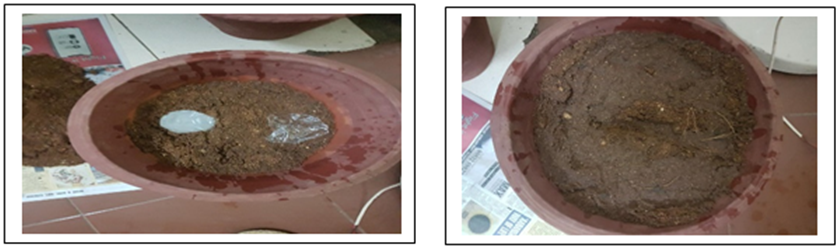
2.2. Soil Burial Degradation TestBiodegradable behavior of bioplastics was determined using soil burial degradation test. The bioplastics were buried in soil so that it would be degraded completely.
Sample Collection
Soils from three different locations
a) Garden soil 1 – with plenty of sunlight and nutrients
b) Garden soil 2 – with less sunlight and nutrients
c) Garden soil 3 – with no sunlight and kept indoors.
• The bioplastic (PLA-PHB) films were buried into the ground at 8cm depth.
• The burial duration lasted for 90 days.
• Prior to burial, the initial mass (mass before degradation) was determined.
• The final mass after degradation of the bioplastics was measured.
 |
Sample Collection
1. 1 gm of the same soil samples was taken.
2. Sterile saline
3. 0.85g of sodium chloride was dissolved in 100ml of sterile distilled water.
4. Nutrient agar medium.
Method
Serial Dilution
1. 1 gm of soil was weighed and suspended in 100ml of sterile saline water.
2. The saline was mixed thoroughly for even distribution of the sample.
3. After mixing, the sample was left undisturbed for few minutes.
4. 1ml of the sample was taken and it was serially diluted from 10-2 to 10-9.
5. 0.1 ml of dilutions 10-4, 10-5, 10-6 were taken and added to the sterile nutrient agar plates in duplicates.
6. The samples were spread plated using L rod.
7. The inoculated plates were kept for incubation at 37°C for 48 hours.
2.4. Differential Staining of Isolated Organisms by Gram Staining MethodA drop of sterile water was placed on the microscopic slide and a suspension of the culture was made with the water. The smear was air dried and heat fixed. Crystal violet was added for 60 seconds and washed with water. Gram’s Iodine was added and washed with water. It was decolourised with acetone and counter stained with safranin for 30 seconds. The slides were washed, dried and observed under the microscope. Gram positive cells appear purple and Gram-negative cells appear pink in colour.
2.5. Identification of the Organisms by Various Biochemical TestsBiochemical identification tests are a standardized colorimetric identification system utilizing conventional biochemical tests and carbohydrate utilization tests. The test is based on the principle of change in pH and substrate utilization. Organisms undergo metabolic changes on incubation which are indicated by a colour change in the media that is either interpreted visually or after addition of a reagent.
1) Catalase Test
The catalase test was performed to detect the presence of catalase enzyme by inoculating a loopful of culture into tubes containing 3% hydrogen peroxide solution. Positive test was indicated by formation of effervescence or appearance of bubbles, due to the breaking down of hydrogen peroxide to oxygen to water.
2) Oxidase Test
The oxidase test was done with the help of a commercially available disc coated with a dye N-tetramethyl paraphenylene diamine dihydrochloride (Himedia) to detect the presence of cytochrome ‘C’ oxidase which is responsible for the oxidation of the dye. Rubbing a small quantity of the isolated bacterial culture on the disc causes the formation of purple colour within 10-30 seconds indicating positive reaction whereas no colour change for negative reaction.
3) Methyl Red Test
Bacteria produce acid by fermentation of glucose, which changes pH of the medium. It falls and is maintained below 4.5. This test detects the production of acids. Positive tests give bright red colour and yellow colour for negative.
4) Voges – Proskauer Test
Fermentation of carbohydrates by several bacteria results in the production of acetyl methyl carbinol (acetoin). In the presence of alkali and atmospheric oxygen, acetoin is oxidized to diacetyl which reacts with peptone of the broth to give a red colour. A positive reaction is indicated by the development of pink colour in 2-5 minutes.
5) Indole Test
If bacteria possess enzyme tryptophanase, they degrade aminoacid tryptophan to indole, pyruvic acid and ammonia.
 |
Pink / red colour indicates a positive reaction.
6) Citrate Utilization Test
This test is used to study the ability of an organism to utilize citrate present in Simmon’s Media, as a sole source of carbon for growth. Positive result is indicated by the appearance of growth with blue colour and negative shows no growth with original green colour.
7) Sugar Fermentation Test
The ability of an organism to ferment various sugars/digest carbohydrates is indicated by the production of acid or gas. Three different sugars like glucose, sucrose and lactose were used. The test organism is inoculated into peptone water broth containing 1% solution of desired sugar. Phenol red was added which is an indicator for acid production. Production of acid is indicated by the change of colour of the medium from red to pink. If gas is produced it collects in Durham’s tube which rises up in the culture tube.
8) Triple Sugar Iron Test
Some organisms degrade Sulphur containing aminoacids to produce hydrogen sulphide. The organism was inoculated in TSI Medium. Production of hydrogen sulphide is indicated by the change of colour of the medium to black or brown.
9) Gelatinase Test
This test detects the ability of an organism to produce proteolytic enzymes using gelatin as substrate. Solidifying of gelatin is a negative result and failure of solidification indicates secretion of gelatinase and hydrolysis of gelatin.
2.6. Identification of Bioplastic Degrading Bacteria by 16S rDNA Based Molecular MethodThe 16S rDNA gene sequence was used to carry out BLAST with the database of NCBI genebank database. Based on maximum identity score first ten sequences were selected and aligned using multiple alignment software program Clustal W. distance matrix was generated and the phylogenetic tree was constructed using MEGA 7.
2.7. Analysis of Biodegradation of Polymer Blends by Scanning Electron Microscope (SEM)SEM Analysis was carried out to understand the size and morphology of the polymer blend before degradation and during the process of biodegradation.
The bacterial isolates were grown as liquid cultures in minimal media with the polymers as the sole carbon source. The residual polymer leftover in the medium after growth was extracted every 15 days using Chloroform technique and was quantitatively estimated by the UV Spectrophotometric method. The results were tabulated. It was found that degradation of the polymer occurred more rapidly when the culture was in constant shaking.
1) Soil Burial Degradation Test
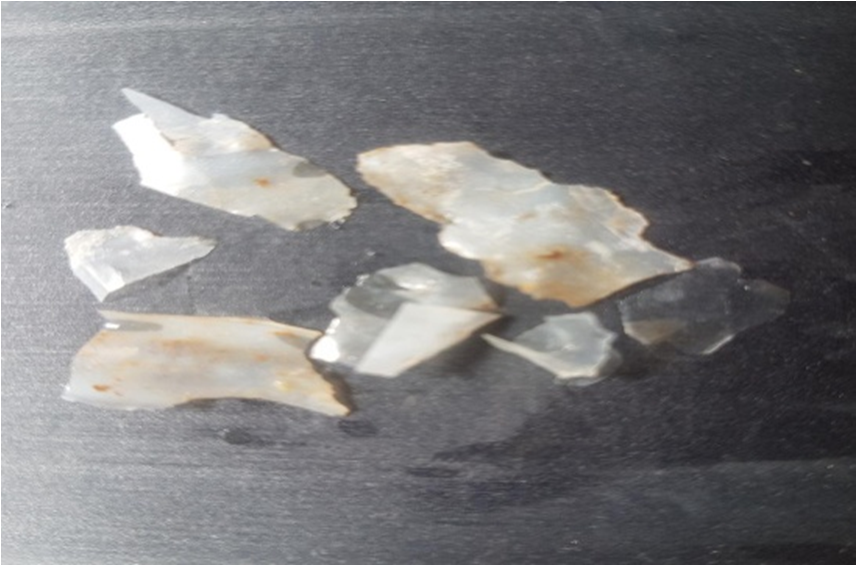
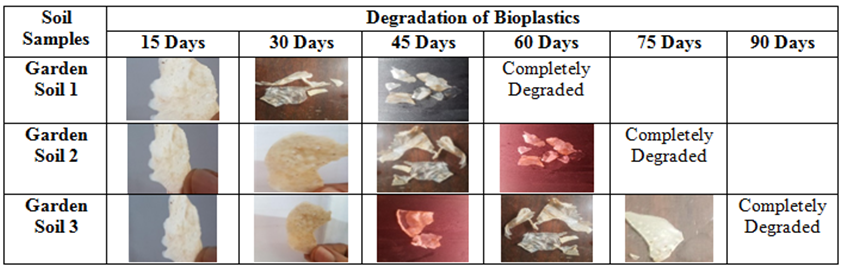
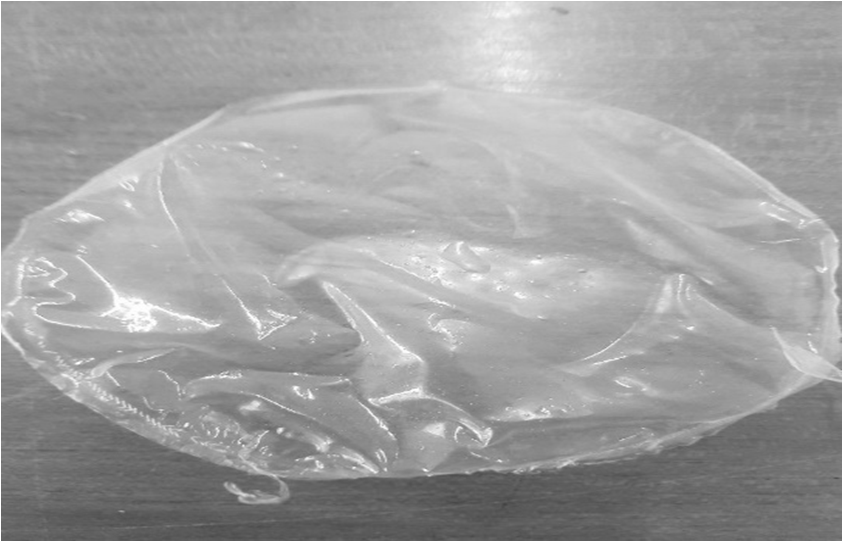
Biodegradability testing was carried out to determine the degradation level of bioplastics in the environment 14 as a parameter of an environmentally friendly material (L.I. Yuniarti et al., 2014). Figure 2 shows the biodegradation of the bioplastics.


From the above results we can interpret that Garden Soil 1 which is rich in nutrients and has sufficient sunlight was able to completely degrade the bioplastic within 60 days.
Garden Soil 2 which is less exposed to sunlight was able to completely degrade the bioplastic within 75 days.
Garden Soil 3 which is not fertile and also not exposed to sunlight took more time to degrade the bioplastic (90 days).
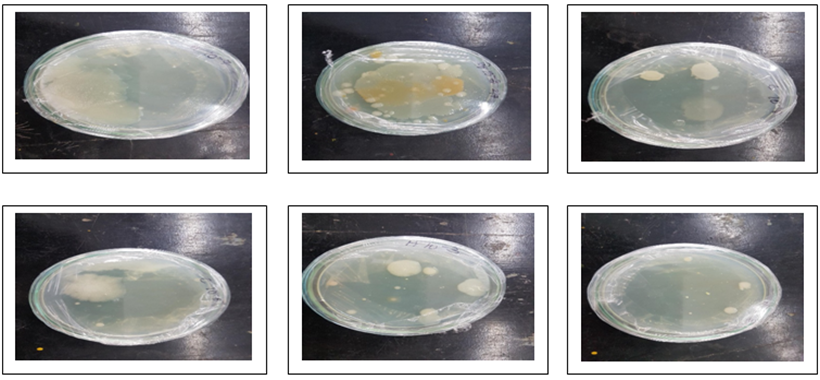
3.2. Isolation of Bioplastic Degrading Bacteria from SoilSamples were collected from 3 different Garden soils for the isolation of bacteria. Diluted samples incubated on the specific plates (i.e. Nutrient agar) produced a variety of bacterial colonies after incubation. Colonies with different morphological appearances were selected.
The colonies which were more in number from the three different soil sample plates were selected for further identification.
3.3. Identification of Bioplastic Degrading Bacteria by 16S rDNA Based Molecular MethodBased on the number of colonies, two organisms were selected for identification based on 16srDNA method.
The organisms identified were
1) Micrococcus aloeverae
2) Pseudomonas aeruginosa.
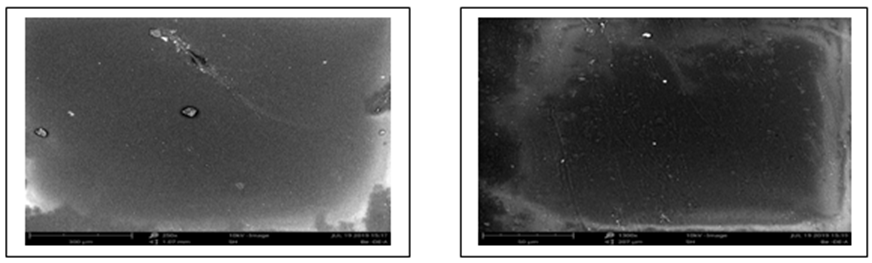
3.4. Analysis of Biodegradation of Polymer Blends by Scanning Electron Microscope (SEM)SEM Analysis was carried out to understand the size and morphology of the polymer blend before degradation and during the process of biodegradation.


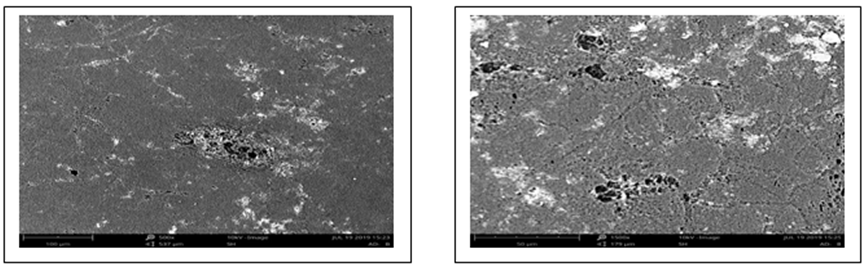
The bioplastics which were buried in soil were observed by SEM, and changes in the bioplastic surfaces were analyzed (Figure 6 & Figure 7). The surfaces were drastically changed confirming the decay of these bioplastics. These results indicate that the structures of the bioplastics were degraded and decayed in the soil environment, though the degradation rates differed among the bioplastics.
The degradation of the polymer can be characterized as a process that results in the breakage of a large and complex molecule into smaller molecules 15. It is also a process of changing in chemical properties or physical properties of the polymer 11. The degradation, loss of functionality of the polymer mainly occurs by the division of the polymer chain and breakage of the structure in the crystalline reticulum 16. The speed of the degradation varies according of crystallinity of the polymer.
Degradation of the polymer in the liquid media occurred more rapidly when the samples were incubated in the rotary shaker at 120rpm in comparison with the samples that were kept still.
The biodegradable behavior of bioplastics were determined using the Soil Burial Degradation Test. Degradation testing serves to determine the extent of damage of bioplastics. The damage can be seen from the mass reduction of respective specimens buried in the ground. The degradation process of bioplastics occurs with the help of the microorganisms present in the environment 6, mechanical degradation (wind and abrasion) and light (photodegradation) 5.
From the above study, we can conclude that Garden Soil 1 which is rich in nutrients and has sufficient sunlight was able to completely degrade the bioplastic within 60 days.
Garden Soil 2 which is less exposed to sunlight was able to completely degrade the bioplastic within75 days.
Garden Soil 3 which is not so fertile and also not exposed to sunlight took more time to degrade the bioplastic (90 days).
Biodegradation of bioplastics can be done by several bacteria found in the soil like etc 12. The degradation level of a compound depends not only on the durability of the molecules, but also the pH, temperature, humidity and oxygen content in the environment 10. The surrounding environment can affect pH, redox potential, presence of suitable microorganisms, availability of adequate nutrition, and concentration of the compound 5.
The biotic degradation loses some of the polymer properties such as: a consequent change in the chemical structure, a significant reduction of average numeric molar mass (Mn), change in the surface roughness, emergence of puncture and craters, structural and mechanical deformations, discoloration or colour change, fragmentation, fragility and formation of biofilm on surface. Biodegradation in different ecosystem is affected by microbiological and environmental factors and material characteristics, being these interdependent.
The degradation rates of bioplastic are propionate to the bacterial biomass in the soil. Many kinds of bioplastic-degrading bacteria might exist in the soil environments, and higher number of bioplastic degrading bacteria seemed to be existed in the soil rich in total bacterial biomass. Since a fertile soil was rich in bacterial biomass; bioplastics seemed to be efficiently degraded in fertile soil environments. Utilization of bioplastics in agricultural fields was expected to increase in the future, thus the influence of bioplastic degradation on material circulation in the agricultural soil should be understood.
| [1] | Mukherjee, S., Chatterjee, H, Int J Curr Microbiol App Sci, 3(5), 318-325. 2014. | ||
| In article | |||
| [2] | Alexander, M., “Biodegradation of chemicals of environmentalconcern,” Science, 211, 132-138. 1981. | ||
| In article | View Article PubMed | ||
| [3] | Doi.Y., Kawaguchi Y., Koyama N., Nakamura S, Hiramitsu M., Yoshida Y and Kimura H “Synthesis and degradation of polyhydroxyalkanoates in Alcaligenes eutrophus.” FEMS Microbiol. Rev. 103: 103-108. 1992 | ||
| In article | View Article | ||
| [4] | Law JH., and Slepecky RA., “Assay of Polyhydroxybutyric acid.” Journal of Bacteriology, 82: 33-36. 1961. | ||
| In article | |||
| [5] | Nathiqoh A.U., Uji Ketahanan., ”Biodegradable plastic Berbasis Tepung Biji Durian (DurioZibethinusmurr) Terhadap Air Dan Pengukuran Densitasnya”, Indonesia., 1-7. 2013. | ||
| In article | |||
| [6] | Lucas, N., Bienaime C., Belloy, M., Queneudec, Silvestre Francoise and Nava-Saucedo Jose Edmundo, “Polymer Biodegradation: Mechanism and estimation techniques-Areview,” Chemosphere, 73(4): 429-442. 2008. | ||
| In article | View Article PubMed | ||
| [7] | Nanang Eko Wahyuningtiyas., Heru Suryanto. “Analysis of Biodegradation of Bioplastics made of cassava starch” Journal of Mechanical Engineering Science and Technology, 1(1), 41-54. 2017. | ||
| In article | View Article | ||
| [8] | Reddy S., Thirumala M., Mahmood S., “Biodegradation of Polyhydroxyalkanoates.” The Internet Journal of Microbiology, 4(2), 1-6. 2007. | ||
| In article | View Article | ||
| [9] | Dinesh Adhikari., Masaki Mukai., Kenzo Kubota., Takamitsu Kai., Nobuyuki Kaneko.,Kiwako S., Araki., Motoki Kubo “Degradation of Bioplastics in Soil and their Degradation effects on Environmental Microorganisms,” Journal of Agricultural Chemistry and Environment, (5)23-34. 2016. | ||
| In article | |||
| [10] | Valeriemassardier., Nageotte, C., Pestre., “Aerobic and anaerobic biodegradability of polymer films and physico-chemical characterization,” Polymer Degradation and stability, 91(3): 620-627. 2006. | ||
| In article | View Article | ||
| [11] | Shah, A.A., Hasan, F., Hameed, A. and Ahmed, S., ”Biological Degradation of Plastics: A comprehensive Review”, Biotechnology Advances, 26, 246-265.2008. | ||
| In article | View Article PubMed | ||
| [12] | Maran J. Prakash., Sivakumar V., Thiugnanasambandham K., and Sridhar R., “Degradation behavior of biocomposites based on cassava starch buried under indoor soil conditions,” Carbohydr. Polym, 101(1)20-28. 2014. | ||
| In article | View Article PubMed | ||
| [13] | Brandl H and Puchner P.,”Biodegradation of plastic bottles made from ‘Biopol’ in an aquatic ecosystem under insitu conditions.” Biodegrade, 2: 237-243.1992. | ||
| In article | View Article | ||
| [14] | Harnist R., and Darni, Y., “Penentuan Kondisi optimum konsentrasi plasticizer pada sinesta plastic biodegrdable berbahan dasar pati sorgum,” in Seminar Nasional Sains dan Teknologi, 2011. | ||
| In article | |||
| [15] | Ghosh, S.K., Pal S., and Ray S., “Study of microbes having potentiality for biodegradation of plastics,” Environmental Science and Pollution Research, 20(7)4339-4355, 2013. | ||
| In article | View Article PubMed | ||
| [16] | Rosa D.S., Chui Q.S.H., Pantano Filho R., and Agnelli J.A.M., “Avaliacao da biodegradacao dc poli-hidroxibutirato em solo compostado.” Polimeros: Ciencia e Technologia, 12(4) 311-317. 2002. | ||
| In article | View Article | ||
Published with license by Science and Education Publishing, Copyright © 2019 Rebecca Robert and Priya Iyer
 This work is licensed under a Creative Commons Attribution 4.0 International License. To view a copy of this license, visit
http://creativecommons.org/licenses/by/4.0/
This work is licensed under a Creative Commons Attribution 4.0 International License. To view a copy of this license, visit
http://creativecommons.org/licenses/by/4.0/
| [1] | Mukherjee, S., Chatterjee, H, Int J Curr Microbiol App Sci, 3(5), 318-325. 2014. | ||
| In article | |||
| [2] | Alexander, M., “Biodegradation of chemicals of environmentalconcern,” Science, 211, 132-138. 1981. | ||
| In article | View Article PubMed | ||
| [3] | Doi.Y., Kawaguchi Y., Koyama N., Nakamura S, Hiramitsu M., Yoshida Y and Kimura H “Synthesis and degradation of polyhydroxyalkanoates in Alcaligenes eutrophus.” FEMS Microbiol. Rev. 103: 103-108. 1992 | ||
| In article | View Article | ||
| [4] | Law JH., and Slepecky RA., “Assay of Polyhydroxybutyric acid.” Journal of Bacteriology, 82: 33-36. 1961. | ||
| In article | |||
| [5] | Nathiqoh A.U., Uji Ketahanan., ”Biodegradable plastic Berbasis Tepung Biji Durian (DurioZibethinusmurr) Terhadap Air Dan Pengukuran Densitasnya”, Indonesia., 1-7. 2013. | ||
| In article | |||
| [6] | Lucas, N., Bienaime C., Belloy, M., Queneudec, Silvestre Francoise and Nava-Saucedo Jose Edmundo, “Polymer Biodegradation: Mechanism and estimation techniques-Areview,” Chemosphere, 73(4): 429-442. 2008. | ||
| In article | View Article PubMed | ||
| [7] | Nanang Eko Wahyuningtiyas., Heru Suryanto. “Analysis of Biodegradation of Bioplastics made of cassava starch” Journal of Mechanical Engineering Science and Technology, 1(1), 41-54. 2017. | ||
| In article | View Article | ||
| [8] | Reddy S., Thirumala M., Mahmood S., “Biodegradation of Polyhydroxyalkanoates.” The Internet Journal of Microbiology, 4(2), 1-6. 2007. | ||
| In article | View Article | ||
| [9] | Dinesh Adhikari., Masaki Mukai., Kenzo Kubota., Takamitsu Kai., Nobuyuki Kaneko.,Kiwako S., Araki., Motoki Kubo “Degradation of Bioplastics in Soil and their Degradation effects on Environmental Microorganisms,” Journal of Agricultural Chemistry and Environment, (5)23-34. 2016. | ||
| In article | |||
| [10] | Valeriemassardier., Nageotte, C., Pestre., “Aerobic and anaerobic biodegradability of polymer films and physico-chemical characterization,” Polymer Degradation and stability, 91(3): 620-627. 2006. | ||
| In article | View Article | ||
| [11] | Shah, A.A., Hasan, F., Hameed, A. and Ahmed, S., ”Biological Degradation of Plastics: A comprehensive Review”, Biotechnology Advances, 26, 246-265.2008. | ||
| In article | View Article PubMed | ||
| [12] | Maran J. Prakash., Sivakumar V., Thiugnanasambandham K., and Sridhar R., “Degradation behavior of biocomposites based on cassava starch buried under indoor soil conditions,” Carbohydr. Polym, 101(1)20-28. 2014. | ||
| In article | View Article PubMed | ||
| [13] | Brandl H and Puchner P.,”Biodegradation of plastic bottles made from ‘Biopol’ in an aquatic ecosystem under insitu conditions.” Biodegrade, 2: 237-243.1992. | ||
| In article | View Article | ||
| [14] | Harnist R., and Darni, Y., “Penentuan Kondisi optimum konsentrasi plasticizer pada sinesta plastic biodegrdable berbahan dasar pati sorgum,” in Seminar Nasional Sains dan Teknologi, 2011. | ||
| In article | |||
| [15] | Ghosh, S.K., Pal S., and Ray S., “Study of microbes having potentiality for biodegradation of plastics,” Environmental Science and Pollution Research, 20(7)4339-4355, 2013. | ||
| In article | View Article PubMed | ||
| [16] | Rosa D.S., Chui Q.S.H., Pantano Filho R., and Agnelli J.A.M., “Avaliacao da biodegradacao dc poli-hidroxibutirato em solo compostado.” Polimeros: Ciencia e Technologia, 12(4) 311-317. 2002. | ||
| In article | View Article | ||





)

)