Abstract
Rapid urbanization and the increasing demand for energy in Bangladesh have propelled grid-based power development projects, necessitating a comprehensive examination of their environmental impact on biodiversity. The Government of Bangladesh has taken the initiative to develop electrical transmission systems and substations development projects; a step-in power sector to achieve the vision of ‘Smart Bangladesh’. This study investigates the intricate interplay between environmental parameters and biodiversity specific to grid-based power development projects at several locations in Bangladesh. Using a multidisciplinary approach, the study integrates environmental monitoring to discern the potential ramifications on territorial ecology. All living beings’ diversity depends on temperature rise, acid rain, sea level altitude, soil pollution, storms, water run-off, higher noise level, deforestation, and different pollutions that adversely impact project sites. Air pollutants such as sulfur dioxide, nitrogen oxide, and ozone level can cause excess levels of acid in surface water and streams which impact soil as well as plants and forests. Noise pollution can affect animal behavior and even their physiology. Consequently, it results in increased infertility, higher mortality, and intensified migrations of different animal species. This paper quantifies air quality, surface water quality, noise level, soil quality at different urban, peri-urban, and rural areas for substation projects and the result shows that the project areas are safeguarded of biodiversity during the construction period of gird-based power development project.
1. Introduction
1.1. Literature Reviews Sayed Tariq Uzzaman et al (2024) showed that heavy metals (Pb, Cr, & Cd) are considered the top pollutants in the aquatic ecosystems because of their harmfulness and manifold extended effects on the biological systems in the Sundarbans mangrove area 6. Mohamed Zyadah et al (2004) showed the impact of environmental parameters on zooplankton and benthic invertebrates of coastal areas of Egypt 7. Clinton D. Francis et al (2009) mentioned that higher noise levels have been associated with a decline in bird density in specific areas, which is contrary to conservation regulations of biodiversity, and noise intolerance can result in many species moving away from otherwise suitable habitats 5. Matthew Chidozie Ogwu, et al [2024] have mentioned that the effects of air pollutants on biodiversity are multifaceted and often indirect. Particulate matter, nitrogen oxides, sulfur dioxide, ozone, and volatile organic compounds are among the primary pollutants implicated in biodiversity decline. These pollutants can alter habitat quality, disrupt ecosystem functioning, and directly harm organisms through physiological stress and toxicity. Additionally, air pollutants can exacerbate other environmental stressors, such as climate change and habitat loss, further compounding their impact on biodiversity. It is reported that (2021) air pollutants have direct impacts on birds and long-term exposure can cause inflammation, split blood vessels, and respiratory failure. Since birds have faster breathing rates and are constantly exposed to outdoor air, they tend to take in more harmful particles—like PM10 and PM2.5—than humans 8. A study exploring the collective effect of metal pollution especially lead on the body condition of birds and conditions exhibited shorter telomeres in bird DNA 9. Hamm D et al (1967) found that extended periods of noise-induced stress reduced egg production 10. On the contrary, McFarlane et al. (1989a) reported on noise not having an influence on weight gain, food intake, or behavioral traits in broiler chickens 11. Exposure to noise at 100 dB reduced the number of attempts needed to induce tonic immobility in broiler chickens. Petr Chloupek et al. concluded that noise exposure significantly increased the stress and fearfulness in broiler chickens. The effect of different noise levels (80 dB vs. 100 dB) was not significantly different, although the levels of all monitored biochemical indicators were higher in the group of broilers exposed to a higher level of noise (100 dB) 12. Yuanning Liang at el. (2020) have concluded that ozone pollution is the most detrimental to tiny migratory birds – such as sparrows, warblers as well as finches and ozone pollution directly harms birds by harming their respiratory systems and indirectly harms their food sources 13
2. Methodology
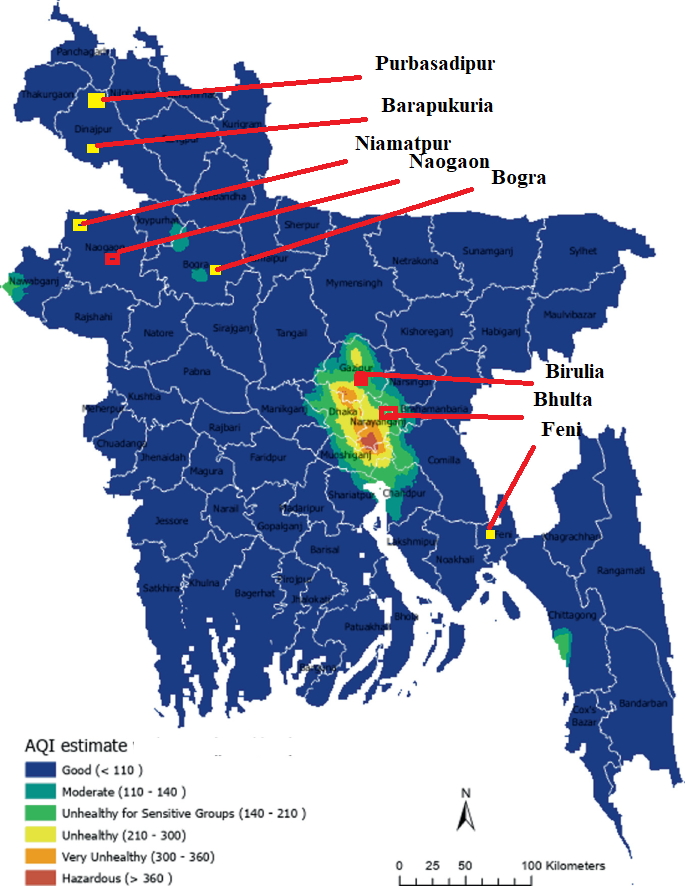
2.1. Power Gird Project AreaThe scope of gird project works under this turnkey contract is: design, supply, manufacture, quality assurance, inspection and testing, delivery, new packing for export, insurance, shipment & transport to the site, complete construction, installation, jointing, terminating, bonding, earthing, painting, setting to work, site testing and commissioning, defect liability for all equipment, including all civil works of new and the extension and renovation of existing 230/132 kV and 132/33 kV substations under package 1.1 under PGB PLC. The project areas were Dhaka, Feni, Naogaon, Dinajpur, Narayangonj, & Bogura district areas. Birulia Power Gird Point is very close to Dhaka city area. Naogaon, Bogura, Dinajpur and Feni cities are lower populated than the Dhaka capital city.
Figure 1. Map of grid project locations
During the construction phase and as per the monitoring plan, ambient air quality parameters and noise levels were measured quarterly from eight study grid point areas. The methods and procedures of BS 7445-1 that are practiced when measuring noise in outdoor areas with involvement of the procedures; the measurement should be attained more than 3.5 m from a reflective structure and the ideal measurement height ranges between 1.2 m and 1.5 m at the fourth corner of the grid point.
Particulate matter (SPM, PM2.5, and PM10) monitoring was accomplished with a high-volume air sampler, which is a vacuum type device that draws air with particulate matter through a filter paper. Particles within the range of 100 to 0.1 microns diameter are ordinarily collected on glass fiber filter. The instrument sucks the ambient air with a blower at a flow rate that allows suspended particles to pass to the filter surface. Some impingers with specific absorbing solutions were attached with a high volume sampler. The sampler was run within a certain period of time for deposited PM on glass filter papers and absorbing gaseous pollutants (SO2, NO2, O3, CO). Lead was determined by the AAS method from the PM after the digestion of filter paper with nitric and perchloric acid. EPA’s validated reference test methods for PM (EPA Methods 5) measurement. TCM with pararosaniline method was used for SO2 measurement and Colorimetry method with 540 nm wavelength for the spectrophotometric determination of oxide of nitrogen in air samples. UV-visible spectrophotometry at 352 nanometers (nm) is used to determine ozone in air. Iodine pentoxide acts as an oxidizing agent here and oxidizes carbon monoxide to carbon dioxide while being reduced to iodine in the process. Iodine is liberated from iodide ions when titrated with sodium thiosulfate. About 0.0025 N sodium thiosulfate is equivalent to 0.056 cc of CO.
3. Results and Discussion
Air quality parameters and noise levels were measured from the grid project areas from August 2021 to July 2023 quarterly. About 8 eight numbers of air quality and noise level measurement during period of this above period. Microsoft Excel sheet is a digital spreadsheet used for calculating, and analyzing data of mean and standard deviation. The construction of eight power grid points as per plan of power distribution among the Feni, Naogaon, Bhulta (Narayangonj), Purbasadipur (Dinajpur), Birulia (Dhaka), Barapukuria (Dinajpur), Niamatpur (Naogaon) and Bogura. Bangladesh has set ambient air quality standards under the Air Pollution Control Rules 2022. The standard level of SPM is 200 µg/m3 as per ECR 1997 and the rest of the air quality parameters [PM10, PM2.5 SO2, NO2, lead and ozone (O3)] have been set up in 2022 in lieu of environmental conservation rules (1997). It was observed that the concentration of air quality parameters was within the limit of Bangladesh standards as per air pollution control rule 2022. The construction activities of eight power grid points have the potential to generate a wide range of environmental impacts on ecologically valuable receptors (flora & fauna) including designated sites, sensitive habitats and protected species. The environmental monitoring plan is developed under the EMP framework which identifies the power grid project’s environmental impacts. The monitoring framework has been done during pre-construction stage and the construction phase quarterly. As per monitoring parameters, air quality and noise level were measured during the construction phase of these eight projects.
Table 1. Results of SPM, PM10, PM2.5 & SO2 with sampling locations
Table 2. Results of CO, NO2 Lead & O3 with sampling locations
Air pollution can harm birds in many ways, including lung damage, reduced egg production, and DNA mutations. Birds are particularly vulnerable to air pollution because they breathe in and out oxygen in one breathe. The pollutants; organic pollutants, sulfur dioxide, and nitrogen dioxide affect both species diversity and population density and the effect of higher noise affects the chromosomes of the bird 9
Effect of PM on Biodiversity
Air pollutants cause morphological and physiological changes in the avian respiratory system leading to noticeable respiratory distress and an increased susceptibility to respiratory infections in birds. Due to their faster breathing rate and greater time spent in open-air environments, birds inhale more airborne particles, or particulate matter (PM), than humans. The pollutants mentioned in the Air Pollution Control Rule 2022 might not be for the standard level for birds. Extra-fine particles, especially those less than PM2.5 microns in diameter, are small enough to reach the deepest branches of the lungs. Effect of PM2.5 is more effective than PM10 on the bird respiratory 14. It is concluded from the above statement that birds’ respiratory system is more prone to be affected by PM2.5 compared to SPM and PM10
Effect of Gaseous Pollutants on Biodiversity
The concentration level of CO higher than 425 ppm (531,250 µg/m3), it is plausible that other atmospheric contaminants (NO2, SO2, O3, and PM) might also be able to pass through the egg’s layered surface and affect bird embryos’ 14. However, the level of eight grid point areas was found lesser than above mentioned level.
NOx and SO2 react with water vapor in the air to form sulfuric and nitric acid which when deposited in wet (rain) or dry (dew drop) form contribute to acid deposition and soil acidification. Acid deposition is thought to promote the accumulation of metals in birds, potentially by enhancing the solubility of elements like aluminum. Additionally, exposure to acid rain disrupts calcium and phosphorus metabolism, elevates stress hormone production, reduces appetite, slows developmental rates, and impairs reproductive performance. Acid deposition and heavy metal uptake of soils near the grid point projects often disrupt the plant and invertebrate communities on which birds rely to meet their dietary needs. However, various avian species may struggle if air pollution impacts the abundance or quality of food resources 14. The levels of SO2 and NOx were lower which indicates that acid rain with lower pH did not occur at the grid point areas. The level of NOx, CO and SO2 might not affect the bird’s health due to acid rain at the grid point area. Quail exposed to higher concentrations of O3 (1.50 ppm or 3170µg/m3) were more affected. Individuals in this treatment group exhibited a significant decrease in the number of ciliated cells in the trachea and bronchi. The level of ozone was found to level of 27 µg/m3, indicating that there was no chance of affecting ozone to aviation health.
Table 3. Results of noise levels at grid point area
Effect of Higher Noise Level on Biodiversity
Construction work is one of the main contributors to noise pollution where the noise produced is in long term period and with mixture of varies type sound 14. Noise plays significant role in shaping bird ecology: larger species that communicate with low-frequency calls may be driven out of noisy environments, while smaller birds can persist by using higher-frequency signals that travel more effectively through the noise. 16. An analysis of calls from 529 bird species revealed that those with low-frequency songs were often masked by urban noise and consequently disappeared from urban environments, whereas species with higher-pitched calls were able to remain. Further research on 322 migratory and resident bird species found that anthropogenic noise pollution (ANP) influenced song complexity, with forest-breeding species exhibiting simpler songs compared to non-forest breeders. Interestingly, song complexity tended to increase with rising levels of noise pollution 9. Additionally, background noise levels exceeding 45 dB have been shown to significantly reduce the likelihood of detecting birds within a 60-meter range 17.
For a bird to detect a sound, it must be 24–30 dB above the ambient noise level. Studies have shown that declines in the population densities of woodland and grassland bird species occur at noise thresholds between 45 and 48 dB, respectively. Moreover, the most sensitive species in these habitats exhibit population declines at even lower noise levels, ranging from 35 to 43 dB 19. Songbirds appear to be particularly sensitive to subtle sound levels, akin to those typically found in a library reading room (~30 dBA) 19. The higher noise due to be four locations have traffic noise due to heavy vehicles passed through Birulia-Savar Road, Dinajpur-Rangpur Road, Naogaon-Shantahar road, and Barapukria-Parbotipur road. The noise levels were found at eight locations which were higher dimensions of thresholds limit of noise level. These noise levels might be hampered to the avian health around the project boundary.
4. Conclusion
This is clear evidence that birds are impacted by exposure to a range of airborne pollutants, particularly gases and particulate matter like PM2.5. Air pollution in birds leads to respiratory issues, increased detoxification efforts, heightened stress, immune suppression, behavioral alterations, and reduced reproductive success. These demographic consequences result from both the direct, toxic effect of exposure to air pollution and habitat degradation resulting from poor air quality at the eight-construction grid point areas. The PM2.5 levels varied from 31 to 36 µg/m3 at the eight grid point areas which might be affected to the bird respiratory system.
The results of noise level might be degraded habitat quality with a significant proportion of migrating birds avoiding a stopover site, primarily younger birds than adult birds, and body condition during a stopover is negatively affected. The noise level above 45 dBA might be hampered by the nearby project area faunas. However, noise levels of greater than 45 dBA were found at the eight grid point areas. As per Air Pollution Control Rule 2022, the air quality parameters at eight power grid points were within the standard limit of the government of Bangladesh. According to Noise Pollution Control Rule 2006, the noise were levels at eight grid point areas within the limit of the Residential zone and mixed zone of noise levels. The noise levels might be hampered on avian to the negative impact at all the eight grid point areas. The government of Bangladesh has already taken initiatives to construct grid points outside the city area. Future studies should work to identify which species across the project area may be most sensitive to air pollution and noise pollution Future studies on how air pollution impacts birds, especially endangered ones, could help shape conservation efforts, and improve the way we manage wild bird populations. The average air pollutant levels and higher noise level were found at Birulia and Barapukuria. Higher level of air pollutants at Birulia grid point might be contributed by Dhaka city air pollutants levels and noise level, because Birulia grid point is very near to Dhaka city. Higher level of air pollutants at Barapukuria grid point might be contributed by 525 MW Barapukuria Thermal Power Plant air pollutants levels and noise level, because this grid point Barapukuria is situated within boundary wall of the coal power plant. Although the measured pollutants remain within national limits, noise levels above 45 dBA may still threaten avian diversity. Relocation of substations away from ecologically sensitive areas and periodic biodiversity monitoring are recommended.
ACKNOWLEDGMENT
We would like to thank PGB (PLC), China National Technical Import & Export Corporation, GOPA Intec, and Kreditanstalt für Wiederaufbau (KfW) for contributing to supply data to carry out this research paper.
References
| [1] | Making Biodiversity Safeguards for REDD+ Work in Practice - Developing Operational Guidelines and Identifying Capacity Requirements - 9 May 2011-published by UNEP; |
| In article | |
| |
| [2] | Red List of Bangladesh Volume 1: Summary, IUCN, International Union for Conservation of Nature Bangladesh Country Office 2015. |
| In article | |
| |
| [3] | A. Scott, Kathryn D. Eckhoff, Sara G. Baer, Plant diversity decreases potential nitrous oxide emissions from restored agricultural soil, Pedobiologia, Volume 83, November 2020; |
| In article | View Article |
| |
| [4] | McLaughlin KE, Kunc HP. Experimentally increased noise levels change spatial and singing behaviour. Biol Lett, 9: 2013. |
| In article | View Article PubMed |
| |
| [5] | Clinton D. Francis, Catherine P. Ortega & Alexander Cruz, Noise Pollution Changes Avian Communities and Species Interactions, Current Biology 19, 1415–1419, August 25, 2009 |
| In article | View Article PubMed |
| |
| [6] | Sayed Tariq Uzzaman, Shamshad B. Quaraishi, Salma Begum, Assessment of Heavy Metals in Johnius Dussumieri (Cuvier, 1830) at Downstream Pasur, the Sundarbans Bangladesh, Applied Ecology and Environmental Sciences, 2024, Vol. 12, No. 1, 1-6 |
| In article | |
| |
| [7] | Mohamed Zyadah; Mahmoud Ibrahim & Amany Madkour, Impact of environmental parameters on Benthic Invertebrates and Zooplankton Biodiversity of the Eastern region of Dalta coast of Damietta, Egypt J. Aquat. Biol. & Fish, vol (8) No 4; 35-52 (2004) |
| In article | View Article |
| |
| [8] | Kenneth Qin, Birds suffer from air pollution, just like we do, National Audubon Society, July 23, 2015 |
| In article | |
| |
| [9] | Freddie-Jeanne Richard, India Southern, Mari Gigauri, Ginevra Bellini, Oscar Rojas and Anne Runde, "Warning on nine pollutants and their effects on avian communities, Global Ecology and Conservation, Volume 32, December 2021, e01898. |
| In article | View Article |
| |
| [10] | Hamm D: Sensory stress effect on layers. Poult Sci 46: 1267, 1967. |
| In article | |
| |
| [11] | McFarlane JM, Curtis SE 1989: Multiple concurrent stressors in chicks 3. Effects on plasma-corticosterone and the heterophil-lymphocyte ratio. Poult Sci 68: 522-527. |
| In article | View Article PubMed |
| |
| [12] | Petr Chloupek et al, Stress in Broiler Chickens Due to Acute Noise Exposure, Acta Veterinaria Brno, 78: 93–98; March 2009; |
| In article | View Article |
| |
| [13] | Yuanning Liang, Ivan Rudik, Eric Zou, Alison Johnston, Amanda D. Rodewald, Catherine L. Kling. Conservation Co-Benefits from Air Pollution Regulation: Evidence from Birds. The Proceedings of the National Academy of Sciences, November 2020. |
| In article | View Article |
| |
| [14] | Olivia V, Sanderfoot and Tracey Holloway, Air pollution impacts on avian species via inhalation exposure and associated outcomes, Environ. Res. Lett. 12 (2017) 083002 |
| In article | View Article |
| |
| [15] | Chow Yi Feng1, Nur Ilya Farhana Md Noh1, *, Ramez Al Mansob1, “Study on The Factors and Effects of Noise Pollution at Construction Site in Klang Valley, Journal of Advanced Research in Applied Sciences and Engineering Technology 20, Issue 1 (2020) 18-26. |
| In article | View Article |
| |
| [16] | Technical Guidance for Assessment and Mitigation of the Effects of Highway and Road Construction Noise on Birds, California Department of Transportation Division of Environmental Analysis 1120 N Street, Room 4301 MS27, Sacramento, CA 95814, 2016. |
| In article | |
| |
| [17] | Christopher J W McClure 1, Heidi E Ware 2, Jay Carlisle 2, Gregory Kaltenecker 2, Jesse R Barber, an experimental investigation into the effects of traffic noise on distributions of birds: avoiding the phantom road, Proc Biol Sci. 2013 Dec 22;280(1773):20132290. |
| In article | View Article PubMed |
| |
| [18] | The Effects of Noise on Wildlife, Research prepared by Meghan C. Sadlowski, Environmental Scientist, Division of Migratory Bird Management, US Fish & Wildlife Service |
| In article | |
| |
| [19] | California Department of Transportation, Technical Noise Supplemental, A Technical Supplement to the Traffic Noise Analysis Protocol, October 1998 |
| In article | |
| |
Published with license by Science and Education Publishing, Copyright © 2026 Dr. Kazi Mohammad Anamoul Haque, Saruar Jahan Shourov, Dr. Saika Nizam, Md Habibur Rahman Khan, Mohd Nur E Alam Siddique, Syed Nazmul Husain, Md Habibur Rahman, Md. Abubakar Ahmed and Mizanur Rahman
 This work is licensed under a Creative Commons Attribution 4.0 International License. To view a copy of this license, visit
http://creativecommons.org/licenses/by/4.0/
This work is licensed under a Creative Commons Attribution 4.0 International License. To view a copy of this license, visit
http://creativecommons.org/licenses/by/4.0/
Cite this article:
Normal Style
Dr. Kazi Mohammad Anamoul Haque, Saruar Jahan Shourov, Dr. Saika Nizam, Md Habibur Rahman Khan, Mohd Nur E Alam Siddique, Syed Nazmul Husain, Md Habibur Rahman, Md. Abubakar Ahmed, Mizanur Rahman. Assessment of Environmental Parameters Affecting Biodiversity in Grid-Based Power Development Projects in Bangladesh. Applied Ecology and Environmental Sciences. Vol. 14, No. 1, 2026, pp 27-33. https://pubs.sciepub.com/aees/14/1/4
MLA Style
Haque, Dr. Kazi Mohammad Anamoul, et al. "Assessment of Environmental Parameters Affecting Biodiversity in Grid-Based Power Development Projects in Bangladesh." Applied Ecology and Environmental Sciences 14.1 (2026): 27-33.
APA Style
Haque, D. K. M. A. , Shourov, S. J. , Nizam, D. S. , Khan, M. H. R. , Siddique, M. N. E. A. , Husain, S. N. , Rahman, M. H. , Ahmed, M. A. , & Rahman, M. (2026). Assessment of Environmental Parameters Affecting Biodiversity in Grid-Based Power Development Projects in Bangladesh. Applied Ecology and Environmental Sciences, 14(1), 27-33.
Chicago Style
Haque, Dr. Kazi Mohammad Anamoul, Saruar Jahan Shourov, Dr. Saika Nizam, Md Habibur Rahman Khan, Mohd Nur E Alam Siddique, Syed Nazmul Husain, Md Habibur Rahman, Md. Abubakar Ahmed, and Mizanur Rahman. "Assessment of Environmental Parameters Affecting Biodiversity in Grid-Based Power Development Projects in Bangladesh." Applied Ecology and Environmental Sciences 14, no. 1 (2026): 27-33.