Primates’ conservation had faced enormous challenge due to human activities altering ecosystems, combined with inadequate data and existing knowledge gap on their site-specific population size, distribution and trends, threats, climate change impact, human-primate interactions, detailed population recovery plans and strategic monitoring programs. This study examines the species population status (i.e., density, abundance, and geographic distribution) of Pan troglodytes verus (Western chimpanzee), Cercopithecus diana (Diana Monkey) and Colobus polykomos (Black and White Colobus) in a 12.5km2 Forested Island in Pujehun District, Southern, Sierra Leone. The Standing Crop Nest Count (SCNC) method was adopted for the chimpanzee nest count along systematically placed linear line transects for estimation of chimpanzee population. Direct encounter-based technique was carried out along the same transects to account for the population of Diana Monkey and Black and White Colobus. The monkey groups were detected from their vocalization, direct sighting, and the shaking of tree branches during their movement, feeding and other activities. A Compass and Geographical Positioning System (GPS) were used for navigation and a binocular was used to aid in the proper identification of monkey species. Data were entered into Excel tables and encounter rates and other findings were derived. Data from the transect survey were analyzed using QGIS 3.22.0, Excel, and the Distance 7.3 software. A total of 40 chimpanzee nests were detected on 12 transects and the species density of chimpanzee in was 0.25chimpanzee/km2. The species density of Western Black-and-white Colobus within the study area was 57.75/km2 and with an encounter rate of 0.51/km, and 0.89 (signs/km). The encounter rate for the Diana Monkey was 0.37/km2. There were more wildlife direct sightings and signs in areas where less human activities and disturbances were recorded. It is recommended that less human activities be maintained coupled with regular monitoring programs be implemented for adaptive management and conservation of primates in Sierra Leone
The human impact on ecosystems have been recognized as a global environmental problem and a challenge for sustainable development 1. The primary causes of the alteration and degradation of natural habitats are anthropogenic activities including agriculture, mining, and infrastructure development 2, 3. Research has shown that nearly 97% of the planet's surface has been impacted by human activity 4, 5, 6. Natural resource exploitation and deforestation caused by such activities have an impact on the survival of species 7, 8. Anthropogenic activities in different habitats reduce forest cover and resource availability, endangering species populations 9, 10, 11, 12. Due to humans' direct and indirect influence on species habitats and ecosystems, many species have become extinct or are on the verge of extinction 13. The current ever-increasing rate of human activity altering ecosystems, combined with inadequate data and a knowledge gap on many aspects of species conservation, particularly the population status and distribution of rare and threatened species, makes wildlife conservation an enormous challenge 10, 14, 15, of which non-human primates are no exception.
Non-human primates (hereafter primates) are one of the bio-diverse taxa which comprises about 504 living species belonging to 79 genera and 16 families 10. The order Primate is exceeded only by two other taxonomic groups of the class Mammalia - Chiroptera (bats, 1151 species), and Rodentia (rodents, 2256 species) in terms of species diversity 10, 16. Globally, primate species occur in three regions - the Neotropics (171 species), Africa (mainland countries 111 species and island country - Madagascar 103 species), and Asia (119 species), and are endemic to 90 countries, with Brazil, Madagascar, Indonesia, and the Democratic Republic of the Congo hosting 65% of the total primate species (439) 10, 16. Being diverse, primates are among the many wildlife species faced with the current threats of extinction and population reduction 10. It is anticipated that around 60% of all primates are endangered with extinction, with the primary challenges to their existence being habitat loss and fragmentation because of a rapid human population increase and land conversion for agriculture. Additional documented challenges to their survival includes logging, mining, local and global market demands for food and non-food commodities; hunting and poaching for domestic consumption and illegal commercial bush meat trade; introduction and spread of invasive species; the pet trade; the climate change, and both existing and emerging diseases 10 [17-22] 17. Despite the impediments faced by primate from human communities, primates among other wild species give several ecological, social, economic and cultural advantages to human communities. Primates act as prey, predators, and mutually beneficial species in food chains and food webs, as well as significant contributors to forest development and ecosystem health, influencing ecosystem structure, function, and resilience 10, 23 that are essential for human wellbeing.
The Western Chimpanzee – Pan troglodytes verus, Diana Monkey - Cercopithecus diana and Western Black-and-white Colobus - Colobus polykomos, that are the focal species of this study, are among the many species of primates on the list of increasing human threats to their population, distribution, and habitats. These primate species are increasingly threatened, and their population and range have experienced dramatic decline in the last two to three decades 10, 24. In 2016, the Western chimpanzee was categorized as critically endangered and ranked the most vulnerable among the four chimpanzee subspecies 17. The Diana Monkey and the Western Black-and-white Colobus are globally endangered and their populations are steadily decreasing 19, 20. Attributed to this is the rapid increase in human population growth coupled with the need for more resources, and the lack of effective policy actions across sectors and other known threats 10, 17. This has left the species extremely vulnerable in this irreversible human generation characterized by rapid human development, population growth and ecosystem degradation. Thus, there has been an increasing interest in research on primates, living in human-modified habitats to better understand how they behave and thrive in fragmented landscapes and to determine which conservation strategies might work best for the species outside of nature reserves 25.
In West Africa, Sierra Leone is home to the third-largest chimpanzee population, with more than half of them residing outside of nature reserves 26, 27. According to estimates, the nation's forest and woodland ecosystems have lost 36% of their area since 1975 28. Hence, primates are subject to severe challenges such as habitat degradation, poaching, and retribution as a result of competing with humans for resources 26, 29. Due to habitat modification brought on by human activity, species' population status (i.e., density, abundance, and geographic distribution) may change through time and space 10, 30. Insights into how primates are adapting to these altered settings, and for the successful conservation and management of wildlife species, may thus be gained through studying primate populations. Thus, this study seeks to determine the species population status (i.e., density, abundance, and geographic distribution) of three primate species, i.e. the Western Chimpanzee, the Diana monkey and the Western Black-and-white Colobus, in Jaibui Island in Pujehun District southern, Sierra Leone.
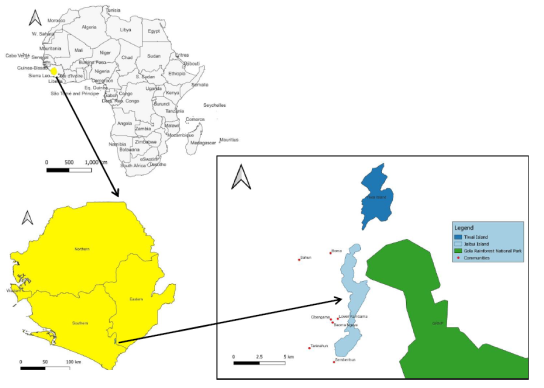
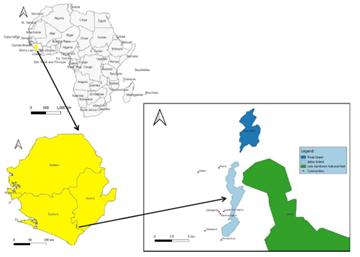
The research was conducted in Jaibui Island, located in Pujehun District – Southern Sierra Leone (UTM 29, X: 238199; Y: 823787) and its’ closest seven human communities (Boma, Sahun, Kambama, Gbengama, Baoma Ngeya, Sembenhun and Taninahun) that use the island’s resources. Over the time span, the island has been owned and managed by the community members for the harvesting of local resources to meet their livelihood demands, until 2017 when Tacugama Chimpanzee Sanctuary entered into an agreement for co-management of the Island. Jaibui Island has a total area of about 12.5 km2, surrounded by the Moa River, and shares it land borders with the Gola Rainforest National Park (GRNP) in the East and Tiwai Island in the North (Figure 1). The two adjacent forest blocks are extensions of the Upper Guinea Forest considered one of the 35 global most important biodiversity hotspots 31. The Jaibui Island has a tropical climate which is transitional between two seasons - dry season (December – April) and wet season (May – November). The major livelihood activities in the study area are agriculture, trade and mining activities.

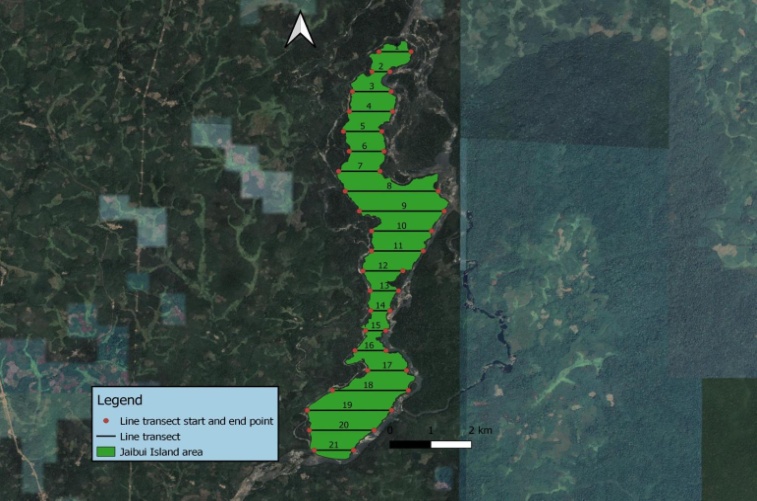
The survey was designed using the distance 7.3 software. The sampling design followed the standardized method as described in Thomas et al., 32. The line transects were systematically placed with a random origin over the study area thereby satisfying the key design assumption – “Animals are distributed independently of the lines” 33. Encounter-based survey was carried out along each of the line transects produced by the distance software. A total of 21 transects were generated by the distance software which were walked once on a single visit within the duration of 13 days during the month of October 2021, from morning to evening depending on the transect lengths and the number of observations made.
The distance between one transects and the other was 500m (Figure 2). For each line transects the coordinate of the start and end point were generated by the distance software including their lengths. The length of each transects vary according to the edge of the study area and the total lengths of all the line transects from the design was estimated to be 23,920m. The length of the line transects ranged between 440m and 2,280m and were oriented from west to east across the Island. The transection orientation was informed by the Moa River which surrounds the Island allowing the movement of animals from shore to shore through the core area and cuts through the different habitat categories of the Island. Also, it was the best fit for the study area which produced a higher total transect length, a perquisite for more encounters compared to other simulation designs that resulted from the Distance software. A total transects length of 21,301m transect was walked (Mean transect length = 1,014.33 m (range 394 – 2190 m) at the end of the survey out of 23,920m from the initial design.

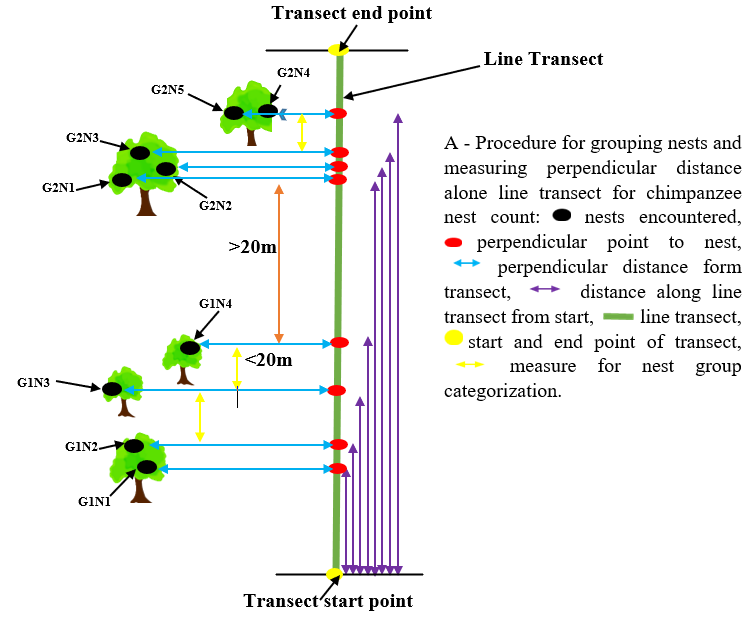
Reflecting on the short duration of the study, the SCNC method was adopted for the chimpanzee nest count along transects for subsequent estimation of chimpanzee population living within the Island. The SCNC involves the count of all chimpanzees sleeping nests detected by the survey team on a single visit along each line. The method is effective in terms of cost and time where resources are limited, and result required from a few days of field work. Walking slowly along the line transects, with a team of four members: one transects cutter who was clearing the transect path at a minimal rate to allow the survey team to move, two other observers and one data recorder who also assisted in measuring perpendicular distances. Between the two observers, one observer focused on looking up for chimpanzee nests, and the other observer was looking down for other indirect signs of chimpanzees and human activities. Chimpanzee nests were searched for on the forest canopies. Nest detection was followed by recording of the following data sets on the same data sheet as the monkeys: nest-group size, perpendicular distances to transect, nesting tree species (local or scientific name if known by survey team), nest height, nest age class, time, distance from start and GPS coordinate of each nest. During the survey, nests which were of the same age class and found within 20m from each other were assigned to the same group, while nests that were of different age classes and separated from each other with more than 20m were considered as a different group 34. Also, among the line transects, nest which were encountered on each transects were considered to belong to different group regardless of the age of the nest (Figure 3). Encountered chimpanzee nest were classified following Tutin and Fernandez 35 as: Fresh (all leaves in the nest were green and feces or urine odors found underneath the nest); Recent (nest which has drying leaves of different colors, with dominant green coloration, and there was no smell of dung or urine underneath the nest location); Old (majority of the leaves were brown and the structure of the nest were still visible); and Decay/Rotten (nest has holes showing few or no leaves, but was identified based on the bent twigs and branches). Direct encounter-based count of Diana Monkey and Western Black-and-White Colobus was done.
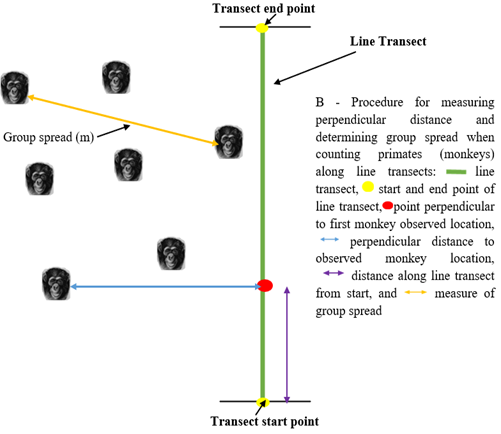
Conducted simultaneously as the nest count along the same transects, for an encountered monkey group, the team paused movement for about 10 to 15 minutes to count and observe the monkey group and recorded on a data sheet: time of encounter, perpendicular distance from the transect to the first individual seen in the group, distance from starts of the transect, GPS location of the first individual seen in the group, monkey species, number of individuals in the group, group composition, group spread, group height, habitat type where the group was encountered, how the group was first detected, activity of the group when encountered, and fruit species (local name or scientific name) if found feeding 36, 37, 38 (Figure 4). The monkey groups were detected from their vocalization, direct sighting, and the shaking of tree branches during their movement, feeding and other activities. However, due to the dense vegetation and high canopy cover that is typical of tropical rainforests and the occurrence of some primate species in large group spread, recording distance to group center was difficult and prone to bias. Therefore, it was avoided during the survey and perpendicular distances were measured to the first monkey observed in the group. Whitesides et al. 39 documented that distance to first individual of a monkey group can be used as a close proxy for group center when the size or spread of groups are small. The monkey groups were defined whenever the targeted species were detected at a particular time along the line transects.
3.2. Wildlife Signs and Human Activities and DisturbanceThroughout the survey, wildlife signs were recorded as tracks or trails, footprints, feeding remains of eaten fruits, seeds and other plant parts, dung/feces, vocalization, nest in case of chimpanzee and direct sighting were possible. Based on the size of bite or eaten part of the fruits, feeding remains on fruits were referred to belong to either chimpanzee or monkey, as chimpanzee feeding remains were found to have larger bites or eaten parts than that of the monkeys. To decide whether a particular feeding remain was for a specific monkey species, one of the team members had to see the monkey feeding on the fruit or plant part otherwise it was referred to as a general feeding remain of monkeys.
The signs of human activities and disturbances collected were logging, gun shells, snare trap, and mining camp, fish smoking site/camp, hunting trail and fruit collection sites. All encountered signs/activities (both human and wildlife) were categorized as fresh, recent, old, and active depending on the sign type and the duration of the activity or disturbance. Nonlinear reconnaissance walks (recce walk) were carried out while moving from one transects start and end point to another. During the recce walk, opportunistic data were recorded on all observable features of human activities and disturbance, and wildlife signs and sightings (both direct and indirect) encountered, with focus on the studied species to save time 40.
3.3. Data AnalysisData from the transect survey were analyzed using QGIS 3.22.0, Excel, and the Distance 7.3 software. Data were entered into Excel tables and encounter rates and other findings were derived using formulae in excels to derive mean, total distances walked, encounter rate and speed on transect. QGIS was used to produce a distribution map of the encounters of primate signs and human activities. The Conventional Distance Sampling engine (CDS) in the Distance 7.3 software was specifically used to derive an estimate of the population densities of the primate species, their abundance, and associated coefficients of variation and 95% confidence intervals. The model selection criterion was based on Akaike’s Information Criterion and the selection method used was sequential. Robust population estimate for indirect surveys – nest count required multipliers. Therefore, analysis of chimpanzee nest data was done while incorporating multiplier values from other studies conducted at various sites into the distance analysis engine as it was not possible to set up separate studies for that due to the short duration of this study. These include:
• An estimate of nest decay rate for forest nests from the 2010, Sierra Leone National Chimpanzee Census - 109 days (SE = 19.76, 95% CL = 76-154 days) 26;
• Nest production rate of 1.143 nests per day (SE = 0.04, % CV = 3.51) from a study in the Taï National Park 34.
• Proportion 0.83 of non-nest builders, this is the same that was used in national chimpanzee census, and similar to what was reported for Ugandan data 10, 41.
The Western Black-and-white Colobus final population density was calculated by multiplying the group density by mean group size. The mean of observed group size was used in the estimation of the cluster size.
In choosing the detection function, the model with the best fit to the data was a half-normal function with the simple polynomial adjustment term for both nest and monkey analysis.
The species density of chimpanzee in the study area was 0.25 chimpanzee/km2 (SE = 0.88, % CV = 34.63, 95% CI = 0.13 – 0.49), resulting to an estimate of 3 individuals (SE = 1.03, % CV = 34.63, 95% CI = 2 – 6) (Table 1). The results corroborates with Brncic et al. 26 who conducted a re-analysis of the primary data from a chimpanzee study in the Gola Rainforest National Protected area (GRNP) and recoded the species density of 0.25 chimpanzee/km2 (95% CI = 0.14-0.43) using a longer nest duration. On the contrary, Garriga, 42 noted higher chimpanzee density of 0.36 individuals/km2 (CI = 0.1- 1.32) in protected natural reserve. In addition, Loma Mountains National Park (LMNP) was observed to have the highest density of chimpanzees in the country with species density 2.69 (95% CI =1.44-5.01) 26. After a decade long of conservation effort, Molina‐Vacas 43 reaffirm LMNP taking the lead in occupying the highest Chimpanzee density nationally and in all chimpanzee range habitats in Africa given a chimpanzee density of 3.47 individuals/km2. Also, Carvalho et al. 44, carried out research in the Greater Mahale Ecosystem in Tanzania, and estimated a higher mean density of 0.86 chimpanzees/km2 in a reserved forest (95% CI 0.60–1.23). Most chimpanzee population studies done using indirect survey from line transect, nest production and decay rates are taken from studies conducted at other sites due to factors like short study duration and resources constrains. To reduce uncertainties and enhance robustness of the final population estimate, Buckland et al. 33 recommended to conduct site specific estimate of multipliers (Nest production and decay rates) at the study site prior or during the time of the study for analysis. Besides, it has been observed by Brncic et al. 26 that selection of these parameters can lead to higher or lower population estimates, and therefore care should be taken in their selection for analysis purpose. The management status of a particular species habitat has influence on the population of species that occur within compared to protected areas that are legally restricted for entry or any activity except with approval from the authorities. Thus, protected areas with proper species monitoring strategies and effective ranger patrols is a possibility of high species density and abundance because of the conservation effort compared to a community forest like the Jaibui Island, thereby creating a significant impact on species population occurring within the area.
The species density of Western Black-and-white Colobus within the study area was 57.75/km2 (% CV = 36.85, 95% CI = 27.86 - 119.69), resulting to an estimate of 722 individuals (% CV = 34.63, 95% CI = 348 – 1496) (Table 2). However, a study conducted by Kifle and Bekele 45 in Awi Zone of the northwestern Ethiopia, reported on the abundance of black-and-white colobus monkeys (Colobus guereza) along surveyed transects to be 48.2 ± SD 16.9 individuals/km (range 12.5–73.0 individuals/km) with a 95% confidence interval of 41.4–54.7 individuals/km. On the contrary, a study conducted by Yezezew et al. 46 in Amhara National Regional State, in the central highlands of Ethiopia, reported a mean individual species density of this species to be 94.4 ± SD 25.2 individuals/km2 (range 56.8–110.1individuals/km2). This could be attributed to the total area surveyed which was 85.5 km2. Other studies have also reported population density for Angolan Pied Colobus (Colobus angolensis) at 7.7 km2 in Ituri Forest, DR Congo 47 and 0.27 km2 in undisturbed and 44.2 km2 in disturbed areas of Budongo Forest, Uganda for Colobus guereza 48. The variation in population densities of the western black-and-white colobus monkeys and its sub species reflect the present-day realities like habitat destruction and hunting as well as other known threats faced by this species for their survival across its range states and habitats. The density and abundance for the Diana Monkey was not calculated due to the very low number of sighting groups’ encountered (8 sightings). However, the encounter rate for Diana Monkey was 0.37/km2.
A total of 40 chimpanzee nests were detected on 12 transects (57.1% of total transects walked) 10 fresh, 22 old, and 8 decayed nests. A total transect length of 21.301km surveyed in Jaibui Island resulted in a chimpanzee encounter rate of 1.87/km, with an average nest group size of 2.66 nests (range 1-5 nests) (Table 2). The results corroborates with the study conducted by Garriga, 49 in Sierra Leone, who reported chimpanzee nest encounter rate of 1.7 per km. Diana monkey density and abundance were not calculated due to the low number of sightings: a total of eight (8) group sightings were recorded with an encounter rate of 0.37/km and an average group size of 5.75 (range 4 - 8 individuals) and 1.07 (signs/km). The information on encounter rate of a species within a defined geographical boundary can be utilized to provide valid information about their population and can serve as a proxy to inform planning for management 50. In the GRNP area neighboring the study site, Klop et al, 51 observed an encounter rate of 1.048 (No./km) for this species.
However, eleven (11) groups of the Western Black-and-white Colobus were spotted on 8 transects (38.1% of total transects) with a group encounter rate of 0.51/km, and 0.89 (signs/km) in this study. Within the GRNP area, the encounter rate of this species was 0.282 (groups, individuals, signs/km) which is lower than these findings combined 51. Variation in the encounter across the two sites can be attributed to the size of the sampled area. GRNP area covers a land area of 710 km2 given the possibility of placing more transects at longer lengths than in Jaibui Island with only 12.5km2. Subsequently, a study conducted in Grébouo in Soubré Department in the South-western Côte d'Ivoire on Black-and-white colobus reported an encounter rate at 0.19 groups/km 52, which conforms to the rapid population reduction faced by this species downgrading its status from vulnerable to endangered over the last decade 20, thus making detection of the species difficult in their habitats.
The Jaibui Island is a potential wildlife refuge site where human activities from the adjacent settlements have forced especially primates to thrive within the Island all year round avoiding the surrounding farmlands and disturbed habitat patches. This among other favorable ecological characteristic of Jaibui Island accounts for the distribution of primates throughout the Island. Thus, like most other wildlife, human disturbance is the major ongoing threat to primates 53, 54.
4.3. Impact of Anthropogenic Disturbances on the Spatial Distribution of the Three Primate SpeciesHuman activities and disturbance were discovered across the study area. The different kinds of human activities were categorized as: mining (mining pits and camps), hunting (gun shell, snare trap, and hunting trail), logging, fishing, and fruit collecting, resulted in 5 categories that could directly impact the conservation of the three primate species. The human activities and disturbances encountered were rated as high impact (20-30 signs), moderate impact (10-20 signs), and low impact (1-10 signs). Hunting using shotguns and snares had the highest impact which accounted for 23 signs, followed by mining with moderate impact (10 signs), and logging, fishing and fruit collections each found to have low impact on these threatened primate species within the study area. There were more wildlife direct sightings and signs in areas where less human activities and disturbances were recorded. Similarly, human activities have been documented to impact wild species population and distribution to varying degrees across several different sites 55, 56, 57. Large terrestrial mammals mostly tend to avoid areas that are frequently accessible to human use 36. Primates in general tend to favor certain areas within their habitat that are free from human disturbance and activities providing favorable ecological conditions for their survival 58. Hence, human activities have been identified among global drivers acting in synergy to exacerbate the population decline and disappearance of primates in the present era 10, 27, 59
The species density of chimpanzee in the study area was 0.25 chimpanzee/km2. The species density of Western Black-and-white Colobus within the study area was highest (57.75/km2 and with an encounter rate of 0.51/km), as compared to Chimpanzees (0.25 chimpanzee/km2), and the Diana Monkey (0.37/km2). Overall, there were more primates’ direct sightings and signs in areas where less human activities and disturbances were recorded, and primates’ direct and indirect presence occurred throughout the island irrespective of the human activities.
Policy implementation for the conservation of threatened species is challenging with the existing policies. The fact that existing policies are not supported by an updated wildlife and forestry act presents a drawback to the success of wild species conservation in Sierra Leone. Also, existing policies have been described as obsolete, missing the laws that meet the current trend of global species conservation. Programs and policies intended to effectively conserve chimpanzees and other primates must consider factors driving population fluctuations across time and space as well as accurate estimates of the distribution and size of the primate populations.
Therefore, we encourage future management measures to increase resources and strengthen efforts to protect important forest habitat and promote strategies and policies that support primate conservation in Sierra Leone.
Acknowledgements: The authors are grateful to the West Africa Biodiversity and Ecosystem Services (WABES) project, for funds from the International Climate Initiative (IKI) of the German Federal Ministry for the Environment, Nature Conservation and Nuclear Safety (BMU), Germany to support this research. Thanks to ‘’The Rufford Foundation’’ for complementary financial support through their small grant portal that supported the field work. Appreciation to the management and staff of the Tacugama Chimpanzee Sanctuary for hosting the research work, and granted permission for the research to take place in their project sites and communities. We greatly appreciate the courageous support of the Jaibui Island Bio-monitors – Vandi Kallon, Mustapha Sesay, Ansu Kallon and Abdul-Rahaman Sherriff who served as guides and contributed their local expert knowledge during field data acquisition that contributed to the overall outcome of the study.
Conflicts of Interest: The authors declare no conflict of interest.
| [1] | Handl, G., Deutsch, E., & Law, I. (2012). Historical Archives-Introductory Note-Declaration of the United Nations Conference on the Human Environment (Stockholm Declaration), 1972 and the Rio Declaration on Environment and Development, 1992-English, 1–11. United Nations Audiovisual Library of International Law. | ||
| In article | |||
| [2] | Sih, A. (2013). Understanding variation in behavioural responses to human-induced rapid environmental change: a conceptual overview. Animal Behaviour, 85(5), 1077-1088. | ||
| In article | View Article | ||
| [3] | Díaz, S., Settele, J., Brondízio, E. S., Ngo, H. T., Agard, J., Arneth, A., ... & Zayas, C. N. (2019). Pervasive human-driven decline of life on Earth points to the need for transformative change. Science, 366(6471), eaax3100. | ||
| In article | View Article PubMed | ||
| [4] | Dirzo, R., Young, H. S., Galetti, M., Ceballos, G., Isaac, N. J., & Collen, B. (2014). Defaunation in the Anthropocene. science, 345(6195), 401-406. | ||
| In article | View Article PubMed | ||
| [5] | Bersacola, E., Hill, C. M., & Hockings, K. J. (2021). Chimpanzees balance resources and risk in an anthropogenic landscape of fear. Scientific Reports, 11(1), 4569. | ||
| In article | View Article PubMed | ||
| [6] | Plumptre, A. J., Baisero, D., Belote, R. T., Vázquez-Domínguez, E., Faurby, S., Jȩdrzejewski, W., ... & Boyd, C. (2021). Where might we find ecologically intact communities?. Frontiers in Forests and Global Change, 4, 26. | ||
| In article | View Article | ||
| [7] | Halpern, B. S., Walbridge, S., Selkoe, K. A., Kappel, C. V., Micheli, F., d'Agrosa, C., ... & Watson, R. (2008). A global map of human impact on marine ecosystems. science, 319(5865), 948-952. | ||
| In article | View Article PubMed | ||
| [8] | Parmesan, C., & Yohe, G. (2003). A globally coherent fingerprint of climate change impacts across natural systems. nature, 421(6918), 37-42. | ||
| In article | View Article PubMed | ||
| [9] | Boyle, S. A., & Smith, A. T. (2010). Can landscape and species characteristics predict primate presence in forest fragments in the Brazilian Amazon?. Biological Conservation, 143(5), 1134-1143. | ||
| In article | View Article | ||
| [10] | Estrada, A., Garber, P. A., Rylands, A. B., Roos, C., Fernandez-Duque, E., Di Fiore, A., ... & Li, B. (2017). Impending extinction crisis of the world’s primates: Why primates matter. Science advances, 3(1), e1600946. | ||
| In article | View Article PubMed | ||
| [11] | Marsh, L. K., Chapman, C. A., & Arroyo-Rodríguez, V. (2013). Primates in fragments. Primates in fragments: Ecology and conservation, 6-7. | ||
| In article | View Article | ||
| [12] | Spaan, K. M., van Noordenburg, C., Plassmann, M. M., Schultes, L., Shaw, S., Berger, M., ... & Benskin, J. P. (2020). Fluorine mass balance and suspect screening in marine mammals from the Northern Hemisphere. Environmental Science & Technology, 54(7), 4046-4058. | ||
| In article | View Article PubMed | ||
| [13] | IPBES, 2019. Summary for policymakers of the global assessment report on biodiversity and ecosystem services of the Intergovernmental Science-Policy Platform on Biodiversity and Ecosystem Services. IPBES secretariat, Bonn, Germany. 56 pp. | ||
| In article | |||
| [14] | Tordoff, A. W., Baltzer, M. C., Fellowes, J. R., Pilgrim, J. D., & Langhammer, P. F. (2012). Key biodiversity areas in the Indo-Burma hotspot: process, progress and future directions. Journal of Threatened Taxa, 2779-2787. | ||
| In article | View Article | ||
| [15] | Tran, D.V. and Tien Vu, T., 2020. Combining species distribution modeling and distance sampling to assess wildlife population size: A case study with the northern yellow‐cheeked gibbon (Nomascus annamensis). American Journal of Primatology 2020; e23169. | ||
| In article | View Article PubMed | ||
| [16] | Supriatna, J., Shekelle, M., Fuad, H. A., Winarni, N. L., Dwiyahreni, A. A., Farid, M. ... & Zakaria, Z. (2020). Deforestation on the Indonesian island of Sulawesi and the loss of primate habitat. Global Ecology and Conservation, 24, e01205. | ||
| In article | View Article | ||
| [17] | Humle, T., Maisels, F., Oates, J. F., Plumptre, A., & Williamson, E. A. (2016). Pan troglodytes (errata version published in 2018). | ||
| In article | |||
| [18] | Korstjens, A. H., & Hillyer, A. P. (2016). Primates and climate change: A review of current knowledge. An introduction to primate conservation, 175-192. | ||
| In article | View Article | ||
| [19] | Koné, I., McGraw, S., Gonedelé Bi, S., and Oates, J.F., 2019. Cercopithecus diana. The IUCN Red List of Threatened Species, 1-11pp. | ||
| In article | |||
| [20] | Gonedelé Bi, S., Koné, I., Matsuda Goodwin, R., Alonso, C., Hernansaiz, A., & Oates, J. F. (2020). Colobus polykomos. The IUCN red list of threatened species 2020: e. T5144A17944855. | ||
| In article | |||
| [21] | Crooks, K. R., Burdett, C. L., Theobald, D. M., King, S. R., Di Marco, M., Rondinini, C., & Boitani, L. (2017). Quantification of habitat fragmentation reveals extinction risk in terrestrial mammals. Proceedings of the national Academy of Sciences, 114(29), 7635-7640. | ||
| In article | View Article PubMed | ||
| [22] | Gibson, L., Lynam, A. J., Bradshaw, C. J., He, F., Bickford, D. P., Woodruff, D. S. ... & Laurance, W. F. (2013). Near-complete extinction of native small mammal fauna 25 years after forest fragmentation. Science, 341(6153), 1508-1510. | ||
| In article | View Article PubMed | ||
| [23] | Chapman, C. A., Bonnell, T. R., Gogarten, J. F., Lambert, J. E., Omeja, P. A., Twinomugisha, D., ... & Rothman, J. M. (2013). Are primates ecosystem engineers?. International Journal of Primatology, 34, 1-14. | ||
| In article | View Article | ||
| [24] | IUCN, 2020. Regional action plan for the conservation of western chimpanzees (Pan troglodytes verus) 2020–2030. SSC Primate Specialist Group, Gland, Switzerland: IUCN. | ||
| In article | |||
| [25] | McLennan, M. R., Spagnoletti, N., & Hockings, K. J. (2017). The implications of primate behavioral flexibility for sustainable human–primate coexistence in anthropogenic habitats. International Journal of Primatology, 38, 105-121. | ||
| In article | View Article | ||
| [26] | Brncic, T.M., Amarasekaran, B., and McKenna, A., 2010. Final report of the Sierra Leone National Chimpanzee Census Project, Tacugama Chimpanzee Sanctuary, Freetown, Sierra Leone, 118pp. | ||
| In article | |||
| [27] | Kühl, H. S., Sop, T., Williamson, E. A., Mundry, R., Brugière, D., Campbell, G. ... & Boesch, C. (2017). The Critically Endangered western chimpanzee declines by 80%. American Journal of Primatology, 79(9), e22681. | ||
| In article | View Article PubMed | ||
| [28] | Inter-états de Lutte, C. P. contre la Sécheresse dans le Sahel (CILSS). Landscapes of West Africa—a window on a changing world. Ouagadougou, Burkina Faso: CILSS; 2016. | ||
| In article | |||
| [29] | Garriga, R. M., Marco, I., Casas-Díaz, E., Acevedo, P., Amarasekaran, B., Cuadrado, L., and Humle, T., 2019. Factors influencing wild chimpanzee (Pan troglodytes verus) relative abundance in an agriculture-swamp matrix outside protected areas. PloS one, 14(5), e0215545. | ||
| In article | View Article PubMed | ||
| [30] | Wich, S. A., & Marshall, A. J. (Eds.). (2016). An introduction to primate conservation. Oxford University Press. | ||
| In article | View Article | ||
| [31] | Klop, E., Lindsell, J. A. and Siaka, A. 2008. Biodiversity of Gola Forest, Sierra Leone. Royal Society for the Protection of Birds, Conservation Society of Sierra Leone, Government of Sierra Leone. | ||
| In article | |||
| [32] | Thomas, L., Buckland, S. T., Rexstad, E. A., Laake, J. L., Strindberg, S., Hedley, S. L., & Burnham, K. P. (2010). Distance software: design and analysis of distance sampling surveys for estimating population size. Journal of Applied Ecology, 47(1), 5-14. | ||
| In article | View Article PubMed | ||
| [33] | Buckland, S. T., Rexstad, E. A., Marques, T. A., & Oedekoven, C. S. (2015). Distance sampling: methods and applications (Vol. 431). New York: Springer. | ||
| In article | View Article | ||
| [34] | Kouakou, C. Y., Boesch, C., & Kuehl, H. (2009). Estimating chimpanzee population size with nest counts: validating methods in Taï National Park. American Journal of Primatology: Official Journal of the American Society of Primatologists, 71(6), 447-457. | ||
| In article | View Article PubMed | ||
| [35] | Tutin, C. E., & Fernandez, M. (1984). Nationwide census of gorilla (Gorilla g. gorilla) and chimpanzee (Pan t. troglodytes) populations in Gabon. American journal of Primatology, 6(4), 313-336. | ||
| In article | View Article PubMed | ||
| [36] | Blom, A., Van Zalinge, R., Heitkönig, I. M., & Prins, H. H. (2005). Factors influencing the distribution of large mammals within a protected central African forest. Oryx, 39(4), 381-388. | ||
| In article | View Article | ||
| [37] | Araldi, A., Barelli, C., Hodges, K., & Rovero, F. (2014). Density estimation of the endangered Udzungwa red colobus (Procolobus gordonorum) and other arboreal primates in the Udzungwa Mountains using systematic distance sampling. International Journal of Primatology, 35, 941-956. | ||
| In article | View Article | ||
| [38] | Fragoso, J. M., Levi, T., Oliveira, L. F., Luzar, J. B., Overman, H., Read, J. M., & Silvius, K. M. (2016). Line transect surveys underdetect terrestrial mammals: implications for the sustainability of subsistence hunting. PloS one, 11(4), e0152659. | ||
| In article | View Article PubMed | ||
| [39] | Whitesides, G. H., Oates, J. F., Green, S. M., & Kluberdanz, R. P. (1988). Estimating primate densities from transects in a West African rain forest: a comparison of techniques. The Journal of Animal Ecology, 345-367. | ||
| In article | View Article | ||
| [40] | Refisch, J., & Koné, I. (2005). Impact of commercial hunting on monkey populations in the Taï region, Côte d'Ivoire 1. Biotropica: The Journal of Biology and Conservation, 37(1), 136-144. | ||
| In article | View Article | ||
| [41] | Plumptre, A. J., & Cox, D. (2006). Counting primates for conservation: primate surveys in Uganda. Primates, 47(1), 65-73. | ||
| In article | View Article PubMed | ||
| [42] | Garriga, R. M. (2012). Camera Trap Survey in the Western Area Peninsular Forest Reserve, Sierra Leone. | ||
| In article | |||
| [43] | Molina‐Vacas, G., Muñoz‐Mas, R., Amarasekaran, B., & Garriga, R. M. (2023). Reaffirming the Loma Mountains National Park in Sierra Leone as a critical site for the conservation of West African chimpanzee (Pan troglodytes verus). American Journal of Primatology, 85(4), e23469. | ||
| In article | View Article PubMed | ||
| [44] | Carvalho, J. S., Stewart, F. A., Marques, T. A., Bonnin, N., Pintea, L., Chitayat, A... & Piel, A. K. (2022). Spatio‐temporal changes in chimpanzee density and abundance in the Greater Mahale Ecosystem, Tanzania. Ecological Applications, 32(8), e2715. | ||
| In article | View Article PubMed | ||
| [45] | Kifle, Z., & Bekele, A. (2022). Dietary ecology of the southern gelada (Theropithecus gelada obscurus) living in an afroalpine ecosystem of the borena sayint national Park, Wollo, Ethiopia. Global Ecology and Conservation, 34, e02018. | ||
| In article | View Article | ||
| [46] | Yazezew, D., Bekele, A., Fashing, P. J., Nguyen, N., Moges, A., Ibrahim, H., ... & Mekonnen, A. (2022). Population size and habitat preference of the Omo River guereza (Colobus guereza guereza) in a multi-habitat matrix in the central highlands of Ethiopia. Primates, 63(2), 151-160. | ||
| In article | View Article PubMed | ||
| [47] | Thomas, S.C. (1991). Population densities and patterns of habitat use among anthropoid primates of the Ituri Forest, Zaire. Biotropica 23: 68-83. | ||
| In article | View Article | ||
| [48] | Plumptre, A. J., & Reynolds, V. (1994). The effect of selective logging on the primate populations in the Budongo Forest Reserve, Uganda. Journal of Applied Ecology, 631-641. | ||
| In article | View Article | ||
| [49] | Garriga, C. (2019). Optimal fiscal policy in overlapping generations models. Public Finance Review, 47(1), 3-31. | ||
| In article | View Article | ||
| [50] | Plumptre, A. J., Sterling, E. J., & Buckland, S. T. (2013). Primate census and survey techniques. Primate ecology and conservation: A handbook of techniques, 10-26. | ||
| In article | View Article | ||
| [51] | Klop, E., Lindsell, J. A., & Siaka, A. (2008). Biodiversity of Gola Forest, Sierra Leone. Royal Society for the Protection of Birds, Conservation Society of Sierra Leone, Government of Sierra Leone. | ||
| In article | |||
| [52] | Form, G. A., & America, S. Black-and-white colobus monkey (Colobus vellerosus). | ||
| In article | |||
| [53] | Cavada, N., Barelli, C., Ciolli, M., & Rovero, F. (2016). Primates in human-modified and fragmented landscapes: the conservation relevance of modelling habitat and disturbance factors in density estimation. PLoS One, 11(2), e0148289. | ||
| In article | View Article PubMed | ||
| [54] | Linder, J. M., Cronin, D. T., Ting, N., Abwe, E. E., Davenport, T. R., Detwiler, K., & Struhsaker, T.T. (2021). Red colobus (Piliocolobus) conservation action plan 2021–2026. IUCN: Gland, Switzerland. | ||
| In article | View Article | ||
| [55] | Refisch, J., & Koné, I. (2005). Impact of commercial hunting on monkey populations in the Taï region, Côte d'Ivoire 1. Biotropica: The Journal of Biology and Conservation, 37(1), 136-144. | ||
| In article | View Article | ||
| [56] | Korstjens, A. H., & Hillyer, A. P. (2016). Primates and climate change: A review of current knowledge. An introduction to primate conservation, 175-192. | ||
| In article | View Article | ||
| [57] | Estrada, A., Garber, P. A., & Chaudhary, A. (2020). Current and future trends in socio-economic, demographic and governance factors affecting global primate conservation. PeerJ, 8, e9816. | ||
| In article | View Article PubMed | ||
| [58] | Moraes, B., Razgour, O., Souza-Alves, J. P., Boubli, J. P., & Bezerra, B. (2020). Habitat suitability for primate conservation in north-east Brazil. Oryx, 54(6), 803-813. | ||
| In article | View Article | ||
| [59] | Strindberg, S., Maisels, F., Williamson, E. A., Blake, S., Stokes, E. J., Aba’a, R., & Wilkie, D. S. (2018). Guns, germs, and trees determine density and distribution of gorillas and chimpanzees in Western Equatorial Africa. Science advances, 4(4), eaar2964. | ||
| In article | View Article PubMed | ||
Published with license by Science and Education Publishing, Copyright © 2023 Prince T. Mabey, Ambrose Bockarie Kanneh, Rosa M. Garriga, Inza Koné and Abu J. Sundufu
 This work is licensed under a Creative Commons Attribution 4.0 International License. To view a copy of this license, visit
http://creativecommons.org/licenses/by/4.0/
This work is licensed under a Creative Commons Attribution 4.0 International License. To view a copy of this license, visit
http://creativecommons.org/licenses/by/4.0/
| [1] | Handl, G., Deutsch, E., & Law, I. (2012). Historical Archives-Introductory Note-Declaration of the United Nations Conference on the Human Environment (Stockholm Declaration), 1972 and the Rio Declaration on Environment and Development, 1992-English, 1–11. United Nations Audiovisual Library of International Law. | ||
| In article | |||
| [2] | Sih, A. (2013). Understanding variation in behavioural responses to human-induced rapid environmental change: a conceptual overview. Animal Behaviour, 85(5), 1077-1088. | ||
| In article | View Article | ||
| [3] | Díaz, S., Settele, J., Brondízio, E. S., Ngo, H. T., Agard, J., Arneth, A., ... & Zayas, C. N. (2019). Pervasive human-driven decline of life on Earth points to the need for transformative change. Science, 366(6471), eaax3100. | ||
| In article | View Article PubMed | ||
| [4] | Dirzo, R., Young, H. S., Galetti, M., Ceballos, G., Isaac, N. J., & Collen, B. (2014). Defaunation in the Anthropocene. science, 345(6195), 401-406. | ||
| In article | View Article PubMed | ||
| [5] | Bersacola, E., Hill, C. M., & Hockings, K. J. (2021). Chimpanzees balance resources and risk in an anthropogenic landscape of fear. Scientific Reports, 11(1), 4569. | ||
| In article | View Article PubMed | ||
| [6] | Plumptre, A. J., Baisero, D., Belote, R. T., Vázquez-Domínguez, E., Faurby, S., Jȩdrzejewski, W., ... & Boyd, C. (2021). Where might we find ecologically intact communities?. Frontiers in Forests and Global Change, 4, 26. | ||
| In article | View Article | ||
| [7] | Halpern, B. S., Walbridge, S., Selkoe, K. A., Kappel, C. V., Micheli, F., d'Agrosa, C., ... & Watson, R. (2008). A global map of human impact on marine ecosystems. science, 319(5865), 948-952. | ||
| In article | View Article PubMed | ||
| [8] | Parmesan, C., & Yohe, G. (2003). A globally coherent fingerprint of climate change impacts across natural systems. nature, 421(6918), 37-42. | ||
| In article | View Article PubMed | ||
| [9] | Boyle, S. A., & Smith, A. T. (2010). Can landscape and species characteristics predict primate presence in forest fragments in the Brazilian Amazon?. Biological Conservation, 143(5), 1134-1143. | ||
| In article | View Article | ||
| [10] | Estrada, A., Garber, P. A., Rylands, A. B., Roos, C., Fernandez-Duque, E., Di Fiore, A., ... & Li, B. (2017). Impending extinction crisis of the world’s primates: Why primates matter. Science advances, 3(1), e1600946. | ||
| In article | View Article PubMed | ||
| [11] | Marsh, L. K., Chapman, C. A., & Arroyo-Rodríguez, V. (2013). Primates in fragments. Primates in fragments: Ecology and conservation, 6-7. | ||
| In article | View Article | ||
| [12] | Spaan, K. M., van Noordenburg, C., Plassmann, M. M., Schultes, L., Shaw, S., Berger, M., ... & Benskin, J. P. (2020). Fluorine mass balance and suspect screening in marine mammals from the Northern Hemisphere. Environmental Science & Technology, 54(7), 4046-4058. | ||
| In article | View Article PubMed | ||
| [13] | IPBES, 2019. Summary for policymakers of the global assessment report on biodiversity and ecosystem services of the Intergovernmental Science-Policy Platform on Biodiversity and Ecosystem Services. IPBES secretariat, Bonn, Germany. 56 pp. | ||
| In article | |||
| [14] | Tordoff, A. W., Baltzer, M. C., Fellowes, J. R., Pilgrim, J. D., & Langhammer, P. F. (2012). Key biodiversity areas in the Indo-Burma hotspot: process, progress and future directions. Journal of Threatened Taxa, 2779-2787. | ||
| In article | View Article | ||
| [15] | Tran, D.V. and Tien Vu, T., 2020. Combining species distribution modeling and distance sampling to assess wildlife population size: A case study with the northern yellow‐cheeked gibbon (Nomascus annamensis). American Journal of Primatology 2020; e23169. | ||
| In article | View Article PubMed | ||
| [16] | Supriatna, J., Shekelle, M., Fuad, H. A., Winarni, N. L., Dwiyahreni, A. A., Farid, M. ... & Zakaria, Z. (2020). Deforestation on the Indonesian island of Sulawesi and the loss of primate habitat. Global Ecology and Conservation, 24, e01205. | ||
| In article | View Article | ||
| [17] | Humle, T., Maisels, F., Oates, J. F., Plumptre, A., & Williamson, E. A. (2016). Pan troglodytes (errata version published in 2018). | ||
| In article | |||
| [18] | Korstjens, A. H., & Hillyer, A. P. (2016). Primates and climate change: A review of current knowledge. An introduction to primate conservation, 175-192. | ||
| In article | View Article | ||
| [19] | Koné, I., McGraw, S., Gonedelé Bi, S., and Oates, J.F., 2019. Cercopithecus diana. The IUCN Red List of Threatened Species, 1-11pp. | ||
| In article | |||
| [20] | Gonedelé Bi, S., Koné, I., Matsuda Goodwin, R., Alonso, C., Hernansaiz, A., & Oates, J. F. (2020). Colobus polykomos. The IUCN red list of threatened species 2020: e. T5144A17944855. | ||
| In article | |||
| [21] | Crooks, K. R., Burdett, C. L., Theobald, D. M., King, S. R., Di Marco, M., Rondinini, C., & Boitani, L. (2017). Quantification of habitat fragmentation reveals extinction risk in terrestrial mammals. Proceedings of the national Academy of Sciences, 114(29), 7635-7640. | ||
| In article | View Article PubMed | ||
| [22] | Gibson, L., Lynam, A. J., Bradshaw, C. J., He, F., Bickford, D. P., Woodruff, D. S. ... & Laurance, W. F. (2013). Near-complete extinction of native small mammal fauna 25 years after forest fragmentation. Science, 341(6153), 1508-1510. | ||
| In article | View Article PubMed | ||
| [23] | Chapman, C. A., Bonnell, T. R., Gogarten, J. F., Lambert, J. E., Omeja, P. A., Twinomugisha, D., ... & Rothman, J. M. (2013). Are primates ecosystem engineers?. International Journal of Primatology, 34, 1-14. | ||
| In article | View Article | ||
| [24] | IUCN, 2020. Regional action plan for the conservation of western chimpanzees (Pan troglodytes verus) 2020–2030. SSC Primate Specialist Group, Gland, Switzerland: IUCN. | ||
| In article | |||
| [25] | McLennan, M. R., Spagnoletti, N., & Hockings, K. J. (2017). The implications of primate behavioral flexibility for sustainable human–primate coexistence in anthropogenic habitats. International Journal of Primatology, 38, 105-121. | ||
| In article | View Article | ||
| [26] | Brncic, T.M., Amarasekaran, B., and McKenna, A., 2010. Final report of the Sierra Leone National Chimpanzee Census Project, Tacugama Chimpanzee Sanctuary, Freetown, Sierra Leone, 118pp. | ||
| In article | |||
| [27] | Kühl, H. S., Sop, T., Williamson, E. A., Mundry, R., Brugière, D., Campbell, G. ... & Boesch, C. (2017). The Critically Endangered western chimpanzee declines by 80%. American Journal of Primatology, 79(9), e22681. | ||
| In article | View Article PubMed | ||
| [28] | Inter-états de Lutte, C. P. contre la Sécheresse dans le Sahel (CILSS). Landscapes of West Africa—a window on a changing world. Ouagadougou, Burkina Faso: CILSS; 2016. | ||
| In article | |||
| [29] | Garriga, R. M., Marco, I., Casas-Díaz, E., Acevedo, P., Amarasekaran, B., Cuadrado, L., and Humle, T., 2019. Factors influencing wild chimpanzee (Pan troglodytes verus) relative abundance in an agriculture-swamp matrix outside protected areas. PloS one, 14(5), e0215545. | ||
| In article | View Article PubMed | ||
| [30] | Wich, S. A., & Marshall, A. J. (Eds.). (2016). An introduction to primate conservation. Oxford University Press. | ||
| In article | View Article | ||
| [31] | Klop, E., Lindsell, J. A. and Siaka, A. 2008. Biodiversity of Gola Forest, Sierra Leone. Royal Society for the Protection of Birds, Conservation Society of Sierra Leone, Government of Sierra Leone. | ||
| In article | |||
| [32] | Thomas, L., Buckland, S. T., Rexstad, E. A., Laake, J. L., Strindberg, S., Hedley, S. L., & Burnham, K. P. (2010). Distance software: design and analysis of distance sampling surveys for estimating population size. Journal of Applied Ecology, 47(1), 5-14. | ||
| In article | View Article PubMed | ||
| [33] | Buckland, S. T., Rexstad, E. A., Marques, T. A., & Oedekoven, C. S. (2015). Distance sampling: methods and applications (Vol. 431). New York: Springer. | ||
| In article | View Article | ||
| [34] | Kouakou, C. Y., Boesch, C., & Kuehl, H. (2009). Estimating chimpanzee population size with nest counts: validating methods in Taï National Park. American Journal of Primatology: Official Journal of the American Society of Primatologists, 71(6), 447-457. | ||
| In article | View Article PubMed | ||
| [35] | Tutin, C. E., & Fernandez, M. (1984). Nationwide census of gorilla (Gorilla g. gorilla) and chimpanzee (Pan t. troglodytes) populations in Gabon. American journal of Primatology, 6(4), 313-336. | ||
| In article | View Article PubMed | ||
| [36] | Blom, A., Van Zalinge, R., Heitkönig, I. M., & Prins, H. H. (2005). Factors influencing the distribution of large mammals within a protected central African forest. Oryx, 39(4), 381-388. | ||
| In article | View Article | ||
| [37] | Araldi, A., Barelli, C., Hodges, K., & Rovero, F. (2014). Density estimation of the endangered Udzungwa red colobus (Procolobus gordonorum) and other arboreal primates in the Udzungwa Mountains using systematic distance sampling. International Journal of Primatology, 35, 941-956. | ||
| In article | View Article | ||
| [38] | Fragoso, J. M., Levi, T., Oliveira, L. F., Luzar, J. B., Overman, H., Read, J. M., & Silvius, K. M. (2016). Line transect surveys underdetect terrestrial mammals: implications for the sustainability of subsistence hunting. PloS one, 11(4), e0152659. | ||
| In article | View Article PubMed | ||
| [39] | Whitesides, G. H., Oates, J. F., Green, S. M., & Kluberdanz, R. P. (1988). Estimating primate densities from transects in a West African rain forest: a comparison of techniques. The Journal of Animal Ecology, 345-367. | ||
| In article | View Article | ||
| [40] | Refisch, J., & Koné, I. (2005). Impact of commercial hunting on monkey populations in the Taï region, Côte d'Ivoire 1. Biotropica: The Journal of Biology and Conservation, 37(1), 136-144. | ||
| In article | View Article | ||
| [41] | Plumptre, A. J., & Cox, D. (2006). Counting primates for conservation: primate surveys in Uganda. Primates, 47(1), 65-73. | ||
| In article | View Article PubMed | ||
| [42] | Garriga, R. M. (2012). Camera Trap Survey in the Western Area Peninsular Forest Reserve, Sierra Leone. | ||
| In article | |||
| [43] | Molina‐Vacas, G., Muñoz‐Mas, R., Amarasekaran, B., & Garriga, R. M. (2023). Reaffirming the Loma Mountains National Park in Sierra Leone as a critical site for the conservation of West African chimpanzee (Pan troglodytes verus). American Journal of Primatology, 85(4), e23469. | ||
| In article | View Article PubMed | ||
| [44] | Carvalho, J. S., Stewart, F. A., Marques, T. A., Bonnin, N., Pintea, L., Chitayat, A... & Piel, A. K. (2022). Spatio‐temporal changes in chimpanzee density and abundance in the Greater Mahale Ecosystem, Tanzania. Ecological Applications, 32(8), e2715. | ||
| In article | View Article PubMed | ||
| [45] | Kifle, Z., & Bekele, A. (2022). Dietary ecology of the southern gelada (Theropithecus gelada obscurus) living in an afroalpine ecosystem of the borena sayint national Park, Wollo, Ethiopia. Global Ecology and Conservation, 34, e02018. | ||
| In article | View Article | ||
| [46] | Yazezew, D., Bekele, A., Fashing, P. J., Nguyen, N., Moges, A., Ibrahim, H., ... & Mekonnen, A. (2022). Population size and habitat preference of the Omo River guereza (Colobus guereza guereza) in a multi-habitat matrix in the central highlands of Ethiopia. Primates, 63(2), 151-160. | ||
| In article | View Article PubMed | ||
| [47] | Thomas, S.C. (1991). Population densities and patterns of habitat use among anthropoid primates of the Ituri Forest, Zaire. Biotropica 23: 68-83. | ||
| In article | View Article | ||
| [48] | Plumptre, A. J., & Reynolds, V. (1994). The effect of selective logging on the primate populations in the Budongo Forest Reserve, Uganda. Journal of Applied Ecology, 631-641. | ||
| In article | View Article | ||
| [49] | Garriga, C. (2019). Optimal fiscal policy in overlapping generations models. Public Finance Review, 47(1), 3-31. | ||
| In article | View Article | ||
| [50] | Plumptre, A. J., Sterling, E. J., & Buckland, S. T. (2013). Primate census and survey techniques. Primate ecology and conservation: A handbook of techniques, 10-26. | ||
| In article | View Article | ||
| [51] | Klop, E., Lindsell, J. A., & Siaka, A. (2008). Biodiversity of Gola Forest, Sierra Leone. Royal Society for the Protection of Birds, Conservation Society of Sierra Leone, Government of Sierra Leone. | ||
| In article | |||
| [52] | Form, G. A., & America, S. Black-and-white colobus monkey (Colobus vellerosus). | ||
| In article | |||
| [53] | Cavada, N., Barelli, C., Ciolli, M., & Rovero, F. (2016). Primates in human-modified and fragmented landscapes: the conservation relevance of modelling habitat and disturbance factors in density estimation. PLoS One, 11(2), e0148289. | ||
| In article | View Article PubMed | ||
| [54] | Linder, J. M., Cronin, D. T., Ting, N., Abwe, E. E., Davenport, T. R., Detwiler, K., & Struhsaker, T.T. (2021). Red colobus (Piliocolobus) conservation action plan 2021–2026. IUCN: Gland, Switzerland. | ||
| In article | View Article | ||
| [55] | Refisch, J., & Koné, I. (2005). Impact of commercial hunting on monkey populations in the Taï region, Côte d'Ivoire 1. Biotropica: The Journal of Biology and Conservation, 37(1), 136-144. | ||
| In article | View Article | ||
| [56] | Korstjens, A. H., & Hillyer, A. P. (2016). Primates and climate change: A review of current knowledge. An introduction to primate conservation, 175-192. | ||
| In article | View Article | ||
| [57] | Estrada, A., Garber, P. A., & Chaudhary, A. (2020). Current and future trends in socio-economic, demographic and governance factors affecting global primate conservation. PeerJ, 8, e9816. | ||
| In article | View Article PubMed | ||
| [58] | Moraes, B., Razgour, O., Souza-Alves, J. P., Boubli, J. P., & Bezerra, B. (2020). Habitat suitability for primate conservation in north-east Brazil. Oryx, 54(6), 803-813. | ||
| In article | View Article | ||
| [59] | Strindberg, S., Maisels, F., Williamson, E. A., Blake, S., Stokes, E. J., Aba’a, R., & Wilkie, D. S. (2018). Guns, germs, and trees determine density and distribution of gorillas and chimpanzees in Western Equatorial Africa. Science advances, 4(4), eaar2964. | ||
| In article | View Article PubMed | ||