The concept of Ultra Low-Density Fibreboard (ULDF) from natural fibres was originated and advanced during the past few decades due to the need for a light-weight, better insulating and buffering material that could replace the synthetic materials like Styrofoam. Recently developed mycelium-based composites were considered as excellent replacements for such synthetic materials. However, one of the drawbacks of mycelium composites were the need for providing optimum conditions for the fungal growth. The present research work explored for the first time, a more practical way of producing ultra-low-density fibreboard by reinforcing the wood fibres with plant roots. As the plant root system grows, it absorbs moisture and the water which pass through the roots by capillary action to the shoots and the water is removed from the leaves due to transpiration. This process also binds together fibrous substrate materials and a biofibre reinforced system is produced in situ, offering great opportunities for the capillary action to the shoots and the water is removed from the leaves due to transpiration. This process also binds together fibrous substrate materials and a biofibre reinforced system is produced in situ, offering great opportunities for the development of fibreboard, utilising almost zero energy for drying of the substrate. Along with that, the work also experimented on the possibilities of creating moulded products using the same method. The boards produced were of lightweight and the production process eliminated the need of hot pressing or drying, thus being highly energy efficient. Nevertheless, the time taken for drying stands out to be a drawback of the process. The study being in its infancy has lot more to improve, together with the need of detailed tests on the physical and mechanical properties of the ULDF products.
Production process of fibreboards is highly energy expensive (independent of the type of boards being produced). The operations in chip pre-heating and refining, fibre drying and mat hot pressing consume huge quantities of energy 1. Energy for the production comes from electricity, wood sources, natural gas, and oil, whereas other fuels such as diesel, liquid propane gas, and gasoline are used to operate transport equipment within the mill 2. Electricity is commonly purchased and thermal energy is supplied on site by combustion of the wood residues generated in the production process 3. For example, on an average, production of 1m³ of MDF consumes 1.2MWh of energy 4. The purpose of making low density panel is to reduce raw material consumption while maintaining panel properties 5. Various studies have been reported previously on the manufacture and properties of low-density binderless particleboards and ultra-low-density fibreboards (ULDF) with resulting densities ranging from 50 to 400 kg/m³ 6, 7, 8, 9, 10, 11, 12. All these materials show good insulating properties while lacking mechanical strength. Hence, they could be used only for non-structural purposes such as buffer material for packaging and insulation material for building.
Over the years, natural fibre-based panels and other bio-composites have been attracting great attention of the scientific community and construction industry because of our increasing awareness of health and energy conservation and these biodegradable materials incorporating natural fibres present tremendous opportunities for growth and for further industry competitiveness in a world that is rapidly consuming many petroleum-based non-renewable resources at an ever-increasing rate 13, 14, 15, 16. The eco-friendly bio-composites can be easily disposed of or composted at the end of their life without harming the environment, which is not possible with synthetic fibre based polymer composites 17, 18, 19, 20. Many recent studies on this line have been reported including the novel idea of mycelium-based composites, an emerging category of bio-composites relying on the valorisation of lignocellulosic wastes and the natural growth of the living fungal organism. In this technique, for the production of mycelium composite, the scientists have explored the use of the root structure of the fungus, to hold the particles together which form an interwoven three-dimensional filamentous network of hyphal micro-filaments in a natural biological process binding the feedstock into a lightweight material 21, 22, 23, 24, 25, 26.
Our search for biomaterials and/or organisms that have similar performance to that of ‘fungal roots’ has led to the idea of using plant roots as a reinforcing material for making fibreboard from wood fibres. Roots are known to have the capacity of growing deep into the substrate and the optimum distribution of root length depends mainly on the distribution of water and nutrients in the soil or substrate 27, 28. In dicotyledonous plants, the root system consists of a single primary root derived from the embryonic radicle which gives rise to a branched network of lateral roots and in the case of monocots, it consists of several primary roots and extensive shoot-borne (adventitious) roots 29. In literature, there are various studies on the role of plant roots on developing soil-root composites for soil reinforcement applications in the geosynthetic engineering practices 30, 31, 32, 33, 34. The present study aims to explore the potential of plant roots as a natural reinforcing material for another purpose, that is to find out whether the root growth could be successfully utilized for mechanical reinforcement of the wood fibres in the pulp for the development of Ultra Low Density Fibreboard (ULDF). In this system, the plants are expected to absorb water from the substrate as result of transpiration and eliminate the drying stage in production, conserving huge share of the energy consumed in the fibreboard plant.
The studies on developing Ultra-Low Density Fibreboard were carried out in the R&D laboratories of The Western India Plywoods Ltd, Baliapatam, Kannur during the period of January to March, 2020. Seeds of mung bean (Vigna radiata) and wheat (Triticum aestivum) were soaked in water prior to sowing on to the hardwood pulp mat obtained from the hardboard manufacturing unit of the WIP and the waste paper pulp prepared in the lab. Seedlings were grown for a period of 7 and 14 days for T. aestivum and V. radiata respectively along with watering at regular intervals. After the predetermined period, watering was stopped and the mats were allowed to dry under room temperature. The boards were then tested for their density and mechanical strength. The MOR test was performed using a Universal Testing Machine, based on Indian Specification for fibre-insulation board IS 3348:1965 methods.
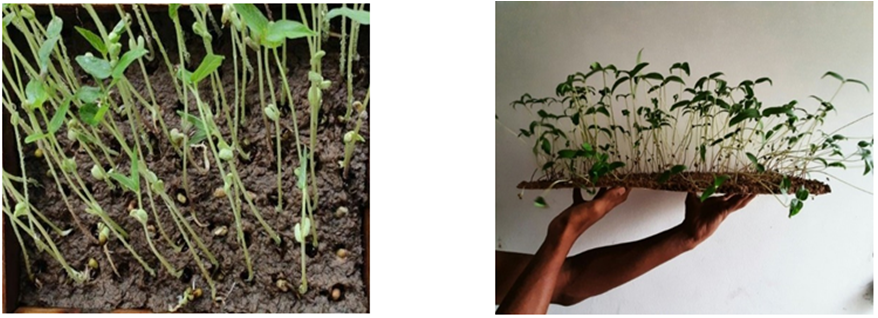
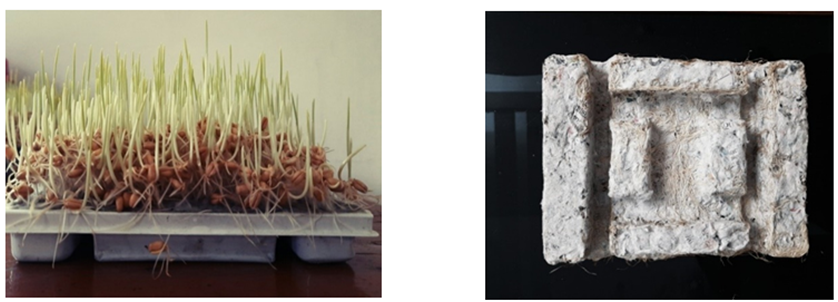
In the present work, as shown in Figure 1 & Figure 2, wood pulp (wet-mat) was transformed into low density fibreboard by the growth and development of mung bean (Vigna radiata) seedlings on the mat, without the use of binders or any other reinforcing agents and a moulded product by the growth of wheat (T. aestivum) seedlings on waste paper pulp (wet-mat). The roots of wheat (T. aestivum) used in these experiments, were found to be growing long, fibrous and more often interconnected and overlapped in nature.


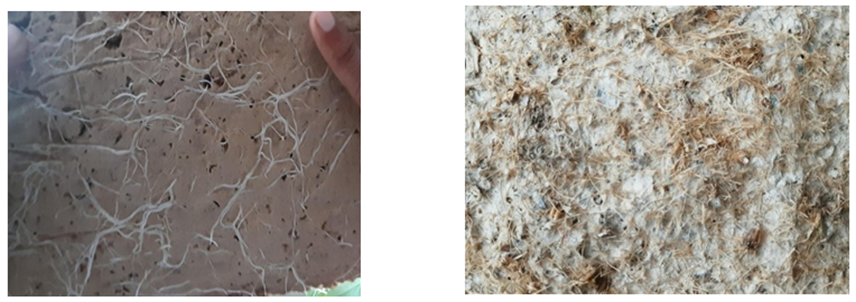
In the case of mung bean (V. radiata), the root system was not as prominent as in T. aestivum and had poor overlapping and network formation (Figure 3). The properties of fibreboards prepared using the mung bean and wheat roots as given in Table 1, clearly indicate that dicot roots were more suitable for the production of fibreboards. During this work, the ability to produce moulded products of very low density using plant roots too showed promising results. However, the drying time was far longer than expected and hence for eliminating the drying step to conserve energy in the case of large scale production, has to be studied in detail, unless the time taken for production is not a major issue.
The use of wood fibre is well-established in commercial horticulture and many researchers and growers have reported vigorous root growth of plants grown in substrates containing wood fibres 35, 36, 37, 38. This method of growing roots on wood fibres was exploited in the present study for a different purpose and this report discusses the results of the experiments on developing an environmentally friendly and formaldehyde-free construction material, Ultra Low-Density Fibreboard (ULDF) from wood pulp and waste paper pulp with the help of actively growing plant root system. The observations during this work indicated that the following two interesting phenomena were taking place in the system:
1) The growth of roots along with the lateral roots which make up the branching pattern increased the surface area in great abundance inside the pulp mat and this constituted a fibre reinforcement of the pulp mat. That is, a biofibre reinforced system is produced in situ.
2) Roots as they grow absorbed moisture and the water which pass through the root system to the shoots and subsequent removal of water from the leaves due to transpiration. Hence the root system helped in driving out water from the substrate. That is drying without applying thermal energy.
According to 39, there is a remarkable influence of substrates and containers on the root density and overall performance of roots in container-grown plants 40, 41, 42, 43. Hence, further experiments on using different biofibre-based substrates and container types and sizes for growing root system from a wide range of plant species are also recommended for enhancing the strength properties of the boards
This research study demonstrated a novel method of producing ultra-low-density fibreboard by the mechanical reinforcement of wood fibres in the pulp using plant roots. This simple, economic and eco-friendly method converts the wood pulp to an industrial wood fibre-based product and it promises to greatly eliminate the conventional steps involved in board making such as the hot pressing or drying of wet-mats. The products were 100 percent biodegradable since no synthetic materials were added to the pulp-mat during this exercise. As the plant root system grows, it absorbs moisture and the water which pass through the roots by capillary action to the shoots and the water is removed from the leaves due to transpiration. Though the boards produced could be dried by the process of plant transpiration, it took longer time than expected and thus creating a disadvantage in terms of energy saving. Thus further lab-scale research is needed to optimize the conditions for eliminating the electrical or thermal drying processes before promoting this preliminary finding as a promising, inexpensive and highly energy efficient technique for manufacturing ultra- low density fibreboard from hardwood pulps.
The authors thank P.K. Mayan Mohamed, Managing Director, The Western India Plywoods Ltd, Baliapatam, Kannur, Kerala for providing necessary facilities for undertaking this research project. We also express our gratitude to Dr. R.N Kumar, former Head, R&D of WIP and Dr. C Mohanan, former Course Director, Department of Wood Science & Technology, Kannur University, Kerala for their support and constant encouragement.
| [1] | Ramesh M, Palanikumar K and Reddy H.K.C (2017). Plant fibre based bio- composites sustainable and renewable green materials. Renewable and sustainable energy review. 79, 558-584. | ||
| In article | View Article | ||
| [2] | Wilson JB (2010). Life cycle inventory of medium density fiberboard in terms of resources, emissions, energy and carbon. Wood and fiber science. 42(CORRIM Special edition): 107-124. | ||
| In article | |||
| [3] | Li J and Pang S (2006) Modelling of energy demand in an mdf plant. Auckland, New Zealand: CHEMECA 2006, 17-20 Sep 2006. Conference Proceedings of CHEMECA 2006: Knowledge and Innovation, 6 pp. Available at: https://pdfs.semanticscholar.org | ||
| In article | |||
| [4] | Piekarshi CM, and Francisco AC (2012) Energy consumption in MDF production: overview of use of renewable and non- fossil energy sources in a Brazilian mill. ICIEOM- July 2012, International Conference on Industrial Engineering and Operations Management. p.1-8. Available at: https://www.researchgate.net/publications/256495247. | ||
| In article | |||
| [5] | Xie Y, Tong Q, Chen Y, Liu J & Lin M (2011). Manufacture and properties of ultra-low density fibreboard from wood fibre. Bioresources. 6: 4055-4066. | ||
| In article | |||
| [6] | Cai L, Zhuang B, Hang D, Wang W, Niu M, Xie Y, Chen T, and Wang X (2016). Ultra-low density fibreboard with improved fire retardance and thermal stability using a novel fire-resistant adhesive. BioRes. 11(2): 5215-5229. | ||
| In article | View Article | ||
| [7] | Kawasaki T, Zhang M & Kawai S (1998) Manufacture and properties of ultra-low-density fiberboard. J Wood Sci. 44: 354-360. | ||
| In article | View Article | ||
| [8] | Liu J, Chen T, Xie Y, Wei Q, Chen Y, Rao J, Niu M and Wang X (2016). Fire performance of ultralow-density fibreboard (ULDF) with complex fire retardants. Bioresources. 11(4): 10261-10272. | ||
| In article | View Article | ||
| [9] | Nasir M, Khali D, Jawaid M, Tahir P, Siakeng R, Asim M and Khan T.A (2019). Recent development in binderless fiber-board fabrication from agricultural residues: A review. Construction and building materials. 211. 502-516. | ||
| In article | View Article | ||
| [10] | Niu M, We Z, Lin X, Xie Y, Bhuiyan IU and Wang X (2018). Manufacturing and properties of ultra-low density fiberboards with an unsaturated polyester resin by a dry process. Eur. J. Wood Prod. 76: 853-859. | ||
| In article | View Article | ||
| [11] | Victrone F, Ramos D, Ferrando F and Salvado J (2021). Binderless fiberboards for sustainable construction materials, production methods and applications. Journal of building engineering.44 (2021). | ||
| In article | View Article | ||
| [12] | Xu J, Sugawara R, Widyorini R, Han G, Kawai S (2004). Manufacture and properties of low-density binderless particleboard from kenaf core. J Wood Sci 50: 62-67. | ||
| In article | View Article | ||
| [13] | Chaitanya S and Singh I (2016) Novel Aloe vera fiber reinforced biodegradable composites -Development and characterization. Journal of Reinforced Plastics and Composites. 35(19): 1411-1423. | ||
| In article | View Article | ||
| [14] | Liu DT, Xia KF, Yang RD, Li J, Chen KF and Nazhad MM (2012). Manufacturing of a biocomposite with both thermal and acoustic properties. Journal of Composite Materials 46(9) 1011-1020. | ||
| In article | View Article | ||
| [15] | Younguist J A, English BW and Rowell R (1993). Alternative uses of waste-paper in wood based composite products [online]. Recycling Symposium. 359-365. Available at: www.fpl.fs.fed.us. | ||
| In article | |||
| [16] | Ramesh M, Deepa C, Kumar R.L, Sanjay M.R and Siengchen S (2020). Life cycle and environmental impact assessments on processing of plant fibres and it’s biocomposites: A critical review. Journal of Industrial textiles. | ||
| In article | View Article | ||
| [17] | Girijappa Y.G.T, Rangappa S.M, Parameswaranpillai J and Siengchin S (2019). Natural fibers as sustainable and renewable resource for development of eco-friendly composites: A comprehensive review. Frontiers in materials. 6: 1-14. | ||
| In article | View Article | ||
| [18] | Gurunathan T, Mohanty S and Nayak SK (2015). A review of the recent developments in biocomposites based on natural fibres and their application perspectives Composites Part A; Applied Science and Manufacturing. 77: 1-25. | ||
| In article | View Article | ||
| [19] | Khoo S.C, Peng W.X, Yang Y, Ge S, Soon C.F, Sonne C and Ma N.L(2020). Development of formaldehyde – free bio- board produced from mushroom mycelium and substrate waste. Journal of hazardous materials. 400. 123296. | ||
| In article | View Article PubMed | ||
| [20] | Udayanga D and Miriyagalla S.D (2021). Fungal – based Biocomposites: An emerging source of Renewable materials. Microbial technology for sustainable environment, springer, Singapore. 529-550. | ||
| In article | View Article | ||
| [21] | Cerimi K, Akkaya K.C, Pohl C, Schmidt B and Neubauer P (2019). Fungi as a source for new bio-based materials: A patent review. Fungal biology and biotechnology. 6(1). | ||
| In article | View Article PubMed | ||
| [22] | Elsacker E, Vandelook S, Brancart J, Peeters E and De Laet L (2019) Mechanical, physical and chemical characterisation of mycelium-based composites with different types of ligno-cellulosic substrates. PLoS ONE 14(7): e0213954. | ||
| In article | View Article PubMed | ||
| [23] | Girometta C, Picco AM, Baiguera RM, Dondi D, Babbini S, Cartabia M, Pellegrini M and Savino E (2019). Physico-Mechanical and Thermodynamic Properties of Mycelium-Based Biocomposites: A Review Sustainability 2019, 11, 281. | ||
| In article | View Article | ||
| [24] | Haneef M, Ceseracciu L, Canale C, Bayer IS, Heredia-Guerreo JA and Athanassiou A (2017). Advanced materials from fungal mycelium: Fabrication and tuning of physical properties. Sci Rep 7, 41292. | ||
| In article | View Article PubMed | ||
| [25] | Jones M, Huynh T, Dekiwadia C, Daver F and John S (2017) Mycelium composites: a review of engineering characteristics and growth kinetics Journal of Bionanoscience, 11 (4): 241-257. | ||
| In article | View Article | ||
| [26] | Jones M, Mautner A, Luenco S, Bismarck A and John S (2020). Engineered mycelium composite construction materials from fungal biorefineries: A critical review. Materials & design .187(2020). | ||
| In article | View Article | ||
| [27] | Bengough AG, Bransby MF, Hans J, McKenna SJ, Roberts TJ and Valentine TA (2006). Root responses to soil physical conditions; growth dynamics from field to cell. Journal of Experimental Botany, 57(2): 437-447. | ||
| In article | View Article PubMed | ||
| [28] | Ravindran G, Ganapathy G.P and Akinwumi I.I (2020). Stabilisation of natural slopes using natural plant root as reinforcing agent. Material today: Proceedings. 39(2). | ||
| In article | View Article | ||
| [29] | Sinha SK, Rani M, Kumar A, Kumar S, Venkatesh K and Mandal PK (2018). Natural variation in root system architecture in diverse wheat genotypes grown under different nitrate conditions and root growth media. Theor. Exp. Plant Physiol. 30, 223-234. | ||
| In article | View Article | ||
| [30] | Cazzuffi D, Cardile G & Gioffrè D (2014) Geosynthetic Engineering and Vegetation Growth in Soil Reinforcement Applications. Transp. Infrastruct. Geotech. 1, 262-300. | ||
| In article | View Article | ||
| [31] | Gadi V, Singh S, Sanghariya M, Garg A, Sreedeep S and Ravi K (2019). Modeling soil-plant-water interaction: Effects of canopy and root parameters on soil suction and stability of green infrastructure. International journal for computer aided engineering and software. 35(3): 1543-1566. | ||
| In article | View Article | ||
| [32] | Guo P, Xia Z, Liu Q, Xiao H, Gao F, Zhang L, Li M, Yang Y, Xu W 2020. The mechanism of the plant roots’ soil reinforcement based on generalized equivalent confining pressure. PeerJ 8:e10064. | ||
| In article | View Article PubMed | ||
| [33] | Jin, H., Shi, D., Zeng, X, Wang S, Duan T and Lou Y (2019) Mechanisms of root-soil reinforcement in bio-embankments of sloping farmland in the purple hilly area, China. J. Mt. Sci. 16, 2285-2298. | ||
| In article | View Article | ||
| [34] | Zhang L, Xia Z, Zhou Z, Liu D, Xu W, Li M, Li T and Zhao B (2018) Experimental Study on Tensile Properties and Reinforcement Ability of Plant Roots. Nature Environment and Pollution Technology.17(3), 729-738. | ||
| In article | |||
| [35] | Gruda N & Schnitzler W (1999) Influence of wood fiber substrates and N application rates on the growth of tomato transplants. Advances in Horticultural Science, 13(1), 20-24. Retrieved November 11, 2020, from http://www.jstor.org/stable/42881976. | ||
| In article | |||
| [36] | Harris C.N, Dickson R.W, Fisher P.R, Jackson B.E and Poleatewich A.M (2019). Evaluating peat substrates amended with pine wood fiber for nitrogen immobilization and effects on plant performance with container- grown petunia. American society for horticultural science. 30(1). | ||
| In article | View Article | ||
| [37] | Muro J, Irigoyen I, Samitier P, Mazuela P, Salas MC, Soler J and Urrestarazu M (2005) Wood fiber as growing me dium in hydroponic crop. Acta Hortic.697, 179-185. | ||
| In article | View Article | ||
| [38] | Sreenivasan E (2018) Softboard as a Novel Wood Fibre-Based Substrate for Hydroponic Systems - A Preliminary Study. International Journal of Research and Scientific Innovation, 5(8): 129-131. | ||
| In article | |||
| [39] | Godara AK and Sharma VK (2016) Influence of Substrate Composition on Roots and their Categories of Strawberry Plants Grown in Different Containers. Research Journal of Agricultural Sciences 7(2): 330-335 | ||
| In article | |||
| [40] | Aziz A.A, Lim K.B, Rahman E.K.A, Nurmawati M.H and Zuruzi A.S (2020). Agar with embedded channels to study root growth. Sci Rep. 10, 14231. | ||
| In article | View Article PubMed | ||
| [41] | Gallegos J, Alvaro J.E and Urrestarazu M (2020). Container design affects shoot and root growth of vegetable plant. HortScience. 55. 1-8. | ||
| In article | View Article | ||
| [42] | Haber E.S (2017). The effect of various containers on the growth of vegetable plants. Bulletin. 24(279). Available at: http://lib.dr.iastate.edu/bulletin/vol24/iss279/1. | ||
| In article | |||
| [43] | Zakaria N.I, Ismail M.R, Awang Y, Wahab P.E.M and Berahim Z (2020). Effect of root restriction on the growth, photosynthesis rate and source and sink relationship of chilli (Capsicum annum L.) grown in soilless culture. | ||
| In article | View Article PubMed | ||
Published with license by Science and Education Publishing, Copyright © 2022 Vincent P, Elwin M, Mithuna M, Ganesh Gopal T M and Sreenivasan E
 This work is licensed under a Creative Commons Attribution 4.0 International License. To view a copy of this license, visit
http://creativecommons.org/licenses/by/4.0/
This work is licensed under a Creative Commons Attribution 4.0 International License. To view a copy of this license, visit
http://creativecommons.org/licenses/by/4.0/
| [1] | Ramesh M, Palanikumar K and Reddy H.K.C (2017). Plant fibre based bio- composites sustainable and renewable green materials. Renewable and sustainable energy review. 79, 558-584. | ||
| In article | View Article | ||
| [2] | Wilson JB (2010). Life cycle inventory of medium density fiberboard in terms of resources, emissions, energy and carbon. Wood and fiber science. 42(CORRIM Special edition): 107-124. | ||
| In article | |||
| [3] | Li J and Pang S (2006) Modelling of energy demand in an mdf plant. Auckland, New Zealand: CHEMECA 2006, 17-20 Sep 2006. Conference Proceedings of CHEMECA 2006: Knowledge and Innovation, 6 pp. Available at: https://pdfs.semanticscholar.org | ||
| In article | |||
| [4] | Piekarshi CM, and Francisco AC (2012) Energy consumption in MDF production: overview of use of renewable and non- fossil energy sources in a Brazilian mill. ICIEOM- July 2012, International Conference on Industrial Engineering and Operations Management. p.1-8. Available at: https://www.researchgate.net/publications/256495247. | ||
| In article | |||
| [5] | Xie Y, Tong Q, Chen Y, Liu J & Lin M (2011). Manufacture and properties of ultra-low density fibreboard from wood fibre. Bioresources. 6: 4055-4066. | ||
| In article | |||
| [6] | Cai L, Zhuang B, Hang D, Wang W, Niu M, Xie Y, Chen T, and Wang X (2016). Ultra-low density fibreboard with improved fire retardance and thermal stability using a novel fire-resistant adhesive. BioRes. 11(2): 5215-5229. | ||
| In article | View Article | ||
| [7] | Kawasaki T, Zhang M & Kawai S (1998) Manufacture and properties of ultra-low-density fiberboard. J Wood Sci. 44: 354-360. | ||
| In article | View Article | ||
| [8] | Liu J, Chen T, Xie Y, Wei Q, Chen Y, Rao J, Niu M and Wang X (2016). Fire performance of ultralow-density fibreboard (ULDF) with complex fire retardants. Bioresources. 11(4): 10261-10272. | ||
| In article | View Article | ||
| [9] | Nasir M, Khali D, Jawaid M, Tahir P, Siakeng R, Asim M and Khan T.A (2019). Recent development in binderless fiber-board fabrication from agricultural residues: A review. Construction and building materials. 211. 502-516. | ||
| In article | View Article | ||
| [10] | Niu M, We Z, Lin X, Xie Y, Bhuiyan IU and Wang X (2018). Manufacturing and properties of ultra-low density fiberboards with an unsaturated polyester resin by a dry process. Eur. J. Wood Prod. 76: 853-859. | ||
| In article | View Article | ||
| [11] | Victrone F, Ramos D, Ferrando F and Salvado J (2021). Binderless fiberboards for sustainable construction materials, production methods and applications. Journal of building engineering.44 (2021). | ||
| In article | View Article | ||
| [12] | Xu J, Sugawara R, Widyorini R, Han G, Kawai S (2004). Manufacture and properties of low-density binderless particleboard from kenaf core. J Wood Sci 50: 62-67. | ||
| In article | View Article | ||
| [13] | Chaitanya S and Singh I (2016) Novel Aloe vera fiber reinforced biodegradable composites -Development and characterization. Journal of Reinforced Plastics and Composites. 35(19): 1411-1423. | ||
| In article | View Article | ||
| [14] | Liu DT, Xia KF, Yang RD, Li J, Chen KF and Nazhad MM (2012). Manufacturing of a biocomposite with both thermal and acoustic properties. Journal of Composite Materials 46(9) 1011-1020. | ||
| In article | View Article | ||
| [15] | Younguist J A, English BW and Rowell R (1993). Alternative uses of waste-paper in wood based composite products [online]. Recycling Symposium. 359-365. Available at: www.fpl.fs.fed.us. | ||
| In article | |||
| [16] | Ramesh M, Deepa C, Kumar R.L, Sanjay M.R and Siengchen S (2020). Life cycle and environmental impact assessments on processing of plant fibres and it’s biocomposites: A critical review. Journal of Industrial textiles. | ||
| In article | View Article | ||
| [17] | Girijappa Y.G.T, Rangappa S.M, Parameswaranpillai J and Siengchin S (2019). Natural fibers as sustainable and renewable resource for development of eco-friendly composites: A comprehensive review. Frontiers in materials. 6: 1-14. | ||
| In article | View Article | ||
| [18] | Gurunathan T, Mohanty S and Nayak SK (2015). A review of the recent developments in biocomposites based on natural fibres and their application perspectives Composites Part A; Applied Science and Manufacturing. 77: 1-25. | ||
| In article | View Article | ||
| [19] | Khoo S.C, Peng W.X, Yang Y, Ge S, Soon C.F, Sonne C and Ma N.L(2020). Development of formaldehyde – free bio- board produced from mushroom mycelium and substrate waste. Journal of hazardous materials. 400. 123296. | ||
| In article | View Article PubMed | ||
| [20] | Udayanga D and Miriyagalla S.D (2021). Fungal – based Biocomposites: An emerging source of Renewable materials. Microbial technology for sustainable environment, springer, Singapore. 529-550. | ||
| In article | View Article | ||
| [21] | Cerimi K, Akkaya K.C, Pohl C, Schmidt B and Neubauer P (2019). Fungi as a source for new bio-based materials: A patent review. Fungal biology and biotechnology. 6(1). | ||
| In article | View Article PubMed | ||
| [22] | Elsacker E, Vandelook S, Brancart J, Peeters E and De Laet L (2019) Mechanical, physical and chemical characterisation of mycelium-based composites with different types of ligno-cellulosic substrates. PLoS ONE 14(7): e0213954. | ||
| In article | View Article PubMed | ||
| [23] | Girometta C, Picco AM, Baiguera RM, Dondi D, Babbini S, Cartabia M, Pellegrini M and Savino E (2019). Physico-Mechanical and Thermodynamic Properties of Mycelium-Based Biocomposites: A Review Sustainability 2019, 11, 281. | ||
| In article | View Article | ||
| [24] | Haneef M, Ceseracciu L, Canale C, Bayer IS, Heredia-Guerreo JA and Athanassiou A (2017). Advanced materials from fungal mycelium: Fabrication and tuning of physical properties. Sci Rep 7, 41292. | ||
| In article | View Article PubMed | ||
| [25] | Jones M, Huynh T, Dekiwadia C, Daver F and John S (2017) Mycelium composites: a review of engineering characteristics and growth kinetics Journal of Bionanoscience, 11 (4): 241-257. | ||
| In article | View Article | ||
| [26] | Jones M, Mautner A, Luenco S, Bismarck A and John S (2020). Engineered mycelium composite construction materials from fungal biorefineries: A critical review. Materials & design .187(2020). | ||
| In article | View Article | ||
| [27] | Bengough AG, Bransby MF, Hans J, McKenna SJ, Roberts TJ and Valentine TA (2006). Root responses to soil physical conditions; growth dynamics from field to cell. Journal of Experimental Botany, 57(2): 437-447. | ||
| In article | View Article PubMed | ||
| [28] | Ravindran G, Ganapathy G.P and Akinwumi I.I (2020). Stabilisation of natural slopes using natural plant root as reinforcing agent. Material today: Proceedings. 39(2). | ||
| In article | View Article | ||
| [29] | Sinha SK, Rani M, Kumar A, Kumar S, Venkatesh K and Mandal PK (2018). Natural variation in root system architecture in diverse wheat genotypes grown under different nitrate conditions and root growth media. Theor. Exp. Plant Physiol. 30, 223-234. | ||
| In article | View Article | ||
| [30] | Cazzuffi D, Cardile G & Gioffrè D (2014) Geosynthetic Engineering and Vegetation Growth in Soil Reinforcement Applications. Transp. Infrastruct. Geotech. 1, 262-300. | ||
| In article | View Article | ||
| [31] | Gadi V, Singh S, Sanghariya M, Garg A, Sreedeep S and Ravi K (2019). Modeling soil-plant-water interaction: Effects of canopy and root parameters on soil suction and stability of green infrastructure. International journal for computer aided engineering and software. 35(3): 1543-1566. | ||
| In article | View Article | ||
| [32] | Guo P, Xia Z, Liu Q, Xiao H, Gao F, Zhang L, Li M, Yang Y, Xu W 2020. The mechanism of the plant roots’ soil reinforcement based on generalized equivalent confining pressure. PeerJ 8:e10064. | ||
| In article | View Article PubMed | ||
| [33] | Jin, H., Shi, D., Zeng, X, Wang S, Duan T and Lou Y (2019) Mechanisms of root-soil reinforcement in bio-embankments of sloping farmland in the purple hilly area, China. J. Mt. Sci. 16, 2285-2298. | ||
| In article | View Article | ||
| [34] | Zhang L, Xia Z, Zhou Z, Liu D, Xu W, Li M, Li T and Zhao B (2018) Experimental Study on Tensile Properties and Reinforcement Ability of Plant Roots. Nature Environment and Pollution Technology.17(3), 729-738. | ||
| In article | |||
| [35] | Gruda N & Schnitzler W (1999) Influence of wood fiber substrates and N application rates on the growth of tomato transplants. Advances in Horticultural Science, 13(1), 20-24. Retrieved November 11, 2020, from http://www.jstor.org/stable/42881976. | ||
| In article | |||
| [36] | Harris C.N, Dickson R.W, Fisher P.R, Jackson B.E and Poleatewich A.M (2019). Evaluating peat substrates amended with pine wood fiber for nitrogen immobilization and effects on plant performance with container- grown petunia. American society for horticultural science. 30(1). | ||
| In article | View Article | ||
| [37] | Muro J, Irigoyen I, Samitier P, Mazuela P, Salas MC, Soler J and Urrestarazu M (2005) Wood fiber as growing me dium in hydroponic crop. Acta Hortic.697, 179-185. | ||
| In article | View Article | ||
| [38] | Sreenivasan E (2018) Softboard as a Novel Wood Fibre-Based Substrate for Hydroponic Systems - A Preliminary Study. International Journal of Research and Scientific Innovation, 5(8): 129-131. | ||
| In article | |||
| [39] | Godara AK and Sharma VK (2016) Influence of Substrate Composition on Roots and their Categories of Strawberry Plants Grown in Different Containers. Research Journal of Agricultural Sciences 7(2): 330-335 | ||
| In article | |||
| [40] | Aziz A.A, Lim K.B, Rahman E.K.A, Nurmawati M.H and Zuruzi A.S (2020). Agar with embedded channels to study root growth. Sci Rep. 10, 14231. | ||
| In article | View Article PubMed | ||
| [41] | Gallegos J, Alvaro J.E and Urrestarazu M (2020). Container design affects shoot and root growth of vegetable plant. HortScience. 55. 1-8. | ||
| In article | View Article | ||
| [42] | Haber E.S (2017). The effect of various containers on the growth of vegetable plants. Bulletin. 24(279). Available at: http://lib.dr.iastate.edu/bulletin/vol24/iss279/1. | ||
| In article | |||
| [43] | Zakaria N.I, Ismail M.R, Awang Y, Wahab P.E.M and Berahim Z (2020). Effect of root restriction on the growth, photosynthesis rate and source and sink relationship of chilli (Capsicum annum L.) grown in soilless culture. | ||
| In article | View Article PubMed | ||